Go Gentle by Maria Semple Summary, Characters and Themes
Go Gentle by Maria Semple is a comic literary novel about aging, desire, motherhood, philosophy, art, and the strange ways people try to repair themselves.
At its center is Adora Hazzard, a divorced philosopher-in-residence in New York who has built a practical community of single women while raising her teenage daughter, Viv. Her carefully ordered life is disrupted by a mysterious man, a questionable art deal, and a crisis that begins as romance and becomes a larger investigation. The book uses wit, emotional honesty, and absurdity to explore how people survive shame, loss, love, and the need to begin again.
Summary
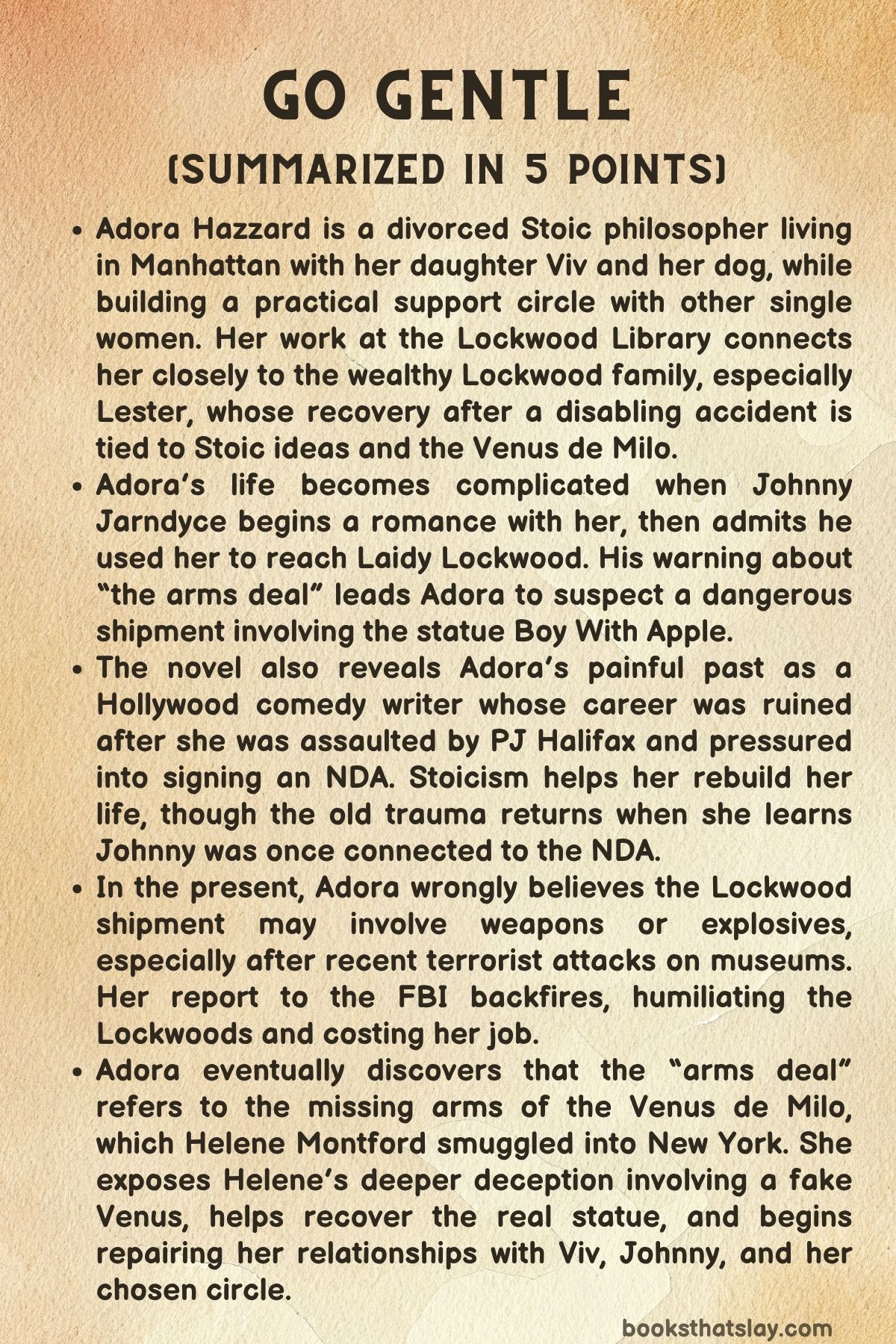
Adora Hazzard lives in the Ansonia in New York with her teenage daughter, Viv, and her dog, Mr. Man. She is sharp, funny, anxious, philosophical, and intensely aware of the absurdity of ordinary life.
Her life is organized around two major structures: her work for the wealthy Lockwood family and a community of single women she and her friends have built inside their building. This group is jokingly called the coven, but its purpose is practical and serious. Adora, Emily Ann, Minna, and others want to age together with independence, companionship, shared expenses, and mutual care.
When apartment 414 becomes available, Adora sees it as a major opportunity. If another trusted woman buys it, the coven can grow, and their plan for the future can become stronger. Soon, Adora meets Blanche Falk, a landscape architect connected to the Lockwoods, and decides that Blanche might be the perfect new member.
Adora’s job is unusual. She works as a philosopher-in-residence at the Lockwood Library, a private cultural institution connected to Lester and Laidy Lockwood. Her duties include writing, thinking, and teaching moral philosophy to their twin sons, Lucien and Lorenzo.
Lester Lockwood was once active and privileged, but a terrible climbing accident left him paralyzed and missing a limb. Adora helped him rebuild his life through Stoic philosophy, especially the idea that true freedom lies in character, not in external circumstances. Their bond is deep because both carry old pain and both have used ideas as a way to survive.
Laidy Lockwood, Lester’s devoted wife, has poured her energy into creating a grand, controlled world around him. The Lockwood home and garden are filled with art, money, ambition, and emotional pressure. Blanche once helped create a wild garden there by refusing to force nature into decorative order, and Adora is drawn to her directness and intelligence.
Adora’s life shifts when she attends the ballet alone and offers an extra ticket to a handsome stranger named Johnny Jarndyce. He is charming, clever, attentive, and strangely interested in her. Their connection feels immediate, and Adora, who had long tried to shut down her hope for romantic love, is alarmed by the strength of her attraction.
Johnny later reappears in the most bizarre way possible: a briefcase he leaves for Adora at the Lockwood Library is mistaken for a bomb. It is detonated by a robot dog, only for everyone to discover that it contains a burrito and a note. The humiliation is public, but Adora is thrilled that Johnny has pursued her.
She prepares for their date with help from the coven, especially Minna, who supplies clothes, makeup, and emergency glamour tools. Viv watches with the skepticism of a teenage daughter but also with curiosity and unexpected tenderness. Adora is nervous, excited, and afraid of looking foolish after years of self-denial.
At dinner, Johnny and Adora speak with intellectual and sexual energy. She explains Stoicism, self-control, pleasure, perception, and secure joy. He listens closely and seems to understand both her mind and her hunger for touch.
Their date moves toward intimacy, but in a hotel room Johnny reveals that he has manipulated the meeting. He followed her because he needs access to the Lockwood world. He works for a client who believes something has been stolen, and he wants Adora to deliver an unsealed letter to Laidy without being seen.
Adora is furious and humiliated, but she is also still drawn to him. Against her better judgment, she agrees to help. She plants the letter at the Lockwood Library, using her knowledge of the building and a quick lie to Hailey, Laidy’s literal-minded assistant.
The letter hints at an arms deal, and Adora begins to suspect that something dangerous is happening around the Lockwoods’ newly acquired artwork, a statue called Boy With Apple. Helene Montford, a sophisticated French cultural figure involved with the sale, notices Adora’s involvement and threatens her. Helene makes it clear that Adora can lose her position and reputation if she continues acting for Johnny.
Adora confronts Johnny, who refuses to give clear answers. He speaks about international stakes, stolen objects, and the need for courage, but his vagueness begins to sound like manipulation. When he mocks her principles and grabs her wrist, Adora breaks away from him and sees more clearly the entitlement beneath his charm.
At the same time, Adora’s relationship with Viv grows more central. Viv is embarrassed by her mother, irritated by her intensity, and absorbed in teenage life, but she also pays attention. She photographs Johnny’s letter and later tells Adora that it mentioned an arms deal.
Adora tries to rationalize the situation, but Viv calls out her denial. Their confrontation forces Adora to admit that she may have been used in something far more serious than a romantic game.
Adora becomes worried about Ravi, the elegant curator at the Lockwood Library. He has vanished after leaving a strange voicemail. At first, Adora misreads the transcription as casual laughter, but then she realizes the repeated “ha ha” sounds were actually the double rings of the old Lockwood house phone.
With help from Scott, Ravi’s husband, Adora understands that Ravi may have been frightened before he disappeared. She reviews surveillance footage with Dante, the charismatic doorman, and later asks Ziggy, the young dog walker, to lip-read footage of Ravi’s call.
Ziggy identifies words that seem alarming: Nazi, Mona Lisa, reputation, apple, arms, and C4. Adora interprets C4 as a possible explosive and connects it to the statue, Johnny’s warning, Ravi’s disappearance, and recent terrorist attacks on famous art objects.
Believing there may be a bomb or weapons deal, Adora contacts the FBI. The raid at the Lockwood Library is disastrous. The crates are empty, Boy With Apple is safely displayed, and the supposed arms deal turns out to refer to literal statue arms, not weapons. C4 means crate four.
Adora is fired and humiliated. She loses her role with the Lockwoods, and the media paints her as an unstable former employee. Viv is deeply embarrassed at school, and Adora’s sense of judgment collapses.
Soon after, Adora receives a package connected to the deepest wound of her past. Years earlier, as a young comedy writer in Los Angeles, she had been assaulted and exploited by a powerful entertainer, PJ Halifax. She had been pressured into signing an NDA, which helped silence her and contributed to her despair.
The new package releases her from that NDA. It also reveals that the young lawyer involved in that old silencing was John E. Jarndyce, the same Johnny who has now entered her life. This discovery makes his betrayal even worse. He did not merely manipulate her in the present; he was connected to the event that shaped her shame, anger, and life after trauma.
Adora and Viv travel to Paris, where Adora is scheduled to give a philosophy lecture. The trip is strained. Adora wants Paris to heal or distract them, but Viv remains angry and embarrassed. Their conflict grows when Adora mocks Viv’s teenage tastes, including her interest in pop culture and social media.
Viv pushes back with force. She explains the cruelty of adults who belittle girls for the things that comfort them. Her speech forces Adora to recognize her own judgment and the ways she has dismissed Viv’s world.
In Paris, Blanche reveals that she is not simply a landscape architect. She is connected to Interpol and has been tracking a larger plot involving stolen art, the Lockwoods, Helene, and possible terrorist activity. Ravi has been found locked in a soundproof room in the Lockwood home, badly injured after being trapped for days.
Adora prepares for her lecture but can no longer deliver her usual Stoic certainty. She realizes that the philosophy that saved her also hardened her. It taught self-command, but it also made her suspicious of hope, dependence, and love.
She has a new insight: the real arms deal may involve the arms of the Venus de Milo. She races to the Louvre with Viv, Blanche, and Dorris, a brilliant contractor connected to Blanche. There, she reasons that Boy With Apple may have been used as a cover for smuggling the missing arms of the famous statue.
Johnny appears and confirms that his true client is tied to the Louvre’s effort to recover the arms. He and Adora reconcile publicly, and he admits his love for her. Their moment is interrupted when Adora sees signs of danger near the Venus de Milo.
A bomb explodes, apparently damaging or destroying the statue. The disaster exposes the larger conspiracy. Helene had acquired the statue’s arms and tried to control their fate, not simply for money but to protect a family secret.
Adora deduces that the Venus displayed at the Louvre may have been a fake for decades. Helene’s father, once credited with hiding masterpieces during World War II, may have hidden the real Venus and returned a substitute. Reattaching the authentic arms would expose the truth.
At Helene’s chateau, Adora confronts her. Dorris discovers a hidden room, and inside it is the real Venus de Milo. The truth comes into the open. Adora is vindicated, and France recognizes the importance of what she and Viv helped uncover.
The ending restores many parts of Adora’s life without making them simple. Ravi survives and later has a daughter with Scott. Blanche joins the coven and moves into the apartment that began Adora’s plan. Laidy still receives Boy With Apple, though its true arms are returned to France.
Johnny becomes part of Adora’s life, not as a perfect rescuer but as someone trying to live differently after helping protect powerful men for years. Adora keeps her friends, her daughter, her philosophy, her humor, her dog, and her hunger for love.
By the end, Adora is not cured of fear, shame, or uncertainty. She is changed because she has allowed herself to want more: more love, more truth, more community, and more room for hope.
Characters
Adora Hazzard
Adora Hazzard is the central figure in Go Gentle, a woman whose intelligence is both her power and her defense. She has built a life around philosophy, especially Stoicism, because it gave her language and structure after trauma, suicidal despair, professional humiliation, divorce, and the daily chaos of motherhood.
She is comic, sharp, vain, insecure, generous, self-mocking, and often wrong in ways that matter. Her mistake with the Lockwoods and the FBI shows how easily intelligence can become overconfidence when fear, desire, and wounded pride enter the picture.
Adora’s greatest conflict is between control and surrender. She wants to believe that reason can save her from pain, but Johnny, Viv, Laidy, Ravi, and the Venus de Milo mystery all force her to see that life cannot be reduced to mental discipline.
Her growth comes from learning that vulnerability is not the same as weakness. By the end of the book, she has not abandoned philosophy, but she has softened her use of it. She can still think fiercely, but she is more willing to love, hope, apologize, and be changed by other people.
Viv Hazzard
Viv is Adora’s teenage daughter, and she gives the book much of its emotional reality. She is beautiful, phone-dependent, socially anxious, easily embarrassed, and often impatient with her mother’s dramatic language and philosophical habits.
At first, Viv seems like a familiar teenage counterforce: sarcastic, distracted, resistant to adult seriousness, and highly aware of public shame. Yet she is far more observant than Adora realizes. She photographs Johnny’s letter, notices inconsistencies, and becomes a crucial witness to the truth.
Viv’s relationship with Adora is loving but tense because both of them are trying to be seen correctly. Adora wants Viv to understand her pain and wisdom, while Viv wants her mother to respect her boundaries, tastes, and inner life.
Her Paris speech about girlhood, shame, and pop culture is one of the clearest moral corrections in the story. Viv forces Adora to see that contempt can hide inside sophistication, and that teenage pleasures should not be treated as evidence of emptiness. By the end, Viv becomes not only Adora’s daughter but her partner in survival and discovery.
Johnny Jarndyce
Johnny Jarndyce is one of the most seductive and morally complicated figures in Go Gentle. He enters Adora’s life as a romantic possibility: witty, handsome, attentive, and unusually able to match her mind.
His appeal is real, but so is his manipulation. He follows Adora, engineers access to her, uses her attraction, and asks her to perform a risky task without giving her the full truth. This makes him both a lover and a threat.
Johnny’s past deepens the conflict. As a young lawyer, he helped create the NDA that silenced Adora after PJ Halifax assaulted and humiliated her. Even though he later tries to make amends for his role in protecting powerful men, he cannot erase the harm he helped make possible.
What makes Johnny interesting is that he is neither a simple villain nor a clean romantic hero. He wants to repair damage, but he still uses charm, secrecy, and pressure. His connection with Adora can only continue once the truth is exposed and his desire to be useful is separated from his need to control the story.
Blanche Falk
Blanche Falk begins as a landscape architect and becomes one of the book’s most surprising sources of competence. She is blunt, skeptical, practical, and quick to recognize both Adora’s brilliance and her instability.
Her work with the Lockwood garden reveals her philosophy before her secrets are known. Rather than forcing beauty into a rigid design, she allows wildness, growth, and chance to create a living space. That approach mirrors her role in the story: she sees value in what others underestimate.
When Blanche reveals her connection to Interpol, her earlier toughness gains a new meaning. She is not merely eccentric or severe; she has been operating with discipline and purpose while others mistake her for a side character in their dramas.
Blanche also fits naturally into the coven because she understands the need for chosen structures of care. Her friendship with Adora is not sentimental. It is built on candor, usefulness, irritation, and respect, which makes it one of the more durable bonds in the book.
Helene Montford
Helene Montford is elegant, powerful, controlled, and dangerous. She understands reputation as a form of currency and treats cultural history as something that can be managed, hidden, sold, or weaponized.
Her first major function is to expose Adora’s weakness. She sees that Adora has acted for Johnny, notices the intimacy behind Adora’s language, and uses that knowledge with surgical calm. Helene’s power lies in her ability to make other people feel exposed while giving away very little herself.
As the art mystery develops, Helene becomes more than a social antagonist. Her actions are driven by family legacy, national image, money, pride, and fear of historical disgrace. She is protecting not only an object but a story about who her family was and what France has displayed to the world.
Helene is compelling because her villainy is cultured rather than crude. She does not simply want wealth. She wants control over truth itself, especially when truth threatens reputation. Her downfall comes because Adora finally learns to read the human motive beneath the polished performance.
Ravi
Ravi is the Lockwood Library’s elegant curator and one of the people Adora admires most. He represents taste, intelligence, beauty, and professional seriousness, but he also carries a private life that Adora barely understands.
Adora’s affection for Ravi is immediate and physical in its warmth, yet her ignorance about his marriage to Scott and their coming child shows how partial her knowledge can be. She loves the version of Ravi available to her, but the book reminds readers that every person has a life outside another person’s perception.
Ravi’s ethical dilemma over Boy With Apple is central to the plot. He suspects trouble around the statue and its provenance, and his concern places him in danger. His disappearance turns the story from comic intrigue into a moral emergency.
His suffering also corrects Adora’s self-centeredness. At first, she reads events through Johnny and her own humiliation, but Ravi’s danger forces her toward responsibility. His survival near the end offers relief, but it also leaves a mark: the cost of secrets is not abstract, and cultural deception can injure actual bodies.
Laidy Lockwood
Laidy Lockwood is extravagant, forceful, protective, and easy for Adora to misread. She appears at first as a wealthy woman controlling a rarefied world of art, security, sons, staff, and cultural ambition.
Her devotion to Lester can seem excessive, but the book gradually reframes it as courage. After Lester’s accident, Laidy refused to reduce him to loss. She built beauty, ritual, and power around him, not as denial alone, but as a way of insisting that his life remained large.
Adora’s changing view of Laidy is important because it reveals the limits of Adora’s Stoicism. Adora initially treats Laidy’s emotional intensity as something lesser than philosophical discipline. Later, she realizes that Laidy’s hope may be braver than her own suspicion of hope.
Laidy is also flawed. Her wealth and control create systems in which secrecy can flourish, and her art dealings contribute to the confusion that nearly ruins Adora. Still, she is not merely a rich patron. She is a woman whose love has taken an extreme, sometimes overwhelming form.
Lester Lockwood
Lester Lockwood is one of the book’s clearest examples of survival after bodily catastrophe. His climbing accident leaves him paralyzed and missing a limb, but his story is not written as simple inspiration.
When Adora first reaches him through Stoic thought, he is angry, grieving, and trapped inside the scale of what has been taken from him. Philosophy helps him separate identity from circumstance, and character from physical loss.
His bond with Adora matters because both of them recognize damage in each other. Her “Amor Fati” tattoo, placed over an old suicide scar, becomes a sign that she is not advising him from a safe distance. She knows something about wanting not to continue.
Lester’s presence also shapes the Venus de Milo revelation. The missing arms of the statue are connected to his own missing limb and to Laidy’s fear that restoring the statue might damage the myth that helped him accept himself. Through Lester, the book asks whether beauty is more powerful when it is whole, broken, or honestly understood.
Phyllis
Phyllis, Adora’s mother, is sharp, self-absorbed, theatrical, and emotionally unsafe in ordinary ways. Her home should be a refuge, but it also reminds Adora of childhood erasure and old patterns of judgment.
The detail that Adora’s childhood room has become a closet captures Phyllis’s role with brutal economy. Adora returns home needing comfort, yet the house itself shows how little room her mother has preserved for her as a full person.
Phyllis is comic because of her bizarre references, rituals, and fixation on her own stories, but the comedy has teeth. She can spoil fragile moments, such as throwing away the cookies Adora and Viv made, and she reactivates Adora’s old feelings of being dismissed.
Her importance lies in how she helps explain Adora’s hunger for chosen family. The coven, Viv, and even the Lockwood world all function partly as alternatives to the emotional instability Adora inherited. Phyllis is not the main source of the plot, but she helps define the wound beneath Adora’s need for control.
Emily Ann and Minna
Emily Ann and Minna are central to the coven, the practical sisterhood Adora has built around aging, friendship, and shared logistics. They represent a form of female life that is neither dependent on marriage nor resigned to loneliness.
Their presence gives the book one of its strongest social ideas: care can be planned. Groceries, apartments, tickets, dog walking, cleaning, and future elder support are not minor details. They are the infrastructure of affection.
Minna’s emergency transformation kit before Adora’s date with Johnny is funny, but it is also generous. She understands that desire in later life can feel embarrassing and urgent, and she responds not with lectures but with tools.
Emily Ann and Minna matter because they show that romance is not the only answer to isolation. Even as Johnny disrupts Adora’s life, the coven remains a more reliable model of love: imperfect, funny, organized, and rooted in shared reality.
Ziggy
Ziggy is the young dog walker whose casual presence becomes unexpectedly important. At first, he seems like part of the Ansonia’s comic ecosystem: useful, sweet, slightly odd, and connected to everyone through dogs and errands.
His tip about apartment 414 helps set the coven plot in motion. Later, his connection to Johnny becomes more troubling because he tells Johnny where Adora lives, believing Johnny’s interest is romantic and harmless.
Ziggy’s partial deafness turns into a crucial skill when Adora asks him to lip-read Ravi’s surveillance footage. The words he identifies help Adora build her theory about the arms deal, even though her interpretation turns out to be badly mistaken.
What makes Ziggy sympathetic is his innocence. He wants to help and worries that he has done wrong. Adora’s reassurance that he can do no wrong is affectionate, but the story also shows how easily innocent assistance can become part of a larger chain of consequences.
Dante
Dante, the Ansonia doorman, is charismatic, observant, socially gifted, and more resourceful than his position might suggest to outsiders. He reads people quickly and moves through the city’s social spaces with confidence.
His role in helping Adora access the Lockwood Library shows his usefulness under pressure. He is not just a comic figure with charm; he has practical intelligence and the courage to assist when Adora’s fear and suspicion begin to escalate.
Dante also represents one of the book’s recurring interests: people who operate in the margins of elite spaces often understand those spaces better than the people who officially own them. He knows how to enter, talk, distract, and pass.
His warmth toward Adora, including his delighted reaction to her date-night transformation, adds social texture to her world. Dante helps make the Ansonia feel like a living community rather than just a setting.
Dorris
Dorris is a formidable contractor whose skills become essential in the Paris sections of the story. She is practical, direct, confident, and immediately compelling to Viv.
Her importance comes from the book’s respect for material intelligence. Dorris understands walls, rooms, structures, and hidden spaces. While others interpret motives, art history, and philosophy, she notices how buildings work.
This becomes crucial when she discovers the hidden room at Helene’s chateau. Her contractor’s instincts uncover what wealth, culture, and secrecy have concealed for decades.
Dorris also fits the book’s larger argument that competence has many forms. Academic knowledge, philosophical training, curatorial expertise, and spycraft all matter, but so does the knowledge of someone who can knock on a wall and know that something is behind it.
Scott
Scott is Ravi’s husband, and his presence expands Ravi from an admired colleague into a person with a private emotional world. Through Scott, Adora learns that Ravi is loved, expected, worried over, and soon to become a parent.
Scott’s design studio above the Benjamin Moore store is a wonderful example of hidden life in the city. He is polished, specific, and affectionate, and he has been trying to reach Ravi while sensing that something is wrong.
His description of Ravi’s opinion of Adora gives Adora a brief emotional lift, but the more important function of their meeting is moral. Scott’s anxiety turns Ravi’s absence from a clue into a human crisis.
By the end, Scott’s future with Ravi and their daughter Ravija becomes part of the restored world. His role is not large, but it gives weight to what could have been lost.
Lucien and Lorenzo Lockwood
Lucien and Lorenzo are the Lockwood twins, privileged boys whose conflicts give Adora a stage for moral teaching. Their damaged sneaker dispute becomes a lesson in Stoic thought: externals can be lost, destroyed, outgrown, or made irrelevant, but character remains the true field of choice.
They could easily have been written only as spoiled rich children, but the book gives them a softer function. Adora cares about them, and her tenderness before the FBI raid shows that teaching them has become part of her emotional life.
Through the boys, the book shows Adora at her most confident and most vulnerable. She can turn a petty sibling conflict into a philosophical lesson, yet she cannot always apply that same clarity to her own desire and fear.
Their presence also reveals the strange intimacy of Adora’s work. She is not family, but she is not merely staff either. Losing access to them after the failed raid becomes one of the quieter pains of her firing.
PJ Halifax
PJ Halifax is mostly rooted in Adora’s past, but his influence shapes her entire adult life. He is a powerful comedy figure whose approval she once wanted and whose abuse became a defining trauma.
He represents the old Hollywood system in which male talent, fame, and cruelty were protected by silence. The assault, the public humiliation, the firing, and the NDA all teach Adora how institutions can turn harm into paperwork.
PJ’s importance lies not only in what he does but in what others do around him. The laughing men, the agent, the lawyers, and the culture of compliance all become part of the wound.
His daughter Evelyn’s later release of Adora from the NDA does not undo the damage, but it returns voice and moral recognition to Adora. PJ remains a symbol of impunity, but the book refuses to let his version of the story be the final one.
Evelyn Halifax-Brown
Evelyn Halifax-Brown is PJ Halifax’s daughter and the person who releases Adora from the old NDA. Her letter is profane, funny, compassionate, and morally important.
She represents a later generation trying to clean up the damage left by powerful men. Her gesture does not pretend that a legal release can erase trauma, but it acknowledges that silence was part of the injury.
Evelyn’s letter also complicates inheritance. She has inherited not only wealth or a famous name but the consequences of her father’s behavior. Her response is to give Adora back the right to speak.
Though she appears briefly, Evelyn changes the emotional direction of the book. She connects Adora’s past to the present and helps expose Johnny’s hidden connection to the original betrayal.
Themes
Aging, Desire, and the Need for a Livable Future
In Go Gentle, aging is treated as a practical, emotional, and erotic condition rather than as a quiet retreat from life. Adora and the coven refuse the idea that single women should drift toward loneliness, decline, or dependence without a plan, so they turn friendship into housing strategy, grocery economics, shared services, and future care.
This vision is funny because it begins with things like splitting celery and muffins, but it is also radical in its refusal of shame. The coven treats aging as something that can be organized around pleasure, efficiency, and dignity.
Adora’s desire for Johnny complicates this theme because it shows that planning for independence does not erase the longing to be touched, chosen, and seen. She has tried to convince herself that romantic love is no longer available to her, but her body and imagination disagree.
The book does not treat desire in later life as ridiculous. It treats it as risky, comic, embarrassing, and deeply human. Adora’s challenge is not to choose between self-sufficiency and love, but to create a life strong enough to include both without surrendering her judgment.
Philosophy, Control, and the Limits of Self-Command
Adora’s devotion to Stoicism gives her a way to survive pain, but it also becomes a way to avoid certain truths. The philosophy teaches her to separate character from circumstance, to distrust fear, and to seek freedom through self-command.
These ideas help Lester after his accident and help Adora make meaning from her own history. They are not mocked or dismissed. The book respects philosophy as a tool that can rescue a person from despair.
Yet the story also shows how any tool can become a shield. Adora sometimes uses Stoic thought to stay above messy feeling, to judge other people’s attachments, or to imagine that reason alone can protect her from humiliation and desire.
Her failed lecture in Paris marks a turning point because she can no longer perform certainty. She realizes that hope, love, and dependence are not merely traps for the undisciplined. They can also be forms of courage, especially when they accept risk without pretending risk can be mastered.
Mothers, Daughters, and the Pain of Being Seen Incorrectly
Adora and Viv’s relationship is full of irritation because both are constantly misreading each other. Adora sees Viv as beautiful, anxious, phone-absorbed, and vulnerable to cultural nonsense, while Viv sees Adora as embarrassing, intense, judgmental, and often too eager to turn life into a lesson.
Their conflict is not a failure of love. It is the friction of closeness. Viv wants privacy and respect, while Adora wants connection and proof that her daughter understands the seriousness of the world.
The Paris argument over taste, girlhood, and pop culture becomes a major correction. Viv explains that adult contempt for teenage pleasures can become another form of shame, especially for girls who are already judged for wanting the wrong things, liking the wrong music, dressing the wrong way, or caring too much.
Adora’s relationship with Phyllis adds another layer. Having been misread and minimized by her own mother, Adora risks repeating a softer version of that injury with Viv. The book’s hope lies in Adora’s ability to hear Viv, apologize, and allow her daughter’s intelligence to exist outside maternal control.
Art, Reputation, and the Danger of Protected Lies
The art mystery turns questions of beauty into questions of power. Boy With Apple, the Venus de Milo, the missing arms, and the hidden true statue all show how cultural objects can carry national pride, family secrets, money, desire, and fear.
Helene’s choices are driven by the need to protect reputation. The public story of the Louvre, her father’s wartime legacy, and the meaning of the Venus all depend on concealment. If the truth comes out, history itself must be revised.
The book suggests that lies protected by prestige are especially dangerous because they appear respectable. A false story can sit inside a museum, a family archive, a legal agreement, or a famous man’s career and be treated as truth because powerful people benefit from it.
Adora’s personal NDA and the hidden Venus belong to the same moral universe. Both involve beauty or talent surrounded by silence, and both require someone to challenge the official version. The final exposure argues that truth may cause chaos, but protected lies cause deeper damage because they ask everyone else to live inside someone else’s fiction.