Good Material Summary, Characters and Themes
Good Material by Dolly Alderton is a sharp, witty, and honest novel about the painful aftermath of heartbreak and the messy journey of rebuilding a life. Told primarily through the perspective of Andy, a thirty-five-year-old comedian struggling after a breakup with his long-term partner Jen, the book captures the raw chaos of love lost, self-doubt, and the desperate attempts to find meaning again.
With humor, vulnerability, and sharp observations about relationships, friendship, and aging, Alderton examines how love shapes identity and how its absence forces reinvention. It is both a modern love story and a tale of survival after emotional collapse.
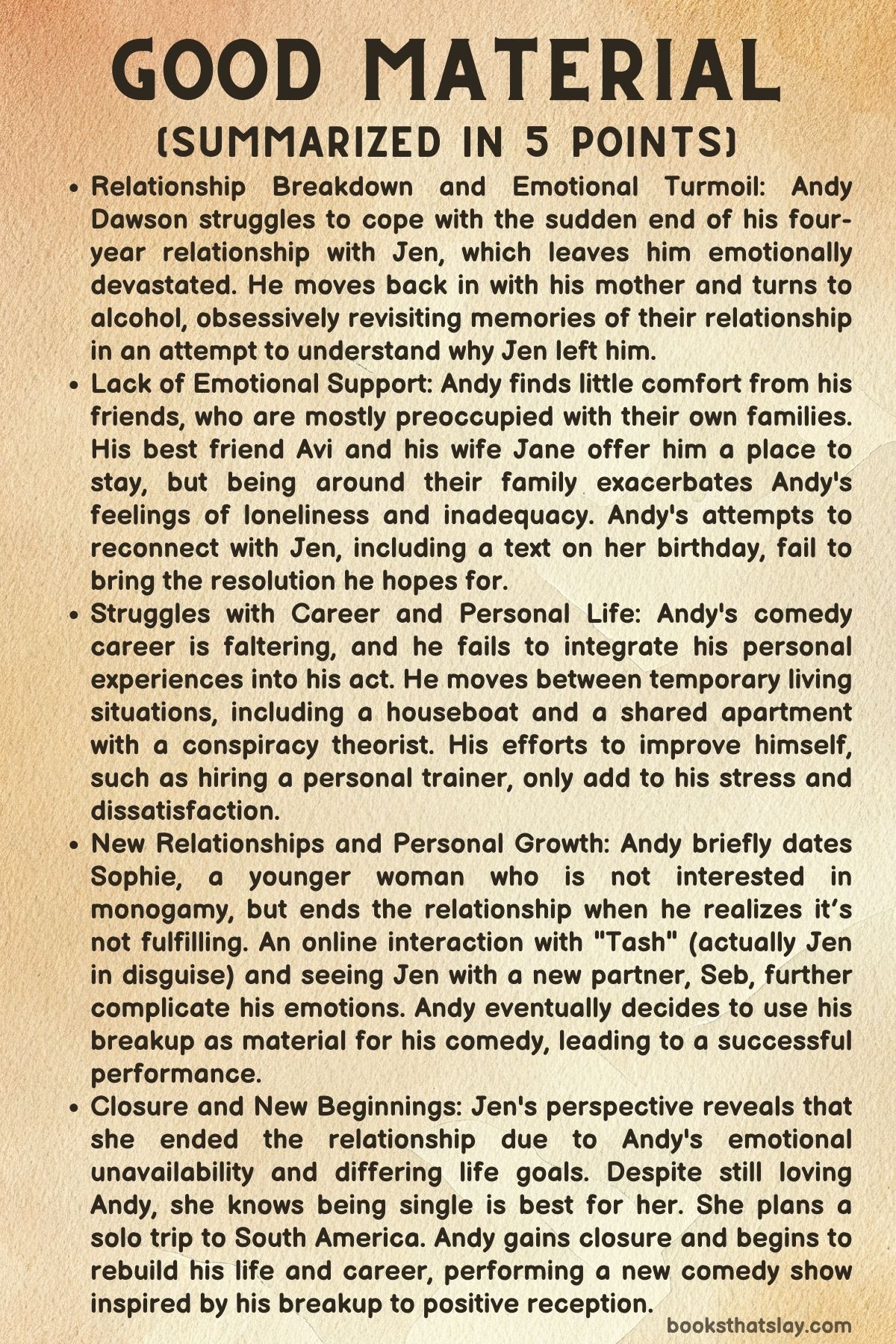
Summary
Andy, a stand-up comedian in his mid-thirties, is left reeling after Jen, his girlfriend of nearly four years, ends their relationship. At the beginning, he tries to console himself by making a mental list of Jen’s flaws: her irritating habits, family quirks, punctuality inconsistencies, and emotional guardedness.
He convinces himself that these reasons justified the breakup, but the truth is that he’s devastated. His longing for fatherhood, coupled with Jen’s refusal to engage with conversations about children, lingers as a painful difference between them.
In the days following the split, Andy clings to every memory, from their first kiss to their domestic routines. A symbolic moment comes when he photographs two shirts on a washing line, now representing their lost intimacy.
His grief is intensified when Jen, following her therapist’s advice, encourages him to write down why the breakup was for the best. To Andy, her pragmatic approach feels like cruelty, and when she signs off a phone call with “lots of love,” he breaks down, knowing the phrase is hollow.
The story rewinds to when Andy and Jen first met in 2015 at a pub for a mutual friend’s birthday. They connected quickly, exchanging jokes and stories, teasing each other, and building a bond over the course of one evening.
Their chemistry was undeniable, and although Andy was struggling with his career during the Edinburgh Fringe, daily contact with Jen made it the happiest summer he could remember. What began as flirtation soon became a deep relationship, marked by affection, humor, and shared routines.
Back in the present, Andy spirals into despair. He stalks Jen’s social media, misinterprets signs, and tries clumsy rituals of closure, like buying bottles of her perfume and hurling them into a canal.
He leans on his friends Avi and Jane, a married couple, but their domestic life only reminds him of what he’s lost. He obsesses over whether Jen left him for someone else, torturing himself with theories.
His attempts at distraction—pub nights, reminiscing with old friends, and casual encounters—only leave him emptier.
As he tries to reenter single life, Andy struggles with the reality that his peers have settled into families while he’s back to awkward flirtations in clubs filled with people much younger than him. His friends attempt to rally around him, but Andy feels out of step, too old to start over and too lost to accept change.
He experiments with new living arrangements, briefly renting a canal boat before realizing its impracticality. Eventually, he moves in with Morris, an eccentric old man who offers cheap rent but an unsettling environment.
This stage of his life feels like one humiliation after another, punctuated by moments of reckless behavior—mis-sent texts to Jen, drunken voicemails, and failed romantic distractions.
The most destabilizing moment comes when Andy unexpectedly runs into Jen with Seb, her new partner. Seb is confident, polished, and everything Andy believes he isn’t.
Their encounter drives Andy into obsessive research about Seb’s life, from his education to his ex-girlfriends. Convinced that Jen left him for someone better, Andy’s jealousy becomes consuming.
His desperation even leads him to impersonate a fake client in therapy, trying to extract insights about Jen’s possible motivations, but it only leaves him more bitter.
Despite this, Andy begins a tentative new romance with Sophie, a younger woman with clear boundaries and an upfront attitude. Their relationship is physical and casual, but for Andy, it represents a lifeline.
For the first time since the breakup, he doesn’t feel broken during sex. Sophie insists he block Jen and Seb on social media, helping him reclaim a small sense of control.
Yet Andy remains haunted by reminders of Jen, especially when he sees her old rituals replicated in her new relationship with Seb. He interprets it as a betrayal, proof that Jen has recycled their intimacy with someone else.
Parallel to Andy’s story, the novel also reveals Jen’s perspective. Through unsent letters and reflections, Jen explains her reasons for leaving.
She loved Andy’s charm and humor but found his insecurity, lack of ambition, and self-absorption exhausting. She had doubts about children, career pressures, and a need for independence that clashed with Andy’s longing for permanence.
Key moments—her grandmother’s death, fertility fears, and Andy’s insensitivity—cemented her realization that the relationship couldn’t last. Her grief is real, but so is her relief.
She even admits to unhealthy behavior, such as posing as “Tash” online to check on Andy. While Seb briefly provides comfort, she eventually sees it as a rebound.
Her decision to travel abroad marks her attempt to reclaim autonomy.
Meanwhile, Andy channels his heartbreak into creativity. He writes a new comedy show, “Why Elephants Cry,” which becomes a powerful outlet for his grief.
Using lists, anecdotes, and humor, he lays bare the humiliations and sorrows of his breakup, drawing parallels to elephants mourning their dead. Jen reluctantly attends one of his performances and is struck by its raw honesty.
She admits it’s his best work yet. The two share a gentle, bittersweet exchange, acknowledging their shared madness and hinting at a fragile future friendship.
The novel closes with both characters moving forward, though not together. Jen prepares for her solo travels, seeking freedom and new purpose, while Andy finds meaning in his art and a renewed sense of identity beyond his relationship.
Their love was real, but it was not sustainable. What remains is the recognition that heartbreak, however painful, can lead to growth, creativity, and the possibility of new beginnings.
Characters
Andy
Andy is the central figure of Good Material, and the story is told primarily through his lens of heartbreak and self-reflection. At thirty-five, Andy is a struggling comedian, insecure about his thinning hair, erratic career, and lack of stability compared to his peers.
His breakup with Jen pushes him into a spiral of nostalgia, obsession, and attempts at distraction—ranging from nights out with friends to ill-fated experiments like living on a canal boat. Andy embodies both humor and pathos: he is deeply self-pitying, often immature, yet capable of immense vulnerability and tenderness.
His fixation on Jen reveals both his inability to let go and his desperate yearning for meaning. Despite his flaws—jealousy, self-centeredness, and an almost comical inability to move forward—Andy emerges as a man seeking connection and significance.
His eventual transformation comes when he channels his grief into art, writing a show that blends pain with comedy, finally finding a sense of purpose in his heartbreak.
Jen
Jen is Andy’s ex-partner, whose decision to end the relationship drives the novel’s emotional arc. Intelligent, pragmatic, and emotionally guarded, Jen is both the love of Andy’s life and the figure he cannot stop resenting.
Through Andy’s eyes, she appears frustratingly indecisive, emotionally inconsistent, and critical of his flaws. Yet when the narrative shifts to her perspective, Jen emerges as someone who struggled under the weight of Andy’s immaturity, insecurity, and dependence.
Her reflections show that she valued her independence, was ambivalent about motherhood, and became increasingly alienated by Andy’s lack of ambition and self-awareness. Jen’s own backstory—her family dynamics, her father’s infidelity, and her fear of repeating unhealthy patterns—adds depth to her choices.
Though she experiments with rebounds like Seb and even fabricates an online persona to check on Andy, her final decision to travel alone underscores her desire for growth and autonomy.
Avi and Jane
Avi and Jane serve as Andy’s anchors in the aftermath of his breakup, offering him both refuge and perspective. Avi, Andy’s best friend, provides a mix of support and tough love, gently reminding Andy of the need to adapt and grow rather than wallow.
His stable family life—with Jane and their children—offers Andy a painful contrast to his own chaos. Jane, pragmatic and nurturing, balances empathy with sharp critique.
She calls Andy out on his patterns of self-destruction, particularly in his new relationship with Sophie, and challenges his idealization of Jen. Together, Avi and Jane represent the settled, domestic life that Andy both longs for and resents, highlighting his deep insecurity about being left behind by his peers.
Emery
Emery is Andy’s flamboyant, larger-than-life comedian friend, who serves as both a foil and a catalyst. Unlike Andy, Emery embraces chaos, blunt honesty, and theatricality.
He pushes Andy to use his heartbreak as comedic material, encouraging him to confront his pain rather than hide behind safe performances. Emery’s rising success contrasts with Andy’s faltering career, intensifying Andy’s insecurities.
Yet Emery’s unapologetic lifestyle and brash advice help Andy edge toward authenticity. He represents the possibility of turning failure and humiliation into art, a path Andy eventually follows.
Sophie
Sophie enters Andy’s life as a sharp, witty, and detached young woman twelve years his junior. She challenges Andy with her independence and unorthodox approach to relationships—setting firm boundaries and mocking clichés.
Their relationship is initially liberating for Andy, proving to him that he can desire and be desired again after Jen. Yet their age gap and differing expectations highlight Andy’s vulnerabilities and need for intimacy, which Sophie resists.
Despite her playfulness and candor, Sophie ultimately reveals the imbalance in their dynamic: while Andy clings to her for validation, Sophie insists on autonomy. Her role in the novel underscores Andy’s struggle to reconcile his desire for permanence with the reality of transient connections.
Seb
Seb, Jen’s polished and confident colleague, represents everything Andy is not: stable, accomplished, and effortlessly charismatic. His brief appearances loom disproportionately large in Andy’s imagination, as Andy fixates on him as the embodiment of his inadequacy.
Seb becomes less a person and more a projection of Andy’s fears—that Jen left him for someone more successful and grounded. Though Jen later reveals Seb was little more than a rebound, Andy’s obsession with him highlights his tendency to measure his worth against others, especially in matters of love.
Morris
Morris, the eccentric old man who rents Andy a room, serves as a comic yet unsettling figure in Andy’s downward spiral. Surrounded by plants, newspapers, and conspiracy theories, Morris reflects both the absurdity and bleakness of Andy’s situation.
His character underscores the theme of displacement—Andy literally and metaphorically living in spaces that don’t fit. Morris also embodies a kind of grotesque mirror of Andy’s possible future: lonely, unstable, and cut off from meaningful connection.
In Good Material, Dolly Alderton crafts characters who are deeply flawed yet profoundly human. Andy’s grief and self-absorption, Jen’s guarded pragmatism, and the contrasting stability or chaos of those around them create a layered portrait of love, loss, and growth.
Each character serves to highlight different facets of heartbreak—obsession, independence, friendship, creativity—and together they shape a story that is as painfully funny as it is tender.
Themes
Heartbreak and Obsession
The aftermath of Andy’s breakup with Jen is presented not just as sadness but as an all-consuming fixation that governs every part of his life. His grief is less about the absence of a partner and more about the obsessive need to make sense of rejection, which manifests in irrational behavior—tracking Jen’s social media, interpreting small gestures like a single “X” as monumental, or concocting elaborate theories about her therapist and her new partner.
Heartbreak becomes a psychological trap, where Andy relives memories as though replaying a film he cannot turn off, amplifying every detail of what was lost. This theme underscores how breakups often trigger compulsive cycles of memory, longing, and comparison, especially when unresolved questions linger.
Andy’s inability to detach himself emotionally highlights how grief can distort self-perception, making him feel both powerless and desperate to regain control. His obsessive attempts—buying Jen’s perfume to discard it, attending therapy under a false name, or researching Seb’s background—illustrate the destructive spiral of a mind unable to let go.
Through this, Good Material suggests that heartbreak is less about the loss of love itself and more about the psychological weight of not being chosen, the compulsion to rewrite the ending, and the inability to accept a reality that no longer accommodates the past.
Masculinity and Identity in Middle Age
Andy’s struggles are not only rooted in heartbreak but also in the crisis of identity brought on by being a thirty-five-year-old man whose peers are largely settled into marriage, parenthood, and stable careers. His attempts to reenter single life expose the dissonance between youthful masculinity and middle-aged vulnerability.
Nights out with friends reveal how out of place he feels in clubs filled with younger people, where once-familiar rituals now feel alien. His thinning hair, his faltering career, and his dependence on Avi and Jane’s household compound his sense of inadequacy.
The story examines masculinity not as stoic resilience but as something fragile, shaped by cultural expectations of success, stability, and independence. Andy’s dependence on external validation—through women, through comedy audiences, through friends—shows how his sense of self collapses without those anchors.
His fixation on Seb becomes a projection of his insecurities: Seb embodies the polished, financially secure, traditionally masculine traits Andy believes he lacks. In portraying this, the novel critiques the pressures men face when navigating middle age without the conventional markers of success.
Masculinity, here, is revealed to be less about dominance or strength and more about confronting the uncomfortable reality of failure, vulnerability, and the fear of irrelevance.
Love and Compatibility
The relationship between Andy and Jen is presented with tenderness and humor but also as a study in incompatibility. Their attraction at first meeting is electric, full of charm and spontaneity, but their long-term relationship exposes fundamental differences—his longing for children against her ambivalence, his artistic instability against her structured career, his emotional dependence against her guardedness.
The lists they both create, reflecting on reasons for or against their relationship, reveal not only grievances but also the depth of their mismatched needs. Jen’s perspective makes clear that love, however strong, cannot compensate for differences in ambition, values, or life goals.
Meanwhile, Andy’s perspective is consumed by longing, unable to reconcile that love itself is insufficient for sustaining a future together. This theme demonstrates the painful truth that affection does not always equal compatibility, and that relationships often fracture not from a lack of care but from irreconcilable differences in vision and capacity.
Good Material uses their dynamic to examine how relationships can be both meaningful and doomed, leaving behind a paradoxical legacy of joy, grief, and lessons that reshape one’s understanding of intimacy.
Creativity as a Means of Survival
Andy’s career as a comedian and his eventual creation of the show Why Elephants Cry positions art as a form of catharsis. His breakdown and subsequent transformation of grief into material illustrate how creativity can provide structure and meaning when life feels unmanageable.
The act of turning personal suffering into performance enables him to reclaim agency over his heartbreak, reframing pain as art rather than humiliation. Yet, this theme is complicated by the ethical ambiguities of using personal relationships as material, as Jen herself attends the show and is forced to confront her role in his narrative.
The process of making art from heartbreak shows both its redemptive and exploitative qualities—while it empowers Andy to find purpose, it also risks reducing Jen’s lived experience into comedy fodder. Nonetheless, the novel suggests that storytelling, even when flawed, provides a way to externalize grief and transform private despair into communal recognition.
Andy’s use of creativity as survival highlights the resilience of human beings to turn emotional wreckage into something enduring, even if imperfect, and raises questions about the blurred lines between healing and appropriation.
Growth and Letting Go
The conclusion of the novel shifts the focus from loss to transformation. Both Andy and Jen reach an understanding that while their love was genuine, it was not sustainable, and their future lies in separate directions.
Jen’s decision to travel and Andy’s recommitment to comedy represent acts of growth that stem directly from the breakup. Their parting is not framed as triumph or defeat but as an acknowledgment of reality, marked by humor and respect.
This theme emphasizes the necessity of letting go—not as forgetting, but as accepting the permanence of change. Growth, the book suggests, emerges not in clinging to the past or idealizing what was lost but in finding new forms of meaning beyond it.
Andy’s journey illustrates how heartbreak, as agonizing as it is, can be a catalyst for reinvention, and Jen’s journey demonstrates the courage it takes to honor one’s own needs even at the cost of another’s pain. Good Material ultimately frames love not as a permanent state but as a chapter that shapes identity, providing the raw material for the next stage of life.