Half-Light Harbor Summary, Characters and Themes
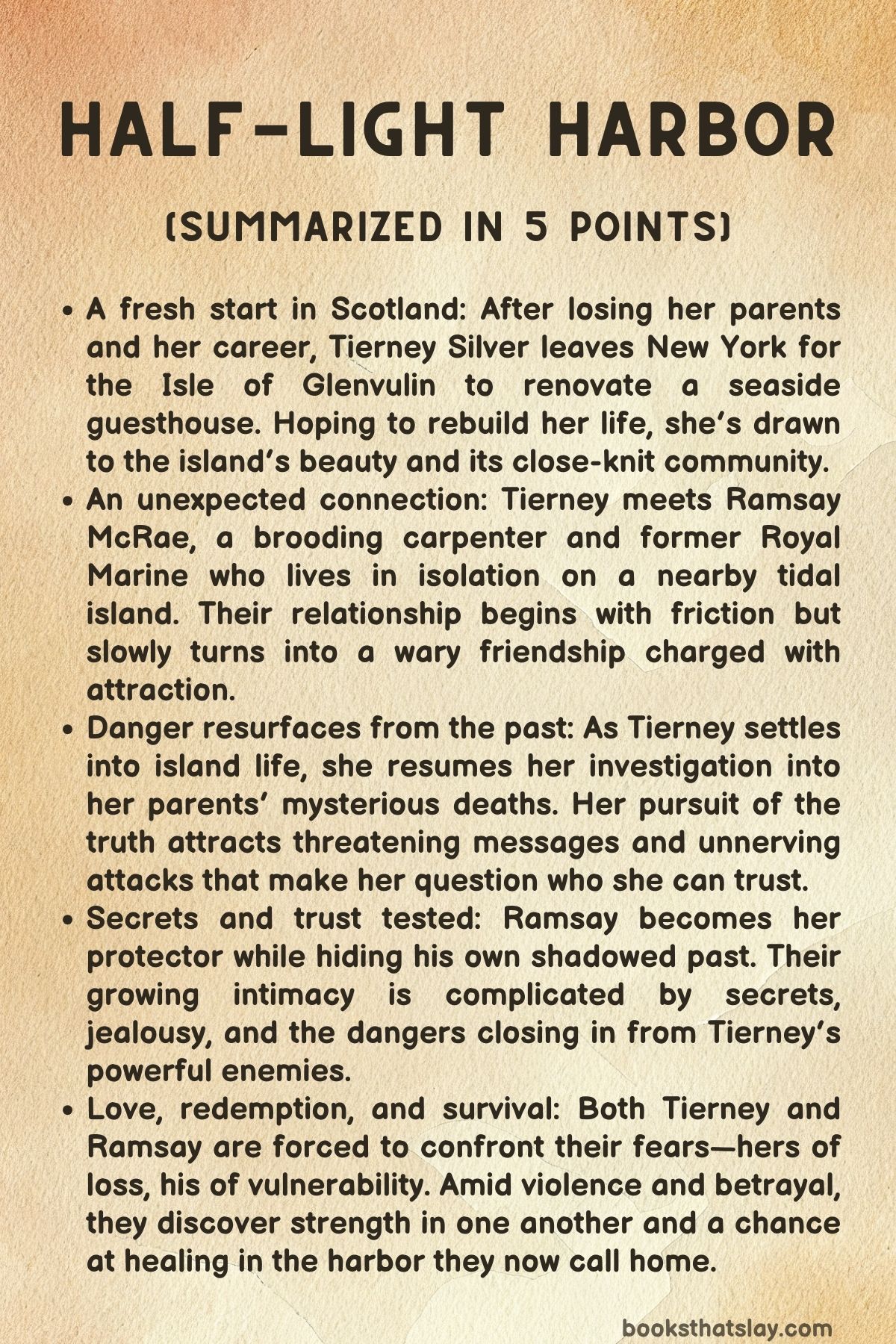
Half-Light Harbor by Samantha Young is a contemporary romantic suspense novel that explores grief, self-discovery, and the power of second chances. The story follows Tierney Silver, an American heiress whose life unravels after the sudden death of her parents and betrayal by her boyfriend.
Seeking escape and purpose, she travels to a small Scottish island to renovate an old guesthouse. There, amid breathtaking landscapes and tight-knit locals, she meets Ramsay McRae, a reclusive carpenter with a dangerous past. Their connection grows amid layers of mystery, buried trauma, and danger linked to Tierney’s family legacy. The novel balances emotional depth with tension, healing, and romance.
Summary
Tierney Silver’s life in Manhattan falls apart when she discovers her boyfriend, Hugh, cheating on her. Already reeling from the recent loss of her parents in a helicopter crash and being fired from her job, Tierney decides to leave the city.
Her best friend, London, encourages her to visit Scotland—the place where her late grandmother once lived. Soon after, a reporter named Perri Wilcox claims that her parents’ deaths weren’t accidental, but the result of a corporate conspiracy.
Shaken yet intrigued, Tierney agrees to hear more, unknowingly stepping into a dangerous web of secrets.
Tierney relocates to the Isle of Glenvulin, purchasing an abandoned guesthouse in the harbor town of Half-Light Harbor to renovate into a bed-and-breakfast. She meets Quinn McQuarrie, her main contractor, and his partner Ramsay McRae, a rugged, solitary carpenter who lives on a nearby tidal island called Stòr.
Her first meeting with Ramsay is anything but friendly—he catches her trespassing on his property after she misreads the tide schedule. Stranded until nightfall, she reluctantly follows him to his cabin.
Though blunt and reserved, Ramsay ensures her safety and shows her subtle kindness. Their exchanges—equal parts tension and curiosity—mark the beginning of an unexpected connection.
As Tierney becomes part of the island’s rhythm, she befriends locals like Cammie and Quinn’s sister, who introduces her to the close-knit community. Through these friendships, Tierney learns about the complicated relationships on the island, including Quinn’s past with a woman named Taran, who has returned home to care for her dying mother.
Meanwhile, Ramsay quietly investigates Tierney’s background and discovers that she had inherited a vast fortune but gave it all away to charity. His curiosity deepens, though he vows to stay detached.
Perri’s investigation into the Silver Group—the hotel empire once owned by Tierney’s family—unearths corruption tied to Halston Cole, the current CEO. When Perri warns that witnesses are being silenced, Tierney begins receiving disturbing threats.
Ramsay steps in protectively when a dead bird is mailed to her and later when she finds her car filled with worms. Though Tierney insists on handling things herself, Ramsay installs security systems and lends her his dog, Akiva, for protection.
His growing feelings for her conflict with his instinct to remain isolated.
The tension between them builds until a confrontation with Hugh, who shows up at her property, exposes deeper dangers. Hugh tries to manipulate Tierney, claiming she’s mentally unfit and threatening legal control over her former inheritance.
Ramsay intervenes, revealing he knows incriminating secrets about Hugh’s past and driving him away. This event brings Tierney and Ramsay closer, and their relationship turns intimate, evolving from wary attraction into love, though Ramsay continues to hide details about his mysterious background.
As renovations near completion, Tierney feels she’s finally found peace on the island. The threats appear to have stopped, and her collaboration with Perri to expose Halston Cole nears success.
But just as life feels secure, Tierney is brutally attacked and stabbed by a masked assailant. Ramsay, nearby, saves her life and stays with her through surgery.
When she awakens, she confides the full truth: her parents were murdered for trying to expose corporate crimes linked to Cole’s illegal activities overseas.
Determined to protect her, Ramsay draws upon a past he’s long buried. He travels to London and meets an old intelligence contact, revealing that he once worked for MI6 under multiple identities.
Using his covert network, he tracks the hitman who attacked Tierney and uncovers evidence tying Halston Cole directly to the assault. Ramsay confronts Cole violently, warning him never to target Tierney again.
Moments later, the FBI raids Cole’s location, arresting him on charges of murder and corruption.
While Tierney recovers, Ramsay vanishes, leaving behind private security to guard her. When police confirm Cole’s arrest and the hitman’s capture, she realizes Ramsay was behind it all.
He returns to take her home, emotionally distant but clearly devoted. Later, he confesses everything—his military and intelligence past, the missions that scarred him, and the death of a fellow agent, Natalya, whose loss drove him into exile.
Tierney listens without judgment, helping him confront his guilt and reclaim his humanity.
Their reunion is interrupted when London, Tierney’s best friend, appears seeking refuge from her abusive fiancé, Nick Huston. Ramsay uses his intelligence contacts to expose Nick’s crimes, ensuring London’s safety.
Tierney’s compassion and courage inspire him to stop running from his past. Their bond deepens into mutual trust and love.
When mercenaries arrive on Ramsay’s island seeking revenge for Natalya’s death, Ramsay and Tierney fight side by side. Using Ramsay’s old defenses and Tierney’s steady aim, they defeat the intruders.
Ramsay’s former ally arrives with a rescue team, ending the threat. The ordeal cements their connection and reveals the depth of their loyalty to one another.
Months later, the newly renovated bed-and-breakfast opens, becoming a symbol of healing and rebirth. London finds solace as the inn’s chef, and Tierney finally puts her parents’ legacy to rest.
Ramsay and Tierney settle into a peaceful rhythm, dividing their time between the inn and his island retreat. They talk about building a family and a future without secrets, embracing the quiet beauty of their new life together.
As they watch the harbor lights glimmer across the water, they know they’ve both found what they were searching for—not escape, but home.
Characters
Tierney Silver
Tierney Silver, the protagonist of Half-Light Harbor, begins as a woman adrift between grief, betrayal, and rediscovery. Born into privilege as the heiress to the Silver Hotel Group, her life initially appears gilded but hollow.
The loss of her parents in a helicopter crash devastates her, and her subsequent firing strips away the last vestige of structure she had left. Her boyfriend’s infidelity is the final fracture that propels her to Scotland—a symbolic journey of rebirth.
Tierney’s defining traits are resilience, compassion, and an evolving self-awareness. She learns to navigate pain not by escaping it but by transforming it into purpose.
Her decision to donate her inheritance—over a hundred million dollars—to charity reveals both moral integrity and a deep yearning for liberation from the corrupt empire that tainted her family name.
In Scotland, Tierney’s emotional and physical journey mirrors the renovation of her guesthouse: she rebuilds herself from ruins. Her interactions with Ramsay McRae awaken vulnerability and strength in equal measure.
Tierney’s courage surfaces not only in confronting corporate corruption and physical danger but also in daring to love again. Even when threatened by her ex-boyfriend Hugh and targeted by hired killers, she remains determined to expose the truth about her parents’ murder.
By the novel’s end, Tierney evolves from a woman defined by loss into one defined by purpose, love, and agency—her transformation standing at the heart of the book’s emotional arc.
Ramsay McRae
Ramsay McRae embodies the archetype of the wounded warrior—stoic, secretive, and bound by guilt. A former Royal Marine and MI6 operative, his past is veiled in espionage, betrayal, and violence.
His retreat to the isolated island of Stòr and his life as a craftsman reflect both penance and self-preservation. Ramsay’s solitude is a defense mechanism against the ghosts of his past—particularly the death of Natalya, a fellow agent he once cared for deeply.
When Tierney enters his life, she disrupts the fragile equilibrium he has maintained, confronting him with emotions he believed buried forever.
Despite his gruff demeanor, Ramsay’s protectiveness and moral code reveal his depth. He is both a man of action and conscience: when Tierney is threatened, he uses his old intelligence connections to eliminate danger without hesitation, yet he remains tormented by the violence he employs.
His relationship with Tierney evolves from wary attraction to profound love, forcing him to reconcile his dual nature—soldier and human, avenger and lover. Ramsay’s eventual confession of his past to Tierney marks his emotional surrender, symbolizing trust and redemption.
By the story’s close, his transformation from a haunted agent into a devoted partner underscores the novel’s theme of healing through vulnerability and love.
London Parker
London Parker, Tierney’s best friend, serves as both emotional anchor and moral mirror. Her dynamic presence brings warmth and humor to Tierney’s turbulent life.
London’s loyalty is unwavering—from encouraging Tierney to leave New York after her breakup to standing by her during the investigation into her parents’ deaths. Yet London herself endures trauma, revealed later through her abusive relationship with Nick Huston.
Her storyline extends beyond secondary support; it highlights the novel’s feminist undercurrent—women reclaiming autonomy after betrayal and control.
London’s decision to seek safety in Scotland and later join Tierney’s life at the newly renovated inn completes her own healing arc. Once defined by glamour and denial, she matures into a figure of strength and self-respect.
Her recovery parallels Tierney’s, and together they represent sisterhood as a form of survival.
Quinn McQuarrie
Quinn McQuarrie is the dependable builder who anchors Tierney’s Scottish world in practical reality. Steady, loyal, and principled, Quinn’s life contrasts sharply with Tierney’s chaos.
His backstory—marked by youthful mistakes, a complicated romantic history with Taran Macbeth, and a sense of responsibility toward his sister Cammie—adds depth to his quiet resilience. Quinn embodies community spirit and integrity; his care for his workers and his genuine affection for Tierney reveal a man deeply rooted in place and purpose.
While not romantically linked to the protagonist, his presence represents the stability and decency that the island life offers her.
Cammie McQuarrie
Cammie, Quinn’s spirited sister, injects warmth and humor into the narrative. As an interior designer and confidante to Tierney, she bridges the outsider’s world with the local community.
Cammie’s curiosity, outspokenness, and fierce loyalty make her a vital part of Tierney’s emotional network. Through her lighthearted teasing and occasional blunt honesty, she grounds the story’s more intense emotional beats.
Yet beneath her playfulness lies a perceptive understanding of pain and love, seen in her sympathy toward both Tierney’s heartbreak and her brother’s regrets.
Taran Macbeth
Taran Macbeth’s return to Glenvulin adds poignancy and reflection to the island’s interpersonal web. Once Quinn’s high school sweetheart, she carries the scars of lost love and years away from home.
Her return to care for her dying mother, Isla, reopens old wounds but also brings reconciliation. Through Taran, the narrative explores how time alters perception—her story serves as a mirror to Tierney’s, showing that healing requires facing the past rather than escaping it.
Taran’s maturity, compassion, and quiet strength balance the novel’s romantic and investigative tension, emphasizing the human capacity for forgiveness.
Perri Wilcox
Perri Wilcox, the tenacious investigative journalist, represents courage under constant threat. Her pursuit of truth regarding the Silver Group’s corruption is relentless, even when faced with intimidation and danger.
Perri’s partnership with Tierney is built on mutual respect and shared moral conviction. Unlike many secondary characters, she operates largely offstage, yet her presence drives the suspense thread of the novel.
Her role underscores the power of integrity and journalism in the face of systemic corruption, reinforcing the story’s undercurrent of justice and accountability.
Hugh Inchcolm
Hugh Inchcolm functions as the embodiment of manipulation and privilege gone rotten. Initially Tierney’s boyfriend, he represents everything hollow in her old life—entitlement, emotional cruelty, and control.
His reappearance in Scotland exposes the darker dimensions of his character: obsession, deceit, and violence. His threats of conservatorship and his ties to Michelle Schull’s death reveal a man accustomed to impunity, shielded by wealth.
Hugh’s downfall, brought about indirectly by Ramsay’s intervention, serves as poetic justice. He is not just a villain but a symbol of Tierney’s liberation from her past—a reminder of what she refuses to become.
Halston Cole
Halston Cole, the corrupt CEO of the Silver Group, operates as the novel’s shadowy antagonist. His greed and moral decay are the catalyst for the tragedy that drives Tierney’s life: her parents’ murder disguised as an accident.
Cole represents the rot at the heart of corporate power, where human lives are expendable in the pursuit of profit. His eventual exposure and arrest, orchestrated through Ramsay’s clandestine efforts, signify not just justice served but moral closure.
Cole’s downfall contrasts sharply with Tierney’s ethical rebirth, reinforcing the theme that redemption belongs to those who confront truth rather than conceal it.
Ian Kingston
Ian Kingston’s late arrival as the vengeful widower of Natalya adds one final surge of conflict and catharsis. Blinded by grief, Ian becomes the instrument of Ramsay’s final reckoning with his past.
His attempt to kill Ramsay and Tierney on the island embodies the literal and figurative return of ghosts that must be confronted before peace can exist. His death at Tierney’s hands closes Ramsay’s arc of guilt and symbolically frees both from their shared burden of violence and survival.
Themes
Grief and Healing
Tierney’s emotional landscape in Half-Light Harbor is shaped by the profound loss of her parents and the upheaval of her identity following their deaths. Grief becomes the central force that propels her journey—both emotionally and geographically.
When the novel begins, Tierney exists in a state of numb survival, detached from meaning and purpose. Her grief is not loud but quietly corrosive, manifesting through her resignation at work, her passive endurance of a toxic relationship, and her sense that life has lost its center.
Moving to Scotland is not a calculated act of reinvention but a spontaneous retreat, a desperate attempt to breathe again in a world that no longer feels familiar. The renovation of the guesthouse becomes a metaphor for her own internal reconstruction; each broken wall and rebuilt space mirrors the dismantling and rebuilding of her fractured self.
Through Ramsay and the people of Glenvulin, she rediscovers connection, patience, and emotional risk. Healing, for her, is not about forgetting the dead but learning to live with their absence while reclaiming joy.
Samantha Young presents grief as cyclical rather than linear—it resurfaces in different forms, often unexpectedly, reminding Tierney that moving forward does not mean erasing the past. By the end, Tierney’s ability to love again and create a home on her own terms shows how grief, when faced with courage and self-awareness, becomes the very ground upon which renewal grows.
Redemption and Forgiveness
Ramsay McRae’s life in Half-Light Harbor embodies the struggle between guilt and the yearning for redemption. His withdrawal to the remote island of Stòr is not merely about solitude but penance.
His past as an MI6 operative, filled with moral compromises and irreversible losses, particularly the death of Natalya, traps him in self-condemnation. Ramsay’s craftsmanship—shaping beauty from raw wood—is symbolic of his subconscious attempt to repair what was once broken beyond repair.
His interactions with Tierney test his belief that he is unworthy of love or peace. The novel uses his journey to question whether redemption requires external forgiveness or self-acceptance.
Ramsay’s protective actions—shielding Tierney, confronting her enemies, and ultimately risking everything for her safety—mark his shift from a man haunted by guilt to one capable of grace. Samantha Young portrays forgiveness not as absolution from others but as the courage to face one’s past without letting it dictate the future.
Ramsay’s eventual openness with Tierney, confessing his history and vulnerabilities, signals a turning point where redemption arises from honesty rather than concealment. His evolution from an emotionally armoured recluse to a partner capable of love and trust highlights the novel’s belief that redemption is earned through courage, empathy, and the willingness to confront one’s own darkness.
Love and Emotional Vulnerability
Love in Half-Light Harbor is portrayed not as an escape from pain but as a crucible through which the characters rediscover their humanity. Tierney and Ramsay’s relationship is built on friction, misunderstanding, and deep emotional need.
Both carry wounds—hers from loss and betrayal, his from guilt and trauma—that make intimacy dangerous. Yet their connection grows through acts of protection, honesty, and unspoken tenderness.
Their romance reflects the novel’s larger message: that love is an act of bravery. For Tierney, trusting Ramsay means dismantling the emotional walls she built after losing everything.
For Ramsay, allowing himself to love her means surrendering control and accepting that vulnerability is not weakness. Their bond evolves through shared moments of quiet strength—a cup of coffee after an argument, a shared laugh amid grief, the comfort of silence after fear.
The narrative refuses idealized romanticism; love here is messy, grounded, and transformative. It demands self-awareness and the willingness to risk pain.
Through their union, both characters learn that intimacy is not about perfection or safety but about standing beside someone even when the past still aches. Love, in the world of Half-Light Harbor, becomes the most human form of courage.
Power, Corruption, and Moral Courage
The political and corporate intrigue within Half-Light Harbor gives the story its pulse of suspense while grounding its moral questions. The Silver Group’s corruption—rooted in greed, exploitation, and murder—contrasts sharply with Tierney’s moral awakening.
Once complicit through silence and privilege, she becomes a whistleblower against her family’s empire, risking her life to expose truth. This narrative arc transforms Tierney from an heiress defined by inheritance into a woman defined by integrity.
Samantha Young frames power not merely as corporate authority but as the ability to silence or protect others. The murders of her parents, the threats against her and Perri, and the manipulation by men like Halston Cole and Hugh Inchcolm expose the systemic abuse of influence.
Yet the novel insists on the resilience of moral courage—Tierney and Perri’s persistence despite fear embodies the defiance of conscience over corruption. Ramsay’s own involvement in espionage reinforces the theme: he too has seen how power corrupts from within, and his decision to use his skills for protection rather than manipulation marks his ethical rebirth.
In the end, justice arrives not through institutions but through personal bravery, revealing that morality is sustained by individuals who refuse to surrender to intimidation.
Identity and Self-Discovery
At its heart, Half-Light Harbor is a story about rediscovering the self after everything that once defined it has been stripped away. Tierney’s transformation from a sheltered heiress to an independent woman in a remote Scottish village encapsulates the search for authentic identity.
Her life before the novel was built on the expectations of family legacy, wealth, and appearance; her firing and her parents’ deaths dismantle those illusions. By rebuilding the guesthouse, she rebuilds a self rooted not in inheritance but in earned purpose.
Scotland becomes both a literal and emotional frontier—a place that challenges her limits while revealing her resilience. Ramsay’s arc mirrors hers, though from the opposite direction: he retreats from the world because of what he’s done, while she moves toward it to reclaim meaning.
Their relationship becomes a mirror through which both confront who they truly are beyond grief, guilt, and fear. Tierney’s evolution into “Silver,” the woman capable of confronting violence and building love, signifies her emergence from identity as inheritance to identity as choice.
Samantha Young portrays self-discovery as an ongoing act, forged in adversity and sustained by self-honesty. The novel’s conclusion, set amid the rebuilt inn and the calm harbor, represents not the end of her search but the serenity that comes from finally belonging to herself.