Hate Me Like You Mean It Summary, Characters and Themes
Hate Me Like You Mean It by Kyra Parsi is a sharp, romantic enemies-to-lovers story about two people who never really got over each other—just got better at hiding it behind revenge. Alice Cloutier is determined to build a life on her own terms, even when it hurts.
Dominic Crawford is rich, powerful, and still furious about a scandal from their teen years that changed everything. When their paths collide again, old wounds reopen fast, and so does the attraction they both deny. What follows is a high-stakes bargain, escalating pranks, and the slow uncovering of what actually happened back then. It’s the 3rd book in the Bad Billionaire Bosses series.
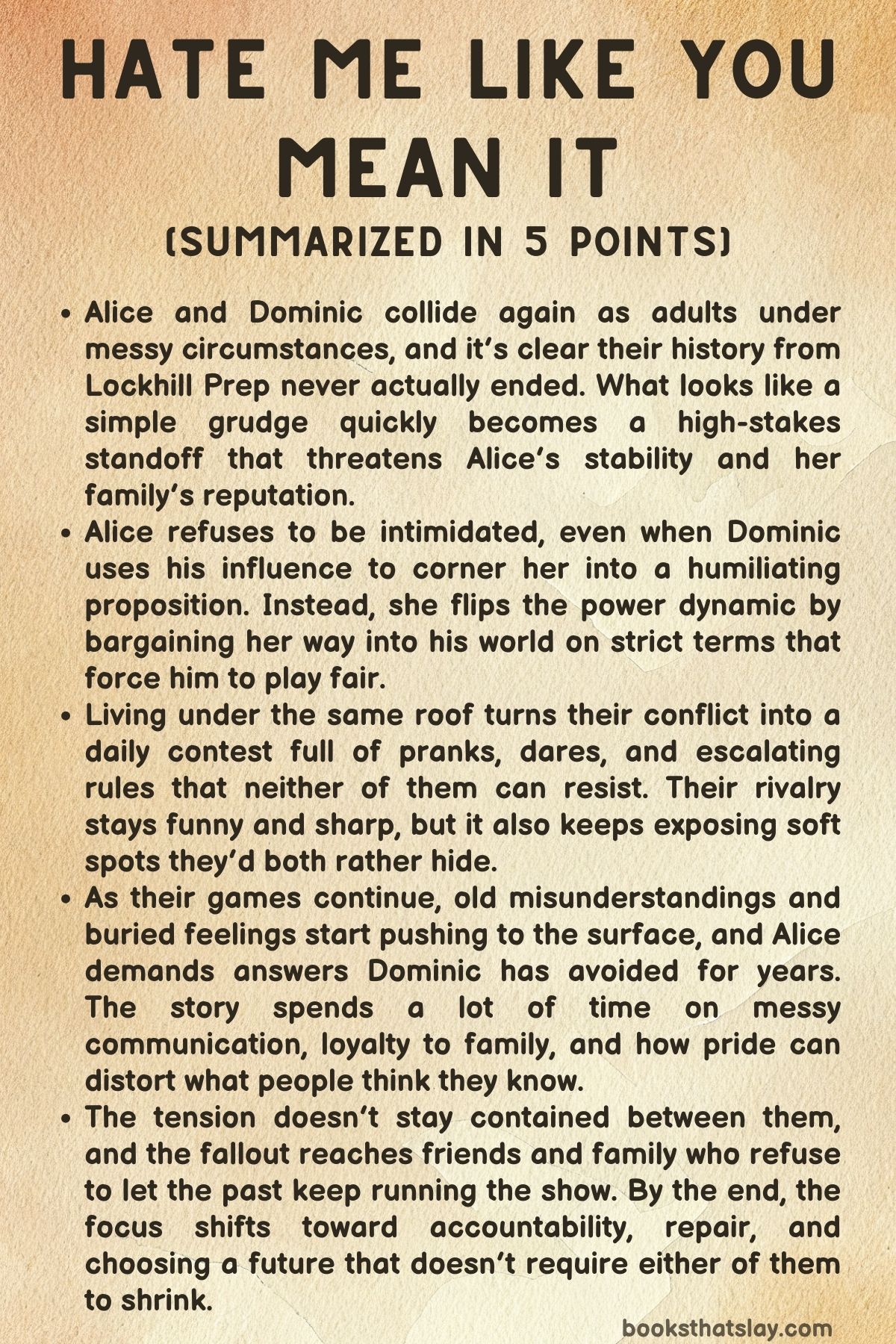
Summary
Eight years ago at Lockhill Prep, Alice Cloutier is cornered in a hallway by Dominic Crawford, the admired student everyone thinks can do no wrong. Dominic is frantic, demanding she retract an accusation connected to stolen jewelry and a damaging photo.
Students gather, friends step in, and Dominic’s composure breaks in public. Alice can’t bring herself to respond.
Dominic leaves humiliated and furious, and by the next day his family is gone from the school. Alice keeps her face blank, then collapses in private, carrying guilt and confusion that never fully fades.
In the present, Alice is twenty-six and barely keeping her life stable. She refuses to touch her trust fund and refuses to let her family know how tight things are, convinced independence is the only way she can breathe.
At work, she pushes through a migraine and watches the clock, hoping to leave exactly on time. Instead, she’s summoned by an executive named Cory and told she’s being fired for “budget cuts.” Alice refuses to accept the vague explanation.
She demands a real reason, sits down in his office, and makes it clear she won’t move until she gets the truth.
A crunch in the doorway interrupts them—someone has stepped on her purse and shattered her sunglasses. The voice that follows turns Alice cold: Dominic Crawford.
Cory instantly deflates under Dominic’s presence, and Dominic dismisses him with a few clipped words. Alone with Alice, Dominic drops the polite mask.
He calls her a liar, tells her he’s been keeping track of her, and reveals the pattern Alice couldn’t explain: job after job ending on the same day isn’t bad luck. Dominic has been arranging it.
He hasn’t been buying companies just to fire her; he’s been using a staffing agency to place her inside companies he already owns, then cutting her loose on schedule. He frames it as payback, a correction of “karma,” for what he believes Alice did to his family years ago—especially to his mother, Rosie.
Dominic adds another layer: his firm, Crawford Capital, owns a media group that includes Gossip Gorilla, and he’s used it to target Alice’s brother, Adrien, after Adrien rose to a prominent CEO role. Alice is outraged, insisting Adrien didn’t deserve any of it.
Dominic insists it’s fair because Alice ruined his life first by framing Rosie for theft. Then he offers a bargain: if Alice admits she lied and set Rosie up, he’ll stop going after her and stop attacking her family.
Alice refuses, insisting she didn’t do what he’s accusing her of. Dominic responds by sending her proof of how far he’s willing to go—an email from the staffing agency offering a humiliating “housekeeper” position with degrading conditions, a costume requirement, and “tips for good behavior.” Dominic tells her to show up for the “interview” on Monday.
Alice storms out, shaking with rage and determination.
Alice meets her friend Rachel for drinks and spills the entire mess. Rachel begs her to walk away.
Alice is wealthy, Rachel reminds her; she could end this through lawyers, or by simply using the money she keeps refusing. Rachel also warns that Alice and Dominic together create something poisonous—an obsession with winning that eats everything else.
Alice pretends she’ll be sensible, but the second Rachel leaves, she decides she’s not backing down. If Dominic wants a fight, she’ll show up.
Before dawn, Alice takes a cab to Dominic’s gated estate carrying a bouquet of toilet brushes as a crude “gift.” To the driver, she invents a humiliating story about Dominic paying for degrading roleplay. Dominic answers the door half-awake and furious.
Alice forces the “interview” herself, turning the situation into a negotiation. She proposes thirty days working in his house.
If she completes the month, Dominic must stop targeting her and her family, retract the smear campaign against Adrien through every outlet he controls, and issue a public apology. She also wants one more thing: to speak to Rosie face-to-face.
Dominic agrees—but with a brutal consequence if Alice quits early. If she fails, she must publicly confess she planted the jewelry and framed Rosie, and the confession must spread everywhere.
Alice accepts. They lock the wager in place.
Alice tries to dig up dirt on Dominic and finds almost nothing. Then she sees a fresh Gossip Gorilla post echoing her cab-driver lie about Dominic’s supposed preferences.
She realizes her rumor already has a life of its own, and she gladly adds fuel by sharing screenshots. On her first day, Dominic hands her a binder schedule and insists on specific clothing rules.
Alice pushes back hard, bargaining him down from costumes to a basic uniform. Then Dominic reveals his opening move: he’s destroyed a chef’s kitchen with sauces and food, even staining the ceiling, and expects her to clean it.
He also points out a hidden security camera—he’ll be watching.
Alice responds with her own strategy: perform the tasks technically, but badly enough to annoy him. She orders groceries and cleaning supplies through delivery, forcing a shopper named Amber to deal with Dominic’s constant changes and impossible requests.
Alice entertains Amber with outrageous stories about Dominic to explain the chaos and tips her heavily. When Alice discovers the refrigerator can’t be used for a day, Amber even brings her own coolers and shows up with her baby son, Ash.
Alice pays her thousands, partly out of gratitude and partly out of spite toward Dominic’s refusal to help.
Alice “cooks” for Dominic as required, but sabotages the meals—burned salmon, unbalanced marinades, and food that looks correct but tastes awful. She also launches quieter pranks, including slipping black dye into his coffee so his teeth and lips turn an unsettling shade.
Dominic watches her attempt to haul the massive refrigerator with rope and makeshift weights before calmly revealing it was already powered; she just didn’t press the obvious button. Alice is pleased he thinks she’s incompetent.
Let him underestimate her.
The next morning, Alice finds a “gift” waiting: a hoodie and dead roses wrapped in poison ivy, left in a locker with a combination that clearly points back to a meaningful date. Furious, she retaliates by ruining breakfast and breaking into Dominic’s bedroom using a diamond earring to trigger the emergency release.
She wakes him with a fake cockroach on his pillow, forcing him into a panicked scramble—then pops the “bug” into her mouth and reveals it’s candy. Dominic is disgusted, and Alice twists the knife by bringing up Rosie and the way she used to care for him.
Their fight escalates when Dominic discovers Alice has destroyed his garden, chopping everything into mulch and even using petals in his salad. A doorbell interrupts them, and Alice assumes it’s furniture delivery.
Instead, it’s a group of middle-aged men dressed like Mrs. Doubtfire, claiming they’re there to “audition” for Dominic based on rumors. One spits at Dominic and insults him.
Dominic looks ready to explode, but Alice steps in, claims responsibility, and plays the situation like a farce, introducing herself as Dominic’s “owner” and calling herself “Grandmommy.” Dominic drags her inside, orders tighter security, and declares the game has escalated.
Soon Dominic tries to force a new humiliation: an adult leash added to her uniform. Alice refuses.
To settle it, she proposes they play Exponential Truth, an old game with strict rules: questions stay on one subject, and calling “chicken” forces a kiss. Dominic agrees instantly.
The questions start sharp and turn personal. Both admit fears they’ve never said out loud—Dominic admits she’s his biggest fear; Alice admits she’s terrified of being stuck and never building the life she wants.
When Dominic calls “chicken,” he kisses her, first lightly, then with growing hunger as the tension between them flips into something neither can deny.
Alice proposes another contest—soccer. Dominic is blindfolded and handicapped, yet still manages to outplay her, teasing and laughing.
The match turns into messy joy: grabbing, tickling, and breathless competitiveness. Alice finally scores, and Dominic honors the loss by dropping the uniform requirement.
He asks for the hoodie back, and Alice hesitates, shaken by how much that simple item still matters. A flashback shows why: as teens, the soccer team used hoodies as prom invitations.
Alice once opened her locker to find Dominic’s hoodie, roses, and a letter that sounded like he was confessing love. Rachel rushed in and insisted it was all a prank, claiming Dominic meant to humiliate Alice by choosing another girl, Harper.
Alice believed Rachel and retaliated in public. Dominic believed a different story entirely, and the misunderstanding hardened into years of anger.
Back in the present, Alice finds a bracelet in Dominic’s ruined garden—something from childhood labeled “PENNY PEONY.” She realizes the garden she wrecked is a replica of Rosie’s old garden from Alice’s family property, built with care and memory. The discovery lands hard.
She recovers the buried hoodie, disinfects it thoroughly, and starts planning to repair what she destroyed. Dominic refuses to be manipulated into leaving the house, then distracts her by showing his underground garage packed with luxury cars, reminding her of the scale of his world—and the scale of what he can do when he’s determined.
After a tense night where Dominic’s jealousy spills out, he drives Alice home and apologizes for interfering with her personal life. But the apology is shaky, because he can’t hide how strongly he feels.
He blurts out that she affects him more than anyone ever has, that it goes back to when they were kids. At her door, the pressure breaks.
They end up having sex, more than once, with the silent understanding that the feud has shifted into something else entirely.
The next morning, Dominic leaves to get coffee and says they need to talk. Alice cooks an elaborate breakfast anyway, adding nostalgic touches, but he doesn’t return for hours and doesn’t answer her calls.
Her confidence collapses into hurt and humiliation. When he finally returns, exhausted, he says, “You win.” He offers to end the war: he’ll admit to the smear campaign against Adrien, issue a public apology, and take Alice to see Rosie.
Then he adds a condition—afterward, they should cut each other off completely and live like strangers. Alice refuses.
She tells him they’ve never truly talked about what happened, and she lays out her memory of the prom hoodie and the letter, and how she believed he planned to mock her. Dominic is stunned because it doesn’t match what he believes.
Alice admits something deeper: when she pushed him away back then, she didn’t want him gone. She just didn’t want to love him.
Before they can finish, Alice’s grandfather—Gampy—shows up unannounced with Maxwell, his loud African gray parrot. Chaos erupts.
Maxwell insults Dominic, repeats affectionate phrases that prove Dominic once mattered to him, and Dominic can’t resist revealing himself. Gampy explodes with anger at Dominic for disappearing and swings his cane at him, and Maxwell tops it off by pooping on Dominic’s head.
Gampy forces them into a couch “time-out,” scolds them both, then hands Dominic a box of keepsakes he saved and tells him to leave until he’s ready to apologize properly.
Dominic digs through the box and finds a Polaroid labeled “Prom night” showing Alice asleep in Rosie’s room wearing his hoodie, clutching a small yellow device. He also finds a camcorder marked “PLAY ME.” The video reveals crucial evidence that undermines the old accusation about the jewelry photo.
Dominic realizes Alice may not have been the person who took the incriminating picture at all, meaning his hatred has been built on the wrong foundation.
Dominic meets Gampy for tea with Maxwell present, and Gampy confirms Alice wasn’t behind the photo. He suggests Alice may have taken blame to protect the real culprit, and they both circle the same likely suspect.
Gampy also reveals something Dominic never understood: Dominic’s past comments about spoiled rich kids hit Alice so hard that she cut herself off from family money and chased independence with stubborn intensity. Gampy warns Dominic not to take away Alice’s spark again.
That night, Alice hears a crackle from a walkie-talkie hidden in her closet—a device she once held onto for months, hoping Dominic would answer. Dominic finally reaches her through it, apologizes, admits he never received past attempts to contact him, and sets up a dramatic gesture meant to show he’s done running.
He sends her along a path of rose petals, into an elevator filled with roses and torn pages of an old childhood letter he wrote about her. On the rooftop, he’s waiting with a hot-air balloon, ready to talk honestly and make things right.
Weeks later, Alice and Dominic are together again and trying to plan how to face her family. Alice starts mapping out the “targets” she needs to win over, predicting her mother Julie will soften first, while her father Anthony will follow.
Adrien is the hard one. Rachel keeps calling, but Alice ignores it.
Then the care home calls: Gampy has had what looks like a heart attack. Alice and Dominic rush to the hospital, only to learn it was severe reflux mimicking one.
Relief floods the family, and plans shift to a dinner out.
Outside, Alice sees Dominic waiting and decides not to hide anymore. She walks to him as her family approaches and asks if he trusts her.
The moment detonates. Adrien turns icy.
Ria recognizes Dominic and confronts him about the smear campaign and the damage it caused. Adrien demands to know why Alice is choosing Dominic after everything.
In the argument, Alice’s sweater shifts and exposes what Dominic drew on her stomach earlier in marker—explicit arrows and words that imply ownership and permission. The family freezes in horrified silence.
Adrien snaps, punches Dominic, and slams him into a vehicle, furious not only about the message but about the way Dominic once broke Alice. Adrien reveals the truth Dominic never saw: after Dominic vanished years ago, Alice stopped sleeping and eating and could barely speak.
Their father retired early to stay close, and Adrien took on leadership sooner than planned because the family was trying to hold Alice together. Adrien storms off, convinced Dominic doesn’t deserve her.
Later, Alice tends Dominic’s bruised jaw. Dominic expects Alice to end it, assuming she’ll finally drop him.
She refuses. She clings to him, kisses him, and shows him she’s not walking away.
She also reveals she arranged something meaningful: she contacted the new owners of Dominic’s childhood home and secured Rosie’s original garden decorations and flowers so Dominic can restore what matters to his mother. Dominic is overwhelmed.
He tells Alice he loves her and has for years, and promises he won’t force her to choose between him and her family.
The next morning, Alice wakes to an empty bed—Dominic is gone again, and the fear returns. Soon Adrien confronts Dominic at dawn and drags him to his apartment, shoving coffee and food at him while showing him a scandalous “Gossip Gorilla” post claiming Dominic targeted Adrien due to rejected advances, plus details about the hospital altercation.
Adrien demands Dominic destroy the story before it spreads. Dominic refuses, believing the outrage will actually help Adrien publicly and wanting to take the hit himself so Alice won’t be stuck in the middle.
In the argument, Dominic reveals another burden: his mother has early-onset Alzheimer’s.
Ria arrives, then Alice arrives with Gampy and their parents, claiming a “family emergency.” Alice notices something odd about the post—the URL shows it’s a private blog designed to look like Gossip Gorilla. The culprit is Gampy, with help from Ria and Jamie.
They staged the hoax to force Adrien and Dominic to face the conflict head-on instead of letting it rot in silence.
With the trick exposed, the tension finally cracks. Julie hugs Dominic while crying.
Anthony joins in. Adrien fights it for a moment longer, then pulls Dominic into a rough hug and calls him an idiot, the insult carrying obvious affection.
The family, battered but honest, starts rebuilding.
A year later, Alice and Dominic live together and are engaged. Dominic and Adrien have formed a daily routine of early morning runs and breakfast, proof their bond has healed.
Alice and Dominic revive the dream they once shared, restart their plans for a gaming company, and fold back into family dinners that now include laughter instead of landmines. Dominic supports Rosie as her Alzheimer’s progresses, and he proposes with the preserved, taped-together letter from their youth.
Alice says yes, choosing a future where the past is finally understood and no longer used as a weapon.
Characters
Alice Cloutier
Alice is the emotional engine of Hate Me Like You Mean It, driven by a fierce need to prove she can survive without the safety net her family built for her. At twenty-six, she’s financially strained not because she lacks resources, but because pride and self-protection have fused into a stubborn identity: she refuses to touch her trust fund or let her family know how badly she’s struggling, as if accepting help would confirm she’s weak or “spoiled.” That stubbornness shows up in everything she does—she’d rather endure humiliation, instability, and exhaustion than admit she needs support.
At the same time, Alice is profoundly reactive and competitive, especially when it comes to Dominic; she doesn’t just want justice, she wants to win, and she wants him to feel what she felt. Her weapon of choice is chaos—pranks, sabotage, outrageous social manipulation—because comedy gives her control when honesty might crack her open.
Under the aggression, though, she’s carrying years of unresolved guilt, confusion, and grief from the Lockhill incident and the prom-hoodie misunderstanding. Her silence in the past wasn’t emptiness; it was paralysis—part shame, part fear that the truth would cost someone else.
As the story progresses, Alice’s arc isn’t about softening into compliance; it’s about integrating her contradictions: independence without self-destruction, rage without self-erasure, and love without surrendering her agency.
Dominic Crawford
Dominic is introduced as power personified—rich, untouchable, and terrifyingly capable—but the novel gradually reframes that power as a coping mechanism for fear. Eight years ago, his public unraveling at Lockhill reads like a boy experiencing an existential threat: not merely reputational damage, but the collapse of safety, family, and identity.
In the present, his revenge is surgical and relentless—he doesn’t just lash out, he architects consequences, turning ownership and influence into a long-term punishment machine. That level of control suggests obsession as much as anger; Dominic is not trying to forget Alice, he is trying to keep her close enough to hurt, because pain is a form of connection he can command.
He also uses humiliation as a language—costumes, “training,” surveillance, coercive job setups—because dominance is how he avoids vulnerability. Yet the cracks in his cruelty keep showing: his intensity around her dating life, his inability to fully detach, the way he remembers details, and his emotional spillovers where he praises her like she’s dangerous and sacred at once.
When the old evidence undermines his certainty, Dominic’s identity fractures—he realizes his hatred may have been built on a lie, and that he has been punishing the wrong person while also ruining the one relationship he never escaped. His later choices—apologizing, offering an exit, sacrificing his reputation to protect Alice’s place with her family—show that his love is real, but so is his self-loathing; he believes he should lose her because he’s already proven what he can become.
Dominic’s character is ultimately about the transformation of control into care: learning to stop using power to force outcomes and instead using it to repair what he broke.
Rachel
Rachel functions as Alice’s reality anchor, the person who can name the unhealthy pattern while still loving Alice through it. She recognizes that Alice and Dominic create a “vortex”—an addictive feedback loop of competition, obsession, and escalation—and she tries to intervene not with judgment, but with urgency.
Rachel’s most defining trait is that she sees consequences before Alice wants to: she understands that legal options exist, that Alice has leverage, and that engaging Dominic emotionally is the one arena where Alice becomes least rational. At the same time, Rachel is also part of the past that shaped the disaster; she was the messenger who told Alice the prom-hoodie moment was a prank, and even if she believed she was protecting Alice, that single interpretation helped harden the misunderstanding into a life-altering narrative.
Rachel carries the quiet weight of that influence, which explains why she is so desperate to stop Alice from stepping back into the same fire. Her repeated calls later in the story read like more than nosiness—they suggest she senses the stakes rising beyond romance into family fallout and public exposure.
Rachel’s role is not to drive the romance, but to emphasize what romance can cost when it becomes a substitute for healing.
Ravi
Ravi appears primarily in the Lockhill flashback, but his presence is sharply revealing because he represents the public courtroom that formed instantly around Alice and Dominic. He steps into the confrontation with moral certainty, calling out the accusation and the missing jewelry with the confidence of someone speaking for the crowd.
That matters because it shows how quickly Dominic’s fear becomes spectacle and how quickly “truth” becomes whatever the loudest witnesses repeat. Ravi’s intervention escalates social pressure rather than de-escalating it; even if he thinks he’s defending someone, he’s also helping cement a narrative in real time.
In the broader character ecosystem, Ravi embodies the cruelty of social environments where nuance is impossible and where teenage catastrophes become permanent reputations.
Rosie Crawford
Rosie is the emotional ghost at the center of the feud in Hate Me Like You Mean It—the person whose alleged wrongdoing becomes the justification for eight years of hatred. Even when she is off-page, the story keeps returning to her through Dominic’s insistence that she was framed, through the replica garden, and through Dominic’s protectiveness that borders on desperation.
Rosie’s significance is twofold: she is both a mother figure and a moral line. Dominic’s identity is tied to the idea that his mother was wronged, and so admitting uncertainty doesn’t just threaten his revenge—it threatens his devotion and his understanding of who he is.
When her early-onset Alzheimer’s is revealed, Rosie becomes even more tragic: time is actively stealing her, and Dominic’s years spent clinging to vengeance look even more wasteful and heartbreaking. Rosie also operates as a mirror to Alice, because the central question becomes not only “who did what,” but “who absorbed the blame,” and why.
Rosie’s role elevates the conflict from petty rivalry to something closer to grief, loyalty, and irreversible loss.
Adrien Cloutier
Adrien is the protective wall around Alice, and his anger is rooted less in pride than in witnessing what Dominic’s absence did to his sister. On the surface, he’s the successful brother who becomes CEO and gets publicly smeared, but his most important dimension is private: he remembers the aftermath—Alice not eating, not sleeping, barely speaking—and that memory turns Dominic into a threat rather than a rival.
Adrien’s punch is not just about the explicit marker on Alice’s body or the humiliation at the hospital; it’s about eight years of damage that he associates with Dominic’s name. Adrien also carries family responsibility as a burden: he had to step up sooner, his father’s life shifted to protect Alice, and the family’s emotional energy was re-routed around her pain.
That’s why his eventual acceptance matters—it isn’t casual forgiveness, it is a hard-won decision to stop punishing Alice for loving someone dangerous. By the epilogue, his daily routine with Dominic signals something intimate and rare: Adrien doesn’t merely tolerate Dominic, he allows him into the family’s ordinary life, which is the deepest form of reconciliation.
Ria
Ria is a crucial intermediary in Hate Me Like You Mean It because she combines clarity with restraint, confronting Dominic without being consumed by the feud. She is personally impacted by the smear campaign’s collateral damage, so she has real authority when she challenges him, and her recognition of Dominic at the hospital turns the moment from romantic reveal into accountability trial.
Unlike Adrien, whose emotions erupt, Ria’s power is composure—she reads the situation, understands how narratives spread, and later helps orchestrate the hoax that forces truth into the open. That participation shows she is not passive support; she’s strategically protective of her family, but willing to use unconventional methods to create a breakthrough.
Ria’s character also highlights what public attacks do to private relationships: she’s living proof that Dominic didn’t only hurt Adrien’s ego—he destabilized their world.
Robert “Gampy” Cloutier
Gampy is both comic relief and moral force, using chaos as a delivery system for truth. On the surface, he’s outrageous—showing up unannounced, ignoring boundaries, staging interrogations, wielding his cane, and narrating karma like it’s a sport.
But beneath the antics is an older man who has been watching the damage for years and is tired of silence. His “time-out” interrogation is funny, yet it also functions as the first moment where adults force the story into the open rather than letting the younger generation rot inside misunderstandings.
The box of “old trash” is Gampy’s most meaningful weapon: he has kept artifacts not because he’s sentimental, but because he suspected the past would need evidence someday. When he uses the camcorder footage and the Polaroid to shift Dominic’s certainty, he becomes the story’s catalyst for re-truthing history.
Gampy’s love is fierce and slightly feral; he protects Alice by provoking confrontation, because he believes avoidance is what almost ruined her. Even his involvement in the fake Gossip Gorilla post is consistent: he engineers discomfort to force accountability, then steps back once the family finally chooses honesty.
Maxwell
Maxwell, the African gray parrot, is a surprisingly potent character in the novel because he functions as an unfiltered truth-teller. He exposes Dominic’s presence immediately, undercutting secrecy with blunt instinct, and his repeated phrases reveal emotional history Dominic can’t hide—proof that Dominic was once woven into Alice’s home in a way that complicates the “enemy” narrative.
Maxwell’s comedic chaos—insults, mimicry, even the notorious poop-on-the-head moment—creates levity, but it also serves a narrative purpose: he breaks tension at the exact moment the truth is too heavy to approach directly. In a story full of performance, Maxwell is pure reflex, and that makes him an oddly reliable witness to what people actually feel.
Julie Cloutier
Julie represents warmth and potential forgiveness in the novel, the parent Alice expects will be easier to win over because she likely prioritizes her daughter’s happiness over pride. Her reaction during the family conflict reads as emotionally open—she cries, she hugs, she allows herself to see Dominic as a flawed human instead of a villainous headline.
Julie’s significance isn’t that she excuses what Dominic did; it’s that she refuses to let anger become the family’s permanent identity. She embodies the possibility that love can be protective without being controlling, which is precisely what Alice needs after years of choosing independence in ways that hurt her.
Anthony Cloutier
Anthony’s role is quieter, but his impact is heavy: he is the father who, according to Adrien, altered his life trajectory when Alice fell apart, retiring early and rearranging himself around her wellbeing. That detail paints Anthony as steady and sacrificial, the kind of parent whose love shows up as logistics—presence, structure, practical protection.
When he joins Julie in accepting Dominic, it signals something important: Dominic isn’t being forgiven by sentiment alone; he is being assessed by the people who carried Alice through her worst period. Anthony’s acceptance, even partial, functions like a stamp of seriousness—an acknowledgment that Dominic is no longer just the boy who hurt their daughter, but the man who has to earn the right to stay.
Corinna
Corinna appears briefly, but her role is to illustrate how trapped Alice is before Dominic fully re-enters her life. Corinna is the gatekeeper who blocks Alice’s escape at 5:00 p.m., reinforcing the theme that Alice’s time, body, and stability are always being controlled by external systems—bosses, agencies, contracts, and later Dominic himself.
She is not a villain so much as a symbol of workplace power dynamics that make Alice feel replaceable, which intensifies Alice’s desperation and makes Dominic’s interference even more devastating.
Cory
Cory, the executive who fires Alice, represents institutional cowardice. He hides behind “budget cuts” and policy language, refusing to admit the real driver of Alice’s termination even when she presses him.
His immediate intimidation when Dominic appears exposes what kind of power actually runs the world Alice is stuck navigating; Cory is high-level inside the company, but he becomes small the moment real ownership walks in. Cory matters because he makes Dominic’s revenge feel plausible and terrifying: it isn’t just personal spite, it’s the quiet ability to warp someone’s livelihood while keeping your hands clean.
Amber
Amber is one of the most humanizing presences in Hate Me Like You Mean It, a working woman and mother who gets pulled into Alice’s chaos and responds with unexpected generosity. She starts as a delivery shopper caught in escalating demands, but she becomes someone Alice trusts enough to tell stories to—wildly embellished stories, yes, but still an attempt at connection.
Amber’s willingness to help with coolers and her baby son in tow contrasts sharply with Dominic’s refusal to offer basic assistance; it highlights how care can be ordinary rather than transactional. At the same time, Alice’s massive tipping complicates the relationship—Alice tries to convert gratitude into payment, perhaps because receiving kindness without “earning” it makes her uneasy.
Amber functions as a quiet mirror to Alice’s values: Alice may be vengeful and messy, but she isn’t cruel to bystanders, and she instinctively compensates people who get caught in her battles.
Dr. Hart
Dr. Hart’s role is small but pivotal in tone: he punctures a crisis with reality. By explaining that Gampy’s episode mimicked a heart attack but was severe reflux, he shifts the family from panic to relief, which then sets the stage for the Dominic reveal and confrontation to happen at full emotional volume.
His presence also underlines how fragile the family feels in that moment—how quickly they can be thrown into fear, and how desperately they cling to one another when they think they might lose someone.
Harper
Harper is less a fully developed person in the summary and more a symbolic figure, representing the story Alice was told about herself: that she was the joke, the second choice, the girl set up to be humiliated. Whether Harper knowingly participated or simply existed as part of the rumor, her name becomes a blade Rachel hands Alice in the hallway years ago, and Alice’s entire retaliation and later choices grow around that wound.
Harper matters because she demonstrates how little it takes to permanently alter teenage perception; a single belief—true or not—can rewrite years. In that sense, Harper functions as the embodiment of misunderstanding: a placeholder that absorbs insecurity and becomes “proof” that love was never real, even when it might have been.
Themes
Reputation as a Weapon and a Shield
At Lockhill Prep, a single accusation becomes a public spectacle, and the crowd matters as much as the truth. Dominic’s panic in the hallway isn’t just about what Alice said; it’s about what everyone is watching, what they think they know, and how quickly a story hardens into “fact.” That early humiliation sets the tone for how both families treat reputation as currency.
Years later, the adult version of that same instinct shows up in Dominic’s ability to engineer consequences through corporate ownership and media control. He doesn’t simply dislike Alice; he builds a system where she is quietly punished again and again, job after job, until her life starts to look unstable from the outside.
The cruelty is not only the firing itself, but the way it rewrites her character in the eyes of employers and peers without ever needing a direct confrontation. For Alice’s family, reputation is also tied to protection—Adrien’s leadership, the family’s public standing, and the fear of scandal that could damage people they love.
The theme keeps returning to the idea that reputation can be used to hide pain, to avoid accountability, and to “win” without ever proving anything. When the hoax Gorilla post is revealed later, it exposes how fragile public narratives are and how easily they can be manufactured, weaponized, and then withdrawn.
In Hate Me Like You Mean It, the real cost is that reputation becomes a substitute for truth, and truth becomes something people negotiate only after years of damage have already been done.
Control, Consent, and the Fight for Agency
Alice’s refusal to touch her trust fund is not just pride; it is a claim to self-direction. She would rather struggle than let her family’s money define her choices, and she would rather be fired repeatedly than admit she needs help.
Dominic’s “deal” exploits that determination by cornering her into a role that feels degrading and precarious. The housekeeper arrangement, the surveillance camera, the uniform rules, and the escalating tasks are all attempts to turn her need for independence into leverage against her.
Yet Alice’s response is not passive endurance; she negotiates terms, sets boundaries, and uses the same environment to assert her own control through sabotage, performance, and strategic compliance. The story keeps testing where control ends and consent begins.
The leash demand is a clear line in the sand because it forces Alice to confront whether she is choosing the situation or being coerced by desperation and pride. Their “games” function as a substitute for honest conversation, but they also create a structured space where “rules” matter, where someone can refuse, and where the consequences are known in advance.
That structure is part of why their conflict can transform into intimacy without erasing the power imbalance. Even when sexual tension intensifies, the narrative repeatedly returns to the question of who is deciding, who is performing, and who is being pushed.
Agency is not treated as a single declaration; it is a repeated act—Alice making choices even when the choices are limited, and Dominic learning that domination without accountability is just another form of avoidance.
Miscommunication, Assumptions, and the Tragedy of Missing Context
So much of the eight-year feud is fueled by what each person thinks happened rather than what actually happened. Alice believes the hoodie and letter were bait for public humiliation, and she acts from that belief with the limited information she has, amplified by Rachel’s warning.
Dominic, meanwhile, believes Alice framed his mother and destroyed his family, and he carries that belief like a conviction that no one can challenge. Neither version is treated as foolish; both are emotionally logical given the scraps of evidence and the social dynamics around them.
The plot repeatedly shows how one missing conversation can metastasize into years of retaliation. When Dominic later finds proof that Alice likely did not take the incriminating photo, the story shifts from a romance of enemies to a study of how people build entire identities around a misunderstood event.
The walkie-talkie is a particularly sharp symbol here: Alice clutched it for months, hoping for connection, while Dominic never received the attempts that could have changed everything. The pain isn’t only that they didn’t talk; it’s that each of them made “sense” of the silence in the worst possible way.
The later confrontations—Alice insisting his story doesn’t add up, Dominic realizing her account of the promposal is unfamiliar—reframe their conflict as a crisis of narrative. In Hate Me Like You Mean It, misunderstanding is not a temporary obstacle; it is the engine of harm, and the resolution requires proof, vulnerability, and the willingness to accept that memory can be incomplete and still feel absolute.