Hazelthorn Summary, Characters and Themes
Hazelthorn by C.G. Drews is a gothic mystery that explores the uneasy boundary between humanity and monstrosity. Set in the decaying grandeur of the Hazelthorn Estate, the novel follows seventeen-year-old Evander, a sickly and isolated ward trapped in a mansion steeped in secrets.
His world unravels after the sudden death of his guardian, Lord Byron Lennox-Hall, an event that reveals a web of deceit, inheritance, and dark family traditions rooted in the soil of Hazelthorn itself. As Evander struggles to understand who he truly is and what he has become, he confronts the horrifying truth that the estate may not only be alive—but may have grown him from its own garden.
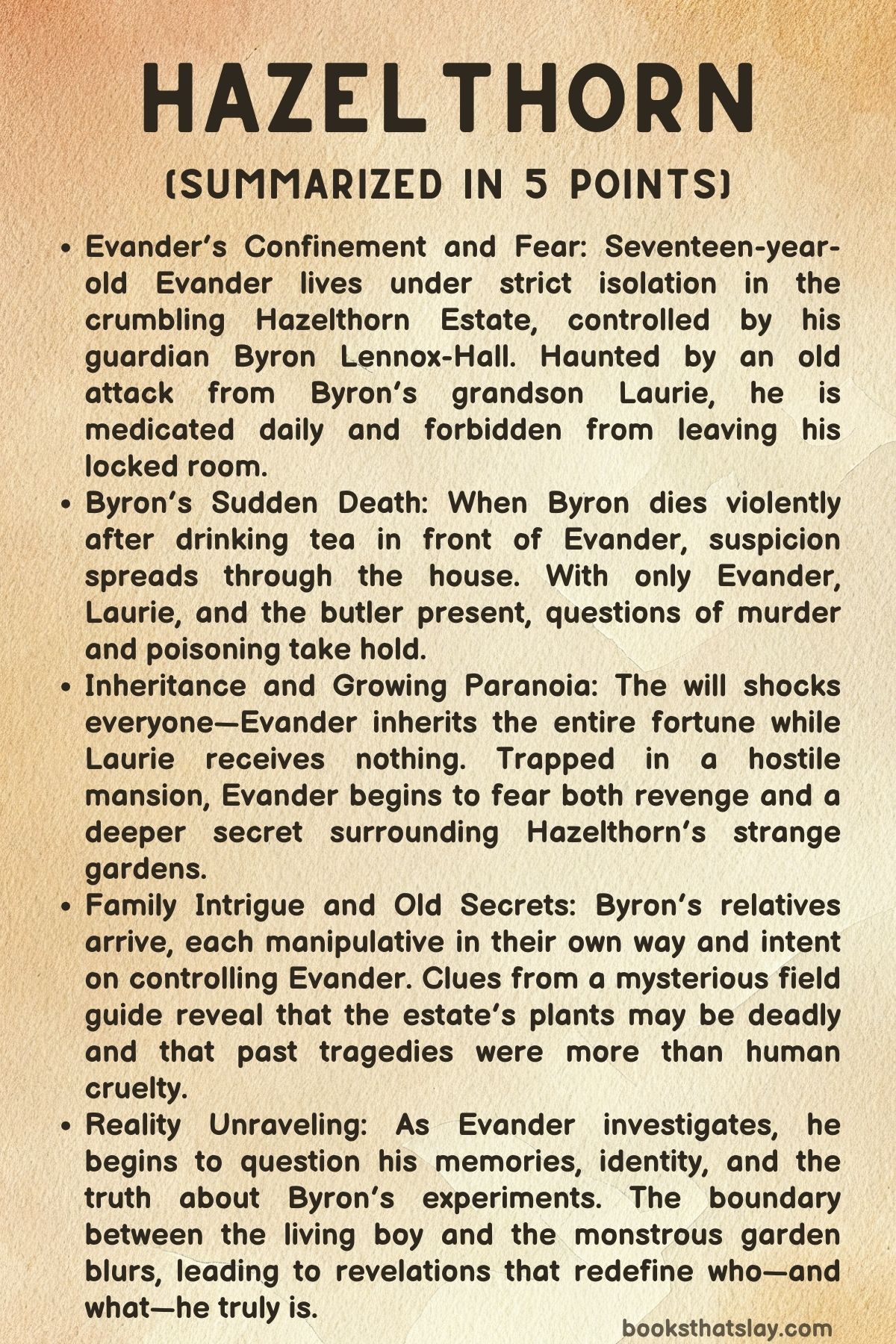
Summary
Evander lives a confined life in the locked north wing of the sprawling Hazelthorn Estate. Frail and heavily medicated, he is watched over by the butler, Carrington, and ruled by his guardian, Byron Lennox-Hall.
The mansion is a decaying labyrinth filled with strange noises, poisonous plants, and the memory of an “accident” seven years earlier when Byron’s grandson, Laurie, nearly killed Evander in the garden. One evening, his bedroom door unlocks without explanation, and Evander ventures out for the first time in years.
He finds Laurie back at the estate—charming, mocking, and claiming Hazelthorn as his own. When Evander rushes to the conservatory to find Byron, he witnesses his guardian convulsing and choking on something that seems to sprout leaves.
Byron dies before his eyes, warning Evander never to enter the gardens.
Evander is locked away by Carrington afterward, suspected of wrongdoing and left without food or medicine. Days later, Laurie returns, announcing Byron’s death as an aneurysm and that a will reading will take place.
To everyone’s shock, Byron leaves Hazelthorn and his fortune to Evander, not Laurie. The decision enrages Laurie, while Evander, frail and confused, becomes both wealthy and trapped.
He learns he will remain under the guardianship of Byron’s sister, Oleander Lennox-Hall, until he comes of age. Overwhelmed, he flees into the forbidden gardens, where the air seems alive and dangerous.
Among the tangled plants, he finds a mysterious “Hazelthorn Field Guide” filled with drawings of toxic species that mirror Byron’s death symptoms. The garden feels sentient, its silence full of threat and recognition.
Returning indoors, Evander becomes obsessed with solving Byron’s murder. He builds a board of suspects—Carrington, Laurie, and the young lawyer Dawes—each with motive and means.
Laurie alternates between cruelty and concern, mocking Evander’s obsession yet protecting him from others. When Oleander arrives with her assistant Jessica, she takes control of the estate and its heir, treating Evander as an experiment to be managed.
Her comment about refusing Hazelthorn’s tea betrays her awareness of the poisoning, contradicting Dawes’s official story. Evander adds her to his growing list of suspects.
As he revisits memories, Evander recalls the “accident” from childhood. Laurie had buried him alive to hide his injuries, whispering that Byron loved him more.
The trauma and violence of that day shaped their lives. Now, isolated together once more, their relationship oscillates between resentment and reluctant intimacy.
Evander continues to experience blackouts—“episodes” where he loses time and awakens covered in dirt or blood. When he and Laurie discover a dead tangle of vines under his bed, Evander recognizes it as a toxic plant called Devil’s Tongue.
He becomes convinced Carrington, or something wearing his face, is trying to kill him.
That night, Evander sees movement in the garden and believes Carrington has returned. Despite Laurie’s protests, he escapes outside.
There, he witnesses Oleander’s gardener, Bane, and Jessica digging under the red door—a locked section of the grounds. They unearth a corpse before Bane murders Jessica and buries her in the soil, claiming blood makes the best fertilizer.
Laurie drags Evander away just as the garden seems to pulse with life. Later, Carrington reappears, half-rotted and infested with plants.
In a frenzied attack, he nearly kills Laurie before Evander smashes his skull, spilling compost instead of blood. The garden seems to claim Carrington’s remains as Evander flees, terrified of what he’s becoming.
Inside, Evander pleads with Dawes for help, but the lawyer dismisses his fears and keeps him confined. Oleander’s twin, Azalea, soon arrives and calmly admits that the Lennox-Halls have long fed human sacrifices to the garden, which rewards them with blood-red gems.
She offers to adopt Evander or marry him to gain control of his fortune, explaining that their family’s power literally grows from death. Evander’s sense of identity crumbles when he realizes he cannot remember his surname and that his supposed parents never existed.
His past has been fabricated by Byron. He rips apart an old photograph and discovers it’s only a magazine cutout.
His body begins to betray him—white roots grow from his feet, and his skin reacts to the plants. When Oleander and Bane forcibly drug him, Evander loses consciousness, aware of hands restraining him as the garden stirs inside his veins.
Later, he and Laurie uncover Byron’s true will, revealing that the estate was meant for Laurie, not Evander. Byron’s handwritten notes expose the horrific truth: Evander was created from the garden itself, grown from Laurie’s childhood blood offering.
Byron kept him alive only to harvest parts of his body for Hazelthorn’s expansion. Byron’s final order had been for Laurie to kill Evander once he died.
Evander collapses, and when he wakes, the conservatory has erupted into wild growth. Following a trail of blood, he finds Laurie gravely injured, bearing thorn-like wounds that match Evander’s own.
When he examines himself, he discovers that his ribs are wooden branches filled with sap and vines. He is part plant, part human—the garden’s living creation.
Laurie confesses that he poisoned Byron accidentally and that he once prayed for Evander to exist, not realizing what he was summoning. Dawes then enters, revealing his plan to replicate Hazelthorn’s power for profit.
Oleander, Azalea, and Bane join him, restraining Evander and cutting off his hand to use his “roots” for planting. The garden surges in fury.
Poisoned wine later becomes Evander’s weapon. Weak but cunning, he adds the deadly plant Heart Rot to the bottles served at Byron’s funeral dinner.
As the Lennox-Halls toast their legacy, they begin to choke and die, their veins blackening with sap. Evander flees into the night, determined to end the curse.
At the red garden, he digs through blood-soaked soil until he finds Laurie buried alive. Pulling him free, he begs the garden to spare him.
For the first time, it obeys—healing Laurie instead of devouring him.
Hazelthorn’s vengeance ignites. Trees burst through the estate’s walls, swallowing Dawes and the surviving family.
Evander, now one with the land, almost kills Dawes himself before Laurie’s voice brings him back. The garden consumes Dawes, and the house falls silent at dawn.
Amid the wreckage, Laurie and Evander lie together in the poisoned garden, both changed forever. Laurie throws away the key meant to imprison Evander, vowing to stay with him in Hazelthorn’s ruins.
As they hold each other, the garden hums beneath them—alive, hungry, and still growing.
Characters
Evander
Evander, the central figure of Hazelthorn, is both victim and vessel—a character whose existence is entangled with the sinister consciousness of the Hazelthorn estate. At seventeen, he appears frail, withdrawn, and perpetually medicated, confined to a locked bedroom that mirrors his psychological imprisonment.
His early life is marked by trauma, isolation, and manipulation by his guardian Byron Lennox-Hall, who molds him into a dependent, fearful child under the guise of protection. Yet beneath Evander’s fragility lies a strange vitality connected to the garden’s dark power.
His transformation from a timid, controlled boy into a being of both horror and agency forms the novel’s central arc. The revelation that he is not fully human, but a creation of the garden itself—grown from blood, bone, and plant—recasts his suffering as both tragic and mythic.
Evander’s evolution blurs the boundary between human and monster; he becomes the embodiment of Hazelthorn’s corruption and revenge, wielding the same power that once victimized him. His ultimate act of poisoning the family represents both liberation and damnation, as he embraces the monstrous inheritance that Byron cultivated within him.
In the end, Evander’s love for Laurie tempers his rage, suggesting a faint hope that even something born from horror can choose tenderness.
Laurence (“Laurie”) Lennox-Hall
Laurie stands as the mirror and foil to Evander—once his abuser, later his only companion, and finally his anchor to humanity. As Byron’s grandson, he is a product of privilege and cruelty, raised in a family that normalizes manipulation and secrecy.
His childhood violence toward Evander stems from this inherited corruption, yet as the story unfolds, he reveals layers of guilt and longing for redemption. Laurie’s mixture of arrogance, charm, and vulnerability gives him a dangerous allure.
He oscillates between protector and aggressor, driven by jealousy, trauma, and an enduring, twisted affection for Evander. His confession that he once “asked the garden” to create Evander out of his blood cements their bond as one of creator and creation, love and guilt intertwined.
By the novel’s end, Laurie’s survival and refusal to abandon Hazelthorn embody his transformation; he chooses compassion over the family’s legacy of control. His final act—staying with Evander despite the danger—turns him from a symbol of inherited sin into one of human defiance and loyalty.
Byron Lennox-Hall
Byron Lennox-Hall, the patriarch of Hazelthorn, embodies aristocratic decay and moral rot. Outwardly dignified, disciplined, and concerned for Evander’s health, Byron’s authority masks a profound cruelty.
He isolates Evander under the pretense of medical necessity, dosing him with poisons and cutting into his body for years, all while speaking of “care.” His obsession with maintaining control over Hazelthorn and its secrets defines his every act. Byron views both Laurie and Evander as tools—Laurie as the heir conditioned into obedience, Evander as the vessel for the estate’s dark fertility.
The revelation that he literally harvested Evander’s ribs to propagate the cursed garden completes his transformation into a Gothic god-figure: a man who believes himself master of life and death, only to be consumed by the very power he tried to harness. Byron’s death by poisoned tea symbolizes poetic justice—the corruption he sowed taking root within his own body.
Even in death, his influence lingers, shaping the estate’s horrors and the psychological scars of those he ruled.
Oleander Lennox-Hall
Oleander, Byron’s sister, represents the poisonous refinement of the Lennox-Hall bloodline. She is elegant, theatrical, and deeply manipulative, wielding charm and cruelty in equal measure.
Her arrival at Hazelthorn marks a new phase of domination, as she treats Evander not as a person but as an asset to be controlled. Her knowledge of the poisoning and of the garden’s true nature reveals her complicity in the family’s long tradition of exploitation.
Oleander thrives on hierarchy and spectacle—her heavy drinking, opulent mannerisms, and calculated humiliations of Laurie underscore her delight in asserting power. Yet beneath her composure lies rot; she is another flower of Hazelthorn, beautiful but deadly.
Her death during Evander’s final act of vengeance feels less like a murder than the inevitable withering of a poisonous bloom that has outlived its soil.
Carrington
Carrington, the butler, is the face of servitude twisted by loyalty and fear. To Evander, he is both caretaker and jailer—the man who administers medicine, locks doors, and enforces Byron’s rules.
His quiet obedience conceals his participation in the estate’s horrors, whether by ignorance or complicity. When Carrington reappears later as a grotesque, plant-infested creature, he becomes the most visceral symbol of Hazelthorn’s corruption: a man literally consumed by the system he served.
His transformation into a monstrous revenant reflects the fate awaiting anyone who feeds the estate’s hunger too long. Carrington’s tragedy lies in his faith; he is destroyed by the very order he spent his life preserving.
Benedict Dawes
Benedict Dawes, Byron’s young attorney, is the story’s cold pragmatist—a man who cloaks greed and ambition in civility. His polished demeanor and legal precision disguise his deep moral emptiness.
Dawes is neither haunted nor delusional like the Lennox-Halls; he is opportunistic, seeking to exploit the supernatural power of Hazelthorn for personal gain. His blackmail of Byron and his eventual mutilation of Evander expose him as the true modern villain of the Gothic world—rational, bureaucratic, and profit-driven.
Dawes’s demise at the hands of the garden serves as the ultimate rejection of his sterile greed by the wild, uncontrollable nature he sought to domesticate.
Azalea Lennox-Hall
Azalea, another of Byron’s sisters, presents herself as calm and pragmatic but conceals a chilling amorality. Her composure and intelligence distinguish her from Oleander’s flamboyance, yet her motives are equally self-serving.
She views Hazelthorn as an inheritance to be controlled, not a curse to be escaped. Her proposal to marry or adopt Evander purely for financial access reveals her calculating nature.
Azalea embodies the quiet corruption of the upper class—her evil is not emotional but institutional. She is a matriarch of convenience, willing to rationalize horror as “tradition.” Her death is part of the estate’s necessary purging, a rebalancing of the unnatural order she upheld.
Bane
Bane functions as Oleander’s brutal enforcer—a man of muscle and menace who hides sadism behind professionalism. His loyalty to the Lennox-Halls is transactional, rooted in power rather than belief.
Bane’s murder of Jessica and his participation in Evander’s torture demonstrate his complete moral decay. Yet like the others, he is ultimately swallowed by the world he helps sustain.
His death during the garden’s uprising feels inevitable, the destruction of a weed that thrived on others’ suffering. Bane represents the estate’s physical violence, the hands through which aristocratic cruelty becomes real.
Jessica
Jessica, Oleander’s assistant, is one of the few outsiders to Hazelthorn and thus one of the few innocent figures in the novel. Her nervous energy and obedience mark her as prey among predators.
Her gruesome murder by Bane exposes the casual inhumanity of the Lennox-Hall world, where life is merely fertilizer for wealth. Jessica’s death also reawakens Evander’s moral consciousness—her innocence contrasts sharply with the family’s depravity, deepening his resolve to end the cycle of exploitation
Themes
Isolation and Control
Hazelthorn Estate becomes a physical manifestation of Evander’s isolation, enclosing him within decaying walls and carefully regimented routines that suppress his autonomy. His confinement to a single room for years under the pretense of illness illustrates a life stripped of agency, where medicine becomes a tool of subjugation rather than care.
Byron’s authority over Evander extends beyond the physical; it shapes his perception of himself and the world, convincing him that weakness defines him and that the outside is dangerous. This prolonged isolation erodes Evander’s sense of identity, leaving him susceptible to manipulation and psychological disarray.
Every locked door, every withheld truth reinforces that he is a possession rather than a person. When he finally escapes his confinement, the estate itself mirrors his mental state—sprawling, chaotic, and suffused with rot.
His tentative movements through Hazelthorn’s corridors reveal how isolation distorts one’s grasp of freedom; the openness of the mansion terrifies as much as it liberates. Even the other characters—Laurie, Carrington, Oleander—operate under systems of control, whether familial, social, or supernatural.
The Lennox-Hall family maintains dominion not only through wealth but through secrets that bind and mutilate generations. Control is exerted as both punishment and preservation, creating a cycle where isolation becomes hereditary.
Evander’s eventual rebellion—venturing into the forbidden gardens—marks the beginning of his psychological awakening, but also demonstrates that liberation cannot be achieved without confronting the mechanisms that have defined his existence. In this sense, isolation in Hazelthorn is not mere solitude; it is an imposed state designed to stunt growth and perpetuate dependency, making control appear as protection until the truth rots its way to the surface.
Corruption and Inheritance
The theme of corruption in Hazelthorn extends beyond the moral failings of individuals into the very soil of the estate. The Lennox-Hall family’s wealth and prestige are literally fed by death—blood nourishing plants that yield rubies—and figuratively by generations of deceit.
Inheritance is portrayed as a curse, a genetic and moral contamination that passes down cruelty, greed, and obsession under the guise of duty. Byron, Oleander, and Azalea each uphold the illusion of noble lineage, masking monstrous acts as traditions worth preserving.
The family’s use of the garden as a means of maintaining wealth embodies how privilege thrives on exploitation, where even nature is violated and turned into a machine of profit. Evander’s false inheritance, initially presented as a gift, reveals itself as an act of manipulation—he inherits not fortune but monstrosity, a body cultivated as part of Hazelthorn’s legacy.
The estate itself becomes the ultimate heir, a sentient entity consuming those who try to own it. Laurie’s conflicted relationship with inheritance—both desiring and despising it—reflects how corruption erases genuine human connection.
By the end, the act of inheriting Hazelthorn transforms into a moral reckoning rather than a privilege. Evander’s acceptance of his connection to the garden signifies a reclamation of what inheritance could mean when divorced from greed: nurturing rather than consuming.
Yet, the final image of the estate in ruin, overrun by vines, reinforces that some legacies cannot be purified. In Hazelthorn, inheritance is not the passing down of possessions but of guilt, with each generation sinking deeper into the decay their ancestors planted.
Identity and Transformation
Identity in Hazelthorn is an unstable construct, grown, pruned, and replaced like the plants that fill the estate. Evander’s entire sense of self is built upon lies—his name, his origins, his supposed illness—all engineered to conceal the truth of his creation.
His journey is one of horrifying self-recognition, discovering that he is not merely shaped by Hazelthorn but born from it. The realization that his body contains roots and sap instead of flesh forces a confrontation with what it means to be human.
His transformation challenges the boundaries between self and environment, suggesting that identity is neither fixed nor purely biological. The garden’s influence over him blurs the line between nurture and control: it sustains him but also consumes him.
His oscillation between human consciousness and plant instinct mirrors psychological fragmentation, a literalization of trauma where identity splinters under systemic abuse. Laurie’s presence complicates this further; he becomes both mirror and maker, the one whose blood gave rise to Evander.
Their bond fuses guilt, longing, and self-recognition, making identity a shared construct rather than an individual truth. Transformation in the novel is not redemptive but cyclical.
As Evander becomes Hazelthorn, he inherits both its power and its curse, embodying the very violence he once feared. His decision to use poison to destroy the family demonstrates that transformation cannot occur without destruction.
The merging of man and garden by the end signifies that identity in Hazelthorn is fluid and ever-changing, a process of continuous becoming shaped by memory, desire, and decay.
Nature as Power and Revenge
Nature in Hazelthorn is neither passive nor benevolent. The garden that surrounds the estate is a living consciousness, both creation and avenger.
It grows in proportion to the corruption it feeds upon, transforming human cruelty into botanical monstrosity. The Lennox-Halls treat nature as a tool—harvesting its poisons, bending its growth to their will, and feeding it human sacrifice—but in doing so, they awaken its hunger.
The power dynamic between human and nature reverses as the garden evolves from a submissive servant into a vengeful force. Its sentience manifests through Evander, the embodiment of the estate’s buried rage, making nature’s retaliation inseparable from personal awakening.
The red garden, the poisonous flora, and the creeping vines symbolize nature’s resistance against exploitation, reclaiming what was stolen through rot and regrowth. Byron’s death, Oleander’s manipulation, and the final destruction of the mansion are all acts of natural justice.
Yet the novel refuses to romanticize this revenge. Nature’s power is raw and terrifying, mirroring humanity’s violence rather than transcending it.
When Evander releases the poison during the funeral dinner, he becomes both gardener and executioner, fulfilling nature’s wrath while blurring moral lines. The conclusion, with Hazelthorn and Laurie surviving amidst ruin, suggests coexistence rather than conquest—a fragile truce between destruction and regeneration.
In Hazelthorn, nature is not a backdrop but a sentient moral force that reclaims dominion over those who abused it, proving that every root remembers the blood that once fed it.
Love, Violence, and Dependency
The relationship between Evander and Laurie defines the novel’s emotional and ethical tension, oscillating between tenderness and brutality. Their shared past of abuse and guilt binds them in a dynamic that is both destructive and redemptive.
Love, in Hazelthorn, is inseparable from violence; it is born from trauma and sustained through dependence. Laurie’s attempt to bury Evander as a child and Evander’s later near-murder of Laurie illustrate how affection and harm coexist within cycles of survival.
The two are drawn to each other not in spite of pain but because it is the only language they share. The estate enforces this dependency—every character’s identity is intertwined with another’s suffering, reflecting how trauma fosters attachment even as it corrodes trust.
Yet beneath the brutality lies an insistence on recognition: Laurie sees Evander not as a monster but as a person, and Evander’s final acceptance of Laurie’s presence allows a moment of fragile humanity amid horror. Their intimacy by the novel’s end defies the control and secrecy that destroyed the Lennox-Halls, transforming dependency into mutual choice.
The violence that once defined them becomes, paradoxically, a means of reclaiming agency. In this context, love is not salvation but endurance—the capacity to remain connected in a world built on cruelty.
The closing image of the two lying together within the ruined garden encapsulates this uneasy harmony, where affection and destruction coexist. In Hazelthorn, love survives not because it is pure but because it adapts, taking root even in poisoned soil.