Heartless by Elsie Silver Summary, Characters and Themes
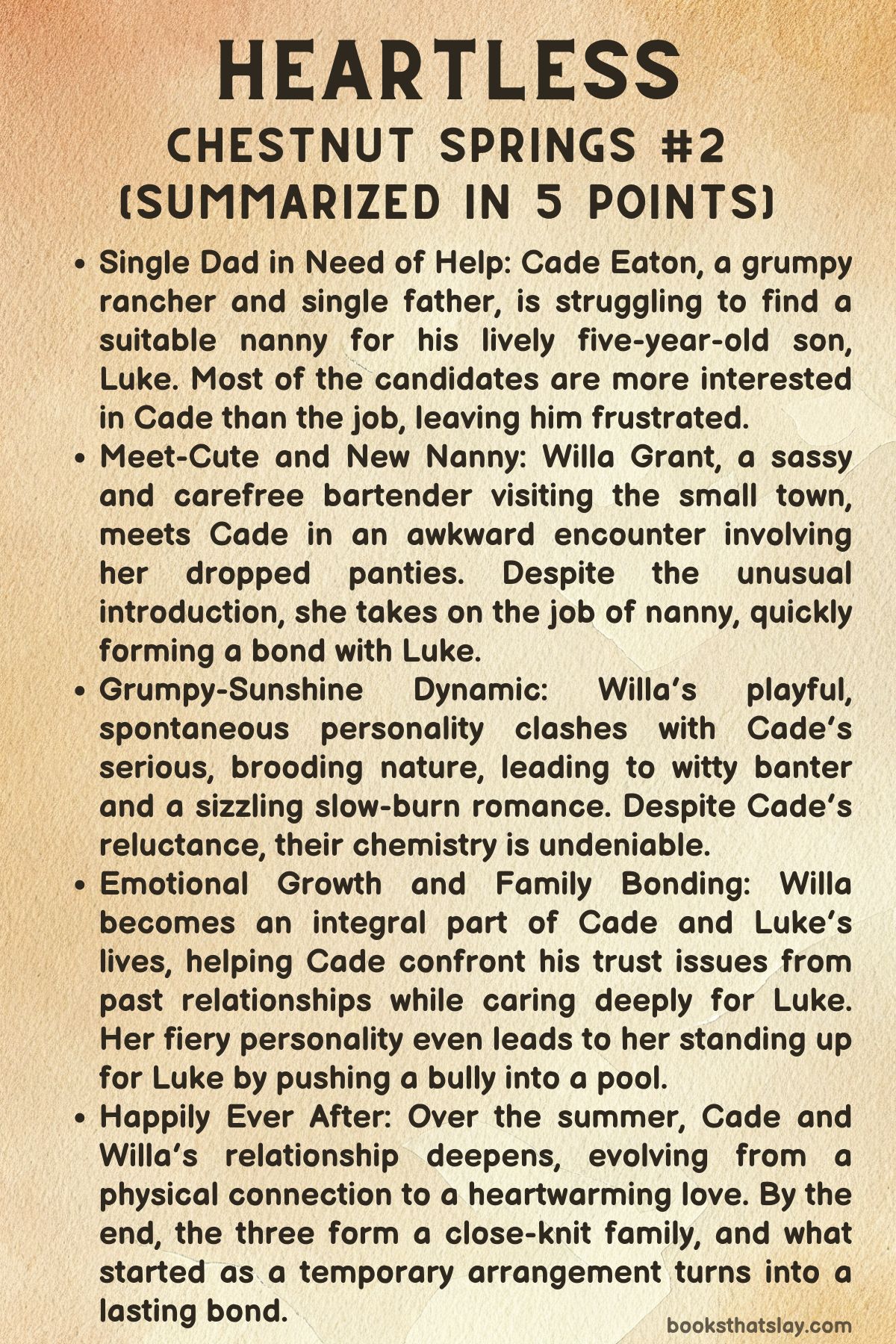
Heartless by Elsie Silver is the second installment in the Chestnut Springs series. The story follows Cade Eaton, a stoic single father determined to protect his young son, and Willa, a spirited woman searching for direction in her life.
When Willa unexpectedly becomes Cade’s nanny, their clashing personalities create sparks—both in arguments and in attraction. Amid chaos, humor, and heartfelt family ties, they slowly discover that love can grow where it’s least expected. With themes of vulnerability, healing, and belonging, the book offers both tenderness and passion wrapped in a deeply emotional journey.
Summary
Cade Eaton, a rancher and devoted single father, struggles to find a reliable nanny for his five-year-old son, Luke. Protective of his child and wary after being abandoned by Luke’s mother, Cade distrusts potential candidates, many of whom seem more interested in him than in caring for Luke.
His family—especially Summer, his brother’s fiancée—pressures him to give Willa, Summer’s best friend, a chance. Cade reluctantly agrees after seeing Luke’s immediate fondness for her, despite his own misgivings about Willa’s carefree and impulsive personality.
Willa, twenty-five and directionless after her horse’s injury derailed her competition plans, takes the nanny role for the summer. She and Cade have already shared an awkward encounter at a coffee shop, where she embarrassed herself in front of him, and their reunion is filled with sarcasm and banter.
Cade is skeptical, but when he sees how Willa treats Luke with humor, respect, and warmth, he concedes that she might be a positive influence. Their clashing styles—Cade’s strict order versus Willa’s playful spontaneity—create frequent tension but also highlight the strengths each brings to Luke’s life.
As Willa bonds with Luke, she proves her resourcefulness and patience. She introduces him to creative adventures like pancake breakfasts, spontaneous singing, and quirky mischief.
Luke thrives under her care, and Cade begins to see her value, though his attraction to her unsettles him. Willa challenges Cade’s rigid rules while also backing him up when it matters, earning his respect little by little.
Their constant teasing grows charged, and Cade struggles to suppress his feelings.
One evening in the hot tub, Cade discovers Willa’s lack of professional childcare experience—she’s actually a bartender, not a trained nanny. Initially furious, Cade is disarmed by her honesty and charm.
He learns about her unconventional upbringing with a sex therapist mother and a rock star father, which adds to her free-spirited outlook. Their conversations reveal surprising depth beneath Willa’s carefree exterior, making Cade even more conflicted.
At a family dinner, Willa impresses Cade when she turns a chaotic situation with Luke into a lesson about empathy and growth. Slowly, Cade begins to trust her.
At the local bar, Willa charms Cade’s friends and family, which only heightens his possessiveness when others show interest in her. Though Cade tries to maintain distance, his jealousy reveals how deeply he’s drawn to her.
Their attraction intensifies during a heated dance, and later, during playful games of truth or dare, their boundaries blur further.
Cade eventually returns to rodeo competition at Willa’s encouragement. Watching him perform fills her with admiration, while Cade battles jealousy when she accepts an invitation from his friend Lance.
Their frustrations erupt into an argument that turns into a passionate encounter, marking a turning point in their relationship. The physical intimacy between them quickly evolves into something deeper, as they begin to trust and open up to each other.
Cade admits his fears of inadequacy, while Willa reassures him that she wants him for who he truly is.
Their relationship, however, is tested by Cade’s insecurities and the realities of their roles. Willa’s discovery of her pregnancy after Cade injures his hand further complicates matters.
Afraid that Cade will feel trapped again as he once did, she distances herself. Cade, devastated, leans on advice from his father and brothers, realizing that his happiness matters too.
The separation weighs heavily on Luke, who longs for Willa’s return. Eventually, Willa comes back, and Cade shows her the sidewalk hearts he and Luke decorated, symbolizing the family they wish to build with her.
Overcome by emotion, Willa confesses her love, and Cade promises she is never an obligation but someone he genuinely wants in his life.
Their reunion is tender and affirming. The family embraces the pregnancy as joyful news, and Cade recommits to both Willa and Luke.
Inspired by her faith in him, he competes in the Canadian Championship Rodeo, achieving a dream he had long set aside. Publicly, he and Willa share a kiss in the arena, cementing their bond.
Together, they face the future as a unified family.
In the epilogue, Willa is heavily pregnant, and Luke asks if he can call her “Mom,” signaling the completeness of their family. Soon after, Willa gives birth to their daughter, Emma Eaton, with Cade by her side, overwhelmed with love for both his children and Willa.
Reflecting on the unexpected path that brought them together, Willa realizes she has finally found the home and family she never knew she was missing.
Heartless is ultimately a story about breaking down walls built from fear and past betrayals. Through humor, vulnerability, and steadfast love, Cade and Willa learn to trust not just each other but also the possibility of a future where family and love are central.
Their journey from wary strangers to partners and parents underscores the power of second chances and the joy of embracing the unexpected.
Characters
Cade Eaton
Cade is introduced as a man defined by responsibility and restraint, a father whose life revolves around protecting his son, Luke. Having been abandoned by Luke’s mother, Cade carries deep scars that manifest in distrust and rigidity.
He comes across as gruff, domineering, and sometimes unyielding, but these traits stem less from arrogance and more from fear of being hurt again. Beneath his guarded exterior is a man desperate to succeed as a parent, terrified of failing Luke, and unwilling to let anyone new disturb their fragile peace.
His evolution throughout Heartless reveals a slow transformation—from a man trapped by duty and mistrust to one capable of vulnerability, laughter, and love. Cade’s protective instincts, his internal battle between desire and discipline, and his eventual surrender to Willa’s chaos highlight a complex journey of healing and second chances.
Willa Grant
Willa bursts into Cade’s rigid life like a force of nature—playful, outspoken, and unapologetically free-spirited. At twenty-five, she represents a sharp contrast to Cade’s controlled world, embodying spontaneity and warmth.
Though she initially appears carefree and reckless, deeper layers reveal her longing for belonging, her resilience despite setbacks, and her fierce loyalty to those she cares for. Willa has her own vulnerabilities: the uncertainty about her future, the fractured relationship with her family, and her fear of rejection.
Yet she balances humor with wisdom, teaching Luke about empathy and imagination while challenging Cade’s emotional walls. Her presence softens the household, bringing joy and mischief, but also igniting desire and transformation.
Willa becomes the anchor Cade didn’t realize he needed, proving that love is not about perfection but about showing up with honesty and heart.
Luke Eaton
Luke, Cade’s five-year-old son, is the heart of the story and the catalyst for change. He is exuberant, innocent, and deeply yearning for attention and affection.
His quick attachment to Willa underscores both his openness and the absence left by his mother. Through Luke, the novel captures moments of innocence—singing in the car, pancake breakfasts, playful pranks—that contrast beautifully with the adult conflicts around him.
Despite his age, Luke is emotionally perceptive, often voicing truths the adults avoid. His simple declarations—like wishing Willa would stay forever or admitting he misses her—carry profound weight, nudging Cade toward emotional honesty.
Luke is not just a child character but the embodiment of hope, bridging the gap between Willa and Cade and ultimately weaving them into a family.
Harvey Eaton
Harvey, Cade’s father, provides a grounding presence in the story. As the patriarch, he balances wisdom with a mischievous streak, often lightening tense moments with humor.
He sees through Cade’s defenses and gently pushes him toward happiness, serving as both an advisor and a mirror. His recognition of Cade’s feelings for Willa often comes before Cade himself admits them, and his acceptance of Willa into the family sets the tone for broader familial embrace.
Harvey represents the voice of experience, reminding Cade that life cannot be lived solely through sacrifice and fear. His support underscores the themes of family continuity, resilience, and the generational wisdom that guides the Eaton family.
Rhett and Beau Eaton
Cade’s brothers, Rhett and Beau, embody the vibrancy and complexity of the Eaton family dynamic. Rhett is warm, charming, and encouraging, often acting as the mediator who reassures Cade about Willa’s capabilities and pushes him to take chances.
Beau, more playful and provocative, tends to stir situations up with humor and teasing, often at Cade’s expense, but always with underlying affection. Together, they highlight Cade’s more serious nature by contrast, but they also reflect the closeness of the family.
Their interactions with Willa show how naturally she integrates into their world, winning approval through her authenticity. Rhett and Beau are essential in showcasing Cade’s growth by illustrating the freedom he has long denied himself.
Jasper Gentry
Jasper, a close family friend and almost-brother figure, is quieter and more introspective than the Eaton brothers. He carries his own share of shadows, hinted at through his gratitude to the Eatons for saving him during difficult times.
His bond with Cade is strong, and his candid advice often cuts through Cade’s stubbornness. Jasper’s presence adds depth to the narrative, reminding readers that Cade is not alone in his struggles and that friendship, too, can be a guiding force.
He also represents an undercurrent of unspoken stories and emotional wounds within the larger ranching community, enriching the sense of interconnected lives in Heartless.
Summer and Violet
Summer, Willa’s best friend and the fiancée of one of Cade’s brothers, serves as the bridge that brings Willa into Cade’s life. She is loyal, supportive, and fiercely protective, pushing both Willa and Cade toward facing truths they resist.
Violet, Cade’s sister, adds humor and familial grounding, often poking fun at her brothers while also voicing the family’s collective hopes for Cade’s happiness. Both women play supporting but pivotal roles, underscoring the strength of female friendship and the importance of community in navigating love and hardship.
Themes
Trust and Vulnerability
In Heartless, the theme of trust and vulnerability shapes both the emotional core of the novel and the characters’ gradual transformation. Cade’s life is defined by abandonment, first by Luke’s mother and then by his own sense of failure as a single parent.
His mistrust is not just directed outward but also inward, as he constantly doubts his ability to protect and provide for his son. This guardedness is evident in his interactions with Willa—he scrutinizes her every move, questions her background, and enforces rigid rules to maintain control.
Yet beneath his stern exterior lies a deep longing for connection, which only begins to surface as Willa demonstrates reliability, warmth, and respect toward Luke. For Willa, vulnerability takes a different shape.
Her carefree persona often masks her uncertainty about belonging and direction in life. Stepping into Cade’s structured household forces her to take responsibility, and in doing so, she exposes her own softer sides—her affection for Luke, her insecurities about her unconventional upbringing, and her willingness to fight for a place in their lives.
The push and pull between Cade’s fear of being hurt and Willa’s willingness to take emotional risks underscores how fragile trust can be, and how essential it is for true intimacy. Their journey proves that love is not born from perfection, but from the courage to expose wounds, accept imperfections, and place faith in another person despite past disappointments.
Family and Belonging
Family, both chosen and biological, emerges as one of the most compelling themes in Heartless. Cade and Luke begin the novel as a tightly bound but incomplete unit, scarred by the absence of Luke’s mother.
Cade’s approach to fatherhood is rooted in duty and control, yet he struggles to balance authority with affection. Luke’s longing for maternal warmth creates space for Willa, who steps into their world almost accidentally but gradually becomes indispensable.
Through her interactions with Luke—singing with him, teaching him playful lessons, and offering unconditional support—she becomes a maternal figure not through obligation but through love freely given. Beyond the immediate household, the Eaton family serves as a reminder of the strength and chaos of extended kinship.
Siblings, cousins, and Cade’s father all influence the dynamic, often meddling but ultimately reinforcing the idea that family is not just about blood ties but about commitment and care. Willa herself, with her unconventional background as the daughter of a rock star and a sex therapist, initially lacks the stability of such a unit.
By embracing Cade and Luke, she discovers a sense of belonging she didn’t know she craved. The culmination of this theme is not just in Cade and Willa’s romance, but in Luke asking to call Willa “Mom,” and the eventual birth of Emma—moments that solidify family as something actively built through loyalty, affection, and shared responsibility.
Healing and Second Chances
The narrative thrives on the idea that brokenness does not define a person’s future but can instead set the stage for healing and renewal. Cade begins the story embittered by betrayal and convinced that romantic entanglements only lead to pain.
His life revolves around protecting Luke, even at the cost of denying his own happiness. Willa represents not only a new romantic possibility but also a challenge to his belief that love is synonymous with loss.
Through her, Cade finds the courage to reengage with parts of himself he abandoned, such as his passion for rodeo and his capacity for laughter and intimacy. Willa too embodies the spirit of second chances.
Stripped of her summer plans after her horse’s injury, she enters Cade’s home adrift and uncertain. Rather than being defined by failure, she allows the situation to redirect her path, uncovering strengths she didn’t know she had.
Her journey demonstrates that setbacks can lead to unexpected opportunities for growth. The pregnancy that initially terrifies her also reinforces the theme—what could be viewed as an accident or burden becomes a symbol of renewal and commitment.
In showing how Cade and Willa rebuild not just their own identities but also a family together, the novel asserts that life offers repeated chances for joy, provided one is willing to embrace change and risk vulnerability.
Love and Desire
Desire is portrayed as both a disruptive force and a transformative one. Cade fights against his attraction to Willa, convinced that giving in would jeopardize his stability and Luke’s well-being.
Yet his resistance only heightens the intensity of their interactions—their constant banter, moments of jealousy, and charged physical encounters reveal how impossible it is to suppress genuine passion. Willa, for her part, refuses to apologize for her boldness and playfulness.
Her teasing becomes both a provocation and a lifeline, drawing Cade out of his self-imposed isolation and forcing him to confront emotions he has buried. Love in the novel is not depicted as smooth or easy but as something messy, fraught with tension, and often born out of conflict.
The turning points in their relationship occur not during calm moments but during arguments, jealousy-fueled confrontations, and emotionally raw admissions. What begins as physical attraction evolves into something deeper, with love expressed through acts of care—Willa nurturing Luke, Cade apologizing sincerely, or both of them choosing each other despite fears of impermanence.
The story insists that love is not the absence of conflict but the decision to keep choosing one another through it, proving that desire, when anchored in respect and devotion, becomes a foundation rather than a threat.
Identity and Transformation
Throughout the novel, both Cade and Willa undergo profound transformations that reshape their sense of identity. Cade begins as a man defined by rigidity, suspicion, and an almost suffocating sense of responsibility.
His identity revolves entirely around being Luke’s protector, leaving little room for his own aspirations or desires. Through his relationship with Willa, he is challenged to redefine himself—not just as a father but as a man deserving of happiness.
His return to rodeo competitions becomes symbolic of reclaiming a part of himself that he had sacrificed to duty. Willa’s arc mirrors this in her own way.
She starts as a woman with no clear direction, seemingly frivolous and carefree, yet gradually proves her depth, resilience, and capacity for commitment. In learning to love Luke and Cade, she discovers her ability to nurture and to build a life rooted in stability rather than impulse.
Her pregnancy further solidifies this evolution, pushing her to embrace responsibility without losing her vibrant personality. Together, their transformations highlight the assertion that identity is not static but continually shaped by relationships, choices, and the willingness to evolve.
Their union is not simply about finding love but about becoming better, truer versions of themselves through it.