Heat of The Everflame Summary, Characters and Themes
Heat of the Everflame by Penn Cole is a sweeping tale of loyalty, betrayal, and destiny set in a fractured world where mortals and god-born descendents clash for survival. At its center is Diem Bellator, a young queen whose life is shattered when the truth about her mother and her bloodline is revealed.
Torn between her duty to her people, her love for those closest to her, and the manipulations of enemies on every side, Diem must navigate treachery, war, and the awakening of her own godhood. This is a story of sacrifice, unbreakable bonds, and the heavy cost of power. It is the 3rd Book in Penn Cole’s Kindred’s Curse Saga.
Summary
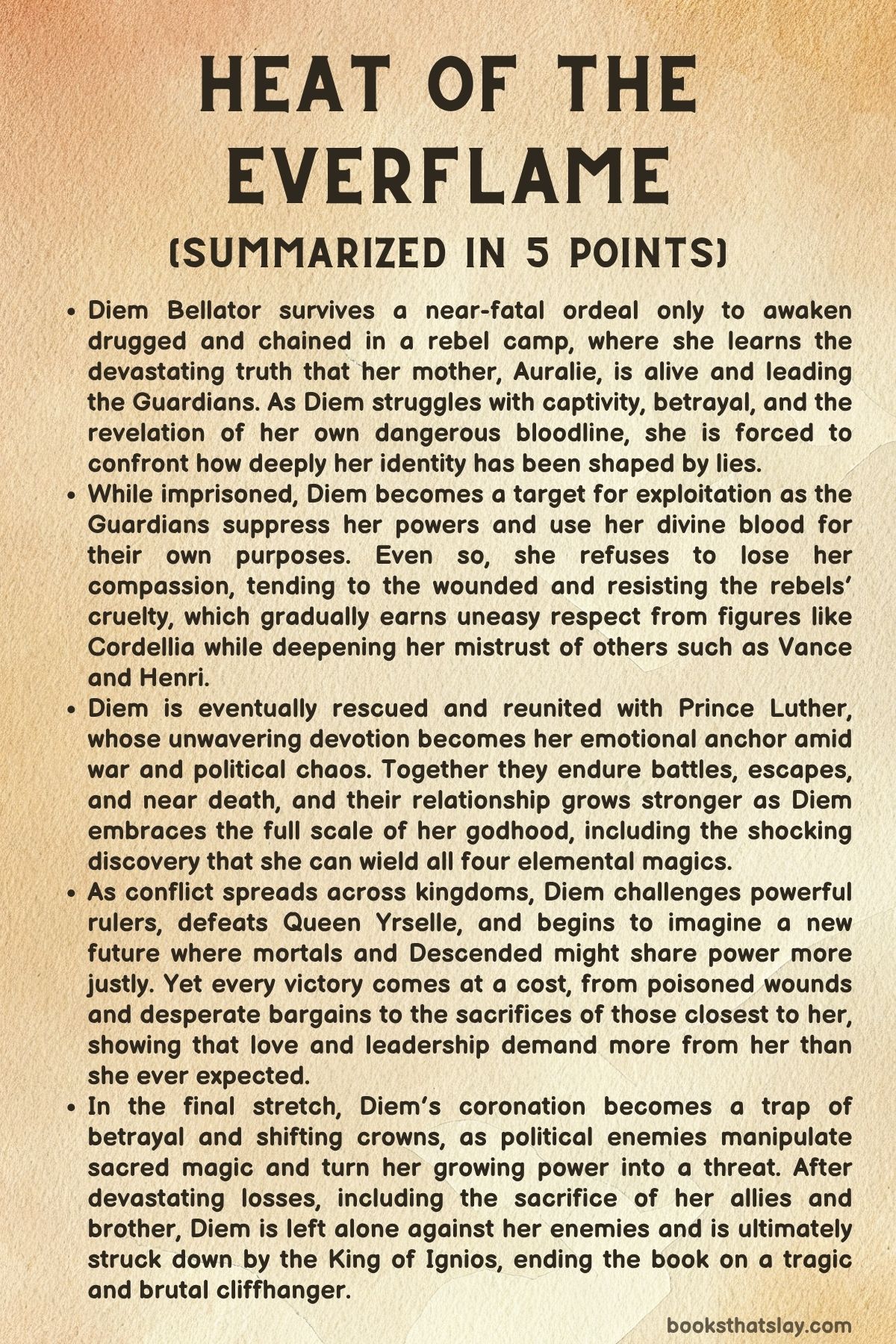
Diem Bellator awakens from near-death, believing she is drowning, only to realize she is being force-fed a drug called flameroot by mortals led by a woman named Cordellia. Weak and shackled, she recalls her coronation day when her blood shattered the heartstone, summoning her mother Auralie before an explosion destroyed the temple.
To her shock, Diem learns that Auralie is alive and leading a rebel faction called the Guardians. This revelation upends everything she believed about her mother.
Among the rebels, Diem confronts Vance, the leader of a Guardian cell, and their past grievances resurface. Cordellia maintains some control, but tension grows between the factions, with Diem caught in the middle.
She also discovers her mother is imprisoned in Fortos and faces execution. Determined to help, Diem offers her cooperation, but the rebels’ suspicion remains.
The camp reveals unexpected secrets, including the imprisonment of the Queen of Arboros. Diem, horrified at their methods, resists their cruelty, revealing flashes of her Descended power.
This frightens the mortals, and she is brutally subdued. Awakening again in chains, she encounters Brecke, a Guardian and former ally, who delivers another devastating truth: Henri, her betrothed, has chosen the rebels over her.
Brecke recounts how Auralie had orchestrated the temple attack, but it was Diem’s blood that cracked the heartstone. Diem conceals this truth, knowing the danger if it were revealed.
The Guardians suppress her powers with flameroot, but Diem secretly disposes of her meals, waiting for her strength to return. Her reprieve ends when Vance forces her blood to be harvested, hoping to use it to unlock sealed passages in the palace.
Just as her restraint begins to snap, gryvern wings thunder above. In the ensuing chaos, her gryvern Sorae and Prince Luther arrive to rescue her.
Battle erupts as the Guardians unleash ballistae with deadly godstone bolts. Diem narrowly avoids capture, destroys one of the bolts with magic, and orders Sorae to protect Luther even at the cost of leaving her behind.
Recaptured, she faces Cordellia’s anger and mistrust. Despite her captivity, Diem shows compassion, advising the rebels on healing the wounded and revealing her conflicted stance—recognizing mortals’ suffering but refusing to condone violence.
Cordellia begins to see her differently. Eventually, with Brecke’s help and Cordellia’s reluctant aid, Diem stages an escape.
Yet, her attempt fails when supernatural forces thwart her journey by sea. Forced back ashore, she disguises herself and sneaks into the rebel camp, overhearing their preparations for war.
There, she discovers Luther has surrendered himself in hopes of rescuing her.
Reunited with him, as well as allies Taran and Alixe, Diem launches a daring escape. Bombs are detonated, chaos spreads, and she and Luther reaffirm their bond with a stolen kiss amid battle.
Yet the escape is stained by blood when she is forced to kill to protect him, leaving her shaken. Together, they flee into the forest, exhausted but determined to stay united against mounting enemies.
Their struggles intensify when Diem confronts Queen Yrselle of Umbros, who demands her submission. Diem refuses, unleashing her godhood fully and declaring independence.
With Sorae’s aid, she and her allies flee into the skies. During a relentless chase, Diem discovers her ability to wield all four elemental magics, defying known limits.
With Luther’s support, she embraces this power and defeats Yrselle. Still, the battle leaves scars, with Luther gravely injured by poisoned wounds.
Back in Lumnos, healers find no cure. In despair, Diem pleads with the goddess Lumnos for mercy, even offering her soul.
Miraculously, a hidden vial from the Queen of Arboros contains the antidote, saving Luther’s life. Their relief binds them further, but the ordeal leaves Diem aware of her growing power and the steep price it demands.
As Sophos recovers from attacks, Luther gifts Diem a night alone in the legendary library, where every book ever written resides. This intimate night deepens their love, as they vow equality in private, beyond their titles.
Their bond becomes unbreakable as Diem discovers a mystical bronze door tied to the Everflame, hinting at her greater destiny.
When the time comes for her coronation on Coeurîle, Diem faces political betrayal. She secures partial support for peace, but her enemies strike back.
Yrselle arrives, only to be murdered by Ignios, which transfers Umbros’s Crown to Diem, making her dangerously powerful in the eyes of the other rulers. Doriel then twists a sacred spell, binding Diem to Coeurîle and capturing her brother Teller as leverage.
As her allies rush to save her, tragedy unfolds. Teller and Perthe sacrifice themselves so Luther can escape.
Alone, weakened, and betrayed, Diem faces her enemies. In a brutal climax, the Ignios King strikes her down with a godstone blade.
Collapsing, her final thoughts are filled with warmth, love, and the cruel irony of her fate.
Characters
Diem Bellator
Diem Bellator is the central figure of Heat of the Everflame, portrayed as both vulnerable and unyielding in the face of betrayal and captivity. She begins the story in a haze of drugged weakness, yet her resilience quickly emerges as she resists her captors and clings to her loyalty to her mother, Auralie.
Her character is defined by constant conflict: torn between the revelations of her mother’s rebel leadership, her fractured trust in former allies, and her own divine bloodline that makes her both a prize and a danger. Diem’s compassion remains steady even when her strength falters—seen in her attempts to heal enemies and prevent unnecessary bloodshed.
Yet she is also marked by a growing awareness of her immense godhood, a power capable of wielding all four elements, which isolates her further even as it grants her unmatched potential. Through betrayals, loss, and love, Diem evolves into a determined leader who refuses to kneel to anyone, embodying defiance, compassion, and destiny intertwined.
Auralie
Auralie, Diem’s mother, is a shadowy but pivotal presence whose choices haunt every aspect of Diem’s journey. Revealed to be alive and the leader of the Guardians, Auralie’s dual identity as both mother and rebel commander shatters Diem’s understanding of her family and her world.
Though she once sought peace, her smuggling of bombs during the coronation shows the extremity of her methods. Auralie is not physically present for much of the narrative, but her influence permeates every choice Diem faces.
She is both an inspiration and a source of pain, embodying the dangerous allure of rebellion and the burden of maternal legacy. Her capture and threatened execution become the catalyst for Diem’s loyalty, while her secrets deepen the heroine’s isolation.
Ultimately, Auralie represents both love and betrayal, a mother who forced her daughter into an impossible destiny.
Cordellia
Cordellia emerges as a figure of measured strength among the Guardians, embodying restraint where others resort to reckless cruelty. She commands with calm authority and a pragmatic sense of morality, standing apart from Vance’s volatility.
Her respect for Diem’s compassion, even while keeping her chained and drugged, reflects her complexity: she is not free of suspicion but is willing to recognize honor in her enemy. Cordellia becomes a quiet ally in moments of dire need, subtly aiding Diem’s “escape” and revealing the fractures within the Guardians themselves.
She bridges the gap between enemy and friend, embodying the possibility of trust even amid war. While not free from the ruthlessness of rebellion, she represents the voice of reason and restraint within a faction often driven by vengeance.
Vance
Vance, once Diem’s ally, now embodies the bitter consequences of betrayal and manipulation. His interactions with Diem are filled with venom and accusation, reflecting both his resentment and his opportunism.
Vance is reckless, obsessed with exploiting Diem’s blood for power, and driven by his belief in the Guardians’ cause to the point of cruelty. His ambition and arrogance put him at odds with Cordellia, highlighting the divisions in leadership.
His injuries during the gryvern attack humble him physically but fail to temper his ruthlessness. Vance stands as the embodiment of corrupted loyalty, a man who twists past alliances into weapons of guilt.
His presence is a constant reminder of Diem’s fractured trust, and his hunger for control makes him a mirror of the very tyranny the Guardians claim to resist.
Brecke
Brecke, once a trusted bladesmith and confidant, provides Diem with fleeting comfort amidst betrayal. His character blends loyalty and deception, as he pretends to be harsh in order to maintain trust among the Guardians while secretly aiding Diem.
He represents the complexity of rebellion—caught between conviction and compassion. Brecke reveals the extent of Auralie’s plot during the coronation, forcing Diem to confront truths she would rather deny.
His support softens her isolation, though his complicity in the Guardians’ schemes leaves a lingering stain of distrust. He is a character who embodies both faith and betrayal, a man trying to balance the duties of a rebel with the loyalty of a friend.
Henri
Henri, Diem’s childhood love and betrothed, becomes a symbol of devastating betrayal. Though alive, he chooses allegiance to the Guardians over his bond with her, leaving Diem fractured and abandoned.
His absence looms heavily, as his decision embodies the crumbling of the trust that once sustained her. Henri’s betrayal cuts deeply, not only as a political act but as a personal wound that reshapes Diem’s understanding of love and loyalty.
His character underscores the central theme of trust corrupted by ambition, love undermined by duty, and the painful severing of bonds once thought unbreakable.
Luther
Prince Luther stands as Diem’s unwavering anchor amid chaos, embodying loyalty, devotion, and partnership. He risks everything to rescue her, braves battle without his magic, and offers her both emotional and physical sanctuary.
Their relationship evolves into an equal partnership, strengthened by vulnerability and shared sacrifice. Luther’s survival from a godstone wound—through Diem’s desperate gamble and his own resilience—cements their bond as one forged through fire and near-death.
He tempers Diem’s recklessness with his protective instincts, though he struggles with possessiveness and fear of losing her. Their intimacy, culminating in the library of Sophos, highlights a love rooted in both passion and deep mutual respect.
Luther symbolizes the life Diem longs for beyond politics and war, embodying both her fiercest ally and her greatest weakness.
Queen Yrselle
Queen Yrselle of Arboros embodies the ruthlessness of power. Initially imprisoned by the Guardians, she later emerges as an antagonist who seeks Diem’s submission.
Her demand for obedience, met with Diem’s fiery declaration of defiance, epitomizes the clash between old authority and new godhood. Yrselle wields manipulation as deftly as power, turning allies against one another and nearly breaking the unity of Diem’s companions.
Yet her eventual downfall at Diem’s hands underscores the shifting balance of power, as the younger generation overthrows the old order. Yrselle is both a formidable queen and a cautionary figure, showing the corrupting grip of authority and the inevitable consequences of underestimating Diem.
Taran, Alixe, and Zalaric
These three companions, though not as central, play vital roles in supporting Diem’s escape and survival. Taran’s boldness and destructive tendencies contrast with Diem’s hesitance to kill, forcing her to confront the costs of rebellion.
Alixe and Zalaric, manipulated under Yrselle’s sway, embody the fragility of loyalty when exposed to external control. Together, they represent the bonds of friendship and camaraderie, fragile yet vital, in the face of war.
Their survival alongside Diem and Luther reflects the strength of chosen family even as trust is tested again and again.
Doriel
Doriel is a manipulative force cloaked in diplomacy, one who entangles Diem in bargains that test her morality. Though initially promising to secure pardons, Doriel’s true nature is revealed in betrayal, binding Diem through twisted spells and leveraging her family against her.
Doriel represents political treachery at its sharpest—where words and bargains cut deeper than blades. She is cunning, calculating, and relentless, embodying the dangers of alliances forged out of desperation.
Her manipulation not only traps Diem but also highlights the vulnerability of even the strongest leaders when cornered by politics.
Ignios King
The King of Ignios stands as the embodiment of cruelty and ambition, mocking Diem, rejecting her pleas for peace, and ultimately betraying the balance of power with the murder of Yrselle. His final act of stabbing Diem with a godstone blade cements him as the harbinger of devastation.
He is the cruel hand of fate, delivering the blow that ends Diem’s struggle, at least for this part of the story. His character encapsulates the dangers of unchecked ambition, the ruthlessness of the old order, and the inevitability of betrayal at the highest levels of power.
Themes
Betrayal and Trust
The narrative of Heat of the Everflame is saturated with betrayal, both personal and political, which becomes a constant obstacle for Diem. Trust is eroded in every relationship she values—her bond with Vance, once an ally, is poisoned by resentment and manipulation, while her discovery that Henri, her childhood love, sided with the Guardians dismantles the stability of her past.
Even her mother Auralie, long idolized as a figure of wisdom and strength, emerges as a leader of rebellion whose actions cast doubt on the purity of her intentions. Betrayal in the story is never clean or simple; it cuts along lines of family, friendship, and loyalty, often leaving Diem questioning not just the people around her but the very foundations of her reality.
Each betrayal forces her into choices where she must weigh her personal heartbreak against her political role. In turn, the novel positions trust as something precious, rare, and dangerous—an act that could bind allies together or lead to destruction.
Luther becomes her most dependable anchor, not because his faith in her is unshakable, but because both of them willingly confront their flaws and secrets. By portraying betrayal as an ever-present force, the book emphasizes that trust, once broken, cannot be assumed; it must be rebuilt painstakingly, making every alliance in the story fragile yet invaluable.
Power and Exploitation
Power in Heat of the Everflame is less a gift than a burden, and its exploitation defines much of Diem’s journey. Her blood, both literal and symbolic, is treated as a resource by the Guardians, who drain it to unlock sealed passages and further their war.
She is shackled, drugged, and physically weakened, not because of her own failings but because her body is weaponized by those who see her as a means to an end. The tension between Descended power and mortal ingenuity blurs the boundaries of control, as even those without divine abilities find ways to manipulate or suppress her strength through flameroot or godstone.
Power in this world is also tied to heritage and identity, forcing Diem to confront the uncomfortable truth that her godhood, while extraordinary, marks her as both protector and target. Her ability to wield all four Kindred magics escalates the stakes, yet it also isolates her further, turning her into a figure of suspicion and awe.
Exploitation extends beyond the physical; it invades trust, emotions, and political alliances, showing how authority can be used coercively. The theme ultimately questions whether power can ever be separated from exploitation, or if strength inevitably invites control by others.
Identity and Legacy
Diem’s struggle with her own identity and the legacy she has inherited from Auralie forms a core theme of the novel. From the first revelation that her mother is not dead but a rebel leader, her entire understanding of her family, heritage, and destiny is overturned.
Identity becomes unstable, constantly shifting as secrets emerge: she is at once a daughter, a queen, a pawn, and a god. Her cracked heartstone and her unique capacity to wield multiple magics blur the distinction between mortal and divine, leaving her to question where she belongs in a world fractured by conflict.
Legacy amplifies this tension, as Diem must carry the weight of her mother’s decisions and the expectations of Crowns and mortals alike. Unlike Auralie, she dreams of a council where mortals and Descended share power, signaling her refusal to repeat the same mistakes.
Yet even in this vision, she cannot escape the inheritance of bloodlines and the political debts tied to them. Identity and legacy intertwine in her every choice, shaping her into a figure who must reconcile the ghosts of her family’s past with the uncertain shape of her own future.
This theme highlights the painful yet necessary act of redefining oneself outside of history’s shadow.
Love and Sacrifice
Love in Heat of the Everflame is portrayed not as simple affection but as sacrifice that demands everything. Diem’s bond with Luther crystallizes into a relationship that thrives on both vulnerability and risk.
Their love becomes a force of survival, driving her to defy destiny, barter her soul to the goddess Lumnos, and face impossible odds. The novel portrays love not as escapism from conflict but as a confrontation with it, where every declaration is tested by war, betrayal, and mortality.
Sacrifice emerges repeatedly—whether in Diem’s choice to give up her freedom for Luther’s safety, in Teller and Perthe laying down their lives for her, or in the gut-wrenching decision to kill a mortal to protect those she cherishes. These moments illustrate that love is inseparable from loss, that devotion often carries a cost greater than life itself.
By embedding sacrifice into every form of love—familial, romantic, and even platonic—the story underscores the fragility of human connection in a world poisoned by war. Yet it also affirms love as a defiance against despair, a reason to endure when betrayal and death seem overwhelming.
For Diem, love is the one truth that cannot be suppressed, even as it consumes her.
War, Rebellion, and Justice
The novel situates its conflicts within a backdrop of rebellion and fractured justice, making war not only inevitable but deeply personal. The Guardians’ cause is rooted in grievances against the Descended, exposing the unequal balance of power that has defined Emarion’s history.
Yet their methods—bombings, imprisonment, and exploitation—complicate the moral ground of their rebellion. Justice in this world is never clear-cut; it is a shifting concept wielded to justify bloodshed on both sides.
Diem’s perspective forces the reader to see the rebels not simply as villains but as desperate mortals fighting for survival and recognition, even if their methods veer into brutality. Similarly, the Crowns, guardians of order, are revealed to be corrupt, manipulative, and treacherous, with rulers like Ignios embodying tyranny.
War exposes how institutions designed to preserve peace become instruments of oppression, leaving Diem in the impossible position of choosing between loyalty to her bloodline and justice for mortals. Her vision of a council bridging Descended and mortal voices represents a radical reimagining of justice, one that seeks balance over dominance.
Through its exploration of war, the novel critiques the futility of violence as a path to peace, while recognizing the inevitability of rebellion when injustice festers unchecked.