Her Last Breath Summary, Characters and Themes
Her Last Breath by Taylor Adams is a fast, claustrophobic thriller about fear, survival, and the lies people tell when they think no one will live to expose them. Set largely inside a dangerous cave system in the Cascade Range, the story begins as a rescue attempt and slowly becomes something darker.
Tess DeWater appears to be a terrified survivor trapped underground after a violent attack, while Detective Layla Washington tries to understand how a caving trip turned deadly. But as Tess explains her ordeal, small gaps in her story begin to matter. The novel turns a fight for survival into a tense mystery about betrayal, evidence, and truth.
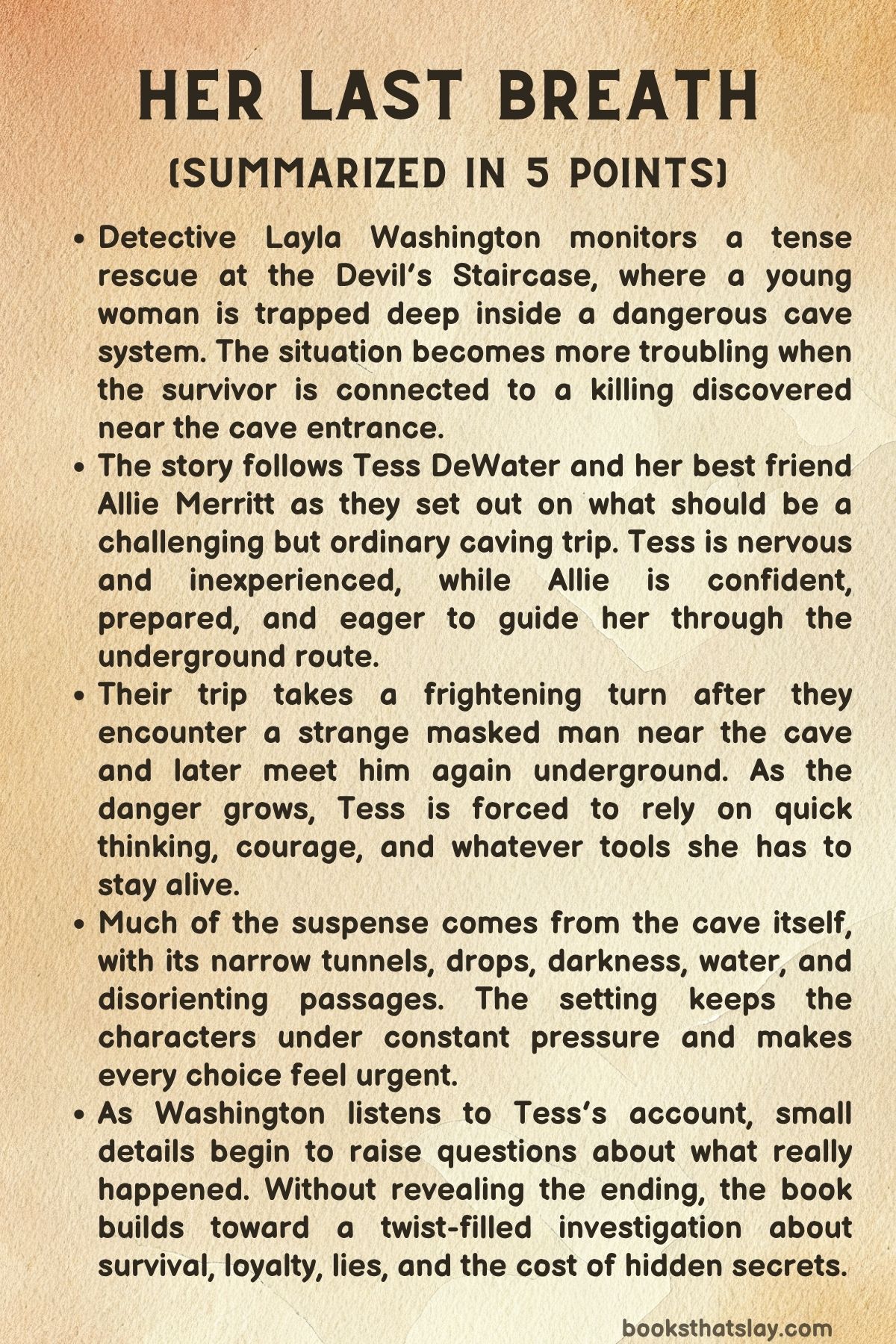
Summary
Detective Layla Washington is called to the Devil’s Staircase, a remote cave system in the Cascade Range, where a rescue operation is underway. A young woman is trapped deep underground after a collapse.
The rescuers can reach only her fingers through a narrow opening in the rocks, and her condition is serious. She has suffered head trauma, an injured ankle, cuts, bruises, and is drifting in and out of consciousness.
At first, the rescue seems like a desperate effort to save an accident victim. Then Washington learns that the woman underground may also be connected to a killing.
A body has been found outside the cave with a fatal gunshot wound. Washington needs the trapped woman alive, not only to save her life but also to learn what happened.
The woman is Tess DeWater. The day before, Tess had left her apartment feeling uneasy and joined her best friend, Allie Merritt, for a caving trip.
Allie was a confident travel blogger and experienced caver, while Tess was cautious, anxious, and new to the activity. On the drive, Allie tried to prepare her by telling frightening stories about caves, while also explaining that danger usually came from carelessness.
The Devil’s Staircase had a reputation, but Allie believed they would be safe if they followed the rules.
When they reached the area, Tess noticed another vehicle parked nearby. Before they entered the cave, Allie gave Tess the necessary equipment: helmet, headlamp, harness, and a GoPro camera.
Allie seemed distracted and upset about something involving her boyfriend, Ethan, but she delayed the conversation. Tess sensed that there was more to say, but the moment passed.
Near the cave entrance, they met a masked man who introduced himself as Jacob. He claimed to work for Green Ridge, a lumber company, and said he was checking the caves for bat disease.
His friendly manner quickly became unsettling. He paid too much attention to their gear, noticed Tess’s GoPro, called her “Babygirl,” and offered to guide them.
Allie refused. When he kept pushing, she firmly told him to leave them alone.
Tess worried that Allie had made him angry, but they went into the cave anyway.
Inside, Allie guided Tess through the upper passages and explained the strange world around them: the darkness, the echoes, the formations, the stale air, and the tricks the mind could play underground. Tess was frightened, but she began to gain confidence.
During a rappel down a drop called the Great Wall, her hair became caught in her descender. Instead of freezing, Tess used her Swiss Army knife to cut herself free.
The moment made her feel stronger and more capable.
Soon after, Allie noticed a faint red glow above them. She climbed back up to investigate but dismissed it as either another caver or a trick of vision.
They moved deeper into the cave and reached a tight crawl called the Drainpipe. Tess could not bring herself to enter it, and Allie did not force her.
Just then, as Allie began to confess something about Ethan, the red glow appeared again.
Jacob stepped out of the darkness. He admitted that he had lied about working for Green Ridge and demanded an apology from Allie.
He threw zip ties toward the women and ordered them to bind themselves. Allie tried to talk him down and even offered money, clearly trying to protect Tess.
Jacob shot Allie in the head.
Tess escaped by throwing herself into the Drainpipe. Jacob followed, armed with a knife, but Tess squeezed through a narrow gap caused by a cave-in.
Jacob could not fit. Tess realized that her GoPro had recorded Allie’s murder, and she told Jacob that the footage would send him to prison.
He backed away, then returned with a car jack and lifted the rock enough to crawl through. Tess pretended to be trapped, lured him close, and slashed at his face with Allie’s knife, damaging his mask.
From there, they faced each other in the tight passages, each trying to outthink and outlast the other.
Tess tricked Jacob by giving him a spare memory card while the real GoPro kept recording. Jacob removed his mask, exposing his face, and said he would kill her anyway.
Now Tess had recorded both the murder and his identity. She kept moving deeper, driven by the need to survive and protect the evidence for Allie.
As Tess tells this story, Washington studies the details. She suspects Jacob may not have acted alone.
His Jeep contains signs of planning, and a smaller bloody glove print suggests a second person was involved. Washington also learns that Allie had bought pregnancy tests and may have been pregnant.
That makes Ethan a possible suspect, especially because he knew where Allie and Tess were going.
Underground, Tess reaches dangerous areas called Razor Alley and the Chimney. Rather than descend the Chimney, she sets a rope trap for Jacob.
He runs into it, and during the struggle, Tess falls over the edge. The rope tangles around Jacob and tightens around his hand, crushing his fingers and knocking away his gun.
Tess is left hanging over a deadly drop, kept alive by the same rope that has trapped him above. Jacob cuts the rope, forcing Tess to cling to the slick wall.
Unable to hold on, she falls into the water below and survives.
Tess says she later found Jacob’s gun at the bottom of the Chimney. The magazine appeared empty, but she continued searching for a way out.
She remembered an old rescue story Allie had told her and realized there might be a second route through a flooded passage called Worse Than Death. Meanwhile, Jacob left the cave, went into town, and bought tools, heat-resistant tape, and long lengths of garden hose.
His plan was to remove the catalytic converter from his Jeep, attach hoses to the exhaust, and send carbon monoxide into the cave to kill Tess.
Tess then says she realized the gun still had one round in the chamber. She waited below.
Jacob tried to force her to surrender the GoPro by claiming he had stabbed Ethan and would torture him unless she threw up the camera. Tess pretended to obey.
When Jacob leaned over to catch it, she fired. The bullet hit his throat and killed him.
Washington notes the skill and luck of the shot, but Tess says Ethan died anyway.
As Tess continues, Washington begins to doubt her. Allie’s body has not been found, and key evidence does not fit Tess’s version.
Washington starts to understand the truth: the trapped woman is not Tess. The real survivor underground is Allie.
Tess has taken Allie’s place in the story.
The truth is far more calculated. Tess had arranged for Jacob, her secret boyfriend, to murder Allie.
She wanted Allie dead because Tess had been stealing money through Allie’s business and needed to hide her financial crimes. After Allie’s death, Tess planned to blame the fraud on her.
The “attack” was staged so Tess could appear to be an innocent survivor.
What really happened was that Allie escaped Jacob’s first attack with her GoPro still recording. She fought back, used the rope to break Jacob’s hand, survived the fall into the water, found the gun, and shot him in the throat.
Jacob managed to reach the surface, where Tess killed him by ripping the bandage from his wound. Tess then tried to start the Jeep and gas Allie inside the cave, but she discovered that Allie had removed and swallowed the memory card.
Tess went back underground to recover it or make sure Allie never came out.
Below, Allie prepared to fight Tess, but Jacob’s dying action changed everything. He started the Jeep, sending carbon monoxide into the cave.
Allie and Tess were forced to work together long enough to escape through the flooded passage of Worse Than Death. Tess kept control of the map and manipulated Allie’s choices.
Allie survived several underwater sections by instinct, but Tess eventually tricked her by holding the wet map backward. Allie took the wrong path into a dead end, became trapped underwater, and nearly died.
In her struggle to reach air, she dislocated her ankle.
Washington arrests Tess before she can escape. In interrogation, Washington lays out the truth: Tess planned Allie’s murder, killed Jacob, left Ethan for dead, and created a false survivor story to protect herself.
Tess refuses to confess because she believes everyone who could contradict her is dead. Then Washington reveals that Ethan survived.
Because of his medical knowledge, he had hidden his pulse, freed himself, and called for help using Jacob’s CB radio. Rescue teams have been trying to save Allie for twenty-four hours.
Tess finally asks for a lawyer.
In the end, Ethan wakes in the hospital after surgery. Washington visits him and shows him a message that confirms the outcome he has been hoping for: Allie has been saved.
Characters
Tess DeWater
Tess DeWater is the most deceptive and psychologically layered character in Her Last Breath. At first, she appears to be a terrified, inexperienced woman trapped in a cave after witnessing her best friend’s murder.
Her fear seems understandable because she is physically injured, underground, hunted, and desperate to survive. This early image makes her seem vulnerable, and her actions inside the cave initially suggest courage under pressure.
She cuts herself free when her hair gets caught, thinks quickly when Jacob corners her, protects the GoPro footage, and repeatedly uses the cave’s dangers against him. However, the deeper truth reveals that this version of Tess is carefully manufactured.
She is not simply a frightened survivor but the architect of the violence surrounding Allie, Jacob, and Ethan.
Tess’s defining trait is manipulation. She understands how to shape a story so others will believe her.
Her statement to Detective Layla Washington is not just a recounting of events; it is a performance. She casts herself as the victim, Allie as the murdered friend, Jacob as the lone predator, and Ethan as another casualty.
This false version works because Tess borrows pieces of the truth and rearranges them. The cave-in, Jacob’s attack, the GoPro, the gun, the fall, and the flooded passage all matter, but Tess changes who experienced them and why.
Her intelligence is therefore not heroic in a simple way. It is dangerous because she uses observation, timing, and emotional control to hide guilt.
Her relationship with Allie reveals Tess’s envy, resentment, and desperation. Allie is successful, adventurous, socially confident, and professionally visible, while Tess is anxious, controlled, and dependent on appearances.
Tess’s financial crimes through Allie’s business expose how long she has been living behind a false surface. She does not kill out of sudden panic; she plans because exposure would destroy her.
This makes her betrayal especially cruel. She does not merely harm a stranger or enemy.
She chooses her best friend as the person who must disappear so that Tess can preserve herself.
Tess is also morally chilling because she can imitate vulnerability so convincingly. Her injuries, fear, and underground ordeal are real, but she weaponizes them.
Even when she suffers, she continues calculating. She uses Jacob, kills him when he becomes a liability, leaves Ethan for dead, and tries to erase Allie completely.
Her survival instinct is intense, but it is detached from loyalty or conscience. By the end of the book, Tess stands as a character whose outward fragility hides ruthless self-preservation.
She is frightening not because she lacks fear, but because fear makes her more inventive, more persuasive, and more willing to destroy anyone who threatens her.
Allie Merritt
Allie Merritt is the emotional and moral center of the story. She begins as the confident best friend who introduces Tess to the cave, but she gradually emerges as the real survivor and the true heroic figure.
Allie’s experience as a travel blogger and caver gives her authority in the dangerous underground world. She understands the cave’s rules, its risks, and its strange psychological effects.
Her confidence is not arrogance; it comes from knowledge, preparation, and respect for danger. She reassures Tess, equips her properly, and tries to make the trip both safe and meaningful.
Allie’s warmth is important because it makes Tess’s betrayal more painful. She is patient when Tess is afraid of the Drainpipe, and she does not shame her for fear.
She also seems to carry private emotional weight, especially concerning Ethan, but she still prioritizes Tess’s comfort and safety. Her attempt to confess something before Jacob interrupts suggests that she is honest by nature, even when the truth is difficult.
Unlike Tess, Allie does not control others through falsehood. She tries to face problems directly, which makes her vulnerable to someone like Tess, who survives through concealment.
When the truth is revealed, Allie’s strength becomes even more impressive. The acts Tess claims as her own are actually Allie’s achievements.
Allie escapes Jacob, fights him, breaks his hand with the rope, survives the fall, finds the gun, and shoots him. These actions show courage, intelligence, and adaptability.
She is not simply brave in a loud or dramatic way; she is brave because she keeps acting while injured, betrayed, and trapped in one of the worst possible environments. Her physical suffering, including her damaged ankle and near-drowning, makes her endurance even more remarkable.
Allie also represents truth. The GoPro footage and swallowed memory card make her body itself a container of evidence.
Even when Tess tries to erase her, Allie preserves the proof that can expose the crime. Her survival is therefore not only physical but moral.
She survives long enough for the truth to survive with her. In Her Last Breath, Allie becomes the character who most clearly separates appearance from reality.
She is first presented as the dead friend, then revealed as the living witness, the fighter, and the person whose resilience defeats Tess’s carefully built lie.
Detective Layla Washington
Detective Layla Washington is the book’s force of reason, suspicion, and justice. She begins in a position of uncertainty, waiting for updates about the rescue while trying to understand how the trapped woman connects to a homicide outside the cave.
Her role is not physically centered inside the cave, but her mind becomes one of the most important investigative spaces in the story. She listens, compares, doubts, and slowly separates Tess’s performance from the truth.
Washington’s intelligence is shown through patience rather than dramatic confrontation at first.
Washington is especially effective because she does not accept a survivor’s story simply because it is emotionally powerful. Tess gives her a version filled with terror, injury, and apparent heroism, and many people might have accepted it out of sympathy.
Washington does not dismiss Tess’s suffering, but she notices when the evidence does not align. The missing body, the glove print, Jacob’s planning, Allie’s possible pregnancy, Ethan’s involvement, and the strange gaps in Tess’s version all push Washington toward a deeper truth.
Her strength lies in holding compassion and suspicion together.
Her character also provides structure to the mystery. As Tess speaks, Washington becomes the reader’s guide through doubt.
She asks the questions that expose contradictions. She understands that trauma can produce confusion, but she also understands that lies often hide inside selective detail.
This makes her a strong detective figure because she does not rely on instinct alone. She follows evidence, motive, and behavior.
Her discovery that Tess has reversed the roles of victim and survivor is the turning point that changes the meaning of the entire story.
Washington’s moral clarity is also important. She does not simply want a neat explanation; she wants the living truth protected.
Her decision to arrest Tess before Tess can disappear shows decisiveness. Her later confrontation with Tess is satisfying because Washington refuses to let Tess control the story any longer.
The message she shows Ethan in the epilogue confirms her role as both investigator and bearer of hope. Washington represents the idea that truth can be buried, distorted, and delayed, but careful attention can still bring it back to the surface.
Jacob
Jacob is the most openly violent character in the book, but he is not merely a random attacker. He first appears as a masked man pretending to work for Green Ridge, and this false identity immediately shows his mixture of planning and theatrical intimidation.
He acts overly friendly, uses unsettling language, studies Tess and Allie’s gear, and tries to insert himself into their trip. His behavior is predatory because he tests boundaries before becoming openly dangerous.
The mask, the lie, and his forced friendliness all create the sense of a man who enjoys control before he uses force.
Jacob’s relationship with Tess reveals that he is both dangerous and disposable. He participates in the murder plot because of his secret connection to Tess, but he is not the mastermind.
This makes him frightening in action yet weaker in judgment. He believes he is part of a plan with Tess, but he does not fully understand that Tess will sacrifice him once he becomes inconvenient.
His brutality is real, especially in his willingness to attack Allie, stab Ethan, and hunt through the cave, but his confidence blinds him. He underestimates both Allie’s ability to fight back and Tess’s readiness to betray him.
Inside the cave, Jacob becomes a symbol of pursuit and physical threat. His knife, gun, mask, and attempts to force surrender make him a nightmare figure in the confined underground setting.
Yet the cave gradually turns against him. His size, aggression, and impatience become weaknesses in narrow passages and dangerous drops.
He can threaten, chase, and improvise, but he cannot fully master the environment. His injured hand, damaged mask, and throat wound show the collapse of his power.
The more he tries to dominate the cave, the more vulnerable he becomes.
Jacob’s final actions add a grim complexity to him. After Tess turns on him, he still manages to start the Jeep and send carbon monoxide into the cave.
This act is vengeful, destructive, and almost indiscriminate. He wants the people below to die, even if his plan no longer serves any larger purpose.
In Her Last Breath, Jacob functions as a brutal accomplice whose violence sets the plot in motion, but he is ultimately outmatched by both women in different ways: Allie defeats him through courage, while Tess destroys him through betrayal.
Ethan
Ethan is a character whose importance grows after he is nearly removed from the story. At first, he exists mostly through Allie’s emotional tension and Tess’s version of events.
He is Allie’s boyfriend, someone connected to the secret Allie wants to discuss, and later a possible suspect because he knows where the women are going. The discovery of Allie’s pregnancy tests also makes him seem potentially significant in a darker way.
For much of the story, Ethan is surrounded by uncertainty, which allows Tess’s lies to shape how others might view him.
The truth reveals Ethan as another victim of Tess and Jacob’s plan. His stabbing shows how far Tess is willing to go to protect herself.
He is not merely collateral damage; he is someone whose survival could expose her. Tess leaves him for dead because she believes he cannot contradict her.
This makes Ethan’s survival crucial. He becomes the hidden witness who breaks Tess’s confidence.
His medical knowledge, especially his ability to hide his pulse and stay alive long enough to call for help, shows calm intelligence under extreme physical threat.
Ethan’s character also deepens the emotional stakes around Allie. His survival means that Allie is not alone in the truth.
He becomes the bridge between the outside world and the trapped victim underground. By reaching the CB radio and calling for help, he transforms from presumed dead victim into the reason rescue remains possible.
His role is quieter than Allie’s or Washington’s, but it is essential because without him Tess might have escaped justice and Allie might have remained lost.
By the end, Ethan represents endurance and love under trauma. His hospital scene is brief but powerful because it confirms that the rescue effort mattered and that Allie’s life has been saved.
The message Washington shows him gives his suffering meaning. Ethan is not the central fighter in the cave, but he is central to the restoration of truth.
He survives long enough to help expose Tess, protect Allie, and complete the chain of evidence that Tess believed she had destroyed.
Themes
Survival Under Extreme Pressure
In Her Last Breath, survival is shown as a test of body, mind, and moral strength. The cave becomes more than a dangerous setting; it becomes a place where fear, injury, darkness, and isolation strip away every false comfort.
Tess and Allie are pushed into conditions where hesitation can mean death, and each decision must be made with limited time and limited knowledge. The struggle to survive is not only about escaping rock, water, or poisonous gas, but also about resisting panic.
The story shows that survival depends on observation, memory, courage, and the ability to turn weakness into action. The tight passages, falls, wounds, and lack of air create constant physical danger, but the deeper threat is psychological collapse.
Allie’s endurance especially shows how survival can come from instinct and refusal to surrender, even when the body is broken and hope seems almost gone.
Deception and False Appearances
Nothing in the story can be trusted at face value. The survivor’s account initially appears tragic and heroic, but the truth slowly exposes how carefully lies have been arranged to protect guilt.
Tess presents herself as a frightened victim, yet her version of events hides planning, betrayal, and murder. This theme is powerful because the story uses deception not only between characters, but also between the narrator’s version of events and the reader’s expectations.
Jacob’s false identity at the cave entrance is only the first layer of dishonesty. Later, Tess’s entire statement becomes a performance designed to control Detective Washington’s understanding of the crime.
The theme shows how lies can be built from partial truths: real injuries, real danger, and real deaths are used to make a false story believable. By the end, the collapse of Tess’s story becomes as important as the physical cave-in itself.
Betrayal and Greed
Betrayal stands at the center of the conflict because the violence is not random; it grows from personal greed and the desire to avoid consequences. Tess’s betrayal of Allie is especially disturbing because it comes from someone trusted as a close friend.
She does not simply act in a moment of fear or anger; she plans harm in advance to hide financial crimes and protect herself. This makes the betrayal colder and more calculated.
The friendship between Tess and Allie gives the crime emotional weight, because Allie enters the cave believing she is with someone who cares about her. Greed turns that bond into a weapon.
Tess values money, freedom, and self-preservation above loyalty, truth, and human life. The theme suggests that betrayal is most destructive when it wears the face of intimacy, because trust makes the victim vulnerable before the danger is even visible.
Truth, Evidence, and Justice
The search for truth drives Her Last Breath as strongly as the rescue itself. Detective Washington’s role shows that justice depends on questioning stories that seem convincing.
Tess believes she can control the truth by controlling evidence, witnesses, and timing, but the details refuse to fully obey her. The GoPro footage, missing body, glove print, Ethan’s survival, and inconsistencies in Tess’s statement all become signs that reality is pushing back against her lies.
This theme shows that truth often survives through fragments: a recording, a wound, a pattern, a contradiction, or a witness thought to be dead. Justice does not arrive through certainty at first, but through careful doubt.
Washington’s suspicion matters because she refuses to accept the easiest explanation. The story presents justice as patient and observant, built from evidence rather than emotion, and powerful because even a well-planned lie can fail when facts remain behind.