Hexed by Emily McIntire Summary, Characters and Themes
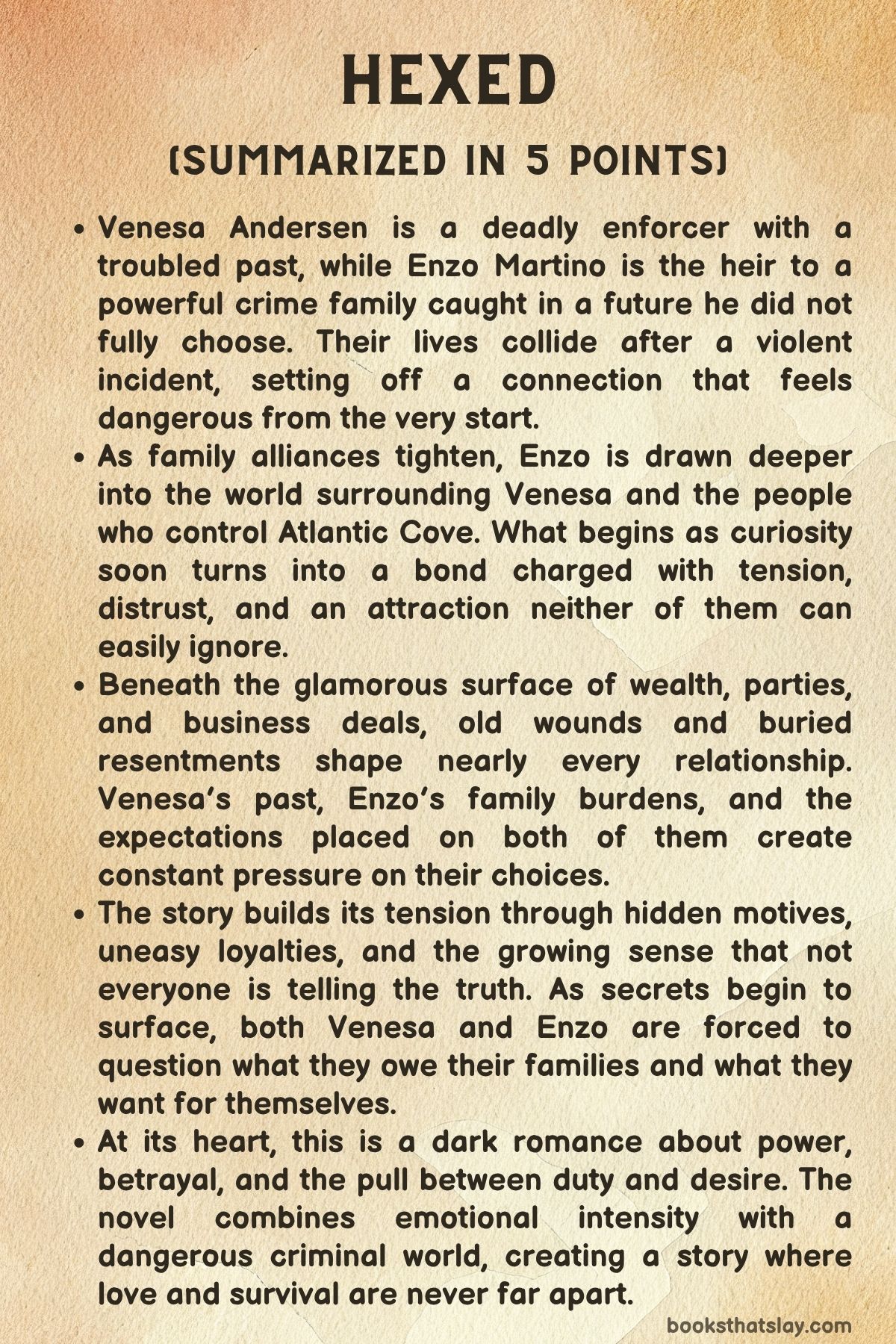
Hexed by Emily McIntire is a dark romance with a mafia backdrop, built around power, revenge, and forbidden desire. The novel follows Venesa Andersen, a feared assassin tied to the Kingston crime family, and Enzo Martino, heir to a rival criminal empire.
Their connection begins in violence and grows into something intense, dangerous, and deeply personal. The storyr reimagines The Little Mermaid in a world of crime, betrayal, and forbidden love. At its core, it is about two people shaped by brutality who recognize each other in a way no one else can, even while the worlds around them keep pulling them toward bloodshed and control.
Summary
The novel opens with Venesa Andersen carrying out a ruthless murder in a Manhattan hotel room, establishing her as someone calm, lethal, and fully at home in violence. Years later, while searching for her cousin Aria in New York, Venesa finds a badly wounded man near the Hudson River.
Though Aria wants to walk away, Venesa chooses to save him, using quick thinking and one of her potions to keep him alive long enough for help to arrive. That man is Enzo Martino, son of powerful mob boss Carlos Marino.
Aria stays behind, and later Enzo comes to believe that Aria was the one who saved his life.
A year passes. Enzo and Aria are now engaged, largely because their families want an alliance between the Marinos and the Kingstons.
Enzo travels to Atlantic Cove, South Carolina, to meet Aria’s family and discuss business plans involving a hotel project. The moment he arrives, he notices Venesa.
Their attraction is immediate, unsettling, and difficult to ignore. Venesa, meanwhile, works closely with her uncle Trent Kingston, the head of the Kingston empire, and she understands how much is riding on the alliance.
Trent orders her to behave and help smooth things over.
As Enzo spends time with the Kingston family, he starts seeing cracks in the polished surface. Aria is petty, cruel, and entitled, while Venesa is sharp, guarded, and far more capable than anyone else in the room.
Enzo learns that Venesa runs a rough local restaurant called the Lair and acts as one of Trent’s most trusted enforcers. Their paths keep crossing, and Trent pushes Venesa to show Enzo around town in hopes of convincing him to support the hotel project.
During these outings, their bond strengthens. On the boardwalk, over lunch, and through private conversations, they begin to reveal pieces of themselves.
Enzo talks about his unhappy family life, his father’s volatility, and the damage left by his mother’s suicide. Venesa carries the scars of a childhood marked by poverty, bullying, and a brutal father who abused her mother.
She also lives with the memory of her mother’s murder, an event that shaped her entire life. Their emotional connection grows because each sees pain, loneliness, and hunger for something better in the other.
That connection deepens when Enzo sees Venesa at work in the darker corners of her world. At the Lair, he discovers a hidden gambling room and watches her interrogate a man who has been cheating and spying on him.
Venesa uses poison, fear, and surgical cruelty to get answers. Instead of being horrified, Enzo is drawn even closer to her.
He understands violence, and he recognizes in her the same ability to act without flinching. Their chemistry becomes impossible to ignore, even though Enzo is still engaged to Aria.
At the same time, trouble builds around them. Enzo starts to suspect that he is being watched and that forces from New Jersey are involved.
He also grows more disturbed by Aria’s behavior and by the strange alliances between the families. Venesa, for her part, is still serving Trent while privately resenting him.
She wants a painting that once belonged to her mother, a symbol of inheritance and family legacy, but Trent refuses to give it to her. His refusal reflects a deeper theft at the center of Venesa’s life.
Their relationship shifts from tension to emotional intimacy during a day on the beach and boardwalk. They laugh, talk honestly, and begin to imagine what life might look like outside duty and family control.
Enzo defends Venesa when an old tormentor mocks her, and Venesa comforts Enzo during a Ferris wheel ride when his fear of heights surfaces. These moments matter because they are some of the first times either of them feels seen without being used.
Venesa’s birthday brings everything closer to the surface. Aria cruelly asks Venesa to be her bridesmaid, and later, at a gathering on Trent’s yacht, Aria reveals an even worse surprise by inviting Venesa’s abusive father, Harald.
The sight of him brings back the full horror of her mother’s death. Enzo is furious on Venesa’s behalf and later kidnaps Harald as a gift to her.
Venesa tortures him for information and learns something devastating: he claims he did not kill her mother and suggests Trent arranged the murder as punishment connected to money and betrayal. After getting what she can from him, Venesa kills him.
From there, Venesa’s loyalty to Trent begins to collapse. Enzo and Venesa confess how much they feel for one another, though both know their families make a future seem impossible.
At the engagement party, tensions explode. Trent publicly gives the treasured painting to Aria, denying Venesa again.
Venesa and Enzo finally give in to their desire and nearly begin an affair, but they are interrupted. Soon after, Trent admits that he had Venesa’s mother killed because family wealth was supposed to pass through Venesa’s side of the line.
Then he throws Venesa out.
Enzo, meanwhile, learns that Aria never truly saved him. He overhears enough to realize their engagement was built on lies and manipulation.
Freed from the false debt he thought he owed her, he returns to New York. Venesa follows and reunites with him there.
Their relationship finally becomes physical and openly intimate. Enzo gives her comfort, space, and a sense of belonging she has never had.
But as they move closer, larger truths emerge.
Bastien, one of Trent’s men, reveals that he has been acting in Venesa’s interest. He knows Trent had her mother killed and that evidence of the true inheritance was hidden in the backing of the family painting.
Venesa is in fact the rightful heir to the Kingston holdings. At the same time, Enzo uncovers the full corruption between the Kingston and Marino families.
Through interrogation of Aria’s uncle Frankie, he learns that Carlos, Enzo’s own father, ordered the hit that nearly killed him. Worse, the attempted murder was tied to long-running family power plays.
Another secret nearly destroys Enzo and Venesa: Venesa was the one who killed Enzo’s brother Giuseppe years earlier, acting under Trent’s orders. Carlos reveals this, hoping to drive them apart and force Enzo to choose blood over love.
Enzo reels from the betrayal, and Venesa finally breaks down completely. Yet Enzo soon learns that Carlos was responsible for far more than he ever admitted, including Giuseppe’s death and the conspiracy against him.
When Carlos threatens Venesa and shoots Enzo’s ally Gio, Enzo kills his father and takes control of the Marino empire.
Venesa is then captured and taken back to the Lair, where Aria reveals the truth about her own role in trying to kill Enzo and in manipulating the engagement. Fisher, Venesa’s longtime friend, has betrayed her because he believes Aria’s lies and fears for a supposed child.
Venesa cleverly turns the situation, convincing Aria that they can both escape Trent if they work together. Bastien helps set the next stage, while Venesa works on Fisher until he starts to understand that he has been used.
Enzo rushes back to save Venesa, killing Fisher before realizing Fisher had been trying to free her. Even so, Enzo and Venesa are finally honest with each other, and he forgives her.
Together with Bastien, they set a trap for Trent using Aria as leverage and the recovered inheritance documents as proof of Venesa’s claim. In the final confrontation, Trent is lured to the Lair.
The plan turns chaotic, but Venesa manages to kill him with poison after Bastien wounds him. Aria is spared death but left unable to sing and stripped of power, money, and protection.
A month later, Venesa has taken her place as heir, with Bastien handling business operations for her. She and Enzo appear to have survived the storm, but Aria makes one last move.
She sneaks into Enzo’s penthouse and prepares to kill him. Venesa reaches them in time and stabs Aria, ending the threat for good.
In the epilogue, the following August, Enzo brings Venesa back to the boardwalk for her birthday. In a setting filled with the kind of memory and meaning that once belonged only to pain, he proposes marriage.
She says yes. As a final gesture of devotion, Enzo also presents her with two enemies who harmed her deeply, offering her the chance to take revenge on her own terms.
The story closes with Venesa and Enzo united in love, power, and shared darkness, having built a future out of the ruins of the families that tried to control them.
Characters
Venesa Andersen
Venesa stands at the center of Hexed as a character shaped by violence, neglect, and stolen inheritance. She begins as a contract killer who appears emotionally sealed off, highly competent, and almost ritualistic in the way she carries out punishment.
Her use of poison, her interest in witchcraft, and her control in moments of danger all create the impression of someone who has turned pain into method. Yet the summary makes clear that this hardness is not simply a personality trait; it is a survival structure built during a childhood marked by domestic terror, poverty, social humiliation, and the murder of her mother.
She has learned to make herself untouchable because being vulnerable once meant watching the people she loved get hurt. This explains why she is so guarded, why desire unsettles her, and why power matters to her in such a personal way.
What makes Venesa compelling is that she is not driven by revenge alone, even though revenge becomes one of her main goals. She also wants recognition, legitimacy, and a sense of belonging.
Her struggle over the trident painting and the hidden inheritance is not only about money or status. It is about being erased from her own family story and denied what should have been hers through blood and law.
Trent’s treatment of her keeps repeating the message that she is useful but never truly valued. That tension defines much of her personality.
She is essential to the family machine, but she is denied the emotional and symbolic rewards that go to Aria. This creates a constant split in her life between service and resentment, obedience and private fury.
Her relationship with Enzo reveals sides of her that brutality alone cannot explain. Around him, she becomes uncertain, reactive, and emotionally exposed in ways that frighten her.
She is not softened into a different person; rather, the story shows that softness was always buried beneath the defenses she built. Her awkwardness around intimacy, her surprise when someone acts to please her, and her emotional response to being protected all suggest that care is more destabilizing to her than violence.
She knows how to survive cruelty, but she does not know what to do with tenderness. That is why her connection with Enzo feels dangerous to her long before it becomes physically intimate.
He recognizes the damage in her without reducing her to it, and that gives her room to feel wanted without being controlled.
Venesa’s arc is also about reclaiming agency over her own history. At first, she acts within systems built by stronger figures: Trent, the Kingston empire, and the mythology of family loyalty.
By the end, she has broken those systems, uncovered the truth about her mother, asserted her claim to her inheritance, and chosen her own future. Her transformation is not from darkness to innocence, because innocence was never available to her.
Instead, it is a movement from being weaponized by others to choosing how and why she uses power. That distinction matters.
She remains dangerous until the end, but danger is no longer proof of her exploitation. It becomes part of her self-possession.
Enzo Martino
Enzo is introduced as the heir to a criminal empire, but his character gains depth through the fact that he does not fully belong in the life prepared for him. He has authority, status, and a violent capacity of his own, yet he is also weary, morally strained, and deeply conscious of the emotional damage left by his family.
His engagement to Aria is built less on love than on duty, debt, and political expectation. Because he believes she saved his life, he sees marriage as an obligation.
This mistaken belief is crucial to understanding him. It shows that he wants to act honorably even in a corrupt world, and it also reveals how easily loyalty can become a trap when it is tied to guilt.
Enzo’s family history explains much of his psychology. He grew up with a paranoid and volatile father, a mother destroyed by misery and addiction, and a brother whose death hangs heavily over the family line.
These experiences leave him suspicious of power, wary of emotional dependence, and afraid of becoming a version of the men who shaped his life. He is not innocent by any ordinary standard, but he is reflective in a way many of the other powerful men are not.
He notices manipulation, feels revulsion toward cruelty when it is casual or self-serving, and reacts strongly when he sees someone being degraded. This is why Aria starts to lose her hold over him.
The more he sees her coldness, the less he can pretend that duty is enough to sustain a future with her.
His attraction to Venesa comes partly from recognition. He sees in her a person whose violence has meaning, whose cruelty is not empty performance but connected to wounds, instinct, and survival.
He does not romanticize her because she is gentle; he is drawn to her because she is fierce in a way that feels honest. At the same time, he brings to their relationship something she has almost never received: active care.
He notices what frightens her, protects her from humiliation, makes room for her desires, and wants her to feel cherished rather than merely possessed. This aspect of his character is important because it separates him from the patriarchs around him.
He is still capable of killing and commanding, but his model of love is not domination.
Enzo’s arc is shaped by disillusionment followed by choice. He begins bound by false narratives: that Aria saved him, that his father still deserves allegiance, that duty must outweigh desire, and that family structure is stable enough to obey.
One by one, those beliefs collapse. He learns that his father tried to murder him, that the alliance with the Kingstons is based on manipulation, and that even Giuseppe’s death is tied to internal corruption.
Once those illusions fall away, Enzo becomes more decisive. Killing Carlos is not only a power move; it is the final severing of fear-based obedience.
From that moment, he is no longer a reluctant son trying to survive a rotten inheritance. He becomes a man actively choosing the future he wants, and that future includes Venesa as an equal in darkness, loyalty, and rule.
Aria Kingston
Aria functions as one of the clearest embodiments of entitlement, vanity, and emotional cruelty. She is introduced as spoiled and self-centered, but her role grows darker as the story reveals how much of her charm and vulnerability are calculated.
She benefits from family privilege in ways Venesa never does, and she uses that privilege carelessly, often with an instinct for psychological harm. Her treatment of Venesa stretches back to childhood, when she helped turn class difference and insecurity into humiliation.
The nickname she helped create, her involvement in past violence against Venesa, and her continued habit of belittling or undermining her cousin show that her cruelty is sustained and deliberate. She does not merely dislike Venesa; she depends on keeping Venesa beneath her.
At the same time, Aria is not powerful in the same way as Trent or Venesa. Her power is derivative, rooted in beauty, status, and her father’s protection.
This makes her a fascinating figure because she lives within patriarchy while also acting as one of its enforcers. She performs femininity in a way that suits the men around her when it benefits her, yet she also carries out dirty work for the family, including the attempted murder of Enzo.
Her role in the false rescue and in the planned marriage makes clear that she is not just a decorative mob princess. She is a participant in coercive schemes, fully capable of manipulation and deceit when it protects her place.
Aria’s emotional logic seems driven by possession and resentment. She wants Enzo less because she understands him than because he confirms her desirability and status.
She cannot accept being displaced, especially by Venesa, who represents everything she has long treated as inferior. This makes her especially dangerous once her position starts to crumble.
She is not built for loss, self-reflection, or independence. When Venesa and Enzo form a genuine bond, Aria reacts not with grief but with vindictiveness, denial, and escalation.
Even when she cooperates temporarily, she does so from self-interest and fantasy rather than moral reckoning.
Her final condition is symbolically rich. Being left voiceless, penniless, and stripped of security forces her into the very vulnerability she spent years mocking in others.
Yet the story does not suggest that she learns from this fall. Her last attempt to murder Enzo shows that she remains driven by obsession and rivalry until the end.
Aria’s importance lies in how she reflects the corrupt values of the world that raised her: privilege without conscience, desire without love, and dependence disguised as superiority.
Trent Kingston
Trent is the architect of much of the suffering in the story, a man who treats family, business, and violence as parts of a single system of control. He presents himself as a patriarch managing alliances and preserving order, but his decisions reveal a colder truth.
He values bloodline, wealth, and image above affection, justice, or loyalty. His treatment of Venesa is especially revealing.
He uses her skills, trusts her with dangerous work, and keeps her close enough to serve him, yet he also withholds what is rightfully hers and lies about the past that shaped her life. He wants her obedient, dependent, and emotionally hungry, because that makes her easier to control.
The inheritance plot gives Trent moral and symbolic weight as more than a conventional crime boss. He does not simply commit violence for profit; he rewrites family history for personal gain.
By stealing Venesa’s claim and hiding the evidence, he turns guardianship into theft. The painting becomes the perfect symbol of his character: he displays legacy as decoration while suppressing the truth it contains.
That detail captures how he works. He is a curator of appearances and a destroyer of rightful order.
His public gestures, such as rewarding Aria or managing family ceremonies, are all part of preserving his version of reality.
His cruelty is often indirect, which makes it more chilling. He arranges murders rather than carrying them out, manipulates others into enforcing his will, and creates situations where people betray one another while he appears above the chaos.
Even Venesa’s near-destruction at the gun drop seems part of this pattern. He does not always need to strike with his own hands because he has built a structure in which others can be pressured into serving his interests.
This also explains why so many characters around him have compromised loyalties. Trent rules through fear, selective reward, and control of information.
His attachment to Aria also reveals the limits of his paternal love. He treasures her, but even that love is tangled with possession and dynasty.
She is meaningful to him partly because she extends his line and reflects his public identity. This is why the final confrontation with Aria as leverage is so effective.
It forces him into a contest between power and family, exposing that the two have never truly been separate in his mind. His death matters not only because the villain falls, but because the entire order he created is built on emotional corruption as much as criminal violence.
Carlos Marino
Carlos represents the most toxic form of patriarchal power in the story: paranoid, manipulative, and consumed by the fear of being replaced. Unlike Trent, whose authority often appears polished and strategic, Carlos is increasingly unstable.
His declining mental state creates an atmosphere of threat around every interaction with him. Enzo must constantly measure his words and actions because Carlos responds to perceived disloyalty with suspicion and aggression.
This makes him more than a remote mob boss; he becomes an intimate source of dread in his son’s life.
His greatest significance lies in the revelation that he orchestrates violence even against his own family. The attempted murder of Enzo, the truth about Giuseppe, and the lies he maintains for years show that he does not experience fatherhood as protection.
He experiences it as possession. Sons are assets until they become rivals, and once they threaten his supremacy, he treats them like enemies.
This mindset reveals a worldview based entirely on dominance. There is no room in it for generational transition, mutual trust, or emotional attachment strong enough to restrain brutality.
Carlos also casts a long shadow over Enzo’s moral development. Many of Enzo’s fears about marriage, power, and emotional damage come from watching what Carlos did to his mother and to the family structure as a whole.
The collapse of that household is not background detail; it is the condition that makes Enzo so resistant to becoming another version of his father. In this way, Carlos operates both as antagonist and as warning.
He is what happens when authority is cut loose from conscience and when insecurity hardens into tyranny.
His death at Enzo’s hands is therefore both political and psychological. It removes the old boss from power, but it also marks Enzo’s final rejection of the belief that blood alone deserves loyalty.
By killing Carlos, Enzo refuses the logic that fathers own their children’s futures. Carlos dies as he lived, trying to manipulate fear and maintain control through secrets.
His failure shows that the empire he guarded was already collapsing from the inside.
Bastien
Bastien is one of the most intriguing secondary figures because he moves through the story with secrecy, restraint, and divided loyalties. At first, he appears to be simply Trent’s efficient second-in-command, a man trusted with torture, enforcement, and sensitive operations.
Yet as the story unfolds, he becomes a hinge character between the old order and the new. He knows far more than he says, chooses his moments carefully, and seems to have been watching over Venesa in ways she did not fully understand.
His usefulness comes not only from strength but from timing. He survives because he knows when to withhold, when to act, and when to shift allegiance.
His relationship to Venesa is especially important. He does not approach her sentimentally, and the summary does not suggest open emotional confession, but there is a steady pattern of protection in his actions.
He uncovers the truth about her inheritance, preserves evidence Trent believed destroyed, helps manage Aria during the endgame, and ultimately supports Venesa’s claim rather than Trent’s continued rule. This makes him a quiet corrective to the many forms of betrayal around her.
In a world where family repeatedly fails her, Bastien becomes one of the few people whose reliability proves real.
Bastien also reflects the story’s interest in practical loyalty over declared loyalty. Many characters speak of family, obligation, and alliance, but Bastien is one of the few whose actions carry real weight when it matters most.
He is not idealized; he is still part of a brutal system. Yet his brutality does not seem rooted in vanity or chaos.
It is procedural, directed, and subordinate to judgment. That gives him a stabilizing quality in a story full of emotional volatility.
By the end, his role in running the day-to-day operations of the Kingston holdings under Venesa suggests continuity without submission. He is one of the few remnants of the old system who can function inside the new one because his loyalty was never purely to Trent’s ego.
It was to competence, order, and perhaps to a deeper sense of who had truly been wronged.
Fisher Engle
Fisher begins as one of the few sources of continuity and companionship in Venesa’s life. He knows her history, he shares a rough familiarity with the town’s underside, and his presence often gives her moments of ease that she does not get with family.
Because of this, his eventual betrayal carries emotional force. He matters not just as a side character but as proof that even chosen bonds can be compromised by fear, longing, and manipulation.
What makes Fisher tragic is that his betrayal does not come from pure malice. He is compromised by his attachment to Aria and by his belief that he is protecting a child.
This does not excuse what he does, but it complicates it. He becomes another person bent by Trent and Aria’s ability to weaponize emotional weakness.
In that sense, Fisher is a study in how damaged loyalty works in the novel. He wants love, relevance, and a role in someone’s life, and those desires make him manipulable.
His connection to Venesa also highlights the difference between affection and steadiness. He may care for her, but care alone is not enough when pressure rises.
He fails her at the decisive moment because his emotional life has been built on illusion. Aria’s hold on him is rooted in fantasy, and that fantasy overrides years of friendship.
When Venesa talks him toward the truth, it is already too late. The trust between them has been broken beyond repair.
His death is abrupt and painful because it comes at the exact moment when he is beginning to reverse course. That irony fits his role in the story.
Fisher is neither villain nor savior. He is a casualty of manipulation, a man whose desire to matter leaves him vulnerable to the worst people around him.
Even after his death, Venesa’s response suggests that she understands him as flawed rather than monstrous, which adds sadness rather than triumph to his end.
Scotty
Scotty provides a different kind of presence in the narrative: less psychologically central than Venesa or Enzo, but essential in establishing loyalty, warmth, and continuity. He is the cousin, assistant, driver, and helper who keeps showing up in moments of stress, often handling practical problems while others are consumed by emotional and political conflict.
His usefulness could have made him a purely functional character, but the summary suggests more than that. He becomes part of the emotional architecture of Enzo’s world, someone trusted enough to remain close during a period of collapse and transition.
Part of Scotty’s value lies in contrast. In a world dominated by betrayal, hidden motives, and inherited cruelty, he is refreshingly direct.
He gossips, reports information, cooks, drives, protects, and remains dependable. That does not make him simplistic.
Instead, it makes him one of the few characters whose loyalty feels uncomplicated in a productive way. He helps create the sense that Enzo’s future rule might be different from the regimes of Carlos and Trent because it is supported by people who are loyal without being ruled by fear.
His interactions with Venesa also matter. He becomes one of the first members of Enzo’s circle to treat her as someone who belongs rather than as a temporary threat or scandal.
The domestic moment in which he helps create a meal and a more comfortable atmosphere is small compared to the violent set pieces, but it has real meaning. It gives Venesa a glimpse of life beyond survival and revenge, a life in which closeness can exist without humiliation.
Scotty therefore serves an important thematic purpose. He represents the possibility of kinship not based on blood, inheritance, or coercion.
In a story where family structures are often poisonous, his presence suggests that loyalty can still be ordinary, generous, and sustaining.
Giuseppe Martino
Giuseppe never appears as a living participant in the present action, yet his absence shapes the emotional and political stakes of the story. He exists as memory, wound, and accusation.
For Enzo, Giuseppe represents both brotherhood and unfinished grief. His death is one of the events that keeps the Martino family unstable, and because it is later revealed that Venesa killed him under Trent’s orders, his memory becomes the sharpest test of Enzo’s love and moral flexibility.
Giuseppe’s significance also lies in what his death reveals about the old generation of rulers. At first, he may seem like a dead brother whose loss belongs to the past.
Later, it becomes clear that his death is tied to hidden betrayals and internal family politics. This transforms him from a private grief into evidence of systemic corruption.
The fact that Carlos may have arranged or benefited from events around Giuseppe shows that sons in this world are expendable when power is threatened.
As a symbolic figure, Giuseppe marks the cost of obedience. Venesa did not kill him out of personal hatred but because she was carrying out orders, long before Enzo became meaningful to her.
That fact complicates any simple division between victim and perpetrator. Giuseppe’s death becomes part of the story’s larger argument that violent systems destroy people by turning duty into murder and family into strategy.
Harald Andersen
Harald occupies a relatively brief stretch of the narrative, but his role is powerful because he embodies the terror of Venesa’s early life. He is the father whose abuse defined her childhood and whose presence still has the force to collapse her composure.
The fear he triggers is not abstract. It is visceral, immediate, and tied to the central trauma of her mother’s death.
His appearance on the yacht is one of the cruelest acts in the story because it turns memory into spectacle.
Yet the novel does something interesting with him by refusing to make him the final answer to Venesa’s pain. She has believed for years that he killed her mother, and while he remains violent and hateful, he claims he was not the one who carried out that murder.
This does not redeem him; it repositions him. He becomes both a real abuser and a false center of blame, which underscores how thoroughly Trent manipulated the truth.
Venesa’s hatred for Harald is justified, but killing him does not solve everything because he is only one part of the machinery that destroyed her family.
His death matters less as revenge against a singular monster than as the beginning of a wider awakening. By confronting him, Venesa learns that her trauma has been framed for her in a way that served someone else’s interests.
That discovery pushes her from personal vendetta toward structural reckoning.
Themes
Inherited power as theft, performance, and corruption
Power in Hexed is never presented as stable legitimacy. It is shown as something seized, staged, hidden, and defended through lies.
The struggle over inheritance makes this especially clear. Venesa’s claim is not merely overlooked; it is actively buried, concealed behind family myth, false narratives, and symbolic objects.
The trident painting becomes a powerful image because it appears to honor legacy while literally hiding the truth of that legacy. This tells us that authority in the novel depends on controlling not only resources but also memory.
Whoever gets to define the family story gets to define who belongs, who inherits, and who is disposable.
This theme also appears through the fathers who run the major crime families. Trent and Carlos act as though power is their natural right, but their rule is sustained through paranoia, coercion, and preemptive violence.
Neither man trusts succession because succession threatens ownership. Sons, daughters, nieces, and allies are acceptable only as extensions of the patriarch’s will.
The moment they begin to appear autonomous, they become risks to be managed or eliminated. That is why both families are full of betrayal.
Betrayal is not the breakdown of the system; it is the system working as designed. When power has no moral center, loyalty becomes temporary and truth becomes negotiable.
The younger generation exposes the instability of this model. Enzo and Venesa are both heirs in different ways, but neither inherits cleanly.
Each must uncover deception before claiming anything meaningful. Even then, taking power does not look triumphant in a simple sense.
It comes after murder, grief, and shattered illusions. The novel suggests that inherited systems of rule do not pass down honor.
They pass down damage, fear, and unresolved violence. To claim authority, the next generation must first understand how deeply the previous one corrupted it.
What makes this theme especially effective is that it extends beyond business or mob hierarchy into emotional life. Family affection itself is contaminated by ownership.
Aria is treasured because she reflects Trent’s dynastic fantasy. Enzo is valuable until he challenges Carlos’s control.
Venesa is useful until her existence threatens Trent’s version of inheritance. In this world, power shapes love until love becomes almost indistinguishable from possession.
The story’s final rearrangement of control matters because it is not just about who rules. It is about who finally refuses to let lineage remain a cover for theft.
Trauma as a force that shapes identity, intimacy, and moral behavior
Trauma in the novel is not decorative background. It is the structure beneath the characters’ choices, fears, and forms of attachment.
Venesa and Enzo are both shaped by early exposure to violence, but the narrative is careful to show that trauma does not affect everyone in the same way. Venesa responds by becoming hyper-controlled, emotionally armored, and physically dangerous.
Enzo responds with vigilance, guilt, and a deep unease about the futures being arranged for him. Neither emerges untouched, and neither is offered a clean route to healing.
Instead, the story shows how trauma can become part of a person’s logic, part of how they read danger, distribute trust, and even interpret care.
Venesa’s inability to cry is one of the clearest examples of this. It is not simply a sign of toughness.
It reflects a childhood lesson that emotional expression had consequences for the people she loved. In her case, trauma does not only create fear; it alters bodily and emotional response.
Similarly, Enzo’s discomfort with comfort, his caution around intimacy, and his horror at becoming trapped in a destructive marriage all emerge from what he witnessed between his parents. These details matter because they show trauma not as a dramatic memory that occasionally resurfaces, but as an everyday lens through which the world is understood.
The relationship between Venesa and Enzo gains meaning because it is shaped by this shared damage. They are drawn to each other not because either offers innocence or escape, but because each recognizes the other’s fractures without flinching.
This creates a form of intimacy based on recognition rather than fantasy. Yet the novel does not pretend that such recognition is enough by itself.
Their bond is repeatedly threatened by secrecy, inherited obligations, and actions taken under older systems of violence. Love does not erase trauma; it must survive inside it.
The story also links trauma to moral ambiguity. People who have been hurt do not automatically become virtuous.
Venesa kills, tortures, and manipulates. Enzo is capable of brutal retaliation.
Aria, though differently positioned, is also a product of a corrupt environment, and she channels her own damage into cruelty and control. In this sense, the novel resists easy moral comfort.
It argues that pain may explain behavior without excusing it, and that survival often produces people who are difficult to sort into simple categories. The emotional force of the narrative comes from this refusal to separate damage from consequence.
Love as recognition, protection, and chosen allegiance
The central romance works because love is presented not as innocence arriving in a dark world, but as a form of recognition between two people who already know darkness. Enzo and Venesa do not fall for idealized versions of each other.
They see blood, violence, fear, anger, and guilt very early on. Their attraction grows anyway, and this matters because it changes what love means in the story.
Love is not rescue in the conventional sense. It is the act of seeing another person’s full damage and choosing them without asking them to become unmarked first.
Protection becomes one of the clearest expressions of this love. Enzo defends Venesa publicly, stands beside her in dangerous spaces, and repeatedly acts to make her feel safe and wanted rather than merely desired.
Venesa, in turn, reveals truths to Enzo that she has hidden from almost everyone else, and she places trust in him despite every reason not to trust anyone. These acts are meaningful because both characters have learned that closeness usually comes with threat.
For them, being protected is emotionally disruptive because it contradicts the rules their past has taught them. That is why even small gestures, like gifts or acts of consideration, carry unusual emotional weight.
Chosen allegiance is equally important. Much of the novel is built around false loyalties imposed by blood, crime, or obligation.
The romance matters because it challenges those systems. Enzo begins by believing duty binds him to Aria.
Venesa begins by accepting that service binds her to Trent. As their relationship develops, both start choosing each other over inherited structures.
This is not framed as selfishness but as moral clarity. The novel suggests that chosen loyalty can be more ethical than biological loyalty when family has become a vehicle for abuse and manipulation.
At the same time, the love story remains fully embedded in the novel’s violent world. Enzo’s proposal and final gift show that even devotion is expressed through the moral logic of the world they inhabit.
This means the romance never becomes separate from danger; instead, it claims that intimacy can exist within darkness without becoming false. For these characters, love is not a retreat from who they are.
It is the one bond that allows them to stop being tools in other people’s hands and start becoming partners in a shared future.
Revenge as justice, identity, and the attempt to restore stolen selfhood
Revenge drives much of the plot, but the novel treats it as more than an appetite for retaliation. For Venesa especially, revenge is bound up with identity.
She is not simply trying to punish people who hurt her. She is trying to reclaim a self that was shaped, diminished, and nearly erased by other people’s decisions.
The wrongs against her are personal, familial, financial, and symbolic all at once: her mother’s murder, her stolen inheritance, her years of humiliation, and the repeated message that she should remain useful without ever becoming central. Because of this, revenge becomes a way of refusing the role assigned to her.
What makes the theme compelling is that revenge often reveals truth before it delivers satisfaction. Venesa’s torture of Harald does not produce closure; it opens a larger betrayal.
Her pursuit of answers leads her away from the obvious villain of childhood memory and toward the more devastating discovery that the trusted patriarch engineered her suffering. In this sense, revenge acts as investigation.
It strips away the stories that protected the powerful and exposes the mechanisms beneath them. The same is true for Enzo.
His path toward avenging betrayal requires him to confront not only enemies outside the family but the father whose authority shaped his entire life.
The novel also presents revenge as morally double-edged. It can clarify purpose, but it can also trap people inside the logic of injury.
Aria’s final actions show revenge in its most corrosive form, driven by envy, entitlement, and refusal to accept loss. Venesa’s revenge, by contrast, is linked to memory, justice, and restoration, but it is never depicted as clean.
It involves torture, poison, and strategic cruelty. The story does not ask the reader to confuse revenge with innocence.
Instead, it asks whether justice is even available in a world where formal systems have already failed and power protects itself.
By the end, revenge has done more than punish villains. It has reordered the map of legitimacy.
Trent is dead, Aria is stripped of the identity she relied on, and Venesa stands as the rightful heir to what was taken from her line. This suggests that revenge in the novel functions as a brutal method of historical correction.
It cannot undo trauma or resurrect the dead, but it can force recognition. It can make the buried truth visible and prevent the old lie from ruling the future.