Holiday Ever After Summary, Characters and Themes
Holiday Ever After by Hannah Grace follows Clara Davenport, a woman raised inside her family’s influential toy company, whose professional life and personal hopes collide during one unexpected trip. After a viral scandal accuses Davenport of stealing a handmade doll from a small town, Clara is pushed into the center of the crisis.
Her journey to Fraser Falls—intended to repair corporate damage—steadily becomes a search for honesty, belonging, and connection. What begins as a public relations mission turns into a story about community, love, and choosing a future built on one’s own terms.
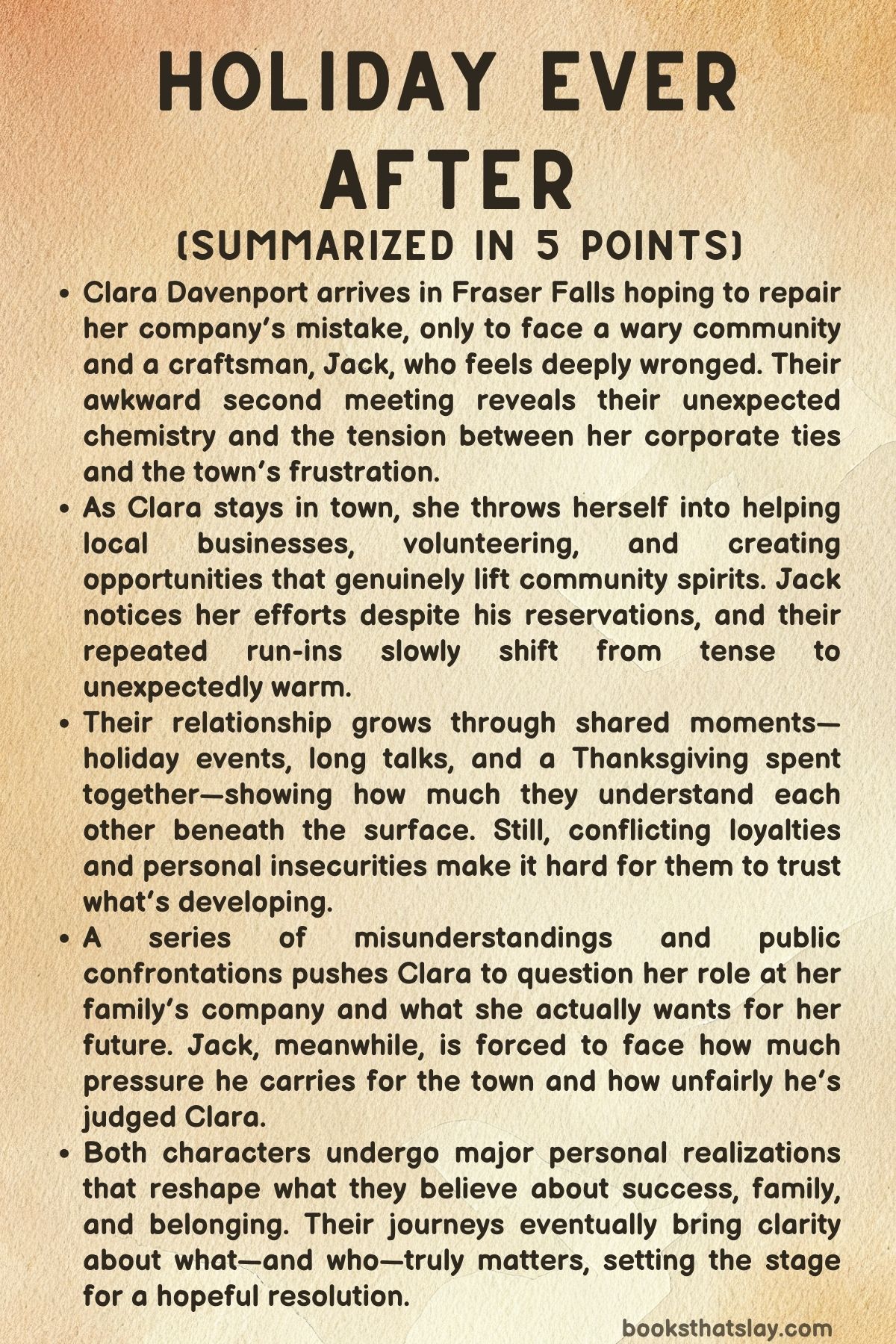
Summary
Clara Davenport starts her morning in chaos when a viral video accuses her family’s company, Davenport Innovation Creative, of copying a handmade doll from the small town of Fraser Falls. The video, created by Florence Girard, shows the original doll—Holly—crafted from local materials and supporting several small businesses.
Florence argues that Davenport’s new mass-produced Evie doll has crushed their orders and harmed the town’s economy. The online campaign against Davenport gains rapid momentum, and Clara, though uninvolved in the Evie project, is expected to fix the mess because she leads the company’s small-business program.
During an emergency meeting, Clara insists the company must sincerely apologize and work with Fraser Falls. Her father responds by assigning her to meet Florence and repair the situation.
Leaving New York, Clara calls her best friend Honor, venting about her overlooked work, her brother Max likely getting her promised promotion, and her plans to visit her program’s partner businesses.
When she arrives in Fraser Falls, the quiet and holiday-decorated streets charm her. Meanwhile Jack, owner of the shop that makes the Holly doll, is dealing with reporters drawn by Florence’s videos.
That evening, Clara visits the local tavern for dinner. Jack assumes she’s just a visitor, and the two share an immediate, easy connection.
They talk, tease each other, play pool, and bond over drinks. Jack later brings his dog Elf to meet her, and they continue talking by the fire until closing.
Walking her back to her bed-and-breakfast, both hesitate on the edge of a kiss before parting.
The next morning, Clara goes to Florence’s café to introduce herself professionally. She tries to approach casually, but Florence quickly realizes who she is.
Jack walks in, stunned to see her again. When she asks to meet “Harry,” Jack explains he owns the shop and the original Harry—his grandfather—is gone.
Their flirtatious night instantly becomes complicated. They sit to talk, but Florence interrupts repeatedly, suspicious of Clara’s intentions.
Jack is angry, convinced Davenport is only there to repair its image. Clara explains the company truly relies on small business partners, but Jack refuses her offers of support and tells her to leave town and pull Evie from the market.
He walks out, taking his breakfast plate, which Florence later turns into town gossip.
Jack’s friends urge him to reconsider, noting how much he liked Clara. Jack refuses to believe she could have come with genuine motives.
Back in New York, Clara is scolded for failing to gain the town’s cooperation. She later goes out drinking with coworkers and drunkenly emails Jack from her personal account.
Their messy back-and-forth reveals her frustration and his distrust. When Jack challenges her to prove she means what she says, Clara impulsively replies that she’ll see him “tomorrow.
” The next morning, Jack is shocked when Clara appears at a town meeting, announcing she’s moved temporarily to Fraser Falls to help in earnest.
Clara stays at Maggie’s bed-and-breakfast, secretly creating a full wall of sticky-notes outlining how she’ll support local businesses. She volunteers around town, buys supplies, visits shops, and makes herself visible.
She calls Honor often, trying to figure out how to earn trust without appearing forced.
A breakthrough comes when she meets Dove at a Christmas tree farm and volunteers for the annual toy drive. She later helps Miss Celia at the bookstore secure an author event with Matilda Brown through her personal connections.
Despite Jack trying to keep his guard up, he keeps running into her and slowly sees her steady influence on town life.
At the tavern, a misunderstanding makes Jack think Davenport exploited Clara as a child when she mentions she once designed the “Clara doll. ” Hurt, she leaves abruptly.
Jack realizes he overreacted but is still unsure how to approach her. When he finds her later searching alone for a missing nativity prop, he insists on helping, their tension softening again.
On Thanksgiving, Clara arrives at his house with wine so he won’t spend the day alone. Attraction that has simmered between them finally surfaces.
They kiss, grow intimate, and spend the entire day together talking, eating pie, cuddling, and falling asleep side by side.
As the holiday season continues, Clara throws herself fully into community efforts. She organizes Small Business Saturday stamp books, supports Flo’s bakery, helps local shops thrive, and works quietly behind the scenes on multiple town projects.
Jack tries not to show how much he cares but keeps getting pulled toward her. Their connection deepens, leading to a second, fully realized night together.
Still, both know the situation is complicated.
During the Santa Run, Clara injures her ankle, and Jack carries her to safety. She rests at his apartment while he works, and they fall into a comfortable rhythm.
When orders for the Holly doll surge after a news appearance, Clara helps reorganize Jack’s production system. Working together long hours brings them even closer.
Everything unravels when a misunderstanding about donated toys causes Jack to believe Clara acted behind his back. Feeling betrayed, he lashes out, and she leaves Fraser Falls heartbroken.
At a town meeting soon after, the community confronts Jack, revealing that Clara fixed numerous problems quietly, supported nearly every local business, and carried the town through its busiest season. Jack realizes how unfairly he treated her.
Encouraged by friends, he goes to New York to apologize. Meanwhile, Clara is struggling with her own life.
She feels undervalued at Davenport and discovers her father offered her promotion to Max. After reflecting with Honor and hearing Max’s encouragement to start something new, Clara agrees to leave the company and build a business with her brother.
At a lavish gala, her father once again fails to acknowledge her. Moments later, Jack appears.
Clara runs, and Jack follows. In a private room, he finally admits the depth of his feelings and his fear of repeating the past.
She apologizes too, and they reconcile. Clara shares that she’s leaving Davenport to start fresh, and Jack reassures her that the decision should be for herself, not for him.
One year later, Fraser Falls is thriving. Clara and Jack ring in the new year together.
After the celebrations, Jack leads her to a house he secretly bought for them—a place with room for Elf, space for her work, and a shared future. She accepts with joy, and they exchange “I love you,” ending on a moment of certainty and hope.
Characters
Clara Davenport
Clara is the emotional center of Holiday Ever After, a woman caught between the immense pressure of her family legacy and her own need to be valued for who she is rather than what she represents. She begins as a high-functioning professional whose career is overshadowed by her powerful, dismissive father and her more celebrated brother.
Her arc is defined by learning to trust herself, separate her identity from Davenport Innovation Creative, and understand that she deserves respect—not just obligation—from the people in her life. Clara’s defining traits are her empathy, determination, and deep desire to contribute meaningfully.
Even when the world views her as the corporate villain, she relentlessly works to earn Fraser Falls’ trust by showing up physically and emotionally, investing her time and heart into every business she touches. Her kindness isn’t performative; she helps people long before anyone offers praise, and even when she is insulted or misunderstood, she tries again.
Her relationship with Jack forces her to confront her own patterns—her habit of overextending herself, the ache of never feeling good enough, and her instinct to take responsibility for everyone else’s mess. By the end, Clara’s growth lies in recognizing her power, walking away from a company that diminished her, and choosing a life built on mutual respect, love, and self-worth.
Jack Kelly
Jack is both the emotional guardian and stubborn protector of Fraser Falls, a role he inherited too young and has carried for fifteen exhausting years. Known for his quiet steadiness, deep loyalty, and almost overwhelming sense of responsibility, he initially views Clara as the embodiment of everything that hurt his town—the corporate machine that stole the Holly doll, his grandfather’s legacy, and his sense of security.
His rigidity comes from fear: fear of losing control, fear of disappointing the people he feels responsible for, and fear that opening his heart will leave him vulnerable again. Jack’s interactions with Clara begin with genuine chemistry and an undeniable pull, but he repeatedly shuts down any softness out of mistrust, convincing himself she can only hurt the people he loves.
Over time, as Clara embeds herself in the town, Jack is forced to confront the truth—that he doesn’t let others help him, he hoards responsibility to the point of isolation, and his self-punishing habits are the real threat to Fraser Falls. His ultimate growth is recognizing that Clara was never his enemy, that love requires vulnerability, and that he deserves joy rather than simply duty.
Clean-shaven and humbled, he chooses to fight for Clara, not against her, learning that letting someone in does not mean losing control but gaining a partner.
Florence (Flo) Girard
Flo is the vibrant sparkplug of Fraser Falls, the woman whose viral video brings national attention—and chaos—to the town. Fierce, protective, and gloriously dramatic, she represents the beating heart of Fraser Falls, rallying residents to defend their community’s integrity.
At first, she is Clara’s harshest critic, a gatekeeper fueled by loyalty to local artisans and understandably fueled by betrayal. Her suspicions of Clara are not rooted in malice but in her determination to shield her people from being exploited again.
As Clara’s sincerity becomes undeniable, Flo evolves into one of her strongest advocates, exemplifying the town’s capacity for forgiveness once trust has been earned. She is also a symbol of communal hope and resilience—an entrepreneur, town historian, holiday enthusiast, and emotional compass for Jack and the others.
Flo embodies the importance of community spirit, proving that one passionate voice can spark meaningful change.
Tommy
Tommy serves as the humorous, warm-hearted best friend who relentlessly pushes Jack toward emotional honesty. Owner of the local tavern, he is both comedic relief and surprising wisdom, calling Jack out when he falls into self-sabotage.
Tommy understands Jack better than anyone and is unafraid to strike the nerve that gets him moving—whether by teasing him about Clara, orchestrating a pseudo-intervention with the town, or hiring an Etsy “witch” just to manifest a date for him. Beneath his playful personality lies a deep loyalty to both his best friend and the town that depends on him.
Tommy also represents the hope for growth within Fraser Falls, especially through his patio expansion, which Clara secretly helps him with. His gratitude and belief in Clara help soften the town’s perception and remind Jack that accepting help is not a weakness.
Maggie
Maggie, the owner of the bed-and-breakfast, is one of the first locals to quietly support Clara. She is gentle, observant, and motherly in the way only small-town pillars can be.
Though she never pushes Clara directly, she offers subtle encouragement—like welcoming her into the community, trusting her with responsibilities, and treating her with a kindness Clara rarely receives from her own family. Maggie’s illness during Clara’s stay creates opportunities for Clara to help, further intertwining her with the town.
Her presence symbolizes home, warmth, and the comfort Clara didn’t know she needed.
Dove
Dove is the compassionate owner of the animal sanctuary and a grounding force within Fraser Falls. Sensitive, thoughtful, and quietly powerful, she recognizes Clara’s intention from early on and becomes one of her earliest and most genuine allies.
Dove sees beyond Jack’s protective exterior and helps orchestrate moments that force him to confront his feelings. Her appreciation for Clara—whether through the toy drive, the anonymous donation, or just noticing Clara’s effort—becomes one of the clearest reflections of Clara’s positive impact.
Dove is also a reminder that healing, for both towns and individuals, often begins with small acts of kindness.
Sailor, Luke, and the Other Townspeople
The supporting residents of Fraser Falls collectively form a character of their own. Luke, with his family’s tree farm, Sailor with her artistic skills, and various shop owners each reveal different facets of community vulnerability and resilience.
Their reactions to Clara evolve from suspicion to admiration as she invests her time and heart into their success. They help demonstrate how deeply a town can be shaped by trust—how quickly it can mobilize to protect its own, and how willing it is to embrace an outsider once her intentions are clear.
Together, they show that Fraser Falls thrives on connection, mutual support, and shared traditions.
Max Davenport
Max is Clara’s brother, the overlooked anchor who ultimately becomes her greatest advocate. Unlike their father, Max sees Clara’s worth clearly and consistently.
He is forthright, occasionally blunt, but always driven by his desire for both siblings to break free from their father’s unhealthy expectations. His refusal of the promotion—a silent act of solidarity long before Clara even knew about it—proves how deeply he values fairness and family.
Max becomes the catalyst for Clara’s liberation when he convinces her to build something of her own with him. Their new partnership is not only a business venture but also an emotional reclamation of agency and mutual respect.
Mr. Davenport
Clara’s father is the book’s primary human antagonist—not through overt cruelty, but through decades of emotional neglect, manipulation, and minimization of his daughter’s achievements. He represents the weight of legacy, the coldness of corporate ambition, and the damaging belief that affection must be earned through performance.
His refusal to acknowledge Clara’s contributions, even during the gala meant to honor the doll she originally designed, cements his role as the force she must break free from. Mr. Davenport’s rigidity contrasts sharply with Fraser Falls’ warmth, highlighting why Clara thrives when she chooses community and love over compliance.
Elf
Elf, Jack’s dog, is a symbol of warmth and emotional disarmament. He bridges the emotional distance between Clara and Jack, often appearing at moments when tension needs softening.
Elf’s instinctive fondness for Clara mirrors Jack’s suppressed affection, and his presence provides comfort, levity, and a sense of family long before Jack and Clara articulate their feelings. Elf represents uncomplicated loyalty, grounding the story in love that is pure and uncomplicated.
Themes
Corporate Responsibility and Ethical Accountability
The conflict surrounding Davenport Innovation Creative’s theft of Fraser Falls’ handmade Holly doll pushes questions of corporate responsibility into the center of Holiday Ever After. Clara’s company has not only copied a design but disrupted an entire local economy, revealing how a single corporate decision can ripple through a community that lacks the resources to defend itself.
Rather than sensationalizing outrage, the story presents a grounded portrait of what happens when accountability is unavoidable: Clara faces a situation where the truth is clear, denial is impossible, and action must reflect genuine remorse rather than public-relations spin. Her struggle becomes more than a business challenge—it’s a personal reckoning with a company she has devoted her life to, discovering that her values no longer align with its practices.
The narrative highlights how large companies often underestimate the emotional and economic weight of their decisions on people who depend on small businesses for survival. Jack’s distrust embodies that wider injury: for him, the stolen design is not a hypothetical ethical lapse but a lived loss affecting his livelihood, reputation, and identity.
As Clara attempts to repair the connection, the story explores how accountability needs honesty, vulnerability, and persistence, not just strategic solutions. It also shows the long-term consequences of corporate neglect, from strained community trust to the erosion of employee loyalty.
Ultimately, the theme challenges assumptions about what genuine responsibility looks like—whether apologizing matters if the actions that follow don’t change, and how individuals inside a flawed system must often decide whether reform is possible or departure is the only ethical path forward.
Community, Belonging, and Interdependence
Fraser Falls is not presented as a quaint backdrop but as a living organism shaped by relationships, traditions, and shared responsibility. The town’s unity contrasts starkly with Davenport’s corporate isolation, demonstrating how belonging is cultivated through mutual reliance rather than hierarchy.
Every resident has a role—Tommy supporting Jack, Flo rallying holiday events, Dove caring for animals, Maggie running the B&B—and each contribution becomes crucial when the town is thrust into crisis. Clara’s journey into this environment reveals how community forms around authentic presence.
Her attempts to integrate—helping with stamp cards, volunteering, participating in local events—are not instantly rewarded, emphasizing that belonging requires both time and humility. The story illustrates how communities protect their own, especially after being exploited, yet remain capable of opening their doors when sincerity is proven.
Jack himself embodies the burden and beauty of such interdependence. He has carried responsibilities that were never meant to rest on one person, a pattern the town confronts directly.
The eventual redistribution of tasks shows that belonging is not just about contribution but about allowing oneself to be supported. Clara’s influence demonstrates how an outsider can enrich a community by embracing its spirit rather than trying to control it.
The theme ultimately reveals that belonging is created through shared work, vulnerability, and acknowledgment of one another’s strengths. Fraser Falls thrives because its people show up for each other, and Clara finds healing by stepping into that rhythm instead of remaining tethered to an environment where she was seen as replaceable.
Healing from Betrayal and Learning to Trust
Trust operates as a quiet but persistent force throughout the novel, shaping relationships, conflicts, and eventual growth. Jack’s distrust of Clara is rooted in personal and communal betrayal, where Davenport’s actions undermined not just his business but his sense of safety and autonomy.
His resistance is more than stubbornness—it is self-protection learned from years of carrying others’ burdens and fearing further disappointment. Clara enters Fraser Falls not as a romantic interest but as a living symbol of the company that wronged him, making any emotional connection fraught with internal conflict.
Meanwhile, Clara’s own life is shaped by a different kind of betrayal: a father who consistently overlooks her achievements, colleagues who diminish her contributions, and a workplace that prioritizes optics over truth. Her struggle to trust herself mirrors Jack’s challenge to trust another person.
Their relationship grows only when both confront these wounds. The novel emphasizes that trust is not restored by grand gestures but by consistent action—Clara proving her intentions through daily work in the town, and Jack gradually recognizing her sincerity.
Their missteps, arguments, and reconciliations illustrate how trust can be rebuilt when both parties are willing to confront uncomfortable truths about themselves. The theme highlights that healing is nonlinear; moments of closeness are often followed by setbacks, yet each experience deepens understanding.
By the end, trust becomes a mutual choice rather than a passive hope, shaped by transparency, shared goals, and vulnerability.
Identity, Self-Worth, and Personal Agency
Clara’s arc is a story of reclaiming identity from structures that have quietly diminished her for years. Growing up as the face of a doll line, she has been treated more like a symbol than a person within her own family’s empire.
Her ideas are often dismissed, her labor taken for granted, and her future predetermined by others’ expectations. Her work in Fraser Falls forces her to confront the gap between the version of herself shaped by Davenport and the person she becomes when allowed to contribute freely.
Through meaningful interactions with townspeople and opportunities to create real impact, she begins to see her own value outside of her family name. The contrast between the vibrant purpose she feels in Fraser Falls and the hollow routine of New York underscores how environments can shape identity.
For Jack, identity is tied to responsibility and legacy. He believes he must protect the town the way his grandfather did, even at the cost of his well-being.
This self-imposed identity traps him in patterns of overwork and emotional isolation. Clara’s presence challenges him to reconsider the possibility that identity can evolve rather than remain anchored in duty.
The novel presents personal agency as a transformative force. Both characters eventually choose paths that reflect their true desires rather than inherited expectations—Clara starting her own company, Jack learning to share responsibilities and pursue happiness without guilt.
The theme reveals that self-worth grows when characters step out of confining roles and shape their lives with intention.
Love as Partnership and Mutual Growth
The romantic relationship in Holiday Ever After is built not on instant compatibility but on learning, conflict, and evolution. Their chemistry is undeniable from the start, yet the narrative refuses to treat attraction as enough to sustain a relationship.
Instead, love becomes a catalyst for both characters to confront their insecurities, prejudices, and emotional barriers. Clara enters Jack’s life at a moment when trust feels dangerous, yet her steady commitment to the town challenges his instinct to shut people out.
Jack’s honesty—sometimes too sharp, sometimes protective—forces Clara to examine her patterns of seeking approval and hiding vulnerability. Their bond deepens as they repeatedly choose openness over defensiveness.
Each major moment between them—awkward beginnings, heated arguments, quiet acts of care, the intimacy that builds gradually—cements the idea that love thrives when both partners are willing to grow. They learn to articulate needs, apologize without pride, and recognize the fears driving each other’s reactions.
Love is portrayed as a partnership where both give and receive support, whether through Clara easing Jack’s workload or Jack offering emotional constancy that Clara has rarely known. Their shared future becomes believable not because the story idealizes romance, but because it grounds the relationship in work, communication, and emotional responsibility.
The theme underscores that love is strongest when it becomes a place where both people can be fully themselves—imperfect, learning, and still choosing each other.
Tradition, Change, and the Value of Small-Town Culture
The holiday setting highlights the tension between preserving traditions and embracing necessary change. Fraser Falls depends heavily on its seasonal events, handmade crafts, and collective spirit to sustain its economy and identity.
The arrival of mass-produced competition threatens more than sales; it jeopardizes a way of life that relies on human connection and artistry. Clara’s involvement helps the town breathe new life into old traditions without erasing their character.
The toy drive, stamp cards, tree farm event, and bookstore author visit all show how tradition can adapt while still honoring its roots. Jack represents the fear that change will dilute authenticity, a fear intensified by Davenport’s previous harm.
Clara demonstrates that change, when guided by respect and collaboration, can strengthen rather than diminish community heritage. This theme reinforces the importance of valuing local culture, not as a nostalgic idea but as a tangible force that binds people together, sustains small economies, and enriches everyday life.