Holly by Adalyn Grace Summary, Characters and Themes
Holly by Adalyn Grace is a romantic, magical fantasy set during a Christmas season filled with enchantment, spirits, and family bonds. It follows Blythe Dryden, her long-lost love Aris—recently returned in a new life—and their unusual family, which includes Death himself walking the world as Sylas.
As they try to create a peaceful holiday together, their home becomes overrun by spirits tied to a tragic fire decades earlier. What begins as a dream of a perfect Christmas becomes a journey about trust, love, forgiveness, and helping restless souls find peace.
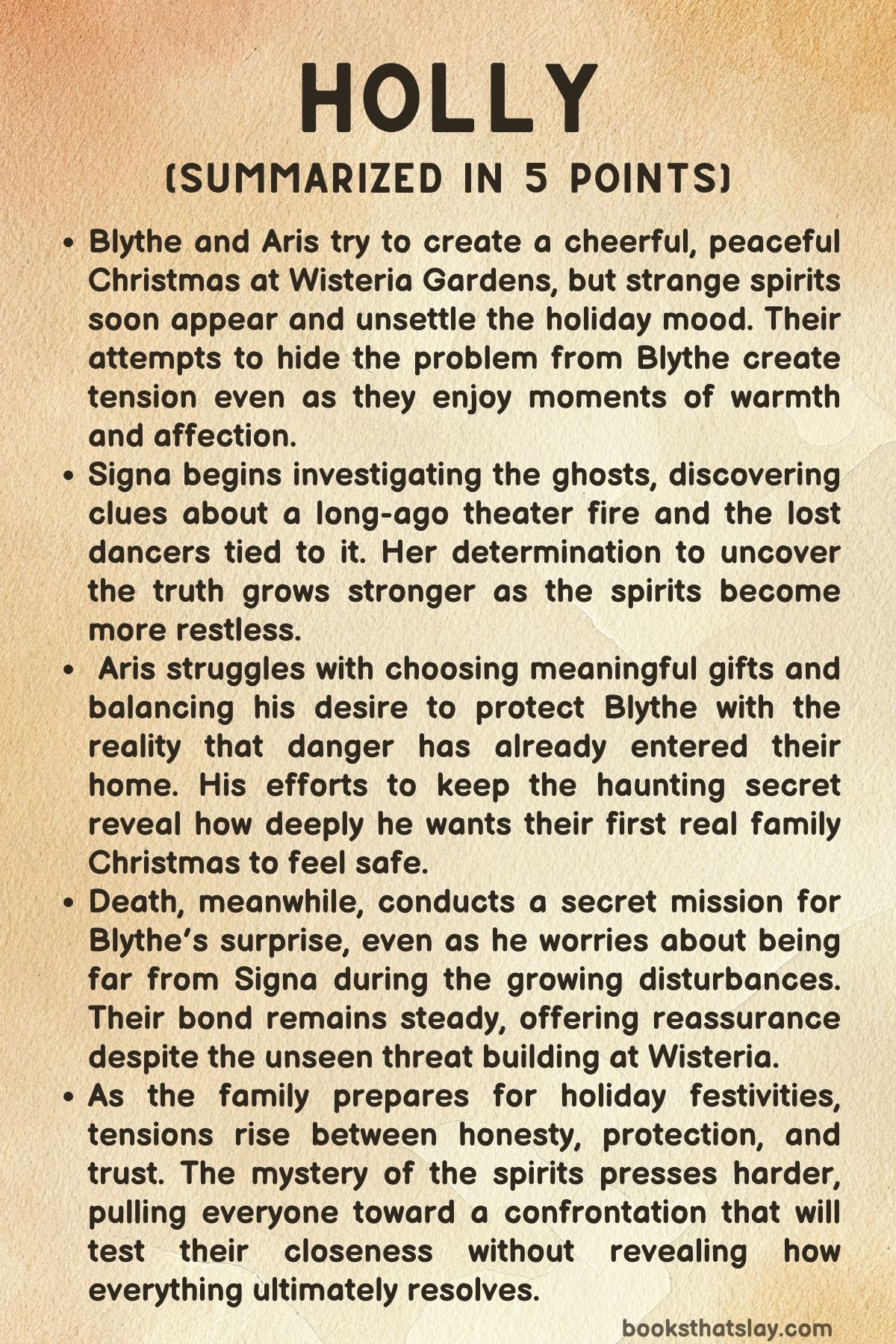
Summary
Blythe Dryden is determined to finally have a harmonious Christmas at Wisteria Gardens. She decorates the estate with living holly she coaxes from the earth, hoping its protective power will keep misfortune away.
Aris, newly reincarnated but unmistakably the man she once loved, surprises her with playful affection as he adjusts to inhabiting a younger body. Their moment is interrupted by Sylas—Death in human form—who teases them before vanishing to complete a secret errand for Blythe.
Aris frets over presents. He hates gift-giving because it carries expectations, and after decades away from Blythe he worries he no longer knows what she truly wants.
His memories of his reincarnated life surface: growing up as a dressmaker’s son, discovering magic in his craft, creating works so strange and perfect they revealed glimpses of other lives—visions that eventually led him back to Blythe. He abandoned everything to return to her, fighting through the briars that guarded her home.
Seeking advice, he visits Signa, who is wrapping gifts for children at the hospital. She tells him Blythe needs nothing extravagant; she simply wants a peaceful Christmas with the people she loves.
Their discussion is cut short when invisible spirits begin dropping books from shelves. Signa sees what Aris cannot: soot-covered figures in damaged costumes asking for someone named Jules.
More figures appear, all confused and repeating fragments of memories. Realizing the estate is haunted, Signa reaches out to Death through their bond, but he refuses to return immediately—he is far away securing an important Christmas surprise for Aris.
That evening, Blythe gathers everyone for a lively holiday game called snapdragon. As they reach into a bowl of flaming brandy to grab raisins, a distressed red-haired spirit reacts violently to Aris touching the fire.
Her panic causes a brandy bottle to explode, injuring Aris’s hand. Blythe heals him, and Signa quietly investigates the spirit, who recalls her name—Odette—before slipping into confusion again.
Signa notices burn damage on Odette and realizes all the spirits likely perished in a fire.
Aris begs Signa to hide the haunting from Blythe so the holiday remains peaceful. Signa agrees, though reluctantly.
That night she is kept awake by the restless spirits gathering in her magically decorated room. Determined to uncover the truth, she heads into town the next morning.
Blythe and Aris insist on accompanying her, turning the outing into a festive trip. They enjoy the snow, holiday stalls, and each other’s company, ending with a lighthearted snowball fight that reaffirms their love.
Signa continues to the cemetery alone.
There she meets an elderly man tending a plaque for Odette. He reveals he is Jules, once a dancer partnered with Odette.
Sixty-one years earlier, the theater where they rehearsed burned down after sparks from his pipe ignited the entrance. Everyone inside died.
Though told it was a tragic mistake, Jules has carried the guilt his entire life. When Signa explains that the victims now haunt Wisteria, he reacts with grief and disbelief.
Before leaving, she offers him comfort: Odette and most others died of smoke inhalation, not flames.
Returning to Wisteria, Signa and Aris plan to appeal to the spirits as performers. In the library, which feels like a backstage, Signa announces she has come to see their show.
The dancers want music but lack a score. When Signa attempts a piano piece, a musician spirit appears in fury at her mistakes.
Aris steps in, playing a gentle winter melody that lures more musician spirits. Just then, Blythe, Elijah, and Gundry arrive to carol, their presence calming the room.
But Signa, afraid Blythe’s participation will stir the spirits again, asks Aris to distract her. They leave for town, unaware of the larger plan forming.
Meanwhile Sylas, working on Blythe’s secret gift for Aris, ventures through towns with clothing scented by Aris and Blythe to lure the soul he seeks. A plump black cat with glowing green eyes appears, and after a struggle he captures it.
Blythe later finds Sylas hiding the creature and asks him to store it at Foxglove Manor until Christmas morning.
Back at Wisteria, Signa organizes the spirits into a ballet, arranging instruments Aris conjured. As they begin a hauntingly beautiful winter performance, Odette becomes furious when another dancer takes her role in Jules’s absence.
Her rage sparks chaos—violent spins, shaking shelves, flying books. The ballet mistress attacks Signa in an attempt to possess her.
Gundry becomes a monstrous hound to protect her. Death arrives, commanding the spirits to stop.
Downstairs, Blythe senses the danger and races up the stairs, but Aris tries to restrain her with his magical threads. They fight briefly, Blythe overpowering him with vines.
She forces her way into the freezing room and sees the full extent of the haunting. Furious that Aris and Sylas hid the truth, she reminds Aris that her life magic repels spirits and she could have helped all along.
She warms Signa back to consciousness and takes control of the situation.
Determined to free the trapped souls before Christmas, Signa and Sylas travel to Jules’s cottage. When he refuses to open the door, Signa storms inside with Sylas’s help.
Convinced of the spirits’ suffering, Jules finally agrees to return to the stage.
By Christmas Eve, Wisteria has been transformed into a functioning theater. Aris casts subtle illusions so human guests see only a charming holiday performance.
Backstage, spirits wait eagerly. Signa brings Jules to Odette, who regains clarity at the sight of him.
She asks to dance with him one final time.
When the curtains rise, the mortal audience sees Jules alone among drifting costumes, but in truth the stage is filled with spirits performing their last ballet. Jules and Odette move together with grace born from decades of longing.
Their dance ends in a quiet farewell. Odette kisses him softly before dissolving into light, and the remaining spirits follow, guided peacefully onward by Sylas.
Jules bows to rousing applause, at peace at last.
Later that night Sylas returns to Signa, who waits for him in the moonlit garden wearing the red dress from their first dance. They share a tender moment, dancing among the snow and flowers.
Christmas morning fills Wisteria with joy. Sylas presents Aris with a shocking gift: Beasty, Aris’s beloved fox from a past life, reborn as a black cat.
The family exchanges magical gifts—enchanted keys, journals, charms—and spends the day playing games and laughing.
That night, Aris quietly visits Signa to offer one final gift: a dangerous stopwatch infused with the power of Time itself. It might reveal answers about her parents and the figure known as Chaos.
Cautious but grateful, Signa accepts it and hides it away. As Sylas curls beside her and snow falls outside, she feels content, surrounded by love and ready for whatever mysteries come next.
Characters
Blythe Dryden
Blythe is the vibrant heart of Holly, a woman whose magic is rooted in life, growth, and renewal. She charges every room she enters with warmth, stubborn joy, and a fierce determination to protect the people she loves.
Christmas, for her, is not simply a holiday but a symbolic reclamation—after years of loss and longing, she is determined to craft a season unmarred by tragedy. Her insistence on perfect decorations, abundant holly, and elaborate festivities reflects both her nurturing nature and a deep-seated desire for stability after decades of grief.
Blythe’s relationship with Aris is passionate, playful, and deeply grounding; she is still adjusting to the strangeness of his reincarnation, yet she recognizes the soul behind the new body instantly. She is powerful in ways she does not always realize—able to heal with a touch, capable of commanding forces of life itself—yet she never wields her abilities for triumph or ego.
When she discovers that Aris and Sylas hid the haunting from her, her anger is born not of fragile pride but of hurt trust, because to her, love is inseparable from honesty. Ultimately, Blythe is the anchor of the makeshift family at Wisteria Gardens, a woman who believes that perfection is not the absence of problems but the presence of the people she cherishes.
Aris
Aris is a man reborn—literally. Having lived an entire reincarnated life as a dressmaker before regaining memories of Blythe, he carries the quiet elegance of a craftsman and the aching devotion of someone who fought his way back to the love he lost.
He is gentle, meticulous, and profoundly emotional beneath a calm exterior. His magic manifests through creation: weaving illusions, shaping fate threads, enhancing objects, and crafting tapestries that reveal glimpses of lives and memories.
These abilities speak to his need to understand, to preserve, and to connect. Christmas becomes a source of both joy and anxiety for him; he desperately wants to give the perfect gifts, driven by years of separation and the guilt of having left Blythe alone.
Aris also attempts to shield her from the haunting, believing he is sparing her worry, but in truth he reveals a lingering insecurity—he fears he cannot yet give her the peace she deserves. When he finally offers her his life-tapestry, woven with threads marking every day he has loved her, he shows the depth of his vulnerability and devotion.
Aris is the embodiment of devotion shaped by loss, a man who loves so deeply it often becomes his greatest flaw.
Sylas (Death)
Sylas is the eternal and enigmatic embodiment of Death, yet in Holly, he is also a brother, a lover, and a man learning intimacy for the first time. His dry wit and teasing nature mask an ancient loneliness, one only eased by his bond with Signa and the fragile family forming at Wisteria.
He moves through shadows, ferries souls, and wields cosmic power with frightening ease, yet he is surprisingly gentle in his affections. His decision to choose the haunted land for Wisteria is not malicious but rooted in a desire to give Signa a mystery she would revel in—a flawed but heartfelt attempt to understand her needs.
His journey to retrieve Beasty, the soul of Aris’s childhood fox, reveals the tenderness beneath his brusque demeanor. Sylas struggles with the tension of being a cosmic force bound by ritual responsibilities while yearning for simple domestic joy, especially during the holiday season.
With Signa, he is vulnerable, earnest, and deeply romantic. Sylas embodies the paradox of being Death while desperately wanting the warmth of life.
Signa
Signa serves as the bridge between the living and the dead, a woman shaped by both mortal heartbreak and immortal love. Her abilities make her uniquely suited to confronting the haunting at Wisteria, but it is her tenacity and curiosity that drive her forward.
She has matured into someone who balances compassion with stern resolve—kind to the suffering spirits yet unafraid to challenge Sylas or Aris when she believes they are wrong. Her exhaustion from the nightly disturbances highlights the toll her role takes, yet she never loses her sense of determination or her thrill for a new puzzle.
Signa’s relationship with Sylas is passionate, playful, and built on a deep emotional bond forged through shared danger and vulnerability. She demands honesty and partnership, refusing to be handled or manipulated even out of love.
Signa is the story’s investigator, its moral compass, and the character most attuned to the pain of the trapped spirits. Her final scene, dancing under snowfall with Sylas, illustrates her transformation into someone who embraces both love and responsibility with equal strength.
Elijah
Elijah is the grounding presence of the family, a father who has endured profound loss yet greets each day with warmth and humor. His role in the narrative is subtle but vital—he is steady, supportive, and endlessly amused by the chaos around him.
He brings a paternal calm to the household, joining the children in their games while offering sage reminders and quiet guidance. Elijah’s acceptance of Aris, Sylas, and Signa demonstrates his capacity for love and his desire to rebuild a family that was once shattered.
He does not possess grand magic or dramatic powers, but his steady affection becomes a form of emotional magic that holds Wisteria’s disparate personalities together. His joy in singing carols, his gentle teasing of Blythe, and his amused tolerance of supernatural absurdities all reveal a man who has chosen happiness after sorrow—and who nurtures that happiness in those around him.
Odette
Odette is a tragic and haunting figure whose confusion, grief, and longing shape the mystery at the heart of the story. She is caught in a liminal loop, replaying fragments of her final days as a ballerina whose dreams were cut short by a devastating fire.
Her fixation on Jules, her dance partner and beloved, is both heartbreaking and deeply human. The state of her spirit—flickering awareness, soot-covered costume, missing skin on her feet—reflects the trauma of her death and the agony of unfinished longing.
She is not malicious; her outbursts arise from fear, jealousy, and the desperation of being trapped in a memory she cannot escape. When she finally sees Jules during the ballet’s final performance, clarity and gentleness return to her.
Her final dissolution into glowing fragments becomes a release, a moment of grace earned after decades of wandering. Odette represents grief frozen in time and the profound healing that comes with closure.
Jules
Jules is the solitary survivor—not physically, but emotionally—of the theater fire that claimed his fellow performers. He has spent sixty-one years burdened by guilt, believing himself solely responsible for the tragedy.
Age has not eased his sorrow; instead, it has carved him into a man who lives quietly, haunted by memories he cannot lay to rest. When Signa confronts him, his anger and disbelief come from a place of deep self-loathing.
Yet when he learns Odette remains trapped, his love for her overwhelms his fear. The ballet becomes his redemption.
Dancing with Odette one final time, though visible only to supernatural eyes, allows him to release decades of pain and grant her peace. His final bow symbolizes forgiveness—not only for her, but for himself.
Jules is a portrait of enduring love scarred by tragedy, finally offered a chance to heal.
Gundry
Gundry, Death’s loyal hound, embodies both gentleness and terror depending on the moment. To those he protects, he is affectionate and comforting; to hostile spirits, he becomes a monstrous shadow-clad beast capable of exerting supernatural force.
His sensitivity to unseen presences makes him the first to detect the haunting at Wisteria, and his reactions often foreshadow danger long before others understand the threat. Gundry serves as a guardian, an early warning system, and at times a force of intimidation that even spirits fear.
He is a symbol of Sylas’s dual nature—dark, fearsome power tempered by unwavering loyalty and tenderness.
Themes
Love Reclaimed Through Time
Love in Holly is shaped by distance, death, reincarnation, and longing, yet it retains a steady center in Blythe and Aris’s devotion. Their relationship is not defined by the dramatic separation of twenty-seven years but by the way they navigate the aftermath.
When Aris returns in a new body, the emotional certainty between them outweighs physical unfamiliarity; Blythe recognizes him not through appearance but through presence, voice, and instinct. Their connection is consistently reaffirmed through small domestic moments—decorating for Christmas, arguing over dangerous holiday games, stealing playful touches, or simply moving through Wisteria together.
The story treats love as something cumulative, built from thousands of days rather than singular grand gestures. Aris’s fear of inadequacy after reincarnation, his worry about giving the right gifts, and his desperate attempts to protect Blythe from stress reveal a man trying to bridge a life interrupted, while Blythe’s frustration with his secrecy shows her desire for partnership rather than preservation.
Their relationship grows stronger not because obstacles vanish but because they confront each other honestly when mistakes are made. Even their magic reflects their bond: his threads reach for her automatically, and her life-light grounds him.
The later gift of his life-tapestry—stitched with red for every day he loved her—captures the novel’s view of enduring affection: love is memory, labor, persistence, and hope woven into a shared future. Their final Christmas together is less about celebration and more about choosing each other again after every trial, making their relationship the emotional anchor of the entire narrative.
Family Found and Chosen
Family in Holly emerges not from bloodlines alone but from commitment, acceptance, and shared burdens. Wisteria Gardens becomes a sanctuary precisely because its inhabitants are bound by choice.
Blythe grows up with a father who endured decades of grief, a cousin who understands the supernatural world intimately, and two brothers—one living, one Death himself—who form an unconventional but fiercely loyal constellation around her. Their first true Christmas together symbolizes the completion of a family long broken by curses, distance, and fate.
The dynamic is warm yet imperfect: Aris hides the haunting to spare Blythe stress, Elijah alternates between amusement and fatherly exasperation, Signa shoulders spiritual responsibilities alone, and Sylas orchestrates secrets he believes will help the others. These missteps highlight the difficulties of creating a family from people with vastly different pasts, powers, and roles in the mortal and immortal realms.
What unites them is the desire to protect one another and build a shared life, even when their methods clash. Their conflicts produce growth rather than fractures, especially when Blythe confronts Aris for keeping her uninformed or when Signa challenges Sylas for manipulating circumstances.
Through these tensions, the family learns that togetherness requires honesty, vulnerability, and equality. The climax—multiple members working to soothe, calm, or guide tormented spirits—shows them functioning as a unified force, each contributing uniquely to solve a crisis.
By Christmas morning, their harmony feels earned rather than granted, grounded in mutual respect and an understanding that family is something forged deliberately, again and again, through choices rather than destiny.
The Weight of Guilt and the Longing for Redemption
Guilt saturates the storyline surrounding the trapped spirits and deeply influences both the living and the dead. Jules’s lifelong remorse over the theater fire becomes a decades-long punishment he inflicts upon himself, convinced that a thoughtless mistake destroyed countless lives, including that of the woman he loved.
His grief creates a shadow of emotional paralysis; he avoids returning to the site, isolates himself, and tries to rewrite the past through self-inflicted penance. The spirits’ condition mirrors this state: they linger in endless repetition, unable to move forward or accept their deaths.
Odette’s desperation, the older woman’s furious strictness, and the dancers’ confusion all reflect unresolved fear and longing for closure. Signa becomes the catalyst for confronting these lingering emotions.
Her role is not to erase guilt but to acknowledge it and redirect it into understanding. Her assurance that many died peacefully is not meant to absolve Jules entirely but to offer truth where ignorance has created agony.
Redemption unfolds only when Jules faces the consequence of avoiding the past; stepping onto the stage again is a symbolic acceptance of what happened and an act of love that frees Odette. The ballet’s final performance embodies forgiveness: Odette does not cling to her suffering, nor does she condemn Jules.
Instead, their last dance becomes a release of the pain that tethered them both. The theme shows that redemption is not about erasing wrongs but about recognizing them, confronting the wound directly, and allowing truth, compassion, and connection to guide the healing process.
Life, Death, and the Boundary Between Worlds
The novel treats the supernatural not as a distant force but as part of daily existence, threading life and death into a shared space. Signa’s role as a bridge places her at the intersection of these realms, experiencing both the tenderness and the terror of being connected to wandering souls.
Death, embodied in Sylas, moves through the world with a mixture of duty and longing, revealing the emotional complexity behind his responsibilities. Spirits are neither villainous nor benign by default; they react according to memory, trauma, and confusion.
The haunting at Wisteria demonstrates how the boundary between realms becomes unstable when intense emotion remains unresolved. The house’s magic amplifies their presence, turning the library into a makeshift backstage and transforming domestic spaces into liminal ones.
The narrative emphasizes that death does not silence desire, fear, jealousy, or hope. Odette’s outburst during the ballet rehearsal shows how these emotions can manifest violently when spirits cannot release their attachments.
At the same time, Signa’s ability to soothe and guide them illustrates how understanding and intention can steady the boundary between worlds. Sylas’s arrival in the chaos, scythe in hand, reinforces that death is not solely an end but a guide toward transition.
The final release of the spirits during the Christmas Eve performance portrays the passage between life and death as a rite that requires witnessing, compassion, and ritual. The theme underscores that the supernatural is not frightening because it is unknown; it is frightening because it is familiar—a continuation of human emotion beyond mortal limits.
Healing, Hope, and the Meaning of Home
Home in Holly is not defined by walls or geography but by comfort, safety, and the courage to claim joy after long periods of loss. Wisteria shifts from a cursed palace to a living, breathing refuge filled with magic, warmth, and shared memories.
Its transformation mirrors the emotional healing of those who inhabit it. Blythe’s desire for a perfect Christmas is less about controlling every detail and more about reclaiming happiness stolen by years of loneliness and fear.
Aris’s dedication to beautifying the space through magic reveals his yearning to contribute to the sanctuary she created in his absence. Signa’s sleepless nights among spirits show her acceptance of responsibility even when it comes at personal cost.
Sylas’s secret mission to retrieve the cat—Beasty reborn—reflects the deep affection he feels for this family and his willingness to endure hardship for their happiness. Moments of playfulness, from snowball fights to holiday games, serve as reminders that healing thrives in laughter as much as in vulnerability.
The final scenes emphasize that home is a living bond, built through shared traditions, conflict handled with honesty, and the willingness to let others help carry burdens that once felt personal. By the story’s end, Wisteria stands as a symbol of collective hope: a place restored by love, chosen family, and a commitment to embracing the future without erasing the past.