Homeschooled Summary and Analysis | Stefan Merrill Block
Homeschooled by Stefan Merrill Block is a memoir about a boy growing up in Plano, Texas, inside a family world shaped by love, fear, and control. Stefan is bright, imaginative, and eager to please, especially his mother—whose distrust of institutions and obsession with “protecting” him slowly redraws the borders of his life.
What starts as a rescue from a school that feels suffocating turns into years of isolation, blurred boundaries, and a constant push-pull between becoming his own person and staying the version of him his mother can bear. It’s also a story about memory: how a family explains itself, and what those explanations cost.
Summary
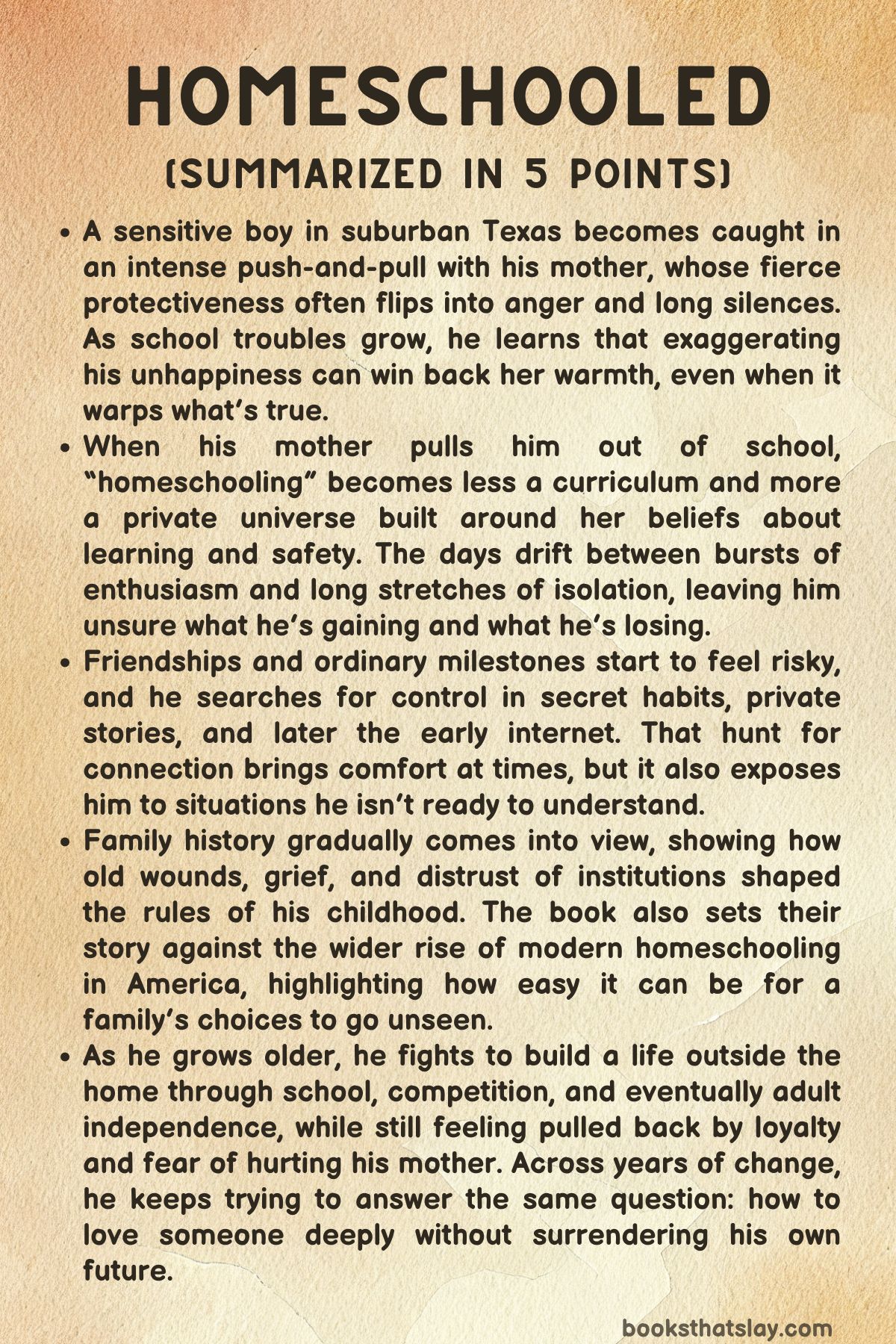
Nine-year-old Stefan storms out of his house after a fight with his mother, who has been punishing him with silence. He goes to a creek bluff and, half out of anger and half out of longing, imagines getting badly hurt so she’ll fuss over him again.
He slips, lands hard, then chooses to make the injury look worse, bruising his arm on purpose before running home sobbing. His mother studies him with unnerving accuracy and realizes he wanted a broken bone—an excuse, maybe, to escape school, maybe to earn her attention.
Instead of scolding him, she turns her rage outward, blaming the school system and the adults who run it. Stefan knows her certainty can be extreme: she mistrusts doctors, she holds grudges, and since the family moved from Indiana her moods have grown sharper.
His older brother Aaron is already under pressure at school, bullied and judged for his body, and their mother’s intensity wraps around him too.
At Brinker Elementary, Stefan feels trapped in a machine designed for tests and compliance. He finds small freedoms—friends, secret reading during class, stories he writes in his head—but he also notices something about his mother: when he says school hurts, she lights up.
Her outrage feels like affection. So he learns to feed it.
He exaggerates what happens in class. He invents a story about a teacher grabbing him.
Each complaint pulls his mother closer and pushes his father into a corner where “private school” becomes the implied solution, even as money tightens.
After a harsh day when their mother tears into both boys, Stefan and Aaron finally tell her to stop being cruel. She withdraws to her bedroom and resumes the family’s familiar punishment: silence that fills the house like smoke.
Their father tries to smooth things over, taking Stefan outside to throw a baseball, but the tension doesn’t lift. At night Stefan hears his parents talking, and one word lands like a verdict: homeschooling.
Soon his mother presents it as salvation. She says she used to teach.
She says school will crush Stefan’s creativity. She tells him he’s gifted, different, “very special.” Stefan feels dread at the idea of being alone with her all day, but he also senses that refusing could trigger another war.
When they meet the principal to withdraw him, the principal warns that homeschooling is a big step and offers Stefan a seat back at any time. Stefan says he’s sure, because he wants peace at home, and because agreeing is the quickest way to repair the bond he keeps trying to earn.
At first, homeschooling feels like a holiday. They shop for supplies, take secret trips for ice cream and movies, and turn weekdays into a private club.
Stefan’s mother divides the family into categories—Dad and Aaron as “linear,” Mom and Stefan as “global”—and treats her connection with Stefan as a special language only they share. Lessons begin with math at the dining-room table, but structure dissolves fast.
Phone calls interrupt. Errands eat whole afternoons.
Stefan is left to teach himself, and he learns he can finish quickly by copying answers from the teacher’s edition. His mother reads the results as proof of genius, and the lie becomes the foundation of their new life.
Soon she abandons most formal work and tells him to “follow your interests.” Stefan reads, draws, watches television, and invents projects designed to impress her. Beneath the freedom, loneliness grows.
He worries he’s falling behind, but his mother insists he’s ahead of everyone and uses trivia games and praise to shut down his anxiety.
As the months pass, his mother becomes fixated on keeping him young. She uses baby talk, holds him too long in the pool, and treats growing up like a threat.
Her obsession narrows to his hair—his childhood blondness—and she mourns its darkening as if it’s a death. She shows him a saved lock from his first haircut, then begins bleaching his hair at home.
The chemicals burn his scalp. The color turns wrong—orange, then an unnatural yellow—but Stefan endures it because resisting would mean conflict, and conflict means losing her.
He gets a single playdate with Noah, a school friend, and hears what he’s missed: shifting friendships, humiliations, new dramas. Stefan gives Noah a prized Spider-Man comic, a gesture that is part generosity and part apology for leaving.
Afterward, Stefan begins injuring himself in secret, pressing a compass needle into his hip to make small marks no one can see—proof that some part of him still belongs to him. He also writes a private story about a lonely boy who finds a portal after a storm and disappears into another world, a fantasy of escape that feels safer than saying what he wants out loud.
During a summer trip to the family’s New Hampshire lake house, Echo Cottage, Stefan watches adults whisper about Nana’s worsening memory. He hopes the trip will give him the courage to tell his mother he wants to return to school, but he keeps delaying, waiting for the “right moment” that never comes.
In a marshy brook his mother has feared since childhood, she finally tells him a story she has guarded for years: as a small child she was isolated behind glass in a hospital for suspected polio, separated from family, then later told she likely never had it. The experience hardened her distrust of professionals and her hunger for control.
In that same place, she asks Stefan to extend homeschooling beyond the original plan. He feels the trap closing and still says yes, because he cannot bear to be the cause of her pain, and because he has learned that her love often arrives as a demand.
Her beliefs have roots beyond family history. As a young woman she discovered the education writer John Holt and adopted his arguments against traditional schooling.
By the time she pulls Stefan out, homeschooling has spread widely, helped along by political and religious movements that push for minimal oversight. Stefan’s mother is not religious, but she benefits from the loosened rules.
Her certainty hardens into performance too: she even drives Stefan past his old school during recess, blasts music, and makes him shout “Suckers!” out the window. Stefan later denies it when Noah confronts him, and the lie adds another layer of shame.
Noah continues coming over after school because his mother works and he’s often alone. Stefan tries to explain his days—some math, then “pursuing passions”—and hears how strange it sounds.
Noah brings sexual gossip and torn porn pages from older boys at church, and Stefan feels curiosity mixed with fear, both about sex and about his own body that seems to lag behind everyone else. Stefan’s mother grows resentful of Noah’s presence and warns Stefan that “bad influences” lead to mediocrity.
Stefan argues that once-a-week “socialization” isn’t enough; his days are shapeless, built around TV, solitary projects, and endless errands. In a bizarre compromise, Noah’s mother pays Stefan’s family so Noah can come every afternoon.
Stefan initially feels saved, then quickly suffocated. Forced closeness poisons the friendship.
They bicker, compete, and resent each other. After Noah abandons Stefan during a dangerous creek crossing, Stefan’s mother ends the arrangement.
Later, the boys fight violently, a scene charged with humiliation and confusion, and their friendship never recovers. Stefan retreats deeper into isolation, spending “project time” in bed with books and daytime television.
As Aaron starts high school, tragedy strikes: Caleb, the son of Stefan’s mother’s best friend, dies suddenly during a basketball game. Stefan watches his mother fly to the funeral and returns home to emptiness and terror during the days she’s gone.
When she comes back, she clings to Stefan with a fierce promise that she will never let anything happen to him and admits she could not survive losing him. Her fear transforms into a new fixation: she reads an article about crawling and development and forces Stefan—and later Aaron—to crawl around the house to “fix” handwriting.
Stefan’s knees and hands bruise. He learns to fake improvement to end the ritual and starts secretly trimming new body hair to avoid triggering his mother’s panic about him changing.
Nana comes to stay for a while, and her presence softens the house. She watches movies with Stefan, reads myths, comforts him, and the crawling stops.
But her dementia worsens; she panics, tries to leave, and one frightening incident ends with Nana leaving again—eventually back to relatives. Stefan loses the one adult who offered him warmth without conditions.
Money stress grows. Stefan’s mother starts a math tutoring business that fills the house with kids—mostly girls—whose laughter Stefan hears through the floor while he hides upstairs.
Grandma Mimi visits and directly challenges the homeschooling, asking Stefan if he’s lonely. In a burst of rebellion, Stefan performs laziness in front of Mimi, hoping someone will finally intervene.
Mimi promises to confront Stefan’s mother, and the fallout is brutal: Stefan’s mother, furious at what she calls betrayal, shoves him into furniture and then pressures him to agree it was “nothing.”
Stefan escapes into early internet chatrooms, becoming addicted to private conversations and attention from strangers. He bonds with someone claiming to be a teenage girl, shares fantasies, and tries to understand sex with the limited knowledge he has.
After his hamster dies, he reaches for comfort online. He sends a scanned photo of himself and receives images in return, only to realize, too late, that the “girl” is an adult man exposing himself.
The betrayal leaves Stefan shaken and more alone than ever.
Nana later falls down basement stairs and dies, and the family returns to Echo Cottage for the burial. Stefan cannot accept the ashes as her.
In the aftermath, Stefan’s mother briefly reconnects with her estranged sister Ella, and the sisters share stories and laughter that feel like proof another family version once existed. Stefan’s mother suggests Nana may have chosen death rather than become a burden; Stefan suspects confusion, darkness, and an absence of help.
On Stefan’s fourteenth birthday, he and his mother visit an art museum to see a Monet painting Nana loved. His mother again urges him to homeschool through high school, predicting greatness for him and treating his future as an extension of her dream.
Stefan negotiates a trial: he’ll attend Shepton High for a few weeks and return home if it goes badly. In a surreal moment at the café, his mother bites into cake and spits out a shard of glass, bloody in her palm—an image of danger hidden inside sweetness.
Stefan starts ninth grade and is instantly marked as different. His mother insists he bring a loud portable typewriter and a wheeled filing cabinet instead of a backpack, turning him into a walking spectacle.
He is mocked, taunted, and hunted through hallways and bathrooms. A history quiz comes back failing because Stefan answers with lofty generalities rather than expected facts.
A teacher calls him brave, but bravery doesn’t protect him from physical bullying. When a classmate dies by suicide, the school’s quiet handling of it fuels Stefan’s fear and his mother’s arguments that school will destroy him.
Stefan insists on finishing the semester anyway, clinging to the idea that endurance might equal freedom. He throws himself into achievement, wins science fairs, and reaches a national competition where he briefly finds people like him—until his mother arrives and pulls him back into her orbit.
A chaperone tells Stefan the truth he has been avoiding: he will have to break his mother’s heart to live his own life.
Years later, Stefan’s mother shares her own hidden story from college: a rape by a boy who barged into her dorm room, followed by the cold reactions of the people around her, and then the sudden death of her father back in Singapore. She explains how loss and betrayal taught her to trust no one fully, and how her need for control grew from that lesson.
Stefan connects her past to their present, including a later car crash in Plano that triggers another long silence from her—punishment framed as moral education.
Stefan eventually leaves for college, tastes freedom, and tries to remake himself, but the pull remains. Even as his writing career grows and he builds an adult life, he stays locked into long phone calls where his mother praises him and keeps him close.
When he has a family of his own, she proposes moving near him and treats his independence as abandonment. Soon she is diagnosed with stage-four lung cancer.
During the pandemic, their final contact is a mix of tenderness, control, and denial—dreams of future shopping trips alongside the reality of dying. After her death, the family buries her ashes at Echo Cottage beside Nana’s and Ella’s.
Stefan learns more about the alcoholism and pain that deepened after he left. As he covers the ashes with soil, he recognizes what he is carrying forward: love, damage, and the lasting force of the world they built together inside the word “homeschooling.”
Key People
Stefan “Stef” Merrill Block
Stefan is the story’s center of gravity: a bright, imaginative child who learns early that survival in his family depends on reading emotional weather and shaping himself accordingly. At nine, his urge to be cared for curdles into performance—he stages injury, exaggerates school misery, and discovers that pain, whether real or manufactured, can pull his mother back into closeness.
As homeschooling begins, his intelligence becomes both refuge and trap: he reads, writes, and invents private worlds, but he also learns to “prove” giftedness by cheating with answer keys, which reinforces the family myth that he is exceptional and therefore should stay enclosed. Over time, Stefan develops a split self—outwardly compliant, inwardly panicked—and that split shows up in secret self-harm, compulsive online intimacy, and later a feverish drive for achievement.
Even when he finally returns to school and then escapes into adulthood, his accomplishments remain tangled with a deeper question: whether he can live a life that isn’t built to regulate his mother’s fear. The older Stefan is both grateful and grieving—aware of what Homeschooled gave him, including art, attention, and intensity, and what it cost, including social development, bodily autonomy, and a stable sense of self not curated for someone else.
Stefan’s Mother
Stefan’s mother is a charismatic, volatile force who loves fiercely and controls fiercely, often in the same breath. Her distrust of institutions isn’t presented as a quirky preference; it is a worldview forged by trauma, humiliation, and loss—beginning with early childhood medical confinement, later shaped by a chaotic family history, and repeatedly reinforced by the feeling that “professionals” either fail or punish.
Homeschooling becomes her grand solution and her private sanctuary: she frames it as protection of Stefan’s creativity, but it also functions as a relationship system where Stefan’s dependence confirms her purpose. She cultivates a mythology of “specialness,” dividing the family into “linear” versus “global,” and she turns motherhood into an ideology that justifies isolation, boundary violations, and emotional coercion.
Her behaviors range from seductive, such as ice cream detours, shared outrage, and “only us” intimacy, to frightening, such as silences as punishment, physical aggression, property destruction, obsessive bodily control, hair bleaching, and forced crawling. Yet she is not a flat villain; grief exposes her fragility, especially after Caleb’s death, when she clings to Stefan with near-panicked vows that she cannot survive losing him.
In adulthood, she continues the same pattern in a longer arc—hours-long calls, attempts to relocate near Stefan’s new family, and a final insistence on “protecting” him even as she is dying—revealing how her love, fear, and need for control remain fused.
Stefan’s Father
Stefan’s father is the household’s quieter stabilizer, often trying to mediate rather than confront, and his caution shapes the family’s drift into dysfunction because it rarely interrupts it. He worries about money when private schooling becomes the implied alternative, and he tries to diffuse tension through normalcy—playing baseball with Stefan, managing logistics, keeping the day-to-day running.
His presence suggests empathy and concern, but also a kind of helplessness: he recognizes the intensity of his wife’s “theories,” yet the narrative often shows him negotiating around them rather than setting firm limits. Later revelations—like the depth of the mother’s alcoholism after Stefan leaves—cast the father as someone who carried knowledge and burden privately, which makes him both protector and participant in the family’s silence.
He represents the tragic middle: he loves his children and wants peace, but peace often comes by allowing the most volatile person to set reality.
Aaron
Aaron, the older brother, functions as both mirror and warning for Stefan—someone who suffers under the same maternal intensity but with different vulnerabilities. He is bullied and pressured about his weight, and his mother’s scrutiny of him is harsher, more openly contemptuous at times, which makes Aaron an early example of what life looks like when the “special” narrative doesn’t protect you.
His relationship with Stefan includes solidarity—confronting their mother together—yet Aaron also becomes a boundary line Stefan watches closely as he grows: Aaron’s entry into high school signals time moving forward, the future arriving whether or not the mother permits it. In adulthood, Aaron’s engagement and marriage to Nicki becomes the family’s most explicit rebellion against the mother’s worldview, and his conversion intensifies the conflict into something moral and identity-based rather than merely behavioral.
Aaron’s arc shows the cost of leaving: liberation paired with the mother’s rage, and the necessity of choosing adulthood even when it triggers family catastrophe.
Ella
Ella is the mother’s estranged sister, positioned for much of the story as an “enemy” inside family mythology—proof, in the mother’s telling, of betrayal and danger. The mother repeatedly uses Ella as a repository for old grievances, and that scapegoating supports the mother’s broader theory that outsiders harm and insiders must close ranks.
When Ella reappears at Nana’s burial and the sisters end up laughing together, Ella becomes something else: evidence that the mother’s rigid narratives can soften, and that reconciliation is possible even after years of banishment. Ella’s presence also deepens the mother’s backstory, connecting family trauma—pregnancy, forced adoption, shame, and silence—to the mother’s later obsession with control and “protection.”
Nana
Nana is a rare source of uncomplicated warmth for Stefan and a counter-model of adult care that doesn’t require Stefan to perform suffering. As her dementia progresses, she becomes both comfort and crisis: her presence temporarily improves Stefan’s daily life—movies, myths, attention that feels steady rather than conditional—and her decline forces the household to confront what cannot be controlled.
Nana’s wandering and panic expose the fragility beneath the mother’s systems, and her eventual death becomes a turning point loaded with contested meaning. The mother interprets Nana’s end as intentional refusal to be a burden, while Stefan remembers confusion and misstep, a tragedy of ordinary vulnerability rather than dramatic agency.
Nana’s legacy—through stories, through the museum visit for Monet, through the Goethe quote—becomes a quiet ethical push toward courage and separation, the opposite of the family’s instinct to close in.
Grandma Mimi
Grandma Mimi is the story’s blunt external pressure, the adult who names what Stefan and his father skirt around. Her visit confronts homeschooling directly and asks Stefan the question at the center of his private suffering—whether he is lonely—forcing a rare moment where his isolation is witnessed rather than normalized.
Stefan responds with rebellion and performance, partly to test whether an adult will actually intervene. Mimi’s willingness to confront the mother triggers backlash and violence, showing both Mimi’s importance and her limits: she can see the problem, but she cannot easily dismantle the emotional regime that governs Stefan’s home.
Her role highlights how family systems can defend themselves fiercely against accountability, even when the critique is accurate.
Aunt Patricia
Aunt Patricia appears most prominently during crisis, serving as the messenger who pulls the family back to Echo Cottage when Nana falls. Her phone calls punctuate the shift from ordinary dysfunction to irreversible loss, and she functions as a practical node in the extended family network—the person with proximity and information when tragedy happens.
In a narrative where silence and omission are common, her communications are starkly factual, and that fact-bearing role intensifies the sense of shock and helplessness that Stefan feels.
Noah
Noah begins as Stefan’s bridge to normal childhood—proof that Stefan can still belong, still be known outside the mother-son enclosure. He brings news of school life, shifting friendships, and humiliations Stefan has missed, which makes him both a friend and a trigger for Stefan’s envy and grief.
As the arranged daily “socialization” turns their friendship into a paid obligation, Noah becomes entangled in adult economics and resentment; the boys’ closeness corrodes into rivalry and cruelty. Noah also introduces sexual knowledge in a messy, adolescent way, accelerating Stefan’s confusion about puberty and desire while Stefan remains developmentally stalled by isolation.
The cliff abandonment and the later violent fight mark Noah not as a simple antagonist but as a child also shaped by neglect, pressure, and the distorted setup the adults create. By the time the friendship breaks, Noah embodies Stefan’s most painful lesson: connection can be weaponized, and losing it can feel like being sealed back into a private world.
Sylvia
Sylvia, Noah’s mother, represents a different kind of adult compromise—someone trying to survive structurally rather than ideologically. Her work schedule and Noah’s frequent aloneness create the conditions for him to spend time at Stefan’s house, and the babysitting-fee arrangement shows how money and childcare needs can entangle families in relationships that aren’t emotionally safe.
Sylvia is not depicted as malicious; instead, she is part of the social reality Stefan’s mother both condemns and relies on—outsourcing “socialization” while also judging it as corrupting. Sylvia’s presence emphasizes the ordinary pressures that homeschooling rhetoric can obscure: kids still need care, adults still need income, and those needs can twist friendships into transactions.
Principal Sterne
Principal Sterne functions as the institutional voice that is calmer and more humane than Stefan’s mother expects. When Stefan withdraws, Sterne warns about lack of data but keeps a door open, offering a return at any time—even mid-semester—which underscores the tragic irony that the system the mother demonizes can sometimes be more flexible than the home.
Sterne’s gentle insistence that Stefan be sure highlights how much Stefan’s “yes” is coerced by family tension and the desire to restore peace, not by genuine preference. In Homeschooled, Sterne stands for the path not taken: a supportive adult outside the family who might have provided continuity if Stefan could have chosen freely.
Rachel
Rachel, the mother’s best friend, appears primarily through her connection to Caleb, but her importance is relational: she anchors the mother in an adult friendship that mirrors how the mother wants Stefan to function—as an intimate, devoted companion. Rachel’s presence suggests that the mother can attach intensely beyond her children, yet the narrative’s focus shows how quickly those attachments get absorbed into the mother’s larger emotional system of fear and possession.
Through Rachel, the story also shows how community can be both genuine and precarious: one loss can collapse the structure.
Caleb
Caleb’s sudden death is a psychological earthquake in the family, detonating the mother’s protective obsession and Stefan’s dread of abandonment. Because Caleb was once “like a brother” to Stefan, his loss clarifies the stakes of Stefan’s mother’s control: she treats the outside world not as merely flawed but as lethal.
The mother’s grief turns into vows and clinging, and Stefan learns that tragedy can be used—consciously or not—as evidence for a worldview that demands tighter enclosure. Caleb’s absence becomes a permanent presence, shaping the mother’s fear that Stefan’s independence is not just separation but an existential threat.
SNICKERZ4U
SNICKERZ4U begins as Stefan’s fantasy of being desired and understood—a digital intimacy that feels safer than the unpredictable moods at home and the humiliations at school. The chats give Stefan the illusion of control: he can craft identity, choose words, and receive affirmation without physical vulnerability.
The reveal that SNICKERZ4U is an adult man shatters that illusion and forces Stefan into an encounter with predation, shame, and the dangerous mismatch between his innocence and his exposure. The episode also underlines how isolation increases risk: Stefan seeks connection in the one place his mother cannot supervise emotionally, and the internet becomes both escape hatch and trapdoor.
“Xavier”
Xavier appears in the mother’s earlier life story as the figure of sexual violence that reorients her relationship to trust. His assault is not just an event; it becomes a template for how the world feels afterward—people enter spaces uninvited, take what they want, and then control the narrative of what happened.
The aftermath, with social responses that treat the rape as a reputational or medical inconvenience, deepens the mother’s sense that institutions and communities protect themselves first. Xavier’s role is therefore less about his individual psychology and more about what he represents: the origin point of a lifelong conviction that safety must be constructed privately, even if that construction becomes a prison for others.
Tiffany Houser
Tiffany is a small but cutting symbol of social re-entry and the price of being labeled. When Stefan tries to reconnect, she reduces him to “the homeschooler,” signaling that identity in adolescence is often a verdict rather than a conversation.
Tiffany’s dismissal shows Stefan that the years he spent in the private world did not pause the social world; it moved on, formed hierarchies, and now treats him as a curiosity or cautionary tale. Her role is brief, but it sharpens the theme that returning to school is not merely academic—it is a collision with a peer culture that has already assigned him a place.
Burt
Burt is less a fully drawn person than a reference point used to police status. When Stefan becomes “Mini-Burt,” the nickname turns another student’s social position into a weapon, illustrating how cruelty in school often works through comparison and contamination: it is not enough to be targeted; the target is also linked to someone already marked.
Burt’s presence highlights Stefan’s vulnerability to group dynamics after years away, and it shows how quickly a new student can be drafted into existing structures of ridicule.
Jackson Rogus
Jackson is the most direct embodiment of physical bullying in Stefan’s school return, turning the cafetorium into a place of bodily threat. His kicks and stomps are not just painful incidents; they confirm Stefan’s fear that the outside world is predatory and that he is underprepared for it.
Jackson’s violence also creates a tragic feedback loop: Stefan hides injuries and lies to protect his mother from panic, but those lies keep him isolated and prevent adults from intervening. Jackson matters because he makes Stefan’s endurance look like “bravery” from the outside while it feels like entrapment from within.
Erik Almond
Erik’s suicide becomes a collective wound that the school barely acknowledges formally, and that silence mirrors the family’s own patterns of avoidance. For Stefan, Erik’s death is both terrifying and clarifying: it suggests that suffering at school can end in catastrophe, and it gives the mother a devastating piece of evidence for her argument that institutions harm children.
Stefan’s breakdown at dinner shows how grief can finally pierce his performance of control, and how the community’s inability to hold death openly intensifies private despair. Erik’s role is pivotal because he transforms Stefan’s struggle from personal embarrassment into existential fear.
Sharon Koenig
As a school counselor who dies by the same method as a student, Sharon Koenig embodies the story’s bleak insistence that adult authority does not guarantee stability. Her death collapses the comforting idea that professionals can reliably care for the vulnerable, and it echoes the mother’s lifelong suspicion of institutions—though the narrative holds the irony that the mother’s private system is also dangerous.
The early dismissal after Sharon’s death contributes to the atmosphere of contagion and fatalism that surrounds Plano in Stefan’s mind, deepening his sense that the community itself is haunted by despair.
Oliver Wick
Oliver Wick’s death is part of the larger wave of loss Stefan experiences in adolescence, reinforcing the sense that the environment is saturated with risk. In the narrative, such deaths accumulate into a background pressure that shapes Stefan’s behavior—his obsessive achievement, his frantic attempts to be liked by teachers, and his constant search for a rational system that can predict danger.
Oliver’s role is therefore atmospheric but significant: he adds weight to Stefan’s belief that death is not distant, and that success might be the only shield available.
Martin
Martin, the new homeschooled boy who replaces Stefan in the mother’s emotional ecosystem, reveals how the mother’s needs operate independently of Stefan himself. While Stefan might want to believe he is uniquely essential, Martin shows that the role—devoted child-companion, proof of the mother’s righteousness—can be recast.
That replacement is painful because it confirms what Stefan fears: the bond he experienced as destiny is also a pattern, and patterns can continue with new participants. Martin’s presence exposes the mother’s loneliness and her compulsive need for an enclosed world, even after Stefan is physically gone.
Nicki
Nicki enters as Aaron’s fiancée and becomes a catalyst for open conflict because she challenges the mother’s stories rather than absorbing them. Where Stefan learned to placate and translate, Nicki disrupts, questions, and sets boundaries, making her a destabilizing force in the family’s narrative economy.
Her Conservative Jewish community and Aaron’s conversion intensify the mother’s paranoia into explicit bigotry, revealing how the mother’s fear can mutate into ideological attack when she feels she is losing control. Nicki matters because she demonstrates an alternative style of adulthood in the family: one that refuses to treat the mother’s emotions as the organizing principle.
Liese
Liese, Stefan’s wife, represents the adult life Stefan builds that is not centered on his mother, and that very fact makes her a structural threat to the mother’s fantasy of permanent closeness. Liese is not primarily characterized through dramatic scenes; instead, her importance lies in what she makes possible: a home where Stefan’s identity is not a project his mother manages.
When Stefan refuses his mother’s push to move near them, Liese’s presence sharpens the boundary: Stefan is no longer a child to be enclosed, and his loyalties are no longer singular. Liese embodies the quiet strength of ordinary partnership as an antidote to enmeshment.
Stella
Stella, Stefan’s daughter, functions symbolically as the next generation—the life Stefan must protect not through control, but through healthier attachment. Her existence raises the stakes of Stefan’s decisions about boundaries, especially when his mother proposes moving close and frames Stefan’s independence as harm.
Stella also appears in the late-stage arc where Stefan and his mother exchange final messages, making Stella part of the emotional bridge between past and future: a child born into a family trying, imperfectly, to break old patterns.
Alice
Alice’s birth occurs in the shadow of the mother’s terminal decline, concentrating the narrative’s themes of beginning and ending, inheritance and release. Stefan FaceTiming his mother from the hospital, and the mother’s last communications about the baby, capture a collision of roles: Stefan as son, Stefan as father, Stefan as boundary-setter.
Alice therefore represents both renewal and rupture, because becoming a parent forces Stefan to confront what he does and does not want to pass on from the world that shaped him.
Harriet the Hamster
Harriet is a small domestic figure whose fate becomes a vessel for Stefan’s feelings he cannot otherwise safely express. The hamster’s pregnancy briefly suggests life and continuity, and her later death—experienced by Stefan as heartbreak—mirrors Stefan’s own fear that love can literally kill, that attachment is dangerous because it makes loss unbearable.
Telling the story to SNICKERZ4U shows how desperate Stefan is for comfort, and how he reaches for meaning in suffering when the adults around him either intensify pain or deny it. Harriet’s role is minor in plot but emotionally revealing: Stefan projects onto her the fragility he feels in himself.
Themes
Control as a Form of Love and a Source of Harm
A child’s daily life in Homeschooled is shaped by a mother who treats closeness as something she must manage, protect, and constantly verify. Her affection does not arrive as steady reassurance; it arrives as an active force that rearranges Stefan’s choices until he can barely tell where his own wants end and her fears begin.
The early scene where Stefan injures himself to regain her attention shows how quickly love becomes conditional and performative inside the family. He learns that pain, complaint, and helplessness are reliable currencies for repairing distance.
Later, homeschooling becomes the grand solution that promises safety and specialness, but it also removes the natural limits that school once placed on her moods, her beliefs, and her reach into Stefan’s identity. The mother’s language about “giftedness” and “creativity” sounds supportive, yet it functions like a contract: if he accepts her version of him, he receives warmth; if he resists, he risks silence, rage, or emotional collapse.
That bargain pushes Stefan into a constant strategic mindset, deciding which truths are safe to say and which feelings must be hidden.
Her control also moves from educational choices into Stefan’s body. Hair bleaching, baby talk, and attempts to keep him childlike are not random eccentricities; they are efforts to freeze time at the moment when he belonged fully to her.
Puberty becomes a threat not only because it signals adulthood, but because it signals separation. Stefan responds by turning inward, creating secret injuries and private rituals that feel like the only territory she cannot govern.
The cruelty is that this hidden self-protection still mirrors her control: he becomes both the watched child and the watcher, both the one who must perform and the one who must manage the consequences. Even when Stefan leaves for school again, the pattern persists in new forms: he lies to protect her feelings, overachieves to justify his independence, and keeps returning to the emotional rules of home.
The theme lands with a bleak clarity: love can be real and still be possessive, and a parent’s fear can be so loud that a child learns to confuse obedience with connection.
Isolation, Dependence, and the Distortion of Reality
The story repeatedly shows how isolation does not only reduce social contact; it changes what feels normal. Once Stefan leaves Brinker, his days lose the outside structure that would otherwise expose dysfunction.
“Learning” becomes whatever his mother declares it is, and progress becomes whatever she is willing to celebrate. When Stefan copies answers from a teacher’s edition and is praised as brilliant, the household’s reality shifts to accommodate that praise.
The feedback loop rewards him for appearing exceptional rather than for developing real confidence or skill, and it rewards her for believing she has created a superior alternative to school. The longer they live inside this self-confirming world, the harder it becomes for Stefan to test his own perceptions.
Loneliness grows, but he cannot name it directly because doing so threatens the story that homeschooling is freedom. Instead, the loneliness leaks out as anxiety, self-harm, obsession, and a hunger for any space where he can be seen without being managed.
That hunger explains why online life becomes so powerful. The chatroom offers Stefan a stage with instant validation and immediate intimacy, but it also exposes him to danger he cannot properly assess.
His naivety is not simply about age; it is about being cut off from the ordinary peer learning that teaches boundaries, skepticism, and basic social cues. The adult predator who appears behind the screen is frightening on its own, yet the deeper harm is how easily Stefan is pulled toward the illusion of connection because his offline world has narrowed so drastically.
Even his friendship with Noah, which initially looks like rescue, becomes poisoned by forced proximity, parental bargaining, and resentment. Their relationship collapses into humiliation and violence, and the loss does not just hurt emotionally; it confirms Stefan’s fear that he is becoming unfit for normal life.
When Stefan re-enters public school, isolation does not end; it changes shape. He is physically surrounded by peers but socially stranded, marked as different, inexperienced, and easy to target.
The ridicule over the typewriter and filing cabinet is not only bullying; it is a public announcement that he does not know the rules of the place he is trying to join. He responds by chasing approval through achievement and teacher favoritism, using accomplishment as a substitute for belonging.
Throughout the story, isolation creates dependence, and dependence encourages denial. The family’s private logic becomes its own climate, and Stefan’s struggle is not just to escape it, but to relearn how to trust his senses in a world that does not match what he was told to expect.
Trauma’s Inheritance and the Fear of Institutions
The mother’s distrust of schools and professionals is not presented as an abstract ideology; it is anchored in personal history and a lifelong feeling of being harmed by people with authority. Her childhood experiences—medical separation, family violence, instability, and the sense that adults made irreversible decisions over her body and her future—become the emotional foundation for her later certainty that institutions cannot be trusted.
When she tells Stefan her traumatic story in New Hampshire, it reframes homeschooling as more than a preference: it becomes a corrective fantasy, a way to rewrite the past by ensuring that her child will never be taken from her, mislabeled, or left behind glass. That origin matters because it explains the intensity.
She does not argue casually that school is flawed; she experiences school as a threat to survival and identity.
The book also shows how trauma can harden into a worldview that demands constant proof. The mother reads and underlines educational theory until it becomes scripture, but what she really seeks is permission to treat fear as wisdom.
She gains political and legal space from broader homeschooling movements even when she does not share their religious motivations, and that structural freedom allows private trauma to become private policy. As oversight fades, her convictions become harder to challenge.
Anyone who questions her plan—relatives, administrators, even Stefan himself—can be cast as naïve, cruel, or complicit. This is how inherited trauma travels: not only through stories, but through rules that shape a child’s access to the world.
Stefan inherits more than her beliefs; he inherits her suspicion and her urge to build theories when reality feels unbearable. He becomes an investigator of his own life, scanning for signs, trying to decode motives, trying to make emotional chaos feel legible.
His science project on detecting deception carries an ironic echo of his home environment: he is both fascinated by truth and trained to hide it. Later, he meets death repeatedly in adolescence—classmate suicides, overdoses, sudden losses—and the environment around him offers few stable explanations, only shock and silence.
That mirrors the mother’s earlier experience of learning about her father’s death amid secrecy and confusion. The pattern is not that trauma repeats in identical events; it repeats in the nervous system’s expectations.
People disappear, adults fail to protect, institutions look indifferent, and the mind tries to regain control by building narratives that feel stronger than uncertainty. The inheritance of trauma becomes a family language, and the hardest work is learning to live without translating every risk into a reason to retreat.
Identity Formation Under Surveillance and the Cost of Becoming
Stefan’s identity develops under conditions where being himself is rarely neutral. His mother’s attention is intense, and it trains him to treat selfhood as something that must be managed for someone else’s emotional stability.
He becomes skilled at reading micro-signals—silence, mood changes, sudden enthusiasm—and adjusting his personality to fit the moment. That skill looks like maturity from the outside, but internally it creates fragmentation.
There is the version of Stefan who reassures his mother, the version who competes with Noah, the version who hides in bed during “project time,” and the version who tries to invent a social self online. None of these versions is fake in a simple sense; each is a survival response to being watched and evaluated by different audiences.
A key part of this theme is the way Stefan’s body becomes a battleground for autonomy. The bleaching of his hair, the crawling regimen, and the pressure to remain “little” are not only humiliating episodes; they communicate that his physical development belongs to the family narrative.
Stefan’s response—secret self-harm with a compass needle, trimming body hair, hiding injuries, lying about pain—shows how identity sometimes forms through refusal when direct refusal is too dangerous. He creates a private world where he can experience ownership, even if it is through pain.
That is the tragedy: his first reliable experience of control is self-inflicted suffering that no one can confiscate from him.
When he returns to school, he tries to build identity through achievement and performance because belonging feels unstable. The bullying teaches him that visibility is risky, yet he cannot disappear because school demands participation.
So he attempts another strategy: make himself impressive enough that adults will protect him, and successful enough that his mother will accept his separation as justified. This is why the teacher’s comment that he will have to break his mother’s heart carries so much weight.
It names the central cost of becoming: for Stefan, growing up is not only learning independence, it is choosing to disappoint someone who equates his independence with abandonment.
Even adulthood does not fully dissolve the old pattern. Long phone calls, the habit of reading his writing aloud for approval, the gravitational pull of Echo Cottage, and the mother’s plans to relocate near him show that emotional surveillance can outlast physical distance.
The later years, including her illness and death, complicate the theme by refusing a clean villain story. Stefan can love her, mourn her, and still recognize how much of his life was organized around her needs.
The story presents identity as something formed not just by choices, but by the emotional conditions under which choices are allowed. The final ache is that freedom is real, yet it is never free of the history that trained him to earn it.