Honey Bee Mine Summary, Characters and Themes
Honey Bee Mine by Sarah T. Dubb is a small-town romance about Penny Becker, a beekeeper and farm owner fighting to protect her family’s land, and Zander Bouras, a guarded single father who returns to the town he once wanted to escape. Set in Sullivan’s Glen, upstate New York, the story blends farm life, family wounds, second chances, and community support.
Penny and Zander begin with old judgments and sharp edges between them, but their connection grows through bees, festival planning, honesty, and shared vulnerability. Honey Bee Mine is ultimately about learning that love does not have to mean carrying everything alone.
Summary
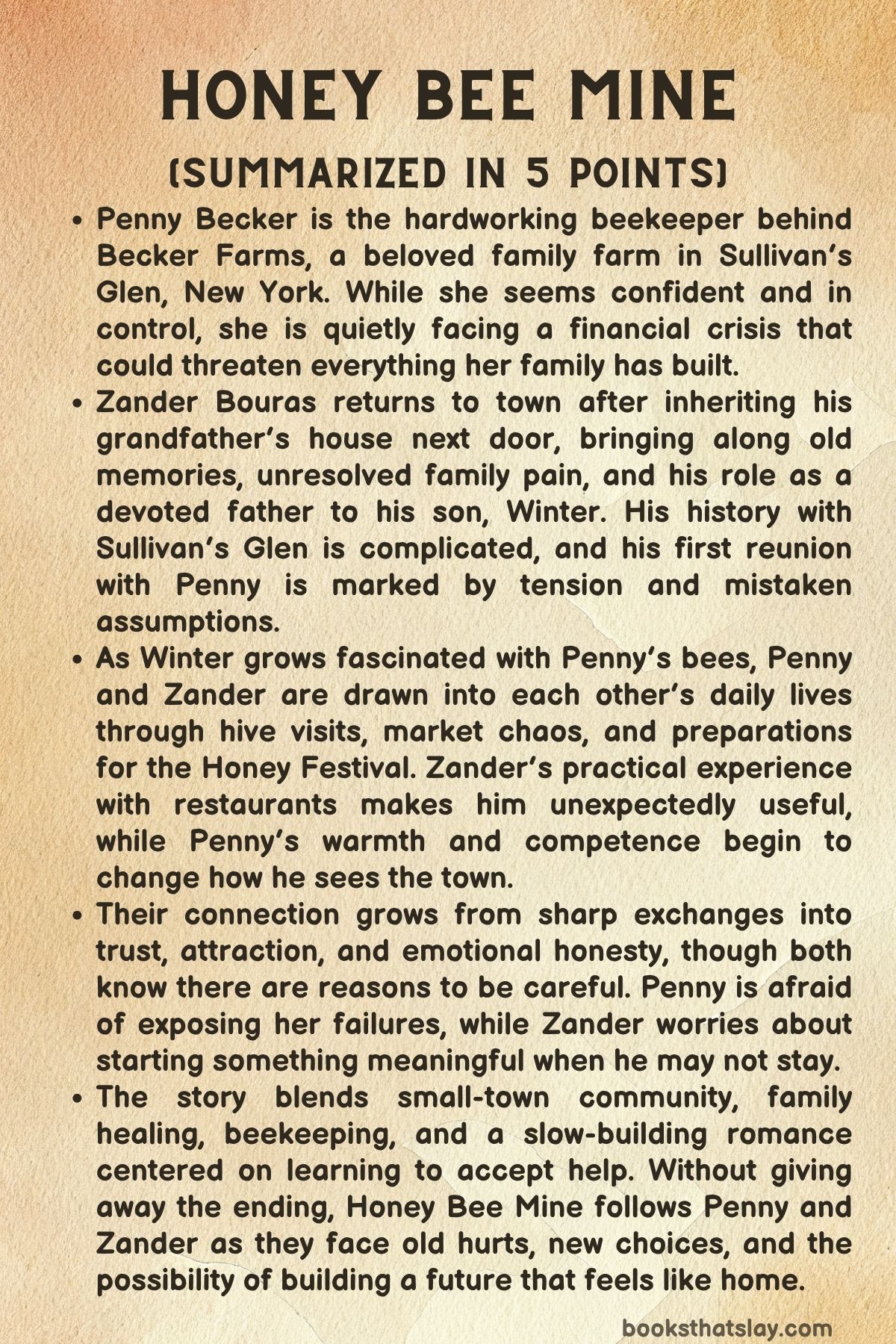
Penny Becker runs Becker Farms in Sullivan’s Glen, a rural town in upstate New York known for its local markets, orchards, honey, and annual Honey Festival. On the surface, Penny looks like the reliable heart of the farm.
She handles the bees, sells produce and honey, manages market days, and prepares for the festival that brings money and attention to the farm each year. Her mother Ruth and grandmother Mimi trust her, and the town sees her as steady and capable.
Beneath that image, Penny is under heavy financial pressure. Her grandmother once transferred ownership of the farm to her, and Penny later used it as collateral for a loan to build a hard cider facility.
The plan had been encouraged by her former partner, Henry, but it collapsed when the contractor vanished with the money. Henry eventually left too, and Penny has been trying to clean up the damage by herself.
Now the farm is close to loan default, and Penny has not told Ruth or Mimi how bad things are.
At the same time, Zander Bouras returns to Sullivan’s Glen after inheriting his late grandfather Nikolai’s house beside Becker Farms. Zander does not come back with affection for the place.
As a teenager, he spent painful summers there after his troubled mother sent him to live with Nikolai, a strict man who never knew how to give Zander the love he needed. Zander now lives in Boston, works in restaurant openings, and co-parents his eleven-year-old son Winter with his ex-wife Mallory.
Mallory’s girlfriend Quinn is also Zander’s best friend. When Mallory comes back to Sullivan’s Glen to help her mother recover from surgery, Zander follows so he can stay close to Winter and decide what to do with his grandfather’s house.
Penny and Zander meet again when he wanders into her bee yard. Their memories of each other are not kind.
Penny remembers him as the angry boy who seemed to hate the town, while Zander remembers her as the perfect local girl his grandfather always praised. Their first exchanges are tense, but Winter becomes fascinated by Penny’s bees.
Zander asks whether Penny will show Winter a hive, and Penny agrees. Before that visit, Zander unexpectedly helps her during a chaotic farmers’ market shift.
He organizes customers, sells products, and handles Brad Preston, an old enemy who tries to bait him with insults about Mallory. Penny sees that Zander is more useful and controlled than she expected, and she gives him her number.
The hive visit changes the way Zander sees Penny. She teaches Winter and Zander about the queen, brood, honey, and the life of the hive, and Winter is delighted by the sight of a baby bee emerging from its cell.
Zander is touched by his son’s wonder and impressed by Penny’s skill. Penny’s best friend and orchard manager, RJ, suggests that Zander help plan the Honey Festival because his restaurant work gives him experience with events, crowds, vendors, and budgets.
Penny resists because she is used to doing things alone, but Zander asks for a chance to prove himself.
When Zander later finds bees in his inherited house, Penny comes to remove them. While she works, they begin to speak more honestly.
Zander admits he disliked her when they were young because she seemed to have the family warmth and approval he never received. Penny admits she wrongly believed he had abandoned Mallory and Winter.
This conversation softens something between them, and they agree to start over. Penny allows Zander to help with one festival task, especially if he also helps RJ think through a baking business.
RJ keeps nudging them together and arranges for Penny and Zander to attend the Fairy Light Magic display. Penny insists it is not a date, but the evening becomes personal.
They talk about parenting, Mallory, Quinn, family expectations, and Penny’s frustration with Ruth’s optimism. Zander reviews the festival finances and quickly sees that Penny has been undercharging vendors and taking on too much risk.
He suggests practical ways to raise more money and reduce expenses. By the end of the night, their attraction is clear, and they share an intense kiss at Penny’s door.
Zander pulls back afterward. He plans to sell the house and return to Boston in two months, and he worries he will become one more person who leaves Penny behind.
Instead of explaining himself, he avoids her messages. Penny is hurt and angry when she finds him meeting with a Realtor.
She confronts him for acting as if he cares while planning to disappear, and she also points out that selling his land could affect her bees and the town. Zander realizes he has handled everything badly.
He goes to her cabin to apologize, and Penny tells him she does not need to be protected from possible disappointment. She explains that she was the one who finally ended things with Henry.
Zander admits that the kiss mattered and that he cannot stop thinking about her. Their argument turns into a passionate encounter, though they stop before going too far because Winter is expected home.
Their relationship becomes more intentional when Zander asks Penny on a real date. He takes her to an abandoned development site overlooking Sullivan’s Glen, where they share champagne and a picnic.
They talk about home, memory, and what their earlier intimacy meant. Before the night can unfold as planned, a local cop named Brad Jeffries interrupts them for trespassing and tries to intimidate Zander.
Penny defends Zander fiercely and uses town gossip about Brad’s secret poker trips to get him to back off. Zander is deeply affected because few people have ever stood up for him.
Penny and Zander agree that what is happening between them is real, even if they still think it may be temporary. They sleep together and grow closer in the days that follow.
Zander becomes woven into Penny’s daily life through festival planning, RJ’s baking plans, time with Winter, and visits with Ruth and Mimi. Winter begins to adjust to Sullivan’s Glen, makes friends, and keeps learning about bees.
For a while, it seems as though Zander, Penny, and their families are creating something that could last.
Still, Penny’s secret financial crisis weighs on her. She receives a notice of default warning that foreclosure proceedings will begin in thirty days.
RJ urges her to tell Zander, arguing that keeping the truth from him prevents him from truly knowing her. Zander senses that something is wrong and pushes gently until Penny finally shows him the notice.
She tells him everything: the failed cidery, the stolen money, Henry’s role, the loan, and her shame. She fears Zander will see her as a failure.
Instead, he reassures her and stands beside her as she tells Ruth and Mimi.
Penny expects anger from her family, but Ruth and Mimi respond with love and resolve. Ruth admits she once made a risky farm decision too, and they agree to face the problem together.
Penny also confesses that, as a child, she felt responsible for her father leaving and spent her life trying to prove she was worth staying for. Ruth apologizes for the jokes and comments that deepened that wound and tells Penny she has always been a gift.
At the same time, Zander enters his grandfather’s room and finds clippings about his restaurant career. He realizes Nikolai had followed his life from a distance, even though he never knew how to show affection openly.
With Mimi’s help, Zander begins to see his grandfather as flawed but not heartless, and he starts to release some of his old bitterness.
Just before the Honey Festival, Mallory and Quinn announce that they are getting married and want to move back to Sullivan’s Glen. Zander is shocked, but they explain that Winter is happy there, they have family nearby, and Zander himself seems happier than he has been in years.
Then disaster strikes: a sinkhole damages part of Main Street, forcing the festival’s cancellation. Penny is crushed because the festival was her best chance to bring in enough money to help save Becker Farms.
Zander distracts Penny the next morning while the town works behind the scenes. When Penny returns, she discovers that the community has moved the Honey Festival to the Becker and Bouras properties.
Vendors, neighbors, hockey players, friends, and family have set up booths, food stations, signs, and demonstrations. Penny sees that the people around her are ready to help, and that saving the farm was never meant to be her burden alone.
During a bee demonstration, Penny reflects on the difference between bees and people. Bees have fixed roles, but humans can change, rest, ask for help, choose love, and build imperfect lives together.
This realization leads her to Zander. She tells him she wants a future with him, even though they had called their relationship temporary.
Zander tells her that he, Mallory, Quinn, and Winter may all move to Sullivan’s Glen. Penny welcomes him home, and they admit they love each other.
Two years later, Penny and Zander are living together in his renovated house. Zander has turned the property into Honeybee Haven, an event venue connected to Becker Farms, which helps refinance the loan and stabilize the farm’s future.
Mallory and Quinn are married, Winter has settled into town life, and Penny and Zander have created a shared home. In the bee yard, Zander proposes by hiding a honey-colored ring in a hive frame.
Penny accepts, asking him to marry her too, and their story closes with love, family, and the farm finally secure.
Characters
Penny Becker
Penny Becker is the emotional center of Honey Bee Mine, and her character is built around responsibility, fear, competence, and the painful habit of carrying burdens alone. On the surface, she is practical, hardworking, and deeply rooted in Becker Farms.
She manages the bees, produce, market work, and Honey Festival with the confidence of someone who knows every corner of her land. However, beneath that capable exterior, Penny is overwhelmed by financial danger and shame.
Her decision to use the farm as collateral for the failed cidery project leaves her trapped between guilt and desperation, especially because the farm is not just property to her; it is family history, identity, and home. Her secrecy shows how deeply she fears disappointing Ruth and Mimi, and how much she has internalized the belief that she must prove herself worthy by being useful, reliable, and unbreakable.
Penny’s emotional conflict is closely tied to abandonment. Her father’s absence shaped the way she sees herself, making her feel as though she had to become perfect enough not to be left behind again.
This explains why she struggles to ask for help even when help is available. Her relationship with Henry worsened this pattern because his encouragement helped lead her into financial risk, and his departure left her feeling alone with the consequences.
Yet Penny is not weak or passive. She is wounded, but she is also decisive, intelligent, and resilient.
When she finally tells her family the truth, her growth becomes clear: she begins to understand that love does not have to be earned through silent sacrifice.
Her relationship with Zander allows another side of her to emerge. At first, she judges him through the lens of old assumptions, seeing him as the difficult boy from the past.
As she gets to know him, she becomes more open, more playful, and more willing to be emotionally vulnerable. Penny’s work with bees also reflects her inner journey.
She understands order, labor, and duty, but by the end of the story, she realizes that humans are not meant to live like bees with fixed roles and endless productivity. Her growth lies in accepting rest, love, partnership, and community.
Penny becomes a character who learns that saving a home does not mean saving it alone.
Zander Bouras
Zander Bouras is one of the most emotionally complex figures in the book because his sharpness and defensiveness are rooted in years of rejection, loneliness, and misunderstood grief. When he returns to Sullivan’s Glen, he brings with him resentment toward the town, his grandfather’s house, and the memories of his difficult teenage summers.
As a boy, he felt unwanted by his mother and judged by Nikolai, and Penny became part of that pain because she seemed to represent everything he lacked: approval, family warmth, and belonging. His hostility toward the past is therefore less about the town itself and more about the wounded version of himself that still lives there.
Zander’s character is defined by contradiction. He is prickly but deeply caring, guarded but emotionally perceptive, afraid of commitment but devoted to his son.
His relationship with Winter reveals his best self. He is determined to break harmful family patterns and become the kind of father he never had.
Even when he doubts himself, his concern for Winter is sincere and constant. His co-parenting relationship with Mallory and his friendship with Quinn also show maturity.
He is not a traditional romantic hero isolated from everyone else; he is part of a complicated but loving chosen-family structure.
His romance with Penny forces him to confront his fear of becoming someone who leaves. Because he plans to sell the house and return to Boston, he believes getting involved with her might hurt her.
However, this fear also becomes a form of avoidance. Penny challenges him to stop making choices for her under the excuse of protecting her.
Through her, Winter, Mallory, Quinn, and the discoveries about Nikolai, Zander begins to reinterpret his past. Finding evidence that his grandfather followed his career helps him understand that love can exist imperfectly, even when it was not expressed in the way he needed.
By the end of Honey Bee Mine, Zander’s arc is one of coming home emotionally as well as physically. He stops seeing Sullivan’s Glen as a place of rejection and begins to see it as a place where he can build love, family, and permanence.
Winter Bouras
Winter Bouras is an important character because he brings innocence, curiosity, and emotional honesty into the story. As Zander and Mallory’s eleven-year-old son, Winter is caught between households, locations, and adult decisions, yet he is not written as merely a background child.
His fascination with Penny’s bees creates one of the earliest bridges between Penny and Zander, allowing them to interact in a softer, more open way. Through Winter’s excitement, Zander sees Penny’s patience and skill, while Penny sees Zander’s tenderness as a father.
Winter’s frustration about being away from his friends also gives emotional depth to his character. He is curious and adaptable, but he is still a child who feels disruption strongly.
His outburst about isolation reminds Zander that good intentions do not erase a child’s loneliness. At the same time, Winter’s eventual friendships with Jazz and Adam show that he is capable of finding belonging in Sullivan’s Glen.
His adjustment helps make the possibility of staying feel real rather than forced.
Winter also serves as a quiet measure of Zander’s growth. Zander’s fear of repeating family damage is strongest around his son, and Winter’s happiness becomes one of the reasons Zander begins to imagine a different future.
Winter’s interest in bees connects him to Penny’s world and symbolizes the blending of families. By the end of the book, his settled life in Sullivan’s Glen reflects the healing of the adult relationships around him.
Mallory
Mallory is a stabilizing and emotionally generous presence in the story. As Zander’s ex-wife and Winter’s mother, she could easily have been presented as a source of conflict, but instead she represents maturity, cooperation, and chosen family.
Her relationship with Zander is not romantic anymore, yet it is still built on care, honesty, and shared responsibility. Their co-parenting arrangement shows that family can change shape without losing its emotional value.
Mallory’s return to Sullivan’s Glen begins as an act of duty toward her mother, but it gradually becomes part of a larger reconsideration of home. Her decision to marry Quinn and possibly move back to town affects Zander deeply because it opens a future he had not allowed himself to imagine.
Mallory understands Zander well enough to see that he is happier in Sullivan’s Glen than he admits. Her role is therefore not only practical but also perceptive.
She helps reveal truths Zander resists.
Mallory’s character also broadens the emotional world of the story. She is not defined by jealousy or bitterness, and her support of Zander’s happiness with Penny reinforces the book’s belief in generous love.
Through Mallory, the story shows that past relationships do not have to remain wounds; they can become foundations for new forms of family.
Quinn
Quinn is Zander’s best friend and Mallory’s partner, and her role is especially important because she understands Zander’s emotional defenses without enabling them. She is direct, warm, and clear-eyed.
When Zander panics about his feelings for Penny, Quinn reminds him that Penny is capable of making her own choices. This advice matters because Zander often hides behind the idea that he is protecting others, when he is actually protecting himself from vulnerability.
Quinn’s presence gives Zander a safe place to be uncertain. He can call her about what to wear, what to do, and whether he is being unfair, which reveals a softer and more anxious side of him.
She functions as a voice of emotional reason, but she is not merely there to advise him. Her relationship with Mallory and her place in Winter’s life make her part of the story’s broader vision of family as something chosen, flexible, and deeply supportive.
Quinn also helps normalize the idea that love does not need to follow a single traditional structure. She belongs naturally within Zander, Mallory, and Winter’s family circle, and her decision with Mallory to marry and move back to Sullivan’s Glen helps create the conditions for Zander’s own future there.
Her character adds warmth, humor, and emotional steadiness to the book.
RJ
RJ is Penny’s best friend, orchard manager, and one of the story’s most effective catalysts. He knows Penny well enough to see when she is hiding pain, and he is bold enough to interfere when he believes she needs help.
His decision to suggest that Zander assist with the Honey Festival is not casual; it is his way of pushing Penny toward support she would not seek on her own. RJ understands that Penny’s independence has become dangerous because it keeps her isolated.
His own baking ambitions also give him dimension beyond being Penny’s friend. Zander’s help with RJ’s baking business creates another thread of growth and community, showing how one person’s skills can strengthen many lives.
RJ is practical, loyal, and emotionally observant. He sees the chemistry between Penny and Zander before Penny is ready to admit it, and he nudges them together without reducing either of them to a joke.
RJ’s friendship with Penny is important because it is grounded in truth. He does not simply comfort her; he challenges her.
When he urges her to tell Zander about the default notice, he is pointing out that love requires being known, not merely being admired. Through RJ, the story emphasizes that friendship can be an active force of rescue, honesty, and growth.
Ruth Becker
Ruth Becker, Penny’s mother, is a loving but sometimes frustrating figure because her optimism can feel painful to Penny while Penny is secretly drowning in fear. Ruth’s desire to take a vacation and speak hopefully about life seems disconnected from the farm crisis, but this is partly because Penny has kept her in the dark.
Ruth is not careless; she simply does not know the full truth. This gap creates tension between mother and daughter, especially because Penny has long believed she must protect Ruth and Mimi from disappointment.
Ruth’s most important moments come when Penny finally reveals the danger facing Becker Farms. Instead of responding with anger, Ruth responds with compassion.
This reaction transforms Penny’s understanding of family. Ruth admits that she too once made a risky farm decision, which helps Penny see that mistakes do not make her unworthy.
Ruth’s apology for joking about Penny’s absent father is also crucial because it addresses a wound Penny has carried since childhood.
Ruth represents imperfect but genuine maternal love. She may not always see Penny’s pain clearly, but when the truth is placed before her, she chooses tenderness.
Her character helps Penny realize that she was never a burden to be endured or a problem to be solved. She was always loved.
Mimi
Mimi, Penny’s grandmother, represents memory, continuity, and the deep roots of Becker Farms. Her earlier decision to transfer ownership of the farm to Penny shows trust, but it also places emotional weight on Penny’s shoulders.
Mimi’s presence reminds readers that the farm is more than a business. It is a family inheritance, a living history, and a place shaped by generations of labor and love.
Mimi is also important because she connects the Becker and Bouras family histories. Her memories of Nikolai reveal that he was not always cold, and that grief changed him after the death of his wife.
This insight helps soften Zander’s view of his grandfather, not by excusing Nikolai’s emotional failures, but by making him more human. Mimi understands that people are shaped by love and loss, and her perspective allows Zander to begin grieving in a more complicated and honest way.
In Penny’s life, Mimi offers steadiness. Like Ruth, she responds to Penny’s confession with compassion rather than condemnation.
Her character reinforces one of the central emotional lessons of the story: family love is not proven by perfection but by the willingness to face hardship together.
Nikolai Bouras
Nikolai Bouras is physically absent for most of the story, but his influence over Zander is powerful. As Zander’s grandfather, he represents a painful mixture of discipline, emotional distance, and hidden care.
Zander remembers him as stern and judgmental, especially because Nikolai compared him to Penny and made him feel like a failure. Those memories shaped Zander’s resentment toward Sullivan’s Glen and contributed to his belief that he was unwanted.
However, the later discoveries about Nikolai complicate that image. The clippings about Zander’s restaurant career reveal that Nikolai followed his life from afar.
This does not erase the harm caused by his coldness, but it suggests that he cared in ways he could not express. Mimi’s memory of Nikolai as a man changed by grief also gives context to his emotional hardness.
He becomes a tragic figure, not because he was cruel without reason, but because he allowed grief to narrow his ability to love openly.
Nikolai’s character matters because he forces Zander to confront the difference between understanding someone and excusing them. Zander deserved more warmth than he received, but he also begins to see that his grandfather’s failures were not proof that he was unloved.
This realization becomes part of Zander’s healing and helps him choose a different kind of family life.
Henry
Henry is Penny’s ex-partner and an important figure in her backstory because he is tied to the failed cidery project and the financial crisis threatening Becker Farms. He encouraged the idea that led Penny to take a major risk, and after the contractor disappeared with the money, Henry eventually left.
His departure intensified Penny’s sense of abandonment and failure, making her feel as though she had been foolish not only financially but emotionally.
Yet Henry’s role is not simply that of a villain. He represents the kind of relationship in which Penny was not fully supported when consequences became real.
His absence leaves Penny alone with the debt, shame, and fear of losing the farm. This is part of why Zander worries about becoming another man who walks away from her.
Henry’s shadow hangs over Penny’s ability to trust, but Penny’s confession that she was the one who finally ended things shows her strength. She was not merely abandoned; she made a choice to stop accepting a relationship that no longer served her.
Henry’s importance lies in what he reveals about Penny’s growth. He belongs to the version of her life where she confused endurance with love and secrecy with responsibility.
Moving beyond him allows Penny to accept a relationship built on honesty, partnership, and mutual care.
Brad Preston
Brad Preston functions as a small but revealing antagonist in the book. His attempt to provoke Zander at the farmer’s market shows that some people in Sullivan’s Glen still view Zander through the narrow lens of his teenage reputation.
Brad’s insults about Mallory are designed to humiliate and destabilize him, but Zander’s calm response shows how much self-control he has developed.
Brad’s scene is important because it allows Penny to see Zander differently. Instead of the hostile former bad boy she expected, she sees someone capable, composed, and protective without being aggressive.
Zander organizes the market crowd, helps sales, and refuses to take Brad’s bait. In that sense, Brad’s antagonism accidentally helps Penny recognize Zander’s maturity.
Brad also represents the judgmental side of small-town memory. Sullivan’s Glen can be loving and communal, but it can also hold onto old stories about people.
Through Brad Preston, the story shows how difficult it can be for someone like Zander to return to a place where others still expect him to be the person he once seemed to be.
Brad Jeffries
Brad Jeffries, the local cop who interrupts Penny and Zander at the abandoned development site, serves as another figure of intimidation and small-town power. His confrontation with Zander could have reinforced Zander’s old belief that Sullivan’s Glen is a place where he will always be judged and cornered.
Instead, the scene becomes a turning point because Penny fiercely defends him.
Brad Jeffries is less important as a fully developed character than as a pressure point. He creates the situation in which Penny proves, through action, that she sees Zander as worthy of protection and respect.
Her willingness to challenge Brad and use gossip about his poker trips shows her boldness, loyalty, and refusal to let Zander be treated unfairly.
For Zander, this moment is deeply emotional because he is not used to having someone stand up for him. Brad’s role therefore helps reveal the depth of Zander’s loneliness and the significance of Penny’s love.
The scene strengthens their bond because it gives Zander an experience he has long needed: being chosen publicly and defended without hesitation.
Jazz
Jazz is a minor but meaningful character because of her connection to Winter’s adjustment in Sullivan’s Glen. Winter’s loneliness is one of Zander’s major concerns, and Jazz’s friendship helps show that Winter can build a life in the town rather than merely endure his time there.
Her presence supports the story’s larger movement toward belonging.
Although Jazz does not have a large individual arc, she matters because she helps make Sullivan’s Glen feel like a real community for the younger generation as well as the adults. Through Winter’s friendship with Jazz, the possibility of staying becomes more emotionally believable.
She helps show that home is not only where adults decide to settle, but where children can find friendship, comfort, and joy.
Adam
Adam, like Jazz, is a minor character whose importance comes through his friendship with Winter. His presence helps Winter feel less isolated and gives Zander evidence that Sullivan’s Glen may be good for his son.
Adam contributes to the gradual shift from temporary stay to possible home.
Adam’s role also supports the theme of community. The story does not make Winter’s adjustment depend only on adults solving problems for him.
Instead, friendship with other children helps him form his own connection to the town. Adam may not occupy much space in the plot, but he helps complete the picture of Sullivan’s Glen as a place where the Bouras family can belong.
Themes
The Burden of Self-Reliance
Penny’s life is shaped by the belief that love must be earned through usefulness, strength, and constant responsibility. Her management of the farm is not only practical work but also emotional proof that she deserves the trust her grandmother placed in her.
Because of this, the financial crisis becomes more than a business problem; it becomes a private judgment on her worth. She hides the default notice from Ruth and Mimi because admitting the truth feels like admitting personal failure.
Her silence shows how self-reliance can become harmful when it grows from fear rather than confidence. Penny is capable, hardworking, and intelligent, but her need to carry every burden alone cuts her off from the very people who would support her.
Her growth comes when she realizes that accepting help does not make her weak. The relocated Honey Festival becomes a powerful sign of this change: the farm is saved not by one person’s endurance, but by shared effort, love, and community.
Healing from Abandonment and Old Hurt
Both Penny and Zander carry wounds from being left behind, though they respond to them differently. Penny internalizes her father’s absence and turns it into a lifelong need to prove she is not a burden.
Zander, shaped by his mother’s instability and his grandfather’s emotional distance, protects himself through sarcasm, distance, and the assumption that rejection is inevitable. Their early misunderstandings come from these old hurts: Penny sees Zander as careless, while Zander sees Penny as someone who had everything he lacked.
As they begin speaking honestly, they discover that neither person’s surface image tells the full truth. In Honey Bee Mine, healing does not happen through sudden forgiveness, but through being seen accurately by another person.
Penny stands up for Zander when others reduce him to his past, and Zander helps Penny face the farm crisis without shame. Their relationship becomes a place where old stories can finally be corrected.
Home as a Choice, Not Just a Place
Sullivan’s Glen begins as a complicated place for Zander because it is tied to loneliness, judgment, and memories of feeling unwanted. For Penny, the farm is home, but it is also a responsibility so heavy that it nearly traps her.
The story gradually changes the meaning of home for both of them. Zander’s return is supposed to be temporary, centered on selling his grandfather’s house and going back to Boston.
Yet his growing bond with Winter, Mallory, Quinn, Penny, and the town gives him a new way to understand belonging. Penny also has to learn that home is not preserved by sacrifice alone.
It needs openness, adaptation, and shared care. By the end, home becomes something actively chosen rather than merely inherited.
Zander’s decision to stay and transform the property into Honeybee Haven shows that a painful past does not have to define a place forever. Home becomes possible when people build trust inside it.
Love as Partnership and Accountability
Romantic love in Honey Bee Mine is not treated as escape from problems, but as a force that asks both characters to become more honest. Penny and Zander’s attraction is immediate, but the deeper strength of their relationship comes from practical support, emotional accountability, and mutual respect.
Zander does not simply admire Penny’s strength; he notices when that strength is hurting her and pushes her to stop hiding. Penny does not simply comfort Zander; she challenges the unfair judgments surrounding him and insists that he deserves to be defended.
Their love grows through planning, parenting conversations, festival work, family honesty, and difficult disclosures. This makes the relationship feel grounded rather than idealized.
The “temporary” agreement fails because their connection keeps creating real responsibilities and real hope. By choosing a future together, they move beyond passion into partnership.
Their ending is meaningful because it is built on shared labor, truth, family, and the willingness to stay.