Hopelessly Teavoted Summary, Characters and Themes
Hopelessly Teavoted by Audrey Goldberg Ruoff is a romantic contemporary fantasy set in the quirky, ghost-touched town of Hallowcross, Vermont. The story follows Azrael Hart, a young witch grieving his past and the parents he’s lost, and Victoria “Vickie” Starnberger, a devil-kissed medium trying to reclaim her own life after years under her wealthy family’s control.
When Azrael returns home and Vickie buys the local tea shop once run by his mother, their paths collide again. Amid strained history, unresolved feelings, magical debts, and a rising threat tied to a corrupt megachurch, the two must face danger and their long-buried love.
Summary
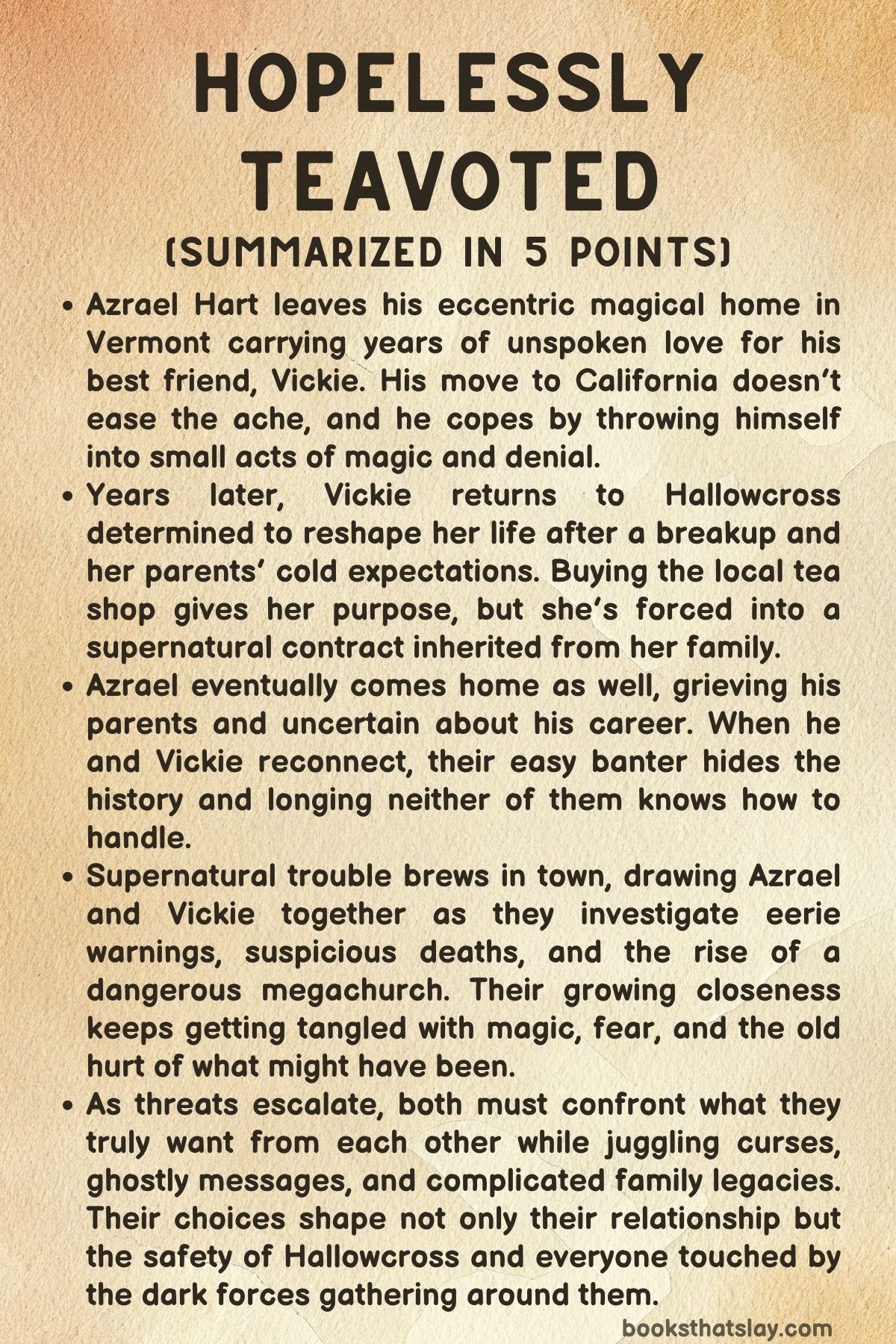
Azrael Hart grows up in Hallowcross beside his best friend, Vickie Starnberger. Though he loves her deeply, he leaves for college in California without ever confessing, managing only a stiff handshake before their paths separate.
At nineteen he enters adulthood alone, carrying embarrassment over that farewell and the quiet ache of never saying what he felt. His family home, Hart Manor, remains full of witchcraft, traps, and supernatural mischief, yet he chooses independence and distance.
On the way to California he uses subtle magic to comfort strangers, repeating to himself that he is fine even when he knows he isn’t.
Years later, in the present, Vickie returns home after being dumped by her shallow musician boyfriend. Her parents, wealthy and controlling, value social status more than her emotional well-being.
They demand she use her inherited medium gift to summon a dead man named Kyle George using bloody cuff links. Kyle appears long enough to provide a password and warn about strange activity at the megachurch Brethren of One Love.
When the summoning ends, Vickie announces her real plan: she wants to drop out of school and buy Hopelessly Teavoted, the town tea shop once run by Azrael’s late mother. Her parents refuse and threaten to sever her from their wealth.
Vickie expected the reaction and leaves to secure a loan on her own terms. She succeeds and becomes the tea shop’s new owner.
Outside the shop, she is confronted by Olexandre (Lex), a devil with whom her parents once bargained. Because they disinherited her, their contract transfers to her.
She owes three souls by Halloween, all previously deceased, and she must reap them. If she fails, she becomes bound to the contract for a decade.
Lex warns her to avoid objects tied to lingering spirits until her debt is fulfilled.
Meanwhile, Azrael returns to Hallowcross after years away. His screenwriting career has collapsed, his finances are strained, and both his parents have recently died.
He moves back into Hart Manor with his chaotic younger sister Priscilla. While wandering town in his grief, he ends up at Hopelessly Teavoted and reunites with Vickie.
Their conversation is awkward and tender, and old emotions rise to the surface. He reveals he will be teaching English at the high school; she admits she dropped out and bought the shop.
They part with more unsaid between them.
Vickie later meets Priscilla for drinks and learns Priscilla hopes to push her and Azrael back together. They discuss the ghost’s warning about the megachurch and Vickie’s inherited devil’s contract.
Priscilla suggests Vickie trust Azrael with the truth, though Vickie insists they can only be friends, still haunted by their painful college history.
Days later, Azrael visits the shop again, forgetting it is Sultry Sunday, when customers dress in flirtatious outfits. Seeing Vickie in lingerie rattles him.
He tries to help an elderly man with magic, struggles with a rude customer who happens to be his new department chair, and ends up spilling coffee on himself. Vickie tends to him gently.
They decide to talk after closing, but memories, grief, and attraction keep tugging at them. When the shop empties out, Vickie slips on the floor and Azrael catches her, leading to a charged moment he quickly pulls away from.
She pushes through the awkwardness and invites him to the back office. There, while preparing ingredients, Az asks for her help summoning his deceased parents.
As a devil-kissed medium, she can do so safely. She agrees.
The ritual succeeds. Through Vickie, Az hears his parents’ final messages of love and pride.
They warn both of them about the suspicious megachurch and the dangers surrounding Madam Cleopatra, a local psychic. They also reveal Vickie’s accidental encounter with a devil and the contract binding her.
As the objects burn away, Az says “I love you,” meant for his parents, though Vickie hears it differently. When the spirits vanish, the two collapse into each other, nearly kissing before stopping themselves.
Soon after, an attack at Hart Manor sends Azrael and Vickie deeper into the ongoing mystery. Someone has vandalized the greenhouse using a symbol connected to the megachurch.
In the shed, Vickie accidentally summons Azrael’s father again, who warns her that a dangerous figure in Hallowcross has struck a deal with a greater devil. The group investigates further using the Hart family grimoire.
When the manor magically traps them in a romantic setting, they choose to “pretend” for the sake of comfort, sharing a dance. Az reveals there is a soul-sealing ritual that could allow them to touch safely despite her curse.
He would do it if she wished. She remains uncertain but moved.
A tracing spell points them toward Havenwall instead of the megachurch. On the road there, Vickie summons Az’s parents again.
They warn that a man in town made a flawed bargain with a greater devil and will seek a witch’s soul on Halloween. This is the final time the pair can communicate with the spirits.
Az begins tracking his coworker Chet Thornington, suspecting him of involvement. Vickie, meanwhile, realizes she has loved Azrael all along and fears losing him to the Council if they discover the threat.
When they reunite at Hart Manor, she tells him plainly that she chooses him. They plan to perform the sealing ritual after confronting the villain.
They break into the megachurch with Priscilla and Evelyn and discover Chet, who has bargained with Lucifer (calling himself Frankie) for the ability to steal souls. He attacks them with protection magic.
Vickie summons the ghost of Chet’s father, who reveals the anchor to Chet’s shield: a lighter. She destroys it.
Az knocks Chet unconscious, but Lex arrives and allows Azrael a fair duel. Az wins, and Vickie reaps Chet’s soul, burning the object tying it to his body.
With three souls collected, Lex dissolves the devil’s curse and frees Vickie from her parents’ debt.
Back home, Azrael and Vickie perform the sealing spell among fire and glass. For the first time, they can touch without danger.
They confess everything they once hid and finally come together fully.
A year later, Vickie runs her flourishing tea shop. Azrael teaches English and enjoys a calm, magical life at her side.
Their love, once delayed by fear and unfinished moments, becomes the steady center of their everyday world.
Characters
Azrael Hart
Azrael is the emotional center of Hopelessly Teavoted, a young witch whose life is shaped by longing, loyalty, and loss. From childhood, his love for Vickie defines him, yet his crippling self-doubt prevents him from ever voicing it at the moments that matter most.
His awkwardness—shaking her hand instead of confessing his feelings, overthinking texts, panicking at physical intimacy—comes from a lifelong habit of trying to protect others from the darkness of his own emotions. After the death of his parents, Azrael is a mixture of hollow grief and fierce tenderness.
He uses magic compassionately, subtly easing strangers’ pain even as he carries his own. His return to Hallowcross forces him to face the past he has avoided: the unresolved heartbreak involving Vickie, the painful silence between them, and the loneliness that haunts Hart Manor.
Despite his anxieties, Azrael is deeply brave. He welcomes the chance to speak to his parents one last time, even though it shatters him emotionally.
He faces down supernatural threats, physical danger, and ultimately confronts Chet in a duel that blends desperation with the courage of someone who has spent years running from himself but refuses to run anymore. His love for Vickie is unwavering—gentle, patient, selfless.
Even when the curse makes her touch deadly, he won’t pressure her for the sealing spell, choosing instead to wait for her decision. His character arc is a slow unfurling of suppressed emotion into open vulnerability.
By the end of the novel, Azrael becomes someone who can claim the life and love he has always wanted, not by transforming into a different person, but by accepting that he is worthy of happiness and that home is not a place, but Vickie.
Victoria “Vickie” Starnberger
Vickie is a character defined by boldness, buried hurt, and a stubborn desire for a life shaped on her own terms. Growing up under cold, appearance-obsessed parents who treat her magical gift as a tool rather than a talent, she has spent years fighting for autonomy.
Her breakup with Robbie barely stings because her heart has always been tethered elsewhere—to Azrael, though she spends much of the novel convincing herself otherwise. Her purchase of the tea shop is a declaration of independence, a refusal to let wealth, pedigree, or her parents’ expectations script her life.
She is pragmatic yet impulsive, compassionate yet guarded, someone who masks fear with sarcasm and insecurity with competence.
Her gift—summoning ghosts through objects they loved—makes her one of the most emotionally attuned characters in the story. She carries the weight of death with nuance: respect, empathy, and a tinge of exhaustion.
When Lex transfers her parents’ devil bargain to her, she treats it not as a melodramatic doom but as another responsibility she will shoulder to survive. Her attraction to him is complicated by both fear and curiosity, but her heart never wavers from Azrael.
Their history—particularly the wound he inflicted unintentionally in college—shadows their every interaction, making her cautious. But as the story progresses, Vickie evolves from someone who reacts to her circumstances into someone who claims them.
She chooses Azrael, chooses the sealing spell, chooses love that is terrifyingly permanent. In doing so, she finally steps into a life she built herself, not one forced upon her.
Priscilla Hart
Priscilla—Prissy—is the chaotic brilliance of the Hart family distilled into a single person. Mischievous, sharp-tongued, fiercely loyal, she hides a deep emotional intelligence beneath her pranks and dramatic flair.
Her grief over their parents manifests differently from Azrael’s; instead of collapsing inward, she becomes more protective and more determined to keep the people she loves connected. She pushes Vickie and Azrael back toward each other not out of meddling for its own sake, but because she sees clearly what they try so hard to hide.
Her magic is powerful, sometimes unpredictable, but always grounded in genuine care. Priscilla serves as both comic relief and emotional anchor.
When danger arises, she reacts with confidence and fury, and her resilience becomes vital to the climax—particularly when she is attacked by Chet. Her presence reminds the reader that grief does not always look fragile; sometimes it looks like laughing too loudly, smoking on the porch, or refusing to let the people you love keep lying to themselves.
Benedict and Persephone Hart
Azrael’s parents are the warm, loving ghosts who linger in spirit and memory. In life, they were eccentric, nurturing witches whose home brimmed with love disguised as haunted chaos.
Even after death, they remain guides, protectors, and the steady reassurance Azrael desperately needs. Their summoning scene is one of the most emotional moments in the book—five fleeting minutes in which they wrap their son in the love he spent years aching for.
They offer warnings about the megachurch, comfort Vickie, tease their children, and express pride without hesitation. Their final vanishing is heartbreaking, not because they are gone, but because they use those last moments to remind Azrael that he has never been alone.
Their presence gives the story its emotional backbone and sets both Azrael and Vickie on the path to confront the danger stalking Hallowcross.
Amelie and Maximillian Starnberger
Vickie’s parents are a chilling contrast to the Harts. Wealthy, calculated, and emotionally distant, they treat their daughter as an accessory to their reputation.
Their coldness shapes Vickie’s independence; she has learned to expect neither warmth nor approval, only demands. Their willingness to involve her in devil bargains for family gain reveals the extent of their moral decay.
When they disown her for choosing the tea shop and walking away from their expectations, they do so without hesitation or guilt. Their influence explains Vickie’s reluctance to trust love, her determination to build her own life, and her complicated reaction to Lex’s devilish flirtations.
They are not villains in the magical sense, but they are dangerous in the quieter, more real way that emotional negligence wounds a child long after childhood ends.
Olexandre “Lex”
Lex is the seductive, sardonic devil who brings a dangerous charm to the narrative. Neither purely evil nor remotely trustworthy, he operates by the logic of deals, bargains, and cosmic fine print.
He enjoys pushing boundaries, teasing mortals, and finding entertainment in human emotions. His fascination with Vickie is genuine enough to give their interactions a crackling tension, but his priorities never waver: contracts must be fulfilled, debts must be paid, and souls are currency.
What makes Lex compelling is that he is not malicious so much as otherworldly. He sees humans as interesting puzzles rather than moral beings.
Yet he is not immune to being impressed; Vickie’s resourcefulness and Azrael’s determination earn his respect. His undoing of the curse at midnight feels less like an act of kindness and more like a bemused nod to a contract fulfilled—though one senses that he, too, finds satisfaction in watching the love story he inadvertently complicated finally resolve.
Chet Thornington
Chet is the human face of monstrous ambition. Arrogant, bullying, and resentful, he hides a greedy hunger for power beneath the veneer of a demanding educator.
His deals with Lucifer—made for protection, dominance, and freedom from consequences—turn him into something predatory. He becomes a soul-stealer not out of desperation, but entitlement, believing he deserves the power no matter the cost.
His cruelty emerges in his treatment of Azrael at work, in the shield that repels magic, and in his attack on Priscilla. Yet his downfall is shaped by the same flaw that drives him: he underestimates others, particularly Vickie.
His duel with Azrael—and the irony that his own father’s ghost helps defeat him—cements him as a character destroyed not by darkness alone, but by his belief that he could act without ever being held accountable.
Evelyn Hart
Evelyn is the competent, level-headed witch who brings structure to the chaos of Hallowcross. As a member of the Witchery Council, she carries the weight of responsibility, and her magic is both practical and powerful.
She cares deeply for her siblings and, even when stern, shows her love through protection and action. Evelyn’s role in the investigation of the megachurch ties the supernatural plotlines together, and her steady presence balances the volatility of magic, grief, and romantic tension swirling around the protagonists.
She embodies the part of the Hart legacy that is disciplined and wise, and she plays an essential role in both guiding and safeguarding the family.
Hank Dewey
Hank is a minor but emotionally resonant character—a widower whose grief is soothed briefly by Azrael’s magic. His presence highlights one of Azrael’s defining traits: he cannot stop himself from helping others, even when his own heart is in pieces.
Hank’s warmth toward Azrael and the tenderness of that moment contrast with the coldness of Vickie’s parents and the hostility of Chet, reminding the reader that Hallowcross is full of ordinary people whose lives brush quietly against the supernatural.
Hazel
Hazel adds levity and grounded friendship to the book. Her teasing remarks during key emotional moments between Azrael and Vickie offer comic relief without undermining the stakes.
She is the kind of friend who sees everything, says little, and supports much. In the world of witches, devils, and deadly curses, Hazel represents the townsfolk’s perspective—amused, lightly bewildered, and always ready with a joke to push tension into humor.
Themes
Love Complicated by Fear, Timing, and Miscommunication
Romantic longing in Hopelessly Teavoted is shaped not by dramatic declarations but by years of hesitation, private yearning, and conflicting emotional needs. The story presents love as something that persists even when the individuals involved spend years moving in opposite directions.
Azrael’s lifelong affection for Vickie is sincere but tangled in anxieties about rejection, physical boundaries, and a fear of losing the closeness they already share. His silence on the day he leaves for college becomes the defining fracture that influences everything that follows, teaching him to treat desire as dangerous rather than liberating.
Vickie carries her own history of longing, paired with the frustration of never receiving clear emotional signals from Az, and this leaves her convinced that admitting her love will only repeat the hurt of the past. Their relationship grows from shared history, mutual grief, and unspoken expectations, and because of that, every moment between them is weighted with what hasn’t been said.
As adults, the curse tied to Vickie’s bargain introduces a literal danger to touch, transforming the metaphorical emotional distance of their youth into a tangible threat. Their conversations become cautious negotiations around longing, and even small gestures—hands hovering close, a nearly-kiss through plastic—gain emotional force.
Love becomes something they must rebuild slowly, with honesty replacing the quiet misunderstandings that once kept them apart. By the time they choose each other fully, their connection is shaped not by dramatic passion alone but by years of internal conflict, apologies, vulnerability, and a shared willingness to confront their fears.
The novel frames love not as a single transformative moment but as an ongoing reckoning with past mistakes, present limitations, and the courage required to finally stop pretending.
Grief, Memory, and the Burden of Unfinished Goodbyes
Grief permeates the story as a companion rather than a temporary emotional event. Azrael’s return to Hallowcross is shaped by the heaviness of his parents’ deaths and the loneliness that settles into his routines long before he comes home.
His grief is tied to unfinished conversations, unsent letters, and the guilt of having built a life far away while his parents continued their magical eccentricity without him. Their absence becomes an invisible presence in every corner of Hart Manor, making the house feel less like a sanctuary and more like a monument to everything he wishes he had said earlier.
Small tasks—walking through rooms, touching old objects, enduring the house’s quirks—remind him repeatedly that memory can comfort and wound in equal measure.
Vickie’s relationship with spirits complicates her own experience of grief. She summons the dead as part of her talent, but the ability offers no relief when it comes to the people she has lost or the connections she wishes she could restore.
Her interactions with spirits highlight how memory can give clarity, warnings, or affection, yet can disappear in seconds when an object burns away. The five-minute conversation Azurel receives with his parents captures this idea: closure is precious, temporary, and rarely complete.
Their final ghostly appearance in the car underscores how grief evolves rather than disappears.
For both characters, grief shapes how they love, how they hesitate, and how they protect others. It reminds them that time is finite and choices matter, and it ultimately becomes the emotional catalyst that pushes them toward honesty.
The novel portrays grief not as darkness but as a force that teaches the living how to move forward with tenderness, memory, and renewed purpose.
Autonomy, Identity, and the Fight Against Parental Control
The novel presents a striking contrast between chosen identity and inherited obligation. Vickie’s entire life is shaped by the expectations of her wealthy, status-driven parents, who treat her abilities as transactional tools rather than personal gifts.
Her desire to own Hopelessly Teavoted is not simply a career decision—it is her attempt to craft an identity independent of the people who believe they have the right to dictate her future. Her parents’ attempt to block her ownership of the shop illustrates how deeply rooted their control is, extending into financial threats and legal maneuvers.
Their past deal with Lex, which transfers to Vickie without her consent, becomes the clearest metaphor for inherited burdens: she is literally forced to pay a debt created by the generation before her.
Azrael’s identity crisis is quieter but equally important. Returning home broke and emotionally depleted, he grapples with the fear that he has failed both himself and his family.
Teaching at Hallowcross High feels like settling, even though it becomes one of the first stable pieces of his life after years of drifting. The expectations he places on himself—being a good witch, a good son, a good partner—often paralyze him more than the expectations of others.
Both he and Vickie spend the story learning how to define themselves based on what they want rather than what others demand.
Their intertwining arcs show autonomy as a practice rather than a final achievement. Vickie’s purchase of the tea shop, her defiance against her parents, her willingness to face dark magic, and Azrael’s gradual acceptance of his own strengths all reveal that identity is built through uncomfortable choices.
The story ultimately suggests that freedom is earned not by escaping one’s origins but by deciding which parts of them deserve to be carried forward.
Power, Responsibility, and the Moral Complexity of Magic
Magic operates as an extension of personality and ethics in the story, revealing the moral character of the people who wield it. Azrael’s small everyday spells—cooling an airplane, soothing children, repairing electronics—reflect his instinctive desire to care for others while ignoring his own emotional needs.
His magic is unpretentious, gentle, and largely unnoticed, which mirrors how he often undervalues himself. Conversely, Vickie’s power to summon spirits forces her into situations where responsibility becomes unavoidable.
Every spirit she calls arrives with its own grief, warnings, or unfinished business, and she must balance compassion with pragmatism.
The devil’s bargain introduces a different form of power: one rooted in consequences rather than capability. Vickie is required to reap souls, but the moral weight of each choice is influenced by context.
The souls she must claim are already dead, but the responsibility still feels heavy because she becomes the instrument through which lingering ties are severed permanently. Her discomfort shows how magic amplifies ethical dilemmas rather than resolving them.
Chet’s arc illustrates magic corrupted by desire and entitlement. He enters a pact seeking shortcuts to power, protection, and status—traits that already defined his behavior long before he made a deal with a greater devil.
His shield, his soul-bound objects, and his manipulation of the megachurch reveal a hunger for dominance, not survival. His story makes clear that the danger comes not from magic itself but from the intentions behind it.
Throughout the novel, magic becomes a lens through which responsibility is negotiated—whether it is the responsibility to help strangers, protect loved ones, uphold promises, or confront wrongdoing. The narrative shows that power without reflection leads to destruction, while power used with care becomes a way to heal, connect, and protect.
Home, Belonging, and the Meaning of Place
Hallowcross functions as more than a town; it becomes the emotional landscape through which the characters understand themselves. For Azrael, leaving home is necessary for growth, yet returning reveals the depth of connection he never outgrew.
Hart Manor, full of traps, music-changing hallways, and lingering magic, mirrors his internal state: unpredictable, nostalgic, familiar, and comforting even when painful. The house protects him, teases him, and ultimately approves of his union with Vickie.
It represents belonging as a living force—something that responds to the people who cherish it.
Vickie initially views Hallowcross as a place she needed to escape, shaped by her parents’ rigid expectations and the suffocating pressure of their wealth. Her choice to stay, buy the tea shop, and rebuild a life on her own terms represents a reclamation of place.
Hopelessly Teavoted becomes a symbol of stability and personal pride, a space where she can create warmth for others and redefine who she is.
Their partnership transforms the town from a painful backdrop of missed chances into a shared home grounded in mutual acceptance. The idea of home becomes intertwined with choice rather than geography.
By the end of the story, Hallowcross stands not as a trap from the past but as a foundation for their future. The novel frames home as the culmination of emotional safety, shared history, and long-awaited honesty—something achieved when both characters finally choose to stay not out of obligation but because they feel genuinely seen.