Hot for Slayer Summary, Characters and Themes
Hot for Slayer by Ali Hazelwood is a paranormal romance that blends centuries-long rivalry, reluctant alliances, and slow-burn desire. The story follows Aethelthryth—Ethel—a fourteen-hundred-year-old vampire who has survived countless eras while being hunted by Lazlo Enyedi, a nearly immortal slayer sworn to end her bloodline.
What begins as a deadly pursuit transforms when an act of unexpected rescue forces them into close proximity. With Lazlo’s memory gone and Ethel hiding the truth, the two confront unfamiliar tenderness, old assumptions, and the possibility that their bond has always run deeper than either dared to admit.
Summary
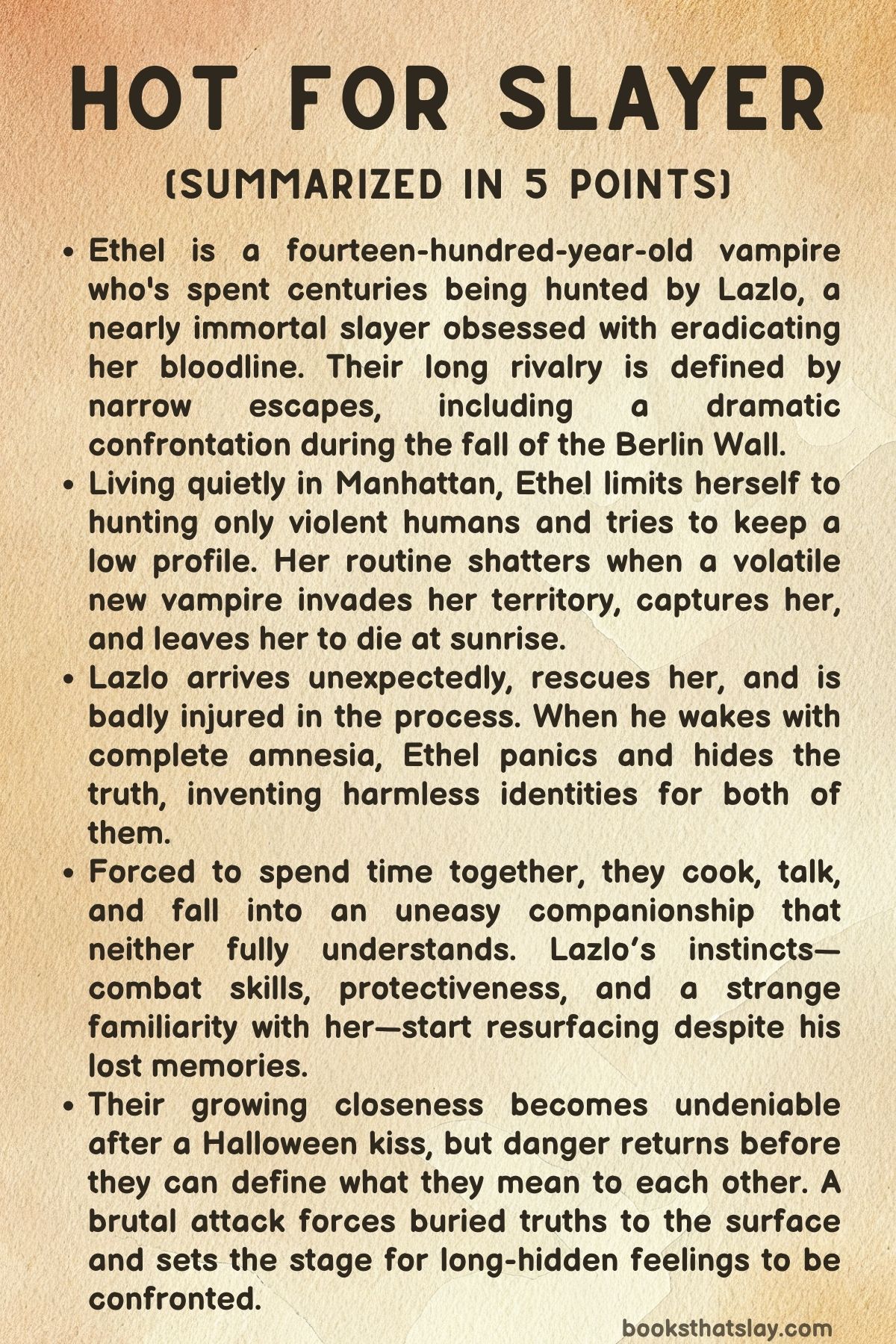
Aethelthryth, known as Ethel, has spent fourteen centuries eluding Lazlo Enyedi, the legendary slayer assigned by the Hällsing Guild to destroy her and every member of her bloodline. Their most memorable clash took place in Berlin in 1989 during the fall of the Wall.
Lazlo nearly trapped her, but she escaped by forcing him to retreat in front of cameras, knowing he wouldn’t risk revealing the existence of their world. Though they separated that night, the tension between them remained suspended across decades.
In the present day, Ethel lives quietly in Manhattan. She maintains a disciplined routine, feeds only on humans who cause harm, and stays out of conflicts with other immortals.
Her careful existence fractures when a volatile, newly turned vampire intrudes on her territory. He grows increasingly unstable, eventually attacking her in her own city.
After beating her nearly to death, he binds her before an east-facing window so that sunrise will kill her slowly. As the first rays begin to burn her skin, she prepares for the end.
Instead, Lazlo appears. He battles the attacker with swift, brutal efficiency, cuts Ethel free, and shields her with his own body as the sunlight intensifies.
A falling beam knocks him unconscious, leaving her to drag them both away while her body repairs itself bone by bone. When Lazlo wakes, he has lost every memory — not only of her, but of himself, his mission, and his centuries-long identity as a slayer.
Terrified that he will kill her if he remembers, Ethel immediately lies. She tells him he is an exterminator, she is an entomologist, and their hostility is related to pest control disputes, not an ancient battle between predator and hunter.
His instincts make him wary, but with no memories to counter her explanations, he follows her home for shelter from the daytime sun. The close quarters force an uneasy companionship.
They cook together, talk, and rest side by side on her small couch. Lazlo keeps noticing that she feels familiar, and Ethel struggles with guilt each time he looks at her with trust she has not earned.
The next day, subtle signs hint that Lazlo’s abilities remain even without his memories. His awareness sharpens at the slightest disturbance.
His reflexes are precise and deadly. When danger seems near, he steps in front of her without thinking.
They spend the day cooking, solving puzzles, and easing into a surprising, domestic rhythm. That night he dreams of dancing with her — something that never happened — yet the emotional weight of the dream lingers between them.
As they walk through Manhattan during Halloween celebrations, Lazlo kisses her. She returns the kiss but quickly stops, realizing the imbalance created by his amnesia.
Before they can discuss it, the ancient vampire who attacked her earlier appears again. With no time to think, Ethel pushes Lazlo aside and fights.
The attacker is stronger, and he tears into her deeply. Lazlo recovers just in time to decapitate the vampire.
As he turns back to Ethel, she sees a new look in his eyes — recognition. His memories have returned.
Certain he will now try to kill her, Ethel attacks first. Lazlo refuses to fight back.
Instead, he asks her one question: if she killed him, where did she believe he would go afterward? The question pulls her into a long-buried memory of a masquerade ball centuries earlier.
Before she knew who he was, the two had spoken about life, death, and the nature of their kind. That conversation changed something fundamental in him.
Lazlo explains that he left the Hällsing Guild long ago. After observing her through the ages — her mercy, her restraint, her small acts of kindness — he came to doubt the Guild’s teachings.
The only way he could keep approaching her without revealing his abandonment was to pretend their hunt continued. He confesses that he moved into the apartment across from hers years ago so he could ensure she remained safe.
He admits he cared for her long before their latest clash.
Overwhelmed by truths she never imagined, Ethel promises they can talk the next night but says she must feed first. Lazlo refuses to let her hunt.
Instead, he cuts his palm and offers his blood. She drinks, and the intimacy of the act transforms their connection into a physical reality neither has allowed themselves before.
They fall together with urgency and tenderness, crossing the divide between slayer and vampire for the first time.
In the epilogue, Ethel and Lazlo build a shared life free from the chaos of the Guild and the dangers of other immortals. They travel together, live in different places as seasons shift, and return to New York every Halloween.
They live quietly, closely, and with a sense of belonging that eluded them for centuries, finally content within the strange immortality they share side by side.
Characters
Ethel (Aethelthryth)
Ethel is a fourteen-hundred-year-old vampire whose long life has been defined by both survival and loneliness. She carries the immense weight of history—centuries of hiding, fleeing, adapting, and learning how to move through a world that changes faster than she can.
Her moral code is an unusual one for a vampire: she feeds only on “evil” humans, deliberately choosing predators so she can survive without harming the innocent. This selective predation reflects a deep-rooted desire to live ethically despite her nature, and it shows how her identity has been shaped not only by power but by restraint.
The trauma of being hunted relentlessly by Lazlo for centuries has made her hyper-vigilant, secretive, and emotionally guarded. Her dry humor and careful routines in Manhattan reveal how much she craves stability after so many lifetimes of fear.
When Lazlo loses his memory and displays gentleness, protectiveness, and curiosity toward her, she is torn between guilt and yearning—desperately wanting connection yet terrified that truth will restore the cycle of violence. Her arc evolves from mistrust and concealment to a courageous willingness to be known.
Ultimately, Ethel becomes a character who embodies the paradox of monstrous immortality paired with deeply human vulnerability, longing, and love.
Lazlo Enyedi
Lazlo is a legendary slayer, nearly immortal himself, whose entire identity was crafted by the Hällsing Guild and weaponized against Ethel’s bloodline. For centuries, he is the embodiment of relentless pursuit—disciplined, lethal, and unwavering in his mission.
Yet beneath that reputation lies a man who has spent far too long observing the world in rigid binaries: human versus vampire, good versus evil, hunter versus hunted. The turning point in his true internal journey comes long before the events of the book, during a masquerade ball where he unknowingly meets Ethel without the roles that defined them.
That moment plants the seed of doubt, allowing him to see nuance in creatures he was trained to destroy. Over time, witnessing Ethel’s compassion dismantles his lifelong indoctrination, leading him to abandon the Guild and shadow her life not as a predator but as a quiet guardian.
His amnesia strips him down to his raw instincts—protective, intuitive, and inexplicably drawn to Ethel—revealing that affection for her has shaped him more than duty ever did. When his memories return, his refusal to harm her underscores his transformation: he has become a man defined not by violence but by choice, devotion, and moral clarity.
His arc is the story of shedding inherited purpose to claim selfhood—and love—on his own terms.
The Ancient Vampire (Unnamed Attacker)
The ancient vampire who invades Ethel’s territory functions as a disruptive force in her carefully constructed life. Unlike Ethel, this vampire represents the worst of vampiric nature: uncontrolled hunger, territorial aggression, and a willingness to inflict torment for dominance.
His attack forces Ethel into confrontation not only with physical danger but with the vulnerability she tries to avoid at all costs. He serves as the catalyst for the novel’s emotional and relational shifts—nearly killing Ethel, triggering Lazlo’s protective instincts, and later reappearing at the exact moment Ethel begins to glimpse a life beyond fear.
His brutality highlights the contrast between predatory immortality and Ethel’s ethical restraint, reinforcing why Lazlo initially believed vampires had to be eradicated and why Ethel spent centuries hiding. In the end, his destruction signals an end to the old cycle of violence for both Ethel and Lazlo, opening a narrative space for healing and partnership.
The Hällsing Guild (Collective Character)
Though not a single person, the Guild operates as a shaping force in Lazlo’s life and an ever-present threat to Ethel’s. It represents institutionalized violence, unquestioned dogma, and generational prejudice against supernatural beings.
The Guild is the unseen antagonist whose beliefs sculpted Lazlo into a weapon and forced Ethel into lifetimes of running. Its influence provides important thematic contrast: while the Guild upholds rigid ideology, both Ethel and Lazlo ultimately reject the roles it imposed on them.
The Guild’s shadow over their relationship creates the tension that drives much of the story—fear of discovery, fear of betrayal, fear of inevitable conflict. Its presence underscores the courage required for Ethel and Lazlo to build a life together outside systems that sought to define them as enemies.
Ethel and Lazlo Together (Their Dynamic as a Character)
Their relationship transforms the narrative from a hunter-prey chase into an intimate exploration of trust, identity, and redemption. Together, they embody centuries of conflict condensed into a fragile, unexpected tenderness.
The amnesia interlude allows them to interact without the weight of the past, revealing that their connection is emotional before it is historical. Their dynamic is characterized by contradiction: a slayer who abandons violence, a vampire who practices mercy, enemies who become protectors, and two immortals who find comfort in the ordinariness of cooking, puzzles, and shared silence.
The final revelation—that Lazlo has spent years living across from her simply to ensure her safety—reframes their decades-long pursuit as a story not of vengeance but of longing. As a pair, they represent the possibility of rewriting destiny, choosing compassion over inherited roles, and building a life rooted not in fear but in partnership.
Themes
Immortality, Memory, and the Weight of Time
Immortality in Hot for Slayer becomes less a gift and more a long, unbroken stretch of accumulated consequences that never fade. Ethel carries fourteen centuries of survival, loss, adaptation, and self-reinvention, and the novel shows how immortality hardens and isolates her rather than granting her freedom.
The decades blur, yet every violent encounter—especially those involving Lazlo—builds into a personal history she can never escape. Her long life is marked by routines and careful boundaries, not indulgence, as she navigates a world that changes while she remains constant.
Lazlo’s amnesia offers a temporary rupture in this pattern. For the first time, Ethel experiences a moment where the past loosens its grip: her predator does not remember he is supposed to kill her, and she is suddenly free of the centuries-old script binding them.
The absence of memory becomes a relief, even as guilt shadows her deception. When Lazlo regains his memories, the novel brings these threads together, revealing how immortality shapes identity not through the events lived but through the meaning imposed on those events.
His memories matter because they show that he, too, changed across centuries, forming a perspective shaped not by the Guild’s mission but by what he witnessed in her. Immortality therefore becomes a shared burden that reshapes both of them: a record of all they have been to each other, reinterpreted once truth surfaces.
The story ultimately suggests that time alone cannot erode violence, longing, or connection—only understanding can shift what those memories mean.
Enemies, Perception, and the Collapse of Prejudice
The relationship between slayer and vampire begins as something rigid and unquestioned, crafted by institutions and traditions older than either of them. The Hällsing Guild defines vampires as monsters and slayers as righteous hunters, and Lazlo once accepted this role without hesitation.
Ethel, in turn, sees slayers as relentless instruments of death, dogmatic and incapable of nuance. Their centuries of conflict are rooted in predetermined identities rather than personal understanding.
Lazlo’s amnesia disrupts this long-standing hostility, turning an ancient rivalry into an unfamiliar partnership. As he navigates the world without the Guild’s doctrine guiding him, his instincts still push him to shield Ethel, revealing that his bias had weakened long before he lost his memory.
Her decision to lie about their history exposes how deeply prejudice has shaped her expectations; she cannot imagine a slayer who would spare her unless he is confused or incapacitated. Once he remembers the truth, the foundation of their enmity collapses.
His history of quietly watching over her, studying her choices, and rejecting the Guild’s absolutism reframes their past entirely. Even before memory loss, he had begun treating her as an individual rather than a category.
This theme shows how entrenched animosity can survive only as long as people refuse to examine it. When centuries of assumptions are stripped away, the war between them dissolves into something more introspective: a recognition that both had constructed versions of each other defined by fear, duty, and survival.
Their bond grows out of the collapse of those old prejudices and the willingness to see the individual behind the myth.
Deception, Vulnerability, and the Fear of Being Known
Ethel’s deception is not a simple lie born of self-preservation; it is a defense against vulnerability she has not allowed herself in centuries. When Lazlo awakens without memories, she confronts the dangerous possibility of intimacy—something that could destroy her if the truth returns.
Her lies are shaped not only by fear that he will kill her, but by fear that genuine connection will expose parts of herself she has spent centuries protecting. She hides the truth because she cannot reconcile closeness with someone who once chased her across continents.
The narrative dwells on her internal conflict: each hour spent in domestic quiet with him erodes her ability to maintain emotional distance, while each moment of comfort intensifies the guilt that she is building something false. Lazlo’s instinctive protectiveness unsettles her further, challenging her belief that she is fundamentally alone.
Once he regains his memories, the dynamic shifts. Instead of confirming her fears, he lays bare his own vulnerability—his decision to abandon the Guild, his long-standing fascination with her, his desire to understand her rather than destroy her.
This openness mirrors the risk she tried so hard to avoid. The theme resolves through mutual exposure: both characters step outside the roles they have inhabited for centuries.
Their bond forms not because deception is forgiven, but because truth becomes the only way forward. In confronting the risk of being known, Ethel discovers that vulnerability, rather than strength or survival, is what allows immortals to form lasting connection.
Redemption, Choice, and Moral Ambiguity
At the center of the story is a question of what makes a monster: nature, action, or perception. Ethel refuses to hunt innocents, selecting only those who harm others, constructing a personal ethic that contradicts the Guild’s broad condemnation of her species.
Her morality is self-imposed, shaped by centuries of observation and regret, demonstrating that immortality does not remove the capacity for conscience. Lazlo undergoes a parallel transformation.
Though initially molded by Guild doctrine, he slowly questions the righteousness of his mission as he observes Ethel’s restraint. His eventual defection reveals that redemption for him is not a single decision but a gradual shift built from countless moments witnessing her choices.
The novel frames redemption not as atonement for a singular wrong but as the willingness to rewrite one’s identity despite entrenched expectations. Neither character fits neatly into traditional roles: Ethel is a vampire with a strict moral code, and Lazlo is a slayer who refuses to kill a creature his order deems irredeemable.
Their union challenges the absolutes that have governed their lives, showing that moral clarity is rarely dictated by institutions but by individual decisions. This ambiguity becomes the foundation of their connection.
They choose each other not because one is purely good or the other purely villainous, but because they recognize the agency both possess. The theme emphasizes that redemption emerges from choice, and that the path away from violence is shaped by intention rather than lineage or duty.
Love, Trust, and the Rewriting of Destiny
The romantic core of the novel rests on the tension between fate and agency. For centuries, Ethel and Lazlo appear destined to destroy each other, bound by roles larger than their personal inclinations.
Yet the narrative demonstrates that destiny can be rewritten through individual decisions: Lazlo chooses to save her from the sun, she chooses to pull him from danger despite believing he would kill her, and both repeatedly choose understanding over violence. Their growing closeness during his amnesia becomes a rare moment where neither history nor prophecy dictates their actions.
Trust emerges gradually, shaped by shared meals, quiet conversation, and mutual curiosity. When the truth is revealed, the survival of their relationship depends on whether this trust can withstand centuries of conflict and deception.
Lazlo’s confession—that he has admired her for years and stepped away from the Guild because of her—repositions their history into something far more complex than predator and prey. Love here is portrayed as a force capable of overriding ancient loyalties and personal fears, but only when paired with honesty and agency.
Their decision to build a life together, traveling and avoiding old conflicts, shows that intimacy is not a magical resolution but a continuous series of choices to move beyond fear. The final union between slayer and vampire transforms what once seemed inevitable—that one must kill the other—into a shared future shaped by commitment rather than destiny.