Howl’s Moving Castle Summary, Characters and Themes
In Howl’s Moving Castle, Diana Wynne Jones presents a lively, unpredictable adventure set in the magical land of Ingary, where everyday life sits comfortably beside spells, curses, and wandering castles. The story follows Sophie Hatter, a young woman who quietly accepts a dull future until an unexpected curse propels her into the chaotic world of the wizard Howl.
What begins as a quest to free herself becomes a journey of self-discovery, truth, and courage. Filled with unusual magic, sharp humor, and complex characters, the book explores how ordinary people can reshape their fate when they finally dare to act.
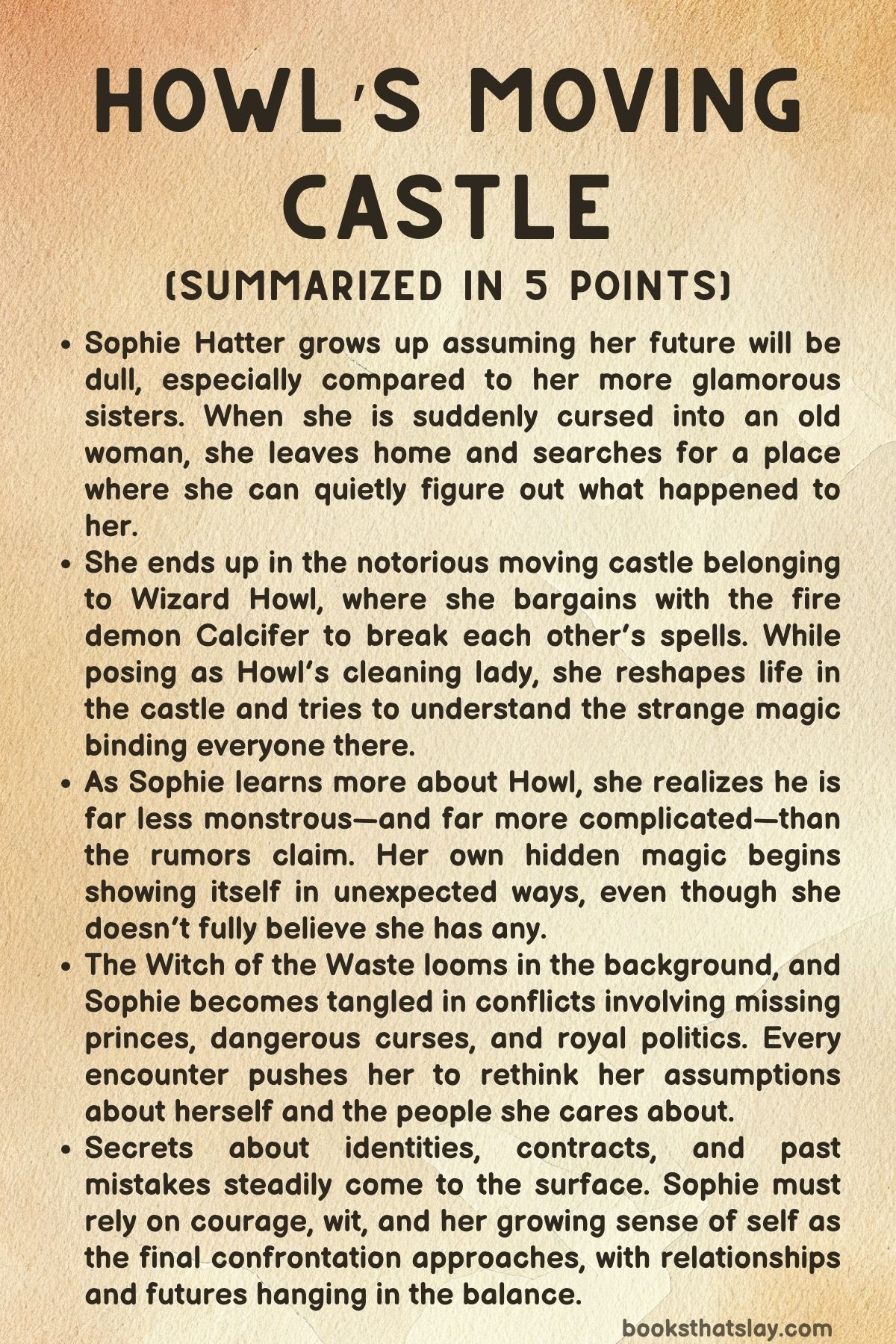
Summary
Sophie Hatter grows up convinced that, as the eldest of three sisters in Ingary, she is destined for an uneventful life. After her father dies, her stepmother Fanny sends each girl into an apprenticeship, placing Sophie in the family hat shop while Lettie goes to a pastry shop and Martha to a witch.
Sophie becomes isolated as she works long hours shaping hats for customers. Her life changes when she encounters the Witch of the Waste, who accuses her of interfering in matters she does not understand.
Without allowing Sophie a word of explanation, the Witch curses her, transforming her into an elderly woman who cannot reveal what has happened to her.
Unable to remain at the shop, Sophie quietly walks out of Market Chipping with a few belongings. Her journey takes her across the hills, where she props up a scarecrow, frees a trapped dog, and eventually comes face-to-face with the moving castle said to belong to the dangerous Wizard Howl.
Reasoning that Howl is rumored to prey only on young girls, Sophie boldly enters the castle. There she meets Michael, Howl’s apprentice, and Calcifer, a fire demon bound to the hearth.
Calcifer senses her curse and privately proposes a deal: if Sophie can discover and break the contract between him and Howl, he will break her spell. Sophie must figure out the terms herself, since neither Calcifer nor Howl can speak of them directly.
Howl returns and finds Sophie already acting as though she belongs there. When she declares herself his cleaning lady, he seems too evasive or distracted to challenge her.
From that point on she throws herself into an enormous cleaning campaign, disturbing both Michael and Calcifer but refusing to stop. The castle’s door opens to multiple places: the hills, the seaport town of Porthaven, the capital Kingsbury, and a mysterious fourth destination marked in black.
Sophie’s presence is soon noticed in each location, and people begin assuming Howl has hired a witch.
Her frustration rises as she tries to find evidence of Howl’s wickedness and any hint that might reveal the nature of Calcifer’s contract. She even inspects Howl’s bedroom, provoking dramatic objections from him.
Their arguments become frequent, especially as Sophie learns more about Howl’s habit of courting girls only to lose interest once they care for him. This becomes personal when Sophie discovers that the girl Howl is currently pursuing is none other than her own sister Lettie.
Meanwhile, Howl is being pressured by the King to help search for Prince Justin and Wizard Suliman, both of whom have disappeared. To avoid royal responsibilities, Howl instructs Sophie to pretend to be his mother and convince the King that he is useless.
Sophie tries but fails spectacularly; her complaints only convince the King that Howl is the clever wizard he needs. During this visit, Sophie also meets Mrs.
Pentstemmon, Howl’s former teacher, who recognizes that Sophie has magic of her own and warns her that Howl’s contract with Calcifer is as dangerous as the one that ruined the Witch of the Waste.
Tension grows as the Witch’s curse tightens around Howl. A magical dog under a spell arrives with a message from Lettie, and Howl’s annoyance at Sophie’s interference turns into deeper concern.
After a fierce magical battle between Howl and the Witch, the castle must be moved. Howl buys Sophie’s old hat shop and disguises it as a flower shop, where Sophie, Michael, and the dog-man begin gathering enchanted flowers daily from a magical meadow reached through the castle door.
In this quieter life, Sophie grows increasingly uneasy. She experiments with spells, encounters the scarecrow again, and deals with the dog-man’s unstable transformations.
Miss Angorian, the gentle schoolteacher Howl visits often, appears in the castle, claiming to search for her fiancé Suliman. Sophie distrusts her immediately.
Through further spells and revelations, the dog-man is revealed to be Percival, a magically assembled being containing parts of Suliman and Prince Justin. Sophie becomes angry with Howl for keeping secrets, and their conflicts escalate until emotion and magic cause chaos throughout the house.
Midsummer approaches, the moment when Howl must face the Witch’s curse. After a series of reunions with Sophie’s family, Miss Angorian turns up again, and Calcifer suddenly senses danger.
The Witch has discovered Howl’s sister’s family. Howl confronts her outside, and shortly afterward the scarecrow arrives and reveals he was created to help find the missing men.
Just then the Witch sends a message: she has captured Miss Angorian and demands Howl come to her fortress.
Blaming herself and determined to fix everything, Sophie takes seven-league boots and races alone across the Waste. She reaches the Witch’s terrible stronghold, where the Witch reveals her intention to build a perfect human using parts of Suliman, Justin, and Howl.
The scarecrow appears, battling the Witch long enough for Sophie to escape. When Howl arrives, he uses his remaining strength to defeat the Witch, who collapses into dust.
The truth about Miss Angorian emerges. She is not a victim but the Witch’s fire demon, now seeking Howl’s heart, which Calcifer has been guarding through the contract.
In a final confrontation, Miss Angorian seizes Calcifer and nearly destroys him. Sophie, discovering the full strength of her magic, animates her stick and drives Miss Angorian back.
She breaks the contract, freeing Calcifer, and restores Howl’s heart to his chest, bringing him back from the edge of death.
As the danger fades, Seliman and Prince Justin are restored to themselves, the scarecrow returns to his true form, and Calcifer comes back, now free to come and go. Sophie’s spell dissolves entirely, and she and Howl finally admit their feelings for each other.
Their home begins to settle into peace, and the tangled events that began with a simple curse lead to a future none of them could have imagined.
Characters
Sophie Hatter
Sophie begins Howl’s Moving Castle as a timid, resigned young woman convinced that being the eldest daughter has doomed her to a dull and uneventful life. Her character arc is one of profound self-revelation: when the Witch of the Waste curses her into the form of a ninety-year-old woman, Sophie finally gains the freedom she never allowed herself.
Age gives her boldness, stubborn confidence, and the authority to speak and act as she pleases. As an old woman she becomes assertive, outspoken, and unafraid to confront wizards, demons, kings, or powerful witches.
This transformation reveals the core of her personality—resourceful, compassionate, fiercely loyal, but also hot-tempered and prone to self-sacrifice. Sophie possesses strong, unconscious magic that manifests through her speech, bringing life to objects, coaxing movement from scarecrows, and influencing spells without realizing it.
Much of her struggle is internal: she denies her own talent, beauty, and worth, and the curse becomes a metaphor for the way she ages herself with insecurity. Sophie’s journey is ultimately one of reclaiming identity—learning to recognize her magic, accept affection, and see herself as someone capable of shaping her own destiny.
Wizard Howl
Howl is a paradox: flamboyant, brilliant, vain, cowardly, kind-hearted, and deeply self-protective. He cultivates a notorious reputation as a devourer of girls’ hearts, yet his real flaw is emotional avoidance rather than malice.
He is terrified of responsibility, including royal duties, commitments, and even the burden of caring for people. Beneath his theatrical tantrums and shallow flirtations lies a man who is consistently generous—helping strangers without charge, protecting the vulnerable, and defying the Witch despite the danger.
His childish vanity, especially about his appearance, masks genuine fear; his contract with Calcifer left him literally without a heart, a symbol of his unwillingness to be vulnerable. Howl recognizes Sophie’s magic early on and deliberately allows her into the castle because he senses she may be able to break both his curse and his emotional stagnation.
Over time he shows increasing courage, love, and responsibility, culminating in his willingness to face the Witch and accept the return of his heart. His affection for Sophie is constant beneath the chaos, and by the end he becomes a more grounded, emotionally present version of himself.
Calcifer
Calcifer, the fire demon bound to Howl’s hearth, is simultaneously mischievous, sarcastic, loyal, and weary from years of magical servitude. His personality blends fiery wit with a certain vulnerability, particularly when the Witch’s demon threatens him.
Though he presents himself as cunning and slippery, his interactions with Sophie reveal a kind of lonely earnestness. He trusts her instinctively, understanding that her magic makes her capable of unraveling the contract that imprisons him.
Calcifer’s relationship with Howl is complex—part friendship, part dependency, and part mutual exploitation. He benefits from the power of Howl’s heart but suffers from the binding contract, longing for freedom while still caring deeply for the wizard.
His bond with Sophie evolves into a partnership, and through their cooperation the truth of his contract comes to light. When freed, Calcifer demonstrates genuine loyalty by returning to the castle voluntarily, proving that his attachment to Howl and Sophie goes far beyond magical obligation.
Michael Fisher
Michael serves as apprentice and grounding force within the chaos of the moving castle. Practical, hardworking, and good-natured, he provides the stability that Howl often lacks.
Michael admires Howl but also understands his flaws, accepting them with a patient maturity. He quickly warms to Sophie, treating her with a brotherly mixture of affection and exasperation.
Although young, Michael shows considerable magical promise and earnest dedication to his craft, balancing the extravagant wizardry of Howl with steady competence. His subplot with Lettie highlights his sincerity and loyalty, contrasting sharply with Howl’s unstable romantic pursuits.
Michael’s growth is quieter than Sophie’s or Howl’s, but he evolves from a nervous apprentice into a capable young wizard ready to stand on his own.
Miss Angorian
Miss Angorian initially appears gentle, cultured, and harmless, but her soft and pleasant demeanor hides a deeply sinister truth. As the Witch’s fire demon, she is the true force behind the Witch’s power—manipulative, patient, and capable of wearing a completely convincing human persona.
Her interactions with Sophie are filled with subtle tension, as Sophie instinctively distrusts her despite her outward charm. Miss Angorian’s manipulation of Howl, her feigned vulnerability, and her calculated attempts to isolate him all serve a larger goal: reclaiming Howl’s heart to gain ultimate power.
Unlike Calcifer, who genuinely cares for Howl, Miss Angorian treats Howl’s heart as an object of conquest. Her final attack, in which she nearly kills both Calcifer and Howl, reveals the cold ruthlessness beneath her human mask.
She represents the darker nature of fire demons—consuming, deceiving, and destructive.
Lettie Hatter
Lettie is lively, confident, and determined—almost the opposite of Sophie’s initial self-perception. She refuses to accept the roles assigned to her and trades places with Martha to pursue her own desires.
Lettie’s independence, magical aptitude, and charm draw admiration from many characters, yet she remains grounded and sincere. Her relationship with Sophie is affectionate and protective, and she is one of the few people who worries about Sophie’s emotional isolation.
Despite becoming the focus of Howl’s initial courting, Lettie remains uninterested in him and instead falls for Percival. Lettie’s biggest role in the story is as a catalyst—prompting Sophie’s self-reflection, inadvertently entangling Howl, and influencing several of the novel’s misunderstandings.
She highlights the theme of choosing one’s own path rather than accepting predetermined roles.
Martha Hatter
Martha’s character reflects practicality, empathy, and a quiet rebellion against societal expectations. Though deemed the youngest and therefore traditionally destined for a magical apprenticeship, she longs for simplicity, domesticity, and a future where she can make her own choices.
Her willingness to trade places with Lettie shows both daring and a desire to protect her sisters from lives they do not want. Unlike Sophie, Martha openly communicates her feelings and ambitions, demonstrating a level of self-assuredness that Sophie initially lacks.
Martha’s role in the story emphasizes the importance of personal agency, particularly for women in a magical society filled with rigid narrative “rules. ” She symbolizes the freedom of choosing ordinary happiness over prescribed destiny.
Fanny
Fanny, Sophie’s stepmother, is more nuanced than the stereotypical “wicked stepmother. ” She genuinely cares for the girls but struggles to manage the hat shop and household after Sophie’s father dies.
Her decisions—placing the sisters in apprenticeships and prioritizing the shop—are influenced by financial stress rather than malice. However, she inadvertently places too much responsibility on Sophie, allowing her to become isolated and overworked.
Fanny represents the pressures of practicality in a world filled with magic. Her love for Sophie becomes clearer once the truth is revealed, and her reunion with Sophie near the end shows she was never an antagonist but rather a flawed guardian doing her best.
Percival
Percival is a fascinating figure—quite literally a constructed man, pieced together by the Witch using parts of Prince Justin and Wizard Suliman. His existence raises questions about identity and autonomy.
Though created for the Witch’s purposes, Percival learns kindness, loyalty, and fear through his experiences. He develops genuine affection for Lettie and a protective instinct toward Sophie, sensing the danger surrounding her.
His fragmented nature makes him gentle and passive, but once freed from the Witch’s enchantments, he becomes a symbol of restoration and healing. His transformation into two whole men at the end—Justin and Suliman—brings closure to multiple mysteries and reveals how profoundly the Witch distorted lives to build power.
Prince Justin
Prince Justin appears mainly through the consequences of his disappearance. His reputation as a just and capable leader contrasts sharply with the horrifying reality of his partial disassembly by the Witch.
Even in fragments, his sense of duty persists—his individually enchanted parts continue searching for Suliman and attempting to oppose the Witch. When restored, Justin embodies dignity and gratitude, acknowledging Sophie’s bravery and Howl’s sacrifice.
His storyline underscores the political stakes of the conflict and illustrates the Witch’s disregard for human life.
Wizard Suliman
Suliman was once a brilliant wizard in the King’s service whose attempts to stop the Witch resulted in his capture and partial destruction. Like Justin, his magically animated remains seek help, creating the scarecrow that later aids Sophie.
When restored to his full self, Suliman becomes a quiet yet authoritative presence who helps contextualize Howl’s history and the Witch’s rise to power. His survival reinforces a recurring theme: identities fractured by magic can be restored through courage, compassion, and cooperation.
Themes
Identity and Self-Perception
Sophie’s journey in Howl’s Moving Castle steadily reveals how much of her life has been shaped by the assumptions she has accepted about herself. She grows up convinced that her birth order condemns her to an unremarkable future, and this belief quietly limits her confidence and imagination long before any magic touches her life.
When the Witch of the Waste curses her into an elderly woman, the transformation does not simply change her body; it strips away the hesitations she carried as a young girl. As an old woman, Sophie feels liberated from expectations about beauty, charm, or worthiness, and this unexpected freedom pushes her into situations she would never have dared face before.
Her time in the moving castle becomes a period of discovery in which she gradually realizes she possesses a strong magical ability shaped by her emotions and spoken intentions. The curse, rather than imprisoning her, removes the anxieties that once defined her sense of identity.
As she interacts with Howl, Calcifer, and Michael, she starts understanding that her perception of herself has been distorted by fear, comparison, and a quiet resignation to imagined fate. Even her stubbornness—initially a shield—becomes the key to breaking both her own enchantment and Howl’s contract.
By the end, Sophie no longer accepts the narrative assigned to her. She sees that identity is not predetermined by birth or circumstance but built through choices, courage, and the willingness to claim one’s own power.
Her restored youth is not a reward but a reflection of her new self-understanding, showing that growth occurs when someone stops believing limiting stories about who they are allowed to be.
Power, Choice, and Responsibility
Throughout Howl’s Moving Castle, characters are repeatedly confronted with the consequences of the choices they make with the power they hold. The story contrasts those who wield power responsibly with those who allow it to consume them.
The Witch of the Waste represents the extreme end of selfish magic—she relies on domination, manipulation, and the pursuit of control regardless of the harm caused. Her partnership with her fire demon illustrates how power used without restraint corrodes both its user and its source.
In contrast, Howl possesses immense magical ability yet spends much of the narrative evading responsibility, hiding behind charm and cunning to avoid commitments he fears. His avoidance, however, is not malicious; it stems from an unwillingness to confront vulnerability, duty, and the risks attached to caring for others.
As he grows closer to Sophie, he begins making choices that place him in direct danger, indicating a shift from self-preservation to self-sacrifice. Sophie herself grapples with the responsibility attached to her magic.
For most of the story she does not fully recognize her power, yet her words animate objects, influence events, and alter lives. The turning point arrives when she takes responsibility for her abilities and stops distancing herself from their impact.
The novel suggests that power becomes meaningful when guided by compassion, honesty, and the willingness to act for the sake of others. It also argues that choosing to care—whether through protecting a fire demon, rescuing a scarecrow, or defending a loved one—carries greater weight than raw magical force.
In the end, the story asserts that power without responsibility is destructive, but responsibility without fear transforms both the individual and the world around them.
Love, Vulnerability, and Emotional Maturity
Romantic love in Howl’s Moving Castle unfolds through misunderstandings, irritations, and emotional messiness rather than grand declarations. The story resists idealized portrayals and instead examines how affection requires vulnerability, honesty, and a willingness to grow.
Sophie’s and Howl’s relationship begins with friction—her suspicion of his reputation and his exasperation at her stubborn intrusions. Their dynamic exposes the ways each hides behind certain defenses.
Howl uses flamboyance, dramatics, and charm to avoid emotional risk; Sophie uses irritation, denial, and a self-imposed sense of unworthiness to avoid recognizing her feelings. Their bond deepens not through romance but through everyday interactions: cooking breakfast, arguing over messes, handling customers, and supporting each other during danger.
These ordinary moments reveal their compatibility long before either acknowledges it. Sophie learns that Howl’s apparent frivolity masks loneliness and fear shaped by his contract with Calcifer.
Howl recognizes that Sophie’s bluntness is a shield for insecurity and exhaustion. Their love becomes an act of seeing one another clearly when both are accustomed to being misunderstood.
The restoration of Howl’s heart symbolizes a shift from emotional avoidance to acceptance, while the breaking of Sophie’s curse reflects her readiness to acknowledge love instead of protecting herself through denial. The novel frames love not as destiny but as a difficult, transformative commitment that demands honesty and courage.
It suggests that emotional maturity emerges when two people allow themselves to be known fully—flaws, fears, and hopes included—and still choose each other.
Freedom, Contracts, and the Cost of Binding Oneself
The narrative repeatedly examines the idea of binding—through magic, promises, contracts, or expectations. Each major character is entangled in some form of constraint.
Howl’s contract with Calcifer grants extraordinary power but chains both of them to a dangerous dependency that steadily threatens their lives. Sophie is bound by a curse that distorts her body and silences her ability to speak the truth, yet she is also constrained by a lifetime of internalized beliefs about duty and inferiority.
Calcifer’s existence is reduced to servitude, despite his mischievous personality and desire for autonomy. Even Percival, created from fragmented pieces of two men, illustrates the destructive extremes of magical binding.
These constraints shape not only physical realities but emotional and moral ones. The Witch of the Waste embodies the darkest form of binding—her demon eventually becomes the dominant partner, revealing how the hunger for control ultimately destroys the self.
In contrast, Howl and Calcifer’s partnership is built on trust, humor, and mutual benefit, even though it endangers them both. Sophie’s eventual role in breaking the contract stands as an assertion that freedom cannot exist without compassion and perception.
The story suggests that binding oneself—whether through promises or emotional walls—can be necessary, dangerous, or even noble, depending on the intention behind it. True freedom emerges not from avoiding ties but from choosing them wisely.
When Sophie restores Howl’s heart and frees Calcifer, the novel affirms that liberation gained through understanding and care holds far greater power than magic enforced through domination.