Huguette Summary, Characters and Themes
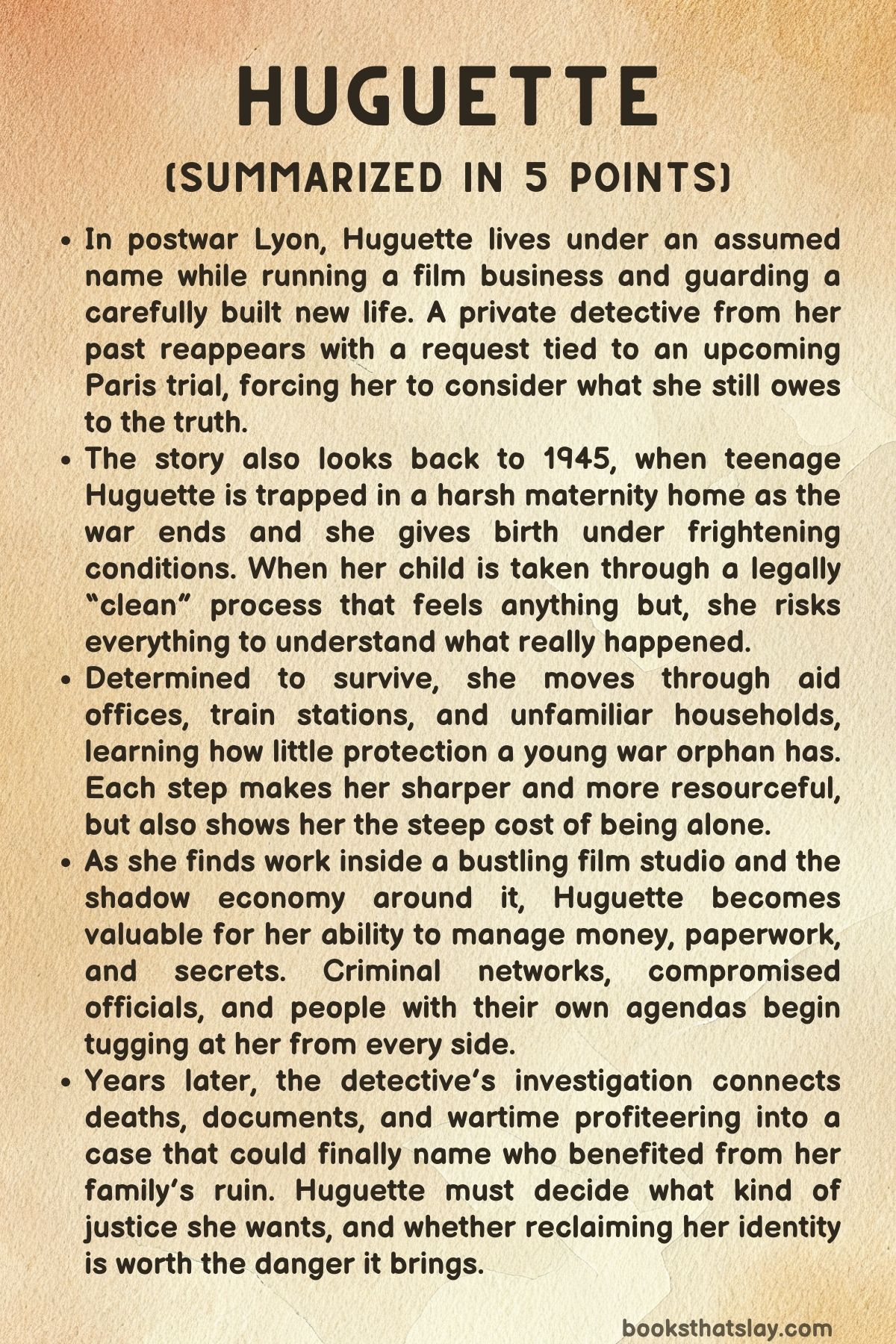
Huguette by Cara Black is a historical crime novel set in post-Liberation France, following a young woman who survives war, exploitation, and betrayal and then builds a new life under a false name. In 1947, Huguette is a successful cinema executive in Lyon, but her carefully constructed identity is threatened when a man from her past reappears with demands tied to an upcoming Paris trial.
The story moves between her present-day suspense and the earlier years that shaped her—loss, a stolen baby, black-market survival, and a trail of murders linked to wartime corruption.
Summary
In December 1947 in Lyon, Huguette lives as “Lise de Jouvenal,” running the Étoile cinema business with her capable assistant, Simone. Every week they count the cash from ticket sales and concessions and manage a growing surplus.
Huguette projects calm authority, but she operates with constant vigilance. Her hair is dyed, she wears glasses that help her look like someone else, and she avoids patterns that might let anyone track her.
She knows that if the wrong person connects her present to her past, everything she has built could vanish.
That fear becomes immediate when Claude Leduc walks into the bouchon where she stops for coffee. Claude is a figure from her life in Paris during the chaotic months after the war.
He gives her a small red booklet—an updated bilingual map of Paris—presented like a casual gift but loaded with meaning. Huguette assumes he has come to expose her.
Instead, Claude claims he is keeping his presence in Lyon secret and only wants to ask two questions. She refuses to speak in public and takes her emergency kit—cash, a forged identity card, spare clothes, and a ticket that could get her to Marseille—and meets him outdoors where she can see anyone approaching.
Claude explains that he is no longer a police officer; he now works as a private detective specializing in missing persons. He asks Huguette to help with a case that is turning into a major trial in Paris.
A notaire named Honoré Gisors is about to face judgment, and Claude says Huguette’s testimony is essential. Huguette refuses immediately.
Their history is poisoned by betrayal and money: she believes Claude once took her cash and abandoned her when she was most vulnerable. Claude produces an envelope returning what he owed, saying he used the money to launch his agency but can repay her now.
He also frames the request as something more personal—an opportunity for Huguette to speak publicly about what happened to her family and finally push justice forward. Even when a brief spark passes between them, she pulls back, insisting she is not the same person he once knew.
The narrative then shifts back to April 1945, revealing how Huguette became someone who could reinvent herself. At seventeen, she lives in a maternity home outside Sceaux in a converted abbey, working in the laundry with another girl, Lena.
The war has left them underfed, exhausted, and watched by staff who hold power over their bodies and futures. Huguette is heavily pregnant, furious at the child’s father and haunted by losses that have torn her family apart.
When labor begins, she faces a dangerous delivery: the baby is breech, there is no doctor available, and the midwife and her assistant must manage the birth with crude, painful techniques. Huguette gives birth to a boy.
Despite her earlier resolve not to care, she bonds with him as she nurses him through a severe winter storm that delays the adoptions and keeps mothers and infants together longer than expected.
When the weather clears in May, Huguette wakes to find her baby gone. The director, Madame Silot, claims the adoption is complete and produces paperwork indicating Huguette surrendered her rights.
Huguette insists she never knowingly agreed, but she is treated as a problem to be controlled. Silot even suggests Huguette stay on as a wet nurse, a way to use her body for the institution’s benefit.
Huguette’s suspicion becomes certainty when she overhears conversations that sound like bargaining over her baby, including talk of a “contribution” and a commission. She searches Silot’s office and finds the adoptive family’s name—Renadot—along with cash and a receipt that includes an address.
Realizing her child has been turned into profit, she takes the money with the intention of forcing the truth into the open and flees.
At the train station she spots the Renadots with her infant. She confronts them, tries to return the cash, and pleads that there has been fraud.
The adoptive father calls the police and brandishes legal documents. Gendarmes seize Huguette, the money disappears into official hands, and the Renadots board the train with the crying child.
Huguette is jailed and dragged before a magistrate who treats her as a delinquent, not a wronged mother. He shows her a document with her supposed signature and a birth certificate marked with an X rather than her name, then cites police records that paint her as an orphan linked to theft and collaboration through her father’s café.
The court’s “mercy” is another form of coercion: Silot will drop charges if Huguette returns to the maternity home to work off the missing money.
While awaiting transport, Huguette meets Claude Leduc in the gendarmerie kitchen. He is young, quick with jokes, and unexpectedly attentive.
He listens to her account and checks his notes, then points out that a new law—the February 1945 ordinance regarding juvenile offenders—requires different handling because Huguette is a minor and a war orphan. When officials try to bully her into compliance, Huguette refuses to move without a lawful review, and Claude supports her, forcing procedure to be followed.
Social services places her with a foster family, but the home is bleak and unsafe. Before dawn she leaves and heads toward Paris, determined to find her child herself.
Using Red Cross resources, Huguette locates the Renadots’ address. She steals a uniform and a bicycle from a clinic to reach the manor and observes the household from the edge of the property.
She sees her baby healthy, cared for, and soothed by Madame Renadot. A nurse, Jeanine, explains that Madame Renadot is fragile and has suffered miscarriages, and that the child is thriving.
Huguette learns that rumors label him a “Boche baby,” but the Renadots’ status and wartime reputation shield him from some of the hatred that could have followed him. Still, Huguette cannot let go.
During nap time she enters the child’s room, lifts him, and tries to leave a letter explaining everything. The baby wakes and screams.
Madame and Monsieur Renadot rush in. Huguette admits the father was a Nazi and insists the child was never meant to be sold.
Monsieur Renadot promises the boy will have a secure life with them. When the baby calms in Madame Renadot’s arms, Huguette recognizes that the primary bond has shifted.
She asks his name—Hugues, called Hugo—then walks away, devastated but convinced he is safer where he is.
In the months after Liberation, danger gathers around Huguette’s family history. Claude is assigned to examine bodies pulled from the Seine near Saint-Cloud.
One is Remy Faure, Huguette’s father, labeled a suspected collaborator. The injuries suggest murder: blunt trauma, marks from a rope, and evidence he was weighted down after death.
Another body recovered the same day shows the same handling, including an execution-style gunshot. Claude senses a pattern—a signature—and begins to suspect the killings are tied to wartime profiteering and the settling of accounts under the cover of “justice.”
Huguette, meanwhile, is homeless and desperate. She seeks out Enzo, an Italian connected to her father’s black-market dealings, hoping to collect on an IOU.
Enzo feeds her but offers little real help, and she is repeatedly reminded that in the new France, survival often depends on who can exploit whom. After a brief shelter stay, she returns to Studio Étoile in Boulogne-Billancourt and accepts work that keeps her fed and hidden: kitchen help, errands, and off-the-books trades involving American soldiers.
She proves valuable because she understands how illicit money moves; she learned bookkeeping tricks in her father’s café, including how to keep two sets of accounts. Louis de Jouvenal, an aging producer with power inside the studio, tests her, then uses her talent to tidy financial messes that could draw an audit.
Through this work, Huguette becomes entangled with American deserters and French criminals trafficking gasoline, goods, and weapons. She changes her identity again, adopting a name pulled from missing-person lists and altering her appearance with studio help.
A deal goes wrong when she is assaulted during a delivery attempt, and she is redirected toward a more dangerous network based out of Café Central in Paris. Claude, investigating the deserters, crosses paths with her again when she secretly offers information in exchange for protection.
They agree on a coded warning—she will mention “roses” when a raid is imminent.
A major raid erupts, but coordination fails, and Huguette is caught between French police, American MPs, and gang members desperate to recover a bag of cash. She hides the money inside a church, is arrested, interrogated, and then forced back into the operation as bait.
At a garage on rue Rambuteau, men threaten to kill her, and she narrowly escapes amid gunfire and chaos, stealing papers and a map that may hold clues about who profited from her father’s death. Exhausted and trapped by power cuts, she returns to Café Central seeking her wallet and anything that can help her run, but she collapses into sleep—and wakes to someone demanding answers.
Back in 1947–48, the present-day stakes sharpen. Huguette, now an influential figure in the film world, pushes a plan to rescue the Cannes Film Festival by underwriting most of its funding, adding prizes and contests, and accepting Hollywood donations without surrendering control.
She wins the board vote, but attention increases, and a letter addressed to “Huguette Faure” reaches her under her assumed name. The message signals that someone knows exactly who she is.
Claude, now a private detective with a complicated family life, digs into files tied to Remy Faure’s murder and a chain of suspicious deaths linked to an address and an institution—the Pension Richelieu and the Institut Dentaire. He uncovers evidence suggesting bodies were hidden and moved through tunnels, witnesses were eliminated, and paperwork was forged to steal property during the confusion of Liberation.
He pushes Huguette to testify against Honoré Gisors, arguing that her account is the missing piece.
At the Palais de Justice in Paris, Huguette takes the stand. Under pressure, she must reveal her birth name.
She describes the day in August 1944 when Gisors appeared at Café du Soleil as vigilantes accused her father, hauled him before an improvised court, and killed him. She also identifies a later forged bill of sale that “proved” Gisors obtained the café, even though Remy was already dead.
Outside the courtroom, Claude confronts Gisors with documents showing collaboration, theft, and falsified transactions connected to German authorities. Then Claude reveals the fact that reorders Huguette’s entire life: Gisors is her biological father, confirmed by a British-embassy birth certificate.
Claude argues that Gisors engineered Remy’s death to reclaim the café and then removed witnesses to secure his cover story.
When Gisors produces a German pistol and points it at Huguette, the mask finally drops. Claude knocks the weapon away as police arrive.
Gisors is arrested for conspiracy in multiple murders and illegal possession of a firearm, and the case that has haunted Huguette begins to break open.
In March 1948, Huguette returns to the ruined Café du Soleil. She removes the liquidation notice and starts cleaning and rebuilding, choosing not just to survive but to reclaim what was taken.
Claude brings firewood and Remy’s “insurance”: a letter from Huguette’s mother explaining the bargain that shaped her childhood. Her mother, Jane, had a relationship with Gisors, became pregnant, and arranged for the café to be placed in Remy’s hands so Huguette could be raised in safety, even if the truth had to remain hidden.
The letter confirms what Huguette already feels in her bones: Remy was her real father in every way that matters. With the café warming again and the record finally turning against the men who profited from her pain, Huguette prepares to move forward on her own terms.
The epilogue jumps to May 1958 at Cannes, where Huguette is a powerful industry figure sponsoring an award. When a presenter disappears, she is pushed onstage.
She recognizes the award recipient—using the name Viktor Holasch—as Sigmund Keller, the Nazi who raped her and was believed dead. Huguette publicly identifies him as a wanted war criminal.
Security closes in, Keller tries to flee, and Huguette stops him, ensuring he cannot vanish again. Later, with prosecution underway, she and Claude stand together at Cap d’Antibes, marking a future that is finally not ruled by secrets.
Characters
Huguette Faure (also known as Lise de Jouvenal / Hélène Foy)
In Huguette, Huguette is written as a woman who survives by continually reinventing herself, but who never fully escapes the emotional “paper trail” of her past—her body, her memory, and her need for justice. As a teenager she is shaped by layered violations: wartime deprivation, sexual violence, and the institutional betrayal surrounding her forced adoption consent; these experiences don’t just traumatize her, they train her to read power structures quickly and to assume that official systems will protect themselves first.
When she later becomes a formidable operator in Lyon’s cinema world, her competence is inseparable from fear: money, ledgers, buildings, and routines become both armor and prison, a way to control outcomes when the law once controlled her. What makes her character compelling is the tension between tenderness and calculation—she bonds fiercely with her newborn and then chooses to let him stay where he is safe, a sacrifice that proves she is not merely hardened, but capable of morally agonizing choices that prioritize a child over her own need.
By the end, her arc is not a simple “revenge” story but a reclamation of identity: she stops living only as a fugitive and starts acting as a witness, then as an accuser in public, converting private shame into public accountability without losing the part of herself that still wants to build rather than only destroy.
Claude Leduc
Claude is the novel’s most emotionally double-edged figure: he is both the man who once failed Huguette and the man who later insists on dragging the truth into daylight. His early presentation carries the ambiguity of state power—he is a flic, then he’s not, then he’s a private investigator—and that instability mirrors Huguette’s distrust: with Claude, help and harm feel like adjacent rooms.
He is driven by a very specific kind of obsession that can look like conscience: he cannot let the pattern of bodies, forged documents, and erased files remain “just” postwar noise, and he keeps pushing even when it costs him professionally and strains his personal life. At the same time, Claude is not romanticized as purely noble; he compartmentalizes, uses access and deception when needed, and his intimacy with Huguette exists alongside the reality of his wife and child, underscoring how his sense of duty and desire often overlap messily.
What ultimately redeems him in the story’s moral logic is not that he is flawless, but that he chooses exposure over comfort—he keeps returning the case to the surface, forcing institutions and perpetrators to face consequences, and in doing so becomes one of the few men in Huguette’s life who does not demand her silence as the price of survival.
Simone Delambry
Simone functions as Huguette’s stabilizing counterweight in the Lyon chapters, embodying the practical loyalty that makes Huguette’s constructed life possible. She is not portrayed as naïve; her job—counting takings, confirming figures, managing surplus—places her right beside the machinery of money and concealment, yet she maintains a grounded presence that keeps Huguette tethered to daily reality rather than spiraling into paranoia.
Simone’s importance is also thematic: she represents the kind of chosen family Huguette gradually learns to accept, a relationship based on mutual competence and trust rather than coercion. Her delivery of the letter addressed to “Huguette Faure” becomes a quiet turning point—Simone is the conduit through which the past breaches the present—yet she remains primarily a figure of steadiness rather than melodrama, highlighting how Huguette’s empire depends on ordinary professionalism as much as on dramatic acts of escape.
Lena
Lena is a brief but significant portrait of solidarity under institutional hardship, showing what friendship looks like when both girls are hungry, cold, and cornered. Her presence amplifies the maternity home’s atmosphere: they are young, worked hard, and treated as expendable, yet they still find room for ritual and affection, such as the birthday gift of the aquamarine clip.
Lena helps define Huguette at her most vulnerable—before the hardened masks—because around Lena, Huguette’s bitterness softens into attachment and future-planning. Even though Lena does not dominate later plot events, she lingers as a symbol of the life Huguette might have had if war and exploitation had not forced every relationship into a calculus of survival.
Madame Silot
Madame Silot is one of the story’s clearest embodiments of “respectable” predation: she does not need a gun or a uniform to ruin lives, because she operates through paperwork, authority, and the social assumption that institutions are benevolent. She weaponizes bureaucracy—claiming Huguette signed a release, framing theft narratives, bargaining with the legal system—to convert a frightened teenager’s motherhood into a transaction that enriches the maternity home.
What makes her chilling is how calmly she normalizes exploitation: she offers Huguette work as a wet nurse as if it is a kindness, while treating the baby’s removal as administrative inevitability. Silot’s character shows that in Huguette, corruption is not only found in gangs and collaborators, but in clean offices where signatures can be forged and a girl’s credibility can be destroyed by a few lines in a file.
Monsieur Renadot and Madame Renadot
The Renadots complicate the adoption storyline by refusing to fit neatly into villainy or saintliness; they are both beneficiaries of an unethical system and, in their private household, genuinely loving caregivers. Madame Renadot is depicted as fragile yet devoted, a woman shaped by loss and infertility whose attachment to the baby feels real rather than performative.
Monsieur Renadot is protective and socially powerful, quick to call police and invoke legality, which makes him an antagonist in the moment—because the law is being used to crush Huguette—yet he also articulates a sincere commitment to raising the child well. Their function in the novel is to force Huguette into the hardest moral recognition of her life: that the “right” outcome for a child can exist inside a wrong process.
When Huguette sees the baby calm instantly in Madame Renadot’s arms, it becomes a devastating measure of reality—bond has shifted, safety has shifted—and the Renadots become the mirror that reflects Huguette’s capacity for love that releases rather than possesses.
Jeanine
Jeanine serves as a humanizing intermediary inside the Renadot household, offering Huguette information without cruelty and reframing the situation in practical, bodily terms—health, anemia, miscarriages, the baby thriving—rather than moral slogans. She is significant because she gives Huguette a kind of truth that institutions deny her: not legal truth, but lived truth about the baby’s day-to-day care.
Jeanine’s presence makes the scene less about melodrama and more about recognition; she embodies the possibility that someone within an unequal system can still act with empathy, and that empathy can be the catalyst for Huguette’s agonizing decision to let the child go.
Hugo (Hugues)
Hugo is both a character and a symbol—the living consequence of violence, war stigma, and bureaucratic theft, but also the anchor for Huguette’s deepest humanity. Even as an infant, he shapes adult behavior: he pulls Huguette into risk when she chases him, and he pulls her into restraint when she recognizes he is safer elsewhere.
The rumor that he is a “Boche baby” adds a social danger that matters in this period, making his identity a political object before he can even speak. Hugo’s role in the story is to embody the cost of survival: Huguette’s later success is haunted by the child she loved and relinquished, and her eventual willingness to testify and confront the past is partly driven by the need to live in a world where her child’s origin is not a weapon used against him.
Remy Faure
Remy is presented through absence, records, and the brutality of his death, which makes him feel like a man the postwar world wanted to erase. He is labeled a collaborator, and that label becomes a tool others can use—whether or not it reflects his full reality—to justify extrajudicial punishment and theft.
His murder is not only personal tragedy for Huguette; it is also a mechanism in a larger scheme involving forged sales, property transfer, and witness elimination, turning his body into both evidence and leverage. The later revelation that he is the father who raised Huguette rather than her biological father reframes him as a figure of chosen—or at least enacted—parenthood, someone who stood in the role of protector even if he was imperfect and compromised.
In that sense, Remy becomes central to the book’s meditation on what “father” means: biology, legality, love, and sacrifice are all put into conflict, and Remy’s life and death sit at the center of that collision.
Jane (Huguette’s mother)
Jane appears mostly through the late letter and the structural consequences of her choices, which gives her a ghostlike power in the narrative. She is not written as purely victim or purely strategist; she is a woman maneuvering within limited options, using secrecy and legal arrangements to create security for her child in a world where scandal and male power could destroy them.
Her background as a London dancer and her affair with Gisors position her at the crossroads of desire, survival, and class vulnerability, and her illness adds urgency to decisions that might otherwise look like moral compromise. Jane’s letter is crucial because it does what the state never does for Huguette: it tells the truth plainly, giving Huguette an origin story that is not just accusation and rumor.
In thematic terms, Jane represents the tragic necessity of concealment for women in wartime and postwar society, and her delayed honesty becomes a final act of mothering—restoring narrative ownership to her daughter.
Honoré Gisors
Gisors is the novel’s most chilling example of respectable evil: a notaire whose authority is built on legality, yet whose actions hollow legality out from within. His character operates through signatures, deeds, and procedural control—he understands that if you can own the paperwork, you can own the story of what happened—and this makes him more dangerous than street criminals because he can launder violence into legitimacy.
The revelation that he is Huguette’s biological father turns him into a perverse inversion of paternity: instead of protection, he offers exploitation; instead of inheritance, theft; instead of recognition, denial and threat. His alleged orchestration of Remy’s death to reclaim the café, and the subsequent pattern of murders tied to covering tracks, depict him as someone who treats human lives as administrative obstacles.
When he finally points a gun in court, the mask drops—revealing that beneath legal polish is the same willingness to use force as any thug—confirming the book’s broader argument that postwar justice is threatened not only by obvious criminals, but by men who can make crimes look like documents.
Sigmund Keller (also known as Sigmund “Siggie” Muller in Huguette’s memory)
Keller is the concentrated figure of Huguette’s trauma: a Nazi predator whose violence is personal, sexual, and politically backed, making him feel untouchable for years. He represents how occupation power collapses private life—what happens to Huguette is not a random assault but an event enabled by collaboration networks, parties, and the currency of fear.
His rumored death and later reappearance are important because they mirror trauma’s persistence: the past is declared “over,” yet it returns in the most public, glamorous space possible, forcing confrontation. Keller’s attempted denial at Cannes underscores his psychology—predators rely on disbelief, confusion, and social hesitation—while Huguette’s public accusation shows how far she has moved from coerced silence.
As a character, he is less complex than others, but that is purposeful: he is the embodiment of a crime that cannot be bargained with, only exposed and stopped.
Corinne Lelouche
Corinne is written as both accomplice and casualty of the occupation’s moral economy, a woman who survives by trading proximity to power, then later tries to convert survival into narrative control. She is deeply unsettling because she is not merely “associated” with evil; she is an active facilitator at the party that destroys Huguette, using glamour, substances, and social pressure as weapons.
Yet the postwar world’s treatment of Corinne—public scandal, legal peril, the precariousness of her status—also shows how women become symbolic battlegrounds for collective guilt, sometimes punished as embodiments of collaboration while powerful men slip away. Her own motherhood adds a sharp, uncomfortable symmetry with Huguette: both have children shaped by wartime violence, but Corinne responds with a colder pragmatism, framing events as material for memoir and insisting that survival is the only currency that matters.
Corinne’s function is to challenge any simplistic moral sorting; she is neither purely monster nor purely victim, but a portrait of what happens when self-preservation becomes ideology and empathy becomes expendable.
Louis de Jouvenal
Louis is the gruff architect of Huguette’s reinvention: a powerful studio figure whose cynicism, illness, and ambition create the conditions for her rise. He is not portrayed as clean; he cooks books, moves in gray markets, and treats people like tools, yet he also recognizes Huguette’s intelligence and gives her access to knowledge and assets that few women in her position would ever receive.
His mentorship is transactional and sometimes coercive—he tests loyalty with secrets, pushes her into dangerous errands—but it is also oddly formative: he teaches her how systems work, how money hides, how businesses can launder both cash and identity. The cinema deed he gives her is simultaneously a reward and a tether, binding her future to the world he controls while providing her a legitimate cover.
Louis embodies the moral ambiguity of postwar rebuilding: the same cleverness that keeps institutions alive can also normalize corruption, and Huguette’s later empire carries traces of his methods even as she tries to use power for more visionary ends.
Enzo
Enzo is a small-scale predator and opportunist who illustrates how desperation creates marketplaces where the vulnerable pay in humiliation. Connected to black-market networks, he positions himself as gatekeeper to food and shelter, offering “help” that always contains an implied cost.
His injury and diminished circumstances after the Liberation do not soften him; they sharpen his bitterness and entitlement, especially when he suggests sexual repayment. At the same time, Enzo is also a pathway character: through him, Huguette enters Studio Étoile and meets Louis, meaning Enzo functions as the grim hinge between homelessness and structured criminal enterprise.
He represents a specific kind of postwar masculinity—wounded, scrambling, still trying to dominate whoever has less power—and his presence reminds the reader that threats to Huguette do not only come from Nazis and officials, but from ordinary men exploiting disorder.
Marie
Marie, the stage-set director, is a quiet emblem of professional female competence in a male-run industry. By helping place Huguette with Louis, she becomes one of the few characters who offers practical assistance without demanding submission or silence.
Her role is important because it shows another model of survival: not hiding behind aliases or trading in black markets, but navigating craft, relationships, and influence within the studio system. Even if she appears briefly, she expands the social landscape around Huguette, hinting that women’s networks—informal, skill-based, and quietly strategic—also shape who gets access and who remains invisible.
Jacques (the studio accountant)
Jacques represents the bureaucratic face of corruption inside ostensibly legitimate institutions, the person who makes unethical choices look like accounting necessities. His disputes with Louis about missing money and “cooking the books” show how wartime justifications can metastasize into postwar criminal risk: what begins as rationalized survival becomes habit and exposure.
Jacques is less a villain than a warning: numbers can become a moral anesthetic, and when audits and investigations loom, the accountant becomes a pressure point where the whole enterprise can collapse. Through Jacques, the novel emphasizes that danger doesn’t only come from guns and gangs; it also comes from ledgers that can be used to blackmail, implicate, or erase.
Marina Roussel
Marina is one of the story’s most painful examples of collateral damage and mistaken identity, a friend whose loyalty turns fatal when the world cannot reliably distinguish one woman from another. Her letter and her recovery of Remy’s briefcase make her a bridge between Huguette’s old life and her new one, carrying both practical evidence and emotional connection.
The belief that she was killed by mistake while wearing Huguette’s scarf underscores the book’s recurring motif of substitutions—names, documents, disguises—and the lethal stakes of those substitutions in a society hungry for scapegoats. Marina’s character deepens the cost of Huguette’s self-erasure: even when Huguette disappears, the violence aimed at her can still find someone else.
Roc
Roc functions as Louis’s operational muscle and logistical brain, the figure who turns plans into transport, buyers, and movement. He embodies the professionalization of the black market as the war ends: not chaotic stealing, but coordinated distribution and laundering.
Roc is significant because he shows how Huguette is surrounded by systems that resemble legitimate business structures—roles, chains of command, front money—blurring the line between crime and enterprise. He is less psychologically explored, but narratively he represents the machinery of organized profiteering that Huguette learns to navigate and, later, partially outgrow.
Ralph
Ralph is a snapshot of postwar informal economies around American depots, where access to supplies becomes a private revenue stream. He is not portrayed as ideologically driven; he is transactional, a node in a supply chain that connects military abundance to civilian scarcity.
His importance lies in how he introduces Huguette to a harsher truth: even when she finds a way to trade, the environment is predatory, and her body becomes a target alongside the goods she carries. Through Ralph, the novel emphasizes that liberation does not end exploitation; it merely changes who controls the inventory.
Pete
Pete is the embodiment of armed opportunism and coercive partnership, a man who wraps threats in business language and treats violence as a negotiating tool. His promises of access to massive gasoline supplies signal scale—this is not petty theft but industrial-level fencing—while his insistence on meetings and splits reveals a need to dominate the terms, not just profit.
Pete’s character demonstrates how quickly organized crime fills power vacuums: the war’s end creates surplus, chaos, and weapons, and men like Pete turn that mix into empires. For Huguette, Pete is a test of boundaries—how much danger she will accept for survival—and his presence pushes her toward seeking protection through Claude, even though that choice carries its own risks.
Vince
Vince operates as Pete’s pressure amplifier, the kind of partner who may not lead but intensifies intimidation through numbers, presence, and implied violence. He contributes to the atmosphere of entrapment around Huguette, making it clear that refusal is not treated as a business decision but as defiance punishable by harm.
Characters like Vince matter because they show how coercion becomes normalized inside gangs: there is always someone ready to enforce what the leader proposes, ensuring fear is built into every “deal.”
Billy Whitlaw
Billy is portrayed as the volatile center of the deserter gang—a charismatic, dangerous figure whose existence exposes the fragility of postwar order. He represents a grim irony: the uniform that symbolized liberation can also produce predators when discipline collapses and weapons remain.
His gang’s operations—raids, hijackings, theft of fuel and arms—are not just criminal episodes but political embarrassments, which is why the American command wants him captured alive for a public example. Billy’s role in the story is to show how violence mutates rather than disappears: the war ends, but armed men accustomed to force keep using it, turning cities into contested terrain where civilians like Huguette must constantly calculate escape routes.
Juju
Juju is a domestic tyrant within the criminal ecosystem, the person who makes day-to-day life miserable and precarious even when the larger “bosses” aren’t present. By tormenting Huguette and controlling the café environment, Juju embodies how exploitation is sustained through constant humiliation, not only through spectacular violence.
Juju’s obsession with the missing bag of money and her frantic suspicion after the raid show the fragility inside criminal “families”: loyalty is thin, paranoia is thick, and the first instinct is always to squeeze the weakest person for answers.
Albertine
Albertine operates as both accomplice and social connector inside the deserter world, arriving with Billy and helping direct errands that use Huguette as a disposable courier. She represents the way women can be integrated into predatory systems not as equals, but as managers of other women’s vulnerability—assigning disguises, giving orders, ensuring compliance.
Albertine’s presence reinforces one of the novel’s harsher insights: patriarchy can recruit women into its enforcement, turning them into intermediaries who translate male violence into everyday instructions.
Tino
Tino is the organized-crime face behind the café operation, a Corsican boss whose authority rests on reputation, weaponry, and networked control. His decision to use Huguette as a courier with a heavy bag of cash shows how he views people as tools and risk as something to outsource.
The “double-cross” element—his cousin with the spider tattoo trying to take the bag—also reveals the instability within criminal hierarchies: even bosses are surrounded by betrayal. Tino helps define the threat landscape that pushes Huguette into impossible choices, because the danger is not abstract; it is immediate, interpersonal, and armed.
Sergeant Mark Beck
Beck is portrayed as the American military’s instrument of order, but his methods blur into coercion and opportunism, making him an uneasy ally at best. The fact that he is reprimanded for going AWOL yet is then leveraged for a mission suggests an institution more interested in outcomes than purity, and Beck embodies that compromise.
His clashes with Claude highlight competing jurisdictions and egos, while his handling of Huguette—interrogating her, using her as bait, forcing her to retrieve the hidden bag—shows how quickly “law enforcement” can treat a vulnerable woman as disposable evidence. Beck’s character is important because he complicates the moral map: the Americans are not simply rescuers, and official missions can mirror criminal logic when they prioritize capture and optics over individual safety.
Alain
Alain represents the pliable functionary inside policing—someone with access and authority who can be pulled into dubious choices, whether from loyalty, corruption, or career convenience. His role in forcing Huguette into the car and helping pressure her to retrieve the money shows how state power can operate through ordinary men doing “small” acts that become life-threatening for someone else.
Alain also highlights the theme of files and surveillance: in a world where dossiers can be borrowed, stolen, or altered, a person like Alain becomes a gatekeeper to truth and a potential accomplice to cover-ups.
Dr. Cendrars
Dr. Cendrars is the forensic conscience of the early murder investigation, the character who anchors horror in material fact: skull fractures, rope furrows, post-mortem weighting. His clinical attention provides the story with a kind of objective gravity, making it harder for authorities to dismiss the deaths as random postwar drownings.
In narrative terms, he is essential because he translates corpses into evidence, and evidence into pattern—he gives Claude the first solid reason to believe there is a signature and therefore a planner behind the violence.
Maurice Brion
Maurice Brion exists primarily as one of the linked victims whose life becomes legible through institutions like the Pension Richelieu and the Institut Dentaire. His importance is structural: he helps Claude connect the murders as a series rather than isolated tragedies, expanding the case beyond Huguette’s personal loss into a broader network of silenced witnesses.
Brion underscores how postwar violence often targets the socially marginal—people living in pensions, people whose disappearances can be explained away—making them easier to erase unless someone insists on connecting the dots.
Elena Pouget
Elena Pouget, as concierge and cleaner, represents the kind of person who sees too much because her labor places her everywhere, and who therefore becomes vulnerable when secrets must be protected. Her death reinforces the story’s logic of witness elimination: not only direct participants but also peripheral observers can become targets.
Elena’s presence also sharpens the critique of class: those at the bottom, doing the invisible work of maintaining buildings and institutions, are the ones most easily disposed of when powerful men need silence.
Pascal Dolent
Pascal Dolent appears as a key node in the chain of threats and cover-ups, someone connected to the Institut Dentaire and implicated through a milkman’s claim, and whose later death in a bus accident reads as either grim coincidence or convenient closure. His narrative purpose is to show how investigations can be diverted: when potential perpetrators or handlers die “accidentally,” the system can declare the matter resolved without truly resolving it.
Dolent represents the shadow infrastructure around Gisors’s crimes—the intermediaries and enforcers who make schemes possible and who may also be sacrificed when the net tightens.
Themes
Reinvention as survival and the cost of living under an alias
In Huguette, self-reinvention is not a stylish makeover or a clean break; it is a day-by-day practice that keeps the protagonist alive while quietly eroding her sense of ease. Huguette’s later life in Lyon depends on routines designed to manage risk: she monitors her reflection, checks the disguises that let her pass, varies her movements, and treats ordinary moments—counting cash, ordering coffee, walking past a window—as potential traps.
The alias is not only a name; it is a system of behaviors that must hold under pressure, especially when someone from the past appears without warning. That pressure shows how reinvention can harden into hypervigilance.
Even success—surplus money, expanding businesses, influence in film circles—does not grant safety, because the fear is not purely financial or legal. It is psychological: the dread that identity can be seized by another person’s knowledge.
The story also makes reinvention morally complicated. Huguette’s skills in accounting, negotiation, and strategy become the same skills that allow her to operate in gray zones, hide assets, and manage cover businesses.
Survival requires competence, but competence can blur into complicity when the world rewards those who know how to conceal, redirect, and keep moving. Reinvention therefore becomes double-edged: it protects her from pursuit while keeping her separated from the simplest form of relief—being recognized openly, without calculation.
The tension peaks whenever she is forced to speak her birth name or disclose what she has tried to bury. Each disclosure risks collapse, yet each also hints that the only lasting escape might involve facing the facts she has spent years outrunning.
Motherhood, separation, and the meaning of “doing right” by a child
The narrative’s treatment of motherhood refuses easy comfort. Huguette’s pregnancy begins in bitterness and fear, but the moment she gives birth, care becomes immediate and bodily: feeding, warming, and enduring exhaustion through scarcity.
That bond forms in conditions that offer no stability, and the story makes the cruelty of removal especially sharp because it is bureaucratized. The adoption is not presented as a transparent process grounded in the mother’s consent; it is administered through intimidation, paperwork she disputes, and the casual language of authority that assumes her powerlessness.
When her baby is taken, what follows is not only grief but a disciplined obsession: she traces leads, steals what she needs, and crosses physical distances with a single goal. Yet the most painful moral turn arrives when she finally sees the child thriving with the Renadots.
The novel forces a question with no clean answer: does motherhood mean possession, or protection? Huguette’s attempt to take the baby back is driven by love and injustice, but the child’s calmness in the adoptive mother’s arms becomes undeniable evidence that attachment has shifted.
In that moment, “doing right” is not about winning; it is about conceding the safest outcome even when it breaks her. The theme deepens because the child’s father is tied to Nazi violence and stigma, meaning the child’s identity could endanger him in postwar society.
The Renadots’ social position, public reputation, and household stability become shields Huguette cannot provide. Her decision to leave, therefore, is not framed as surrender; it is a grim form of guardianship carried out through absence.
Later, this loss remains a silent reference point for everything she does—her hunger for financial control, her refusal to be trapped again, and her fierce sensitivity to exploitation. Motherhood in Huguette is shown as a lasting presence even when the child is gone, shaping ethics, ambition, and the capacity to trust.
Exploitation of vulnerable women by institutions and men with power
Power in Huguette frequently appears with a polite face—directors, officials, employers, benefactors—while functioning as a machine that extracts labor, silence, or bodies from those who have fewer options. The maternity home, presented as a place of care, becomes a marketplace where adoption is negotiated as “contributions” and commissions.
The language of paperwork replaces human consent, and the threat of legal punishment keeps the institution insulated. That pattern repeats across other settings.
Men offer coffee, jobs, protection, or deals, and those offers arrive mixed with threat: the foster placement that is unsafe, the studio work that requires secrecy, the black-market arrangements that assume she can be used and discarded. Even when Huguette gains skill and leverage, the environment remains predatory.
Her assault at the 1944 party is tied to a network of complicity: a Nazi officer treats the violence as entertainment, others facilitate it, and her father’s fear and debt lock her into silence. What makes this theme particularly harsh is the way exploitation is reinforced by social narratives.
She is labeled delinquent, a thief, or a collaborator’s child, and those labels become tools to justify mistreatment. Authority figures do not need truth; they need a story that keeps her controllable.
The novel also shows how exploitation adapts after liberation. The war ends, but new predators appear—deserters, corrupt intermediaries, opportunists who traffic in gasoline, guns, and intimidation.
Huguette is repeatedly pushed into positions where her safety depends on reading motives quickly and accepting that “help” often comes with a price. Over time, her refusal to be cornered becomes a form of resistance, but the cost is emotional numbness and distrust.
The theme is not simply that men harm women; it is that systems make harm routine, defensible, and profitable. The story’s realism lies in showing how exploitation can operate through ordinary mechanisms—forms, favors, threats, reputations—while leaving the victim to carry the burden of proof.
Justice versus law: who gets protected, who gets blamed, and what truth costs
The book draws a steady line between legal procedure and actual justice, and it rarely pretends they are the same thing. Early on, the magistrate and gendarmes treat Huguette as a problem to be contained rather than a minor wronged by corruption.
Documents are waved like weapons, her signature is assumed, and an X on a birth record becomes a symbol of how easily a person can be erased. The February 1945 ordinance on juvenile offenders appears as an exception that must be forced into effect, suggesting that rights exist on paper but require an advocate, timing, and luck to matter.
Later investigations deepen this conflict: bodies in the Seine, missing files, forged deeds, and property theft point to a postwar environment where crimes can be hidden behind institutional inertia and selective memory. The legal world becomes a battlefield of narrative control.
People who can shape records, suppress dossiers, or intimidate witnesses can delay accountability for years. Huguette’s eventual testimony shows that truth is not liberating in a simple sense; it is dangerous.
Speaking publicly threatens her carefully built life and forces her to reveal her birth name and personal history. The defense’s tactics make the courtroom less a space for healing than a place where identity is pried open under pressure.
Yet the story also insists that justice, when it comes, is assembled rather than granted. Claude’s persistence, document gathering, and willingness to confront internal obstruction are what make the case possible, and even then the outcome hinges on timing and exposure.
The confrontation with Gisors demonstrates how law can be both shield and stage: the legal system finally acts, but only after years of harm and after multiple murders have been tied together with painstaking effort. The theme becomes even sharper when justice is shown to require personal risk from the victim.
Huguette does not receive closure as a gift; she earns it by stepping into the danger she once fled. In Huguette, justice is portrayed as fragile, contingent, and often late, yet still necessary because silence is what allows theft, violence, and false respectability to endure.