I Haunt It That Way Summary, Characters and Themes
I Haunt It That Way by Isabelle Popp is a paranormal romantic comedy about grief, reinvention, family neglect, and the difficult work of choosing a life because it is genuinely wanted rather than merely expected.
At its center is Thora Williamson, a newly divorced aspiring writer who uses an unexpected inheritance to reclaim her family’s neglected Adirondack camp, only to discover that the house may be haunted and that Lee Halliday, a man she has disliked for years, understands both the property and her far better than she imagined. The supernatural mysteries gradually become inseparable from Thora’s reckoning with guilt, desire, ambition, and the stories she has told herself about the people closest to her.
Summary
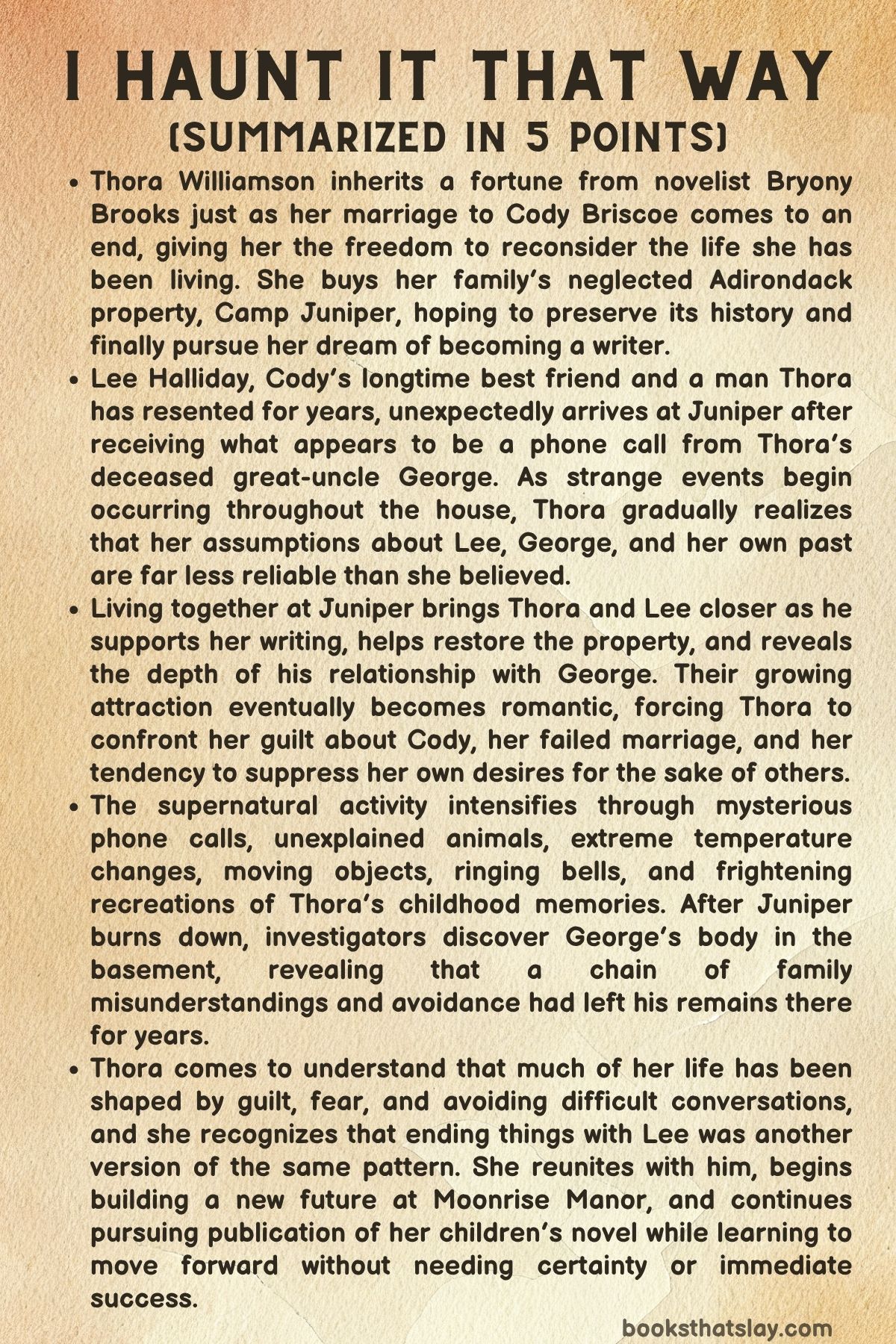
At the beginning of I Haunt It That Way, Thora Williamson learns that Bryony Brooks, the famous novelist for whom she worked as an assistant and caregiver, has left her a considerable fortune. The inheritance arrives during another major upheaval: Thora has finally accepted that her marriage to paleontologist Cody Briscoe is no longer working, and she intends to divorce him.
Cody spends much of his time away on expeditions, while Thora has gradually abandoned parts of herself to accommodate his career and Bryony’s needs. Hoping to recover from Bryony’s death and determine what kind of future she wants, Thora leaves Manhattan and stays with her cousin Mackenzie and Mack’s wife, Jade, in the Adirondack town of Woodhill.
There Thora learns that Camp Juniper, the old Williamson family great camp, is about to be auctioned because generations of relatives neglected the property taxes. The news horrifies her because Juniper is bound to some of her strongest childhood memories, including summers with eccentric Great-Uncle George, strange themed bedrooms, ghost stories, and family rituals.
Thora visits the deteriorating property with Mack and becomes angry at renovations completed years earlier by Lee Halliday, Cody’s longtime best friend. She has spent years disliking Lee, partly because she associates him with George’s isolation and partly because resentment has become easier than confronting her own guilt about barely visiting George before his death.
Bryony’s inheritance gives Thora the means to save Juniper. She buys the camp, begins settling there, and decides to transform it into both a home and a creative refuge where she can finally begin the children’s adventure novels she has dreamed of writing.
Her solitude is interrupted when Lee unexpectedly drives up the mountain in a vintage truck that once belonged to George. Lee believes George is still alive because he claims to have spoken with him by telephone only days earlier, forcing Thora to tell him that George died three years ago.
Lee is devastated. Even more unsettling, his phone records show that a call really did come from Juniper, despite the house having no functioning telephone service.
Thora begins reading letters Lee wrote George and discovers evidence of a warm relationship she had never understood. The letters also contain affectionate observations about Thora herself, making it harder for her to preserve her image of Lee as careless, selfish, or indifferent.
That night, an unplugged telephone rings inside Juniper. Thora and Lee hear strange whispering through the receiver and lose roughly two and a half hours while listening, as though the sound has altered their awareness of time.
Soon other impossible events occur. Food is stripped unnaturally clean from the refrigerator, rooms change temperature without explanation, strange animals appear inside the house, doors lock by themselves, objects disappear, and the camp seems increasingly capable of responding to Thora’s memories and fears.
While living together, Thora and Lee begin reconsidering one another. Lee cooks, repairs things, supports Thora’s writing, and treats her ambitions as worthwhile rather than secondary to someone else’s career.
Thora discovers George’s handwritten version of Tree & Leaf, a strange New Age parable that became a cult publication. Lee immediately recognizes it because his own family admired the book so intensely that his birth name, Leaf, came from it.
The manuscript exposes another hidden piece of family history. George apparently wrote the work, while other Williamsons arranged its publication despite his wishes, reinforcing the pattern of relatives acting for one another without genuinely listening.
Thora’s changing feelings toward Lee intensify when they visit Devil’s Cauldron, a wilderness swimming hole connected to their college memories. Across the water, Thora sees an elderly man who looks exactly like George perform his familiar swan dive and disappear beneath the surface.
Lee repeatedly searches the freezing water but finds no person, clothing, or belongings. Other visitors insist they never saw anyone enter the pool, leaving Thora with the disturbing possibility that she witnessed George’s ghost.
Afterward, the Blue Room at Juniper becomes impossibly cold, forcing Lee into Thora’s room. The intimacy gives them space to discuss George, Thora’s resentment, and the guilt she has displaced onto Lee.
Thora finally admits that blaming Lee for making Juniper comfortable enough for George to remain isolated allowed her to avoid recognizing how little she herself visited him. Lee explains that he believed he was respecting George’s independence, not abandoning him.
Their emotional honesty changes their relationship, and the attraction that has been building between them becomes impossible to ignore. They kiss, but the moment is interrupted by Cody’s unexpected arrival.
Cody has come for his passport and quickly realizes something has developed between his former wife and his best friend. The encounter becomes even more uncomfortable when Thora learns that a ring Cody once gave her was chosen because Lee told him its dark antique style suited her.
Thora overhears Cody criticizing Lee’s unconventional career. Lee explains that he left traditional architecture because he disliked sacrificing every meaningful idea to commercial priorities and has instead spent years gaining restoration and practical construction skills.
Cody directly asks Lee whether anything has happened between him and Thora. Lee refuses to lie, and Cody leaves angry, leaving Thora afraid that pursuing Lee means destroying a friendship that existed long before her marriage.
Mack challenges that guilt. She reminds Thora that her relationship with Cody is over and that Lee is responsible for deciding how he handles his friendship.
Mack also reveals that Lee is the architect responsible for restoring Woodhill House, forcing Thora to confront how confidently she judged a man whose adult life she barely knew. Her resentment had depended partly on refusing to hear information that contradicted it.
Thora and Lee become increasingly comfortable together during local events, dinners, music, restoration work, and quiet nights at Juniper. Thora realizes that Lee enjoys the parts of her personality she once considered excessive, including her curiosity, gossip, creativity, humor, and emotional openness.
The supernatural disturbances nevertheless become more personal. Thora sees a candle positioned beneath the Green Man doorknob exactly as it had been during a childhood prank that permanently burned her hand.
She initially accuses Lee but quickly realizes he could not have arranged it. The episode reveals how easily fear can return her to old assumptions, while Lee’s steady reassurance strengthens their trust.
Thora and Lee eventually sleep together. For Thora, their intimacy is not simply romantic attraction but part of reclaiming desires and bodily confidence she suppressed during her marriage.
Soon afterward, a living barn owl inexplicably appears inside Juniper. Later, the same owl seems to watch Thora outside after her skeleton key disappears and the house locks her out.
The disturbances escalate further when one of the Bell Room bells rings without anyone touching it. Because Williamson legend claims such ringing foretells death, Thora and Lee flee the house, only to discover that Lee’s truck has mysteriously stopped working.
Rather than go back inside, they hike to Moonrise Mountain and sleep outdoors. Removed from Juniper, Cody, and everyone else’s expectations, Thora recognizes that much of her former life was built around choices that seemed reasonable rather than choices she passionately desired.
The following morning the truck works normally. Thora returns to Juniper determined not to surrender the property to fear, but her confidence collapses when she discovers a live rattlesnake inside the bathtub.
Terrified, she announces that she is leaving. When Lee questions whether fear is causing her to abandon something important too quickly, Thora interprets his concern as criticism of her divorce and attacks him emotionally.
She accuses Lee of idealizing her, suggests he will always prioritize Cody, and even uses George’s death against him. Although she knows she is being unfair, panic convinces her that ending the relationship first will protect her from deeper pain.
Their attempt to leave is stopped when fallen trees completely block the driveway. That night they smell smoke and discover fire spreading from Juniper’s basement.
Lee burns his hand on the Green Man doorknob, receiving an injury that echoes Thora’s childhood scar. The two escape with only a few meaningful belongings and stand outside helplessly as Camp Juniper burns.
The fire destroys George’s manuscripts, letters, furniture, antiques, and generations of Williamson history. Yet Lee reminds Thora that the stories themselves can survive if she turns memory into fiction rather than treating physical objects as the only containers of the past.
The destruction becomes even more disturbing when firefighters discover human remains in the basement. At first, Thora wonders whether a hidden intruder might explain the strange telephone calls, moving objects, animals, bells, and other unexplained events.
She separates from Lee anyway, telling him she needs to understand herself before continuing their relationship. Back at Woodhill House, Thora attempts to write while helping Mack catalogue what was lost.
Investigators eventually identify the basement remains as George. The revelation horrifies Thora because the family believed his body had been properly handled three years earlier.
Mikey explains that he discovered George dead in the basement and called his mother in shock. Instead of contacting authorities herself, she called another relative, who contacted someone else, beginning a chain in which everyone assumed another family member would take responsibility.
No one did. George’s body remained forgotten inside Juniper while the Williamsons continued believing the matter had been settled.
The discovery gives the supernatural events a new meaning. If George truly haunted Juniper, perhaps he was trying to direct the family toward his abandoned remains while also pushing Thora and Lee toward truths they had avoided.
Thora recognizes that she has repeated the family’s central failure. When emotions become uncomfortable, the Williamsons transfer responsibility, withdraw, assume someone else understands, or abandon the situation before communicating honestly.
Her breakup with Lee followed the same pattern. Rather than remain present and explain her fears, she fled because leaving felt safer than risking disappointment.
Determined not to repeat that mistake, Thora visits Lee at his restored Massachusetts home. There she finally sees the full extent of his professional life: he has spent years teaching himself restoration, construction, and preservation techniques, partly because he always hoped he might someday restore Juniper properly.
Thora and Lee acknowledge their mistakes without pretending that love can eliminate every conflict. Thora admits that guilt over George influenced her devotion to Bryony, while Lee recognizes that his desire to respect George’s independence was affected by unresolved feelings about his own grandfather.
They agree that neither martyrdom nor avoidance can build a healthy relationship. Instead, they choose direct communication and allow themselves to want a future together.
Lee shows Thora plans for a smaller, safer house inspired by Juniper. Thora names it Moonrise Manor, turning the destroyed camp into the foundation of something new rather than attempting to reproduce the past exactly.
A year later, Moonrise Manor stands on the old property. Lee has recovered both the Green Man doorknob and Thora’s missing skeleton key from the ruins, preserving meaningful pieces of Juniper without forcing the new house to become a replica.
Mack is running the inn she dreamed of creating, Lee and Cody have preserved their friendship, and Cody has continued with his own life. Thora has completed and revised her first children’s novel, though publication has not come easily.
Bryony’s former agent, Nnenna, advises Thora not to spend forever waiting for one manuscript to validate her identity as a writer. She should keep submitting it while beginning another project.
Thora finally understands the lesson that has governed her entire transformation. A meaningful life cannot depend on perfect certainty, approval, permanent possessions, or the guarantee that a chosen path will succeed.
She continues writing because writing is what she wants to do. Surrounded by Lee, Mack, the Adirondacks, and the memories Juniper left behind, Thora no longer waits for someone else’s life to determine the shape of her own.
Characters
Thora Williamson
Thora is the emotional and narrative center of I Haunt It That Way, and much of her development comes from recognizing how thoroughly she has organized her life around other people. Her marriage, her work for Bryony, her guilt about George, and even her hatred of Lee have all allowed her to avoid asking the simpler but more frightening question of what she actually wants.
She begins the book newly wealthy but emotionally unsettled, because money gives her freedom without automatically giving her direction. Buying Juniper represents her first major attempt to reclaim something for herself, yet even that decision is shaped by guilt, nostalgia, and the fear that another person might take control of a place she regards as part of her identity.
Thora is imaginative, sociable, curious, expressive, and attracted to strange stories, qualities that fit naturally with her dream of writing children’s adventures. At the same time, she repeatedly doubts whether her creative ambition deserves the same respect she has given Cody’s scientific career or Bryony’s established literary success.
Her greatest flaw is avoidance disguised as responsibility. She often convinces herself that she is protecting others when she is actually protecting herself from uncertainty, confrontation, or rejection.
Her relationship with Lee exposes this habit because he continually challenges the narratives she has relied on. Once Thora realizes that she deliberately ignored positive information about him, she becomes more aware of how resentment can simplify complicated guilt into a convenient villain.
By the end, Thora has not become fearless or professionally successful overnight. Her achievement is more durable: she continues writing without knowing whether publication will come, allows herself to love Lee without demanding certainty, and builds a home that honors Juniper without trying to recreate what was destroyed.
Lee Halliday
Lee initially appears in I Haunt It That Way through Thora’s hostile assumptions, which makes the gradual correction of her perspective central to his characterization. She believes he is unambitious, careless, responsible for encouraging George’s isolation, and too closely connected to Cody to ever belong independently in her life.
The reality is almost the reverse. Lee cared deeply for George, maintained a private correspondence with him, modified Juniper because George wanted to stay there, and spent years developing restoration skills that could eventually have allowed him to repair the camp properly.
His rejection of conventional architectural success is especially important. Cody interprets Lee’s refusal to follow a prestigious corporate path as wasted potential, while Lee sees his choices as an attempt to preserve creative and ethical independence.
Lee also demonstrates affection through practical action. He cooks, repairs rooms, notices details, listens to Thora’s ambitions, takes her fears seriously, and offers care without assuming that caring for someone means controlling her choices.
His relationship with Thora is complicated by his long-standing friendship with Cody, but he refuses to reduce her to someone else’s former wife. He acknowledges his attraction honestly and accepts that maintaining both relationships may require difficult conversations rather than pretending nothing has changed.
Lee has his own unresolved guilt concerning George and his grandfather, so he is not merely the emotionally healthier romantic alternative to Cody. His development requires accepting that respecting someone’s independence does not remove all responsibility and that good intentions cannot guarantee good outcomes.
By the conclusion, Lee’s design for Moonrise Manor expresses his best qualities. He does not rebuild Juniper exactly as it existed; instead, he preserves its spirit while creating something safer and more appropriate for the future he and Thora have chosen.
Cody Briscoe
Cody functions in I Haunt It That Way less as a villain than as evidence that two people can care about each other and still become fundamentally incompatible. He is intelligent, disciplined, practical, professionally ambitious, and deeply invested in paleontology, but his life leaves limited room for the kind of emotional and creative partnership Thora increasingly needs.
His marriage fails largely through accumulation rather than one dramatic betrayal. Cody’s field expeditions, restrained personality, and assumptions about what constitutes serious work gradually make Thora feel that her own ambitions exist around the edges of his life.
His treatment of Lee reveals similar values. Cody judges Lee according to conventional markers of achievement and struggles to understand why someone with architectural training would reject a prestigious career path for restoration and practical craftsmanship.
Yet Cody is not entirely insensitive. His friendship with Lee has lasted for years, and his anger after discovering the relationship between Lee and Thora is understandable even when it becomes uncomfortable for everyone involved.
The revelation about Thora’s antique ring is quietly revealing. Cody purchased something he knew she would like, but only because Lee had understood her taste well enough to point him toward it, symbolizing how affection and understanding are not always identical.
Cody ultimately moves forward rather than remaining a permanent source of conflict. His friendship with Lee survives, and his presence in the ending reinforces the idea that divorce need not transform former partners into enemies for one person’s new life to become valid.
George Williamson
George’s absence dominates I Haunt It That Way, making him one of the novel’s most influential characters despite his death before the primary events. He represents family memory, creative independence, eccentricity, secrecy, and the consequences of a family whose members repeatedly assume they understand one another without asking directly.
Thora remembers him through Juniper, while Lee knew him through letters, conversations, and practical work on the house. The different versions of George expose how no single person fully possessed his story.
His authorship of Tree & Leaf also demonstrates the Williamson family’s tendency to override individual wishes. Other relatives arranged publication even though George apparently did not want it, turning a private creation into something publicly celebrated.
His death becomes the darkest example of family dysfunction. Because every relative assumed another person would handle the situation, George’s body remained abandoned in Juniper’s basement for years.
Whether his ghost literally caused every disturbance remains somewhat uncertain, but the haunting reflects unfinished responsibility. The telephone, the apparition at Devil’s Cauldron, the bells, the missing objects, the animals, and the final destruction of the house all direct attention toward things the living characters have refused to confront.
George therefore becomes both a person and a warning. Remembering someone lovingly is not enough if memory becomes a substitute for honest attention while that person is alive.
Mackenzie “Mack” Williamson
Mack is one of the stabilizing forces in I Haunt It That Way, combining family loyalty with the willingness to challenge Thora when necessary. Unlike Thora, she usually approaches problems directly, whether that means inspecting Juniper, demanding safety check-ins, rescuing an owl, managing restoration plans, or confronting emotional avoidance.
Her greatest contribution to Thora’s growth is refusing to support convenient versions of the past. She challenges Thora’s belief that Lee was responsible for George’s isolation and reminds her that George himself made choices about where and how he wanted to live.
Mack also possesses information about Lee that Thora has spent years refusing to hear. By revealing his work on Woodhill House and describing his genuine abilities, Mack forces Thora to recognize that prejudice can survive when a person carefully filters out contradictory evidence.
Her dream of turning Woodhill House into an inn gives her an arc of her own. By the end, she leaves work that did not define her and creates the future she wanted, making her story parallel Thora’s movement toward writing.
Mack’s bluntness is balanced by deep affection. Her anger when Thora forgets safety messages is never merely controlling; it comes from genuine concern for a cousin whose impulsiveness and isolation place her at real risk.
Jade
Jade occupies a quieter role but contributes to the stable domestic environment surrounding Mack and Thora. Her marriage to Mack provides an example of companionship that feels grounded, cooperative, and integrated into everyday life rather than built around one person sacrificing personal goals for another.
She also helps make Woodhill House a refuge after Juniper becomes increasingly dangerous. That contrast matters because Thora’s emotional growth depends partly on realizing that home is created through people, communication, and mutual care rather than through attachment to one inherited building.
Jade does not participate as directly in the supernatural mystery as Thora, Lee, or Mack. Her importance instead comes from the ordinary continuity she represents while the central characters are confronting ghosts, family secrets, romantic upheaval, and destruction.
Bryony Brooks
Bryony dies before the main events, yet her influence shapes nearly every major decision Thora makes. Her inheritance gives Thora the financial independence necessary to divorce Cody, purchase Juniper, support community projects, and choose writing without immediate economic pressure.
Their relationship, however, was complicated. Thora cared deeply for Bryony, but years of being her assistant and caregiver gradually consumed time and energy that Thora might have invested in her own creative ambitions.
Bryony therefore represents both opportunity and self-erasure. Thora admired a successful writer while postponing her own writing, becoming essential to someone else’s literary life while treating her own imagined books as something that could always wait.
Her death removes one responsibility but also leaves Thora with grief and guilt. Part of Thora’s development requires accepting that devotion to another person does not justify indefinitely abandoning her own ambitions.
Amethyst
Amethyst is Thora’s Manhattan friend and neighbor, offering an outside perspective at moments when Thora is trapped inside inherited family narratives. Early in the story, she encourages Thora to use her new financial freedom to construct the life she actually wants rather than simply remaining inside a marriage that has already become emotionally empty.
Later, Amethyst provides a playful but meaningful interpretation of the haunting. She suggests that George’s confused spirit might have been trying simultaneously to expose his forgotten remains, push Thora toward Lee, and free itself from Juniper.
The theory cannot be proven, but it helps Thora connect the supernatural events with the emotional problems surrounding them. Amethyst’s role is therefore less about solving the mystery scientifically than about giving Thora permission to imagine possibilities beyond the explanations she has already exhausted.
Mikey Williamson
Mikey’s importance becomes clear near the end when the truth about George’s body is discovered. Years earlier, Mikey found George dead in Juniper’s basement and, overwhelmed by the experience, contacted his mother rather than the authorities.
His response is understandable because he was shocked and expected the adults around him to take responsibility. The real failure occurs afterward, when responsibility passes through multiple relatives until everyone assumes someone else has completed the necessary task.
Mikey therefore becomes the starting point of the most disturbing Williamson family misunderstanding without being morally responsible for its outcome. His experience demonstrates how easily a frightening event can become buried when a family relies on assumption instead of confirmation.
Themes
Choosing Desire Over Obligation
Thora has spent years allowing duty to determine the structure of her life. She supports Cody’s career, devotes herself to Bryony, postpones writing, carries guilt about George, and repeatedly evaluates her choices according to how they might affect everyone except herself.
The problem is not kindness or responsibility but the gradual disappearance of personal desire. I Haunt It That Way repeatedly contrasts actions taken because they seem sensible with actions taken because they genuinely reflect who a person is.
Buying Juniper begins Thora’s movement toward self-direction, although the decision is still influenced by guilt and nostalgia. Her relationship with Lee takes the process further because desire cannot be justified as duty: she wants him despite the complications involving Cody, and accepting that fact forces her to recognize wanting as a legitimate basis for making some choices.
Writing becomes the clearest expression of this transformation. Thora has spent years near literary success through Bryony while avoiding the vulnerability of producing and submitting her own work.
The ending deliberately refuses to reward her with immediate publication. She has written a manuscript, revised it, received rejections, and continued anyway, demonstrating that choosing a meaningful life is not the same as receiving instant proof that the choice was correct.
Her freedom therefore comes from participation rather than certainty. She writes because she wants to be a writer, loves because she chooses Lee, and builds a home because she wants a future there rather than because family history requires her to preserve every piece of the past unchanged.
Guilt, Avoidance, and Responsibility
Nearly every central conflict develops because characters struggle to distinguish responsibility from guilt. Thora blames Lee for George’s isolation because anger at him is easier than admitting how rarely she visited George herself.
Lee also carries regret because he helped George remain at Juniper, even though he sincerely believed he was respecting an older man’s independence. Neither character intentionally abandoned George, but both look backward and imagine that different choices might have prevented his lonely death.
The discovery of George’s body turns this emotional problem into a literal family catastrophe. Every Williamson who receives information assumes another relative will handle the situation, creating a chain of transferred responsibility that leaves a dead man forgotten in a basement.
Thora repeats the same basic pattern in her romance. When her feelings for Lee become frightening, she tries to end the relationship rather than stay present long enough to discuss what she fears.
Her growth comes when she recognizes that avoidance can look deceptively responsible. She tells herself she is protecting Cody, protecting Lee’s friendship, or preventing future disappointment, but these explanations allow her to leave before another person can participate in the decision.
Responsibility in the novel ultimately requires communication. People cannot guarantee outcomes, but they can remain present, ask questions, confirm what has happened, and refuse to make another person responsible for resolving what they themselves are afraid to face.
Memory, Haunting, and the Meaning of Home
Juniper is more than property because generations of memories have attached emotional meaning to every room, object, story, and imperfection. Thora initially believes preserving the camp means physically saving these things, which explains both her anger at Lee’s renovations and her determination to buy the house.
The supernatural incidents complicate that attachment. The house seems able to reproduce memories that belong specifically to Thora, including the candle beneath the Green Man doorknob, while George’s apparent presence connects haunting with events the family has never properly resolved.
In I Haunt It That Way, ghosts function as reminders that ignored histories do not simply disappear. George’s forgotten body becomes the clearest example: the family behaves as though his death has been handled, yet the physical truth remains inside the home until destruction exposes it.
The fire initially appears to erase everything Thora hoped to protect. Manuscripts, letters, furniture, antiques, family objects, and the building itself disappear, confronting her with the fear that losing material evidence means losing the past.
Lee offers a different understanding when he encourages her to preserve stories through imagination. Memory survives not because every object remains untouched but because people reinterpret what those objects meant and carry that meaning forward.
Moonrise Manor completes this shift. The new home preserves selected pieces of Juniper without attempting to reproduce it, showing that honoring history does not require remaining trapped inside its original structure.
Reinvention and Letting Go
The rediscovered Tree & Leaf manuscript introduces the principle of finding beauty in release, and that idea becomes central to several character arcs. Thora must let go of her marriage, her simplified hatred of Lee, her idealized version of Juniper, her guilt about George, and eventually the physical camp itself.
Letting go does not mean pretending that the past did not matter. Thora’s divorce still contains grief, George’s death remains painful, Bryony remains important, and the destruction of Juniper is a genuine loss rather than a convenient opportunity for renewal.
The difference lies in whether memory becomes a foundation or a prison. Thora initially tries to save Juniper partly because she believes recovering the building can repair neglected family history and give her another chance at something already lost.
The fire removes that possibility completely. Once the house is gone, she can no longer fix the old Juniper and must decide whether her relationship with the place can survive in another form.
Lee undergoes a related transformation. He leaves conventional architecture, develops restoration skills on his own terms, acknowledges mistakes involving George, and eventually uses everything he has learned to design something new rather than recreating the past exactly.
The final image of Thora continuing to write reinforces the same principle. She submits one manuscript while beginning another, accepting that creative work and personal growth depend on movement rather than endlessly waiting for one project, one relationship, or one remembered place to become perfect.