I Have Some Questions for You Summary, Characters and Themes
I Have Some Questions for You by Rebecca Makkai is a layered literary mystery that examines memory, justice, and the stories people tell themselves to survive. At its center is Bodie Kane, a successful podcaster and film professor who returns to her elite boarding school decades after her classmate Thalia Keith was murdered.
The crime, pinned on the school’s athletic trainer, has long been considered solved, yet doubts linger. As Bodie teaches a course on podcasting, her students begin re-examining the case, and old suspicions resurface. Makkai blends questions of guilt, complicity, and systemic bias into a compelling narrative that challenges the reliability of truth and the consequences of silence.
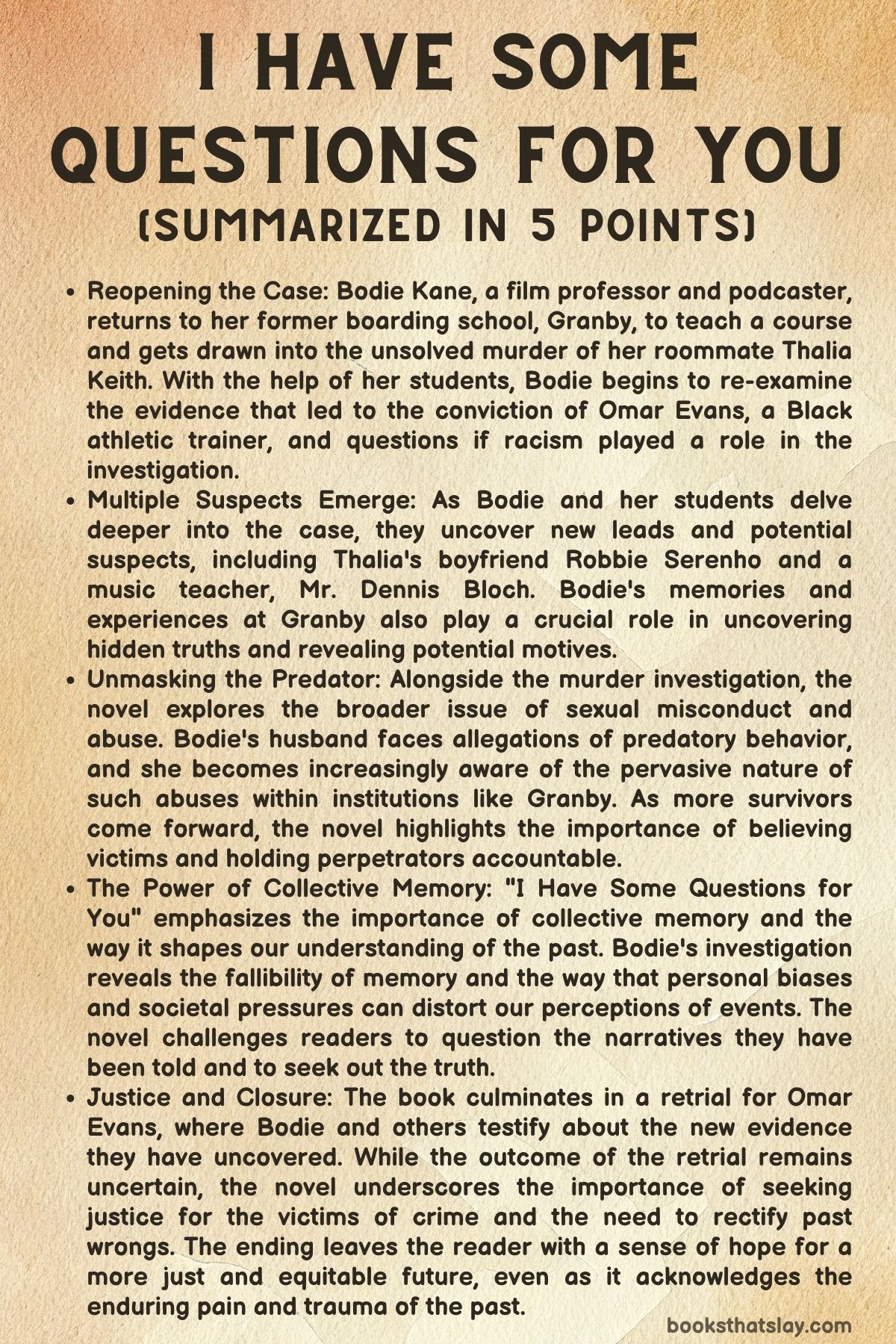
Summary
Bodie Kane, now in her forties, first revisits Thalia Keith’s story by watching a grainy video of their high school’s 1995 play, Camelot, where she had been stage manager. In the video, Thalia briefly appears, and online sleuths obsess over whether she was present during the curtain call.
This small detail becomes part of an endless cycle of speculation about her disappearance and death, which occurred later that night.
In 2018, Bodie returns to Granby, her old boarding school, to teach a short course in podcasting. She is invited by her former friend Fran, now a faculty member.
As she walks the familiar grounds, she is overwhelmed by memories—childhood tragedies, the chaos of her upbringing, and the role of the wealthy Robeson family who had sponsored her education. For much of her adolescence, Bodie hid the truth of her unstable family, including the violent death of her father at the hands of her brother Ace, who later also died.
At Granby, she carefully reinvented herself, clinging to survival while forming close bonds with classmates like Fran.
During her stay, Bodie reflects on her complicated personal life. Though technically still married to Jerome, she has distanced herself emotionally and is having an affair with a man named Yahav.
Over dinners with Fran and Anne, she shares fragments of her life but avoids discussing how deeply Thalia’s murder has haunted her. The conversation of that tragic year—when three classmates died—floods her with unease.
Bodie’s return coincides with her class of young podcasters exploring potential stories. One student, Britt, becomes fixated on Thalia’s case, convinced the wrong man was convicted.
The supposed killer, Omar Evans, was Granby’s athletic trainer, a young Black man whose coerced confession and questionable forensic evidence led to his imprisonment. Bodie, reluctant but unable to resist, is pulled into Britt’s determination to reexamine the case.
The parallels to her own podcast, which often explores women’s exploitation and silenced voices, deepen her sense of responsibility.
Flashbacks reveal Thalia’s short but impactful presence at Granby. As a transfer student, she quickly attracted attention with her charisma, beauty, and openness, though she became the subject of rumors and objectification.
A cruel “bingo card” circulated by boys tracked supposed encounters with her. Despite the gossip, Thalia managed to project warmth and strength.
Her sudden death was discovered in the school pool, her body showing multiple injuries. Omar was soon arrested, interrogated for hours without a lawyer, and convicted despite flimsy and contradictory evidence.
Even then, Bodie and others harbored doubts, but the school and community seemed eager for a quick resolution.
Back in the present, Bodie’s students dig into archival material, uncovering inconsistencies in timelines and suspicious behavior from classmates. They revisit the night of the play, the strange moments when Thalia appeared unsettled, and the possibility of someone else—perhaps a student—being with her.
The group also watches a Dateline special about the murder, where police presented Omar’s supposed confession and the Keith family’s grief. Yet Bodie, and increasingly her students, begin to see the gaps.
Omar had an alibi during much of the critical window, and his confession was riddled with coercion.
Bodie herself reconsiders the role of Mr. Bloch, a music teacher admired by students but perhaps too close to some of them, including Thalia. Through the lens of 2018, amid wider cultural reckonings about power and predation, she views what once seemed like harmless mentorship with suspicion.
At the same time, Robbie Serenho, a classmate of theirs, emerges as another possible suspect. Known for his charm with adults and controlling behavior with Thalia, he had been protected by privilege and the rehearsed alibis of friends.
Haunted by these possibilities, Bodie immerses herself in interviews, documents, and online conspiracy theories about Granby’s dark history. She recalls her own past statements to police, realizing she may have inadvertently fueled suspicions against Omar by suggesting Thalia had used drugs.
The guilt weighs heavily, and she feels obligated to help set the record straight.
Her investigation gains momentum when she presses old classmates, including Mike Stiles, who eventually admits they rehearsed stories to protect Robbie. Robbie himself, it turns out, had manipulated timelines, hidden aspects of his relationship with Thalia, and even pressured friends to maintain his alibi.
Further testimony from Beth, another classmate, reveals Robbie’s jealous, abusive behavior and undermines his supposed innocence. She recalls him slapping Thalia and describes his obsessive attempts to control her.
Though reluctant, Beth ultimately agrees to testify, providing the defense with crucial new evidence.
As the case is revisited, Omar’s lawyer pushes for a retrial. In court, Beth’s testimony and Mike’s revelations weaken Robbie’s alibi.
Yet Robbie pleads the Fifth, never fully denying his role, and the judge eventually denies the motion for retrial. Omar remains in prison, despite the clear weaknesses in the original conviction.
The justice system’s failure devastates Bodie, who reflects on how often privilege shields the guilty while the marginalized bear the brunt of punishment.
In the aftermath, Bodie continues teaching, reconnecting with Fran, and processing her role in Thalia’s story. She joins Fran in scattering the ashes of another lost classmate, Carlotta, and finds small moments of peace.
Yet the central mystery remains unresolved in court. Bodie remains convinced Robbie was responsible, aided by silence and complicity from peers and teachers, including possibly Bloch.
The unanswered questions weigh heavily, but Bodie’s return to Granby forces her to confront both the past and the broader injustices of power, race, and gender that shaped Thalia’s fate.
In the end, I Have Some Questions for You is not about delivering a neat solution but about exposing how stories are shaped—by memory, rumor, privilege, and silence. Bodie comes to see that truth is not always what the justice system records, and her own responsibility lies in continuing to question, to listen, and to refuse the comfort of easy answers.
Characters
Bodie Kane
Bodie is the central figure of I Have Some Questions for You, and her voice anchors the narrative. As both a narrator and investigator of the past, she represents the complexities of memory, guilt, and identity.
Shaped by family trauma—the violent death of her father and the tragic loss of her brother Ace—she grew up in instability before being taken in by the wealthy Robesons and sent to Granby. This history instills in her a deep need to control her story, often by concealing or revising the truth.
As an adult, she is a film professor and podcaster, navigating a fractured marriage with Jerome and a long-term affair with Yahav. Her return to Granby is both a professional engagement and a confrontation with unresolved grief and suspicion around Thalia’s murder.
Bodie’s character embodies contradictions: she is fiercely intelligent yet plagued by self-doubt, compassionate yet burdened by her complicity in spreading rumors that may have influenced Omar’s wrongful conviction. Her investigative instincts reveal her obsession with detail and truth, but her reflections also highlight how easily stories are reshaped by perspective, silence, and prejudice.
Thalia Keith
Thalia is the tragic figure at the heart of the novel, remembered through others’ memories, rumors, and speculations. As a transfer student at Granby, she was quickly drawn into the spotlight: beautiful, charismatic, and seemingly effortless in attracting admiration and envy alike.
Thalia’s warmth, humor, and resilience made her beloved among peers, even as she endured cruelty in the form of gossip and objectification. Rumors of her relationships with boys, teachers, and possibly Robbie Serenho created a distorted portrait that obscured her real struggles.
Though she handled attention with grace, she was also vulnerable—manipulated, isolated, and ultimately failed by the very institution meant to protect her. Her death in the pool is not only the central mystery but also a symbol of how girls’ lives are often consumed and defined by others.
Thalia’s presence lingers in the narrative as both memory and injustice, her silence filled by the voices that speculate about her instead of truly knowing her.
Omar Evans
Omar is the young Black athletic trainer who was convicted of Thalia’s murder, embodying the racial prejudice and systemic failures of justice in the 1990s. Aged only twenty-five at the time, Omar was targeted quickly by investigators and coerced into a false confession after over fifteen hours of interrogation without legal counsel.
Despite the lack of consistent physical evidence—trace DNA, a hair, and circumstantial notes in a directory—he was convicted and sentenced to sixty years in prison. Through Bodie’s reflections and the students’ investigations, Omar emerges not as a shadowy suspect but as a victim of racism, institutional pressure, and a culture eager for closure rather than truth.
His insistence, even decades later, that he was coerced underscores the persistence of wrongful convictions. Omar represents the cost of injustice: a stolen life, a scapegoated man, and the silence of privilege protecting those who may have been truly responsible.
Fran
Fran is Bodie’s close friend from Granby, now a teacher at the school and one of her few anchors in both past and present. Warm, witty, and loyal, Fran provides Bodie with a sense of continuity, balancing their shared memories with a grounded perspective.
She was one of the few people to whom Bodie revealed the truth about her difficult upbringing, and she continues to be a confidante during Bodie’s return. Fran’s relationship with Anne offers a contrast to Bodie’s complicated marriage, showcasing stability and acceptance.
At the same time, Fran’s presence highlights the weight of Granby’s history, since she remains embedded in the institution that both shaped and scarred them. Through Fran, the novel shows the enduring bonds of friendship, even when complicated by shared trauma and diverging paths.
Robbie Serenho
Robbie embodies privilege, charm, and hidden menace. A fellow student at Granby, he is remembered as a charismatic boy who fit easily into the circles of wealth and influence, despite coming from a less privileged background.
Beneath his polished surface, however, lies controlling and jealous behavior—manipulating Thalia, following her, even resorting to physical violence. His role in Thalia’s death becomes increasingly central as Bodie and others uncover inconsistencies in his alibi and testimonies from classmates like Beth.
Robbie’s ability to deflect suspicion for decades, aided by his peers rehearsing stories and the school’s protective silence, underscores the power dynamics that shield certain men from accountability. His life, continuing in normalcy and family stability, contrasts hauntingly with Omar’s decades in prison, representing the unequal weight of justice and the way silence sustains injustice.
Mr. Bloch
Mr. Bloch, the music instructor, reflects the blurred boundaries and abuses of authority that were often ignored in institutions like Granby. As a teacher admired by Bodie in her youth, he represents both inspiration and betrayal when viewed through the lens of hindsight.
Thalia’s closeness to him, once brushed off as innocent, becomes more disturbing in light of cultural shifts exposing patterns of predatory behavior by men in positions of power. His potential exploitation of Thalia, masked by admiration and gossip, points to a broader theme of how institutions normalize or overlook misconduct, especially when victims are young women.
Though never directly accused of the murder, Mr. Bloch’s presence in Thalia’s orbit raises chilling questions about how adults in power fail their students, whether through action, neglect, or silence.
Britt
Britt, one of Bodie’s podcasting students, represents a new generation’s determination to interrogate injustice and resist silence. Curious, outspoken, and persistent, Britt raises uncomfortable questions about true crime as a genre and about Omar’s conviction specifically.
She pushes Bodie to reconsider her reluctance, framing the case as a story of two stolen lives. Her project on Thalia’s murder becomes a catalyst for reopening old wounds and forcing reconsideration of the evidence.
Britt’s willingness to challenge authority, examine uncomfortable truths, and confront the exploitation of stories contrasts with the silence and complicity of the adults who lived through the events. Through her, the novel highlights the shift in cultural attitudes toward justice, accountability, and the telling of victims’ stories.
Vanessa Keith
Vanessa, Thalia’s sister, provides a painful reminder of the enduring impact of loss on families. In interviews and later in her cooperation with Bodie and the students, she reveals the private dimensions of Thalia’s life and death.
Her initial reluctance to share documents and later decision to release them underscores the tension between protecting family memory and exposing hidden truths. Vanessa embodies grief reshaped over decades: protective of her sister’s reputation, weary of speculation, but also aware of the importance of seeking justice.
She stands as a witness to how families carry both memory and silence, shaped by public narratives that often strip victims of their humanity.
Themes
Memory and the Reconstruction of the Past
In I Have Some Questions for You, memory functions less as a reliable archive and more as a shifting narrative shaped by perspective, time, and cultural context. The narrator, Bodie, often revisits her own past at Granby School, only to realize that what she remembers is partial, uncertain, or influenced by how stories have been retold over the years.
Watching the grainy video of Camelot in 2016 exemplifies this: the details are open to interpretation, with viewers projecting meaning onto fleeting gestures and moments. Similarly, her memories of Thalia are muddled by layers of rumor, gossip, and her own youthful insecurities.
As Bodie teaches her podcasting students decades later, she must confront the possibility that her initial statements and assumptions back in 1995 helped direct suspicion toward Omar Evans, inadvertently feeding into a narrative that still affects his life. Memory here is not just personal but collective, with forums, television specials, and podcasts shaping how Thalia’s story is remembered.
The novel explores how memory can be manipulated, misremembered, or selectively emphasized to suit an agenda, showing that the past is never static but constantly reconstructed. This theme underscores the uncertainty of truth and challenges the reader to question how stories of trauma and violence are preserved, interpreted, and sometimes distorted across time.
Injustice and Systemic Bias
The wrongful conviction of Omar Evans illustrates the deeply embedded flaws of the justice system, particularly in its treatment of Black men. His coerced confession, reliance on circumstantial evidence, and the eagerness of the authorities to close the case highlight how systemic racism functions in tandem with institutional convenience.
Rather than pursuing a thorough investigation, the system fastened onto Omar as a suspect who fit entrenched stereotypes, ensuring both the school’s reputation and the police’s efficiency appeared intact. The theme of injustice extends beyond Omar’s trial, as the novel situates his case within a broader pattern of wrongful convictions, flawed forensic methods, and the exploitation of racial prejudice in judicial processes.
Bodie’s growing awareness of her own role in perpetuating harmful narratives—by repeating rumors about Thalia using drugs—forces her to reckon with how ordinary voices can contribute to systemic wrongs. In parallel, her students’ critiques of true crime as exploitative mirror contemporary debates about whether such narratives re-traumatize victims while sensationalizing perpetrators.
Through Omar’s story, the book examines the uneven scales of justice and the devastating consequences of institutionalized bias, drawing attention to how innocence can be buried under prejudice, convenience, and silence.
Power, Gender, and Exploitation
Throughout the narrative, power operates through dynamics of gender, privilege, and authority. Thalia’s relationships with men, whether through rumor or reality, expose how young women are often subjected to scrutiny, judgment, and control.
The cruel “bingo card” circulated among male classmates reduces her humanity to a tally of conquests, reflecting how easily objectification becomes normalized. At the same time, the shadow cast by Mr. Bloch, the admired teacher who may have blurred or crossed boundaries, underscores how authority figures exploit admiration and trust.
Seen through Bodie’s adult lens and the backdrop of the #MeToo era, what once passed as rumor or harmless fascination now appears exploitative and sinister. Beyond Thalia, the novel also engages with broader themes of female exploitation in Hollywood, mirrored by Bodie’s own podcasting work, where she unpacks how women like Rita Hayworth were used and discarded by powerful men.
These overlapping narratives situate Thalia’s death within a continuum of gendered violence, showing how the silencing of women—through gossip, through institutional protection of men, and through dismissal of female agency—creates conditions where exploitation can thrive unchecked.
The Persistence of Guilt and Responsibility
Bodie’s return to Granby is driven not only by nostalgia but also by an unshakable sense of unfinished responsibility. Her involvement in spreading rumors about Thalia, her silence about certain suspicions, and her failure to question the investigation deeply enough weigh on her decades later.
This guilt manifests in her obsession with piecing together what happened and in her compulsion to help her students pursue the truth. Responsibility becomes complicated: is it collective, resting on the entire community that let rumors grow and suspicions fester, or is it personal, carried by individuals who chose silence or self-protection over justice?
Bodie wrestles with these questions, recognizing that her own survival at Granby depended on detachment and self-preservation, yet acknowledging that such detachment left others vulnerable. The theme of responsibility also extends to the present, as she navigates her students’ projects, aware of the ethical challenges of using someone’s tragedy as narrative material.
By placing Bodie in a position of both past witness and present investigator, the novel highlights the burden of responsibility across time: how choices made in youth echo decades later, and how silence can be as complicit as direct action.
Truth, Storytelling, and the Nature of Justice
At its core, I Have Some Questions for You interrogates the very nature of truth and the stories societies tell in its pursuit. The proliferation of narratives surrounding Thalia’s death—Dateline specials, podcasts, online forums, conspiracy videos—illustrates how stories multiply, competing for authority and reshaping public perception.
Justice itself becomes tied to who controls the narrative: whether it is the police framing Omar as a violent predator, the school promoting its reputation of safety, or Bodie and her students re-examining overlooked inconsistencies. Yet even with new revelations and testimony, the novel resists offering certainty, emphasizing how truth can remain elusive even when fragments align.
Storytelling emerges as both a tool of harm and a vehicle for resistance. Rumors and institutional cover-ups shielded the guilty and condemned the innocent, but new storytelling through podcasts and student inquiry opens pathways to re-examination and potential justice.
By ending with Omar’s case unresolved, the book emphasizes that justice is not always about closure but about ongoing effort, accountability, and refusing to let silence dominate. It highlights the fragility of truth in a world where narratives are contested, and underscores the moral weight of how stories are told, who gets to tell them, and whose voices are silenced.