I Hope This Finds You Well Summary, Characters and Themes
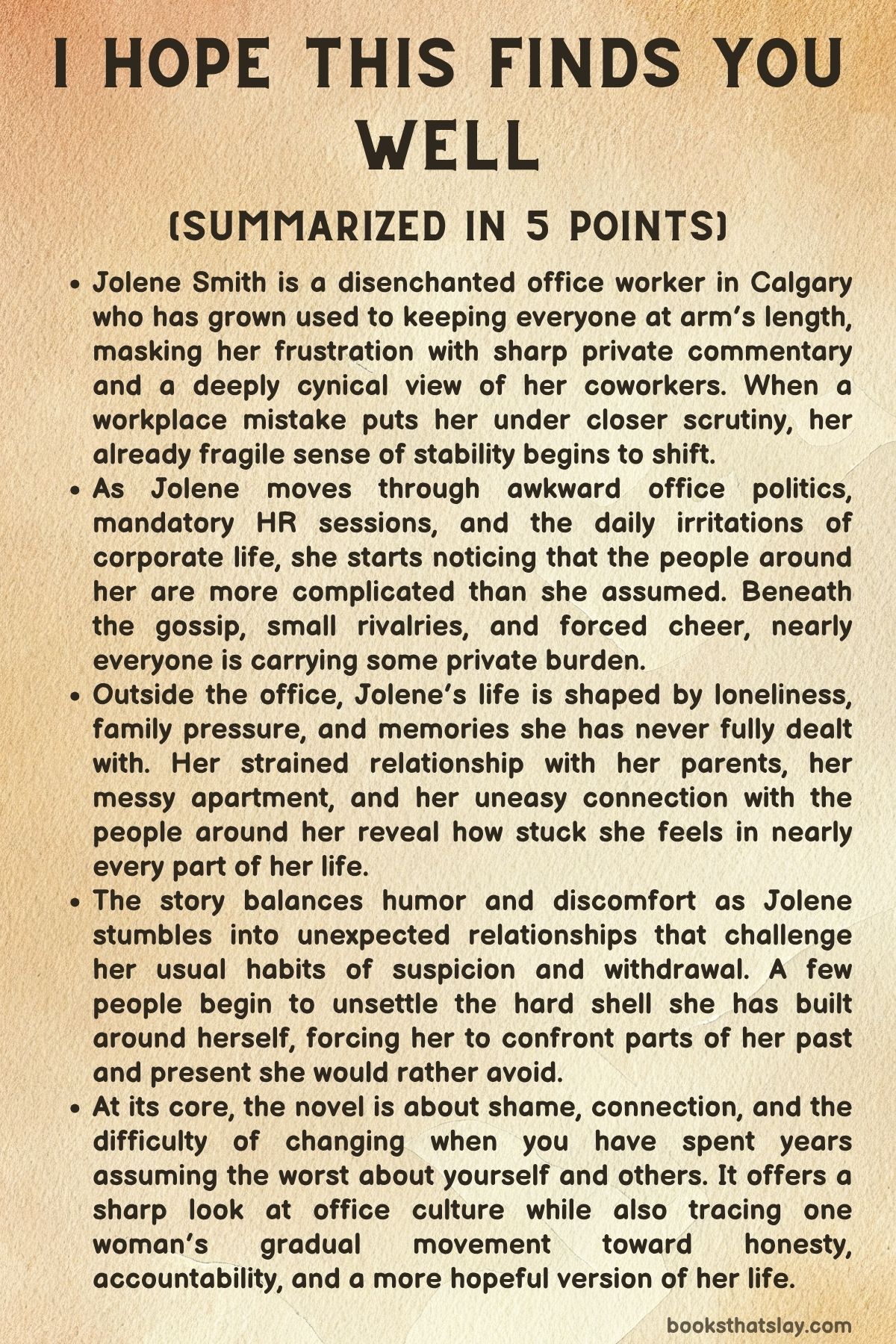
I Hope This Finds You Well by Natalie Sue is a darkly funny, character-driven novel about loneliness, shame, office politics, and the slow work of becoming honest with yourself. At its center is Jolene Smith, a bitter and isolated office worker whose private contempt for the people around her starts to crack when a workplace mistake gives her access to everyone’s emails and messages.
What follows is both comic and painful: a story about bad choices, buried grief, awkward connection, and the way ordinary workplaces can expose people’s fears and needs. Beneath the satire, the novel is about guilt, healing, and learning how to let other people in.
Summary
Jolene Smith is an administrative technician in the accounting department of Supershops Incorporated in Calgary. She has worked there for years and has grown deeply cynical about both the job and the people around her.
She sees office life as fake, shallow, and humiliating, and she protects herself by keeping others at a distance. Her habit of adding rude comments in hidden white text at the ends of emails shows how much anger she carries while pretending to remain polite.
On her thirty-third birthday, that habit catches up with her when one of her insulting postscripts is discovered. Her boss, Gregory Hall, calls her into a meeting with Cliff Redmond, a new HR analyst, and informs her that she must complete anti-harassment training and have monitoring software added to her computer.
Jolene returns home humiliated and alone. Her apartment reflects the state of her life: cluttered, closed off, and joyless.
She drinks too much, scrolls through social media, and becomes fixated on the lives of other people. The novel makes clear that her isolation is not only social awkwardness.
She is carrying deep guilt over the death of her childhood best friend, Ellie, who died years earlier after a drunken night at a party. Although it was an accident, Jolene has long believed that she bears responsibility.
That grief has hardened into self-hatred, distrust, and a fear that others will see her as the person she worries she really is.
The next workday, Jolene discovers that the new security setup has accidentally given her access to private emails, chats, files, and calendars across the office. At first she is shocked, but her embarrassment and resentment quickly turn into curiosity.
She begins reading the private communications of her coworkers, including Caitlin, her office rival; Rhonda, an older coworker nearing retirement; Armin, who works nearby; and Gregory himself. What starts as snooping soon becomes an obsession.
Jolene watches people discuss her behind her back, criticize her, pity her, and plan around her. She also learns things they would never say out loud: Caitlin wants her punished, Rhonda quietly believes Jolene would be the first to go in layoffs, and Gregory is already thinking about staffing cuts.
This access also reveals that the office is more fragile and more human than Jolene ever allowed herself to admit. Rhonda, who seems overbearing and smug, is secretly lonely and struggling with her adult son Carl’s addiction.
Armin, whom Jolene sees as awkward but harmless, is under pressure from his parents and worried about his mother’s cancer treatment. Caitlin, whom Jolene writes off as vain and shallow, is under stress in ways Jolene does not yet understand.
Gregory, for all his authority, is petty, sexist, and involved in an affair. Jolene begins using what she learns in two ways at once: to protect herself and get ahead at work, and to manage relationships she has never known how to handle honestly.
Because layoffs seem likely, Jolene decides to improve her position. She joins office groups, helps Rhonda with digital tasks, starts identifying workflow problems, and tries to make herself valuable.
At the same time, she deepens her connection with Cliff. Their relationship starts through required HR sessions and car rides to work, but it slowly grows warmer.
Cliff is friendly, funny, observant, and more patient with Jolene than she expects. Their conversations are awkward, playful, and unexpectedly meaningful.
For perhaps the first time in years, Jolene feels seen without being judged. She remains suspicious of him because he works in HR and might one day influence whether she keeps her job, but she also begins to trust him.
Outside the office, Jolene’s strained family life continues to press in on her. Her mother worries about her future, marriage prospects, and lack of connection, often in overbearing ways.
Jolene resists her parents while also needing them. She is also drawn, however reluctantly, into the life of her neglected twelve-year-old neighbor Miley, who clearly craves care and attention.
Jolene often pushes Miley away, but she also recognizes something of herself in the girl’s loneliness. These small encounters show Jolene’s capacity for kindness even when she is trying not to feel anything.
As Jolene keeps spying, she crosses more lines. She sabotages Caitlin’s work in small ways.
She records a private meeting between Cliff and Gregory because she fears they are plotting against her. She uses confidential knowledge to prepare an impressive presentation at a company meeting, earning praise for ideas she could only fully develop because of what she has secretly accessed.
Her success gives her a taste of recognition, but it is built on dishonesty. The more effective and socially engaged she becomes, the more unstable her position grows.
Meanwhile, Armin creates a separate crisis by telling his parents that Jolene is his fiancée. What begins as a ridiculous lie becomes increasingly complicated when his mother’s illness makes him desperate not to disappoint his family.
Jolene, half amused and half trapped, gets pulled into the performance. Their fake engagement spirals when both families become involved and begin planning a wedding.
The situation is absurd, but it also reveals how much pressure Armin is under and how often people lie because the truth feels unbearable. Jolene recognizes this because she is doing the same thing in her own life, only in different forms.
The emotional center of the novel sharpens when Jolene is forced to confront her past directly. At Caitlin’s engagement party, she meets Kyle, Caitlin’s fiancé, and recognizes him as one of the boys from the night Ellie died.
His presence brings back the full memory: Jolene convinced Ellie to go to a party where they were mocked, encouraged to drink, and treated cruelly. Ellie wandered off drunk, fell, and died.
Kyle and others later spread rumors that Jolene had hurt her. Jolene has been living inside that shame ever since.
When Cliff finds her in distress afterward, she reaches for comfort, and they nearly act on their feelings before he stops them because of the professional line between them.
From there, several storylines collide. Caitlin, already under pressure, is revealed to be in an abusive relationship with Kyle.
Jolene, after overhearing a late-night call and finally telling the truth about Ellie, persuades Caitlin to leave him. For the first time, Caitlin believes Jolene’s version of the past.
This matters deeply because Jolene has long lived under the fear that no one ever would. At the same time, Jolene’s bond with Rhonda strengthens when she learns the truth about Carl’s theft and addiction.
Instead of mocking or resenting Rhonda, Jolene comforts her. These moments show Jolene moving away from judgment and toward empathy, even as her own actions remain compromised.
Her downfall comes when everything she has hidden catches up with her. Gregory learns she has been reading his emails, including evidence of his affair.
Caitlin reports Jolene’s behavior and raises concerns about her interference. Gregory searches Jolene’s desk and finds printed confidential materials.
In a formal meeting with HR, the truth is laid out: Jolene has repeatedly violated privacy, tampered with work, and overstepped in serious ways. Cliff, despite caring about her, fires her effective immediately.
The scene is painful because Jolene has in some ways changed for the better, yet she is still facing the consequences of choices she kept making.
After losing her job, Jolene crashes. She drinks, hides, ignores messages, and lets the fake engagement collapse around her.
But this crisis also forces honesty. Cliff visits her with letters from her coworkers and admits that he still cares about her.
He also reveals that she pushed him to leave his HR role and return to work that better fits his values. Jolene finally tells her mother the truth: she was never really engaged, she lost her job, and she is not okay.
Instead of rejecting her, her mother offers love, practical help, and support for therapy. Jolene asks to move home temporarily while keeping some independence, and her mother agrees.
It is one of the novel’s most important changes: Jolene accepts care instead of pushing it away.
In the final stretch, Jolene begins rebuilding. She cleans her apartment, says goodbye to the version of herself shaped by old shame, and starts imagining a future not defined by Supershops or Ellie’s death.
She reconnects with Cliff and admits their feelings are real, but she also insists on taking time to work on herself first. Over the following year, she goes back to school with plans to become a youth counselor, a choice that reflects both her concern for Miley and her desire to help people who feel lost and unheard.
When she later attends Rhonda’s retirement party, the changes in everyone’s lives become visible. Rhonda has found purpose outside the office.
Miley is doing better. Caitlin has left Kyle.
Armin has moved forward after telling the truth. Gregory has faced consequences of his own.
Jolene, now in a healthier relationship with Cliff and with herself, realizes that she is no longer stuck in the same patterns. The novel closes on a note of earned contentment: not a perfect life, but a more honest one.
Characters
Jolene Smith
Jolene is the emotional and moral center of the novel, and the entire story depends on the tension between how she sees herself and who she slowly becomes. At the beginning, she is defensive, bitter, and deeply isolated.
She has turned sarcasm into a shield and contempt into a daily habit, especially at work, where she assumes nearly everyone is shallow, annoying, or cruel. That sharpness makes her funny and observant, but it also shows how badly she is hurting.
Her private white-text insults, her obsessive judgment of coworkers, and her retreat into alcohol and online lurking all point to a person who has stopped expecting kindness from others and who no longer believes she deserves much of it either.
What makes Jolene compelling is that her flaws are not cosmetic. She is not simply awkward or misunderstood; she lies, invades privacy, manipulates situations, and at times behaves vindictively.
Once she gains access to private office communications, she does not merely observe people. She uses what she learns to protect herself, get ahead, and sometimes sabotage others.
That moral compromise matters because the novel does not excuse her behavior just because she is lonely. Instead, it shows how pain can distort a person’s judgment until harmful actions begin to feel reasonable.
Her spying becomes an expression of both fear and desire: fear of being humiliated or discarded, and desire for control in a life that feels emotionally unmanageable.
Her inner life is shaped most heavily by Ellie’s death. Jolene has built much of her adult identity around guilt, shame, and the idea that she is somehow toxic to other people.
She carries the memory of that night not as a tragedy she survived, but as proof that she ruins things. This is why she keeps others at a distance and why even ordinary workplace embarrassment feels catastrophic to her.
She is not just worried that people will dislike her; she is afraid they will uncover something fundamentally terrible about her. That fear explains her defensiveness, her need to stay ahead of judgment, and the intensity with which she reacts to reminders of her past.
At the same time, Jolene is more emotionally capable than she lets herself believe. She notices vulnerability in others long before she admits it matters to her.
She sees Miley’s neglect, Rhonda’s loneliness, Armin’s anxiety, Caitlin’s distress, and Cliff’s conflict with unusual clarity. Her problem is not that she lacks empathy, but that empathy frightens her because it demands openness.
As the story moves forward, she begins to respond to people less as symbols of her own resentment and more as full human beings. That shift is the heart of her development.
She does not become perfect or even especially polished, but she becomes more honest, more accountable, and more willing to be known.
By the end, Jolene’s growth feels earned because it comes through consequences rather than reward. She loses her job, faces the damage of her choices, confesses difficult truths, and finally asks for help.
Her decision to pursue therapy, move back with her parents on healthier terms, and work toward becoming a youth counselor shows that she is no longer organizing her life around secrecy and punishment. She ends the novel not as a transformed fantasy version of herself, but as someone beginning to live with more courage and less self-loathing.
Cliff Redmond
Cliff functions as both a romantic interest and a moral counterweight to Jolene. He enters the story as an HR analyst, which immediately makes him suspicious in her eyes because he represents institutional oversight, discipline, and evaluation.
Yet he is not cold or bureaucratic. He is warm, odd, gentle, and often disarmingly sincere.
His office decorations, donuts, doodles, jokes, and slightly awkward friendliness all suggest someone who actively resists becoming mechanical within a dehumanizing workplace. He brings a different emotional temperature into the novel, one that allows the story’s harsher elements to open into tenderness without becoming sentimental.
What makes Cliff important is that he is not merely kind in a passive way. He pays attention.
He notices when Jolene is uncomfortable, when she is masking distress, when she is pushing people away, and when she is trying, however clumsily, to move toward connection. He does not magically solve her problems, but he consistently treats her as a person worth engaging with.
That matters because Jolene expects either rejection or superficial performance from others. Cliff disrupts that expectation.
His patience creates a space in which she can reveal parts of herself that have long been sealed off.
At the same time, Cliff is not written as unrealistically saintly. He has limits, boundaries, and obligations that create real friction in the relationship.
Because he works in HR, he cannot simply act on his feelings without ethical complications. He is torn between personal affection and professional responsibility, and the novel does not let him escape that tension.
His refusal to continue the kiss, his insistence on boundaries, and his eventual role in Jolene’s firing all show that he cannot be reduced to the man who rescues the heroine. He cares about her, but he is also part of a system that harms people, and he feels that strain acutely.
His own characterization gains depth through his family life. His closeness to his sister Grace and grandmother Lisa shows that his capacity for care is not limited to romance.
The fact that he gave up a job he liked in Vancouver to support his grandmother’s recovery reveals a quiet sense of duty that mirrors Jolene’s more tangled relationship to family. He is someone who carries responsibility with sincerity, even when it costs him.
That makes his later decision to leave his HR role believable. He does not want to keep doing work that forces him to hurt people in ways that conflict with his values.
As a romantic figure, Cliff works because he is not presented as a prize at the end of Jolene’s growth. Instead, he is part of the process that helps her imagine a healthier life.
Their connection is built through banter, discomfort, awkward honesty, disappointment, and renewed trust. By the end, his presence suggests possibility rather than completion.
He is meaningful to Jolene not because he fixes her, but because he sees her clearly and still remains open to her.
Rhonda Staples
Rhonda begins as one of the most irritating figures in Jolene’s office world, and that first impression is very deliberate. She seems nosy, smug, old-fashioned, and faintly patronizing.
She is the kind of coworker whose habits, comments, and small displays of self-importance would be easy to mock. Jolene initially reads her as exactly that kind of person, and because the novel is filtered so strongly through Jolene’s perceptions, readers are encouraged to share that annoyance before gradually seeing beyond it.
As the story develops, Rhonda becomes one of the richest examples of the gap between public persona and private life. Beneath her office confidence and her sometimes frustrating behavior is a woman carrying loneliness, disappointment, and fear.
Her repeated attempts to contact her son Carl, her involvement with dating websites, and her quiet efforts to maintain dignity all reveal someone who is much less secure than she appears. She is not simply a comic workplace type; she is a person trying to preserve routine and pride while dealing with a son whose addiction is slowly breaking her heart.
Rhonda’s office habits are also more revealing than they first seem. Her reliance on paper, her resistance to changing methods, and her sometimes rigid way of working can easily be seen as incompetence or stubbornness.
But the novel treats those habits with more sympathy over time. They reflect age, anxiety, and a desperate attempt to hold onto relevance in an environment that is already preparing to treat people like her as expendable.
Her fear of being left behind is not abstract. It is tied to the real threat of layoffs, to subtle mockery from younger coworkers, and to the loss of authority that comes when the workplace moves faster than she can.
Her relationship with Jolene is especially effective because it changes gradually rather than through one dramatic breakthrough. The two women begin with mutual irritation and old resentments, but shared work and glimpses into each other’s vulnerability allow something more honest to develop.
Jolene sees that Rhonda is lonely, and Rhonda sees that Jolene is not as hostile as she appears. Their connection becomes one of the novel’s most satisfying forms of friendship because it is built out of ordinary acts: helping with reports, setting up parties, sharing drinks, offering comfort, and finally speaking plainly about pain.
Rhonda’s gratitude later in the story feels moving because she is not someone who gives affection casually.
By the end, Rhonda represents one of the novel’s clearest arguments for looking past easy judgments. She starts out as a source of comedy and irritation, but she ends as a figure of resilience and warmth.
Her retirement and later role teaching crochet in the community center show that she is capable of building meaning outside the narrow, often humiliating structure of office life. She becomes, in a quiet way, one of the novel’s success stories.
Armin Habib
Armin is one of the most layered secondary characters because he is both funny and deeply sad. At first he appears slightly strange, passive, and difficult to read.
He has odd habits, seems distracted, and often occupies an uncertain social place in the office. Jolene watches him with a mix of curiosity and judgment, especially because he shows flashes of sympathy toward her when others are more openly dismissive.
He is not dominant in the room, but he is never emotionally empty. There is always a sense that something heavier is happening beneath his awkwardness.
That hidden pressure becomes clearer as the story unfolds. Armin is trapped between family expectations, workplace instability, and his mother’s illness.
His fake engagement to Jolene is absurd on the surface, but it grows out of something desperate and revealing. He wants to comfort his parents, avoid disappointing them, and preserve a hopeful narrative while his mother undergoes cancer treatment.
The lie is ridiculous, selfish, and unsustainable, but it is also recognizably human. He is trying to create emotional relief in a situation where the truth feels too painful.
This makes him a useful mirror to Jolene, who also lies and hides in order to manage fear.
Armin’s behavior at work adds another layer. He is not always responsible, and he is clearly vulnerable to being judged as less serious or competent than others.
Rhonda keeps track of his wasted time, Gregory views him through stereotypes, and the threat of layoffs hangs over him constantly. Yet he is not simply careless.
His absences and appointments are linked to family obligations, and much of his instability comes from trying to hold together a life that is fraying on several fronts. The office does not make room for that complexity, which is part of why he looks so inconsistent from the outside.
His relationship with Jolene shifts in interesting ways because it begins in secrecy and discomfort but grows into something like solidarity. He discovers her spying, chooses not to expose her immediately, and eventually develops a kind of uneasy trust with her.
Their fake engagement plot could have remained pure farce, but it ends up revealing shared cultural pressures, family burdens, and the exhaustion of living through lies. Armin is one of the few people who truly understands what it means to feel cornered by expectations.
He also becomes one of the few people willing to tell Jolene that her behavior is hurting her.
By the end, Armin stands as a character who is flawed without being trivialized. He is immature in some ways and evasive in others, but he is also loving, frightened, and capable of change.
His eventual honesty with his parents and his decision to move forward suggest that he, like Jolene, has begun stepping out of a life shaped by performance.
Caitlin Joffrey
Caitlin first appears as Jolene’s office rival and one of the clearest objects of her hostility. She is polished, image-conscious, socially aware, and often condescending.
Through Jolene’s perspective, she seems like the kind of person who thrives on appearances and subtle cruelty. Her social media habits, curated persona, and office confidence make her easy for Jolene to dismiss as shallow.
Early on, Caitlin represents exactly the kind of socially fluent woman Jolene distrusts and resents.
What makes Caitlin more than a stock antagonist is the way the novel gradually exposes the cost of that polished image. She is ambitious and strategic, but she is also under significant emotional pressure.
She benefits from favoritism at work, but that advantage does not make her secure. Her performance, her competitiveness, and her eagerness to position herself well all suggest someone who knows she is being measured and could easily fall.
She does judge Jolene harshly and does take steps against her, but she is also trying to survive in an environment where likability, timing, and presentation can determine who gets protected.
Her personal life deepens the character further. Her engagement initially seems like a symbol of conventional success, especially through Jolene’s resentful eyes, but it eventually becomes clear that Kyle is abusive and controlling.
This changes the emotional stakes of Caitlin’s character. The novel does not erase the ways she has been catty or self-serving, but it refuses to flatten her into a villain once her vulnerability becomes visible.
Her relationship shows how people can appear socially successful while privately enduring fear, manipulation, and harm.
Caitlin’s changing relationship with Jolene is one of the more meaningful arcs in the novel because it moves from rivalry and suspicion toward uneasy recognition. Jolene has tampered with her work and invaded her privacy, so there is real damage there.
At the same time, Caitlin eventually listens when Jolene tells the truth about Ellie and warns her about Kyle. That moment matters because Caitlin becomes one of the first people to explicitly believe Jolene’s version of a story that has haunted her for years.
In return, Jolene begins to see Caitlin not as a symbol of everything she hates, but as a person trapped in her own difficult circumstances.
By the final section, Caitlin’s apology carries weight because it comes after both women have been forced to confront each other beyond office stereotypes. She remains ambitious and socially polished, but she is no longer only that.
She becomes part of the novel’s larger message that mutual cruelty often thrives where people are frightened, constrained, and pretending to be more secure than they are.
Gregory Hall
Gregory is the clearest embodiment of workplace hypocrisy and institutional self-protection. As Jolene’s boss, he holds formal authority, but the novel repeatedly shows that his competence is mixed with vanity, sexism, and a desire to preserve his own comfort above all else.
He presents himself as managerial and reasonable while behaving in petty and often inappropriate ways. His casual remarks, especially those shaped by gendered assumptions, reveal how comfortable he is in a system that excuses his condescension.
He is also a man who manages perception carefully. He enforces standards downward while breaking them upward.
He can discipline Jolene for unprofessional behavior while carrying on an affair and relying on private secrecy to protect himself. This double standard is essential to his characterization.
Gregory is not monstrous in an exaggerated way; he is far more recognizable than that. He is the kind of manager who speaks the language of policy and professionalism while using power opportunistically behind the scenes.
That realism makes him more unsettling.
His conduct around layoffs further sharpens his role. Gregory treats staffing decisions as strategic adjustments rather than life-changing events for the people involved.
He is dismissive of vulnerability, impatient with complexity, and inclined to reduce workers to usefulness or inconvenience. Cliff’s more humane perspective repeatedly clashes with Gregory’s colder judgment, and that contrast exposes Gregory’s limitations.
He sees people in terms of risk, optics, and productivity, not need or dignity.
His interaction with Jolene near the end is especially revealing. When he realizes she knows about his affair, he essentially tries to buy her silence with job security.
In that moment, his entire management style becomes clear. He is willing to use institutional power as personal leverage, and his version of fairness disappears the moment his own reputation is involved.
He represents a workplace culture in which rules are real only for those without power.
Even so, Gregory is not written as a cartoon. He is believable precisely because he is familiar: self-important, casually unfair, image-driven, and convinced of his own reasonableness.
His later requirement to undergo anti-harassment training serves as a fitting reversal, though not a grand moral punishment. The novel does not need to overdramatize him.
It simply shows the kind of man he is and lets that speak for itself.
Miley
Miley may not dominate the office plot, but she is one of the most important emotional figures in the story. As Jolene’s neglected young neighbor, she functions almost like a living reminder of what loneliness looks like before adulthood teaches people how to disguise it.
She is direct, needy, talkative, and often intrusive, but those qualities come from a simple desire to be noticed. Her mother’s neglect leaves her drifting toward anyone who might offer consistency or warmth, and Jolene becomes one of the few adults in her orbit who sees the problem.
Miley matters because she reveals something softer in Jolene long before Jolene is ready to admit it. Jolene often resists her, avoids her, or responds with impatience, but she cannot entirely detach from her.
She recognizes the sadness in Miley’s attempts to get attention and feels guilty whenever she turns away. Those interactions are small on the surface, yet they are central to Jolene’s development.
Miley draws out Jolene’s instinct to protect and guide, especially when it comes to bad friends, shame, and wanting to belong.
The relationship between the two also broadens the novel beyond office satire. Through Miley, the story links adult emotional damage to younger experiences of exclusion and neglect.
Jolene sees in Miley a child who could easily grow into the same kind of guarded, lonely adult she has become. That recognition helps explain why Jolene eventually wants to become a youth counselor.
Miley does not just receive care from Jolene; she helps Jolene imagine a different future for herself.
By the end, Miley’s continued presence and growing bond with Rhonda help signal that a healthier community has formed around the people who were once disconnected from one another. She is a small but powerful figure of continuity, reminding the reader that care can begin in awkward, ordinary ways and still matter enormously.
Jolene’s Mother
Jolene’s mother is one of the most complicated family figures in the novel because she is both loving and overbearing. Much of Jolene’s frustration with her comes from the way she presses into every vulnerable area of her daughter’s life: work, romance, social standing, marriage, and appearances.
Her questioning, matchmaking, and involvement with the Persian aunties often feel exhausting, and from Jolene’s perspective they can seem invasive or humiliating. She embodies a form of parental care that easily tips into control.
Yet the novel steadily reveals that her behavior comes from anxiety, cultural expectation, and genuine concern rather than simple domination. She wants Jolene to be safe, connected, and settled, but she does not always know how to express that without pressure.
Her efforts are clumsy and often counterproductive, but they are not empty. She is trying, in the only way she knows, to pull her daughter back toward life.
The most important part of her characterization comes when the truth finally arrives. When Jolene confesses that she lost her job, lied about the engagement, and is struggling deeply, her mother does not reject or shame her.
Instead, she offers love, housing, and support for therapy, while also accepting Jolene’s request for more independence. This response redefines her.
She is no longer simply the embarrassing parent from whom Jolene hides. She becomes someone capable of listening, adapting, and loving without condition.
Her relationship with Jolene therefore becomes one of the novel’s quietest but strongest signs of healing. The change is not that the mother becomes a totally different person.
It is that both women begin speaking more honestly. That honesty makes room for a warmer, less defensive version of family life.
Jolene’s Father
Jolene’s father is a quieter presence than her mother, but that quietness is part of what defines him. He is less intrusive, less expressive, and often seems to occupy the edges of family scenes rather than controlling them.
Because of this, he may initially appear distant, but the novel uses that reserve carefully. He is not emotionally absent in a cruel way; he is simply less fluent in direct engagement.
His role matters because he represents a softer, less verbally demanding form of care. He apologizes for intrusions, offers subdued support, and never seems to seek emotional control over Jolene.
Where her mother presses, he tends to hold back. That restraint has its own limitations, since it means he is not always a strong intervening force, but it also makes him a stabilizing presence in contrast to the noisier tensions around him.
By the later part of the novel, Jolene’s decision to text him and arrange lunch matters precisely because their relationship has not been as openly developed. It signals her willingness to move toward connection not only with the mother she has fought against, but also with the father she has kept at a quieter distance.
He becomes part of the broader pattern of reconciliation that shapes the ending.
Ellie
Ellie is absent from the present-day plot, yet she is one of the most powerful characters in the novel because she lives inside Jolene’s memory, guilt, and self-concept. Ellie represents friendship, youth, vulnerability, and the catastrophic moment that divided Jolene’s life into before and after.
Everything about Jolene’s emotional life is shaped by losing her, and that makes Ellie less a background tragedy than a constant psychological presence.
Because Ellie is remembered through trauma, she is not given the same day-to-day fullness as the living characters. Instead, she appears as a symbol of innocence, closeness, and unbearable loss.
Jolene’s grief is tangled with shame because she believes her choices helped place Ellie in danger. That burden distorts the memory itself, making Ellie both beloved and impossible to mourn cleanly.
Jolene cannot simply miss her; she also uses her memory to punish herself.
Ellie’s narrative importance lies in what she reveals about the long life of adolescent cruelty. The party, the bullying, the alcohol, and the rumors afterward did not end with one night.
They kept shaping Jolene’s adulthood, her relationships, and her sense of worth. When Jolene finally tells the truth about what happened, Ellie’s role shifts slightly.
She is no longer only the source of secret shame; she becomes part of a story Jolene can speak aloud. That change is essential to Jolene’s recovery.
Kyle
Kyle is the novel’s clearest representation of cruelty carried forward from adolescence into adulthood. In Jolene’s past, he was one of the boys whose bullying and recklessness contributed to the night Ellie died.
In the present, he reappears as Caitlin’s fiancé, forcing Jolene to confront not only memory but the fact that people who cause harm often go on living as if nothing happened. His presence is destabilizing because he embodies the continuity between past trauma and present danger.
What makes Kyle effective as a character is that he does not need enormous page time to feel threatening. His behavior communicates entitlement, control, and intimidation almost immediately.
He does not merely remind Jolene of old pain; he actively reproduces harmful dynamics in the present through his relationship with Caitlin. That parallel matters.
The novel shows that the kind of boy who humiliated vulnerable girls at a party can become the kind of man who controls and frightens a partner.
Kyle is not especially psychologically deep, but he does not need to be. His function is to force truth into the open.
Through him, Jolene’s buried history returns, Caitlin’s private suffering becomes legible, and the novel’s themes of shame and silence gain sharper stakes. He stands for the kind of harm that survives when it is never properly confronted.
Grace Redmond
Grace, Cliff’s sister, has a smaller role, but she contributes important texture to Cliff’s world and to the tone of the novel. She is open, sociable, and easy in a way that immediately contrasts with Jolene’s guardedness.
Her presence at the bowling outing helps shift that scene from awkward obligation into something like genuine inclusion. Through Grace, the reader sees that Cliff’s kindness is not an isolated romantic quality; it comes from a family environment in which warmth and humor are normal.
She also helps communicate family history, especially Lisa’s health struggles and Cliff’s decision to move back to Calgary. In that sense, Grace is a bridge character, giving Jolene and the reader access to more of Cliff’s life.
Her ease with Jolene gently invites Jolene into a social setting she would normally avoid, which makes Grace part of the story’s larger pattern of opening closed emotional spaces.
Lisa
Lisa, Cliff and Grace’s grandmother, appears briefly but meaningfully. She is part of what grounds Cliff’s character in duty, loyalty, and family affection.
The fact that he moved cities to support her recovery says a great deal about both of them. Lisa’s presence suggests a family structure built around mutual care rather than performance, and that contrast matters within a story where so many people are pretending, hiding, or quietly falling apart.
Even in limited appearances, Lisa adds warmth and generational depth. She helps make Cliff’s world feel lived-in and stable, which in turn highlights how disordered and lonely Jolene’s life has become.
She is not central to the plot, but she enriches the emotional world around one of its most important relationships.
Carl
Carl is mostly seen indirectly through Rhonda’s calls, messages, and worry, but his offstage presence is powerful. He represents the ongoing pain of loving someone whose addiction makes trust fragile and family life unpredictable.
Because he is not constantly on the page, he is understood primarily through Rhonda’s fear, embarrassment, hope, and disappointment. That perspective is effective because it keeps the focus on the emotional damage addiction causes within relationships.
Carl also complicates Rhonda’s characterization. Her office fussiness and self-presentation make more sense once the strain of her home life becomes clear.
The stolen company credit card and the suspicion that money might feed something deadly turn Carl into more than just a troubled son. He becomes the source of Rhonda’s constant private dread.
His role is brief in direct terms, but essential in humanizing Rhonda and showing the unseen crises people carry into ordinary workplaces.
Garret
Garret serves as a secondary figure of office power. He is not as central or as vividly drawn as Gregory, but he helps define the culture of Supershops as a place where management decisions are strategic, political, and often quietly unfair.
His positioning close to Gregory makes him part of the machinery that evaluates people from above while keeping emotional distance from the consequences.
He is useful in the novel less as an individually rich character than as part of the managerial environment. Through Garret, the story reinforces how office hierarchies encourage favoritism, calculation, and self-protection.
He helps maintain the sense that workers are always being observed, assessed, and compared, often without transparency or compassion.
Larry Goodwin
Larry appears more prominently late in the story, but his role is memorable because he dramatizes what the workplace has been threatening all along. He is a longtime employee who fears being laid off, and when he is finally fired, his breakdown exposes the humiliation and rage buried beneath office routine.
His mass email, public outburst, and final act of chaos turn an abstract fear into a visible event.
Larry matters because he shows what happens when a person’s identity has become too tied to a workplace that does not care about him. He becomes a warning and a mirror.
His question to the office about whether this is really the life they want lands with force because it cuts through all the politeness and performance that define the workplace. He is not offered as a noble truth-teller, since his behavior is also disturbing and violent, but he does momentarily strip away the false normalcy of the office.
In doing so, he pushes both Jolene and Cliff toward a reckoning with the lives they are living.
Madeline and Sheila
Madeline and Sheila are not major characters in terms of page presence, but together they sharpen Gregory’s characterization and the novel’s interest in appearances versus truth. Madeline, Gregory’s wife, appears at the party and exposes Jolene’s mistaken assumption that the flirtatious emails came from a spouse.
Sheila, the woman involved with Gregory, represents the private misconduct hidden beneath managerial respectability.
These two women matter less as independent figures and more as catalysts. Through them, Jolene realizes how much she has inferred, how much she still does not know, and how dangerous partial knowledge can become.
Their presence also helps expose the hypocrisy of a boss who enforces standards while violating them privately. In a novel deeply interested in surveillance and misreading, they are small but effective parts of that design.
Themes
Loneliness, Alienation, and the Desire to Be Seen
Loneliness shapes nearly every part of Jolene’s life, but the novel treats it as more than simple solitude. Her isolation is emotional, social, and moral.
She works in a crowded office, speaks to people every day, and still feels entirely cut off from meaningful human connection. That gap between physical proximity and emotional distance gives the story much of its tension.
Jolene is surrounded by coworkers, family, and neighbors, yet she experiences most of them as threats, irritations, or reminders of her own discomfort. She has trained herself to stay detached because detachment feels safer than vulnerability.
Her sarcastic inner commentary and cruel hidden messages are not only signs of bitterness; they are defensive habits created by years of humiliation, shame, and disappointment. She would rather judge others first than risk being exposed or rejected by them.
What makes this theme powerful is that the novel does not limit loneliness to Jolene alone. As she gains access to private messages and hidden parts of other people’s lives, it becomes clear that isolation is widespread.
Rhonda performs confidence and busyness while suffering from loneliness and fear about her son. Armin jokes and improvises his way through life while carrying pressure from his family and anxiety about his mother’s illness.
Caitlin presents herself as socially successful while living inside a relationship shaped by control and fear. Even Cliff, the most emotionally open figure in the story, feels constrained by his role and by the demands placed on him.
The office becomes a place where loneliness is disguised through professionalism, gossip, flirtation, routine, and self-presentation.
The novel also shows how badly people want to be understood, even when they are poor at asking for understanding. Jolene reads private messages partly because she wants information, but also because she wants access to the emotional truth people never show her directly.
She is hungry to know what others really think, what they hide, what hurts them, and whether there is any space in their private worlds where she might matter. Her actions are invasive and wrong, but they grow out of a recognizable desire to reach past performance and politeness into something real.
The tragedy is that she tries to solve loneliness through surveillance rather than trust.
By the end, the novel suggests that being seen is frightening because it requires honesty, but it is also the only real answer to alienation. Jolene begins to heal only when she stops trying to manage every perception and starts speaking plainly about her pain, her lies, and her needs.
The movement from secrecy to connection gives the story its emotional force. Loneliness here is not just a mood; it is a condition shaped by shame, fear, and self-protection, and the novel’s answer is not easy companionship but the harder work of letting oneself be known.
Shame, Guilt, and the Long Afterlife of Trauma
The emotional architecture of the novel rests on the distinction between guilt and shame. Jolene feels guilt over Ellie’s death because she persuaded her friend to go to the party where the fatal accident happened.
But what has truly defined her adult life is shame, the belief that the event proves something rotten at the center of who she is. This difference matters because guilt can, in theory, be attached to an action, while shame expands into identity.
Jolene does not merely think she made a terrible mistake; she believes that she is the kind of person who causes harm, ruins safety, and damages the people around her. That belief determines the way she works, drinks, lies, avoids intimacy, and interprets every social encounter.
Even minor embarrassments at the office feel unbearable because they connect to a much older and deeper self-judgment.
The novel is especially effective in showing how trauma survives not only through memory but through behavior. Jolene’s bitterness, suspicion, and need for control are all aftereffects of unresolved pain.
Her trauma does not appear as a neatly labeled wound that she openly discusses. Instead, it lives in flashes, panic, withdrawal, overreactions, and the compulsion to keep emotional distance from others.
The past interrupts the present through sounds, situations, and chance encounters. The reappearance of Kyle is so destabilizing not only because he reminds Jolene of what happened, but because he represents the persistence of an old power structure in which she was humiliated, disbelieved, and left to carry the burden alone.
The past is not over because the emotional meaning of it has never been worked through.
What deepens this theme is the novel’s refusal to romanticize suffering. Jolene’s pain does not make her automatically wise or kind.
In fact, her shame often turns outward into cruelty, manipulation, and avoidance. That is a difficult but honest part of the book’s moral vision.
Trauma explains her behavior without excusing it. Her spying, sabotaging, and dishonesty do real harm, and the novel allows consequences to follow.
At the same time, it shows how unresolved shame can make ordinary honesty feel almost impossible. Jolene lies because the truth feels too dangerous.
She hides because exposure feels like annihilation.
Healing begins only when shame is named and shared. Her conversation with Caitlin about Ellie matters because someone finally believes her.
Her confession to her mother matters because it is met not with rejection but with love. Her decision to seek therapy matters because it signals a shift from punishment to care.
The novel presents recovery not as sudden release but as a change in orientation. Jolene stops organizing her life around concealment and self-disgust.
The trauma remains part of her history, but it no longer has to function as the single truth about who she is. That movement gives the novel much of its emotional depth.
Performance, Secrecy, and the Gap Between Public and Private Selves
One of the most striking ideas running through the novel is that modern life, especially office life, depends on performance. People say one thing, think another, and hide a third thing entirely.
Workplaces demand politeness, self-management, and acceptable versions of personality, and the story repeatedly shows how exhausting and unstable that can become. Jolene is obsessed with this gap from the start.
Her white-text email insults are a perfect symbol of divided expression: one message visible, another concealed. Once she gains access to private communications, the whole office opens up as a world built on versions, masks, and selective disclosure.
The story becomes interested not just in what people hide, but in why hidden selves become necessary in the first place.
Jolene’s access to emails and chats gives her a false sense of truth. She believes that private messages reveal who people really are, but the novel complicates that assumption.
Certainly, the hidden correspondence exposes hypocrisy, gossip, desire, fear, and betrayal. Gregory’s private life contradicts his managerial posture.
Rhonda’s loneliness contradicts her office confidence. Armin’s fake engagement reveals pressure and desperation beneath his oddness.
Caitlin’s polished image covers deep instability. Yet the novel also suggests that private fragments are not the whole truth either.
Jolene often misreads what she sees because context matters, and private language can be as strategic, partial, and performative as public language. Her mistake is to believe that access equals understanding.
This theme extends beyond the office into family and romance. Jolene lies to her parents about promotions and engagement because she cannot bear disappointing them.
Armin invents a fiancée because he cannot bear disappointing his family. Caitlin hides the truth of her relationship.
Gregory hides an affair while presenting himself as respectable. Cliff tries to contain his feelings within professional conduct.
Everyone is managing appearances for someone. The novel suggests that these performances do not always come from vanity.
Often they emerge from fear, duty, cultural expectation, or the need to survive within systems that punish vulnerability. That is why the theme feels richer than a simple contrast between fake and real.
The question is not only who is authentic, but what conditions make authenticity so difficult.
By the end, the story argues that secrecy can protect people for a while, but it cannot sustain a meaningful life. Jolene’s collapse comes when too many hidden things collide at once and the structure of concealment can no longer hold.
Yet this collapse is also what makes honesty possible. The movement toward confession, apology, and direct speech does not make life easy, but it makes it livable.
The novel’s emotional turning point comes when characters begin saying the things they were afraid to say plainly. In that sense, the gap between public and private selves is not merely a social observation.
It is the space where much of the story’s pain is produced.
Power, Work, and the Quiet Cruelty of Office Culture
The office setting is not simply a backdrop for comedy or interpersonal conflict. It is one of the novel’s central systems of power, shaping how characters judge one another, hide themselves, and compete for security.
Supershops is a place where formal procedures and cheerful workplace rituals sit beside humiliation, favoritism, sexism, surveillance, and fear of layoffs. The result is a culture that encourages both passivity and manipulation.
Employees are expected to remain functional, polite, and productive even while they are privately anxious about losing their livelihoods or being pushed aside. The novel captures the ordinary cruelty of this environment with unusual precision.
It is not a workplace defined by dramatic evil, but by constant small degradations that add up to something corrosive.
Jolene’s role in this system is complicated because she is both victim and participant. She is belittled, underestimated, and emotionally stranded in a workplace that offers little genuine care.
But once she has access to privileged information, she also begins to use the system’s hidden structures for her own advantage. She studies people’s weaknesses, anticipates office politics, manipulates outcomes, and tries to convert knowledge into job security.
This matters because the novel is not interested in creating an innocent outsider standing against a bad institution. Instead, it shows how institutions can train people into warped forms of self-protection.
Jolene’s worst behavior grows in part from the office logic that everyone is being ranked, measured, and quietly prepared for replacement.
Management practices intensify this theme. Gregory represents the polished face of organizational power: efficient on the surface, casually disrespectful underneath, and willing to use authority for personal protection.
Cliff offers a contrast by trying to bring care and humanity into HR work, but even he cannot escape the role he occupies. His job requires him to evaluate, discipline, and sometimes terminate people.
Larry’s firing, breakdown, and public rage reveal the brutal edge of a system that treats years of service as disposable once someone is no longer useful. His outburst is ugly and disturbing, but it also exposes what office culture usually keeps hidden: the emotional violence involved when people’s identities and livelihoods are managed like administrative problems.
The novel also pays close attention to how office culture turns coworkers into rivals while pretending to build community. Committees, celebrations, donuts, parties, morale efforts, and group chats create the appearance of friendliness, yet underneath them run competition, resentment, and exclusion.
People are encouraged to be pleasant while quietly protecting themselves. That contradiction shapes relationships among Jolene, Caitlin, Rhonda, and Armin.
Their conflicts are personal, but they are also products of a workplace that offers scarce approval and unstable security.
In the end, the story suggests that the office does not merely contain people’s problems; it magnifies them. It rewards performance over honesty, optics over care, and strategy over trust.
Jolene’s exit from that environment is painful, but it also becomes necessary. Only outside that culture can she begin imagining a life not organized around fear, observation, and self-defense.
The novel’s critique of work is therefore both social and personal. It shows how institutions can deform people, and how leaving them may be the first step toward becoming someone else.