I Want Your Family Summary, Characters and Themes
I Want Your Family by Daniel Hurst is a psychological domestic thriller built around an unsettling form of envy: the desire not merely to resemble someone else’s life, but to take it over completely.
Luna, a delivery driver carrying deep wounds from an unstable childhood, becomes fixated on the Hunt family and begins imagining herself as wife to Reid and mother to his children. What begins as watching soon becomes manipulation, burglary, deception, and calculated violence. Alongside Luna’s obsession, the novel follows Sadie Hunt as marital betrayal leaves her vulnerable at exactly the moment a stranger begins dismantling her life from the outside.
Summary
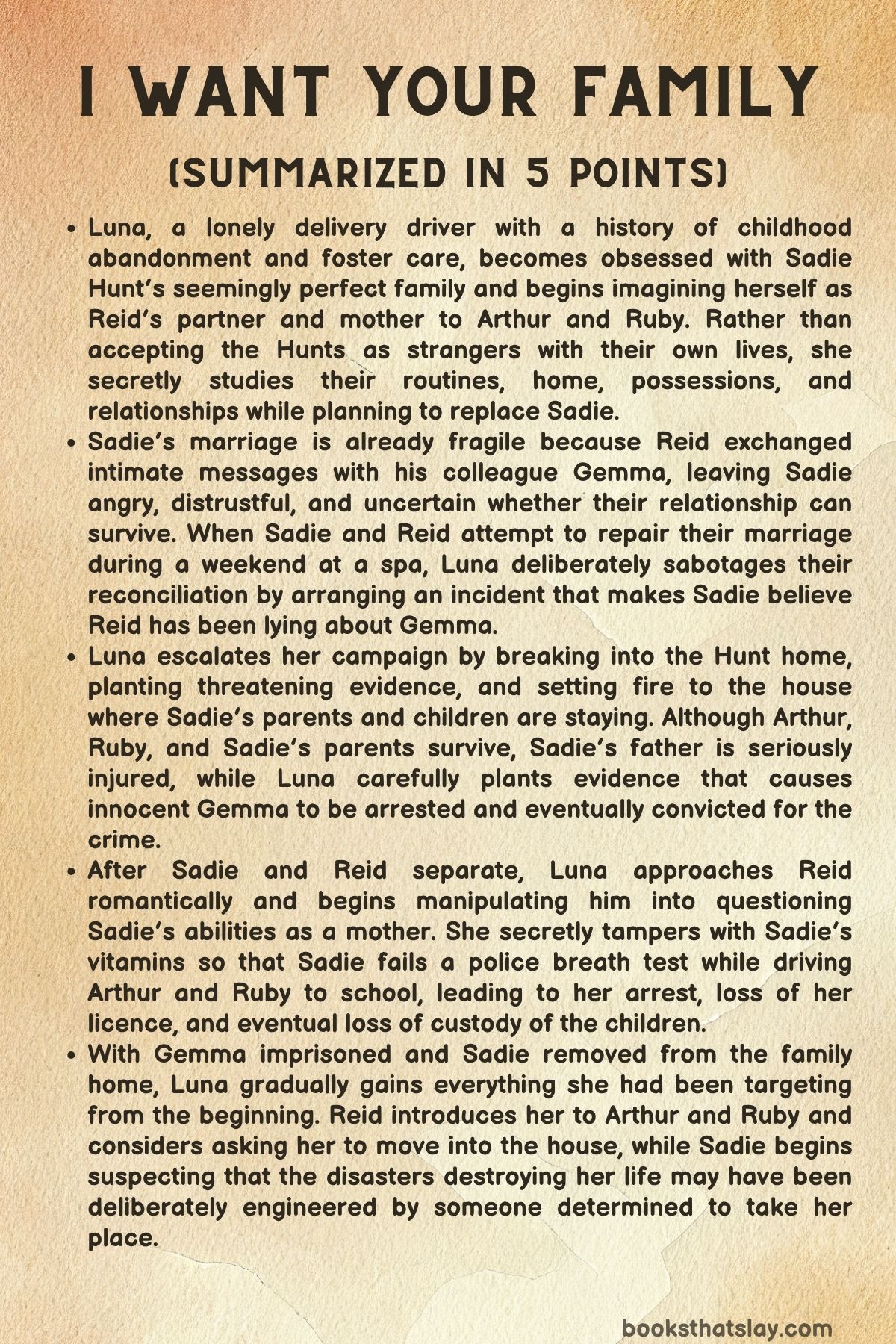
Luna works long shifts as a delivery driver in London, but one address has become far more important to her than any other. Every time she visits the large Hunt home on Birchwood Crescent, she studies Sadie Hunt, her husband Reid, their children Arthur and Ruby, and the comfortable domestic life they appear to enjoy.
Luna has researched the property online, memorized details of its rooms, watched the family’s routines, and collected information far beyond anything required for her job. During one delivery she secretly photographs a framed family picture and later imagines Sadie disappearing from the image so that Luna can take her place beside Reid and the children.
Sadie’s life, however, is far less perfect than Luna believes. Once a surveyor, Sadie left her career after Arthur was born and gradually became consumed by full-time motherhood, leaving her uncertain about her identity outside the family.
Her marriage has also been damaged by Reid’s emotional and sexual messages with a younger colleague named Gemma. Reid claims the relationship never became physical, but Sadie cannot forget what she discovered and has developed a compulsive online-shopping habit partly as comfort and partly as retaliation against him.
The distance between Luna’s reality and the Hunts’ apparent privilege strengthens her fixation. Luna lives alone in an unpleasant flat, has little emotional support, and carries the lasting effects of being surrendered into foster care after a childhood lacking affection and security.
Rather than seeing Reid and Sadie as complicated adults with their own problems, Luna turns the family into an answer to everything missing from her own life. She imagines cooking for them, raising Arthur and Ruby, sleeping beside Reid, and finally belonging somewhere.
Luna’s obsession is not new. During a day trip, she unexpectedly encounters Caitlyn, Ali, and their son Jordan, a family she stalked two years earlier when she was still known by her real name, Sarah Vanguard.
Sarah had become convinced that Caitlyn possessed the husband and child she deserved. She entered their home, lied to Ali about Caitlyn supposedly wanting him dead, attempted to create distrust between the couple, and hoped Ali would leave with Jordan so that Sarah could eventually replace Caitlyn.
The scheme failed when Jordan produced a photograph proving Sarah had been following them. Police arrested her, psychiatric specialists examined her, and restrictions were imposed preventing her from approaching the family.
Sarah received treatment for a period, but she eventually abandoned therapy, ignored official requirements, obtained false identification, and reinvented herself as Luna. Her accidental meeting with the Cartridges should warn her that her behavior remains dangerous, but Luna instead decides that her first attempt failed only because she was not sufficiently careful.
Meanwhile, Sadie and Reid’s relationship continues deteriorating. Arguments about Reid’s betrayal, childcare, money, and resentment become increasingly hostile, and Sadie begins wondering whether separation may be healthier than continuing to live inside constant anger.
Reid eventually proposes one final attempt to rescue their marriage. He arranges a weekend at the Woodland Retreat Spa while Sadie’s parents look after Arthur and Ruby, hoping that time away from parenting and routine will reveal whether they still have a future together.
Luna secretly overhears their plans after lingering near the Hunt property. Realizing that the weekend could restore their marriage, she decides she can no longer wait for Sadie and Reid to separate naturally.
While the couple are away, Luna breaks into their house. She explores the rooms she has dreamed about occupying, touches Reid’s belongings, enters the children’s bedrooms, steals one of Reid’s shirts, and leaves behind a deliberately damaged family photograph carrying a threatening message designed to connect the intrusion to Gemma.
At the spa, Sadie and Reid unexpectedly begin reconnecting. They speak more openly than they have in months, flirt, swim together, kiss, and acknowledge that love still exists beneath the resentment caused by parenting pressures and Reid’s betrayal.
For Sadie, the weekend begins to create genuine hope. She starts believing their marriage may have been badly damaged without being completely destroyed.
Luna is determined to prevent that possibility. She has also prepared an even more destructive operation at the home of Sadie’s parents, where she expects Arthur and Ruby to be staying.
Believing the house is empty because she sees the family leave, Luna later returns with petrol, pours it through the letterbox, and starts a fire. She intends the blaze to traumatize Sadie and help support the larger false narrative she is constructing around Gemma.
Luna quickly discovers that her assumptions were wrong. Sadie’s parents and both children have returned to the house, leaving them trapped inside the burning property.
Although Luna caused the danger, she panics at the possibility that Arthur and Ruby might die. She bangs on the door to warn the family before hiding nearby and watching emergency services arrive.
All four occupants eventually escape, but Sadie’s father is seriously injured. Luna attempts to leave unnoticed, only to encounter a stranger named Darragh while she is carrying petrol and matches, giving him enough information to understand her involvement.
At almost the same moment, Luna’s separate plan against Sadie’s marriage succeeds. A barman at the spa addresses Sadie as Gemma and behaves as though he recognizes Reid, causing Sadie to believe that Reid previously brought Gemma to the hotel and lied about the true extent of their relationship.
Reid insists the barman is mistaken, but Sadie no longer believes him. She leaves the retreat, tells Reid she wants a divorce, and heads toward her parents’ home, only to arrive and discover emergency vehicles surrounding the burning property.
The fire immediately becomes more important than the marital crisis. Sadie learns that her children and mother will recover while her father remains in serious condition, and she becomes determined to discover who deliberately attacked her family.
Darragh, meanwhile, uses what he witnessed to blackmail Luna and force her into an abusive arrangement. When Luna discovers that he works as a cleaner at the hospital treating Sadie’s family, she turns the situation to her advantage by asking him to gather information about Sadie and the investigation.
Luna has already selected Gemma as the person who will take responsibility for the fire. She has researched her, followed her, planted incriminating material among her possessions, arranged false witness evidence, and connected the threatening photograph left at the Hunt home to language associated with Gemma.
Police soon arrest Gemma. Sadie initially finds the theory believable because Gemma already represents Reid’s betrayal, while investigators have physical evidence and witness testimony that appear to support the case.
A further revelation destroys any remaining possibility that Sadie might reconsider her divorce: Reid had lied about Gemma leaving his workplace. When he even expresses doubts that Gemma could have committed the fire, Sadie feels once again that he is choosing dishonesty and another woman over her security.
Luna now begins moving directly into Reid’s life. After learning where he is staying, she transforms her appearance, visits his hotel, arranges what appears to be an accidental meeting, and presents herself as sympathetic and available.
Reid, lonely and separated from his family, responds to her attention. Their relationship soon becomes intimate, and Luna senses that she is finally becoming more than the anonymous delivery driver who watched him from outside.
Reid nevertheless admits that he misses his family and wonders whether he truly wants the divorce. Luna immediately realizes that removing Sadie from the marriage will not be enough if Sadie remains the primary parent and emotional center of Arthur and Ruby’s lives.
Luna therefore begins attacking Sadie’s credibility as a mother. She falsely tells Reid that she once suspected Sadie of drinking while caring for the children, planting suspicion before creating evidence that will make the lie appear true.
Because Luna knows which vitamins Sadie regularly receives by delivery, she secretly replaces the contents of capsules with powdered alcohol and inserts the altered product into one of Sadie’s packages. She waits until Sadie is likely to be taking them before anonymously reporting her car for suspected drink-driving.
Police stop Sadie while she is taking Arthur and Ruby to school. Sadie confidently agrees to a breath test because she knows she has not knowingly consumed alcohol, only to discover that the test shows her above the legal limit.
She is arrested in front of her terrified children and later fails another test. The consequences extend far beyond losing her driving licence because the incident becomes devastating evidence in the custody dispute.
Reid receives full custody of Arthur and Ruby and remains in the family home. Sadie moves into rented accommodation with her parents, struggles financially, loses her daily role in her children’s lives, and begins realizing that the string of disasters around her may be too coordinated to be accidental.
Gemma is eventually convicted of arson and sentenced to ten years in prison despite maintaining her innocence. By this stage, Sadie has developed doubts about the official explanation, suspecting that the same unknown person may have framed Gemma and engineered her own drink-driving arrest.
Reid does not share those doubts. Instead, he tells Sadie that he has started seeing another woman and intends to introduce his new girlfriend to Arthur and Ruby.
That woman is Luna. She has now left delivery work and prepares for the moment she has imagined since first watching the Hunts from outside their home.
Reid introduces Luna to Arthur and Ruby at a park. Arthur recognizes her as their former delivery driver, while Ruby is initially cautious and seeks reassurance that she will continue seeing her mother.
Luna carefully wins both children’s affection, playing with Arthur and offering Ruby a flower. Reid is delighted with how easily the meeting goes and tells Luna that he wants her eventually to move into the Hunt home.
As Luna leaves the park holding Reid’s hand while Arthur and Ruby walk ahead, she feels that her plan has succeeded. Gemma is imprisoned, Sadie has lost her marriage, home, children, licence, and independence, and Luna is preparing to occupy the family role she once imagined while staring at a stolen photograph.
Characters
Luna / Sarah Vanguard
Luna is the central antagonist and psychological focus of I Want Your Family, a woman whose hunger for belonging has hardened into entitlement. Her childhood abandonment, poverty, foster care experience, and lack of stable affection help explain why domestic security has such extraordinary emotional importance to her, but the novel never makes those experiences sufficient justification for what she does.
Her most disturbing characteristic is her ability to reinterpret possession as love. She insists that she wants to care for Arthur and Ruby, yet she deliberately creates situations in which they could be traumatized, separated from their mother, or even killed.
Luna is highly observant and patient when gathering information. Delivery work gives her access to names, packages, routines, homes, and personal habits, and she repeatedly turns ordinary details into weapons, from Sadie’s vitamins to the location of Reid’s hotel.
Her intelligence is therefore inseparable from her moral distortion. She can identify practical weaknesses with remarkable precision while remaining almost incapable of honestly examining the damage she causes.
The existence of Sarah Vanguard reveals that Luna herself is partly a constructed identity. Instead of accepting treatment after the Cartridge case, Sarah changes her name, obtains false documents, and behaves as though becoming Luna has allowed her to escape responsibility as well as detection.
She repeatedly interprets failure as a problem of technique rather than morality. Caitlyn’s family was not, in her mind, proof that taking another person’s household is wrong; it was merely evidence that she needed a better plan the next time.
By the final scenes, Luna has achieved much of what she wanted, but the victory exposes the emptiness of her fantasy. She has not created a loving family through mutual trust; she has entered one by destroying relationships, fabricating evidence, endangering children, and allowing innocent people to suffer for crimes they did not commit.
Sadie Hunt
Sadie is both a victim of Luna’s campaign and a flawed woman dealing with problems that existed long before Luna entered her life. In I Want Your Family, she represents the difference between what domestic happiness looks like from outside and what it actually requires from the people living inside it.
Her decision to leave her career after becoming a mother gradually narrows her identity. She deeply loves Arthur and Ruby, but years of childcare, domestic responsibility, and dependence on Reid have left her exhausted and uncertain about the person she once was.
Reid’s involvement with Gemma destroys Sadie’s sense of security. Her compulsive shopping becomes an unhealthy coping mechanism, while her anger sometimes emerges in frightening ways, including throwing the cereal bowl during an argument.
These flaws prevent Sadie from becoming an unrealistically perfect victim. She can be impulsive, resentful, suspicious, and emotionally reactive, yet none of those weaknesses justify the extraordinary harm later inflicted on her.
Sadie also demonstrates significant resilience. She survives the breakdown of her marriage, the attack on her parents’ home, her father’s medical crisis, a wrongful drink-driving charge, financial instability, and the loss of custody without abandoning her belief that something about the official story is wrong.
Her deepest wound is not losing Reid but losing daily access to Arthur and Ruby. When she begins thinking seriously about the possibility that another woman could occupy her house and help raise her children, the novel turns Luna’s fantasy into Sadie’s nightmare.
Reid Hunt
Reid occupies an intentionally uncomfortable moral position in I Want Your Family because he is simultaneously responsible for creating some of the family’s instability and unaware that a far more dangerous person is exploiting it. His messages with Gemma cause genuine betrayal, and his later dishonesty about her employment further damages Sadie’s ability to believe him.
At the same time, Reid clearly loves Arthur and Ruby and makes a serious attempt to repair his marriage. The spa weekend suggests that his feelings for Sadie remain real, even though his past behavior has made reassurance almost impossible for her to accept.
Reid is especially vulnerable to manipulation because he wants simple explanations for painful situations. When Luna hints that Sadie may drink while responsible for the children, he allows suspicion to grow despite years of experience with Sadie as their primary caregiver.
His relationship with Luna also develops while he is lonely and emotionally displaced. Luna carefully presents herself as uncomplicated, sympathetic, and admiring, offering exactly the emotional response Reid wants after months of conflict.
Reid is therefore neither an innocent husband nor the architect of the larger disaster. His selfishness, secrecy, and weak judgment create openings that Luna exploits, but he has no idea how thoroughly the woman beside him has manufactured the circumstances that placed her there.
Arthur Hunt
Arthur is energetic, curious, and comparatively open toward unfamiliar people. He recognizes Luna when Reid introduces her at the park, immediately connecting her glamorous new appearance with the delivery driver who used to visit the family home.
His easy acceptance of Luna is painful because the reader understands everything Arthur cannot know. The woman pushing him on the swing is the same person who set fire to the house where he was staying and manipulated events that removed his mother from his daily life.
Arthur therefore represents childhood vulnerability in I Want Your Family. Adults make decisions, commit betrayals, fabricate evidence, and fight over custody, while children must live with consequences they are too young to understand.
His affection becomes part of Luna’s idea of success. Yet because that affection is given without knowledge of her actions, it cannot validate the family role she claims to deserve.
Ruby Hunt
Ruby is more cautious than Arthur and shows a stronger instinctive concern about changes affecting the family. When she meets Luna, one of her first concerns is whether she will still be able to see her mother.
That question quietly exposes the emotional cost of everything that has happened. Ruby does not understand the conspiracy surrounding her, but she understands that Sadie is no longer living with her and that another woman is appearing beside her father.
Luna wins Ruby’s confidence through a simple gesture involving a yellow flower. The scene demonstrates how easily genuine childhood trust can be obtained by someone whose intentions remain completely hidden.
Ruby is also one of the clearest contradictions in Luna’s claim that she wants to become a mother. Starting the fire placed Ruby in immediate physical danger, proving that Luna values her imagined maternal identity more than the actual safety of the child she claims to love.
Gemma Peters
Gemma begins as the visible threat to Sadie and Reid’s marriage but eventually becomes one of Luna’s greatest victims. Her involvement with Reid is clearly inappropriate, yet there is an enormous moral difference between participating in intimate messages with a married colleague and committing attempted murder through arson.
Gemma’s role in I Want Your Family is built around that difference. Because she has already done something ethically wrong, Luna can make much more serious accusations against her appear believable.
The planted photographs, manipulated witness evidence, private nickname, and hotel deception create a convincing false identity for Gemma as an unstable woman obsessed with Reid. Once investigators fit each piece into that explanation, innocence becomes extremely difficult for her to establish.
Her ten-year prison sentence shows the full cost of Luna’s manipulation. Gemma loses her freedom not because the authorities act irrationally, but because Luna gives them evidence designed to make the wrong conclusion appear reasonable.
Sadie’s Mother
Sadie’s mother provides some of the clearest emotional wisdom in the story. Even before the larger crisis begins, she warns Sadie that remaining married purely for the children may create more harm than separation.
Her perspective comes from a long marriage of her own, but she does not romanticize endurance for its own sake. She wants Sadie to feel respected and secure rather than sacrificing herself simply to preserve the appearance of a two-parent household.
After the fire, she becomes both survivor and support system. Her memory of someone banging on the door introduces the strange contradiction that eventually makes the attack harder to understand: the person responsible for creating the danger also warned them about it.
She also helps care for Arthur and Ruby when Sadie becomes overwhelmed. Her presence reminds the reader that family can function through practical care and loyalty rather than through the idealized image Luna has created in her imagination.
Sadie’s Father
Sadie’s father has less direct involvement in the central conflict, but his injuries give Luna’s actions some of their most serious consequences. He nearly dies because of a plan aimed primarily at destroying Sadie’s stability.
His condition also changes Sadie’s perspective at the hospital. The possibility that her mother could lose the man with whom she built a life forces Sadie to reconsider marriage, love, regret, and the cost of waiting too long to repair damaged relationships.
His eventual recovery provides relief without removing the consequences of the crime. The family home has been destroyed, his health has been seriously affected, and the emotional security of the entire extended family has changed.
Through him, the story shows how an attack aimed at one person inevitably spreads outward. Luna may believe she is removing Sadie from a desired position, but real families consist of relationships whose suffering cannot be neatly contained.
Darragh
Darragh enters the story through chance, becoming the unpredictable witness Luna could not plan for. He finds her near the burning house with evidence strongly suggesting that she caused the fire and immediately recognizes the power this gives him.
Rather than acting morally, he exploits Luna’s vulnerability and blackmails her. His behavior makes him deeply unpleasant even though the person he is threatening is herself responsible for terrible crimes.
Darragh later becomes useful to Luna because his hospital-cleaning job gives him access to information about Sadie and her relatives. Their relationship is therefore based entirely on mutual exploitation rather than loyalty.
He also reinforces one of Luna’s recurring problems: she can design elaborate schemes but cannot control chance. Darragh becomes another unexpected variable she must incorporate into her plans after the fact.
Caitlyn Cartridge
Caitlyn is Luna’s earlier intended victim and provides an important preview of what could have happened to Sadie if Luna had been exposed sooner. Sarah tries to convince Ali that Caitlyn secretly despises him and may even want him dead.
Caitlyn responds with anger, disbelief, and eventually sharp suspicion toward Sarah. Once she sees Jordan’s photograph, she quickly understands that a stranger has been watching her family and attempting to manipulate them.
Unlike Sadie, Caitlyn discovers the threat before Sarah can successfully dismantle her household. Her presence therefore shows what exposure can prevent and how differently events unfold when Luna’s target understands who is attacking her.
Ali Cartridge
Ali demonstrates how fear can temporarily override judgment. Sarah approaches him with fabricated information about Caitlyn, and because the accusations involve his marriage, finances, child, and personal safety, he initially listens rather than immediately dismissing her.
Once evidence exposes Sarah’s stalking, however, Ali becomes protective and physically prevents her from escaping before police arrive. His behavior contrasts sharply with Reid’s later vulnerability to Luna.
Ali survives Sarah’s manipulation partly because the truth reaches him soon enough. Reid, by contrast, never receives equivalent evidence about Luna before she has already entered his personal life.
Jordan Cartridge
Jordan has one of the most important small roles in the novel because his observation succeeds where the adults initially fail. He notices Sarah following the family and keeps photographic evidence even when his concerns are not taken seriously.
That Polaroid eventually destroys Sarah’s story. A complicated campaign of lies collapses because a child noticed something strange and preserved proof.
Jordan therefore represents the danger of details Luna cannot control. His photograph becomes the lesson she carries into her campaign against Sadie, encouraging her to plan more carefully rather than reconsider the morality of her actions.
Reginald
Reginald is the train employee who encounters Luna after Caitlyn and Ali identify her as their former stalker. He listens when Luna admits that their accusations about her past are true but maintains that their meeting on the train occurred accidentally.
His sympathy is influenced by his experience with his own daughter’s psychological difficulties. That empathy leads him to give Luna a practical opportunity to leave before police can detain her.
Reginald’s compassion is understandable, yet its consequences are troubling. He responds to the damaged person in front of him without knowing that she is already preparing to repeat the very behavior that caused the earlier intervention.
Detective Andrews
Detective Andrews represents the formal investigation surrounding the fire and Gemma. From his position, the accumulating evidence creates a strong and coherent case, and he communicates the investigators’ conclusions to Sadie and Reid.
The character is important because the novel does not require the police to behave foolishly for Luna’s scheme to succeed. Luna manufactures physical evidence, witness information, motive, and behavioral clues specifically designed to survive ordinary scrutiny.
Andrews therefore demonstrates the limitations of an evidence-based system when the evidence itself has been engineered. His conclusions are logical according to the information available, which makes Gemma’s conviction more disturbing rather than less believable.
Darren
Darren is one of Luna’s delivery colleagues and contributes to the atmosphere of the working life she dislikes. His crude remarks reinforce the sexism and discomfort Luna tolerates because the job gives her something far more valuable than professional satisfaction: regular access to the Hunts.
His role is small but revealing. Luna is willing to endure humiliation and an unpleasant workplace because her obsession has transformed employment into surveillance.
Darren also helps establish the contrast between Luna’s ordinary outward life and her secret intentions. To coworkers she is simply another driver; privately, almost every working day is feeding information into her fantasy.
Jane
Jane, Sadie’s lawyer, becomes important once the marriage develops into a formal custody dispute. Her advice initially gives Sadie confidence because Sadie has years of evidence showing that she has been Arthur and Ruby’s primary caregiver.
The legal process also makes Sadie conscious that ordinary behavior can become evidence. Once the drink-driving arrest occurs, however, Luna succeeds in manufacturing exactly the kind of event capable of overpowering Sadie’s previous advantages.
Jane’s presence therefore emphasizes how quickly institutional reality can change. Being a devoted parent is not enough when official records suddenly appear to prove behavior that places the children at risk.
The Woodland Retreat Barman
The barman appears only briefly, yet his performance causes enormous damage. Luna supplies him with information and pays him to act as though he recognizes Reid before mistakenly calling Sadie by Gemma’s name.
The manipulation works because the barman does not need to invent a complicated accusation. One apparently casual mistake activates every fear Sadie already possesses about Reid’s dishonesty.
His role demonstrates how efficiently Luna uses other people. She rarely needs them to understand her full objective; she only needs each person to perform one small action at exactly the right moment.
Themes
Obsession, Entitlement, and the Fantasy of Belonging
Luna’s desire for a family begins in genuine deprivation but becomes dangerous when she decides that suffering has given her a right to possess what belongs to someone else. I Want Your Family repeatedly contrasts the understandable longing to be loved with the destructive belief that another person can simply be removed from a life one wants.
Her fixation depends heavily on idealization. Watching the Hunts from outside, Luna sees the large home, attractive husband, children, cars, belongings, and domestic routines but cannot initially see the resentment, exhaustion, betrayal, financial conflict, and emotional loneliness existing inside the same household.
Even after learning that Reid and Sadie are unhappy, Luna does not abandon the fantasy. Instead, their problems become evidence that Sadie has failed to appreciate what Luna believes she would value properly.
That logic gradually permits almost anything. Burglary becomes preparation, false evidence becomes strategy, arson becomes a route toward disruption, and destroying Sadie’s custody position becomes a necessary step toward becoming Arthur and Ruby’s new maternal figure.
The final park scene makes the theme especially disturbing because Luna appears to obtain the ordinary family moment she has always wanted. Reid holds her hand, Arthur accepts her, Ruby begins trusting her, and the house may soon become her home.
Yet the apparent fulfillment is morally empty because none of it was freely built. Luna has confused access with belonging and possession with love, achieving the appearance of family while violating nearly every principle that makes genuine family attachment meaningful.
Betrayal, Trust, and the Collapse of Marriage
Sadie and Reid’s marriage is damaged long before Luna directly interferes. Reid’s messages with Gemma create the first major fracture because the betrayal destroys Sadie’s confidence not only in his actions but also in her own ability to know when he is telling the truth.
That distinction becomes crucial. Reid may insist that his relationship with Gemma never became physical, yet his previous dishonesty means every later explanation arrives already weakened.
The spa weekend shows that affection between them has survived. Away from domestic pressure, they laugh, flirt, kiss, speak honestly, and briefly rediscover the people they were before resentment became their normal way of communicating.
Luna does not need to destroy their love because the more useful target is their remaining trust. By arranging the barman’s false recognition of Reid and Gemma, she provides Sadie with an event that perfectly fits what Sadie already fears.
Reid’s later admission that Gemma never actually left his workplace makes the deception even more powerful. His genuine lie gives credibility to Luna’s invented ones.
The marriage therefore collapses through a combination of real betrayal and manufactured evidence. Luna succeeds because she understands that trust rarely breaks from one isolated fact; it breaks when new information confirms wounds that have never healed.
The story also refuses to suggest that staying together for Arthur and Ruby would automatically have been better. Sadie’s mother correctly recognizes that children living inside constant hostility can also be harmed, making the question of marriage less about preserving appearances and more about whether genuine respect can still exist.
Manufactured Reality, Evidence, and the Power of a Convincing Lie
Luna rarely depends on a single enormous deception. She builds false realities from small details that reinforce one another until the victim, police, courts, and other characters begin reaching exactly the conclusions she intends.
In I Want Your Family, truth becomes vulnerable when fabricated evidence is designed to fit facts that are already known. Gemma really did exchange inappropriate messages with Reid, so portraying her as dangerously obsessed requires less imagination from investigators than inventing a completely unrelated suspect would.
Luna understands the importance of context. A damaged photograph, a private nickname, a witness description, a hidden object, and a strange hotel encounter appear powerful because each one supports the same explanation.
The same technique destroys Sadie’s custody position. Luna first creates suspicion about alcohol, then secretly alters Sadie’s vitamins, then makes an anonymous driving report at the exact moment the manipulated breath test will produce apparent confirmation.
Institutions respond rationally to what they can prove. Police arrest Sadie because the device detects alcohol, the court considers the arrest because Arthur and Ruby were in the car, and a jury convicts Gemma because the evidence appears overwhelming.
The frightening idea is therefore not that every authority is incompetent. It is that systems dependent on evidence can still produce catastrophic injustice when a sufficiently determined person controls the evidence entering those systems.
Sadie eventually senses that the pattern is too coordinated to be accidental, but suspicion without proof has little institutional power. Luna’s greatest advantage is not merely her willingness to lie; it is her understanding that a carefully constructed lie can become socially stronger than an unsupported truth.
Motherhood, Identity, and the Difference Between Caring and Possessing
Sadie and Luna both organize large parts of their identities around motherhood, but their understanding of the role could hardly be more different. Sadie has sacrificed career independence, personal time, and much of her adult identity while performing the repetitive responsibilities involved in actually raising Arthur and Ruby.
That sacrifice sometimes leaves her exhausted and resentful. She needs breaks, loses patience, worries about money, questions her marriage, and occasionally feels overwhelmed by the same children she loves completely.
Those moments make her maternal role convincing because care is presented as work rather than constant emotional perfection. I Want Your Family contrasts this lived reality with Luna’s romantic fantasy of becoming the ideal mother simply by entering the household.
Luna loves the image of preparing meals, decorating bedrooms, pushing swings, choosing flowers, and receiving affection. She is far less interested in respecting Arthur and Ruby’s existing emotional bonds whenever those bonds interfere with her desired position.
Her actions prove the contradiction. She starts a fire at the house where the children are staying, helps separate them from Sadie, manipulates their father, and allows their mother to be publicly portrayed as dangerous so that Luna can gain access to them.
Ruby’s concern about still seeing Sadie exposes what Luna refuses to acknowledge: children are not empty roles waiting for a more determined adult to claim them. Their attachments have histories, memories, loyalties, and emotional meaning.
The novel ultimately separates motherhood from possession. Sadie can become angry, tired, or imperfect without loving her children less, while Luna can perform affectionate gestures perfectly and still fail the deeper moral test of placing their welfare above her own desires.