If It Makes You Happy Summary, Characters and Themes
If It Makes You Happy by Julie Olivia is a contemporary small-town romance by Courtney Walsh that blends grief, family healing, and slow-burn love.
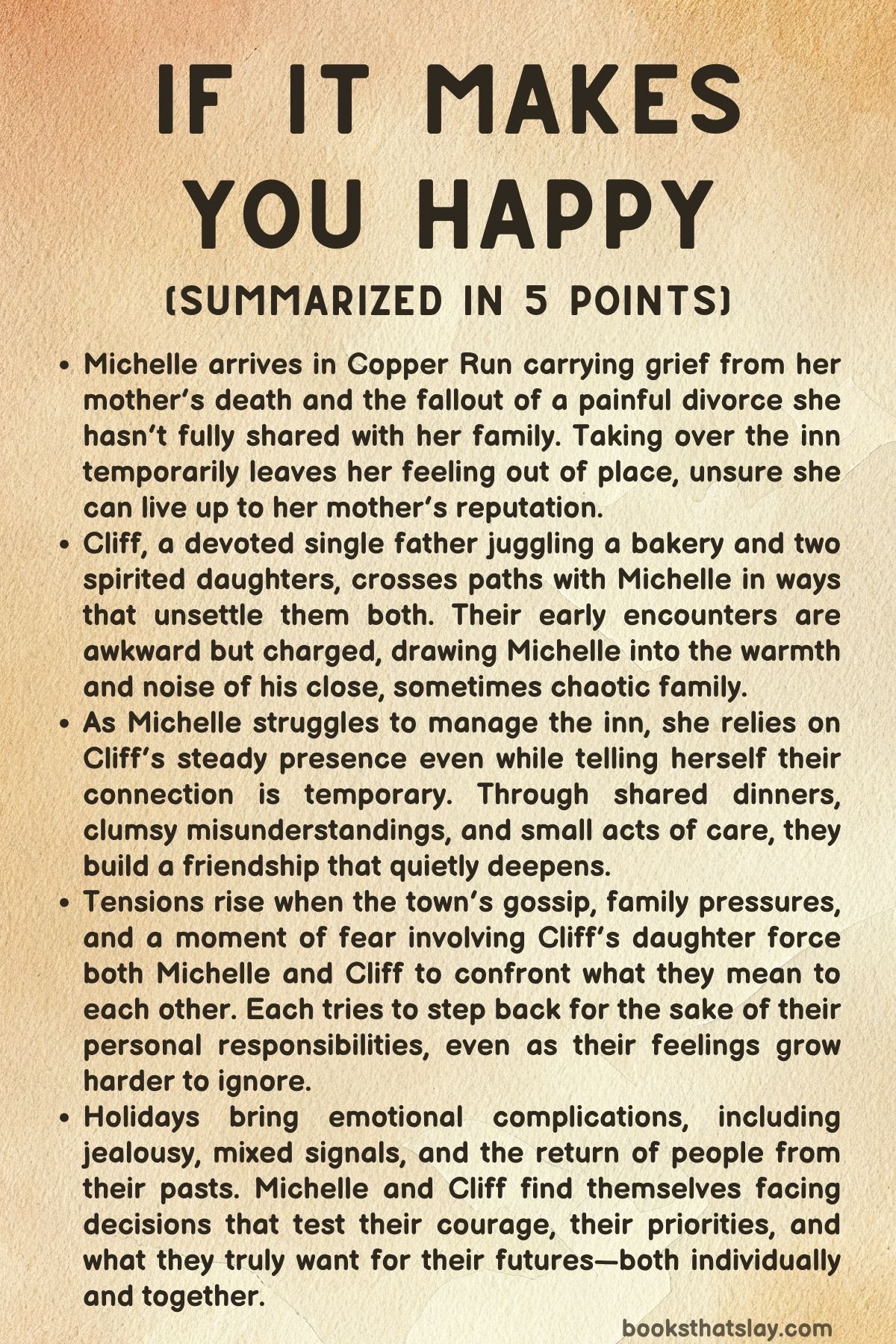
The novel follows Michelle Granger, whose carefully constructed life collapses after her mother’s death and public divorce. Retreating from Seattle to Copper Run, Vermont, she temporarily runs her family’s inn, confronting both her grief and the emotional distance she’s long maintained. There, she forms a hesitant bond with Cliff Burke, a warm, devoted single father juggling his bakery, his daughters, and the scars of a failed marriage. As Michelle becomes entwined with Cliff’s family and the close-knit town, she’s forced to question the version of success she once chased. Grounded in everyday moments rather than grand gestures, the story explores how love, community, and vulnerability can reshape identity.
Summary
If It Makes You Happy follows Michelle Granger, a woman whose life shatters and reshapes itself in the wake of her mother’s death and the end of her marriage. After an explosive revelation at the funeral—when her estranged husband publicly announces their divorce—Michelle withdraws from her former life in Seattle and moves temporarily to Copper Run, Vermont, to run the family inn until her younger sister graduates.
She arrives burdened by grief, humiliation, and the pressure to manage everything alone. What she doesn’t expect is the presence of Cliff Burke, a friendly local baker and devoted single father who had once watched her from across the crowded room at her mother’s wake.
In Copper Run, Michelle finds the inn neglected and silent, heavy with the absence of her mother. She throws herself into cleaning and organizing, refusing help even as she begins to realize she understands far less about hospitality than she assumed.
Her focus shifts when her dog Rocket slips out of the house and leads her straight to Brittany Burke, Cliff’s bright six-year-old daughter. Cliff himself arrives moments later, frazzled, concerned, and unmistakably familiar.
Their first real interaction is a mix of awkward teasing and unexpected warmth. Cliff invites her to dinner before she can escape the encounter, and despite her attempts to withdraw, Michelle becomes tangled in the affectionate chaos of the Burkes’ home.
Life at the inn quickly proves more difficult than she imagined. Guests complain, biscuits burn, and lonely evenings stretch long.
Her sister encourages her to loosen her guard and allow people into her life rather than shutting them out. Michelle reluctantly agrees, starting with an uneasy peace offering to Cliff.
The two form a hesitant friendship built on traded favors: he teaches her how to make the inn feel welcoming, and she watches Brittany after school. This partnership grows into familiarity and trust, though both hide the attraction brewing beneath each exchange.
As autumn deepens, Michelle witnesses the Burkes’ family struggles up close. Cliff’s ex-wife, Tracy, calls sporadically from New York, stirring tension and insecurity in both daughters.
Brittany, tenderhearted and young, is easily overwhelmed. Emily, sixteen and headstrong, feels abandoned and misunderstood.
Michelle finds herself becoming an accidental anchor for both girls, particularly when Emily faces teenage heartbreak and complicated feelings about her absentee mother. For Cliff, this emotional support becomes impossible to ignore.
His fondness for Michelle grows alongside his fear of losing the stability he has worked so hard to build.
A frightening accident on Halloween disrupts their growing closeness. Brittany is dragged and injured after Rocket panics, sending Cliff into fear and Emily into hurt silence when she feels pushed aside.
Amid the chaos, Michelle and Cliff share a kiss—one that both of them immediately regret, believing the moment has come at an unforgivable time. Michelle comforts Emily afterward, recognizing just how deeply this family needs steadiness, not more upheaval.
When Cliff returns from the ER with Brittany, he and Michelle agree to pull back and remain only friends.
Their friendship settles into a quieter rhythm through November. Emily struggles with the idea of spending Thanksgiving with her mom, and Michelle steps in with humor and patience to help her cope.
When Michelle’s sister Sara visits for the holiday, she immediately gravitates toward Cliff, unaware of the undercurrent between him and Michelle. Sara even asks Michelle to set her up with him.
Caught between wanting to appear unaffected and convinced her sister would be better for him, Michelle agrees. Cliff reluctantly goes on the date out of loyalty, but the mismatch only clarifies his feelings for Michelle.
December brings its own avalanche of emotion. On Christmas morning, Tracy’s arrival sparks old wounds.
When she makes a pointed comment about Emily’s boyfriend, Emily lashes out, assuming Michelle betrayed her confidence. The outburst forces buried tensions into the open.
Cliff comforts his daughter outside in the snow, helping her understand the complicated choices behind her mother’s departure. Later, Emily confronts Tracy honestly, insisting on being treated like she matters.
The conversation becomes a turning point, softening their relationship at last.
Michelle becomes a steady presence again throughout Christmas Day, sharing gifts, stories, and quiet glances with Cliff. With only two days left before she must return to Seattle, the weight of her departure presses on both of them.
A playful snowball fight turns into an afternoon of laughter, baking, and community—reminding her how much she has come to love Copper Run. Training Sara at the inn later that night, Michelle discovers a letter their mother wrote before her death.
It urges Sara to watch over Michelle, gently hinting that Michelle’s strength often hides her true needs. Sara suspects the inn is where Michelle truly belongs, but Michelle insists her life is elsewhere.
Unable to resist, Michelle goes to Cliff’s house near midnight. They talk, share pastries he baked especially for her, and finally give in to the feelings they have been avoiding.
They sleep together knowing morning will end their time. At dawn, the town gathers to say their goodbyes.
Michelle promises to think about the inn but claims her future is still in Seattle. Cliff drives her to the airport, trying to keep things light, though both are breaking inside.
He drops her off, believing he must let her go so she can pursue her career.
Inside the airport, Michelle finds an old letter from her mother tucked in her purse—one she must have forgotten to send. In it, her mother encourages her not to cling to a life that doesn’t fit and to trust herself with new beginnings.
As Michelle hesitates at the gate, unsure whether Seattle is still home, she hears Rocket barking. Cliff barrels through the terminal with the dog, chased by security, desperate not to lose her.
In front of the stunned crowd, he confesses he loves her and wants her to stay. Michelle admits she feels the same.
She chooses Copper Run, chooses Cliff, and chooses a future different from the one she spent years chasing.
New Year’s Eve finds Michelle settled into her new life. She has turned down a prestigious job and taken ownership of Bird & Breakfast.
Sara pursues art in a nearby apartment. Cliff works beside Michelle at a bakery booth in the town square.
Emily and Josh skate beneath the lights, Brittany giggles in the crowd, and the townspeople gather as fireworks burst overhead. Cliff kisses Michelle at midnight, sealing their new beginning.
Eight years later, the epilogue reveals their life through Rocket’s aging eyes. The family has grown, Emily has become an artist, and Michelle and Cliff share a home filled with laughter and the happy chaos Rocket adores.
Copper Run has become the place where Michelle’s strength is no longer a mask, but part of a life built from love, community, and the courage to start again.
Characters
Michelle
Michelle is a woman caught between grief, identity, and the pressure of perfection she has long used as a shield. Her mother’s death, her recent divorce, and her sudden relocation to Copper Run push her into emotional terrain she has spent years avoiding.
Michelle presents herself as controlled, efficient, and capable, but this façade cracks often—especially in moments of loneliness, self-doubt, or tenderness toward the Burke family. She struggles with vulnerability, believing warmth is something she lacks and must “perform,” yet she repeatedly demonstrates a deep instinct for care: comforting her father, stepping in for Brittany’s injuries, coaxing Emily out of emotional hiding, and supporting Cliff even when she insists she must leave.
Her evolution is driven by the tension between the life she built out of ambition and the unexpected home she finds in Copper Run. Michelle’s love for Cliff is initially resisted because it threatens the identity she curated in Seattle, but by the end she learns that being truly seen—even in the messy, unguarded parts of herself—is not a flaw but a liberation.
Her journey is about reclaiming softness, belonging, and a sense of self separate from the expectations she once lived by.
Cliff Burke
Cliff is a devoted single father whose life revolves around his daughters, his bakery, and the quiet routines of Copper Run. Warm, humorous, and steady, he contrasts sharply with the instability and criticism Michelle faced in her marriage.
Cliff is a man who loves deeply and without pretense, but he also carries insecurities shaped by his failed marriage to Tracy. He fears not being enough—financially, emotionally, or as a father navigating the complexities of raising two daughters alone.
His guardedness in romance reflects the wounds Tracy left, yet he cannot help being drawn to Michelle’s honesty, strength, and the spark she reignites in him. Despite the chaos around him—from work to parenting to small-town scrutiny—he remains grounded, compassionate, and fiercely protective.
His eventual confession of love is brave precisely because it goes against his vow never to ask anyone to stay. Cliff’s character embodies steadfastness, and his arc shows how rediscovering love often requires confronting old fears and daring to want happiness again.
Sara
Sara, Michelle’s younger sister, is vibrant, affectionate, and expressive—qualities that often highlight Michelle’s emotional restraint. Though she initially seems light-hearted and carefree, Sara carries her own grief and uncertainty about her future.
She idolized their mother and feels overwhelmed by the expectation to inherit the inn, yet she is also perceptive enough to recognize that Michelle, not she, is the one truly suited for it. Her jealousy, flirtation with Cliff, and misunderstanding of Michelle’s feelings stem from a mixture of insecurity and a longing to be seen as competent and independent.
By the end, Sara grows into a more grounded version of herself, pursuing art and stepping out of the shadows of others’ expectations. Her relationship with Michelle evolves from tension and miscommunication into mutual respect and support, reinforcing the theme of sisters finding their own paths while still anchoring each other.
Emily Burke
Emily is a teenage girl navigating the turbulent crosscurrents of adolescence, shifting family dynamics, and the lingering wounds of her mother leaving. She presents a tough exterior—sarcastic, moody, and independent—yet beneath it lies a frightened child who fears being unimportant or replaceable.
Her relationship with Michelle becomes an emotional turning point; Michelle earns her trust by listening rather than judging, offering a maternal presence Emily both craves and resents. Emily’s arc is defined by her struggle to reconcile her mother’s absence with her desire for stability.
Her outbursts, rebellion, and emotional volatility reflect her attempt to find a voice in the chaos. The confrontation with Tracy at Christmas becomes a transformative moment in which Emily finally asserts her needs and demands to be valued.
Her bond with Michelle, and her fierce loyalty to Cliff, illustrate her deep capacity for love once she feels safe.
Brittany Burke
Brittany, at six years old, is the heart of innocence and joy throughout the story. She is imaginative, affectionate, and unfiltered, offering warmth where the adult characters carry emotional heaviness.
Her immediate connection with Rocket and her instant fondness for Michelle soften Michelle’s guarded nature and act as a bridge between her and Cliff. Brittany’s vulnerabilities—especially the injuries she suffers and the fear that follows—highlight the fragility of childhood and the intensity of Cliff’s love as a father.
Her openness, trust, and pure-hearted excitement about family and friendship continually nudge the adults toward healing. Brittany represents the theme of unconditional love, reminding Michelle of the emotional bonds she secretly longs for.
Rocket
Rocket, the border collie, is both comic relief and emotional compass. Despite being inherited through Michelle’s divorce—a symbol of a life she is trying to leave behind—Rocket becomes a symbol of her new beginning.
His instinctive attachment to Brittany and the rest of the Burke family foreshadows Michelle’s deepening ties to Copper Run. Rocket senses emotions before words are spoken, often guiding characters toward each other or forcing them to confront feelings they’re avoiding.
His actions bring Michelle and Cliff together repeatedly, whether through chaotic interference or gentle companionship. In the epilogue, Rocket’s aging perspective reinforces the enduring love and family built around him.
Carol
Carol is Cliff’s outspoken, anxious, and fiercely loyal sister. She is a whirlwind of commentary, worry, and unsolicited advice, yet beneath her boisterous exterior lies a profound devotion to her family.
Carol anchors the household during its emotional storms, especially when Cliff struggles with Tracy or Emily spirals. She serves as comic relief, voice of reason, and surrogate mother all at once.
Her relationship with Michelle begins with chaos and hilarity but grows into genuine affection. Carol’s own journey—such as her battle to quit smoking—mirrors the theme of gradual, imperfect self-improvement.
She embodies the idea that family is built through consistent presence, not perfection.
Tracy
Tracy is a complicated figure defined by regret, unmet dreams, and the painful truth that she was not meant for the small-town life she tried to build with Cliff. Her departure wounded the entire Burke family, especially Emily, yet her return forces everyone to confront long-buried resentments.
Tracy is defensive, insecure, and quick to lash out, but her behavior springs from guilt and the fear that she has lost her daughters’ love permanently. Over the course of the story, Tracy shifts from antagonistic presence to a more honest and humbled one as she recognizes the damage she caused.
Her willingness to listen during Emily’s emotional confrontation marks a turning point, revealing a woman who may not have been a capable mother then but is trying, in her limited way, to be present now. Tracy’s evolution underscores the novel’s theme that imperfect people can still grow, reconcile, and choose a healthier path.
Michelle and Cliff’s Father Figures
Michelle’s father is a grieving husband overwhelmed by the loss of his wife and the responsibilities she left behind. He embodies the disorientation and emotional paralysis that grief can bring, yet he slowly reorients himself through the support of his daughters and the Copper Run community.
Cliff’s father is absent from the narrative, making Cliff’s devotion to fatherhood even more significant, as he strives to give his daughters the stability he may not have known himself. Both father figures highlight the generational contrasts in love, responsibility, and emotional expression.
Lars
Lars is Cliff’s good-natured, supportive friend—a staple of the Copper Run community. He adds humor, stability, and warmth, often stepping in during moments of local chaos.
He cares deeply for the Burkes and becomes part of the extended family dynamic. Though not deeply explored psychologically, Lars enriches the small-town tapestry and reinforces the theme of chosen family.
Lisa and George
Lisa and George are well-meaning but overbearing townspeople who embody Copper Run’s nosy yet genuinely caring community spirit. Their persistent visits to the inn frustrate Michelle but ultimately push her to confront her fears about being inadequate compared to her mother.
They represent the expectations and traditions of the town while also affirming Michelle’s place within it, even before she realizes it herself.
Themes
Grief and the Reshaping of Identity
Michelle’s entire world shifts in the opening pages of If It Makes You Happy, and her grief becomes the force that reorients her life. Her mother’s death is not simply a loss but a rupture that exposes how fragile her sense of self has become after years in a marriage that required her to compress her emotions.
Grief pulls her away from the familiar structure of Seattle and into an unfamiliar environment in Copper Run, where every object in the Bird & Breakfast carries the weight of memory. The quiet, the stillness, and the sudden demand to stand in her mother’s place force her to confront the way she has lived up until now—controlled, guarded, and determined to avoid vulnerability.
Her grief reveals the distance between who she is and who she pretends to be for others, especially evident in her interactions with guests who compare her warmth to her mother’s. Through running the inn, she is pushed to engage emotionally with strangers, to soften her instinct for self-protection, and to recognize that her grief is not a weakness but a transition.
It ushers her into a space where she begins to understand what she truly wants, rather than what she believes she owes others. This journey shows grief not as something to “move past,” but as something that forces a person to rewrite their identity, accept discomfort, and make room for relationships and futures that once felt impossible.
Family Complexity and the Shifting Roles Within It
The novel presents family—both biological and chosen—as a living, evolving network of obligations, wounds, and unexpected support. Michelle finds herself caught between the remnants of her marriage, the guilt of stepping into her mother’s shoes, and the desire to protect her father and sister from further strain.
At the same time, the Burke household exposes her to a different version of family: loud, messy, unfiltered, and openly affectionate. Cliff’s household becomes a mirror that reflects both what Michelle lacked in her marriage and what she longs for but hasn’t allowed herself to claim.
Cliff’s struggle with co-parenting, Emily’s fear of being forgotten in the shadow of her younger sister, and Tracy’s resentment of the life she left behind illustrate the tensions that arise when family members want different things. No relationship is simplistic or neatly resolved.
Instead, the story portrays families as organisms that shift roles constantly—children stepping into caretaker positions, parents learning to apologize, and siblings growing into their own separate identities. Michelle’s role gradually changes from outsider to someone who is trusted with emotional truths.
Through these interactions, the narrative suggests that belonging is not defined by blood but by the people who allow you to be fully yourself and still choose to stay.
Healing After Divorce and Rediscovering Self-Worth
Michelle’s divorce is not painted as a clean break but a shattering of self-confidence that echoes long after Allen is physically gone. His accusations at the funeral—cold, controlling, impossible—linger in her thoughts and shape her fear of forming connections in Copper Run.
Throughout the story, Michelle wrestles with the internalized belief that she is difficult to love, and every misstep with guests or tense moment with Cliff feels like proof. Her healing begins not with romantic affection but through the slow process of regaining trust in her own instincts.
Running the inn forces her to make decisions without deferring to someone else’s judgment. Watching Cliff manage two daughters on his own shows her that imperfection is not a failure but a normal part of loving others.
When she finally allows intimacy with Cliff, it is not impulsive but hard-earned—a moment where she chooses vulnerability despite her fear. The fact that she initially refuses to stay in Copper Run highlights how deeply her self-worth has been shaped by the expectations of her previous life.
Her eventual decision to build a new future is an act of reclaiming agency. The book positions healing after divorce not as “moving on to someone new,” but as rebuilding the belief that one deserves joy, softness, and a life shaped by personal choice rather than obligation.
Community as a Source of Transformation
Copper Run is more than a setting; it functions as a catalyst that breaks down Michelle’s emotional barriers. The town’s nosy, interconnected nature is initially overwhelming for someone accustomed to privacy and self-reliance.
Yet it is this very closeness that begins to thaw her isolation. The Harvest Festival, the daily chaos at the bakery, Carol’s frantic energy, and the neighbors who insist on checking in—all of these forces combine to draw Michelle into a life woven with shared responsibility.
Cliff’s children become bridges that connect her to the heart of the community, pulling her into moments she never would have initiated herself. Even the frustrating interactions, such as Lisa and George pointing out her shortcomings at the inn, contribute to her evolution by teaching her that community involvement means accepting support and critique in equal measure.
Copper Run gradually teaches her that independence does not require loneliness and that accepting help is a sign of strength rather than inadequacy. As she allows herself to be absorbed into this environment, she discovers a level of connection she never experienced in Seattle, ultimately redefining her understanding of home.
Love as a Choice Rooted in Everyday Life
The romance between Michelle and Cliff is grounded not in dramatic declarations but in daily interactions—shared meals, inside jokes, quiet support, and the complicated space between friendship and longing. Their bond develops through the small, persistent ways they show up for each other: Cliff helping her with biscuits, Michelle comforting Emily, the two of them navigating chaotic festivals and late-night conversations.
Love in this story is portrayed as something built through ordinary moments rather than sweeping gestures. The tension between them grows because both are hesitant, both carry wounds, and both fear disrupting the stability they have built.
When they finally confront their feelings, the significance lies not in the intensity of their kiss but in the way they begin to trust that they are worthy of something steady and lasting. Their relationship reinforces the idea that love is not merely an emotion but a commitment to choosing each other repeatedly, even when circumstances feel uncertain.
Michelle’s final decision to remain in Copper Run is not framed as sacrificing her future, but as choosing the life that brings her genuine contentment. The story portrays love as a partnership grounded in mutual respect, shared vulnerability, and the willingness to build a home together, one day at a time.