I’ll Be Home for Christmas Summary, Characters and Themes
I’ll Be Home for Christmas by Jenny Bayliss is a warm, character-driven story about coming home, facing old wounds, and rediscovering the parts of yourself that once felt lost. Set in the close-knit Scottish community of Pine Bluff, the novel follows two generations of Hallow-Hart women as they navigate love, identity, and the pull of family roots.
Through Bella’s past and her daughter Fred’s uncertain present, the story explores how home can become both a refuge and a catalyst for change. With festive charm, humor, and emotional honesty, the book celebrates second chances, supportive friendships, and the courage it takes to choose a life that finally feels true.
Summary
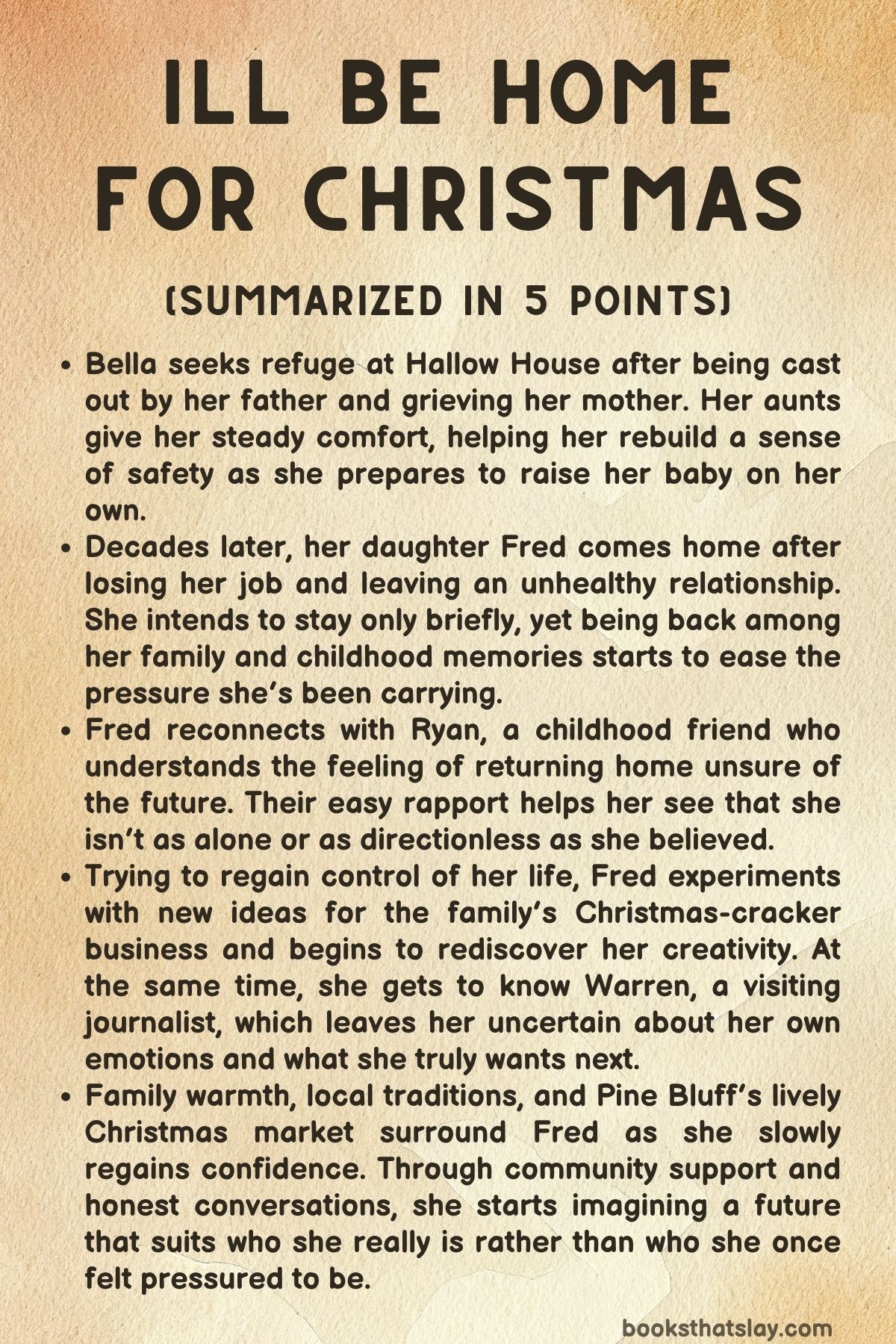
The story of Ill Be Home for Christmas begins in 1988, when sixteen-year-old Bella returns to Hallow House after being thrown out by her father for becoming pregnant. Grieving the loss of her mother and abandoned by her boyfriend, she is taken in by her aunts, Aggie and Cam, who provide the stability and kindness she desperately needs.
Their old, atmospheric home on the cliffs becomes her sanctuary, and Bella chooses to keep her baby, determined to protect the new life forming at a time when so much else has fallen apart.
Decades later, the focus shifts to Bella’s daughter, Fred Hallow-Hart, now thirty-five and returning to Pine Bluff after a decade in London. Her life has recently collapsed: she has been laid off from her advertising job, her long-term partner has left her for a younger colleague, and she has been forced to give up her flat.
She intends her visit home to be temporary and checks into the Forest Inn rather than face her family immediately. But on Krampus Night, a local tradition filled with costumed revelry, she runs into Ryan Frost, a childhood friend.
The inn locks its doors for the festivities, leaving Fred and Ryan to race through the streets until they find shelter in the Crooked Elm pub. Sharing mulled wine and memories, they ease back into an old connection neither expected to feel again.
The next morning, Fred finally approaches Hallow House, where her aunts welcome her with affection, food, and immediate fussing. Bella arrives soon after, and despite their careful formality, Fred breaks down, confessing that she feels like she has failed.
Her family reassures her, helping her settle back into the busy household and the routine of their handmade Christmas-cracker business, Hallow-Hart. Though Fred insists she is only visiting briefly, the comfort of home begins to steady her.
When Ryan arrives with a removals van carrying all of Fred’s belongings, she is embarrassed to see her life packed into boxes. A mistaken delivery then sends her to the Crooked Elm to swap envelopes with Warren Reeves, a journalist staying in town.
Their exchange leads to coffee and flirtation, and Fred learns he is in Pine Bluff to write a travel feature on the Christmas market. Meanwhile, her relationship with Ryan deepens as she discovers his thriving but carefully self-managed coffee business, Coast Roast, and his hope of expanding without compromising his values.
Inspired by the activity of the market and her family’s dedication to Hallow-Hart, Fred starts helping with cracker production and begins imagining ways to rebrand the business. At the same time, she continues to see Warren, who admits he dreams of becoming a food writer.
Fred encourages him to refine his voice and ambitions, drawing on her marketing experience to help him gain confidence.
Bella, watching her daughter rediscover her spark, reflects on her own youth and the choices that shaped her life. Her past resurfaces when Liam, a man she once loved deeply, returns with the market traders for the season.
Their feelings reignite, and soon Bella must decide whether to open herself to love after years of putting everyone else first.
Fred’s world grows more complicated when she stumbles into an old memory: the night she kissed Ryan as a teenager. He had recoiled then, a moment that wounded her badly.
When they dig up their childhood time capsule together on a cold night, Ryan apologizes for his teenage reaction and admits he now has strong feelings for her. Fred, torn between Warren’s polished charm and Ryan’s sincerity, needs time to think.
Her confusion worsens after Warren publishes a harsh article about Pine Bluff, dismissing the community and its food scene. Though he meant it as a bold pitch for a new column, the piece hurts the townspeople, especially Ryan.
Fred is mortified to realize she has been associated with the negativity through her connection to Warren. She takes refuge in the attic among old Hallow-Hart letters and journals, feeling inadequate compared to the kindness and resilience of the generations before her.
Ryan finds her there, and the two reconcile. Fred apologizes for not standing with him, and he reassures her that he never stopped caring.
Their kiss marks a turning point, and Fred decides to take responsibility for healing the breach in the town. She writes apology letters to the affected businesses and proposes a collaborative marketing campaign to highlight Pine Bluff’s strengths.
With her family’s support, she films cheerful behind-the-scenes videos of local restaurants, shops, and artisans, pairing the campaign with special prizes hidden inside Hallow-Hart crackers.
The town responds with enthusiasm, and soon a national columnist visits Pine Bluff, countering Warren’s criticism with a celebratory article that praises the community and its Christmas market. Hallow-Hart sells out of crackers, the local businesses thrive, and Fred finally feels at home again—not as someone passing through, but as someone rebuilding a future.
Meanwhile, Bella and Liam resolve their lingering history. Liam offers to stay in Pine Bluff long-term, choosing love and a new chapter with Bella over his life elsewhere.
Their reunion brings stability and joy to Hallow House.
As the market comes to an end and Krampus Night returns, Fred walks through the festivities hand in hand with Ryan, welcomed by a community that now sees her clearly. The following Christmas finds both women settled into lives shaped by honesty, love, and a deeper understanding of their pasts.
Liam has moved in permanently, and Fred and Ryan are thriving together. On the snowy cliffs, Ryan proposes with a chocolate opal ring, asking Fred to become Mrs.
Frost-Hallow-Hart. She accepts, ready for the life she once feared to claim.
Characters
Bella Hallow-Hart
Bella stands at the emotional center of Ill Be Home for Christmas, embodying both the wounds of her past and the warmth she consciously cultivates for her family. As a young woman in 1988, she arrives at Hallow House after being cast out by her strict father for becoming pregnant, still grieving her mother’s death and abandoned by her baby’s father.
This early trauma shapes her into a fiercely loving, deeply protective figure who builds the kind of home she herself was denied—one filled with acceptance, humor, and creativity. Bella’s nurturing is instinctive but also intentional; she rejects her father’s rigid worldview so completely that she raises her daughter Fred with virtually no rules, trying to give her boundless freedom.
Over time, she recognizes how this approach may have inadvertently pushed Fred toward “sensible,” controlling men like Tim, and she carries quiet guilt about that. Yet Bella’s love remains steady, expressed through food, affection, and unwavering belief in her daughter’s talent.
Her long-suppressed feelings for Liam reveal a softer, more vulnerable side—one still capable of longing, hope, and romantic devotion after decades of self-sacrifice. Bella’s journey becomes one of reclaiming personal happiness without compromising her responsibilities, learning that caring for others does not require denying herself joy.
Fred Hallow-Hart
Fred, Bella’s daughter, is a woman rebuilding herself after years of emotional erosion. Returning to Pine Bluff at thirty-five, she feels like a failure—jobless, newly single, and unsure of who she is outside the life she constructed with Tim.
Her character arc is defined by rediscovery: of self-worth, of identity, of the fierce, imaginative girl she used to be. Throughout the novel, Fred wrestles with shame, insecurity, and the residue of manipulation that left her doubting her instincts.
Yet her resilience surfaces slowly, especially once she becomes immersed again in the creative chaos of Hallow House. Reviving the Hallow-Hart business allows her to reclaim her confidence, blending her professional skills with her heritage.
Her relationships with Ryan and Warren highlight her internal conflict: Warren represents the structured, polished world she came from, while Ryan reflects authenticity, emotional safety, and shared history. Fred’s ultimate growth comes from understanding that stability comes not from external validation but from choosing a life aligned with her values.
By the end, she emerges as someone grounded, empowered, and finally capable of envisioning a future rooted rather than improvised.
Ryan Frost
Ryan is the embodiment of home—steady, genuine, and quietly steadfast even when navigating his own struggles. Once Fred’s childhood partner-in-chaos, he has grown into a thoughtful adult shaped by burnout and heartbreak.
His ownership of Coast Roast represents his desire for meaningful, controlled growth rather than relentless ambition, a philosophy that sometimes clashes with Fred’s big-city instincts. Ryan’s emotional depth is revealed gradually: his lingering affection for Fred, his vulnerability about his past collapse, and his need for connection.
His feelings for her run deeper than nostalgia; he sees the real Fred even when she cannot see herself clearly. Ryan’s confession—borne out of years of quiet longing and a desire not to lose her again—shows his maturity and courage.
He encourages Fred’s creativity, values her work, and becomes her collaborator in the town’s redemption campaign. By the time he proposes, he has become a symbol of emotional safety and shared history, offering not a rescue but a partnership rooted in mutual growth.
Warren Reeves
Warren is a charming but complicated figure whose polished exterior hides deep insecurity. Recently divorced and struggling with a stagnant career, he arrives in Pine Bluff looking to reinvent himself, mirroring Fred’s own journey.
His intelligence and quick wit make him likable, and his initial connection with Fred is rooted in mutual vulnerability. However, his social anxiety leads him to compensate with pushiness and occasional insensitivity, especially when interacting with Ryan or trying to impress the town.
Warren’s missteps, including the biting and damaging article he publishes, reveal his flaws—particularly his tendency to act out of fear rather than empathy. Yet he remains a character worthy of compassion, someone who genuinely wants to grow but is hindered by old habits and emotional self-protection.
His relationship with Fred serves as an important contrast to her bond with Ryan; Warren challenges her intellect, but Ryan understands her heart. Ultimately, Warren’s role becomes catalytic—his mistakes propel Fred into deeper self-reflection and a clearer understanding of what she truly wants from life and love.
Aunts Aggie and Cam
Aggie and Cam are the whimsical, loving anchors of Hallow House. Their eccentricity masks immense strength, forged from building their own unconventional household long before Bella and Fred needed refuge.
They embody acceptance in its purest form, greeting every joy and crisis with cocktails, herbal concoctions, and unfailing loyalty. Their home is a sanctuary not only because of its warmth, but because of their refusal to judge the people they love.
Aggie, with her chaotic energy and mischievous humor, often steals the spotlight, while Cam provides a calmer, steadier presence. Together, they form the emotional scaffolding around which Bella rebuilt her life and where Fred finds her footing again.
Their influence extends beyond domestic comfort—they encourage creativity, community, and resilience, representing the heart of Pine Bluff’s spirit.
Liam
Liam is Bella’s once-in-a-lifetime love, a man whose patience, integrity, and quiet devotion shape the emotional throughline of Bella’s story. Decades earlier, he wanted a life with her, but her fear of commitment and responsibility led her to hold him at arm’s length until it was too late.
His return each winter symbolizes unresolved longing and unfinished business. When he finally confesses that his feelings never faded, Liam reveals himself as someone willing to offer love without demands, providing Bella with a chance to choose happiness instead of survival.
His willingness to uproot his life to be with her shows his depth of commitment, while his respect for her responsibilities reflects a mature, grounded love. Liam’s presence brings Bella full circle, allowing her to heal old wounds and embrace the possibility of a future filled not just with duty, but with joy.
Farmer Bishop
Farmer Bishop serves as a humorous yet unexpectedly insightful secondary character. His brusque, teasing manner masks a keen understanding of people, particularly Fred, whom he gently challenges at a crucial moment.
His commentary on her “city slicker” behavior helps her confront uncomfortable truths about how she presents herself and how she has allowed insecurity to distort her interactions with Pine Bluff. Though often appearing in comic situations, Bishop offers grounded perspective and acts as an unlikely catalyst for Fred’s self-awareness.
His interactions represent the town’s tough love—honest, direct, but ultimately supportive.
Martha
Martha is the no-nonsense moral compass of Pine Bluff, dispensing blunt truths with affection and authority. She knows the town’s history intimately and plays a pivotal role in revealing Bella and Liam’s past to Fred, breaking down decades of misunderstanding.
Martha’s steady presence in community rituals, her loyalty to the local businesses, and her willingness to challenge both Fred and Bella highlight her significance. She stands as a reminder that community history matters and that honesty, even when uncomfortable, can restore relationships and heal generational hurt.
Themes
Family, Belonging, and Chosen Support Systems
In Ill Be Home for Christmas, the idea of family expands far beyond biological ties, shaping the emotional foundation for both Bella and Fred across two generations. Bella’s return to Hallow House as a frightened, grieving eighteen-year-old reveals how powerful it is to be embraced without conditions.
Her aunts give her a level of understanding, protection, and everyday comfort that compensates for the cruelty of her father and the abandonment by her boyfriend. The house becomes more than a place to stay; it becomes a space where she can rebuild trust in herself and others.
Decades later, Fred arrives carrying different wounds, yet Hallow House functions in exactly the same way for her. The aunts’ eccentricity, the warmth of the kitchen, the ease with which they fold her into their routines, and Bella’s steady reassurance give her something she has not experienced in years: safety without expectation.
What stands out is how the home itself becomes a generational constant, a living symbol of refuge that withstands emotional storms. It allows both mother and daughter to fail, grieve, restart, and grow while feeling supported rather than watched or judged.
The theme also expands to include the broader Pine Bluff community. The townspeople remember Fred not as a failure but as someone whose roots are woven into theirs, and their eventual forgiveness becomes another layer of belonging that helps her shake off the persona she adopted under Tim’s influence.
In this way, the story suggests that family can be built through love, shared history, and consistency rather than blood alone, and that returning home is not regression but an opportunity to reconnect with one’s truest self.
Healing from Trauma and Reclaiming Identity
The novel traces how both Bella and Fred must slowly reclaim the parts of themselves they once buried out of fear, shame, or emotional exhaustion. Bella’s early trauma—losing her mother, being cast out while pregnant—marks her for life, influencing how she parents Fred.
Her fear of repeating the rigid upbringing she endured leads her to avoid imposing any structure at all, and this creates unintended gaps in Fred’s emotional development. Fred’s story mirrors Bella’s in a contemporary context: she has spent years diminishing herself to fit Tim’s expectations, to the point where she no longer recognizes her instincts or strengths.
Losing her job reinforces a painful narrative that she is someone who cannot hold things together. Her journey is not about triumph through sudden success but about rediscovering the quiet impulses she once trusted—creativity, community ties, and an instinctive kindness she had suppressed.
Healing arrives in stages: in the gentle way Ryan sees her, in the aunts’ unshakable affection, in the calm of the workshop, and in the act of rebuilding the family business through her own vision. Importantly, the story does not frame healing as erasing the past; it shows both women actively revising how they understand their experiences, making new emotional choices, and accepting support instead of hiding behind independence.
Their healing arcs include acknowledging mistakes, apologizing, forgiving, and redefining what they owe themselves. The novel treats recovery as something rooted in connection, routine, and self-forgiveness rather than dramatic breakthroughs.
Love, Second Chances, and Emotional Maturity
Romantic love in the novel is deeply tied to timing, honesty, and the willingness to grow. Bella’s relationship with Liam spans decades, defined by missed opportunities and old wounds.
What makes their reunion meaningful is not simply the reawakening of old feelings but Bella’s readiness to confront why she pushed him away in the first place. Liam’s offer to change his life for her, rather than asking her to abandon hers, reflects a mature love built on mutual respect rather than sacrifice.
Their second chance becomes a testament to the endurance of genuine connection when two people finally meet one another with clarity. Fred’s romantic arc contrasts sharply with her past, where Tim’s affection was conditional and eroding.
Her dynamic with Warren initially flatters her newly unstable confidence, but it exposes familiar patterns: charm mixed with subtle pressure. Ryan, on the other hand, recognizes her fully—the awkwardness, the ambition, the doubt—and stays patient as she pieces herself back together.
Their shared history gives their relationship depth, and their reconnection becomes a means for both to move forward rather than cling to nostalgia. Love in the novel is shown not as rescue but as partnership: a space where two people can be honest about fears, dreams, and vulnerabilities.
The second chances offered to both Bella and Fred reinforce that meaningful love requires timing, effort, and a willingness to act with courage.
Community, Reputation, and Redemption
Pine Bluff is more than a backdrop; it acts as a moral compass that reflects the characters’ choices back to them. Fred’s rocky return highlights how reputation can distort relationships when misunderstandings and assumptions go unaddressed.
The town initially views her return through the lens of gossip, but the Krampus traditions, the pub gatherings, the market stalls, and the shared history create opportunities for her to rebuild trust. Warren’s scathing article becomes a catalyst for Fred’s transformation: instead of shrinking under the backlash, she takes responsibility for her part in the situation and engages directly with the people affected.
Her handwritten apologies and the collaborative promotional campaign shift the community’s perception, not because she performs grand gestures but because she finally aligns her actions with genuine care for the place she once dismissed. The town’s forgiveness is not instantaneous; it grows through her consistent presence, her willingness to listen, and her visible investment in the collective wellbeing.
This theme underscores how communities can both wound and heal, and how redemption is earned through humility, sincerity, and participation rather than grand speeches. By the novel’s end, Pine Bluff feels like a character in its own right—protective, spirited, and deeply rooted in tradition—and Fred has moved from being an outsider in her own homecoming to becoming one of its champions.
Self-Worth, Purpose, and Reimagining the Future
A significant thread of the story follows Fred’s struggle to understand who she is when stripped of the labels that once defined her—girlfriend, employee, Londoner, high achiever. Being forced to start again initially feels like failure, but the quiet routines of Hallow-Hart, the creative work of rebranding the business, and the conversations she shares with her mother and aunts help her recognize that self-worth cannot be outsourced to jobs or partners.
Her talents resurface organically when she is not trying to perform for approval, showing that purpose often grows from authenticity rather than ambition. The business becomes a canvas for her rediscovery: through design, storytelling, and community engagement, she reconnects with the imaginative, bold girl she used to be.
The renewed sense of purpose also shapes how she approaches love, friendships, and her role in the town. By the time she and Ryan walk through the Christmas market hand in hand, she has rebuilt a life that feels grounded, joyful, and entirely her own.
The theme ultimately affirms that the future is not something to be planned perfectly but something to be shaped through honest choices, community ties, and the courage to believe in one’s own potential.