I’ll Follow You Summary, Characters and Themes
I’ll Follow You by Charlene Wang tells the story of a young woman named Faith, caught between the memories of a complicated friendship and the pressures of a new life. The novel explores themes of manipulation, loyalty, and the consequences of living a life based on lies.
Faith’s best friend, Kayla, had always been the driving force behind their shared dreams of escape, but as the years pass, their bond becomes strained. The novel reveals the emotional and moral toll of trying to escape a small town life, the manipulations that arise from social media, and the painful unraveling of a once-inseparable friendship. Through Faith’s experiences at college and her complex relationship with Kayla, the story dives deep into personal identity, guilt, and the cost of deceit.
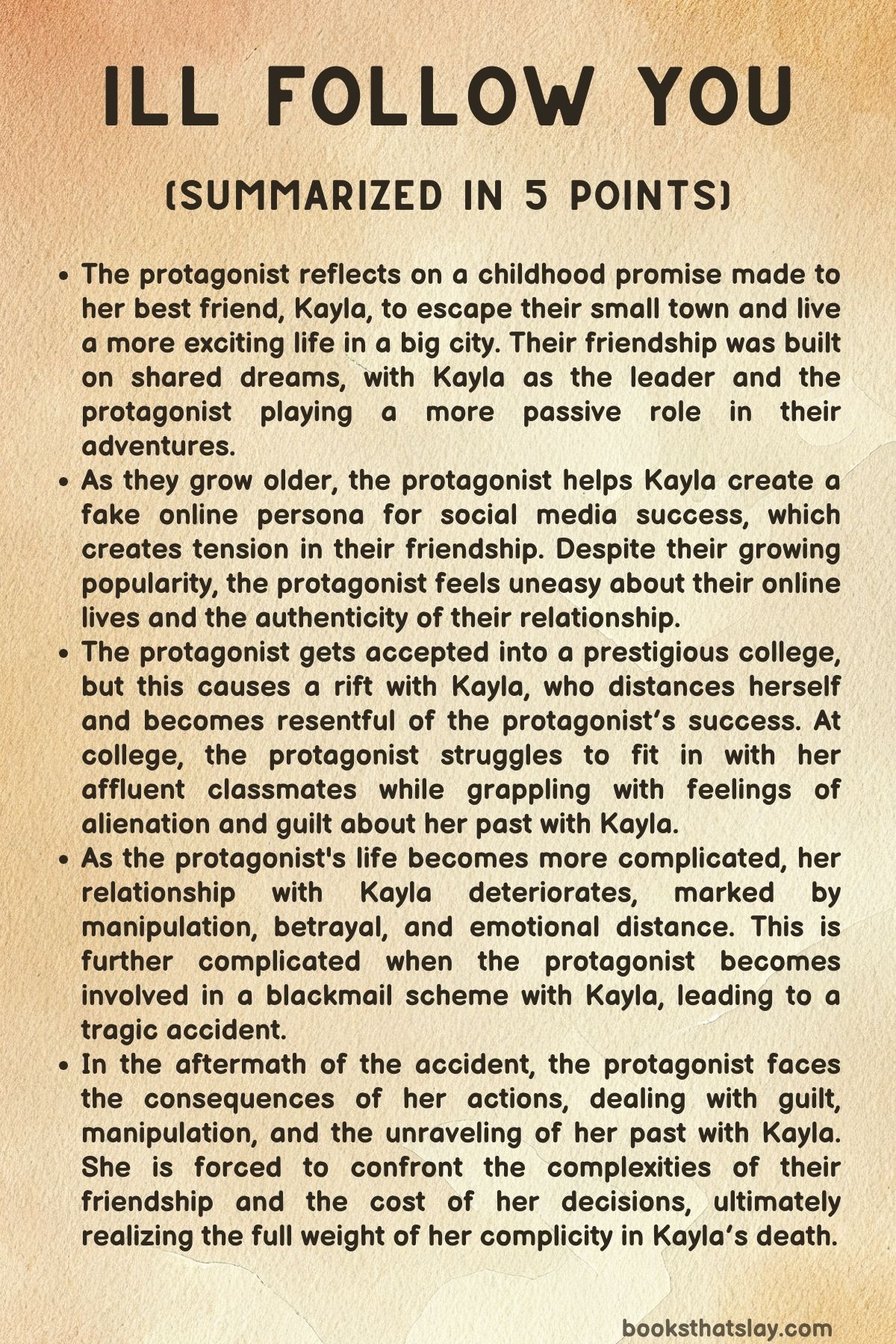
Summary
Faith’s journey begins in her small hometown of Gator Park, where she and her best friend, Kayla, dreamed of escaping their mundane lives. As young girls, they bonded over these shared dreams of moving to the city, where they believed a better life awaited.
Kayla was always the more daring and adventurous one, pushing Faith to follow her wherever she went, whether it was taking risks or making decisions that often had dangerous consequences. Their friendship revolved around their shared ambition, and Faith played the supporting role, always willing to follow Kayla’s lead.
The first spark of their friendship happened when Faith was twelve years old and had just lost her previous best friend, Eunice. Kayla, new to town, quickly became a captivating figure in Faith’s life.
Her bold personality and adventurous spirit pulled Faith into a whirlwind of risky behavior, from making parkour videos to indulging in wild stunts. In one such dangerous moment, Kayla convinced Faith to jump into an old well, which led to Faith injuring herself badly.
When the event made the local news, Kayla positioned herself as the hero who saved the day, while Faith was left to deal with the painful aftermath. This moment marked the beginning of Faith’s growing realization that Kayla’s influence on her was not always positive.
As they grew older, their bond continued to be fueled by the shared dream of leaving Gator Park. Kayla’s desire for fame and success pushed the two of them into the world of social media.
With Faith’s help, Kayla created the persona of “Hannah Primrose,” a fake influencer designed to attract followers. While their social media success grew, Faith began to question the authenticity of their online lives and the toll it took on their friendship.
As their bond grew more strained, Faith’s internal conflict intensified, particularly as Kayla’s increasing fame brought a growing sense of disconnect.
Faith’s opportunity for a new beginning arrived when she was accepted into Harkness College, a prestigious school far from their small town. This was a major step toward escaping the confines of her old life, but it also created a rift between her and Kayla.
Kayla’s jealousy and sense of betrayal led her to distance herself from Faith, leaving the protagonist with a deep sense of loss. Faith’s time at Harkness was marked by her struggle to fit in with the more affluent and socially adept students.
Her memories of Kayla haunted her, and she struggled to reconcile her new life with the fractured friendship.
At college, Faith navigated a complicated and isolating existence. She felt out of place among her wealthy peers and spent much of her time trying to maintain her social media persona.
Her loneliness intensified as she realized that she was losing her identity in the pursuit of fitting into a world that didn’t feel like home. Her relationship with Kayla became increasingly distant, but the memories of their past continued to affect her emotionally.
Faith found one of the few meaningful connections in her life through Professor Wyman, an art professor she met at Harkness. They shared a mutual interest in art, and their discussions provided Faith with a sense of intellectual fulfillment that contrasted with the superficiality of her college life.
However, her emotional struggles with Kayla and the ongoing pressure to maintain her online image made it difficult for Faith to fully embrace this new connection.
As Faith struggled with her academic pressures and the fallout from her friendship with Kayla, she found herself drawn into the sorority rush process at Harkness. Despite her desire for belonging, she felt alienated by the social dynamics and the performance required to fit in.
The sorority events only deepened her sense of isolation, and her friendship with Callie, one of the few people she could rely on, remained superficial. Faith’s growing emotional turmoil was compounded by her failing grades and the stress of trying to maintain her scholarship.
Meanwhile, Kayla’s increasing distance from Faith and her transformation into a more detached social media figure further highlighted the rift between them. The contrast between Faith’s real life at Harkness and Kayla’s fabricated online persona only deepened the emotional gap.
As the semester went on, Faith found herself torn between her desire for success and her inner conflict about the choices she was making.
When Kayla reappeared in Faith’s life, it was through their shared social media world. Kayla’s presence in Faith’s feed brought back painful memories, and Faith was forced to confront the reality of their fractured friendship.
The increasing tension between the two friends, along with the pressures of fitting in and maintaining her social media presence, took a heavy toll on Faith.
Things took a darker turn when Faith was drawn into a dangerous situation involving Kayla’s manipulative behavior. The two women became embroiled in a scheme to blackmail their professor, Wyman, for money.
As they drove away from the scene of their crime, their relationship reached a breaking point. Faith, now realizing just how much Kayla had controlled her life, felt a deep sense of guilt and discomfort.
Their argument escalated, and in a tragic turn of events, the car they were in crashed, leading to Kayla’s death.
Faith, trapped in the wreckage, was forced to make a life-altering decision. She chose to save herself, leaving Kayla behind as the water rose.
In the aftermath of the crash, Faith manipulated the situation to protect herself, telling the authorities that Kayla was responsible for the blackmail and that things had spiraled out of control. As the investigation unfolded, Faith continued to lie about the events leading up to the crash, all while struggling with her own guilt.
The police inquiry and the revelation of the blackmail scheme left Faith grappling with the consequences of her actions. Kayla’s mother, Brenda, portrayed herself as a grieving parent, while Faith was left to confront the reality of her role in the tragedy.
The story ended with Faith trying to move forward, but she could not escape the weight of the lies and the manipulations that had led to Kayla’s death. The emotional and moral toll of their friendship haunted her as she struggled to reconcile the past with her future.
In the end, Faith was forced to face the harsh truth: the lines between loyalty, guilt, and self-preservation had blurred, and the price of trying to escape her past might be losing her sense of self entirely.
Characters
Kayla
Kayla is the central force in the protagonist’s life, a dynamic and bold character who acts as a leader in their friendship, pushing boundaries and taking risks. She enters the protagonist’s life at a crucial time, bringing excitement, rebellion, and danger.
Throughout I’ll Follow You, Kayla remains a captivating yet dangerous character, driven by a desire for attention and validation. Her ambition to escape their small-town life manifests in her pursuit of social media fame, creating a fake persona, “Hannah Primrose,” to build a following.
Kayla’s manipulative nature is evident in her ability to charm others and dominate the protagonist’s decisions, often placing them in uncomfortable and dangerous situations. Her recklessness is a major theme of the story, as seen in the parkour incident where the protagonist is injured but Kayla manipulates the narrative, positioning herself as the hero.
As the story progresses, Kayla’s distance from the protagonist grows, particularly when she becomes resentful of the protagonist’s college acceptance. Despite her growing success on social media, Kayla is revealed to be emotionally disconnected, using people around her to further her own goals.
Her ultimate betrayal is exposed when she becomes entangled in a blackmail plot, which leads to tragic consequences. Kayla’s manipulations and contradictions make her a compelling yet deeply flawed character, embodying the destructive effects of unchecked ambition and control.
Faith
Faith is introduced as a freshman at Harkness College, dealing with her own sense of isolation and the aftermath of her fractured relationship with Kayla. Faith’s internal struggles are a central part of the narrative, as she contemplates her place at the prestigious institution and navigates the complex social dynamics around her.
Initially, Faith is consumed by her thoughts of Kayla, who has distanced herself and created a new, more alluring persona online. This emotional distance leaves Faith feeling alienated, not only from Kayla but also from her peers at Harkness.
Faith’s work-study job, participation in sorority life, and strained relationships with classmates like Callie further emphasize her sense of not belonging. Despite her social struggles, Faith finds solace in a connection with Professor Wyman, who shares her love for art and offers her a glimpse into a life of intellectual fulfillment.
However, Faith’s relationship with Wyman also becomes complicated as she navigates her growing feelings for him, alongside her social media obligations. As Faith becomes more entangled in her influencer persona, she struggles with balancing authenticity and her desire for acceptance.
Her relationship with Kayla deteriorates further, and she becomes torn between pursuing her academic goals and maintaining her online identity. Faith’s emotional turmoil culminates in her involvement in a blackmail scheme that leads to Kayla’s death.
In the aftermath, Faith is left to confront her guilt, manipulation, and the realization that her choices have had irreversible consequences. Faith’s character arc is one of reflection and growth, as she grapples with her role in the tragedy and seeks to reconcile with her past.
Callie
Callie is a character that briefly enters Faith’s life as a fellow student at Harkness College, and though their friendship remains superficial, Callie provides a grounding influence for Faith amid the chaos. Callie is not as deeply involved in Faith’s emotional struggles as Kayla, but she plays a part in Faith’s social interactions, especially within the context of sorority life.
Callie’s own experiences with the social scene at Harkness provide Faith with some insight into the superficial nature of the college’s social circles. Despite their superficial bond, Callie represents one of the few people Faith can rely on for support.
However, this connection is not enough to alleviate Faith’s feelings of alienation. Callie’s role in the narrative underscores the tension between the external pressures of fitting in and the internal desire for authenticity, which remains central to Faith’s journey.
Brenda
Brenda, Kayla’s mother, plays a crucial yet indirect role in the story, primarily through her interactions after Kayla’s tragic death. She embodies the grieving mother trope but is, in many ways, unaware of the full extent of Kayla’s manipulations.
Brenda’s public mourning contrasts with the truth of Kayla’s life, as Faith reflects on the complexity of their friendship and the lies that have surrounded it. Brenda’s role highlights the theme of perception versus reality, as she remains oblivious to the darker side of her daughter’s life.
Her grief, though real, serves to complicate Faith’s own sense of guilt and responsibility in the aftermath of the events.
Professor Wyman
Professor Wyman is a more nuanced character in I’ll Follow You, serving as a mentor and intellectual figure for Faith. He represents a contrast to the superficial world of sororities and social media, offering Faith a glimpse of a life rooted in art and academic fulfillment.
However, his relationship with Faith becomes complicated as her feelings for him grow, and she begins to question whether their bond is purely professional. Wyman’s role in the narrative challenges Faith to reconsider her values and desires, providing a reprieve from the chaos of her social life.
Yet, his distance and occasional coldness add to the emotional confusion Faith experiences, ultimately leaving her unsure of his intentions and her place in his life.
Themes
Friendship and Manipulation
The bond between the protagonist and Kayla is at the heart of the narrative, but it is a relationship that is marked by manipulation and control rather than mutual support. Initially, the protagonist admires Kayla’s confidence and adventurous spirit, with their friendship built on shared dreams of escaping their small-town life.
However, as the story progresses, it becomes clear that Kayla’s influence over the protagonist is one of dominance and manipulation. Kayla’s ability to charm and control those around her, including the protagonist, creates an uneven power dynamic that ultimately undermines the authenticity of their relationship.
The protagonist often plays a passive role, following Kayla’s reckless and dangerous pursuits, such as the parkour stunt that leads to a serious injury. While Kayla positions herself as the hero in this situation, the protagonist is left to deal with the fallout, both physically and emotionally, marking the first signs of Kayla’s manipulative tendencies.
This pattern continues throughout their relationship, with Kayla convincing the protagonist to create a fake persona for social media and pressuring her to maintain this façade. Even when the protagonist succeeds in moving forward by being accepted into Harkness College, Kayla distances herself, showing how fragile their bond truly is.
Kayla’s manipulation culminates in a tragic betrayal, where the protagonist becomes entangled in a blackmail scheme that ultimately leads to Kayla’s death. The theme of manipulation highlights the toxic nature of their friendship, where the protagonist’s loyalty to Kayla is repeatedly tested, and the manipulation extends beyond childhood into adulthood.
Identity and Self-Discovery
The journey of self-discovery plays a significant role in the protagonist’s growth throughout the novel. Initially defined by her friendship with Kayla, the protagonist struggles to forge an independent identity, often losing herself in the shadow of Kayla’s bold and rebellious personality.
Their shared dream of escaping Gator Park and making something of themselves in a larger city shapes much of the protagonist’s sense of self. However, as she gets accepted into Harkness College and begins to experience life away from Kayla’s influence, she is forced to confront who she truly is, apart from the relationship that has defined much of her existence.
The college environment presents new opportunities and challenges for the protagonist, but it also exposes her insecurities and feelings of alienation. She finds herself in a constant tug-of-war between the life she has built at Harkness and her lingering attachment to Kayla.
Her struggle to fit in with wealthier, more socially adept classmates only deepens her sense of isolation. The constant pressure to maintain a social media persona that is far removed from her authentic self further complicates her path to self-discovery.
As the protagonist navigates her emotions about Kayla’s betrayal and her place at Harkness, she begins to realize that the cost of fitting in might be the loss of her true identity. In the end, the protagonist must come to terms with the fact that her past decisions, shaped by her desire for escape and acceptance, have led her to a life that is anything but fulfilling.
This theme of identity and self-discovery is central to the protagonist’s emotional journey, as she learns to navigate the delicate balance between self-acceptance and the external pressures that have defined her life.
The Illusion of Escaping the Past
The idea of escaping one’s past is a recurring theme that runs throughout the protagonist’s journey, both in her childhood and as she transitions into adulthood. From the moment the protagonist and Kayla make their pact to leave Gator Park and live in a big city like Los Angeles or New York, the protagonist believes that escaping their small-town life will solve all their problems.
This fantasy of a new beginning is intertwined with their shared dream of a better life, one that is free from the limitations and struggles of their past. However, as the protagonist moves further away from Kayla and Gator Park, she realizes that the past is not so easily left behind.
Her time at Harkness College brings new opportunities but also new challenges, and she finds herself grappling with the same insecurities and fears that plagued her back home. The increasing emotional distance from Kayla highlights the impossibility of truly escaping her influence, as Kayla’s manipulations continue to haunt the protagonist, even in a new setting.
The protagonist’s attempt to escape her past is further complicated by the presence of social media, where she is forced to continue the facade they created together. The illusion of escaping the past is shattered when Kayla reappears in the protagonist’s life through social media, living a life that feels both distant and out of reach.
The protagonist is confronted with the realization that the dreams they once shared may never have been meant to come true, and the past will always be a part of who they are, no matter how far they try to run from it. This theme underscores the complexities of attempting to escape one’s roots, as the protagonist realizes that running away is never a true solution to the emotional baggage they carry.
Guilt and Responsibility
Guilt is a powerful and pervasive theme that permeates the protagonist’s actions and thoughts, particularly as she reflects on her involvement in the blackmail scheme and the eventual death of Kayla. Throughout the story, the protagonist struggles with feelings of guilt, particularly in relation to her passive role in their toxic friendship.
She often questions her own complicity in Kayla’s reckless behavior, wondering if she could have done more to stop it. The guilt intensifies when she finds herself caught up in the blackmail plot, which ultimately leads to Kayla’s death.
Despite her emotional turmoil, the protagonist tries to protect herself by manipulating the narrative, casting Kayla as the villain while trying to distance herself from the consequences of their actions. However, this self-preservation tactic only amplifies the guilt she feels, as she is forced to confront the reality that her lies and decisions have contributed to the tragic outcome.
The guilt surrounding Kayla’s death becomes even more pronounced as the protagonist reflects on their years of friendship and the manipulation that defined it. In the aftermath of the crash, the protagonist’s feelings of guilt are compounded by the realization that she was never truly a victim in the relationship.
She begins to understand that her own choices—her willingness to follow Kayla, to partake in the lies and deceit—have led to this devastating outcome. This theme of guilt and responsibility highlights the protagonist’s struggle to reconcile her actions with the consequences they have wrought, as she is left to deal with the aftermath of a friendship that was defined by manipulation and betrayal.