I’m Not The Only Murderer In My Retirement Home Summary, Characters and Themes
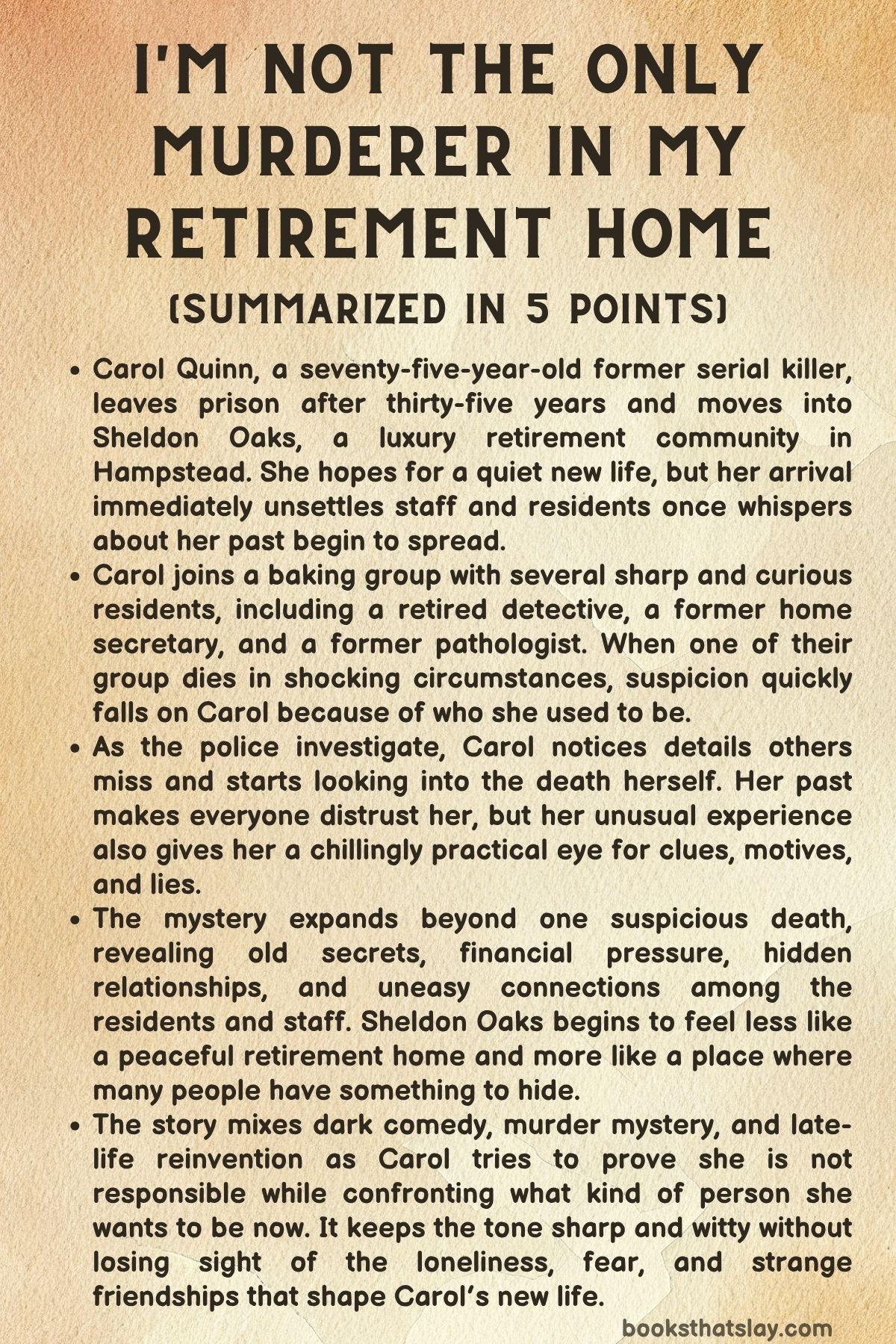
I’m Not The Only Murderer In My Retirement Home by Fergus Craig is a comic murder mystery built around Carol Quinn, a seventy-five-year-old former serial killer trying to begin again after decades in prison. Instead of a peaceful old age, Carol finds herself inside Sheldon Oaks, a luxury retirement home where old secrets, hidden crimes, and dangerous residents are everywhere.
The book plays with the cosy crime format by making its most suspicious person the sharpest investigator in the room. It is darkly funny, fast-moving, and full of twists, using Carol’s bleak past and dry intelligence to turn a retirement community into a scene of suspicion, greed, revenge, and murder.
Summary
Carol Quinn is seventy-five years old when she is released from prison after thirty-five years behind bars. She was once one of Britain’s most notorious serial killers, and she has spent more than half her life paying for her crimes.
Now, old, tired, and no longer interested in violence, she wants a quiet place to live. That place is Sheldon Oaks, an expensive retirement community in Hampstead.
Her arrival immediately unsettles the people who run the home. Elisa, the concierge, and Giles Temple, the owner, both know that taking in Carol is risky.
Her past could terrify the residents and damage the reputation of Sheldon Oaks. Still, Carol has bought her flat outright in cash, and Giles needs the money, so they allow her to move in.
Carol arrives with a small suitcase and begins adjusting to a life that feels strange after prison: private rooms, decent food, comfort, open doors, and the freedom to decide how to spend her day.
At first, Carol tries to keep herself unnoticed. She joins a Tuesday baking group, where she meets several residents.
Margaret is a former home secretary with political authority and a commanding personality. Geoffrey is a retired detective who still believes he has an investigator’s instinct.
Catherine is a former pathologist with a sharp mind and a practical attitude toward death. Desmond is cheerful, friendly, and easy to like.
Carol tells them a simple false version of her life, saying she used to work as a secretary and never married.
Her plan does not last. Geoffrey recognizes her surname and realizes who she really is.
Years earlier, he had helped catch Carol Quinn. He tells Margaret and Catherine, and Margaret remembers the case from her time in government.
Once Carol’s identity spreads, the residents begin to avoid her. The calm new life she hoped for starts to disappear.
Then death arrives at Sheldon Oaks. While Carol is sitting on her balcony doing a crossword, a body falls past her and lands near the entrance.
Carol hears running footsteps above and quickly concludes that the man did not simply fall. He was pushed from the roof.
The victim is Desmond.
The police arrive, led by DCI Bob Beattie and DS Laura Welsh. Carol notices a circular mark on Desmond’s forehead and understands that there is more to the death than a fall.
Geoffrey tries to involve himself in the case, but the police do not take him seriously. He, Margaret, and Catherine then form their own amateur murder club.
At first, they suspect Carol, partly because of her past and partly because she was so close to the incident.
They visit Carol’s flat with makeshift weapons, ready to confront her. Carol admits that Desmond was murdered, but she denies killing him.
She explains that she heard someone running on the roof after the body fell. She also points out that they must find out how Desmond reached the locked roof and why he was there in the first place.
The mark on his forehead is another important clue.
The police gather the residents and staff in the ballroom and announce that Desmond’s death may be suspicious. Geoffrey publicly reveals that Carol is a serial killer, causing fear across the home.
Belinda, another resident, then announces that she loved Desmond. Carol later learns that Desmond was actually Sir Desmond Crisp, a former head of the Metropolitan Police.
To the public, he had status and respectability, but Bob Beattie privately knows that Desmond had a corrupt past and despises him.
Catherine arranges for herself, Geoffrey, and Margaret to attend Desmond’s autopsy. The results show that Desmond’s death was not simple at all.
He had been poisoned, strangled, hit on the head with an object that left a circular mark, and then thrown or pushed from the roof. The evidence looks bad for Carol because Desmond had licked a spoon she handed him during the baking group the day before.
That makes it seem possible that she poisoned him.
Carol begins investigating for herself. She works out that the blow to Desmond’s right forehead suggests a left-handed attacker.
She questions Jim, a former gangster who once helped her bury a body in Epping Forest. Jim admits he argued with Desmond about an old unpaid debt, but he refuses to say more.
Carol notices that Jim is left-handed, making him a possible suspect.
She also looks into Desmond’s daughter Hannah and Hannah’s husband, Shep Newsom. She learns that Shep was in the building shortly before the murder and that Hannah has inherited millions.
Carol discovers that Shep’s real name is Dominic Newsom and that he has a long record of failed businesses. That gives him a strong financial motive.
At a Vera Lynn tribute night, Belinda throws wine in Carol’s face and claims Carol insulted her. Carol almost attacks Belinda with a broken bottle, but Bob stops her and arrests her for Desmond’s murder.
In custody, Carol realizes something important about herself: she no longer truly wants to kill. She breaks down because she does not want to return to prison.
During questioning, Bob and Laura focus on her past, the baking group, poison, and her violent reaction to Belinda. Carol denies killing Desmond and points them toward other possible suspects, including Shep, Jim, Belinda, and anyone who could access the roof.
The police still have no firm evidence. Bob admits he expected Carol to confess simply because of who she used to be.
While left alone in the interview room, Carol secretly photographs Desmond’s murder file. Margaret arrives and helps get her released.
The two women go to a pub and examine the stolen material. They find a reference to a fluorescent yellow wool fiber on Desmond’s shirt and notice that the police file has no photographs of the roof.
Meanwhile, Geoffrey and Catherine search Desmond’s emptied flat. They find boxes of cannabis cakes, eat some, and become badly affected while trying to continue their investigation.
Catherine later finds the weekly meal plan in the kitchen and realizes that Desmond’s last meal may have come from the restaurant at Sheldon Oaks, not from Carol’s baking. This weakens the case against Carol.
Geoffrey and Catherine also break into Carol’s flat and find her old murder journals. The discovery shocks them and Margaret.
Carol feels humiliated and exposed, but instead of retreating, she becomes more determined to clear her name.
Carol questions Elisa, who admits she tried to make Carol look dangerous so the police would remove her from Sheldon Oaks. The murder and Carol’s presence both threaten the future of the already struggling home.
Elisa also reveals that Polly Slaughter, a crime novelist and heavy cannabis user, was once married to Desmond. Carol confronts Polly and sees that Polly’s brightly colored yarn matches the fiber found on Desmond.
Laura arrests Polly, but Carol is not convinced she is the killer.
Giles Temple is also under pressure. Sheldon Oaks is in financial trouble, and he decides to sell the home to Shep Newsom.
Soon after, Giles is found dead, locked inside the sauna and killed by the heat. Carol and Catherine discover the body.
With Margaret and Geoffrey, they move it and conduct their own rough autopsy. They find clues connecting Giles to Eton and to Shep.
They unlock his phone using Face ID and discover recent contact with Shep. Later, Catherine and Geoffrey uncover messages showing that Giles was growing cannabis on the roof and that Shep was tied to his schemes.
Carol and Margaret use Margaret’s old government connections to get information from MI5 about Desmond. From this, Carol finally understands what happened.
Before she can explain, Catherine and Geoffrey go to the roof and find the cannabis greenhouse. Jim appears and attacks them, but Catherine stabs him with secateurs while defending Geoffrey.
They leave Jim’s body on the roof and gather everyone at karaoke night so Carol can reveal the truth.
Carol explains that Tyler, Elisa’s son, killed Desmond. Many years earlier, Desmond had fathered Elisa in Portugal after sleeping with a waitress during his honeymoon with Polly.
Elisa later came to Sheldon Oaks to find him. She became angry that he had never supported her or Tyler properly.
Elisa poisoned Desmond’s cottage pie with deadly nightshade from the garden. When the poison did not kill him quickly enough, Tyler took him to the roof, struck him with a gardening mallet, strangled him while wearing gloves, and pushed him off.
The wool fiber came from Tyler’s jumper, which Polly had knitted for him after he supplied her with cannabis cakes.
Carol then reveals that Elisa had also been secretly moving Sheldon Oaks money into a Portuguese account and had altered Giles’s will. But Elisa did not kill Giles.
Bob Beattie did. Giles’s cannabis business relied on Jim for criminal distribution and Bob for police protection.
When Giles became unstable and threatened Bob, Bob locked him in the sauna and murdered him.
Bob is exposed, Tyler breaks down, and Laura sees the truth about her superior officer. Afterward, Carol ends up back in prison, sharing a cell with Elisa.
Bob is arrested, Laura is promoted, Polly gets clean and returns to writing, Shep and Helen buy Sheldon Oaks, and Catherine and Geoffrey become engaged. They continue to visit Carol, whose attempt at a quiet retirement has ended, but who has proved that at Sheldon Oaks, she was far from the only murderer.
Characters
Carol Quinn
Carol Quinn is the central and most compelling figure in I’m Not The Only Murderer In My Retirement Home. At seventy-five, she enters the story carrying the weight of a terrible past: she is a convicted serial killer who has spent thirty-five years in prison.
What makes Carol fascinating is that she is not presented only as a monster or only as a reformed old woman. She is both frightening and vulnerable.
Her move to Sheldon Oaks gives her a chance at freedom, comfort, and anonymity, but that freedom is fragile because her past follows her everywhere. She wants to live quietly, enjoy her apartment, take part in normal activities, and be treated as an ordinary resident, yet the discovery of her identity makes that almost impossible.
Carol’s personality is sharp, observant, secretive, and often darkly humorous. She has a criminal mind, but that same mind makes her an unusually effective investigator.
She notices details others miss, such as the mark on Desmond’s forehead, the sound of running footsteps after his fall, the absence of roof photographs in the police file, and the meaning of the yellow wool fiber. Her past gives her knowledge of violence, bodies, motive, fear, and concealment, which allows her to read the murder more clearly than the police at times.
However, her past also makes her the easiest person to suspect. Everyone is ready to believe she killed again because they already know what she once was capable of doing.
Her emotional development is one of the most important parts of the book. At first, Carol seems capable of slipping back into violence, especially when Belinda humiliates her and Carol nearly attacks her with a broken bottle.
Yet that moment also reveals change. In custody, she realizes that she does not truly want to kill anymore and breaks down because she does not want to return to prison.
This shows that Carol is not simply pretending to be different; she is struggling against the person she used to be. Her murder journals reveal that the darkness inside her has not disappeared, but the story suggests that she is trying, in her own damaged way, to live differently.
Carol is dangerous, intelligent, lonely, and morally stained, but she is also the character most determined to uncover the truth.
Elisa
Elisa is one of the most tragic and emotionally complicated characters in the book. She begins as the concierge at Sheldon Oaks, appearing practical, professional, and anxious about Carol’s arrival.
At first, her worry seems understandable because a convicted serial killer moving into a retirement home would disturb almost anyone. However, as the story develops, Elisa is revealed to be far more deeply connected to the events than she first appears.
Her actions are driven by resentment, desperation, family pain, and financial ambition.
Elisa’s connection to Desmond gives her character a strong emotional motive. Desmond fathered her years earlier in Portugal but did not properly support her or her son Tyler.
This abandonment shapes her bitterness. She does not merely dislike Desmond; she sees him as a man who escaped responsibility and left damage behind.
Her decision to poison him with deadly nightshade comes from this long-buried anger. She is not a random killer but someone whose crime is tied to betrayal, class privilege, and generational neglect.
At the same time, Elisa is manipulative and calculating. She tries to make Carol look dangerous so the police will remove her from Sheldon Oaks, not because she is purely frightened, but because Carol’s presence and the murder threaten the retirement home.
She is also secretly moving money into a Portuguese account and has altered Giles’s will, showing that her motives are not only emotional but also financial. Elisa is therefore both victim and villain.
She has been wronged, but she also uses deception, theft, and murder to pursue control. Her final position as Carol’s prison cellmate is fitting because both women are older, intelligent, dangerous, and shaped by violent choices.
Giles Temple
Giles Temple is the owner of Sheldon Oaks and represents the polished surface of the retirement home’s corruption. At first, he seems like a businessman trying to maintain appearances.
He is nervous about admitting Carol into the residence but accepts her because she buys her apartment outright in cash. This immediately shows that his moral judgment is weaker than his financial need.
Giles is less concerned with whether Carol’s presence is right for the community and more concerned with keeping Sheldon Oaks financially afloat.
As the story unfolds, Giles becomes a symbol of hidden rot beneath luxury. Sheldon Oaks looks elegant, comfortable, and respectable, but Giles is desperate, compromised, and involved in illegal activity.
His connection to Shep, his financial schemes, and the cannabis operation on the roof reveal that he is not simply an unlucky businessman. He is willing to involve himself in criminal arrangements to save or profit from the home.
His respectability is a mask, and his death exposes the dangerous network beneath the retirement community.
Giles’s murder in the sauna is significant because it shifts the story beyond Desmond’s death. His killing shows that Sheldon Oaks is not haunted by one isolated crime but by overlapping secrets.
Giles is weak, greedy, and frightened, but he is also dangerous because he knows too much. Bob kills him because Giles becomes unstable and threatens the corrupt arrangement involving cannabis, criminals, and police protection.
Giles’s character is important because he proves that the real danger in the story is not only Carol’s past but the respectable people hiding crimes in plain sight.
Margaret
Margaret is a former home secretary and one of the key members of the amateur murder club. She brings authority, political experience, and confidence to the investigation.
Because she once dealt with Carol’s case while in government, she has a direct connection to Carol’s past and understands the seriousness of who Carol is. At first, Margaret is wary of Carol and joins Geoffrey and Catherine in suspecting her, but she gradually becomes more open to working with her.
Margaret’s character is defined by competence and social power. She knows how institutions work, how to apply pressure, and how to use old connections.
Her arrival at the police station helps get Carol released, and her access to MI5 becomes crucial in uncovering Desmond’s history. She is not physically forceful in the way Carol or Jim can be, but she has a different kind of strength: influence.
Margaret understands secrets, bureaucracy, reputation, and the quiet ways power protects itself.
Her relationship with Carol is especially interesting because both women are formidable, older, and morally complicated in different ways. Margaret has lived inside systems of power, while Carol has lived outside them as a criminal.
Their alliance suggests that intelligence and experience can come from very different worlds. Margaret is often stern, practical, and commanding, but she is not closed-minded.
Over time, she sees that Carol’s guilt in the past does not automatically make her guilty in the present.
Geoffrey
Geoffrey is a retired detective who brings both investigative knowledge and comic self-importance to the story. He is the first resident to recognize Carol’s surname and confirm her identity as the notorious killer he helped catch.
This gives him a personal connection to her past and makes him one of the first people to view her as a serious threat. His exposure of Carol in front of the residents creates panic and pushes her further into isolation.
Geoffrey sees himself as useful to the investigation, but the police often dismiss him. This bruises his pride and pushes him toward amateur detecting with Margaret and Catherine.
He has real experience, but he is also impulsive, theatrical, and sometimes foolish. His eagerness to investigate leads him into absurd situations, such as eating cannabis cakes with Catherine and becoming stoned while searching Desmond’s flat.
These moments make him comic, but they do not make him useless. Geoffrey can still connect clues and contribute to the group’s discoveries.
His relationship with Catherine gives his character warmth. Their engagement at the end suggests that amid murder, suspicion, and old secrets, companionship is still possible.
Geoffrey is not the sharpest investigator in the book, but he is persistent, brave in bursts, and genuinely invested in solving the crimes. He also reflects one of the story’s central ideas: old age does not remove curiosity, pride, romance, or the desire to matter.
Catherine
Catherine is a former pathologist and one of the most valuable investigators in the story. Her medical knowledge gives the amateur group insight that the other residents lack.
She understands bodies, injuries, autopsies, and forensic implications, which makes her especially important in interpreting Desmond’s death. When the autopsy reveals poisoning, strangulation, blunt-force trauma, and a fall, Catherine is able to grasp the complexity of the murder more clearly than most.
Catherine’s personality combines intelligence, eccentricity, and courage. She is not merely a quiet expert; she actively investigates, breaks into spaces, examines evidence, and even helps handle Giles’s body for an amateur autopsy.
Her willingness to cross boundaries makes her both useful and morally questionable. Like many characters in the novel, she is respectable on the surface but capable of disturbing actions when circumstances demand them.
Her defense of Geoffrey on the roof is one of her strongest moments. When Jim attacks them, Catherine stabs him with secateurs, proving that she is not only intellectually capable but also physically decisive under threat.
This act places her in the same morally grey world as Carol and the others. Catherine is not a murderer in the same sense as Carol, Elisa, Tyler, or Bob, but she is capable of violence when survival demands it.
Her engagement to Geoffrey gives her arc a lighter ending, but her character remains one of the clearest examples of how the elderly residents are far more dangerous, active, and unpredictable than people might assume.
Desmond Crisp
Desmond Crisp is the murder victim whose death drives the main investigation, but he is far from an innocent background figure. At Sheldon Oaks, he appears cheerful and sociable, joining the baking group and forming relationships with other residents.
Belinda claims to have loved him, and he seems at first like a pleasant older man whose death is shocking because of its brutality. However, his true identity as Sir Desmond Crisp, former head of the Metropolitan Police, changes how the reader understands him.
Desmond’s past is corrupt and morally ugly. Bob privately calls him “scum,” which suggests that those who know the truth about him see him as deeply compromised.
His abandoned connection to Elisa and Tyler makes him personally responsible for long-term emotional damage. He fathered Elisa and then failed to provide meaningful support, leaving resentment to grow over decades.
His position of power makes this worse because he was not a helpless man; he was someone with status, money, and influence.
His death is especially elaborate: he is poisoned, strangled, hit on the head, and thrown or pushed from the roof. The excessive nature of the murder reflects how many layers of hatred, fear, and secrecy surround him.
Desmond is important not because he changes during the story, but because the truth about him changes everyone else’s motives. He is the hidden cause of much of the book’s violence, a man whose respectable public life concealed private wrongdoing.
DCI Bob Beattie
DCI Bob Beattie initially appears as the police officer leading the investigation into Desmond’s death. He is experienced, suspicious, and especially focused on Carol because of her history.
His assumption that she might confess shows how heavily he relies on her past to shape his view of the present. He is not entirely foolish, but he is biased.
Carol’s identity as a serial killer makes her an easy answer, and Bob is tempted by that easy answer.
As the story progresses, Bob becomes increasingly unsettling. He stops Carol from attacking Belinda and arrests her, which makes him appear responsible at first.
However, his private knowledge of Desmond’s corruption and his uneasy reactions suggest that he knows more than he admits. By the end, Bob is revealed as Giles’s killer, and this revelation transforms him from investigator to criminal.
He is not merely a flawed detective; he is part of the corruption he is supposed to expose.
Bob’s motive is tied to protection, fear, and self-preservation. Giles’s cannabis business depends on criminal distribution through Jim and police protection through Bob.
When Giles becomes unstable and threatens him, Bob murders him by locking him in the sauna. This makes Bob one of the most hypocritical characters in I’m Not The Only Murderer In My Retirement Home: a police officer investigating murder while hiding his own.
He represents institutional corruption, showing that danger does not only come from known criminals like Carol but also from people trusted to enforce the law.
DS Laura Welsh
DS Laura Welsh is Bob’s colleague and eventually becomes one of the clearer moral figures in the police side of the story. At first, she participates in the interrogation of Carol and questions her about Desmond, the baking, the poison, and the attack on Belinda.
Like others, she has reason to suspect Carol, but she is not presented as blindly hostile. She listens, observes, and gradually becomes important in recognizing the truth.
Laura’s role grows in significance when Bob’s guilt is exposed. Her realization that Bob is guilty marks a turning point because it means the official investigation can no longer hide behind assumptions about Carol.
Laura’s promotion after Bob’s arrest suggests that she is rewarded not just for competence but for being separate from his corruption. She represents the possibility that the police can still correct themselves, even after being compromised by people like Desmond and Bob.
Compared with Carol, Margaret, Geoffrey, and Catherine, Laura is less eccentric and less morally chaotic. Her importance lies in her steadiness.
She is part of the formal justice system, and although that system is flawed, she becomes the person who can help restore some order. In a story full of hidden murderers, liars, and amateur detectives, Laura provides a quieter but necessary form of accountability.
Belinda
Belinda is a dramatic resident whose emotional attachment to Desmond makes her stand out. Her public announcement that she loved him adds theatrical tension after his death and complicates the list of possible suspects.
She seems to have had a romantic or emotional investment in Desmond, which gives her a possible motive rooted in jealousy, grief, or humiliation.
Her confrontation with Carol at the Vera Lynn tribute night reveals her impulsive and performative nature. By throwing wine in Carol’s face and accusing her of insulting her, Belinda provokes one of Carol’s most dangerous moments.
This scene is important because Belinda functions partly as a test of Carol’s self-control. Carol nearly responds with serious violence, proving that her old instincts are still alive, but Bob’s intervention prevents the situation from becoming worse.
Belinda is not ultimately the murderer, but she is important as a source of misdirection and pressure. She embodies the emotional chaos that follows Desmond’s death.
Her grief may be sincere, but her behavior is also exaggerated and provocative. In a retirement home full of secrets, Belinda shows how love, vanity, and public drama can make someone seem suspicious even when they are not the central criminal.
Jim
Jim is a former gangster with a direct connection to Carol’s criminal past. He once helped her bury a body in Epping Forest, which immediately places him among the darker figures in the story.
Unlike many residents who merely fear or judge Carol, Jim knows something of what she used to be and has participated in criminal acts himself. This makes their conversations tense because they are not simply polite exchanges between elderly acquaintances; they are meetings between people with blood in their histories.
Jim becomes a suspect because he argued with Desmond over an old unpaid debt and because Carol notices he is left-handed, matching her theory about the blow to Desmond’s right forehead. His refusal to fully explain the debt deepens suspicion.
He represents the criminal underworld that intersects with the supposedly respectable world of Sheldon Oaks. His involvement in distribution for Giles’s cannabis business further connects him to the hidden economy beneath the retirement home.
His final appearance on the roof confirms that he is dangerous. When Catherine and Geoffrey discover the cannabis greenhouse, Jim attacks them, and Catherine kills him in self-defense.
Jim’s death shows how far the investigation has moved from cozy amateur detection into real violence. He is not the main murderer, but he is part of the network of crime that makes the community so unstable.
Hannah
Hannah is Desmond’s daughter and one of the characters investigated because of inheritance and family connection. Her role is smaller than that of Carol, Elisa, or Margaret, but she matters because she introduces the possibility of a financial motive linked to Desmond’s death.
Since she inherits millions, Carol naturally considers whether Hannah or someone close to her could benefit from Desmond dying.
Hannah’s importance also comes through her marriage to Shep Newsom. Her inheritance makes Shep’s financial failures more suspicious, especially after Carol discovers his real name and history of failed businesses.
Hannah herself does not emerge as the central villain, but she functions as part of a suspicious family circle around Desmond. Through her, the story explores how wealth, inheritance, and marriage can create motives that appear convincing even when they are not the final answer.
Hannah is therefore more of a structural character than an emotional center. She helps widen the investigation beyond Sheldon Oaks and forces Carol to consider the financial consequences of Desmond’s death.
Her presence reminds the reader that murder investigations often produce several believable motives before the real one becomes clear.
Shep Newsom / Dominic Newsom
Shep Newsom, whose real name is Dominic Newsom, is one of the most suspicious figures in the story. His presence in the building shortly before Desmond’s murder and his connection to Hannah’s inheritance make him an obvious person for Carol to investigate.
When Carol discovers his long history of failed businesses, he becomes even more suspicious because financial desperation often creates motive.
Shep is a character built around reinvention and concealment. The fact that he uses the name Shep while his real name is Dominic suggests a man who reshapes his identity when useful.
His business failures make him look opportunistic, and his later purchase of Sheldon Oaks with Helen places him directly within the future of the retirement home. He is not the murderer of Desmond or Giles, but he is involved enough in the financial and business side of the plot to remain morally questionable.
His link to Giles is especially important. Giles plans to sell the home to him, and Giles’s phone reveals contact between them as well as involvement in business schemes.
Shep represents a different kind of danger from Carol or Jim. He is not openly violent, but he belongs to the world of deals, money, failed ventures, and hidden arrangements.
He helps show that corruption in the book is not limited to physical murder; it also appears in finance, ownership, and opportunism.
Polly Slaughter
Polly Slaughter is a crime novelist, Desmond’s former wife, and one of the story’s most memorable suspects. Her background as a writer of crime fiction immediately makes her suspicious in a playful way because she understands murder as material, structure, and drama.
She is also a heavy cannabis user, which connects her to the cannabis cakes found in Desmond’s flat and to the hidden drug activity at Sheldon Oaks.
Polly becomes strongly implicated when Carol finds that her brightly colored yarn matches the yellow fiber discovered on Desmond’s shirt. This clue makes her look like a serious suspect, especially because she once had a personal relationship with Desmond.
As his former wife, she could plausibly have old resentments, emotional wounds, or unfinished business with him. Her arrest by Laura gives the impression that the investigation has found a likely culprit, but Carol remains unconvinced.
The truth makes Polly more sympathetic. The fiber is connected to Tyler’s jumper, which Polly had knitted for him as thanks for supplying her cannabis cakes.
This means Polly is part of the clue trail but not the killer. Her later recovery, sobriety, and return to writing give her one of the more hopeful endings.
Polly is eccentric, flawed, and suspicious-looking, but she is also a red herring whose life improves after the truth comes out.
Tyler
Tyler is Elisa’s son and one of the hidden murderers in the story. For much of the book, he remains less visible than the older residents and official suspects, which helps conceal his importance.
His connection to Desmond is deeply personal because Desmond is his grandfather, though not in any loving or supportive sense. Tyler’s violence grows out of family abandonment, resentment, and loyalty to his mother.
Tyler’s role in Desmond’s death is brutal and direct. After Elisa poisons Desmond’s cottage pie, Tyler takes him to the roof, hits him with a gardening mallet, strangles him while wearing gloves, and pushes him off.
This makes him responsible for turning Elisa’s attempted poisoning into a completed murder. The circular mark on Desmond’s forehead, the roof mystery, and the fiber from his jumper all point back to him once Carol understands the truth.
His breakdown after being exposed suggests that he is not a cold, professional killer. He is overwhelmed by what he has done and by the collapse of the secret he shared with Elisa.
Tyler is tragic because he is shaped by the failures of the previous generation. Desmond’s selfishness, Elisa’s bitterness, and the family’s hidden history all lead him toward violence.
Still, the book does not excuse him. His suffering explains his motive, but his actions remain horrifying.
Helen
Helen is a minor but important character because she is connected to the future of Sheldon Oaks after the murders are solved. Along with Shep, she buys the retirement home, suggesting a change in ownership after Giles’s death and the exposure of the criminal activity surrounding the place.
She does not have the same depth or direct involvement as Carol, Elisa, or Catherine, but her role helps close the story’s practical loose ends.
Helen’s presence gives the ending a sense of continuation. Sheldon Oaks does not disappear; it changes hands and moves into a new phase.
Because Shep’s own history is questionable, Helen’s involvement does not make the future feel entirely pure or uncomplicated. Instead, it leaves the impression that life at Sheldon Oaks will continue with new management, new arrangements, and possibly new secrets.
Themes
The Weight of a Criminal Past
Carol’s release does not give her a clean beginning; it places her in a world where every action is judged through what she once did. Her neighbors do not first see an elderly woman trying to adapt to freedom, but a former killer whose presence threatens their sense of safety.
This theme shows how difficult reintegration becomes when society refuses to separate a person’s present conduct from their worst past actions. Carol lies about her history because she understands that truth will not bring honesty or acceptance; it will bring fear, gossip, and rejection.
Yet the murder investigation also exposes the unfairness of assuming guilt too quickly. Bob expects her to confess not because evidence proves she killed Desmond, but because her identity makes her an easy suspect.
I’m Not The Only Murderer In My Retirement Home uses Carol’s situation to question whether people can ever escape the stories attached to them. Her struggle is not only to solve a crime, but to prove that she is more than the violence that defined her earlier life.
Age, Power, and Hidden Corruption
The retirement home appears calm, comfortable, and respectable, but beneath its polished surface lie greed, fraud, addiction, violence, and old secrets. The residents and staff may be elderly or associated with care, comfort, and decline, but they are still capable of manipulation, ambition, and brutality.
This theme challenges the idea that old age automatically brings innocence, wisdom, or moral peace. Desmond’s respected public career hides corruption and cruelty.
Giles presents himself as a refined owner, yet he is involved in cannabis schemes and financial desperation. Elisa appears efficient and loyal, but she is driven by resentment, theft, and family pain.
Even the amateur investigators cross legal and moral lines while searching for answers. The setting becomes important because Sheldon Oaks represents social respectability: wealth, status, and good manners.
The crimes inside it reveal that corruption does not disappear behind age, money, or polite behavior. Instead, the story suggests that people carry their desires, grudges, and secrets with them, even into retirement.
Justice Beyond Official Authority
The police investigation is not shown as completely reliable, because assumptions, personal history, and corruption distort the search for truth. Bob’s role is especially important because he represents official power while secretly being guilty of murder himself.
His treatment of Carol shows how authority can become lazy when it relies on reputation rather than evidence. At the same time, the amateur investigators are flawed, chaotic, and sometimes reckless, but they notice details that the official investigation misses.
Carol’s observations about the locked roof, the mark on Desmond’s forehead, the left-handed attacker, and the possible motives around money and family all move the truth forward. This theme explores justice as something that requires attention, doubt, and courage rather than titles or uniforms.
The book presents justice as a messy process in which truth may come from people who are distrusted, underestimated, or morally compromised. Carol’s investigation matters because it proves that even someone with a dark past can recognize wrongdoing and expose it.
Identity, Change, and the Desire for Redemption
Carol’s emotional journey is shaped by the question of whether a person who has done terrible things can still change. Her past journals and violent instincts show that her old self has not vanished completely, but her reaction after nearly attacking Belinda reveals something new: she is frightened by her own capacity for violence and does not want to return to prison.
That moment matters because it shows self-awareness rather than simple denial. Carol is not presented as innocent in a broad moral sense, but she is no longer only the person she used to be.
Her investigation becomes a way of proving her current self, not just clearing her name. She wants freedom, dignity, and a place among others, even when those others fear her.
The ending complicates redemption because Carol still returns to prison, yet her actions expose multiple crimes and protect others from false conclusions. The theme suggests that change does not erase guilt, but it can still create new moral choices.