In A Heartbeat Summary, Characters and Themes
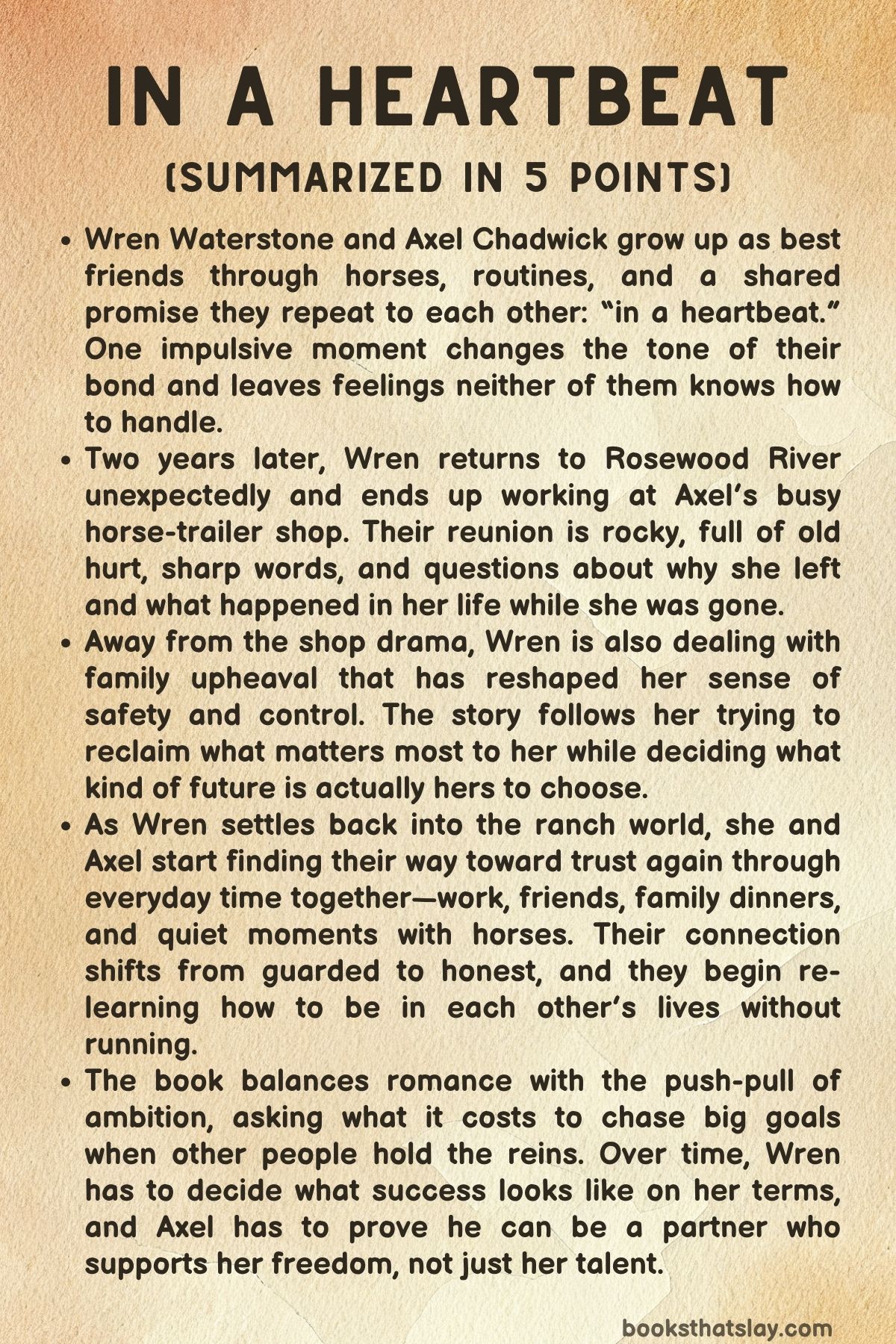
In A Heartbeat by Laura Pavlov is a contemporary small-town romance set in Rosewood River, built around lifelong friendship, horses, and the cost of other people’s expectations. Wren Waterstone is a champion equestrian whose life looks perfect from the outside, while Axel Chadwick runs his family’s custom horse trailer business and quietly carries the hurt of being left behind.
When Wren returns after two years of silence, she and Axel are forced into daily closeness that brings old trust issues to the surface. As family betrayal, public gossip, and career pressure close in, they have to decide what love and loyalty look like in real life. It’s the 5th book in the Rosewood River series.
Summary
Wren Waterstone meets Axel Chadwick at their familiar spot in a field—an old tree that has always been theirs. Wren is a teenage rider on the edge of her first eventing competition, determined to prove herself in a world where the boys still assume they belong at the top.
Axel, her best friend and riding partner, is the one person who can tease her and calm her at the same time. Their banter turns into a challenge when the topic of dating comes up.
Wren insists she is not interested, but Axel pushes, half-joking, that she is scared of kissing. Wren answers by kissing him first.
The moment surprises them both, not just because it happens, but because it feels bigger than a dare. Afterward, Axel shares a song he wrote for her, tied to their lifelong promise: whatever happens, they show up for each other “in a heartbeat.” They ride off together, fast and laughing, like nothing could ever change.
Two years later, everything has changed. Axel is running Chadwick Trailers from the ranch, and the workload is crushing him.
Staff are out, paperwork is piling up, and he’s stuck juggling problems without enough help. His cousin Bridger calls to say a temp worker is starting immediately.
Axel expects a stranger. Instead, Wren arrives in a vintage Bronco, standing in the doorway like a ghost from a life he never got over.
Axel’s shock flips quickly into anger. Wren vanished without warning two years ago, blocked his number, and cut him off as if he meant nothing.
Now she is back, claiming she didn’t know the temp job was with his company until the night before. Axel doesn’t buy that explanation, and Wren doesn’t accept his blame.
Their argument has sharp edges, with both of them talking around the real wound: the sense that they lost each other at the worst possible time. Wren admits she needs work and isn’t riding right now, which unsettles Axel even more because she was once aimed at the Olympics.
Despite his resentment, he lets her stay because the business needs help and because he can’t fully turn her away.
Wren walks into a chaotic office and starts fixing what Axel has neglected—unpaid bills, filing, missed deadlines, and the general mess that comes from stress and exhaustion. As she sorts, she discovers a locked drawer.
Inside is proof that Axel never stopped watching her life: a framed photo of them from her first competition and newspaper clippings tracking her rise, including a World Championships win and later coverage of a traumatic fall. The discovery knocks the wind out of her.
She closes the drawer and pretends she never saw it, but the message is clear—Axel has been carrying her absence, and he has been paying attention from afar. When she asks for online access to organize payments, Axel gives her the login.
His password—“HORSEGIRL1”—hits her like another reminder of the bond they used to treat as unbreakable.
Axel’s family quickly notices Wren is back. At Sunday dinner, the subject turns into speculation, jokes, and concern.
A local gossip column called “The Taylor Tea” reports that Wren’s father sold her beloved horse, Wrax, without her consent, and that Wren’s mother has filed for divorce. Axel reads it with a sick feeling that the story behind Wren’s disappearance is bigger than what he assumed.
The next day, he finds Wren in the barn with his horse Honey, and he presses her for the truth. Wren confirms it: strangers came to take Wrax away, and she didn’t even get a choice.
Worse, her coach supported the decision. Wren’s father controls her trust fund, so even if she wants to fix it, she can’t simply throw money at the problem.
Her brother, Collin, claims he is searching for Wrax, but the situation already feels rigged against her.
At home, Wren learns the divorce has a brutal reason: her father’s mistress, Chrissy, is pregnant. Wren’s mother is leaving town to stay with her sister, trying to reclaim some peace.
Wren feels abandoned from every direction, and the house no longer feels safe or stable. She starts looking for a rental, desperate to get out before her father and Chrissy take over.
Axel offers her the apartment above his garage. In exchange, she will help with the ranch animals while his ranch hand is away.
Wren takes the deal, relieved to be close to horses again and far from the tension of home.
Living on Axel’s property changes the tone between them. Wren brings warmth back into the trailer shop—cooking for the crew, adding small touches like wildflowers, and making the place feel human.
Axel keeps acting irritated, but he also starts relaxing around her in ways he can’t hide. Then Bridger delivers information that shifts everything: he knows who bought Wrax, and the buyer will sell him back for $20,000.
The twist is worse—Collin arranged the sale. That means Collin has been lying to Wren, pretending he doesn’t know where Wrax is.
Without hesitation, Axel agrees to buy the horse and organizes the transfer so Wrax can come home.
Meanwhile, Wren’s relationship with Collin fractures further. When she confronts him, he dismisses her grief and tells her to move on, implying Wrax was just a tool for her career.
The comment is cruel, and Wren realizes her family sees her life through the lens of usefulness: win, earn prestige, perform. That night, she goes out with friends—Emilia, Lulu, and Henley—trying to feel normal for once.
A man named Josh Black makes crude remarks and repeats gossip about Wren’s family, and Axel steps in to protect her. The moment isn’t romantic in a showy way; it is Axel being Axel, solid when it counts.
Wren laughs and dances with her friends, and for the first time in a long while, she feels like herself.
Soon after, Wrax arrives. Axel orchestrates a distraction so Wren won’t know until it is real.
When she walks into the barn and sees him, she breaks down completely—hugging him, sobbing into his mane as he presses close, safe and familiar. Axel gives her space, then returns quietly, watching her and realizing how deep this goes.
Wren admits he makes it hard to hate him, and the truth lands between them: they don’t want to live in anger anymore. They sit in the stall together while Wrax settles and even falls asleep with his head near Wren, as if he’s claiming her again.
Axel encourages Wren to ride, and soon they are galloping side by side like they used to, back to their tree. There, they speak more honestly.
Wren explains she blocked Axel for self-preservation, convinced she had to cut him off to survive what she believed happened. She says crossing the line into romance two years ago was a mistake, and Axel takes the hit, even though it stings.
Still, they agree to rebuild their friendship.
Wren begins spending time with Axel’s extended family and finds comfort there. The family welcomes her without conditions, watching videos of her competitions with pride and teasing Axel about how obvious his feelings are.
Axel’s niece Melody blurts out that Axel attended Wren’s world championship even when they weren’t speaking, forcing Axel to admit he showed up anyway. Wren is emotional—not because it fixes everything, but because it proves she wasn’t forgotten.
When Collin visits, things explode. Wren proudly shows him Wrax, expecting relief or joy.
Instead, Collin reacts oddly and warns her that Axel is manipulating her. At dinner with their father, Wren announces she has Wrax back and intends to compete with him again.
Her father’s response reveals the truth: he ordered Collin to sell the horse, and Collin did it while lying to Wren’s face afterward. Their father cares only about control and cost, not Wren’s bond with her horse.
Then he announces he is marrying Chrissy, who is pregnant. Wren leaves furious and shaken, walking home with a mind full of old wounds reopening.
Back at the ranch, Wren confronts Axel. Did he know Collin sold Wrax?
Axel admits he did, and he didn’t tell her because he didn’t want to add another knife twist when she was already bleeding. Wren feels betrayed anyway, and the argument finally digs up the true reason she left two years ago: Collin told her that Axel had revealed the secret of her father’s affair.
Wren also believed Axel went home with another woman, Megan Wilson, the night after she and Axel slept together. Axel denies both claims and explains what really happened—Collin was drunk and insulting, Axel defended Wren, and a fight broke out, but Axel never betrayed her and never exposed her secret.
Wren realizes Collin used lies like weapons, turning her fear and shame into distance from the one person she trusted most. Exhausted, she apologizes and retreats, wrecked by how much time they lost.
The past clarifies why the secret mattered so much. Years earlier, Wren caught her father in bed with his assistant and fled to Axel in panic.
Axel comforted her, promised to protect her, and reinforced that she was not alone. That trust was the foundation of everything.
Realizing it was sabotaged fills Wren with both rage and grief, but it also opens the door to healing. She asks Axel to ride with her back to their tree again, and this time it is about choosing each other on purpose.
As they talk late at night near the river, Wren admits she feels trapped between expectations. Her father funded her career; her coach invested in shaping her into a winner.
She feels she owes them results. Axel pushes her to consider what she owes herself.
Wren admits the happiest moments aren’t the medals—they are the simple rides, the joy of being with Wrax, teaching kids like Melody, and feeling free. The honesty breaks their restraint.
Wren asks to kiss Axel again, and they do, giving in to the desire that never fully left. Afterward, she sees a tattoo across Axel’s back: lyrics he wrote about her, tied to the nickname “Horse Girl.” The permanence of it stuns her.
Axel admits he got it after she left, because losing her wrecked him. Wren finally admits she suffered too, and they agree to stop punishing each other.
They settle into a new rhythm—friends who are no longer pretending attraction isn’t real. They ride together every morning, eat together, and spend nights sliding from laughter into kissing.
Wren starts coaching children, including Benji’s son Brenton, helping him rebuild courage after a bad experience with a horse. Axel’s family teases them, and Axel doesn’t deny what Wren means to him.
When Wren tries to repay Axel for buying Wrax or insists on paying rent, Axel refuses. He doesn’t want money between them; he wants time, closeness, and truth.
When Wren tells him she loves him, they stop holding back and sleep together fully, making a promise: no matter what happens, they protect their friendship and never lose each other again.
Local gossip escalates, and “The Taylor Tea” hints that Wren and Axel are back together while Wren’s family situation remains messy. Wren, angry and impulsive, joins her friends on a tipsy mission to find out who writes the gossip column.
They break into the newspaper office wearing makeshift masks, trigger an alarm, and escape with scratches and laughter, later realizing their lead was wrong. The adventure becomes a bonding moment—proof that Wren is laughing again, surrounded by people who care about her as a person, not a trophy.
Wren returns to competition with Wrax in a three-day event and performs strongly through dressage, cross-country, and show jumping. The success means more than a win; it proves she can still do this after the fall that once shook her confidence.
Axel supports her, but the controlling side of her coach becomes more obvious, especially when he frames Axel’s presence as a distraction instead of recognizing that Wren thrives with support. The distance returns when Wren travels for another major competition in New York, and Axel stays behind for a family wedding.
On FaceTime, Wren looks pale and exhausted, and Axel worries something is wrong.
In New York, Wren realizes she is ill and also late on her period. A friend quietly gives her a pregnancy test.
At the same time, Collin arrives unexpectedly and, in a rare shift, speaks more honestly about their father’s pressure and how Wren has been treated like proof of his success. Their father, meeting Wren with Chrissy, emphasizes that the trip is only worthwhile if Wren wins.
The pressure makes Wren nauseated and angry, and she retreats to her room to take the pregnancy test. The result shakes her, even as a doctor arrives to check her for illness concerns spreading around the event.
Wren feels the ground shifting under her, as if life is asking her to choose a direction immediately.
Axel, uneasy and unable to sit still, flies to New York without warning. He arrives in time to watch Wren ride brilliantly, and when she spots him, the relief on her face confirms he made the right call.
In the final phase, storms turn conditions dangerous and muddy. Riders struggle.
Wren focuses, rides clean, and wins the competition. The victory is huge, but it doesn’t feel like the old version of success.
It feels like closure.
Afterward, Axel finds the pregnancy test box in her bag. Wren tells him she isn’t pregnant, but the scare forces clarity.
She doesn’t want a life built around pressure, control, and proving herself to people who treat her like property. She decides to retire from elite competition and return home, choosing a life with Axel that centers on horses, community, and stability.
Back in Rosewood River, they build something that belongs to them: the WRAX Riding School. Wren’s mother returns to town and starts fresh.
Wren settles into a routine that brings peace instead of anxiety. Finally, under their tree—the place where everything started—Axel proposes, and Wren says yes, keeping the promise they made long ago: they choose each other, in a heartbeat.
Characters
Wren Waterstone
Wren Waterstone is the emotional and narrative center of In A Heartbeat—a gifted equestrian whose identity has been built around excellence, control, and proving herself in a sport where she’s determined not to be dismissed by men. At the beginning, she presents as fiercely self-contained: she avoids dating, rejects vulnerability, and treats ambition like armor, yet her impulsive kiss with Axel reveals how much intensity she keeps buried.
Her two-year disappearance isn’t just a plot turn; it shows her default survival strategy—cutting off pain by cutting off people—especially when she believes she’s been betrayed. When she returns, she’s no longer riding, which signals how deeply the loss of Wrax, the family collapse, and her sense of agency being stolen have fractured her.
Wren’s arc is ultimately about reclaiming choice: separating what she truly wants from what she has been trained, funded, and pressured to want. Her growth is visible in small, grounding shifts—teaching kids, finding joy in routine, letting herself be cared for—until she can finally rewrite her definition of success into something sustainable, intimate, and hers.
Axel Chadwick
Axel Chadwick is both Wren’s safest place and the person most capable of hurting her, which makes him the perfect counterpart. He reads as steady and capable—running a demanding business, anchoring a tight family network, and handling responsibilities without fanfare—but under that competence is a deep emotional fidelity that borders on stubborn devotion.
Axel’s anger at Wren’s disappearance is real, yet it masks grief and confusion; he doesn’t just miss her romantically, he misses his person, his history, his “in a heartbeat” partner. His love expresses itself through action: tracking her career, keeping mementos, buying Wrax back, creating space for her to heal, and refusing to use money as leverage the way her father does.
At the same time, Axel isn’t perfect—his decision to hide the truth about Collin’s role in selling Wrax shows his protective instincts can slip into paternalism, echoing the control Wren is trying to escape. His arc is about learning that love isn’t only providing and shielding; it’s also trusting Wren with reality, letting her make informed choices, and staying present even when the outcome might hurt him.
Wrax
Wrax is not simply a horse; he is the most tangible symbol of Wren’s autonomy, joy, and identity. He represents the version of her that felt free—earning success through partnership and trust rather than pressure—and his sale without her consent becomes a violation that reverberates through every part of her life.
The intensity of Wren’s reunion with him shows that her grief wasn’t only about losing an animal; it was about losing the one relationship in her world that was uncomplicated by manipulation, status, or expectations. Wrax’s return marks a turning point because it restores more than a teammate—it restores Wren’s ability to imagine a future again.
Even later, when Wren competes and proves she still belongs, Wrax remains the reminder that winning matters only if it doesn’t cost her spirit.
Honey
Honey functions as a quiet mirror to the central bond in In A Heartbeat—steady, affectionate, and rooted in Axel’s world. When Wren is found with Honey early on, it signals how instinctively she still gravitates toward the life she once shared with Axel, even while pretending she’s only there for work.
Honey also helps reintroduce Wren to horses in a lower-stakes, emotionally safe way, contrasting the high-pressure, performance-only mentality she associates with elite competition. In the story’s emotional language, Honey is part of Axel’s “home,” and Wren’s comfort around her foreshadows Wren choosing a life defined by daily belonging rather than distant achievement.
Collin Waterstone
Collin is one of the most complicated figures because he embodies both sibling familiarity and betrayal. For much of the story, he occupies the role of supposed helper—claiming he’s searching for Wrax, positioning himself as the protective brother, and later showing up to buffer Wren from their father and Chrissy.
But his earlier choices reveal a willingness to sacrifice Wren’s emotional wellbeing for convenience, approval, or alignment with their father’s agenda. The revelation that he arranged the sale of Wrax—and lied about it—frames him as someone who believes ends justify means, even when the “end” is simply maintaining family power dynamics.
His later shift, where he more openly calls out their father and encourages Wren to choose happiness, reads less like a full redemption and more like a late awakening: Collin begins to see how destructive the system is, but he’s already done damage that Wren cannot un-feel. He functions as a cautionary character about how loyalty can become complicity when it’s tied to control.
Charles Waterstone
Charles is the primary engine of coercion, representing the brand of parental love that is conditional, image-driven, and transactional. He funds Wren’s career, but the funding is never neutral; it becomes a leash used to shape her choices, especially through control of her trust and constant pressure to win.
His decision to sell Wrax without Wren’s consent reveals how he views her life as an asset portfolio—horses, competitions, and even relationships are evaluated for return on investment. His affair, pregnancy with Chrissy, and the resulting family collapse deepen his characterization: he isn’t simply a stern parent; he is someone who prioritizes appetite and optics over stability, then expects others to absorb the consequences.
Importantly, his dynamic with Axel highlights two competing models of masculinity and power—Charles controls through money and expectation, while Axel advocates for Wren’s autonomy. Even when Charles “backs off” later, it reads as reluctant and strategic rather than truly transformed, reinforcing that Wren’s peace will always require boundaries against him.
Chrissy
Chrissy is a disruptive presence not because she’s written as a direct villain, but because what she represents is inseparable from the betrayal Wren feels inside her own home. Chrissy’s pregnancy makes the affair impossible to ignore and accelerates the divorce, forcing Wren to confront the reality that her family identity was built on denial and appearances.
Her interactions are framed through Wren’s experience of displacement—Chrissy moving into the house is not just a change in address, it’s a symbolic eviction of Wren’s childhood normal. Chrissy also functions as a stress-test character: scenes involving her expose how Charles behaves when he has an audience and a narrative to sell, and they highlight Collin’s shifting role as he tries to “manage” the fallout.
Whether Chrissy is personally malicious matters less than the fact that her presence crystallizes the end of Wren’s old life.
Wren’s Mother
Wren’s mother (unnamed in the summary) embodies exhaustion finally turning into self-preservation. Her decision to leave, stay with her sister, and pursue a new start is both relieving and wounding for Wren: it removes one source of immediate household tension, but it also reinforces Wren’s sense of being abandoned when she’s already reeling.
What makes the mother significant is that she offers Wren an alternative model of choice—walking away from a damaging dynamic rather than tolerating it for appearances. Her later plans to return to Rosewood River and build a barn signal a shift from passive endurance to active rebuilding, aligning with Wren’s own movement toward a life defined by safety, community, and daily joy.
Coach Sharky
Coach Sharky is one of the most psychologically important supporting characters because he represents the seductive trap of high performance: the idea that relentless pressure is the same as care. He has invested years in Wren, and that investment comes with expectations—gratitude, obedience, and prioritizing winning above comfort or health.
His controlling tendencies emerge in how he frames other people as distractions, polices Wren’s social circle, and reinforces that her value is tied to outcomes. Even when he appears protective—warning her about competitors getting “inside her head”—the protection has a cost: it isolates her and keeps her dependent on his authority.
Axel’s discomfort around Sharky helps the story clarify what’s at stake; Wren isn’t just choosing between romance and sport, she’s choosing between two systems of identity—one built on performance surveillance and one built on partnership and choice.
Bridger Chadwick
Bridger acts as an effective catalyst, serving the practical role of connector and information source, but also reflecting the Chadwick family’s broader ethic of stepping in when someone is hurting. His involvement in locating Wrax and facilitating the purchase underscores how Axel’s community operates: people rally, problem-solve, and protect without demanding emotional payment.
Bridger’s presence also highlights how alone Wren has been inside her own family—where information is withheld as a control tactic—by contrast to the Chadwicks, where information is used to help.
Archer Chadwick
Archer contributes to the “home” texture of the storyline by showing Axel not only as a romantic lead but as part of a functioning, affectionate family ecosystem. His casual drop-ins and his role as Melody’s father ground Axel’s character in caregiving and reliability, reinforcing that Axel’s stability isn’t performative; it’s habitual.
Archer’s presence also subtly pressures Axel in a positive way—he’s surrounded by family life, which makes Axel’s longing for a future with Wren feel less abstract and more attainable.
Melody Chadwick
Melody is a bright emotional lever, functioning as both innocence and truth-teller. Her unfiltered comment about Axel attending Wren’s world championship forces honesty into a space where both leads have been hiding behind anger and pride.
She also gives Wren a new, healthier relationship to horses—teaching a child who is excited, not demanding—helping Wren reconnect with riding as joy rather than obligation. Melody’s role makes the romance feel embedded in community and future-building rather than sealed inside private passion.
Butch
Butch serves a practical narrative function —his absence creates the need for help, which opens the door for Wren to move into Axel’s apartment and become integrated into his daily life. Even without heavy characterization, Butch represents the ranch’s operational backbone and highlights how Axel’s world runs on dependable labor and routine.
His temporary absence becomes the mechanism that transforms Wren and Axel’s proximity from accidental to intimate.
Brenner
Brenner’s role in handling the logistics of Wrax’s transfer reinforces a key theme: Axel’s love expresses itself through competence and follow-through. Brenner is part of the supportive infrastructure around Axel, someone who can execute difficult tasks quietly and efficiently.
Narratively, he helps keep the focus on Wren’s emotional reunion with Wrax rather than the transactional details of how the horse physically returns.
Benji
Benji helps illustrate the male friendship culture surrounding Axel—protective, teasing, loyal, and quick to rally. His presence becomes especially meaningful through his connection to Brenton: Wren coaching Benji’s son gives Wren a role where her expertise heals rather than proves.
Benji also participates in the group’s gentle conspiratorial support, showing that Axel is not alone in caring for Wren; his community is invested in her wellbeing too.
Jonah
Jonah functions as part of Axel’s inner circle, reinforcing the theme that chosen family can be steady even when biological family is chaotic. Alongside Benji and Coby, he contributes to the lightness and camaraderie that counterbalances the heavier family drama.
Their dynamic also underscores how much Axel has held his feelings for Wren privately; the friends know enough to help without demanding explanations.
Coby
Coby complements the friend-group texture by adding to the collective “witness” role: these men see Axel’s devotion, see Wren’s pain, and respond with loyalty rather than gossip. Their humor and confusion about Wrax’s name provides a moment of levity that also shows how intimately Wren’s loss has occupied Axel’s world—enough that the entire group becomes part of the plan to bring the horse back.
Emilia
Emilia anchors Wren’s peer support system, representing friendship that isn’t tied to performance, family status, or romantic tension. Her presence at book club and during the chaotic “outlaws” escapade shows Wren regaining access to laughter and impulsive joy—things she lost while trapped in family turmoil and elite pressure.
Emilia also helps the story emphasize that Wren is building a life with multiple pillars; Axel is central, but not the only source of connection.
Lulu
Lulu is part of the friend-group energy in that reintroduces Wren to communal playfulness. The book club scenes show Lulu as someone who participates fully—drinking, scheming, laughing—and therefore models the idea that adulthood can still hold messy fun without punishment.
Functionally, Lulu helps pull Wren out of isolation and reminds the reader that Wren’s healing includes friendship, not only romance.
Henley
Henley contributes to the bold, chaotic solidarity of Wren’s friend circle. Her willingness to join a ridiculous, risky plan to unmask “The Taylor Tea” columnist reflects how deeply the women reject being controlled by public narrative.
Henley helps turn gossip—something that could have shamed Wren—into something the friends confront with humor and agency, reframing humiliation into teamwork.
Eloise
Eloise adds to the sense that Wren’s female friendships are active and protective rather than passive. By participating in the investigation and the group’s nights out, she reinforces that Wren is surrounded by people who want her to feel seen and defended, which contrasts sharply with the way Charles and Sharky attempt to manage Wren through pressure and image.
Clark
Clark’s role as the hockey-playing cousin functions as social glue: his game provides a public setting where Wren reenters town life, and it also creates the circumstance for Axel to step in when Josh Black targets her. Clark’s presence expands the Chadwick family network beyond the ranch and dinner table, reinforcing how interwoven Axel is with the community Wren is slowly choosing.
Josh Black
Josh Black operates as a small but sharp symbol of public cruelty —the kind of person who weaponizes gossip, entitlement, and sexualized disrespect. His crude remarks and fascination with Wren’s family turmoil show how quickly a woman’s pain can become entertainment in a small town.
Axel’s intervention matters not because Wren can’t handle Josh—she clearly can—but because it signals that Wren no longer has to stand alone against that kind of ugliness.
Megan Wilson
Megan Wilson exists primarily as a rumor-shaped character: a name used to create a believable betrayal narrative that keeps Wren away from Axel. Even if her actual actions are minimal, her function is powerful—she represents how easily a woman can become a prop in someone else’s manipulation.
The point is less Megan herself and more how Collin uses the idea of Megan to fracture trust and rewrite a night into a weapon.
Sabrina
Sabrina appears as the embodiment of Wren’s earliest betrayal wound—the moment she discovers her father’s infidelity with an assistant and loses innocence about the stability of her family. Her role is brief but foundational: it explains why secrecy matters so much to Wren and why the claim that Axel “exposed” that secret would feel unforgivable.
Sabrina’s presence in the backstory helps the story frame Wren’s later reactions not as overdramatic, but as trauma-consistent.
Jillian
Jillian is an important transitional figure because she represents a healthier competitive environment—friendly, supportive, and human. By offering dinner invitations and quietly helping Wren access a pregnancy test, Jillian behaves like someone who treats Wren as a person rather than a prize.
In contrast to Sharky’s control tactics, Jillian’s casual kindness reinforces that ambition doesn’t have to come with isolation, paranoia, or emotional restriction.
Jacques Louise
Jacques Louise functions as an elite-level benchmark, a competitor whose placement establishes the stakes of the final phases and gives Wren’s win tangible weight. As a figure just ahead of Wren going into the last day, Jacques helps translate Wren’s internal struggle into external suspense—Wren isn’t only fighting mud and nerves, she’s proving that her excellence is still real even as her life priorities shift.
Cutler “Beefcake”
Cutler adds warmth, comedy, and accidental honesty by voicing what adults are too cautious to say directly. His immediate labeling of Wren as “Uncle A’s girl” and his marriage talk aren’t just jokes; they highlight how visible Axel’s feelings are to those who know him.
Cutler also represents the family future that Axel is already emotionally prepared for—one where Wren is integrated, claimed, and loved out loud.
Emerson
Emerson works alongside Cutler to broaden the sense of family crowding in—more voices, more teasing, more witnessing. Even without deep individual focus, Emerson’s presence contributes to the feeling that Axel and Wren’s relationship isn’t happening in a vacuum.
Their bond is observed, welcomed, and folded into a community that expects commitment and continuity.
Al
Al’s role as the man who delivers Wrax is logistical, but the emotional impact of his arrival is enormous because he is the door through which Wren’s reclaimed self returns. He enables one of the most cathartic scenes in the story without needing to be emotionally central.
In a romance narrative, characters like Al matter because they facilitate the “miracle” moments through ordinary work, making the world feel lived-in and real.
Jazzy Leighton
Jazzy Leighton becomes a red-herring pivot, the name that seems to promise answers about who is behind the gossip column but instead leads to a dead end. Her function is to keep the mystery alive while giving the friend group a mission that channels their frustration into action.
Jazzy’s involvement also highlights a theme: public narrative is slippery, and chasing it can be both empowering and absurd.
Brenton
Brenton, Benji’s son, serves a subtle but meaningful purpose by showing Wren in a healing role. Helping him rebuild confidence after a bad horse experience reflects Wren’s own journey—learning to trust again, learning that fear doesn’t mean failure, and learning that progress can be gentle.
Through Brenton, Wren’s expertise becomes nurturing rather than performative, reinforcing her shift toward community-centered riding and away from validation-chasing competition.
Themes
Trust, Betrayal, and the Cost of Withholding the Truth
Wren’s return to Rosewood River happens with a bruise already in place: two years of silence that neither of them fully understands at first, but both feel in their bodies as anger, defensiveness, and a constant readiness to be hurt again. What makes the rupture so painful isn’t only that she left, but that the leaving was shaped by information that was incomplete, distorted, and weaponized.
Collin’s lie about Axel exposing the father’s affair and abandoning Wren for another woman isn’t just a plot complication; it shows how trust can be redirected like a rein, pulling someone away from the person they’d normally run toward. Wren’s decision to block Axel reads as self-protection, but it is also a grief response—an attempt to stop hoping.
Axel’s reaction, meanwhile, is the kind of fury that comes from being denied the chance to explain, to repair, to even be witnessed in his own loyalty.
The book keeps returning to a specific moral knot: is it better to reveal a truth that will devastate someone, or to hide it “for their own good” and risk repeating the original betrayal in a new form? Axel buys Wrax back and hides Collin’s role in the sale, believing that shielding Wren from another family wound will help her heal.
Yet the concealment becomes its own breach, because it recreates the exact pattern Wren is trying to escape—other people deciding what she can handle, controlling the flow of information, editing her reality. When Wren learns the truth, the hurt is doubled: she’s angry at Collin, but also at Axel for stepping into the same controlling posture her father uses, even if the intention is loving.
Repair only starts when both characters stop arguing about who is “more wrong” and finally name the emotional facts: Wren missed him, Axel never stopped caring, and both were manipulated by someone who benefited from keeping them apart. Trust is rebuilt not through grand declarations, but through repeated, ordinary acts of transparency—showing up, staying, answering hard questions, and letting the other person be angry without disappearing.
Autonomy Versus Control in Family, Money, and Ambition
Wren’s talent gives her prestige, but it also makes her a contested asset. Her father’s control over her trust fund and career funding turns money into a leash that tightens whenever she resists.
The sale of Wrax without her consent is the clearest symbol of that dynamic: she isn’t treated as the owner of her own partnership with the horse, but as someone whose most important relationships can be negotiated by other people for strategy and optics. Even her coach’s complicity reinforces the message that her desires are secondary to an outcome—medals, rankings, and the narrative of an Olympic path.
The pressure is rarely framed as cruelty in the moment; it arrives as “what’s best,” “what makes sense,” “what you owe,” which is exactly how control often succeeds. It doesn’t need to shout when it can sound reasonable.
Against that backdrop, Rosewood River becomes a proving ground for a different kind of adulthood. Wren begins to make choices that are small but radical for someone used to being directed: taking a temp job, choosing where to live, deciding how much she wants to ride, and admitting she’s happier when the sport is about joy rather than performance.
The conflict with her father at the steakhouse exposes how he measures her life—wins justify the expense, and anything else is “wasted potential.” His fixation on cost and optics reduces her to a return on investment, while her anger shows she is finally refusing that ledger. Autonomy in this story is not a single dramatic break; it’s a slow reclaiming of authority over her body, her time, her goals, and her attachments.
Even when she returns to competition, it’s no longer because she is being pushed forward like a product; it’s because she wants to test what the sport means to her now.
The later pregnancy scare intensifies this theme because it forces Wren to confront how quickly her life can change, and how fragile “the plan” really is. In that moment, ambition stops being an abstract ladder and becomes a question of daily life: what kind of home does she want, what kind of partnership, what kind of peace.
Her final decision to step away from elite competition isn’t framed as failure; it’s framed as refusing a system that only values her when she is winning. Building the riding school with Axel is a redefinition of success—control returns to her hands, and the future is built around values she chose rather than expectations she inherited.
Healing After Trauma and Reconnecting With the Body
Wren’s relationship with riding is complicated by trauma that isn’t only physical. The public record celebrates her wins, but the private record includes the fall that changed what the sport feels like from the inside.
The fact that she returns home not riding at all signals a deeper injury than a bruised confidence; it suggests dissociation from the thing that once made her feel most alive. The horse Wrax is not merely a beloved animal in In A Heartbeat; he is the living archive of her pre-trauma self—the version of Wren who trusted her instincts, who believed in her partnership, who could imagine a future without flinching.
Losing him through her father’s decision is therefore not just losing property; it’s losing the safest bridge back to herself.
The moment Wrax returns is written as a release that words can’t manage. Wren sobs into his mane, and the horse responds with familiarity and presence, as if her body finally believes what her mind hasn’t dared to: something good can come back.
The stall scene, with Wrax asleep on her lap, communicates a kind of nervous-system repair. It is quiet intimacy, nonverbal reassurance, and a reminder that safety can be physical—warmth, weight, breath, routine.
That matters because Wren’s trauma isn’t healed by pep talks; it is healed by repeated experiences of being safe while feeling intensely. Riding again alongside Axel, returning to their tree, and conditioning in the mornings all function as exposure therapy shaped by love rather than pressure.
The sport becomes hers again because it happens in a context that doesn’t demand perfection.
This theme also extends into romantic intimacy. The story depicts desire not as a distraction from healing, but as one of its expressions—Wren’s body returning to appetite, sensation, and choice.
At the same time, her intense reactions—crying after orgasm, feeling overwhelmed—suggest that pleasure is touching buried grief and relief at once. Axel’s steadiness matters here: he doesn’t treat her body as something to conquer, and he consistently checks whether she is okay, whether she wants more, whether she is safe.
That kind of care contrasts sharply with the control in her professional life. When Wren later competes successfully again, especially in cross-country conditions that echo past fear, the victory is not only about scoring.
It is proof that she can re-enter the arena without surrendering herself. Healing becomes visible as restored agency: she rides because she chooses to, she stops when she chooses to, and her body is no longer a tool used by other people’s ambitions.
Love Growing From Friendship and the Risk of Wanting More
The emotional foundation between Wren and Axel is built long before romance. Their pact—“In a heartbeat”—and their rituals, like meeting at the tree and racing horses, create a shared language that belongs only to them.
That intimacy is why the first kiss as teenagers is so destabilizing: it isn’t a flirtation between strangers; it is a sudden shift in a bond that already carries history, loyalty, and deep familiarity. When Wren disappears two years later, the loss feels like more than a breakup, because their connection never fit neatly into “dating” in the first place.
The story keeps emphasizing that the real terror is not heartbreak alone, but losing the person who has been your home base since childhood.
When they reunite, their hostility is almost protective. Anger gives them something to hold that isn’t longing, and sarcasm lets them speak without admitting tenderness.
Yet the book repeatedly shows that their closeness is reflexive: they know each other’s moods, habits, soft spots, and tells. Axel keeping clippings of her achievements and using a password that references her isn’t a romantic gesture designed to impress; it’s evidence that he never emotionally relocated.
He might have kept living, working, joking with family, but some part of him remained fixed on her orbit. Wren’s internal admissions—missing him, wanting to hate him but failing—show the same fixation.
The “friends with benefits” arrangement is significant because it highlights fear of permanence. Wren proposes it as a way to have Axel without the pressure of forever, which reflects how much instability she has lived with: her family imploding, her career identity wobbling, and her trust in people fractured.
Keeping the relationship undefined becomes a way to feel pleasure without risking another abandonment. Axel’s restraint—waiting, not pushing—reveals his own fear: he wants her fully, but he believes that demanding more could send her running again.
Their relationship progresses when both recognize that “less” is not safer; it’s just smaller. Confessing love becomes less about romance and more about clarity: they stop pretending it’s casual because pretending is another form of distance.
The proposal under the tree completes this arc by returning to the place where their bond began, suggesting that the romance didn’t replace the friendship; it grew from it, and it still depends on protecting that original promise not to lose each other.
Community, Belonging, and the Power of Chosen Family
Rosewood River operates as more than a setting; it acts like a social net that catches Wren when her biological family is in freefall. Axel’s extended family welcomes her into Sunday dinners, laughs with her, celebrates her achievements, and speaks about her without suspicion.
That acceptance matters because Wren’s home life is defined by secrets, power plays, and conditional support. In Axel’s world, affection is loud and normal—kids blurt out truths, adults tease, cousins show up, and loyalty is practiced publicly.
The warmth is not perfect or polished, but that’s why it heals. It tells Wren that she doesn’t have to earn a place by winning.
The women’s friendships reinforce this theme through humor and solidarity. Book club nights, dancing, and the absurd “outlaws” break-in create moments where Wren is not an athlete under evaluation or a daughter under scrutiny.
She is simply a person among friends, laughing hard enough to forget she’s been bracing herself for months. Even the gossip column, though invasive, highlights the town’s tight social fabric—news travels fast, reputations are communal, and privacy is limited.
Yet the narrative shows that community is not only surveillance; it is also protection. When Josh Black approaches with crude remarks, Axel intervenes immediately, but the deeper protection is that Wren isn’t alone anymore.
There are people who will stand beside her, distract her, feed her, tease her, and show up at competitions.
This theme reaches its most meaningful point when Wren shifts from being supported to becoming a source of support. Coaching kids, helping Brenton rebuild confidence, and agreeing to teach Melody to ride allow her to transform what she has learned into care for others.
It turns her skill into community service rather than personal branding. The riding school at the end is the natural extension of that: a home base where horses, learning, and belonging come together.
Even Wren’s mother moving back and planning property signals that family can be rebuilt on healthier terms when control is removed and mutual respect takes its place. The story suggests that belonging is not guaranteed by blood, money, or titles; it is created through consistent presence, shared work, and people who choose you without turning you into a project.
Identity Beyond Achievement and Redefining Success
Wren has been shaped by the idea that she is her results. Her world championship win proves her value to outsiders, but it also increases the pressure to keep proving it, making her identity increasingly fragile.
When she stops riding after the fall and the two-year absence, the silence around her career exposes a frightening gap: if she isn’t competing, who is she allowed to be? That question follows her into every interaction with her father and coach, who speak as if the only meaningful future is the one where she continues climbing.
Their language treats retirement or slowing down as waste, as if joy and stability are indulgences reserved for people without talent.
Axel consistently counters that worldview by focusing on what makes Wren herself, not what makes her marketable. He cares about her happiness with Wrax, her peace in daily routines, and her ability to choose.
That doesn’t mean he dismisses her talent; he shows up for competitions, celebrates her wins, and believes in her. But he doesn’t treat performance as the price of love.
That difference gives Wren room to imagine a life where riding is still central without being brutal. When she returns to competition and wins again, the win matters because it answers a personal question—can she still do this on her terms?—not because it satisfies an external demand.
The New York arc intensifies the theme by surrounding Wren with old pressures: major events, her father’s presence, a coach who tightens control when stakes rise, and the feeling that her body is being monitored and judged. The pregnancy scare functions like a spotlight: it forces her to confront how much of her life has been organized around winning rather than living.
When she chooses to retire from elite competition after winning, the choice is especially meaningful because it rejects the notion that you leave only when you fail. She leaves at the top because she is finally prioritizing a stable, chosen life over endless escalation.
Creating the riding school is her new definition of success: teaching, community, sustainable joy, and partnership. In A Heartbeat presents fulfillment as something built in daily choices—work that matters, love that stays, and a life where achievement is a chapter, not a cage.