Ironwood Summary, Characters and Themes
Ironwood by Michael Connelly is a crime thriller that combines a targeted police assassination, a serial-killer investigation, and corruption within law enforcement.
Sergeant Stilwell, a skilled detective reassigned to Catalina Island after challenging powerful colleagues, becomes involved in two dangerous cases after a nighttime drug interception ends in bloodshed. His discovery of a missing woman’s backpack also connects him with LAPD detective Renée Ballard and a pattern of murdered hikers. As both investigations develop, Stilwell must depend on careful observation, local knowledge, and personal courage while determining which officers can still be trusted. It’s the second Catalina Island novel featuring Detective Sergeant Stilwell.
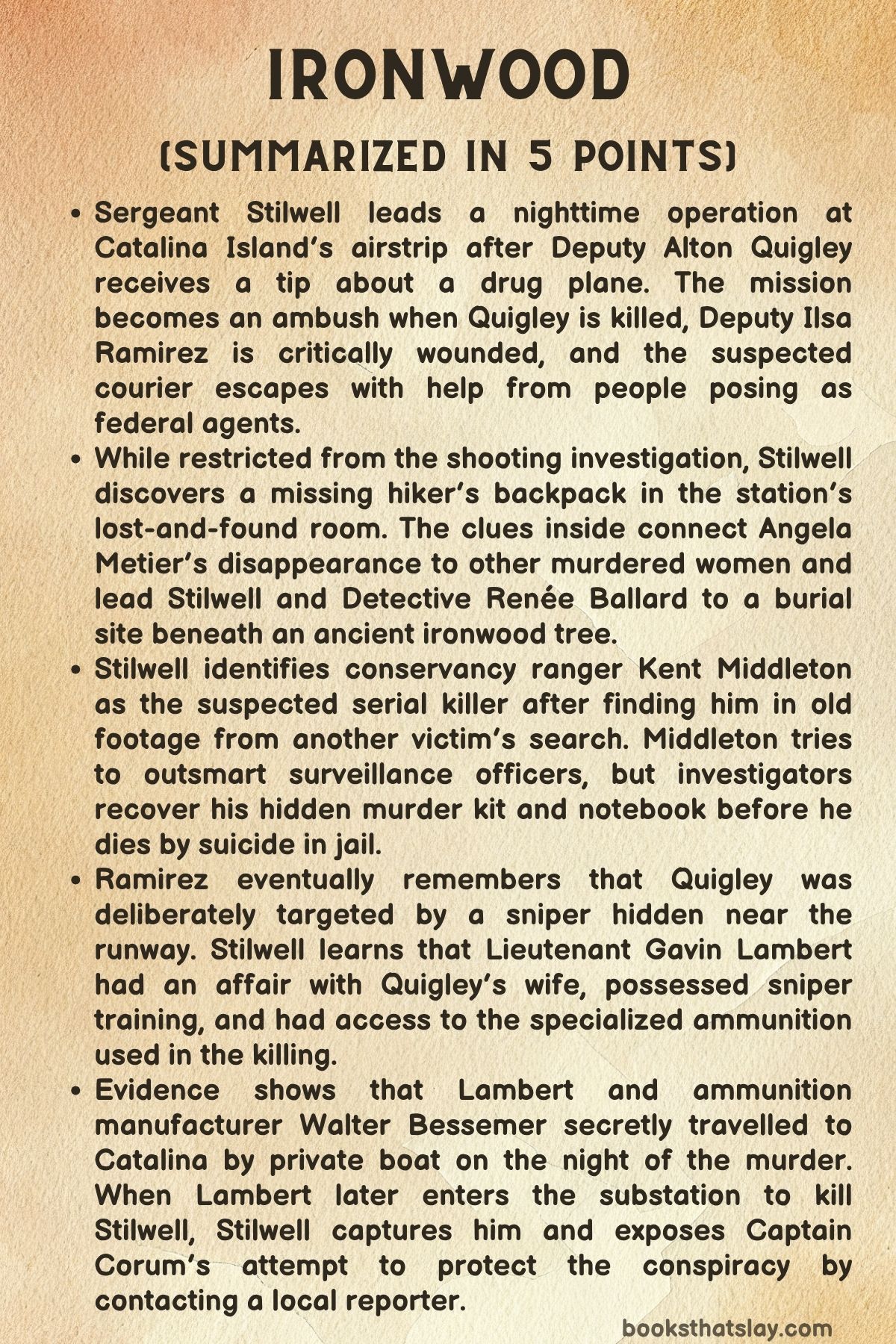
Summary
Sergeant Stilwell leads a late-night surveillance operation at Catalina Island’s remote airstrip after Deputy Alton Quigley receives information about a drug shipment arriving by plane from Mexico. Stilwell separates from Quigley and Deputy Ilsa Ramirez so that they can observe the landing from different positions.
A plane approaches without lights while an ATV driver wearing a black helmet guides it toward the runway. An orange duffel bag is dropped, but when Stilwell orders his deputies to block the aircraft, the ATV driver abandons the bag and escapes down the mountainside.
Stilwell follows through dangerous terrain until the ATV crashes and its driver disappears into the brush. When Stilwell returns to the runway, the plane has taken off, Quigley is dead, and Ramirez is lying badly wounded on the tarmac.
A Coast Guard helicopter arrives and carries Ramirez to a mainland hospital. Stilwell remains beside Quigley’s body, burdened by the knowledge that he was away from his deputies when the attack occurred.
Captain Corum and a homicide team take control of the investigation. Detective Ernie Simon questions Stilwell and quickly notices that several details surrounding Quigley’s confidential informant and recent transfer to Catalina do not make sense.
Quigley had claimed that he was reassigned after arresting the sheriff’s nephew, but Simon reveals that this was not the true reason he left narcotics. Corum nevertheless orders Stilwell to remain at the substation and stay out of the investigation.
Ignoring the spirit of that order, Stilwell checks the first ferry leaving Catalina and notices Gonzalo Kalas, a traveller whose dusty boots, limp, build, and heavy backpack match the fleeing ATV driver. A records search identifies Kalas as a cartel courier and possible assassin wanted by immigration authorities.
Simon helps Stilwell confront Kalas in a restaurant. When Kalas denies owning the backpack under his table, Simon searches it and discovers the black helmet worn by the ATV driver.
Kalas attacks the officers but is subdued and arrested. He refuses to cooperate during questioning, requests an attorney, and appears confident that outside assistance will soon arrive.
That confidence proves justified when two men posing as federal agents present forged transfer documents at the substation. They remove Kalas from custody before Stilwell can intervene, and the real immigration authorities later confirm that they never requested him.
While temporarily confined to administrative duties, Stilwell begins clearing the station’s lost-and-found room. Inside an expensive hiking backpack, he finds women’s clothing, camping equipment, an old Ford key, and a security key registered to Angela Metier, a woman who disappeared four years earlier while hiking on Catalina.
Harbour surveillance footage shows that a masked man deliberately left the backpack on a public bench where it would be discovered. The careful placement suggests that the person connected to Angela’s disappearance wanted police to reopen the case.
LAPD detective Renée Ballard explains that Angela may belong to a group of missing women who shared similar characteristics. They were independent, athletic hikers who travelled alone and vanished near isolated trails.
One confirmed victim, Candace Neary, had been strangled and buried beneath a tree in Griffith Park. The Ford key in Angela’s backpack may have belonged to Candace’s Mustang, creating a physical connection between two cases previously treated as unrelated.
Stilwell also studies a jagged line drawn on the back of Angela’s backpack. With help from his partner, Tash Dano, he realizes that the line matches Black Jack Road, which leads to an ancient grove of Catalina ironwood trees.
Ballard travels to Catalina with a search team. A cadaver dog alerts beneath one of the trees, and investigators uncover human remains that are later identified as Angela.
The discovery confirms that Angela was murdered and buried on the island. It also shows that her killer deliberately created a map directing police to the grave, suggesting that he now wants attention and believes he is more intelligent than those hunting him.
At Quigley’s funeral, his former narcotics commander, Lieutenant Gavin Lambert, delivers an emotional eulogy. Simon privately confirms that Kalas was removed with forged papers and that nobody can identify the informant who lured Quigley to the airstrip.
Ballard tells Stilwell to reconsider the serial-killer evidence from an entirely different perspective. Following that advice, he reviews old news footage from the search for Candace Neary.
The footage shows volunteers walking close to the tree where Candace was buried. Stilwell also recognizes a ranger participating in the search as Kent Middleton, the same conservancy employee who helped secure Angela’s grave site on Catalina.
Middleton previously worked in Griffith Park before transferring to Catalina. His career places him near multiple victims, gives him knowledge of wilderness searches, and allows him to observe investigators without appearing suspicious.
Stilwell creates an innocent reason to interview Middleton while investigating vandalism at Oliver Marquez’s vineyard. That separate case leads Stilwell to discover that Marquez paid his grandson to destroy valuable vines so that he could submit an insurance claim.
Rather than prosecute the teenager immediately, Stilwell confronts Marquez and forces him to abandon the plan. His handling of the case shows his willingness to distinguish between legal punishment and the outcome most likely to protect a young person from further corruption.
Meanwhile, Middleton casually reveals that he hopes to obtain a ranger position in Malibu, where another suspected victim disappeared. Ballard, Stilwell, volunteer investigator Tom Laffont, and former prosecutor Paul Masser establish surveillance near his Catalina apartment.
The airstrip investigation also changes direction. Ramirez regains consciousness and remembers that the shooter was hidden in the woods, called Quigley by name, and fired from behind the deputies.
Stilwell searches the area and discovers a prepared sniper position inside an ironwood tree. Cut branches created a firing lane directly toward the place where Quigley had stood, proving that the drug operation was designed to lure him into an ambush.
Ramirez also reveals that she and Quigley had begun a private relationship. Quigley was already divorcing his wife, Adriana, and claimed that she had been involved with another man.
Quigley’s divorce attorney indirectly identifies Lambert as Adriana’s lover. Lambert therefore had a personal motive to prevent Quigley from revealing the affair, although Stilwell suspects that the threatened divorce may also have exposed criminal activity inside the narcotics unit.
Before Stilwell can pursue Lambert fully, Middleton begins stalking hiking guide Molly Young through false online identities. He books two places on a private hike, apparently planning for the second client not to appear so that Molly will be forced to accompany him alone.
Ballard and a tactical surveillance team watch the meeting at Switzer Falls. When Middleton reaches into his backpack, officers move in, but they find only ordinary hiking equipment.
Middleton smiles after his arrest, making it clear that he expected police intervention. Stilwell reasons that Middleton originally carried an abduction kit but hid it after recognizing the surveillance team during the ferry journey from Catalina.
Investigators search a state building where Middleton attended a job interview. They initially find nothing until Stilwell realizes that Middleton rode alone in an elevator and could have concealed evidence above its ceiling panel.
The hidden cache contains restraints, tape, a hood, handcuffs, a knife, a garrote, a folding shovel, and a notebook filled with maps and victim information. When Ballard confronts Middleton with the evidence, his confident expression disappears.
Middleton attacks across the interview table before demanding a lawyer. The evidence appears sufficient to connect him with several murders, but he kills himself in jail before he can be tried or forced to identify every victim.
Stilwell then concentrates entirely on Quigley’s murder. Research reveals that Lambert attended Marine scout-sniper training, fought in Fallujah, and later worked for the private military company Blackwater.
A fragment recovered from Quigley’s skull came from specialized frangible ammunition manufactured by MIPCO Ammo. The company’s founder, Walter Bessemer, served with Lambert and appears to know him personally.
Stilwell also learns that Bessemer owns a high-speed boat called the Bullet. Marina surveillance confirms that the vessel travelled to Catalina on the night of the airstrip ambush and returned several hours later with a long case that could have contained a sniper rifle.
The official homicide investigation is quietly dismantled. Simon abruptly retires, his partner Bob Trestle leaves on a cruise, and Corum orders that all questions be directed through him.
Stilwell realizes that his inquiries have exposed him. Marina surveillance soon shows Lambert and Bessemer leaving in the Bullet and heading toward Catalina, probably to kill him before he can reveal their connection.
Stilwell sends Tash to safety and prepares the substation as a trap. Lambert enters with a gun, believing Stilwell is alone in his office, but Stilwell approaches through the jail corridor and captures him from behind.
Lambert carries burner phones, a knife, and a small gun that could have been used to stage Stilwell’s death as a suicide. Bessemer is located aboard the Bullet and targeted for arrest as a conspirator.
When Corum sees Lambert in custody through the station cameras, he orders Stilwell to release him. He offers to erase damaging reports, then threatens Stilwell’s career, relationship, and position on Catalina.
The threats confirm that Corum has helped suppress the truth. Stilwell shuts down the cameras and calls reporter Lionel McKey, choosing public exposure as the only way to prevent Lambert, Bessemer, and their protectors from burying the case.
Characters
Sergeant Stilwell
Sergeant Stilwell is the moral and investigative centre of Ironwood. Although he has been transferred to Catalina after conflicts with politically protected officers, the reassignment has not weakened his instincts or his determination to pursue facts that others would rather ignore.
His greatest strength is his ability to reconsider ordinary evidence from a physical and psychological perspective. He recognizes a suspect through dusty boots and a limp, sees a road map in a strange line on a backpack, identifies a killer in old news footage, and discovers hiding places in trees and elevators that other investigators overlook.
Stilwell is also driven by responsibility. Quigley’s death and Ramirez’s injuries create deep guilt because he was separated from them during the ambush, even though the operation was deliberately designed to manipulate his decisions.
His investigative independence repeatedly becomes insubordination, but the book presents this quality as both a flaw and a necessity. He risks his career because official obedience would mean abandoning victims, protecting corrupt officers, and allowing killers to control the truth.
Stilwell’s handling of young offenders also reveals his compassion. He gives Oliver Marquez’s grandson and Matthew Allen opportunities to escape adult failures rather than using punishment to demonstrate authority.
His relationship with Tash prevents him from becoming emotionally isolated. She represents the home, stability, and ordinary human connection that he is constantly in danger of losing because of his work.
Renée Ballard
Renée Ballard enters Ironwood as an experienced cold-case detective who understands the difficulty of proving crimes committed years earlier. She is cautious about Stilwell’s involvement at first, but she quickly recognizes the value of his local knowledge and unusual observational abilities.
Ballard is disciplined, practical, and protective of investigative standards. She understands that suspicion is not enough to arrest Middleton and repeatedly focuses on the need for physical evidence that can survive prosecution.
Her relationship with Stilwell develops into professional equality. She does not treat him as a provincial deputy, and he does not regard her as an outsider attempting to take control of an island case.
Ballard also understands the psychology of ego. When confronting Middleton, she emphasizes that a woman defeated him because she knows that this idea will damage his sense of superiority.
Her leadership is not without mistakes. The operation involving Molly Young nearly fails because Middleton has already detected surveillance, and Ballard must face the possibility that the police exposed an innocent woman without obtaining usable evidence.
Even after Middleton’s suicide, Ballard remains focused on the lives saved rather than only on the trial that will never occur. Her outlook balances Stilwell’s anger and reminds him that stopping future crimes is still a form of justice.
Tash Dano
Tash Dano is Stilwell’s partner and the emotional foundation of his life on Catalina. She works at the harbour, understands the island’s geography and community, and often contributes information that becomes important to his investigations.
Her knowledge of the Trans-Catalina Trail helps Stilwell identify the likely route Angela would have taken. Her explanation of Black Jack Road and the ironwood grove allows him to interpret the drawing on the backpack as a map.
Tash is independent rather than merely supportive. She enjoys walking the island alone, has her own responsibilities, and refuses to let Angela’s murder turn her life into one governed by fear.
She also expects trust from Stilwell. When he appears to suspect her of leaking information to Lionel McKey, she reacts strongly because secrecy between them threatens the equality of their relationship.
Tash’s presence provides a contrast to the deceptive relationships surrounding Quigley, Adriana, Lambert, Middleton, and Gwen. Her bond with Stilwell is imperfect, but it depends on affection, honesty, and the willingness to repair misunderstandings.
Her safety eventually becomes one of the weapons Corum attempts to use against Stilwell. Stilwell’s refusal to surrender despite that threat shows both the depth of their relationship and his belief that submission would never truly protect her.
Kent Middleton
Kent Middleton presents himself as an ordinary conservancy ranger who understands trails, wildlife, and search operations. His calm manner allows him to move near investigations without attracting suspicion.
His employment history reveals the darker purpose behind his career. By working as a ranger, he gains access to isolated landscapes, knowledge of search procedures, and opportunities to observe independent women travelling alone.
Middleton’s crimes are connected to control rather than impulsive violence. He appears to study his victims, select burial locations carefully, and preserve maps or objects associated with them.
His later decision to return Angela’s backpack marks a change in behaviour. Remaining unknown is no longer enough, and he begins directing investigators toward his crimes because he wants recognition for his intelligence.
Middleton treats the investigation as a contest. Once he detects surveillance, he removes the contents of his backpack and stages an encounter that makes the police appear foolish.
The notebook and murder kit reveal how thoroughly he planned his attacks. His final rage comes not from guilt but from the destruction of his belief that he controls the game.
His suicide continues that need for control. By dying before trial, he denies investigators, survivors, and victims’ families the opportunity to question him or watch a court formally judge his actions.
Deputy Alton Quigley
Alton Quigley is dead early in the story, but the mysteries surrounding his life drive the airstrip investigation. He is initially presented as an officer who received valuable intelligence and was killed while attempting to intercept a drug shipment.
The investigation gradually reveals that Quigley had many secrets. His explanation for leaving narcotics was false, his confidential informant cannot be identified, and his request to work on Catalina appears connected to a need to avoid danger.
Quigley is not portrayed as innocent in every aspect of his private life. He begins a relationship with Ramirez while still married, although he had already filed for divorce and claimed that Adriana had betrayed him first.
His decision to end the marriage may have threatened more than Lambert’s affair. The possibility that Quigley knew about cartel payments or corruption in the narcotics unit gives his murder an institutional dimension.
Quigley’s failure to tell Stilwell the complete truth contributes to the disaster at the airstrip. At the same time, the precision of the plot against him shows that he was facing people with considerable resources and internal access.
His absence shapes the story because everyone describes him differently. Lambert publicly presents him as a brother, Adriana treats him as a wronged husband, Ramirez remembers him as a lover, and Stilwell sees him as a deputy whose death demands an honest accounting.
Deputy Ilsa Ramirez
Ilsa Ramirez survives the airstrip ambush but suffers injuries that may permanently end her career. Her survival makes her both a witness and a living reminder of the human cost of the conspiracy.
Her physical condition is described through blood loss, damaged vocal cords, and the long uncertainty surrounding her recovery. These details prevent the shooting from becoming a purely intellectual mystery.
Ramirez’s memory changes the direction of the case. She confirms that the shots came from the woods, that the attacker called Quigley by name, and that the killing was planned specifically around him.
Her secret relationship with Quigley complicates her role. She fears professional judgment and possibly public blame, even though the divorce filing proves that she did not cause the collapse of his marriage.
Ramirez communicates with dignity despite pain and an uncertain future. Her phrase about an injury ending her watch captures how abruptly violence can remove an officer’s identity, purpose, and expected career.
Stilwell’s promise to find the shooter is partly personal because he witnessed her struggle to survive. She becomes one of the main reasons he refuses to accept Corum’s order to leave the case alone.
Lieutenant Gavin Lambert
Gavin Lambert initially appears as Quigley’s loyal former commander. His funeral speech presents their relationship as a deep professional friendship and allows him to stand publicly beside the man he secretly helped destroy.
Lambert’s hypocrisy is central to his characterization. He praises Quigley as a hero while hiding an affair with Adriana and suppressing information about the informant who created the airstrip operation.
His military background makes him capable of carrying out the assassination. Scout-sniper training, combat experience, and later private-security work explain the concealed firing position, disciplined escape, and use of specialized ammunition.
Lambert is dangerous because personal motive and institutional power support each other. Killing Quigley may protect his affair, but it may also prevent exposure of corruption involving the narcotics unit.
He depends on colleagues, forged federal authority, private transportation, and departmental surveillance. His actions therefore reveal a network rather than a single man acting from jealousy.
Lambert’s final attempt to kill Stilwell shows that he responds to exposure with the same method used against Quigley. He expects to enter a police facility, commit murder, stage the scene, and leave under institutional protection.
His capture destroys that expectation. Stilwell defeats him not through greater force but by understanding how completely Lambert trusts the corrupt system surrounding him.
Walter Bessemer
Walter Bessemer represents the private resources supporting Lambert’s violence. His military history and work in private security create a long-standing connection with Lambert based on combat experience and professional loyalty.
As the founder of MIPCO Ammo, Bessemer has access to the frangible round used to kill Quigley. The unusual ammunition links the scientific evidence at the crime scene with Lambert’s personal network.
Bessemer’s boat provides the hidden transportation needed to move men and a sniper rifle between the mainland and Catalina. Its name, the Bullet, reflects his association with weapons and the confidence with which he operates.
He is wealthy enough to believe that money, technology, and private property can protect him. Stilwell understands that this wealth may also make Bessemer more willing to cooperate once arrest threatens his business and freedom.
Bessemer does not receive as much direct attention as Lambert, but his role is essential. He turns Lambert’s motive and training into an operational plan by supplying ammunition, transport, and possible assistance in the attempted killing of Stilwell.
Detective Ernie Simon
Ernie Simon is one of the few department investigators who initially treats Stilwell as a capable colleague. Their shared history allows them to communicate more honestly than Stilwell can with Corum.
Simon quickly identifies weaknesses in the official story. He questions Quigley’s convenient informant, the timing of his transfer, and the assumption that the shooter was hidden inside the plane.
He also helps arrest Kalas and allows Stilwell to conduct the interrogation. These decisions show that Simon values results even when Stilwell has technically violated instructions.
As the conspiracy becomes clearer, Simon grows cautious. He uses a burner phone, warns Stilwell to withdraw, and admits that forces inside the department may be controlling the investigation.
His abrupt retirement suggests pressure rather than a voluntary career decision. Simon may not possess Stilwell’s willingness to sacrifice everything, but his disappearance shows how institutional power can neutralize honest officers without openly attacking them.
Captain Corum
Captain Corum presents himself as a supervisor concerned with procedure, jurisdiction, and departmental reputation. His early orders can initially be interpreted as normal efforts to control a sensitive investigation.
His behaviour becomes more suspicious as he repeatedly blocks Stilwell from pursuing evidence. He restricts access, demands camera feeds, protects Lambert’s version of events, and treats Stilwell’s successful discoveries as acts of disobedience.
Corum’s greatest weapon is administrative power. He can damage careers, control reports, remove investigators, and create an official version of events that may survive regardless of the truth.
His final conversation with Stilwell removes any remaining uncertainty. By offering to erase the Kalas scandal in exchange for Lambert’s release, he openly attempts to trade institutional protection for silence.
Corum also threatens Tash and Stilwell’s life on Catalina. This reveals that his corruption is not passive loyalty but active participation in maintaining the conspiracy.
He represents the danger created when law-enforcement authority becomes more concerned with protecting itself than protecting the public. His commands still sound official, but their purpose is to prevent justice.
Gonzalo Kalas
Gonzalo Kalas is the visible operative in the airstrip plan. His role as the helmeted ATV driver draws Stilwell away from the runway at the exact moment Lambert needs to shoot Quigley.
Kalas is physically capable, disciplined, and prepared to resist arrest. His connection to cartel activity suggests that the ambush may involve criminal relationships developed through Quigley’s former narcotics unit.
He understands legal procedure well enough to request an attorney immediately and manipulate the jail call. His confidence indicates that he expects an organized rescue rather than uncertain help from street-level accomplices.
The forged federal transfer demonstrates the reach of the people supporting him. His escape is not simply a security failure but proof that the conspiracy can imitate lawful authority convincingly.
Kalas remains a partially unresolved figure because he disappears before investigators can establish the full purpose of the drug plane. His absence keeps open the possibility that the shipment was entirely staged or connected to a larger pattern of cartel corruption.
Harry Bosch
Harry Bosch appears briefly, but his investigative philosophy influences Stilwell at a decisive moment. His belief that the missing answer is often already present in the murder book encourages Stilwell to reconsider familiar evidence rather than search only for new information.
That method leads Stilwell to the old television footage in which Middleton appears near Candace Neary’s grave. Bosch therefore contributes indirectly to identifying the serial killer.
His presence also connects Stilwell and Ballard to a wider tradition of investigators who place the victim above politics or personal comfort. Bosch functions less as an active participant than as a standard against which determined detectives measure themselves.
Tom Laffont and Paul Masser
Tom Laffont and Paul Masser are experienced volunteers in Ballard’s cold-case unit. Their careers have ended formally, but both continue seeking justice through investigative and legal knowledge.
Laffont participates directly in the surveillance of Middleton and follows him from Catalina to the mainland. His proximity to the suspect creates both valuable intelligence and the encounter that may have alerted Middleton.
Masser contributes a prosecutor’s understanding of evidence. He repeatedly explains the difference between behaviour that appears threatening and proof strong enough to support criminal charges.
Together, they show the value of experience outside regular departmental hierarchies. Their work is patient, practical, and motivated by commitment rather than promotion.
Gwen Bassett
Gwen Bassett is Middleton’s partner and one of the people most damaged by the revelation of his crimes. She believes she has been sharing a life with an ordinary ranger, not a man who stalks and murders women.
Her disbelief demonstrates how completely Middleton separated his domestic identity from his criminal behaviour. Nothing in their daily life prepared her to accept the accusation.
After Middleton’s suicide, Gwen directs her anger at Stilwell and the police. Blaming them allows her to delay confronting the possibility that the person she loved never truly existed.
She represents the secondary victims created by hidden offenders. Her grief is genuine even though the man she mourns caused enormous suffering.
Oliver Marquez and His Grandson
Oliver Marquez is a wealthy island businessman accustomed to political influence. He treats Stilwell as an employee who should protect his interests and threatens to use his connections when the vineyard investigation does not proceed as he expects.
His plan to destroy his own vines reveals desperation beneath his authority. Financial losses, labour shortages, disease, and delayed production push him toward insurance fraud.
Marquez exploits his grandson by paying him to carry out the vandalism. This decision places the legal and physical risk on a teenager while allowing the adult to maintain distance from the act.
The grandson is less corrupt than manipulated. His injury, confession, and hidden machete expose the scheme, but Stilwell recognizes that prosecution might trap him more firmly within his grandfather’s influence.
Their subplot shows Stilwell acting as more than an arresting officer. He confronts the adult responsible while attempting to preserve the younger character’s chance to leave Catalina and build a different life.
Matthew Allen and Douglas Allen
Matthew Allen uses graffiti to express anger about censorship, authority, and his father’s prosecution. His slogan reflects a genuine political concern, but his method damages public landmarks and risks serious criminal charges.
He is conflicted about Douglas Allen. He describes his father as corrupt yet also resents the imprisonment and public humiliation that will affect the entire family.
Stilwell treats Matthew firmly without seeking revenge. Because Stilwell is preparing to testify against Douglas, any aggressive action could appear politically motivated.
Douglas attempts to exploit the encounter by accusing Stilwell of harassment. The recorded conversation proves otherwise and shows how corrupt figures may use family members and legal procedure to weaken credible witnesses.
Lionel McKey
Lionel McKey is Catalina’s local reporter and an important link between private investigation and public accountability. He followed Angela’s disappearance when earlier officials showed little interest, preserving knowledge that later becomes valuable.
Stilwell is cautious around him because premature publicity could damage active cases. At the same time, he understands that secrecy can also protect wrongdoing.
The final decision to contact McKey is therefore significant. Stilwell uses journalism as protection when departmental channels have become controlled by Corum.
McKey represents the public record that corrupt officers cannot easily erase. Once the conspiracy is reported, Lambert’s arrest can no longer be quietly reversed inside the substation.
Adriana Quigley
Adriana Quigley is introduced through grief and accusation. During Stilwell’s condolence call, she blames him for not standing beside her husband when he was killed.
Her anger places additional guilt on Stilwell, but later revelations change the meaning of her behaviour. She had been involved with Lambert and may have known more about Quigley’s conflicts than she admitted.
Adriana’s relationship with Lambert gives him a personal motive for murder. A contested divorce could have exposed both their affair and any criminal secrets connected to Lambert’s narcotics unit.
Her composure at the funeral can be interpreted as shock, self-control, or fear of discovery. The story never fully establishes how much she knew about the murder plan, leaving her moral responsibility uncertain.
Themes
Justice Against Institutional Loyalty
Ironwood examines what happens when loyalty to an institution becomes more important than loyalty to truth. Stilwell is repeatedly told that obedience, jurisdiction, and proper procedure should determine his actions, yet those rules are being controlled by people who benefit from silence.
Corum uses the language of supervision while preventing meaningful investigation. He removes Stilwell from cases, demands access to surveillance feeds, controls reports, and eventually attempts to force Lambert’s release.
The conflict is not between a reckless officer and a responsible department. It is between a detective who accepts personal consequences and leaders who use official authority to protect corruption.
Simon’s abrupt retirement shows how institutions can suppress opposition without openly committing violence. An investigator can be pressured, isolated, reassigned, or encouraged to disappear before the public notices anything unusual.
Stilwell’s final call to Lionel McKey recognizes that internal systems are no longer capable of correcting themselves. Public exposure becomes necessary because ordinary reporting channels have been compromised.
The theme does not suggest that every rule should be ignored. Ballard and Masser repeatedly emphasize evidence, legal standards, and the danger of unsupported accusations.
Instead, the story distinguishes legitimate procedure from procedure used as concealment. Justice depends on rules, but those rules lose moral authority when powerful officials manipulate them to protect killers.
Recognition, Ego, and Control
Kent Middleton’s crimes are driven not only by violence but by his desire to control how others understand him. For years, secrecy gives him power because investigators do not even know that several disappearances are connected.
Returning Angela’s backpack changes the relationship between killer and police. Middleton is no longer satisfied with hidden success and begins supplying clues that display his planning and intelligence.
The map on the backpack directs investigators to the grave while allowing Middleton to imagine that he remains in command. He wants the discovery to occur according to his design.
His participation in searches serves a similar purpose. Standing near investigators allows him to watch their confusion, revisit the burial location, and privately enjoy knowledge they do not possess.
Once surveillance begins, Middleton adapts by hiding his murder kit and presenting himself as a harmless hiker. His smile after arrest shows that avoiding immediate prosecution matters to him as proof of superiority.
Ballard attacks this self-image during the interrogation. By framing his defeat as the work of a woman, she targets the pride that supports his emotional control.
Lambert displays a related form of arrogance. He believes his training, department connections, and protection from Corum make him untouchable.
Both men fail because they underestimate investigators they consider professionally inferior. Their confidence creates patterns, risks, and assumptions that ultimately reveal them.
Isolation and Hidden Danger
Catalina Island appears peaceful because it is physically separated from the mainland and supported by a close community. Residents leave keys in vehicles, recognize familiar faces, and believe serious crime belongs somewhere else.
That sense of safety allows hidden danger to operate effectively. An ATV can be stolen without immediate suspicion, false federal officers can remove a prisoner, and a killer can live openly as a trusted ranger.
The wilderness also has two meanings. For Tash and Angela, remote trails represent independence, skill, and personal freedom.
For Middleton, the same landscape provides isolation, concealment, and control over victims. Places admired for natural beauty become crime scenes because their distance from witnesses makes them vulnerable to exploitation.
The ironwood trees symbolize this contradiction. A grove appears to consist of separate trees, yet the trunks share an underground root system and form one connected organism.
The investigations follow a similar pattern. A dead deputy, a drug plane, a missing hiker, a ranger, unusual ammunition, and a private boat initially appear unrelated.
Beneath the surface, each clue belongs to a larger structure of motive, access, and concealed relationships. The danger does not arrive from outside the community alone; it has already established roots within trusted positions.
Stilwell succeeds because he knows isolation can create false confidence. He treats the island not as a protected refuge but as a place where distance can hide both victims and offenders.
Moral Discretion and Imperfect Justice
Stilwell repeatedly faces situations in which strict punishment would not necessarily produce the fairest result. His decisions involving Marquez’s grandson and Matthew Allen show that justice requires judgment rather than automatic enforcement.
Both teenagers commit offences, but neither is treated as beyond repair. Stilwell considers the adult pressures surrounding them and offers consequences designed to stop further harm without permanently defining their futures.
This discretion differs from Corum’s corruption. Stilwell does not ignore crimes to protect wealth, status, or colleagues; he uses authority to prevent young people from being further damaged by adults.
The major investigations provide less satisfying outcomes. Middleton kills himself before trial, leaving families without testimony, public judgment, or full knowledge of what happened to every victim.
Quigley is dead, Ramirez may lose her career, Simon is forced out, and Lambert’s arrest does not immediately dismantle the system that protected him. Solving a case cannot restore what has already been taken.
The story therefore presents justice as incomplete but still necessary. Middleton’s victims cannot return, yet Molly survives because investigators acted before he could attack again.
Stilwell may lose his position, but calling McKey prevents Lambert’s capture from being erased. Justice is not shown as a perfect conclusion; it is the continuing refusal to let power, fear, or disappointment make truth irrelevant.