It Should Have Been You Summary, Characters and Themes
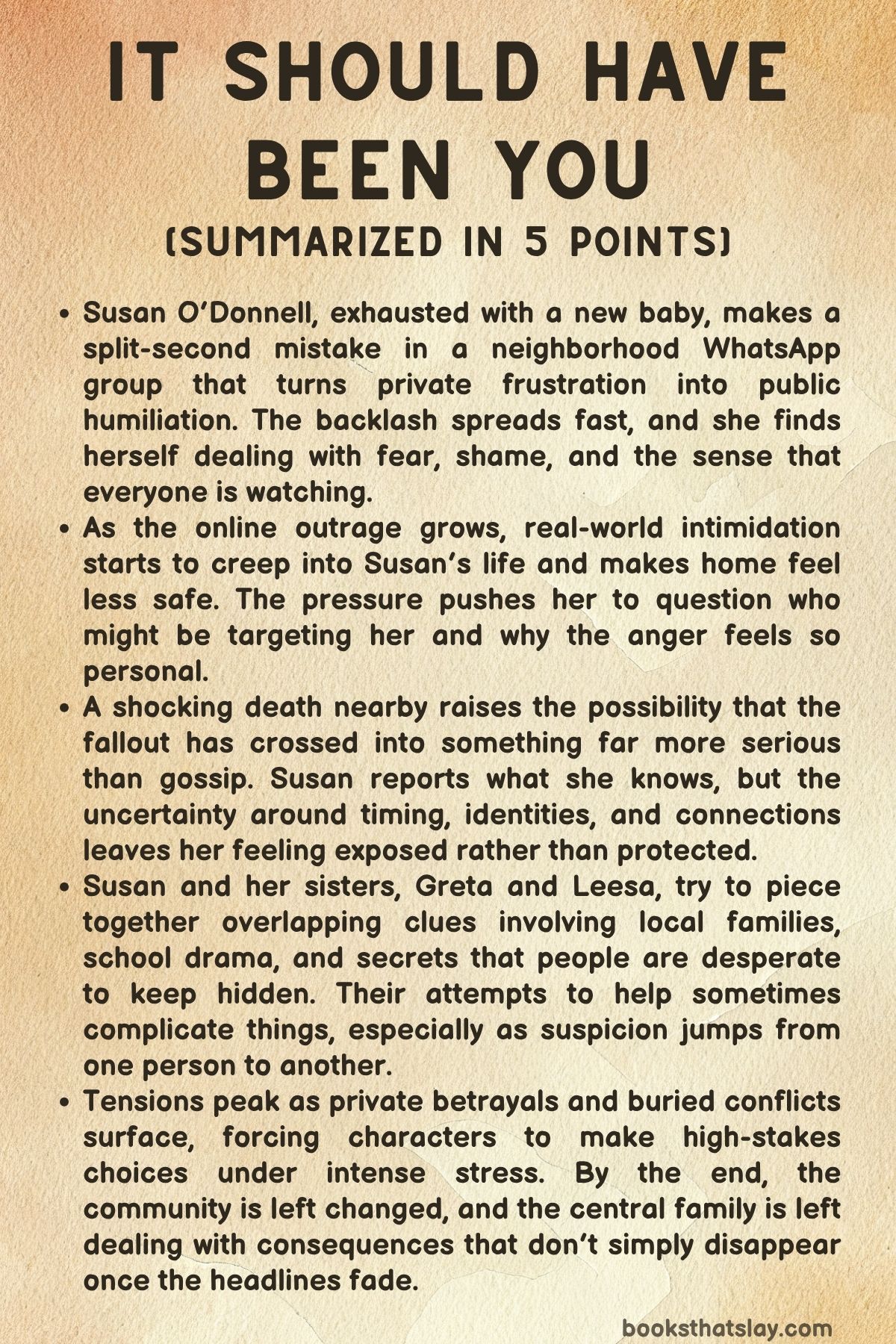
It Should Have Been You by Andrea Mara is a tense, modern domestic thriller set in a close-knit Dublin suburb where everyone is connected and everyone is watching. New mother Susan O’Donnell is exhausted, anxious, and trying to keep life together when one impulsive moment turns her into the neighbourhood villain: she accidentally posts a private rant to a huge WhatsApp group.
Within hours, she’s doxxed, threatened, and blamed for damage she never meant to cause. As fear spreads from online humiliation into real danger, Susan and her family are pulled into a chain of escalating violence that exposes betrayal, obsession, and the brutal cost of being the wrong person at the wrong address.
Summary
Susan O’Donnell is barely functioning on broken sleep and new-mother nerves as she cares for four-month-old Bella in Oakpark. The neighbourhood WhatsApp group is usually background noise, but a message from Celeste Geary—sharp, smug, and scolding—hits Susan at exactly the wrong moment.
Feeling singled out and furious, Susan screenshots it and types a vicious reply meant only for her sisters, Greta and Leesa. In her rant she repeats rumours she’s heard about Celeste’s family and unloads everything she’s been swallowing for months.
She sends it to the wrong place.
Instead of her sisters, the message lands in the Oakpark group itself—three hundred neighbours, acquaintances, parents from school, people she passes at the shop. Within minutes the group erupts.
Some demand to know who “SO’D” is. Others call Susan cruel and insist she apologize.
People take screenshots before she can delete the post. Private messages begin arriving, including warnings that her job as a teacher should be reported.
Susan tries to ring Celeste to apologize, but Celeste refuses to answer.
That night, someone throws a brick through Susan and her husband Jon’s upstairs bedroom window. Bella is in the room.
Susan is shaken by how close it came to tragedy. Jon reports the attack to the Gardaí and assumes it’s teenage retaliation, possibly linked to Celeste’s children and the chaos Susan has triggered.
The next day, their neighbour Juliette Sullivan appears at the door with a too-sweet “check-in,” and casually mentions she heard a noise and saw someone get into a car around the time the window shattered. The way she delivers it feels less like concern and more like something to store away.
The consequences online keep spreading. Susan learns she has been doxxed on Facebook: the screenshot is posted alongside her phone number and home address, and strangers are urged to contact her school.
Susan feels trapped inside her own house, ashamed to step outside, and terrified that the rage on the screen is turning into something physical. Her sisters try to help, but even their support comes with pressure, arguments, and old resentments.
In the middle of the panic, Susan admits something odd she’s been doing: she often receives misdelivered packages meant for another “26 Oakpark” in a different estate near Loughlinstown. The woman there—Savannah Holmes—lives a glossy life online, and Susan has been quietly watching her Instagram posts as an escape from her own messy reality.
Then the threats sharpen. Susan receives a text saying she “got away lightly” and that she “deserve[s] to die.” She forwards it to the Garda email Jon was given, but nothing changes fast enough to make her feel safe.
Around the same time, Greta reveals a fresh reason to hate the Gearys: Celeste’s daughter Nika has been part of a group bullying Leesa’s daughter Maeve at school. Susan’s accidental message has not only humiliated a family; it has exposed a target list that includes children.
A breaking news headline drops like a trapdoor: “Susan O’Donnell dead.” It’s misinformation at first glance, but the real report is worse. Three bodies have been found in South Dublin, and one is a woman at 26 Oakpark, Loughlinstown.
The victim is named as Savannah Holmes. Susan freezes at the detail: same house number, different estate, and a woman who resembles her.
The possibility is sickening—if someone came looking for Susan after her address was spread online, Savannah could have been killed by mistake.
Susan and Leesa go to the Garda station and report everything: the doxxing, the threatening texts, the shared address, the misdelivered parcels, and Susan’s fear that Savannah was targeted because she was mistaken for Susan. The response is cautious and skeptical, but the Gardaí take notes.
Back home, Susan tries again to reach Celeste and offers an apology. When Celeste finally calls, she is cold and controlling.
She demands Susan make a public apology and claim the rumours were invented. Susan agrees, partly from guilt and partly from fear that Celeste knows something she doesn’t.
As the pressure tightens, Detective Kellerman contacts Susan and begins asking pointed questions. Susan has to explain her only real connection to the Gearys: she attended the opening of Bar Four, met Warren Geary there, and later accidentally walked into a storeroom where she saw him kissing a PR woman named Aimee.
Susan included that detail in the message that blew up her life. Susan, Greta, and Leesa start to wonder if the threats are coming from Celeste, from Aimee, or from Aimee’s husband.
Leesa tries to get Aimee’s details through her sister Venetia, who works at Bar Four. When Susan and Leesa visit the bar, they get a shock: Venetia is away because of a bereavement.
Aimee and her husband Rory were murdered in Cherrywood. Susan realizes her message didn’t just cause gossip; it may have detonated someone’s private life.
Susan reports this new connection to Kellerman, who stays guarded and keeps pulling Susan back in for more questioning.
The Gardaí now say the cases may be linked. Susan is required to give fingerprints and DNA for exclusion because unknown prints have shown up at both murder scenes.
Savannah’s death doesn’t look like burglary; only her car keys are missing, not valuables, and the car wasn’t taken. Kellerman asks whether Susan knows Savannah’s ex-husband, and whether Susan knows anyone named “Sam.” Susan leaves the station feeling like she has been marked as the centre of a storm she didn’t create, but also can’t escape.
At home, Susan finds evidence that cracks her marriage open. A rose-gold bangle is wedged near the bed, inscribed with a message from Jon, and there’s a charge on their card at a hotel.
Susan reads it as proof of an affair. She hides the bracelet, says nothing, and starts watching Jon the way she once watched Savannah’s Instagram—searching for meaning in every detail.
Her fear isn’t only about strangers anymore; it’s about what Jon might do if their life collapses, especially because he knows about her past intrusive thoughts and mental health struggles after Bella’s birth.
Meanwhile, school drama becomes fuel for violence. The fallout from Susan’s message turns Nika into a target of rumours.
Maeve, already wounded by bullying, is pushed into despair when a private diary video is posted online. Maeve’s anger turns dark.
In a moment of desperation she searches for ways to hurt someone with a nut allergy. Greta catches her and intervenes, but the threat of escalation hangs over the family.
Susan’s paranoia intensifies when she meets Felipe, Venetia’s husband, and hears him speak about Aimee in a way that doesn’t fit the rumour Susan spread. Felipe hints at hidden truths and later admits he believes Aimee’s death is his fault.
Susan also finds a restaurant receipt from Jon: a romantic dinner for two, with a note about a tree-nut allergy. Susan recognizes the name tied to that allergy—Savannah Holmes.
The conclusion slams into her: Jon was cheating on her with Savannah, and Savannah is now dead.
At the hockey club, the situation with Nika explodes. Greta is caught hovering over Nika’s lunchbox, and Nika finds her brownie dusted with ground almonds.
Given Nika’s severe allergy, it looks like attempted murder. Nika calls Celeste.
Celeste arrives furious and prepared to involve the authorities. Greta insists she didn’t do it, but she can’t explain why she was searching the bag in the first place.
Susan demands answers, and Greta refuses, ending the call. Susan also suspects Greta has been lying about seeing Jon.
Secrets collide. Jon sits in his car, overwhelmed by guilt about his affair with Savannah and terrified about the investigation.
Savannah’s last messages mention her ex-husband harassing her and suggest police involvement. Jon anonymously contacts the Gardaí and points them toward Savannah’s ex, the local councillor Albie Byrne.
Jon also starts to suspect Susan’s timeline, because “physio” appointments were actually counselling, and he realizes he can’t account for where Susan was when Savannah was found.
The true danger, however, is closer than any of them understand. Venetia is unravelling.
In the aftermath of the screenshot spreading online, she raced to Aimee’s house and found Aimee dead. Rory was there, and Venetia killed him in a violent, rage-filled attack.
Felipe helped her cover parts of it up, including hiding evidence that would link Venetia to the scene. Venetia then uses a pay-as-you-go phone to send Susan threatening messages, convinced Susan’s post set everything in motion and determined that Susan should pay.
On top of that, Nika’s cruelty takes a horrifying turn. She panics and deliberately drives her car onto the footpath, hitting Maeve.
Maeve is left unconscious and badly injured. Nika tries to create an alibi through social media, but police attention tightens quickly.
A small ornament from Celeste’s car goes missing during the incident, later becoming a clue when the Gardaí inspect the vehicle.
Susan’s own home is breached in a way that shatters her last sense of safety. While Susan is upstairs, Venetia slips through the side gate and takes Bella from her basket.
Bella is later found outside on the grass, alive but with marks. The incident is terrifying on its own, but Juliette witnesses Susan’s panic and implies Susan might look unstable, hinting at child welfare involvement.
Susan becomes certain someone has been inside her house, and that she is being set up to look dangerous.
The final confrontation is brutal. Venetia breaks into Susan’s home again, attacks Greta, and takes Bella hostage.
She forces Susan into an unbearable choice: kill Greta or watch Bella die. Venetia provides a syringe and heroin.
Susan, desperate and trapped, injects Greta. Greta collapses.
Venetia flees with Bella. Susan runs after her as Felipe rams Venetia’s car to stop her.
Venetia attacks Felipe with a tyre iron and tries to stab the baby. Felipe throws himself over Bella and is fatally wounded.
Susan strikes Venetia with the tyre iron, knocking her unconscious, and Bella survives with minor injuries. Susan then scrambles to get help for Greta.
In the aftermath, Bella is cleared in hospital. Maeve is treated for a concussion and a broken leg.
Nika is charged. The Geary family collapses under what has been revealed, and the community that fueled the online frenzy is forced to face how quickly it helped turn cruelty into harm.
Greta survives the heroin because she had secretly taken naltrexone beforehand, reducing the drug’s effect. That detail raises a final, chilling layer: Greta had been preparing for something.
Over time, the truth comes out about Savannah’s death. Savannah did not die in a random attack.
Greta went to Savannah’s house, confronted her about a past car crash that left Greta with a permanent limp, and realized Savannah likely caused it while drunk and was protected by her politician husband. When Savannah dismissed Greta’s injury with cruel indifference, Greta shoved her.
Savannah fell, hit her head, and died. Greta staged the scene to look like an accident, sent misleading texts from Savannah’s phone, and even altered Jon’s contact name to “Sam” to misdirect suspicion and protect Jon’s alibi.
A year later, the survivors carry the damage forward. Susan and Jon are separated.
Bella is thriving. Nika lives away while awaiting court outcomes.
The neighbourhood attempts to move on, but Susan remains marked by guilt—guilt over the message that started the avalanche, and guilt over how little control anyone really had once the mob decided who deserved punishment.
Characters
Susan O’Donnell
Susan is the emotional and moral center of It Should Have Been You: a new mother whose exhaustion and isolation make her both volatile and painfully human. Her accidental WhatsApp blast is not just a “mistake” but the spark that exposes how quickly a community can turn punitive, how shame can metastasize into paranoia, and how motherhood can become a courtroom where every action feels indictable.
What makes Susan compelling is the way her fear keeps evolving—first social humiliation, then physical danger, then the more intimate dread that the threat might be inside her own home and marriage. She tries to do the “right” thing in a world that keeps changing the rules: she apologizes, cooperates with police, seeks counselling, and attempts to protect her baby, yet she is constantly punished by gossip, surveillance, and the suspicion that she is either careless or unstable.
By the end, Susan survives, but survival is not framed as triumph; it is endurance layered with guilt, the kind that lingers even when she was coerced, even when she acted to save Bella, even when the true villains are unmasked.
Jon O’Donnell
Jon initially appears like the steadier counterweight to Susan’s spiraling anxiety, but It Should Have Been You gradually reveals him as a man whose calmness is partly concealment. His affair with Savannah reframes his “support” as selective truth-telling: he can be protective in emergencies yet still cultivate a private life that destabilizes Susan’s reality.
Jon’s behavior after the brick attack and the murder news reads as guilt braided with genuine fear—he wants safety, but he also wants containment, especially of anything that might reveal his betrayal. His choice to anonymize information to the Gardaí shows a man trying to steer outcomes without fully stepping into accountability, and his “practical” posture becomes another kind of power in the marriage: Susan doubts herself while Jon keeps facts compartmentalized.
By the aftermath, separation feels less like a plot consequence and more like a thematic verdict—Jon’s secrecy helped create the conditions where Susan’s instincts were dismissed as hysteria until danger became undeniable.
Bella O’Donnell
Bella functions less as a conventional character and more as the story’s moral gravity: everyone’s choices orbit her vulnerability. The threats against Susan become exponentially more terrifying because they aren’t only about adult reputations; they are about a baby who cannot consent, flee, or explain.
Bella’s presence also sharpens the novel’s critique of how society polices mothers—Susan’s panic is instantly interpreted as incompetence, and even minor incidents become “evidence” in the eyes of observers like Juliette. When Bella is physically handled and abducted, the book crystallizes its core horror: the leap from online cruelty to bodily violation is not metaphorical, it is literal.
Bella surviving is not merely relief; it exposes who was willing to instrumentalize a child to punish an adult woman.
Greta
Greta is the most dangerous kind of character in the novel because she is both fiercely loving and catastrophically entitled to decide what “protection” requires. As Susan’s sister, she presents as the competent one—directive, practical, quick to crisis-manage the WhatsApp disaster—yet her competence is threaded with control and a taste for influence.
Her underlying rage is personal and old, rooted in injury and humiliation, and she carries it like a private law that justifies escalation. The nut-allergy incident at hockey camp shows how easily her loyalty can curdle into vigilantism, and her evasiveness afterward suggests she is comfortable letting others absorb confusion so she can keep moving pieces off the board.
The late reveal that Greta killed Savannah—then staged the scene, manipulated texts, and built misdirection—recasts her as the novel’s hidden author, someone who can choreograph reality while wearing the mask of the protective sister. What makes her chilling is not impulsiveness but follow-through: she doesn’t just lash out, she edits the world afterward so the story points away from her.
Leesa
Leesa operates as the sister who translates chaos into actionable concern, especially where children are involved. She is motivated by maternal protectiveness but is less performative than the neighborhood moralizers; her anger is targeted, and she tries to ground fear in evidence, which is why she pushes to report connections to the Gardaí and why she seeks out Moira Fitzpatrick’s account rather than relying on rumor.
Leesa’s relationship with Maeve adds a second parenting mirror to Susan’s: she is also navigating the cruelty of adolescent social ecosystems, but she responds with investigation, advocacy, and an insistence that digital harm is real harm. Leesa’s strength is not that she never panics; it is that she keeps returning to the question of what keeps her child safe, even when the “truth” is messy, even when the culprit might be another child.
Maeve
Maeve is the clearest portrait of adolescent damage in the story, showing how humiliation can become both self-destruction and a desire to destroy back. The diary leak and betrayal by Nika are not minor drama; they are identity-level assaults, and Maeve’s collapse into obsessive revenge-searching illustrates how the internet can function as an accelerant for impulsive harm.
She is written with an uncomfortable realism: she is not a saintly victim, but a wounded teenager whose thoughts become frightening because she feels powerless. Her later fear that Greta might have acted on her searches reveals Maeve’s conscience fighting through the rage—she wants retribution in the abstract, but recoils when consequences look real.
Her injury from the hit-and-run seals the novel’s point that “kids’ conflict” is not contained; adult negligence, peer cruelty, and unchecked aggression can spill into irreversible violence. Maeve survives, but the survival is marked by trauma and a loss of innocence about friendship, safety, and the stability of her own impulses.
Aoife
Aoife is positioned as the sharper, more investigative younger generation presence, someone who understands the mechanics of social media exposure in a way the adults cannot fully grasp. Her role in tracking the anonymous account behind the diary leak gives her a quiet competence and a moral clarity: she recognizes patterns, connects digital footprints, and turns vague suspicion into a concrete conclusion.
Aoife also reflects how children in this world are forced into adult-like vigilance—she is dealing with keys, access, and the porousness of home boundaries, which underscores the book’s theme that privacy has collapsed. She isn’t centered as a driver of violence, but as a witness who helps convert chaos into knowledge, a crucial distinction in a story where misinformation is weaponized.
Celeste Geary
Celeste begins as the archetype of neighborhood authority—polished, scolding, and confident that the group’s social rules are hers to enforce. Yet the story gradually reveals the fragility under her control: a marriage with rot in it, children whose actions are spiraling, and a public image that becomes a battleground she cannot fully regulate.
Celeste’s demand that Susan issue a public apology and claim she fabricated everything is less about truth than dominance; she wants narrative power restored, and she understands that humiliation is a tool. At the same time, Celeste is not portrayed as purely monstrous—her later devastation over Nika’s charges and the family’s implosion exposes a woman who built identity on respectability and is now watching it collapse from within.
Her eventual corridor moment with Susan reads as the book’s bleak reconciliation: two mothers who have been enemies discover they share the same exhausted grief, and that neither social status nor performative morality prevents catastrophe.
Warren Geary
Warren functions as the charming liability at the heart of the Geary family, a man whose appetites create ripples that others must absorb. The rumor of him kissing Aimee becomes a fuse line that connects scandal to murder, even if indirectly, because it provokes shame, rage, and frantic containment.
Warren’s nervousness and avoidance suggest someone accustomed to consequences being managed by others—by Celeste, by social power, by plausible deniability. He is not framed as the murderer, but he is deeply complicit in the conditions that make violence easier: secrecy, entitlement, and the casual willingness to let women around him take the reputational hits.
His presence highlights a recurring pattern in the book: men’s private indulgences become women’s public punishments.
Nika Geary
Nika embodies the adolescent apex predator of the novel, but the book complicates her beyond a simple bully. She weaponizes social platforms, orchestrates humiliation, and turns Maeve’s vulnerability into entertainment, showing how cruelty becomes status currency in teen hierarchies.
The hockey-camp allergy incident and the hit-and-run reveal her escalation from social violence to physical violence, and her attempts to craft an alibi through posting and location manipulation show a chilling awareness of optics and traceability. Yet Nika’s panic, her frantic drive, and her desperate seeking of refuge expose the emptiness beneath the performance—she wants power without consequence, control without accountability.
Her arc is a warning about what happens when cruelty is rewarded, when adults are distracted, and when empathy is replaced by audience metrics.
Cody Geary
Cody is a character built around community fear: his reputation becomes a vessel for suspicion because he is volatile and because the neighborhood wants a villain it can point to. The “Fitzpatrick situation” and the nanny-cam account paint him as dangerous around children, and that perception spreads quickly in the same way Susan’s message does—through repetition and moral certainty.
Yet the narrative later reframes his “violent outbursts” as self-harm rather than predation, which doesn’t absolve him of harm but shifts the moral geometry: some of what the community “knows” is projection shaped by panic. Cody’s function is to show how quickly public narratives solidify, how easily people become symbols instead of humans, and how the truth can still be grim even when the rumor is wrong.
Juliette Sullivan
Juliette represents the voyeuristic neighbor archetype sharpened into something menacing. She does not have to throw bricks or send threats to be dangerous; her weapon is insinuation, the ability to frame Susan’s distress as evidence of unfitness and to hint that authorities could be brought in.
Her “checking in” reads as performance—concern as a cover for superiority—and her recounting of seeing someone near the house places her in the story as both potential witness and potential manipulator of narrative. Juliette embodies the theme that social punishment often comes disguised as civic responsibility, and that the most corrosive cruelty can be delivered with a polite smile.
Savannah Holmes
Savannah is the novel’s most haunting absence-presence: a woman known to Susan mostly through misdelivered parcels and curated Instagram glamour, then abruptly transformed into a corpse mistaken for Susan in the public imagination. She functions as a mirror for Susan—same address number, similar appearance, a life that feels adjacent yet inaccessible—and that mirroring makes her death feel like a fracture in reality, as if Susan’s humiliation has spilled into fate.
Savannah is also the pivot point for Jon’s betrayal, revealing how Susan’s sense of threat was not only external. The later revelation that Savannah smashed Susan’s window and that she died at Greta’s hands complicates her into someone who could be reckless, confrontational, and cruel, not merely an innocent symbol.
Her character underscores one of the book’s bleakest insights: people are simultaneously real and instrumentalized—first as online content, then as suspects, then as scapegoats, then as collateral.
Detective Kellerman
Detective Kellerman functions as institutional pressure personified: methodical, skeptical, and blunt in ways that both help and harm. Her insistence on fingerprints and DNA “for exclusion” makes the investigation feel real and procedural, but her tone also amplifies Susan’s fear that she is being treated as the common denominator rather than the endangered party.
Kellerman’s questions about “Sam” and Savannah’s ex-husband show how law enforcement seeks pattern and motive, while Susan is drowning in lived terror and uncertainty. The detective’s presence highlights the mismatch between personal panic and institutional logic: the system looks for linkage and evidence, while Susan is trying to survive an experience that keeps mutating faster than proof can be gathered.
Aimee
Aimee is crucial to the story despite limited direct presence because she becomes the explosive intersection of rumor, marriage, and violence. She is framed publicly through the lens of alleged infidelity with Warren, but those who loved her suggest that narrative doesn’t fit, implying a life more complex than the gossip version of her.
Her death is not only tragedy; it is the moment where scandal becomes bloodshed, and it exposes how easily a woman’s identity can be reduced to a story men generate and communities consume. Aimee’s role forces the reader to confront the cruelty of speculation: even in death, she is discussed as a plot point in someone else’s marriage until the truth of what happened in her home is revealed.
Rory Quinlan
Rory is portrayed as the volatile spark, a man whose response to humiliation and perceived betrayal becomes lethal. The detail that Felipe forwarded the screenshot to Rory suggests Rory’s masculinity is brittle, reactive, and dangerous when publicly pricked.
Even so, the narrative refuses to let Rory hold the entire blame for what follows because Venetia’s actions eclipse his; he becomes both aggressor in the emotional chain and victim of a retaliatory frenzy. Rory’s function is to show how fast violence can erupt when shame, entitlement, and rage collide, and how domestic spaces can become crime scenes in an instant.
Venetia
Venetia is the novel’s most ferocious embodiment of grief weaponized. She experiences Aimee’s death as a violation that must be answered, and her response is not justice but annihilation—first in the frenzied killing of Rory, then in the deliberate campaign of intimidation against Susan, culminating in breaking into the home and holding Bella hostage.
Venetia’s psychology is driven by displaced blame: she chooses Susan as the face of consequence because Susan is visible, reachable, and symbolically responsible in Venetia’s mind for the chain reaction. Her coercing Susan into injecting Greta is the book’s starkest depiction of moral injury, forcing a mother to enact harm under threat to her child.
Venetia’s violence is personal, intimate, and theatrical—she wants Susan not only to suffer but to be complicit—making her the clearest representation of how outrage can become a hunger to contaminate others with your pain.
Felipe
Felipe is a tragic enabler, a man who loves Venetia enough to become her accomplice and fears consequences enough to tamper with reality. His confession that he sent the screenshot to Rory positions him as an inadvertent catalyst, but his later actions—hiding evidence, trying to restrain Venetia, ultimately ramming her car—show a person oscillating between loyalty and horror at what loyalty has become.
Felipe’s emotional transparency when speaking about Aimee contrasts with the secrecy around the murders, suggesting someone who wanted to be decent but kept choosing the path of least immediate pain until the pain became catastrophic. His death protecting Bella is both redemption and indictment: the final good act cannot erase the earlier enabling, yet it reveals that love in this story is often expressed through desperate, belated sacrifice.
Moira Fitzpatrick
Moira functions as the voice of maternal certainty that can be both clarifying and dangerously absolute. Her account of Senan’s injury and the nanny-cam footage offer a rare anchor of concrete evidence in a narrative flooded with rumor and screenshots.
At the same time, her fury at Cody and her readiness to interpret events through the lens of her child’s harm show how trauma narrows perception; she is not lying, but she is primed to see threat everywhere Cody appears. Moira’s presence reinforces a central theme: when children are hurt, nuance becomes unbearable, and communities often convert pain into crusade, whether or not the crusade lands on the right target.
Albie Byrne
Albie is the shadow of institutional privilege, present less through scenes than through implication and the power of what he can make disappear. As Savannah’s ex-husband and a local councillor, he represents the kind of person whose status can distort outcomes—rumors about covering up a drunk-driving crash, the ability to intimidate, the aura that makes others hesitant.
Even when suspicion circles him, he remains slippery, more idea than man: the respectable face that may conceal coercion. His link to Greta’s past injury gives the story its long fuse, showing that the true origins of present violence can sit quietly for years until a trigger finally sets them off.
Jessica
Jessica’s role is small but telling: she is part of the teen social matrix where complicity often looks like silence. Nika uses her space and her image as potential cover, and Jessica’s absence or nonresponse becomes a quiet commentary on how bystanders operate in adolescent cruelty—sometimes not actively cruel, but available to be used.
She represents the blurry middle zone between bully and victim, the kind of person who might not start the fire but provides oxygen by refusing to intervene.
Ariana
Ariana operates as a boundary-setter, a teenager who refuses to be drafted into Nika’s panic and performance. By rejecting Nika when she seeks shelter and condemning the diary posting, Ariana becomes a rare peer voice that treats cruelty as unacceptable rather than entertaining.
Her role is important because it shows that the teen world is not uniformly rotten; moral choice still exists, even under social pressure. Ariana’s refusal also exposes how isolated aggressors become when consequences finally arrive—once the audience turns away, the bully discovers she has no real allies, only spectators.
Themes
Digital Shaming and the Loss of Control
Susan’s mistaken post in It Should Have Been You turns an ordinary neighbourhood chat into a public courtroom, and the speed of that shift becomes the point. What begins as a tired, angry message from a new mother instantly becomes a permanent identity marker: “SO’D” is no longer a person with context, but a symbol the group can punish, gossip about, and use as entertainment.
The story shows how outrage gains momentum because it offers simple roles—villain, victim, judge—while making nuance feel like weakness. The demand for a public apology is not really about repairing harm; it is about restoring the group’s sense of order and satisfying a hunger to see someone submit.
Even people who never meet Susan in person feel entitled to consequences, including workplace reporting and doxing, because the screen makes the act feel both distant and justified. The community’s reaction also exposes the way “safety” language can be misused: people claim to be protecting decency while engaging in coordinated cruelty.
The brick through the window and the anonymous texts push this further, showing how digital humiliation can invite physical danger once a target is made easy to locate. Susan’s fear is not just of a single attacker; it is of the fact that harm can come from anywhere when hundreds of people have access to your address, your number, and a shared belief that you deserve punishment.
The theme becomes less about social media being “toxic” in a vague way and more about how quickly a group can normalize escalation, especially when the victim’s attempts to explain or apologize only create more material to judge. The scandal also traps Susan inside a distorted version of herself, because once a narrative takes hold online, the person at the center loses the power to define what happened, why it happened, or what they are allowed to feel afterward.
Motherhood, Anxiety, and the Pressure to Be “Safe”
Susan’s exhaustion is not background detail; it is the condition that shapes her choices and also shapes how others interpret her. The book keeps returning to how early motherhood can narrow a person’s world into constant vigilance—feeds, naps, alarms, baby skin, household risk—and then punishes her for any slip, even when that slip is human.
Susan’s shame after the WhatsApp disaster is amplified because she is already measuring herself against an impossible standard: the calm, organized parent who never loses her temper and never makes a mistake. That pressure makes the neighbourhood’s judgment especially brutal, because the criticisms land on an existing fear that she is failing at the most important job she has.
When the window is smashed and Bella is in the room, the terror is not only about violence; it is about the unbearable thought that Susan’s mistake might have endangered her child. That kind of fear becomes self-feeding—every odd detail, every look from a neighbour, every online comment becomes evidence that she is not fit, not safe, not trusted.
The supermarket moment where Bella briefly goes missing hits with such force because it triggers a deeper dread: that Susan can be made to look unstable, negligent, or dangerous even when the child is fine. Juliette’s “checking in” adds another layer, showing how social surveillance can hide behind concern.
A new mother is expected to accept scrutiny politely, because refusing it looks suspicious. The plot also sharpens this theme by placing Susan’s mental health history close to the surface—her intrusive fears, her counselling, her worry about what Jon could do with that information if the marriage collapses.
Motherhood, in this context, is not simply love and responsibility; it is also vulnerability to institutional threat, social suspicion, and self-doubt. Even when Susan is right that someone has entered her home, she struggles to trust her own perceptions because she has been trained to believe that anxious mothers exaggerate.
The result is a portrait of how easily maternal anxiety can be weaponized—by neighbours, by online crowds, and even by intimate relationships—until a woman’s fear becomes a story others tell about her rather than a signal that she needs help and protection.
Secrecy, Betrayal, and the Hidden Lives Inside Familiar Homes
The neighbourhood setting functions like a stage where everyone performs normalcy while guarding private disasters. Affairs, bullying, grudges, and cover-ups sit behind polite messages and tidy routines, and the book shows how quickly those private realities spill into public damage once the right trigger appears.
Susan’s accidental message exposes rumours that were already circulating in whispers, and the chaos that follows suggests that the community was primed for eruption. The scandal matters less for its original content than for what it releases: people’s stored resentments and their appetite to use “truth” as a weapon.
Jon’s affair becomes part of this theme because it is not only a betrayal of Susan; it is also a structural reason Susan cannot rely on her closest relationship when danger rises. Suspicion enters the marriage at the exact moment she most needs stability, and every secret Jon keeps makes Susan feel more isolated, more paranoid, and more likely to misread threats.
At the same time, other characters maintain secrets for different reasons—image management, guilt, fear of consequences, desire for control—showing that concealment is not always glamorous or strategic but often frantic. Venetia and Felipe’s concealment around the murders adds a harsher edge, because it frames secrecy as an active force that prolongs harm: tampering, threatening, and rationalizing become ways of postponing accountability while the fallout lands on others.
Greta’s hidden actions sharpen this theme in the most disturbing way, because her role includes both protection and harm. She can be fierce in defending family while also carrying out choices that endanger lives and distort investigations.
That contradiction shows how betrayal is not always committed by an obvious villain; it can come from someone who believes they are acting out of love, rage, or justice. The book repeatedly suggests that the real danger in a community is not the strangers outside but the familiar people who know your schedule, your routines, your vulnerabilities, and your blind spots.
When secrets multiply, trust stops being a comfort and becomes a liability. Everyone starts calculating who might be lying, what they might be hiding, and whether the truth would even help.
The theme lands on the idea that close-knit spaces can produce a particular kind of betrayal: not the dramatic betrayal of an enemy, but the quiet betrayal of people who smile at you, share your doorstep conversations, and still make choices that put you at risk.
Revenge, Moral Certainty, and How Harm Becomes “Justified”
A striking pattern in the novel is how characters convince themselves that the harm they cause is deserved. Once Susan is labeled cruel, the community response shifts from disapproval to punishment, and punishment quickly becomes entertainment.
The moral certainty of the crowd offers a shortcut: if Susan is “that kind of person,” then exposing her, threatening her, and endangering her stability can be framed as communal protection. The book extends this logic beyond online shaming into interpersonal revenge, especially in the school bullying storyline, where humiliation is treated as currency and retaliation becomes a tempting way to restore dignity.
Maeve’s despair and anger show how revenge fantasies grow out of helplessness, and the plot treats that anger as dangerous not because it exists, but because it can be redirected into actions that harm the wrong person or spiral beyond control. The nut allergy incident functions as a concentrated example of moral justification: an object as ordinary as a brownie becomes a possible weapon, and the accusation itself becomes a tool for reputational destruction.
Even when the truth is uncertain, the social machine can still produce a verdict, because suspicion is enough once a person has been cast as a threat. Nika’s hit-and-run intensifies this theme by showing revenge without hesitation, followed immediately by frantic image management—posting old photos, manipulating location settings, searching for alibis.
The act is brutal, but what makes it thematically sharp is the speed with which self-protection takes over, as if avoiding consequences matters more than the victim’s body on the road. Venetia’s violence pushes moral certainty to its extreme.
Her grief becomes permission in her mind: she assigns blame to Susan as the “cause” of the tragedy and builds a personal system of justice that includes terrorizing a baby and forcing an impossible choice. The book’s point is not that grief always leads to violence, but that certainty can.
When someone decides they are right, empathy becomes optional, and cruelty can be presented as correction. Greta’s later revelations underline this theme as well, because her sense of grievance and her belief in her own justification lead to irreversible outcomes.
The story keeps asking what happens when people stop seeing harm as harm and start seeing it as “what had to be done.” By the end, revenge is shown not as a clean act of balance but as a generator of new victims, new secrets, and ongoing damage that outlives the original offense.