June Baby Summary, Characters and Themes
June Baby by Shannon Garvey is a contemporary literary novel about grief, stalled ambition, difficult love, and the fear of choosing a future that cannot be reversed.
The story follows Ruth Phillips, a twenty-seven-year-old seasonal worker who returns to Block Island after the death of Diana Beckett, the artist who became her mentor and substitute mother. Ruth’s return exposes secrets about her mother, revives an unresolved romance, and forces her to confront a possible pregnancy. Through Ruth’s uncertain summer, the novel examines how people preserve the dead, misunderstand the living, and learn to separate love from obligation.
Summary
Seventeen-year-old Ruth Phillips arrives on Block Island three months after her mother Maggie’s death. Her father, Joel, has arranged for her to spend the summer assisting Diana Beckett, an artist who supposedly knew Maggie many years earlier.
Rain destroys the contact information Joel gave her, leaving Ruth lost and frightened when she steps off the ferry. Bonnie, the island librarian, helps her reach Diana, who appears surprised by Ruth’s arrival before welcoming her into her secluded cottage.
Diana feeds Ruth, comforts her, and gives her a sense of safety she has not experienced since Maggie died. Although Diana says little about her connection to Maggie, Ruth senses that their history was more meaningful than she has been told.
Ten years later, Ruth returns to Block Island after learning that Diana has died from lung cancer. Diana concealed her illness, and Ruth misses Charlie’s urgent telephone calls until it is too late to say goodbye.
Ruth has spent years moving between summer restaurant work on the island and winter bartending jobs in Maine. She once planned to become a writer, but exhausting work, financial insecurity, housing problems, and disappointment gradually caused her to abandon that ambition.
Diana’s death also forces Ruth to think about Charlie, Diana’s nephew and the great unresolved love of her life. Ruth and Charlie have shared kisses, emotional intimacy, and several moments when they nearly committed to each other, yet fear and poor timing always prevented them from building a relationship.
Believing that she may lose another person without speaking honestly, Ruth decides to tell Charlie that she loves him when he arrives for the funeral. Her courage quickly weakens, however, and she spends the night before the service with Louis, a fisherman with whom she has occasionally had casual sex.
Louis offers Ruth familiarity and temporary relief from grief. Their night together allows her to postpone thinking about Diana, Charlie, and the possibility that her life has remained unchanged for too long.
On the morning of the funeral, Ruth meets Joel at the ferry. She notices his worsening arthritis, physical weakness, and age, but their shared inability to discuss Maggie prevents either of them from expressing affection or concern directly.
Charlie sends Ruth a message saying that he has something important to tell her. She interprets it as possible evidence that he shares her feelings and attends the funeral with renewed hope.
The service takes place in Diana’s garden, surrounded by people from her artistic and personal life. Ruth feels excluded from the public version of Diana until Charlie describes her as the person who understood Diana most deeply.
That reassurance disappears when Lynn, Diana’s sister and Charlie’s mother, announces that Charlie will marry his fiancée, Nadia, at Diana’s house. Ruth is devastated because Charlie never told her that he was engaged or even involved in a serious relationship.
Ruth becomes even more distressed when she sees Diana’s possessions being packed and the house altered. After she accuses Lynn of treating Diana’s death as an opportunity for profit, Lynn declares that Ruth is not family and no longer belongs there.
That evening, Charlie and Nadia arrive at Ruth’s restaurant. Nadia seems accomplished, gracious, and secure, while Ruth feels ashamed of her stained uniform, unstable work, and directionless life.
Louis later helps Ruth close the restaurant and speaks to her with unexpected care. His kindness reminds her that he understands loss because the uncle who raised him died by suicide.
Ruth begins investigating Nadia online and discovers that she teaches art, supports public arts programs, and creates jewelry. Nadia’s meaningful career makes Ruth ashamed of reducing her to a privileged rival and intensifies Ruth’s dissatisfaction with her own abandoned plans.
Memories of Ruth’s final argument with Diana return. Diana accused her of using grief as an excuse to postpone her life, while Ruth felt that Diana’s wealth prevented her from understanding how financial insecurity had consumed Ruth’s energy.
Diana’s death also reawakens Ruth’s memories of Maggie’s illness. Ruth recalls chemotherapy, a frightening allergic reaction, Maggie’s physical decline, the discovery of a brain tumor, and Maggie’s eventual decision to stop treatment.
Joel later tells Ruth that he has sold their family home and intends to travel before his health worsens. Ruth reacts angrily because the house represents both Maggie’s memory and the final refuge available if her unstable life collapses.
Charlie finds Ruth after Joel leaves and invites her back to Diana’s house to collect belongings that Diana specifically left for her. Inside her former bedroom, Charlie gives her a heavy teal box, but Ruth cannot bring herself to open it.
During the visit, Ruth discovers that the condom used during her night with Louis broke. Because too much time has passed for emergency contraception, she becomes afraid that she may be pregnant.
Ruth persuades Charlie to spend the afternoon hiking and swimming with her. Their old ease returns as they discuss marriage, children, ambition, aging, and the different paths their lives have taken.
Charlie says that he wants stability and a family, while Ruth admits that she does not know whether she wants children. He encourages her to begin writing again, but she hears his support as another judgment of the life she has failed to build.
At Black Rock Beach, Ruth and Charlie acknowledge that they still remember the last time they nearly slept together. They move close enough to kiss, but a telephone call from Nadia interrupts them before Ruth can confess her feelings.
Soon afterward, Diana’s agent contacts Ruth with an unexpected assignment. Diana arranged before her death for Ruth to write a major memorial profile connected to a posthumous exhibition of her work.
Although Ruth has not written seriously in years, she accepts the assignment. Diana also requested that she complete it in the studio, forcing Ruth to return regularly to the house despite Lynn’s restrictions and Charlie’s approaching wedding.
On her first morning in the studio, Ruth feels angry rather than inspired. She resents Diana for placing such a major responsibility on her while hiding both her illness and her expectations.
Ruth finally opens the teal box and discovers Diana’s first camera, photographs, negatives, keepsakes, and a letter. The photographs reveal that Diana and Maggie were lovers during the summer of 1994.
The images show the two women swimming, cycling, reading, and looking at each other with unmistakable affection. Diana explains that Maggie was her first and greatest love and that they once planned to move to New York together.
Maggie initially ended the relationship because she feared her Catholic family and felt uncertain about her sexuality. She later changed her mind and promised to join Diana, but she never arrived.
Diana eventually saw Maggie pregnant and married to Joel. Years later, Ruth’s arrival reopened Diana’s old pain, yet Diana came to love Ruth as a daughter.
The box also directs Ruth to a hidden collection of Maggie’s paintings. Ruth is stunned to learn that her mother possessed a serious artistic identity that had been concealed throughout her childhood.
When Ruth confronts Joel, he admits that Maggie had planned to leave and reunite with Diana. She returned after discovering that she was pregnant, and Joel proposed because he loved both Maggie and the expected child.
Ruth begins to believe that her conception destroyed Maggie and Diana’s possible future. She fears that Maggie surrendered love, art, and freedom because Ruth was born.
The possibility of Ruth’s own pregnancy makes this discovery even more frightening. She imagines herself repeating Maggie’s life by allowing an unplanned pregnancy to determine her future before she has decided what she wants.
Ruth asks Charlie to help her remove Maggie’s paintings from Diana’s studio. When he fails to appear, she feels abandoned and recognizes that she has partly used the paintings as a reason to test whether Charlie will choose her over Nadia.
Ruth continues struggling with the article, producing only lifeless fragments about Diana’s professional career. The public image of the celebrated photographer bears little resemblance to the affectionate, difficult, secretive woman Ruth knew.
At a Fourth of July party at Diana’s renovated house, Ruth feels that Nadia and Charlie’s wealthy friends belong in a world from which she has always been excluded. The changed garden, gray walls, and new decorations make her feel that Diana’s home has been erased.
A storm interrupts the party and cuts the electricity. Ruth goes to the attic for candles, and Charlie follows her into the space where they spent private summer nights as teenagers.
Charlie kisses Ruth in the darkness, but Nadia interrupts them before the encounter goes further. Charlie lies about what happened, and Ruth is disturbed by how easily secrecy enters their relationship.
Later, Louis reveals that he wants more than casual intimacy. He believes that he and Ruth could build a stable life together, but she rejects him because commitment frightens her and because she remains emotionally attached to Charlie.
Ruth’s mounting fear, exhaustion, and frustration eventually erupt at work. After a rude customer grabs her arm and humiliates her, she pours his drink into his lap and leaves, effectively losing the job that supported her seasonal life.
Walking alone afterward, Ruth sees a woman caught in a riptide while the woman’s toddler waits on the beach. Ruth enters the water with a boogie board and guides the drowning woman out of the current.
The rescue becomes a decisive moment for Ruth. Instead of surrendering to fear or allowing another person to disappear before her, she acts, survives, and realizes that she still wants a future.
Charlie finds Ruth afterward and takes her to Diana’s house. Beneath the outdoor shower, they finally have sex, completing the encounter they have postponed for ten years.
Afterward, they discuss their relationship beside Maggie’s paintings. Both admit that they love each other, but they also recognize that much of their love belongs to their younger selves and to the life they repeatedly imagined rather than built.
Charlie admits that he also loves Nadia. Ruth understands that becoming his partner would mean entering a life he has already established instead of discovering what she wants independently.
They separate with affection and sorrow, accepting that their night together has ended their endless uncertainty without creating a shared future. Charlie helps Ruth remove Maggie’s paintings before returning to his wedding plans.
In August, Ruth confirms that she is pregnant. She considers the new possibilities she has begun imagining—writing, education, travel, and a permanent departure from seasonal work—and decides that she does not want to become a mother.
Lucy helps her schedule an abortion and accompanies her to Providence. Ruth tells Louis about the broken condom, and although he is shaken, he offers money, transportation, and emotional support without challenging her decision.
Before the procedure, Ruth sees one of Diana’s photographs in a museum. The experience helps her understand that failing to complete the Vogue assignment does not mean that she failed Diana.
Ruth tells the editor that she cannot finish the profile and proceeds with the abortion. On the ferry home, she watches a mother comfort her child and remembers Maggie’s love, but she remains certain that her own decision was right.
Soon afterward, Charlie confesses to Nadia that he slept with Ruth. During a severe storm, he asks Ruth to check on Nadia, who is alone at Diana’s house after dismissing her friends.
Nadia confronts Ruth directly. Ruth admits that she loves Charlie but explains that their connection is rooted in nostalgia and cannot support the adult life either of them needs.
Their conversation moves beyond betrayal to questions of ambition, marriage, travel, and motherhood. Nadia describes her desire for children as a confident personal choice, helping Ruth consider that Maggie may also have freely chosen motherhood rather than merely submitting to it.
Charlie and Nadia cancel the wedding while deciding whether their relationship can survive. Ruth says goodbye to Charlie at the ferry and accepts that she can love him without continuing to wait for him.
Ruth returns to Diana’s studio and develops the final roll of film. The photographs of Lucy, Louis, Charlie, Nadia, the island, and Diana release the creative energy that Ruth could not access while trying to write an impersonal career profile.
Instead, Ruth writes a personal essay about Diana, Maggie, grief, abortion, love, avoidance, and the summer’s changes. Lynn apologizes for resenting Ruth because Maggie broke Diana’s heart, and Ruth begins to understand Lynn’s renovations as another person’s imperfect response to grief.
Diana’s lawyer then reveals that Diana left Ruth a fully owned studio apartment in Brooklyn. It is the apartment where Diana and Maggie once planned to live together, making the inheritance both an act of love and an invitation to begin again.
Before moving, Ruth returns to Joel’s house and finally speaks honestly with him about Maggie. Joel explains that he sent Ruth to Diana because he believed Diana could give her the understanding and support that he could not provide after Maggie’s death.
Ruth shows Joel Maggie’s paintings, and they grieve together rather than avoiding each other. Handmade baby clothes created by Maggie reassure Ruth that her mother anticipated her birth with love and creativity.
Although the Vogue editor cannot publish Ruth’s personal essay in its intended form, she recognizes its strength and offers professional guidance. Ruth begins searching for jobs, teaching opportunities, residencies, and publications in New York.
On her twenty-eighth birthday, Ruth moves into the Brooklyn apartment. She briefly thinks about contacting Charlie but allows the desire to pass without acting on it.
Ruth hangs Maggie’s painting marked “Happy birthday, June Baby!” above her bed. Surrounded by the work of the two women whose hidden history shaped her life, she sits before Diana’s writing desk and accepts that her future does not need to be certain before she begins creating it.
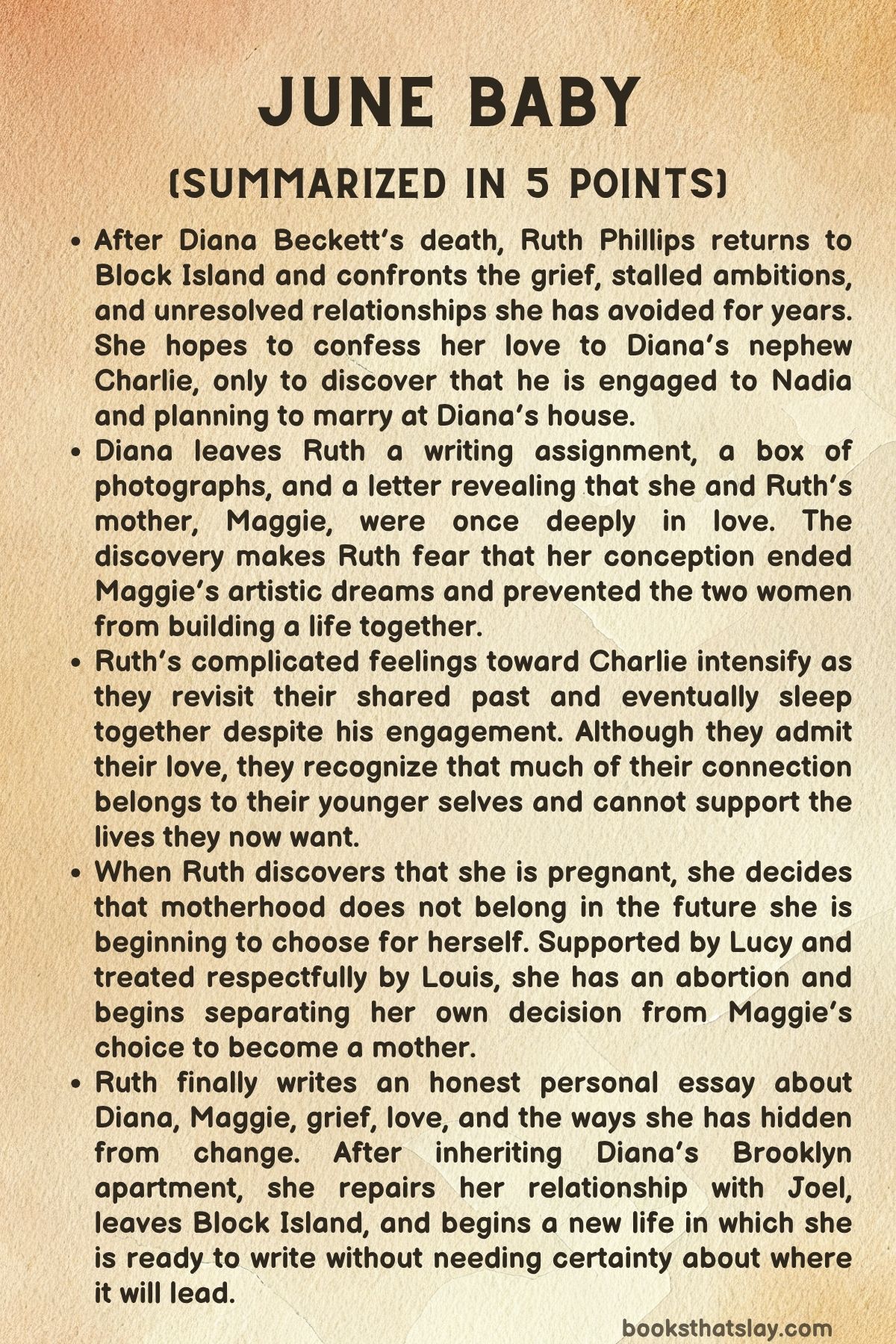
Characters
Ruth Phillips
Ruth Phillips is the emotional and narrative centre of June Baby, and her development depends on learning the difference between preserving love and refusing change. At the beginning, she treats movement as a threat because every major change in her life has been connected to loss.
Her seasonal work allows her to avoid permanent decisions while still telling herself that she remains free. In reality, the arrangement has become a fixed routine that protects her from testing whether she can succeed as a writer or build a stable adult life.
Ruth’s grief is expressed through possession, repetition, and avoidance. She wants houses, clothes, photographs, relationships, and memories to remain exactly as she left them because alteration feels like a second death.
Her love for Charlie reflects the same pattern. She idealizes their unfinished relationship precisely because it has never been tested by ordinary responsibilities, conflicting plans, money, work, or long-term commitment.
Ruth’s attraction to Louis reveals another side of her avoidance. She seeks him when she wants physical comfort without emotional accountability, yet she becomes frightened when he offers the possibility of a real future.
The discovery of Maggie and Diana’s relationship destabilizes Ruth’s identity because she interprets herself as the obstacle that destroyed their happiness. Her possible pregnancy then makes her fear that she will repeat the life she has imagined for Maggie.
Ruth’s abortion is therefore presented as a decision grounded in self-knowledge rather than rejection of Maggie or motherhood itself. She learns that different women can make different choices without either choice invalidating the other.
The riptide rescue marks Ruth’s clearest movement away from passivity. By choosing to fight for another woman’s life, she also chooses to participate in her own future rather than remaining suspended inside old grief.
By the conclusion, Ruth has not solved every practical problem, but she has recovered her ability to act. Her willingness to move, write, forgive, and accept uncertainty shows that maturity is not complete confidence but the courage to proceed without it.
Diana Beckett
Diana Beckett’s role in June Baby is shaped by love, secrecy, artistic conviction, and emotional contradiction. She gives Ruth shelter, education, creative encouragement, and maternal care, yet she also controls what Ruth is permitted to know about Maggie.
Her relationship with Maggie explains both her immediate attachment to Ruth and the sadness beneath that attachment. Ruth resembles the woman Diana loved, but she is also living evidence of the life Maggie chose after failing to join Diana in New York.
Diana’s support for Ruth is generous, but it is not entirely free of expectation. She creates opportunities, supplies books and journals, and insists that Ruth has literary talent, which sometimes makes Ruth wonder whether writing is genuinely her own desire.
Her final actions continue this pattern of loving intervention. The memorial assignment, the teal box, the hidden paintings, and the Brooklyn apartment are all attempts to direct Ruth toward a future Diana believes she has delayed.
Diana’s secrecy about her cancer is harder to defend. By refusing to disclose that she is dying, she denies Ruth the chance to repair their relationship or say goodbye, repeating the silence that surrounded her history with Maggie.
At the same time, Diana’s secrecy comes from fear as well as control. She protects herself from reopening an old wound and avoids becoming vulnerable before someone whose rejection during their final argument deeply hurt her.
Diana remains influential after her death because her photographs and possessions reveal what her words concealed. Her legacy is not simply artistic success but the complicated lesson that love can be generous, selfish, protective, and damaging at the same time.
Charlie Beckett
Charlie is Ruth’s closest connection to her adolescence and the person upon whom she projects many of her hopes for an alternative life. Their affection is genuine, but it survives for so long partly because neither has demanded that it become practical.
He repeatedly reaches toward Ruth, yet he also waits for her to make the decisive move. This allows him to believe that their failure came from her distance while avoiding responsibility for his own hesitation.
Charlie’s engagement to Nadia represents his desire for stability, family, and an adult life with clear direction. Nadia fits the future he claims to want, while Ruth represents emotional intensity, memory, possibility, and an earlier version of himself.
His kiss with Ruth in the attic and their later sexual encounter reveal both sincerity and weakness. He loves Ruth, but he allows that love to become an excuse for dishonesty toward Nadia.
Charlie’s ability to lie quickly after kissing Ruth shows that nostalgia does not automatically produce moral clarity. His confusion becomes harmful when he tries to preserve both his secure relationship with Nadia and the unfinished possibility Ruth represents.
His eventual confession to Nadia is necessary, though it comes after considerable damage. By admitting what happened, he finally accepts that avoiding a decision is itself a decision with consequences.
Charlie’s final separation from Ruth does not make their love false. Instead, it confirms that love alone cannot erase incompatible lives, damaged trust, or the years during which both people chose other paths.
Louis
Louis initially appears to be a source of casual pleasure and uncomplicated escape, but his emotional role steadily becomes more significant. He understands Ruth’s grief because he has experienced a devastating loss within his own family.
His behaviour contrasts with Ruth’s assumption that casual relationships require no responsibility. He checks on her after Diana’s funeral, refuses to take advantage of her when she is drunk, and listens while she speaks about Maggie, Diana, and her fears about motherhood.
Louis’s confession exposes how little Ruth has noticed the emotional reality of the people around her. She has defined him as temporary because that definition protects her from considering what commitment to him might demand.
His response to the pregnancy demonstrates maturity and respect. Although he may be the father and clearly feels personally affected, he offers practical and emotional support without treating Ruth’s body as something he is entitled to control.
Louis does not receive the romantic future he wants, but he remains an important figure in Ruth’s growth. He shows her that dependable love can exist without dramatic history and that care is often visible through consistent actions rather than grand declarations.
Lucy
Lucy is Ruth’s closest friend and one of the few people willing to challenge her directly. Her support is practical, loyal, and occasionally severe because she sees how thoroughly Ruth has converted uncertainty into a permanent way of life.
Lucy returns to the island largely to be near Ruth, yet Ruth often treats that devotion as guaranteed. Their conflict exposes Ruth’s tendency to focus so intensely on lost or unavailable people that she overlooks those who are actively present.
At the Fourth of July party, Lucy’s anger comes from watching Ruth risk herself, Charlie’s relationship, and Diana’s professional gift. Although Lucy’s methods can be confrontational, her criticism is based on accurate observations about Ruth’s avoidance.
Her greatest importance becomes clear when Ruth confirms the pregnancy. Lucy immediately obtains a test, arranges the appointment, travels with Ruth, protects her from a protester, and remains beside her during recovery.
Lucy represents friendship as an active commitment rather than a sentimental idea. She can disagree with Ruth, feel injured by her, and still provide support when the situation becomes frightening.
Maggie Phillips
Maggie is absent from the present-day action, but her concealed life shapes nearly every decision Ruth makes. Ruth initially remembers her only as a loving mother and cancer patient, leaving little space to imagine her as an artist, lover, or young woman with ambitions.
The photographs and paintings restore identities that motherhood and illness had obscured. Maggie once planned to create art, live in New York, and share a life with Diana, but fear and pregnancy redirected those plans.
Ruth initially judges Maggie’s decision through her own anxieties. She assumes that Maggie surrendered her authentic self because of the pregnancy and therefore imagines her own birth as the cause of lasting unhappiness.
Later evidence complicates this interpretation. Maggie’s handmade baby clothes and Joel’s memories suggest that she welcomed Ruth consciously, even though motherhood existed beside other desires and unresolved love.
Maggie’s life demonstrates that a person can make a genuine choice and still mourn another possibility. Loving Ruth does not mean that she stopped loving Diana, just as choosing motherhood does not erase the artist she once hoped to become.
Her complexity eventually frees Ruth from the need to classify her mother as either fulfilled or trapped. Maggie becomes a whole person whose love, fear, creativity, sacrifice, and uncertainty cannot be reduced to one decision.
Joel Phillips
Joel is a loving but emotionally restricted father whose silence has often been interpreted by Ruth as abandonment. After Maggie’s death, he sends Ruth to Diana because he knows that he cannot provide the emotional guidance she needs.
Although his decision is compassionate, his failure to explain it causes lasting damage. Ruth experiences the journey as evidence that her father wanted to remove her while he handled his grief alone.
Joel avoids discussing Maggie because words force him to acknowledge pain he has survived by containing. His sale of the family house initially appears to Ruth as another rejection of memory, but it is also his attempt to use the remaining healthy years of his life.
His marriage contained emotional compromises that he accepted knowingly. Joel understood that Maggie loved Diana, yet he still chose a life with her because his own love included accepting what she could not fully return.
The final conversation between Joel and Ruth allows him to express motives that his earlier silence concealed. Their reconciliation does not erase years of distance, but it gives them the chance to grieve together rather than protecting themselves separately.
Nadia
Nadia is initially presented through Ruth’s jealousy, which makes her appear polished, wealthy, and threatening. As Ruth learns more about her, Nadia emerges as a serious artist, committed teacher, thoughtful partner, and woman with clearly defined hopes.
Her desire to know Ruth is not merely possessive suspicion. She understands that Ruth matters deeply to Charlie and attempts to confront that reality before marriage rather than pretending it does not exist.
Nadia’s treatment of Ruth remains generous even when tension is obvious. This generosity intensifies Ruth’s guilt because Nadia cannot easily be dismissed as shallow, cruel, or undeserving of Charlie.
After discovering the betrayal, Nadia demands honesty from both Charlie and Ruth. Her conversation with Ruth during the storm shows emotional strength because she is willing to ask painful questions without reducing the situation to rivalry.
Nadia’s certainty about wanting children becomes important to Ruth’s understanding of choice. She demonstrates that motherhood can be freely desired just as firmly as Ruth can decide against it.
Cancelling the wedding protects Nadia from entering a marriage before trust has been restored. Whether she later reconciles with Charlie remains uncertain, but her refusal to proceed automatically shows self-respect and emotional clarity.
Lynn Beckett
Lynn initially appears harsh, territorial, and dismissive of Ruth’s relationship with Diana. She regards Ruth as an outsider who has occupied a place within the family without understanding the pain that Maggie caused Diana.
Her rapid renovation of Diana’s house seems cruel to Ruth, but the boxed possessions reveal that Lynn has not simply discarded her sister’s life. Changing the physical space is her method of surviving reminders she cannot yet bear.
Lynn’s resentment comes from loyalty distorted by grief. She has carried anger toward Maggie for breaking Diana’s heart and transfers that anger to Maggie’s daughter.
Her apology acknowledges that Ruth did not create the history that wounded Diana. This admission allows both women to recognize that their hostility grew from different forms of grief rather than from an actual conflict over who loved Diana more.
Ethel Bishop
Ethel Bishop represents the professional world Ruth once hoped to enter. Her invitation to write Diana’s memorial profile gives Ruth a rare opportunity, but it also exposes the gap between Ruth’s former ambitions and her current confidence.
Ethel’s assignment initially feels like a test Ruth must pass to prove that Diana’s belief in her was justified. This pressure prevents Ruth from producing honest work because she tries to imitate the detached voice expected by a prestigious publication.
When Ruth finally sends a personal essay instead, Ethel rejects it for its original purpose but recognizes its literary power. Her editorial guidance shows that professional rejection does not have to mean total failure.
Ethel becomes valuable because she treats Ruth as a developing writer rather than either a gifted prodigy or a disappointment. Her response offers criticism, practical connections, and a route forward without pretending that Ruth’s first serious attempt is perfect.
Bonnie
Bonnie, the island librarian, appears briefly but plays an important role in Ruth’s arrival. When the grieving teenager becomes lost after the rain destroys Diana’s contact information, Bonnie responds with patience and practical kindness.
Her assistance leads Ruth to the home that will shape the next decade of her life. Bonnie represents the small acts of care that can redirect someone’s future without the helper ever fully understanding their eventual importance.
Whitney
Whitney is Ruth’s restaurant manager and a witness to her worsening emotional condition. She recognizes that Ruth’s anger toward the rude customer does not arise from one unpleasant interaction but from grief, exhaustion, fear, and years of instability.
Although losing the job frightens Ruth, Whitney’s decision also ends a routine that has become damaging. Her response contains more concern than punishment, suggesting that Ruth has reached a point where continuing as before would be more harmful than sudden change.
Themes
Grief, Preservation, and Change
Grief in June Baby often appears as a desire to keep the physical world untouched. Ruth clings to houses, clothing, photographs, furniture, routines, and unfinished relationships because she believes that change weakens her connection to the people she has lost.
Diana’s house becomes the clearest symbol of this struggle. Ruth experiences every renovation as an attack on Diana’s existence, yet Lynn changes the same house because preserving it exactly has become emotionally unbearable.
Joel responds to grief by selling the family home and planning to travel, while Ruth initially interprets his movement as betrayal. Their conflict shows that there is no single correct way to carry memory, since one person may need preservation while another needs distance.
Ruth’s fixation on keeping things unchanged also affects her living relationships. She preserves Charlie as an imagined future rather than testing whether their adult lives are compatible, and she keeps seasonal work because uncertainty feels safer than a decision that might fail.
The photographs eventually teach Ruth a different form of preservation. An image can honour a vanished moment without demanding that the present reproduce it.
By hanging Maggie’s painting in her new apartment, Ruth does not recreate her mother’s abandoned future or remain inside Diana’s home. She carries their work into a space where she can create a separate life, showing that remembrance becomes sustaining only when it allows movement.
Choice, Motherhood, and Bodily Autonomy
The parallel between Maggie’s pregnancy and Ruth’s pregnancy creates the novel’s most difficult examination of choice. Ruth initially assumes that her birth forced Maggie to surrender Diana, art, New York, and the life she truly wanted.
This belief makes Ruth view pregnancy as a mechanism through which possibility becomes obligation. When she suspects that she is pregnant, she fears not only motherhood but also the disappearance of the future she has only just begun to imagine.
The story refuses to present Maggie’s decision and Ruth’s decision as opposites in a moral contest. Maggie’s handmade baby clothes suggest that she anticipated Ruth with affection, while Ruth’s certainty about abortion reflects equally serious knowledge of her own needs.
Nadia adds another perspective by expressing a clear desire for children. Her certainty helps Ruth understand that motherhood can be freely chosen, but only when it arises from the woman’s own convictions rather than pressure, fear, religion, or another person’s expectations.
Ruth’s childhood exposure to frightening religious teachings continues to affect her long after she has rejected their conclusions. The protester outside the clinic represents the attempt to replace a woman’s complex reality with accusation.
By completing the procedure and photographing the protester afterward, Ruth refuses both shame and avoidance. Her decision becomes part of her commitment to direct her own life instead of allowing fear to decide it for her.
Love, Nostalgia, and Imagined Futures
Ruth’s relationship with Charlie is sustained as much by memory as by present compatibility. Each unfinished encounter allows them to imagine that a perfect shared life might have existed if one interruption, hesitation, or departure had occurred differently.
Because their relationship remains incomplete, it avoids the ordinary tests that shape lasting partnerships. They do not have to negotiate careers, money, homes, children, geographic distance, or daily responsibilities until Charlie is already engaged to someone else.
Their eventual sexual encounter gives them the certainty they have pursued for ten years. Rather than confirming that they belong together, it reveals that desire and love cannot erase the lives they have built separately.
Charlie wants stability, marriage, and children, while Ruth is only beginning to discover who she might become outside the island. Joining him would give her an immediate structure, but it could also become another way of avoiding the difficult work of creating her own direction.
Diana and Maggie’s history provides a parallel warning. Their lost future becomes almost perfect in imagination because it never had to survive ordinary conflict, social pressure, financial demands, or long-term change.
The novel does not dismiss either relationship as unreal. It argues instead that love can remain meaningful even when it cannot or should not become a permanent partnership, allowing Ruth to release Charlie without denying what they shared.
Art, Identity, and the Courage to Begin
Art connects Ruth to both Maggie and Diana, but it also creates pressure. Diana’s faith in Ruth’s writing is sustaining when Ruth is young, yet it later becomes a standard against which Ruth measures every year she has not produced meaningful work.
Ruth repeatedly questions whether writing is truly her desire or an identity Diana designed for her. This uncertainty becomes an excuse to avoid beginning, because she believes she must first establish whether her talent, ambition, and subject matter are completely authentic.
The failed memorial profile exposes the limits of writing toward another person’s expectations. Ruth cannot produce an honest account while trying to sound like the established critics who describe Diana only through exhibitions, fashion photography, and public reputation.
Her creativity returns when she develops Diana’s final roll of film. The photographs connect private memory with present experience, allowing Ruth to write about grief, desire, abortion, secrecy, friendship, and change in a voice that belongs to her.
Ethel’s response separates artistic value from immediate professional success. The essay is unsuitable for Vogue, but its rejection does not erase its quality or prevent it from opening other opportunities.
Maggie’s hidden paintings also remind Ruth that art can remain meaningful even when the artist’s life takes another direction. By sitting at Diana’s desk in Brooklyn, Ruth accepts that creating does not require certainty, permission, or a guaranteed result; it requires the willingness to begin.