Kill the Beast Summary, Characters and Themes
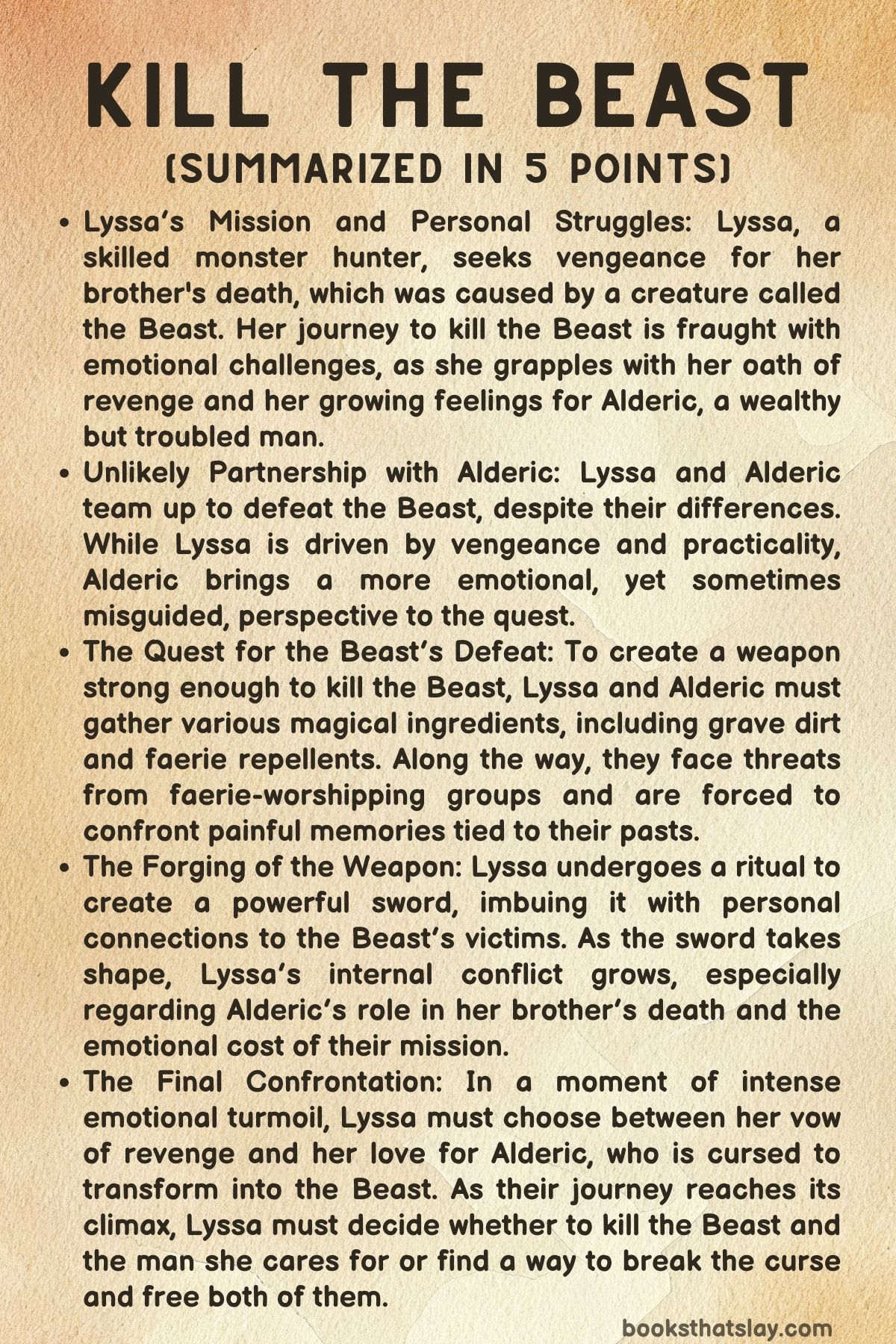
Kill the Beast by Serra Swift is a fantasy novel filled with action, suspense, and emotional depth. It follows the journey of Lyssa, a skilled monster hunter, as she embarks on a quest to kill a deadly creature known as the Beast, which has caused great personal loss in her life.
Along the way, she forms an uneasy alliance with Alderic, a wealthy man with a dark connection to the Beast. As they navigate their dangerous mission, Lyssa must confront her past, her emotions, and the moral complexities of vengeance, ultimately leading to an unexpected conclusion.
Summary
Lyssa, a skilled monster hunter, walks into the Kingmaker restaurant carrying a bloodied burlap sack, immediately drawing attention. She is there to confront William Clarke, a man who owes her for killing a troll.
She brings the severed head of the creature to intimidate him, and after some tense negotiations, Clarke reluctantly gives her a valuable belt as compensation instead of paying the full debt. Afterward, Lyssa heads to a post office, where she picks up letters from a nobleman, Alderic Casimir de Laurent, who requests her help with a monster problem, sparking her curiosity despite her disdain for wealthy clients.
While walking through the streets of Warham with her dog Brandy, Lyssa reflects on her brother Eddie’s death, which still haunts her. She passes his grave in a memorial park and encounters her estranged father, who expresses regret for abandoning her and her brother.
Their conversation is tense, and Lyssa refuses to forgive him. She then returns to the Witch’s Wood, where she lives in a cabin with Ragnhild, a witch, and her apprentice Nadia.
Lyssa has been researching faeries and the Beast for years, and the letter from Alderic provides her with a new lead.
The next day, Lyssa travels to Bleakhaven to meet Alderic, who explains that he has found the Beast of Buxton Fields and offers her a job to kill it. Alderic’s behavior raises Lyssa’s suspicions, and when she visits his manor, she finds the place surrounded by dangerous thorny trees, which only increases her wariness.
As they prepare to leave, they are confronted by a Hound-warden named Honoria, a former lover of Lyssa’s. She is now leading a group that protects faeries, and the confrontation raises tensions between Lyssa and her past connections.
Lyssa and Alderic set off on their mission to kill the Beast, which has terrorized the land for years. Lyssa, a monster hunter, is skilled in tracking dangerous creatures, but Alderic, a wealthy man, has little practical experience.
Despite their differences, Lyssa and Alderic form an uneasy partnership. Along the way, Lyssa protects him from the Hound-wardens, including Honoria.
They escape through a magical Door to the Witch’s Wood, a liminal space between worlds, where they are joined by the witches Ragnhild and Nadia.
In the Witch’s Wood, Lyssa aims to forge a weapon powerful enough to kill the Beast. Ragnhild helps her decipher a glyph related to the Beast, but it remains a mystery.
The glyph reveals that the Beast’s creation is tied to emotional trauma, making it harder to understand. Alderic mentions that he has seen a similar glyph in an old royal book, which could be the key to unraveling the Beast’s secret.
The witches suggest that to kill the Beast, Lyssa and Alderic must create a weapon with personal connections to the Beast’s victims. They gather specific ingredients, including grave dirt, faerie repellents, and botanical items, under the right lunar phases.
Lyssa struggles with the emotional connections required for the weapon, particularly with water, which is linked to happy memories. She eventually decides to use ash wood from a tree she and her brother Eddie used to climb as children, a painful yet important memory.
In Warham, Lyssa and Alderic gather supplies, and despite Alderic’s frivolous spending, he proves helpful in other ways, like knowing the phase of the moon and suggesting places to gather the necessary ingredients.
During their journey, Lyssa feels increasingly anxious about the task ahead. She knows they have limited time before the Beast awakens, and the witches warn her that failing to gather the correct emotional items could result in failure.
Lyssa grows wary of trusting Alderic fully, but they continue working together, gathering the materials needed for the weapon. As their journey progresses, Lyssa and Alderic’s relationship becomes more complicated.
Lyssa tries to maintain emotional distance from him, fearing that any attachment would jeopardize their mission.
In Warham, they visit a graveyard to collect the final pieces for the sword. Lyssa’s father unexpectedly appears, and in a moment of anger, Lyssa injures him while protecting her brother’s grave.
This encounter forces Lyssa to confront her unresolved anger toward her father, who abandoned her and Eddie. Alderic is disturbed by the violence, but Lyssa focuses on their mission.
They continue gathering the remaining ingredients for the sword, including coffin nails from a crypt, where Alderic struggles with the emotional toll of the task. Lyssa decides to use Brandy’s collar as a personal connection for the weapon, symbolizing her love for her dog, her only remaining companion.
The sword is finally forged, and Lyssa prepares for the final confrontation with Alderic. Before she leaves, she has a tense conversation with Nadia, who warns her about the complexity of their mission.
Nadia, a faerie herself, suggests that Lyssa reconsider her vow to kill the Beast, but Lyssa is determined to fulfill her promise of vengeance.
At Alderic’s manor, Lyssa finds a letter from him, along with the deed to her childhood home. Alderic is ready to face his fate, admitting his guilt for the deaths caused by the Beast.
As he prepares to transform into the Beast, Lyssa hesitates, torn between her oath and the humanity she still sees in him. When the Beast appears, Lyssa realizes that it is not the man she knew but an uncontrollable, monstrous part of him.
Despite her anger, she is unable to kill him immediately. The Beast attacks, and in the ensuing chaos, Lyssa is wounded but manages to evade the creature.
Lyssa eventually confronts the Beast one last time, realizing that to destroy it, she must destroy the man she loved. She decides to stop running and find a way to break the curse that has bound Alderic for so long.
Her emotions overwhelm her, and the Beast reverts back to Alderic, now human again. He is confused and remorseful, and Lyssa admits that she still loves him.
They share a moment of understanding, and Lyssa fulfills her vow in a way she did not expect.
In the aftermath, Lyssa visits her brother’s grave and reflects on her journey. She thanks her father for his help, despite their complicated relationship, and decides to give him a chance to be part of her life.
Lyssa and Alderic walk away from the grave together, uncertain of their future but hopeful. They step into the unknown, with the possibility of healing and redemption guiding their way.
Characters
Lyssa
Lyssa is the central figure in Kill the Beast, and her character is shaped by a profound sense of vengeance and loss. The death of her brother, Eddie, at the hands of the Beast of Buxton Fields remains her driving force, molding her into a skilled and relentless monster hunter.
She is independent, emotionally distant, and has a strong sense of justice, which is evident in her determination to collect what is owed to her and her ability to confront adversaries like William Clarke. However, beneath her tough exterior, Lyssa struggles with deep guilt over her brother’s death and unresolved anger towards her estranged father, who abandoned her and Eddie.
As the story progresses, her interactions with Alderic reveal her internal conflict between fulfilling her oath of vengeance and grappling with the emotional consequences of their shared quest. Her character evolves as she confronts her emotions, especially when faced with the realization that the Beast is not just a monster but a tortured reflection of Alderic himself.
By the end of the novel, Lyssa’s journey of vengeance transforms into one of understanding and healing, not just for herself, but for the man she once loved.
Alderic Casimir de Laurent
Alderic, in stark contrast to Lyssa, is wealthy, slightly bumbling, and emotionally complex. Initially appearing as an erratic nobleman hiring Lyssa to kill the Beast, his motivations and struggles are slowly unraveled as the narrative progresses.
He is haunted by his past, particularly the death of his brother, Desmond, and his deep involvement with the Beast’s curse, which transforms him into the very monster Lyssa has sworn to destroy. Alderic’s initial presentation as a clueless and somewhat impractical nobleman gives way to a man consumed by guilt and internal conflict.
As he works alongside Lyssa, his emotional weight becomes increasingly apparent, especially when he reveals his actions surrounding the Beast and his inability to control the transformations. Despite the tension and mistrust that develops between him and Lyssa, his relationship with her is a key component of his character arc.
His eventual transformation back into the Beast and his subsequent remorse showcases his struggle with his dual nature. By the end of the story, Alderic’s path to redemption is intertwined with Lyssa’s, as their shared trauma leads them to a place of mutual understanding and the possibility of healing.
Ragnhild
Ragnhild is a witch who plays a pivotal role in helping Lyssa throughout her journey, particularly with the forging of the weapon to kill the Beast. She is wise, experienced, and grounded in her magical practices, providing the knowledge necessary to decode the Beast’s glyph and assist Lyssa in gathering the materials for the weapon.
Though Ragnhild is a figure of authority, her vulnerabilities also shine through, especially as she becomes ill from prolonged exposure to the magical forge. Her illness, coupled with her role in guiding Lyssa through the rituals, highlights her deep connection to the task at hand and her loyalty to Lyssa’s mission.
While she doesn’t take center stage in the emotional narrative, Ragnhild’s presence offers guidance and stability, and she acts as a crucial mentor figure for Lyssa, even if her own struggles remain quietly in the background.
Nadia
Nadia, the witch’s apprentice, adds an additional layer of complexity to the story through her personal connection to Lyssa and her own tragic past. Nadia harbors feelings for Alderic and is not as eager to confront the Beast, especially after learning the emotional toll it takes on the people involved.
As a faerie, she has her own reasons for hesitating in the mission, particularly when she warns Lyssa of the emotional consequences of their quest. Nadia’s relationship with Lyssa is more nuanced, as she provides a different perspective on the situation, urging Lyssa to reconsider her mission.
Nadia represents a different kind of struggle in the story—one between duty, love, and the emotional cost of their dangerous pursuits. Her warning to Lyssa and her own emotional baggage provide a stark contrast to Lyssa’s singular focus on vengeance, offering a glimpse into the more complicated dynamics at play in the world Lyssa inhabits.
Honoria
Honoria, a Hound-warden and former lover of Lyssa, plays a significant role in complicating Lyssa’s mission. As the leader of a group dedicated to protecting faeries, Honoria is positioned as an antagonist of sorts, her motivations shrouded in a deep-rooted sense of duty and unresolved emotions towards Lyssa.
Her appearance in the narrative serves as a reminder of Lyssa’s past, both emotionally and professionally, and their tense interactions underscore the conflicts Lyssa has left behind. Honoria’s role as a protector of faeries places her at odds with Lyssa’s quest, and her attempts to prevent the killing of the Beast introduce another moral layer to the story.
Despite the tension, Honoria’s presence also highlights the gray areas in Lyssa’s mission, forcing Lyssa to confront not just her personal demons, but also the larger political and emotional implications of her actions.
Brandy
Brandy, Lyssa’s loyal dog, acts as her sole remaining companion and symbol of the life Lyssa left behind after her brother’s death. Though Brandy is not an active participant in the story’s central conflicts, the dog’s presence in Lyssa’s life is significant.
Brandy represents the last bit of warmth and love Lyssa allows herself to experience, and as such, Brandy’s role in the narrative is symbolic of the personal sacrifices Lyssa has made in the name of vengeance. The emotional connection between Lyssa and Brandy is pivotal, especially when Lyssa chooses to use Brandy’s collar as a symbolic item in the creation of the weapon meant to defeat the Beast.
Brandy’s loyalty and steadfastness underscore the emotional journey Lyssa embarks upon, reinforcing the theme of companionship in the face of overwhelming loss and grief.
Themes
Revenge and Redemption
Lyssa’s journey in Kill the Beast is driven by a deep and all-consuming desire for revenge, one that has shaped much of her life since the death of her brother, Eddie, at the hands of the Beast. Her oath to avenge Eddie’s death is the cornerstone of her existence, and it propels her through dangerous situations and emotional turmoil.
Lyssa is determined to kill the Beast, but her quest for vengeance is complicated by the realization that the Beast is, in fact, a part of Alderic, a man she has grown to care for deeply. This emotional conflict highlights the theme of redemption, as Lyssa is forced to confront the dual nature of the Beast: it is both a monster and a man, and in killing it, she risks killing the person she loves.
The story ultimately portrays that revenge, while it offers a sense of justice, often leads to complicated consequences, where the lines between right and wrong blur. Lyssa’s willingness to sacrifice her emotions and her desire for closure is challenged as she discovers that redemption may come not through vengeance but through understanding and compassion.
Alderic’s eventual transformation from the Beast back to a human being, coupled with Lyssa’s decision to break the curse rather than destroy him, reflects a profound shift from the pursuit of revenge to the possibility of healing and redemption. This theme suggests that, even in the darkest circumstances, forgiveness and love can offer a path forward.
Grief and Loss
Grief is a pervasive theme throughout Kill the Beast, deeply influencing the actions, motivations, and relationships of the characters. Lyssa’s grief over her brother’s death drives her relentless pursuit of the Beast.
Her pain is ever-present, affecting her ability to connect with others and clouding her judgment as she focuses entirely on revenge. This grief is complicated by the ongoing loss of her relationship with her father, who abandoned her and her brother when they needed him most.
The unresolved anger and sadness she carries from both her brother’s death and her father’s neglect weigh heavily on her. These emotions affect Lyssa’s interactions with others, particularly Alderic, as she keeps herself emotionally distant to avoid further heartache.
The theme of grief is also explored through Alderic, who has lost his own family to the Beast and bears guilt for the pain caused. The shared experience of loss between Lyssa and Alderic creates a bond between them, but it also fuels their personal struggles.
Lyssa’s eventual decision to embrace Alderic, despite the danger and emotional turmoil, signals a moment of healing. It suggests that while grief may never fully disappear, acknowledging it and confronting it together can lead to growth and a renewed sense of purpose.
The Complexity of Human Nature
Kill the Beast intricately examines the complexity of human nature, particularly through the characters of Lyssa and Alderic. Lyssa is portrayed as a woman hardened by her past and driven by a singular goal: to kill the Beast.
However, as the story unfolds, her rigid commitment to vengeance begins to crack. She grapples with conflicting emotions as she becomes more involved with Alderic, who represents both the monster she wishes to destroy and the man she might have loved.
Alderic, too, embodies the complexity of human nature. On the surface, he appears to be a wealthy, slightly bumbling figure, ill-suited for the dangerous quest they undertake.
But as the story reveals, he is haunted by his own past, filled with guilt and sorrow for the harm caused by the Beast he once became. His dual identity as both the Beast and a man creates a profound internal conflict.
The book suggests that human beings cannot be reduced to simple binaries of good or evil; rather, they are shaped by their experiences, their regrets, and their capacity for both destruction and redemption. This exploration of human nature invites readers to reconsider their assumptions about the people they encounter, understanding that everyone carries a complexity that cannot be easily understood or judged.
Isolation and Connection
Isolation is a recurring theme in Kill the Beast, as many of the characters, especially Lyssa, struggle with being alone in their pain. Lyssa’s emotional detachment from others, including her estranged father and her partner, Alderic, underscores her reluctance to trust or rely on others due to past traumas.
She keeps her distance, not allowing herself to become too attached, fearing that doing so will hinder her mission and lead to further heartbreak. Her relationship with Alderic is fraught with tension, as she constantly battles her growing feelings for him, viewing emotional connection as a potential weakness.
However, as the journey progresses, Lyssa begins to realize the importance of connection. Despite her initial reluctance, she forms a bond with Alderic, driven by their shared grief and the understanding of each other’s pain.
Similarly, the witches, particularly Ragnhild and Nadia, play important roles in providing support, even if Lyssa struggles to open up to them. The theme of isolation and connection is central to Lyssa’s emotional growth, as she learns that true strength comes not from pushing others away, but from allowing herself to rely on them.
By the end of the novel, Lyssa’s decision to forgive her father and acknowledge the role of connection in her healing process highlights the transformative power of relationships, even in the face of overwhelming isolation.
The Burden of Duty
Throughout Kill the Beast, the theme of duty is explored through the character of Lyssa, whose commitment to avenging her brother’s death becomes her singular purpose. She lives and breathes for this mission, allowing it to dictate her every action and decision.
The burden of this duty weighs heavily on her, isolating her from others and preventing her from experiencing joy or emotional fulfillment. As the story progresses, the question of duty versus personal happiness becomes more pronounced.
Lyssa’s evolving relationship with Alderic forces her to question whether fulfilling her vow is worth the emotional cost it demands. In contrast, Alderic’s own sense of duty is tied to his family’s legacy, and his willingness to sacrifice for a greater cause mirrors Lyssa’s struggles.
The pursuit of their shared goal—killing the Beast—becomes a burden they both bear, but it is only through confronting the reality of their duties and making difficult choices that they can find a way to move forward. The theme of duty in the novel raises questions about personal sacrifice, the cost of vengeance, and the fine line between fulfilling one’s responsibility and losing oneself in the process.
Ultimately, the characters’ growth lies in their ability to balance duty with compassion and the realization that some burdens are too heavy to carry alone.