Kingdom of Today Summary, Characters and Themes
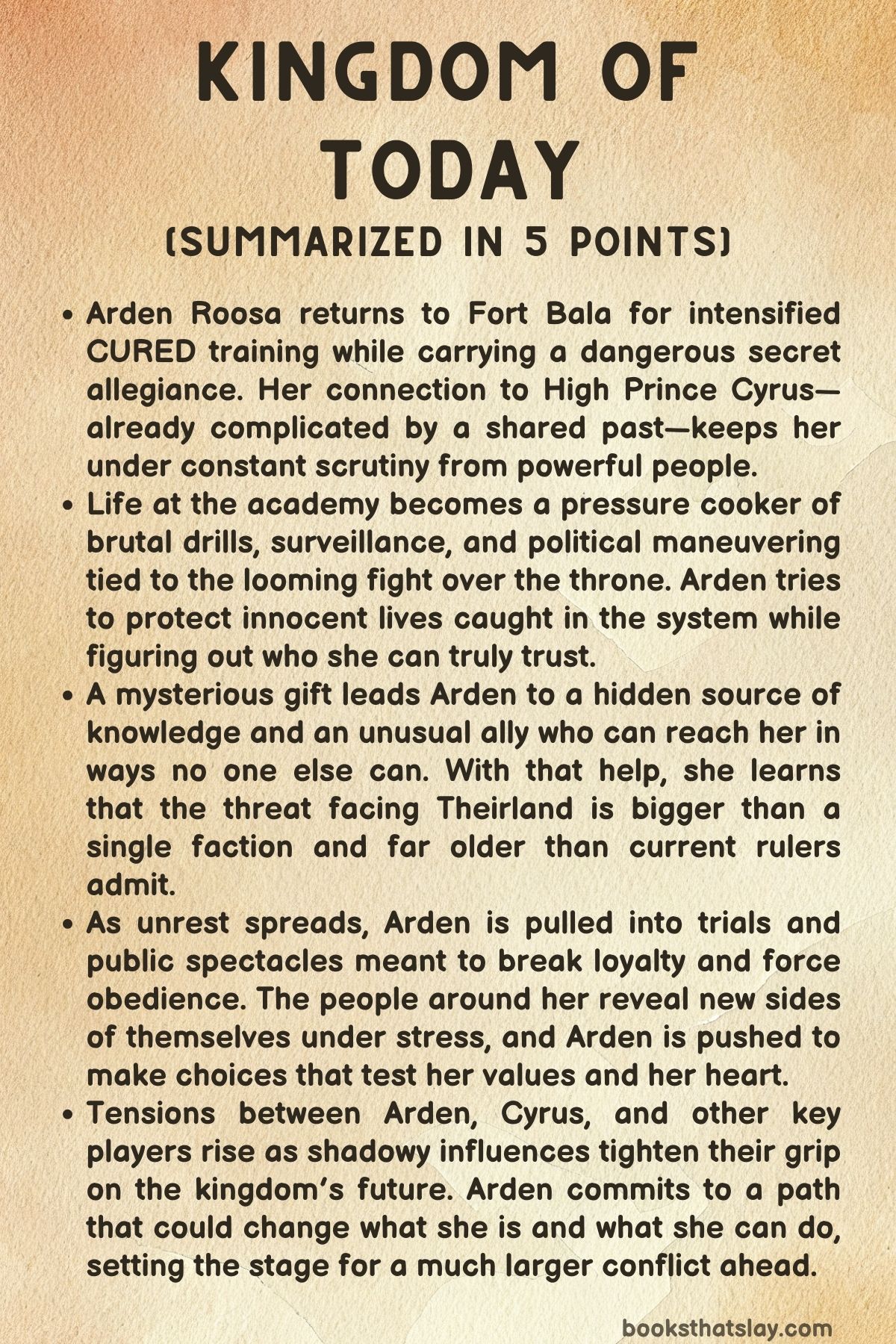
Kingdom of Today by Gena Showalter is a fast-paced fantasy romance set in Theirland, a world ruled by harsh doctrine, royal power games, and a spreading sickness called Madness. Arden Roosa lives a double life: she trains inside CURED’s military system while secretly serving Soal, the resistance blamed for the very chaos CURED claims to prevent.
Her closest tie is also her biggest risk—High Prince Cyrus Dolion, the man she once helped kill a king to survive. As Arden uncovers hidden prisoners, forbidden magic, and gods hunting human hosts, love stops being a safe place and becomes a battlefield. It’s the 2nd book in the Book of Arden series.
Summary
Arden Roosa begins the story headed to Fort Bala, a strict military academy controlled by CURED. She is officially a lady-in-training and future officer, but in truth she is working for Soal as a covert operative.
Her secret mission is complicated by Cyrus Dolion, a high prince with both power and danger wrapped into him. Arden and Cyrus share a history that cannot be undone: during a previous crisis, they killed Cyrus’s father, King Tagin, to save Arden.
The kingdom now needs a new ruler, and Cyrus is one of several royals eligible for the crown. Arden fears that if Cyrus enters the competition and loses, he will lose access and influence—access that Soal needs to survive the larger war.
On the train, Cyrus corners Arden with his usual confidence and a controlled kind of affection. He gives her a necklace that merges with her skin and alters her voice when she is recorded, a protection normally reserved for royals.
He orders her never to remove it. Arden reads this as both a gift and a warning: inside CURED territory, every conversation can become evidence.
At Fort Bala, Arden is subjected to invasive testing, strapped down and scanned through the chip embedded in her hand. Dr. Korey confirms she is negative for Madness, but then announces her chip has been updated with a royal designation, meaning staff must now explain procedures to her.
Arden realizes she is being watched at a higher level than she expected. Soon after, Mr. Vyle—an influential figure close to the emperor—interrogates her.
Arden answers carefully, giving a version of Tagin’s death that is technically true but shaped to protect Cyrus and herself. Vyle also fixates on a forbidden red berry connected to Cyrus, pressing Arden for details.
Arden refuses to give him anything useful. Before ending the interrogation, Vyle warns that someone inside their ranks is playing both sides, and he intends to find that person.
Arden’s daily life turns brutal. She is moved into the harsher side of the fort and assigned constant escorts who make it clear she is under surveillance.
Archduke Heta tightens the program, chaining trainees together in pairs to force teamwork under pressure. Arden is chained to different partners and pushed through exhausting drills.
She keeps her head down, but rumors about Tagin’s death, the royal contest, and Cyrus’s political enemies spread through the academy.
Back in her cell, Arden discovers someone has upgraded her living conditions: better bedding, a chair, and an extra reader device. A message from Cyrus explains that the reader is their safest communication channel.
He also hints that he has left her a hidden gift and tells her to “get dirty” to find it. Arden digs into the pot of soil and finds an orb-like fragment tied to the Rock, a legendary gateway connected to an invisible library and the cure to Madness.
That night, a figure appears that only Arden can perceive: Domino Crane, an elite librarian of the Tome Society. Domino explains that the Rock fragment has linked them, allowing Arden to summon him by focused need.
He refuses to let her access certain sacred texts outside the library’s rules, but he does give her critical warnings. He tells Arden there is another hidden Soalian among her group, and he urges her to learn to sense allies.
He also reveals that Mr. Vyle is far more than an aide—he is the royal executioner—and that Cyrus has been suspected of treason with an execution date already set.
Arden panics and contacts Cyrus through coded messages. Cyrus arranges a private meeting and appears in her cell, confirming that Vyle’s authority over him is limited for now.
They share a brief, urgent closeness before Cyrus leaves, both of them aware that affection is a liability in a place built to punish it.
Heta soon takes the trainees to a medical basement where infected soldiers are kept behind glass. CURED claims the treatment is necessary, but Arden sees suffering, cruelty, and a system that uses patients as objects.
She spots her old roommate Mykal imprisoned and deteriorating. Worse, she sees John Victors, a captured ally, strapped to machines and badly injured.
Arden’s anger hardens into resolve: she will not leave them to rot, even if helping them exposes everything.
The fort erupts into chaos when maddened patients break loose and attack the training gym. Arden and the trainees fight with whatever weapons they can grab.
In the middle of the battle, Arden’s body ignites with golden light, revealing her Soalian nature. She expects everyone to notice, but the guards and trainees don’t react—yet the maddened do.
They converge on her as if drawn by instinct. Arden moves with sudden speed and control, dropping attackers and protecting others despite her terror.
Her chained partner, Miller, proves unexpectedly reliable in the fight, and together they survive until reinforcements arrive with netters to capture the infected.
Afterward, Cyrus arrives with other royals and Mr. Vyle. Vyle announces the breakout was engineered: someone planted a device to open patient rooms on a timed schedule.
Everyone will be tested and questioned. Cyrus privately warns Arden that CURED may be trying to trap her through her reactions and her loyalty to imprisoned friends.
Arden admits she glowed during the battle, and Cyrus explains that perception can shift depending on infection and exposure—sometimes people don’t see what they should.
Over the next days, Arden learns that Mykal escaped, and a scapegoated trainee is executed as an example. Arden uses her day off to reach the Rock.
Domino appears, warns her she’s being followed, and cloaks her in fog so she can enter a carved circle and step into the library realm.
Inside is a lush, living archive. Arden meets Ember Cruz, a powerful Soalian figure who forces her into a lesson outside normal time.
Arden reunites briefly with her mother, Elise, now Soalian, and learns deeper truths about Theirland’s history: gods trapped in monuments, lies that shaped the world, and the danger of divine beings seeking hosts. Domino then shows Arden her personal record: “The Book of Arden, Volume 20.” A message warns her of coming trials.
Arden decodes a terrifying line—Astan has claimed Cyrus as his chosen.
When Arden returns, Cyrus becomes harder to reach and more tightly guarded by circumstance. Vyle’s control intensifies, and selected trainees—including Arden—are moved to the emperor’s crystal palace under a suffocating dome of shadow.
In a public display meant to crush dissent, Vyle executes captured glowers while the crowd cheers. Arden has to hide her horror to survive.
At the palace, CURED subjects the chosen group to a deadly “trial,” ordering them to fight until enough people die. Panic and suspicion explode.
A shadowy force slams into Arden with terror, and she pushes it out by anchoring herself through her bond to Domino. Miller reveals he is Soalian and saves Arden, but he is shot and killed.
The lesson is clear: CURED is shaping them into tools who will commit atrocities on command.
Vyle later shows Arden footage of Mykal and Victors being tortured, threatening to destroy Arden if she becomes an enemy—and hinting that Astan can offer power if she yields. Arden is then brought into a temple-like chamber where royals and the emperor sit in a trance beneath Astan’s statue.
Arden senses a key she needs, and she reaches for Cyrus—only to see him unraveling.
A deadly confrontation ends with Felix dead and Cyrus returning wounded and distant. In a sudden, brutal move, Cyrus stabs his own grandfather and declares he will share power with no one.
Arden realizes what has happened when six golden stars flare in Cyrus’s eyes: he has agreed to host Astan. Cyrus insists he is still himself, only stronger, and he pressures Arden to accept Briar Rose as her own god-host so they can destroy Soal together.
Arden refuses. Cyrus shows her visions meant to break her will, including Domino’s torture, and briefly removes Astan’s presence to prove he will die without it.
Arden treats his collapsing body and begs him to stop. When he sleeps, she steals his key ring and escapes toward the Rock for answers.
Mr. Vyle intercepts her and reveals the truth: he is Soalian too, hosting Bala, Astan’s dragon. He destroys Arden’s escort and nearly kills her.
Domino surges into Arden through their bond, healing her and amplifying her strength. They fight together, but Roman shoots Arden from behind, forcing Domino out.
Arden is captured again, and Cyrus—still marked by the stars—executes Roman instantly. Cyrus gives Arden a final ultimatum: accept Briar Rose or die.
Cyrus attempts to drug and persuade Arden inside a manufactured paradise. Arden resists, anchoring herself to Domino and refusing the god.
Cyrus responds by offering Briar Rose to Lolli instead. Lolli accepts, and her body erupts with flowers and vines as Briar Rose takes control.
Arden escapes by leaping from the castle and nearly drowning in the icy moat until Domino rescues her.
Domino tells Arden she must learn to forge Soal’s flame into a weapon. They flee through gunfire and monsters, steal a truck, and race toward the barrier around the berry field where glowers are trapped.
Lolli’s vines spread, controlling the battlefield. Cyrus and the possessed Lolli confront them.
Arden stalls Cyrus, then kisses him to buy a heartbeat of distance, and stabs him. She then kills Lolli, breaking the vines and freeing captives.
Winslet sacrifices herself against the barrier, opening a doorway with blood.
Arden and Domino charge into the field. The Rock grows rapidly as battle rages.
Arden fights through pain, reaches the Rock, and collides with it as it expands into her. Darkness takes her.
She wakes inside the library realm, transformed into a librarian with a memorial space bearing her name. Domino explains that Arden now has a domain of her own and must train for what comes next.
Cyrus appears outside her domain, visibly corrupted by greed and power, and declares the war is only beginning. Arden tells him they are enemies now—but promises she will free him from Astan.
With the Rock changed, her identity remade, and her heart still tied to a man becoming something else, Arden commits to preparing for the next stage of the fight.
Characters
Arden Roosa
Arden is the story’s moral center and its most volatile catalyst, a young woman forced to live as two people at once: a CURED trainee outwardly loyal to Theirland’s system and a hidden Soalian operative working to undermine it. What makes her compelling is how often her principles put her in immediate danger; she repeatedly chooses restraint and mercy even when lethal force would be easier, and that choice becomes both her defining strength and a tactical weakness in combat.
Her identity is not just a secret but a pressure system—her Soalian glow, her bond to the Rock, and the way the “inward sense” begins to guide her all mark a transformation from soldier-in-training into something rarer and more consequential. Across the story, Arden’s arc is driven by escalating knowledge: each revelation in the library doesn’t simply inform her, it changes what she must be willing to sacrifice.
By the end, she is no longer only trying to survive CURED or protect friends like Mykal and Victors; she is forced into a role where her body, loyalties, and future are literally rewritten, and her final commitment is not to comfort or romance, but to preparation—training, responsibility, and the resolve to save Cyrus even after he becomes her enemy.
High Prince Cyrus Dolion
Cyrus is written as both romance and threat, a man whose tenderness and brutality are never cleanly separable, and whose love for Arden is genuine even when it becomes possessive, coercive, and strategically dangerous. He begins with a rebellious edge—talking about dismantling CURED, freeing Soalians, and challenging imperial authority—yet that defiance is tangled with entitlement, because he also expects obedience from Arden and uses proximity, power, and intimidation as tools.
The most frightening part of his descent is that it doesn’t erase his feelings; it weaponizes them. Missing memories, the removed brand, the itch in his chest, and the gradual shift in language and temperament all foreshadow a takeover that is not purely external—Astan’s influence amplifies Cyrus’s fear of loss, jealousy, and need for control until “protection” becomes domination.
His decision to host Astan is framed as a choice made under emotional duress: he believes he’s preventing a future where he dies and Arden leaves him, and that belief becomes the lever that turns him into the very catastrophe Arden must stop. Even after he “proves” he can pull Astan back, the relationship becomes a war over consent—his insistence that Arden accept Briar Rose, his use of terror images, drugs, and staged paradise all show a man trying to secure love through force rather than trust.
By the end of the story, Cyrus remains tragic rather than flatly villainous because the story keeps a sliver of him visible beneath the corruption, making Arden’s vow to free him feel like an act of love that has matured into something harsher: love that refuses to excuse.
Mr. Vyle
Mr. Vyle embodies institutional cruelty made personal: he is not merely an official enforcing policy, but the system’s sharpest blade, a figure who treats terror as governance and spectacle as discipline. His interrogations are structured like traps—he invites explanation only to measure weakness, and he uses partial truths to corner people into self-incrimination.
The public beheadings of captured glowers, the hanging of a scapegoated trainee, and the staged “trial” where trainees are ordered to ensure deaths reveal his philosophy: morality is irrelevant, obedience is everything, and complicity is the point. What elevates him beyond a typical sadist is his layered position in the mythic conflict; he is revealed as Soalian and as a host to Bala, turning him into a paradox—someone tied to the oppressed side while serving the oppressor’s machine.
That contradiction makes him feel like a warning about power: identity alone does not determine allegiance, and suffering does not prevent someone from becoming an instrument of suffering. Vyle’s presence constantly collapses the illusion that the protagonists can “play the game” safely; he is the reminder that the rules are designed to break people, and that any victory will require something more radical than outsmarting bureaucracy.
Domino Crane
Domino is the story’s most enigmatic protector—part ally, part gatekeeper, and eventually part fate—because his help always comes with rules, boundaries, and a sense that he is constrained by forces larger than personal preference. As an elite Tome Society librarian, he represents knowledge that is alive, coded, and dangerous, and his refusal to let Arden read freely underscores that information in this world is not neutral; it shapes outcomes and can ensnare the reader.
His bond with Arden begins as survival and becomes irreversible, turning him into both a lifeline and a complication, especially when the bond allows spirit-walking, concealment, decoding, and even emergency possession that saves her life. The tenderness of his care is real, but so is his severity; he pushes Arden out of the library realm when fear clouds her decoding, and he shows her disturbing visions not to entertain but to prepare her.
The history between Domino and Cyrus adds emotional depth: Domino is not simply “the other man,” but a living scar from Cyrus’s earlier choices—betrayal, torture, and loss—making their triangle less about romance and more about trust, guilt, and the cost of aligning with the wrong power. By the end of Kingdom of Today, Domino functions like a bridge between Arden’s former life and her transformed one; he is the guide who cannot fight the war in her place, but can train her, anchor her, and keep her alive long enough to become what the coming conflict requires.
High Princess Lolli Dolion
Lolli operates as a social predator within the royal ecosystem, someone who treats affection, loyalty, and even violence as transactional tools, and she is dangerous precisely because she understands how to perform innocence while pursuing advantage. Her rapid shift into sexual and political entanglements—moving through relationships and rivalries with little visible remorse—paints her as pragmatic rather than passionate, and her hostility toward Arden feels rooted in competition and fear of displacement.
What makes her role especially grim is how she becomes a vessel for coercion: when Arden refuses Briar Rose, Cyrus redirects that demand onto Lolli, and Lolli’s acceptance becomes both punishment and weaponization. The imagery of vines and flowers erupting from her body turns her into a living symbol of violated agency and corrupted “beauty,” and once possessed she becomes a battlefield hazard rather than a person with choices.
Her death is not treated as triumphant so much as necessary, an act Arden commits to free others and break the immediate threat, but it also reinforces one of the story’s darkest themes: in a world ruled by gods and empires, even the cruel can be used as tools, and even the powerful can be consumed.
Roman
Roman is a study in opportunism and cruelty wrapped in the protective camouflage of charisma and competence. Early on he presents as a source of information and camaraderie inside Fort Bala, someone who knows the rumors and the political weather, but that usefulness hides a willingness to harm others the moment it benefits him.
His private entanglement with Lolli reveals a comfort with betrayal and secrecy, and his behavior during the forced-death trial exposes a hunger for domination—torturing Miller, escalating chaos, and steering blame. Roman’s role peaks as a reminder that not every threat is mythic; some dangers are simply human ambition armed with institutional permission.
When he shoots Arden and is executed instantly by Cyrus, his end lands like a brutal punctuation mark: the system rewards predators until a bigger predator decides they are inconvenient.
Miller Bosworth
Miller begins as friction—Arden’s chained partner, argumentative, needling, and seemingly aligned with the culture of mockery and suspicion in the academy. What makes him memorable is the gradual reveal that antagonism can be a mask for survival and allegiance, and that competence under pressure can create trust even between people who dislike each other.
During the gym outbreak he shifts from adversary to shield, taking blows and coordinating tactics, and that moment matters because it’s one of the few times Arden experiences cooperation inside CURED without immediate betrayal. His eventual confirmation as Soalian and his use of a pritis cannon recast many earlier interactions as guarded positioning rather than simple hostility.
His death is abrupt and ugly, the kind that underlines the story’s refusal to romanticize rebellion; allies can be real and still be expendable. Miller functions as a proof of concept for Arden’s mission—there are hidden Soalians in plain sight—but also as a warning that discovery often arrives too late to save the discovered.
Mykal
Mykal represents the cost of CURED’s “treatment” and the moral line Arden cannot stop seeing once she’s crossed it. Introduced through Arden’s shock at finding her former roommate imprisoned and deteriorating, Mykal becomes the personal face of a broader horror: the system doesn’t merely fight Madness, it creates suffering and then calls it medicine.
Her later reappearance—gaunt, terrified, insisting she isn’t infected—captures how the regime’s logic weaponizes uncertainty, turning the absence of proof into justification for capture. Mykal’s trajectory also complicates the political landscape; she ends up with rebels who reject both CURED and Soal, suggesting a third position born out of disillusionment rather than ideology.
That detail matters because it challenges Arden’s assumptions about what “saving” someone means in Kingdom of Today: rescue is not just extraction, it’s helping a person reclaim agency in a world determined to own their body.
John Victors
Victors serves as both evidence and strategist: evidence of what CURED does to captured glowers, and strategist in how he frames the mechanics of god-hosting and anchoring. His battered, machine-strapped condition in the ward is one of the story’s clearest condemnations of the regime, and Arden’s reaction to him is a turning point where her double-agent strategy begins to feel morally impossible to maintain.
Later, when he turns himself in to be present for the “finale,” he reveals a form of courage that isn’t loud but deliberate—he is willing to be trapped if it positions him to influence the outcome. His explanation that gods require anchors and full agreement reframes the conflict from pure power to emotional leverage, emphasizing that fear and pride are not just feelings but vulnerabilities the enemy feeds on.
Victors functions like a grim compass: he reminds Arden that the war isn’t only fought with weapons, but with consent, identity, and the ability to keep one’s mind intact while everything tries to rewrite it.
Dr. Korey
Dr. Korey is a quieter instrument of the regime, and that quietness is what makes her role unsettling. By declaring Arden negative for Madness and explaining the chip’s royal designation, she participates in a system that pretends transparency while maintaining control.
The medical framing—tests, scans, protocols—creates a veneer of legitimacy, yet the environment is coercive: Arden is strapped down, examined, and processed like property. Dr. Korey’s presence shows how oppression often relies on professionals who may not relish brutality but normalize it through procedure.
she embodies the idea that harm can be delivered politely, with charts and rules, and still be harm.
Archduke Heta
Heta is the academy’s ideological drill press: he doesn’t only train bodies, he trains beliefs, and he does so by compressing choice until obedience feels like the only sane option. His chaining system turns partnership into forced dependency, engineering conflict and exhaustion as tools to break individuality.
By dragging trainees through the infected ward and justifying cruelty toward Soalians, he reinforces the regime’s propaganda in a setting where dissent can be punished as weakness. Heta’s most effective tactic is how he frames brutality as necessity; he teaches that compassion is naïveté, and that moral hesitation gets people killed.
he stands for the middle layer of authoritarian power—the kind that doesn’t need to be royal to be lethal, because it shapes the next generation into enforcers.
Emperor Piven Dolion
Emperor Piven is the apex of the political structure Arden is trapped inside, and his power is felt as distance, decree, and atmosphere more than intimacy. He assigns Arden bodyguards, influences training structures, and presides over trials that treat human lives as raw material for conditioning.
His presence at the crystal palace—where shadows and Madness feel thick—links imperial authority to the supernatural rot in the kingdom, implying leadership is not merely corrupt but actively entangled with the rising gods. The moment Cyrus stabs him is significant not only as a coup but as a revelation that the empire’s stability is an illusion maintained by fear; even the emperor can become disposable once a stronger, more mythically empowered force emerges.
Piven symbolizes inherited power that believes itself permanent—until it meets a monster it helped create.
High Prince Felix Dolion
Felix functions primarily as a looming rival and a pressure point in Cyrus’s psyche, less defined by personal warmth than by the way others orbit him as a contender. He is repeatedly positioned as a favored candidate for the crown, and that status makes him a threat to Cyrus’s access and plan, as well as a likely focal point for palace intrigue.
The fact that Cyrus remembers fighting Felix and that Felix’s death becomes part of the chain leading to Cyrus hosting Astan casts Felix as a narrative accelerant: his existence and rivalry help shove Cyrus toward desperation and fatal choices. Felix’s importance is less about who he is on the page and more about what he triggers—competition, fear of replacement, and the justification Cyrus uses to embrace corruption.
High Prince Summit
Summit is presented as a reflection of the court’s decadence and moral vacancy, surfacing through voyeuristic glimpses that show how power is indulged and bodies are used. The spirit-walking scene that reveals him being pleasured by trainees positions him as someone comfortable exploiting hierarchy for gratification, and his later battered appearance after the deadly duel inside the energy field suggests he is also a participant in the regime’s violent rites of selection.
Summit is not the story’s main villain, but he is part of the environment that makes villains inevitable: a royal accustomed to consumption without consequence. he functions as texture that reinforces the kingdom’s rot—pleasure, cruelty, and entitlement braided together.
Winslet
Winslet begins as an annoyance and potential liability, insisting on proximity when Arden wants secrecy, and her presence heightens Arden’s paranoia because she appears whenever concealment matters most. Over time she becomes something more complicated: a trainee swept into larger forces, exposed to violence, and forced to interpret Arden’s refusal to arrest civilians as either principled or privileged.
Her final act—killing herself against the barrier to open a doorway with her blood—reframes her completely, transforming her from nuisance into sacrifice. That moment suggests a late-arriving clarity, a decision to trade her life for a chance at stopping something larger than any personal grudge.
Winslet embodies how ordinary people can be shaped by propaganda for most of their lives and still, in one moment, choose a truth that costs everything.
Elise
Elise, Arden’s mother, appears as both emotional anchor and thematic bridge between Arden’s childhood identity and her emerging destiny. Meeting her in the time-adjacent class reinforces that Arden’s transformation is not an isolated accident but part of a lineage and a broader awakening among Soalians.
Elise’s existence as a Soalian in hiding, protected by undercover guards, shows the generational cost of the conflict: families fractured, identities buried, survival dependent on secrecy. Her presence in Kingdom of Today is less about plotting and more about grounding—reminding Arden that behind every prophecy and divine war, there are relationships worth fighting for, and people who have already endured what Arden is only beginning to face.
Ember Cruz
Ember is the hard-edged mentor figure who treats Arden less like a fragile asset and more like a weapon that must be sharpened quickly. She delivers information with urgency, makes choices for Arden when time is short, and forces her into instruction that is not comfortable but necessary.
Her teaching about Theirland’s history, the gods, and the Rock reframes Arden’s personal drama as part of an ancient, cyclical struggle where narratives are manipulated and divinity preys on human weakness. Ember also acts as an operational node—coordinating rescues, hiding people from surveillance, and managing risk—so her role blends ideology with logistics.
Ember represents the side of resistance that has moved past innocence: she still cares, but her care looks like pressure, preparation, and the refusal to let Arden remain untrained in a world that will not spare her.
Nine (Meta “999”)
Nine is a brief but emotionally potent figure because it represents the possibility of loyalty inside an inhuman system: a designated escort that Arden humanizes with a nickname and treats as more than a tool. Its destruction at Mr. Vyle’s hands is one of the story’s sharper reminders that attachments—especially small, tentative ones—are punished swiftly in Theirland’s power structure.
Nine’s function in Kingdom of Today is symbolic as much as practical: it underscores how Arden’s instinct is always to personify and connect, and how the enemy’s instinct is always to sever and dehumanize.
Astan
Astan is the story’s central corruption: a godlike force tied to Madness, empire, and ideological control, offering power that always arrives with a hook sunk into the host’s worst vulnerabilities. He doesn’t merely possess; he persuades, using curated futures, whispered commands, and emotional leverage to make the host believe surrender is self-protection.
His influence reshapes language, desire, and morality, turning love into a justification for conquest and fear into a tool for compliance. The altered statues, the thick living shadows, the chosen-host gym, and the claim that a man capable of containing Astan’s full brunt has been born all build the sense that Astan is not a singular antagonist but an approaching era.
Astan’s most terrifying trait is how plausible he makes evil feel—how he reframes domination as destiny and cruelty as clarity.
Briar Rose
Briar Rose represents a different flavor of divine predation—more intimate, more seductive, and more explicitly tied to the manipulation of longing and romantic outcome. Her vision to Arden is not simply a threat of death but a threat of replacement: Cyrus holding Lolli as he once held Arden, a future engineered to provoke jealousy, grief, and capitulation.
Her “offer” is framed as acceptance, but it functions as annexation, and when Arden refuses, Briar Rose flows into Lolli instead, turning a political rival into a monstrous floral weapon. Briar Rose embodies how gods weaponize the most human parts of people—desire, insecurity, the need to be chosen—and how refusal can shift the damage onto someone else.
Bala
Bala operates as the mythic extension of brutality, linked to predation and the regime’s monstrous appetite, and its role becomes most vivid through Mr. Vyle’s reveal as Bala’s host. That reveal reframes Vyle’s near-immortality and rapid healing as supernatural reinforcement, turning him from terrifyingly human to terrifyingly empowered.
Bala’s association with the dragon statue and the barriered field positions it as a force that thrives in containment, violence, and hunger—mirroring how CURED treats people as consumable resources. Bala functions as proof that the enemy’s strength is not only political but cosmological, and that the oppression Arden fights is backed by entities that feed on suffering.
King Tagin Dolion
Tagin’s presence is mostly afterimage, but his death is the political detonation that sets the entire succession struggle and surveillance apparatus into motion. The fact that Arden and Cyrus killed him “to save Arden” becomes the kind of truth that can never be safely spoken, because every faction can twist it into treason, scandal, or justification for harsher control.
Tagin’s Madness break during transport and the chaos around his death also serve as a warning about infection and instability—proof that no rank is immune and that the regime’s obsession with control cannot fully prevent collapse. Tagin’s function is catalytic: his fall clears the board for successors, intensifies paranoia, and forces Arden and Cyrus into the same bind that defines their relationship—shared guilt that can be used to destroy them.
Themes
Power, Legitimacy, and the Machinery of Rule
Authority in Kingdom of Today is never presented as a neutral structure; it is a weapon system built to standardize obedience and punish deviation. The succession contest after Tagin’s death is less about governance and more about control of the state’s tools: surveillance, imprisonment, narrative management, and sanctioned violence.
Arden’s early examination—strapped down, scanned through her chip, and questioned under sterile lights—shows how legitimacy is manufactured through procedure. “Safety” language masks domination, and the royal designation on her chip turns into another form of possession: the state claims a right to her body while pretending to protect it.
As Arden moves from the palace-like wing of Fort Bala to its prison-like half, the physical architecture reinforces the social one—comfort and privilege exist on one side, deprivation and coercion on the other, and trainees are the bridge being shaped into instruments.
Mr. Vyle embodies how power operates when it is honest about its cruelty. He is not merely an administrator; he is an executioner who uses terror as policy, beheading captives publicly to fuse spectacle with loyalty.
That scene clarifies that the regime is not trying to eliminate dissent alone; it is training the population to celebrate the elimination of dissent, turning violence into civic bonding. Even the “trial” where five must die is framed as a test, but its real purpose is conditioning: it teaches future elites to commit atrocities under orders, then live with themselves afterward.
In that environment, legitimacy becomes performance—who can look unshaken, who can follow commands quickly, who can rationalize cruelty as necessity. Arden’s resistance threatens the entire logic of the institution because she insists on moral evaluation inside a system designed to erase morality.
This theme reaches a sharper edge when Cyrus seizes the throne by stabbing his own grandfather, rejecting shared rule in favor of singular domination. The act is not only personal brutality; it is a statement about what kind of sovereignty is coming—one that does not negotiate, does not compromise, and does not tolerate independent centers of authority.
When Cyrus later tries to force Arden to accept a god and frames the demand as destiny and partnership, it mirrors the state’s logic: consent is expected, refusal is treated as treason, and “choice” is offered only inside a cage. The book repeatedly shows that the regime’s stability relies on turning human beings into assets, and the most dangerous people are those who refuse to become property.
Surveillance, Secrets, and Identity Under Control
Arden lives inside a world that treats privacy as a crime waiting to be discovered. The necklace Cyrus gives her—blending into her skin and distorting her voice when recorded—signals how normal surveillance has become for the ruling class.
Protection is not about dignity; it is about operational advantage. Arden’s double-agent status intensifies this theme because she must constantly decide which truth can safely exist in public and which must be disguised, delayed, or encoded.
Her message to Cyrus through the reader is not simply romantic communication; it is survival language shaped by the expectation that every channel is monitored. Even the academy’s system of chaining trainees together extends beyond discipline into observation: it limits what bodies can do, who can speak privately, and how easily an individual can disappear from notice.
The state’s surveillance is reinforced by social surveillance. Rumors about succession, Cyrus’s reputation, and Arden’s relationship travel instantly through the trainee population, turning peers into amplifiers of control.
When Arden refuses to detain civilians during the field exercise and is declared the sole winner, her teammates’ resentment becomes another monitoring system, punishing her socially for refusing group cruelty. In this world, visibility is dangerous whether it comes from cameras, officials, or classmates.
Arden’s Soalian glow during combat captures the same problem from another angle: identity refuses to remain hidden, and exposure can be fatal. The fact that others do not notice her glow while the maddened do suggests perception itself is politicized—some people are trained not to see, while others are tuned to hunt what the regime fears.
Secrets, however, are not only defensive. They also rot relationships.
Cyrus’s missing memories, his unexplained itch, and the questions surrounding the berry show that information gaps create openings for manipulation. Arden’s need to protect her cover makes her selectively honest, while Cyrus’s access to classified orders makes him selectively controlling.
They care for each other, but even their tenderness is pressured into strategy—what can be said, what must be hidden, what must be staged. This theme becomes most painful when Arden’s bond with Domino introduces another layer of secrecy.
The rooted connection allows extraordinary access—spirit travel, hidden observation, entry into forbidden spaces—but it also destabilizes Arden’s autonomy and provokes jealousy and fear in Cyrus. The book treats secrecy as both shield and poison: it is necessary to resist a surveillance state, yet it also fractures intimacy because trust cannot fully grow where full truth cannot safely exist.
Love as Leverage, Loyalty as a Battlefield
The emotional core of Kingdom of Today is shaped by relationships that are never allowed to remain simply personal. Arden and Cyrus are drawn to each other through heat, trust built in danger, and a shared history of Tagin’s death, yet their bond exists inside systems that constantly convert affection into leverage.
Cyrus’s early dominance on the train—caging Arden with his arms, insisting she will obey—carries flirtation but also foreshadows how easily desire can slip into control. Arden’s defiance keeps the connection from becoming pure submission, but the surrounding world keeps trying to force it into a political tool: if Cyrus becomes king, Arden’s position changes; if he loses, her mission and their plans collapse; if their relationship becomes public scandal, it becomes a weapon for enemies to use.
Loyalty in the book is never singular; it is layered and frequently contradictory. Arden cares about Cyrus, serves Soal, wants to protect innocents, and feels responsibility for friends like Mykal and Victors.
Each loyalty creates a different version of “the right action,” and the plot repeatedly forces her to choose which loyalty takes precedence in the moment. Cyrus mirrors this conflict.
He wants to dismantle CURED and free prisoners, yet he is also a royal conditioned to command, and he responds to threats with possessiveness. His protective insistence that he is Arden’s best defense is sincere, but it also implies ownership: staying near him is framed as the safest way for her to exist, which slowly narrows her freedom.
The most devastating conversion of love into leverage happens when gods enter the emotional field. Cyrus accepts Astan after being shown a future where he dies and Arden ends up with Domino.
That vision exploits his fear of loss and humiliation, transforming love into a justification for surrendering to domination. Afterward, Cyrus’s language shifts—endearments become borrowed, persuasion becomes coercion, and “partnership” becomes a demand for Arden to accept Briar Rose so they can destroy Soal together.
The book makes the point that corrupted loyalty does not always announce itself as evil; it often presents itself as devotion with urgency, as protection that requires obedience, as love that insists it knows best. Arden’s refusal is powerful because it rejects the idea that love excuses control.
Even when she uses a kiss as distraction before stabbing Cyrus, the act is framed as tragic necessity, not triumph: the relationship has become a frontline where tenderness and survival tactics occupy the same space, and loyalty must be redefined as the courage to oppose the person you want when they become a threat to everyone else.
Dehumanization, Institutional Cruelty, and Moral Injury
The book’s violence is not only physical; it is procedural. People are processed, labeled, strapped down, scanned, isolated, and punished in ways meant to erase their humanity.
The treatment ward is presented as “care,” but it functions like containment and experimentation, with suffering visible behind glass. Heta’s justification of cruelty toward Soalians shows how institutions maintain brutality: they teach a story that the targeted group deserves it, that harshness is “saving lives,” and that empathy is naïve or dangerous.
Arden’s reaction to seeing Mykal and Victors imprisoned reveals moral injury—the psychological damage that occurs when a person is forced to witness or participate in acts that violate their values. Her fury is not simply anger; it is a recognition that the institution is systematically producing harm and then normalizing it.
The public beheadings deepen the theme by showing how cruelty becomes entertainment and proof of belonging. The crowd cheers while prisoners shout devotion to Soal, and Arden’s nausea marks her refusal to adapt.
That refusal isolates her, because one of the regime’s goals is to make horror feel ordinary. The test chamber where five must die pushes trainees into that exact adaptation process.
By forcing young soldiers into a closed room with weapons and a quota of deaths, the leadership attempts to create shared guilt. Once you have done the thing, you are easier to control, because you now fear exposure and crave justification.
This is why Vyle later explains the test as conditioning: he wants them capable of “objectionable things” without hesitation. The cruelty is not accidental; it is training.
Arden’s struggle not to kill during combat shows how morality can become a tactical disadvantage inside a system designed for slaughter. Her restraint leads to injuries, yet the narrative does not treat restraint as weakness.
It treats it as evidence that Arden still sees the attackers as people, even when they are maddened and dangerous. When Miller shields her, the story briefly opens space for solidarity across constant bickering—an example of how humanity can reappear under pressure.
That moment matters because it contrasts with the institution’s purpose: to ensure that, in crisis, people become compliant tools rather than ethical agents.
This theme culminates in Cyrus’s transformation under Astan and Vyle’s revelation that he hosts Bala. The horror is not only that gods possess humans, but that the institution has always been building toward this: bodies as vessels, minds as resources, fear as fuel.
Arden’s eventual transformation into a librarian adds another layer. It is a kind of rescue, but it also shows that survival often requires becoming something new, even at the cost of a former life.
Moral injury does not end; it changes form. Arden carries the memory of what she saw and what was done, and her commitment becomes not just to win a war, but to resist becoming numb.