Kingdom of Tomorrow Summary, Characters and Themes
Gena Showalter’s Kingdom of Tomorrow introduces a broken society ruled by fear, controlled by a government that claims to protect its people from a deadly infection called Madness. At the center of this world stands Arden Roosa, a young woman whose anxiety has shaped her entire life.
Her quiet hopes for a simple future collapse when she is forced into military service, pulling her into a dangerous realm of secrets, shifting loyalties, and unexpected power. The story follows Arden as she learns what bravery truly requires, discovers the truths hidden beneath her nation’s propaganda, and confronts choices that will determine not only her survival but the fate of her world.
Summary
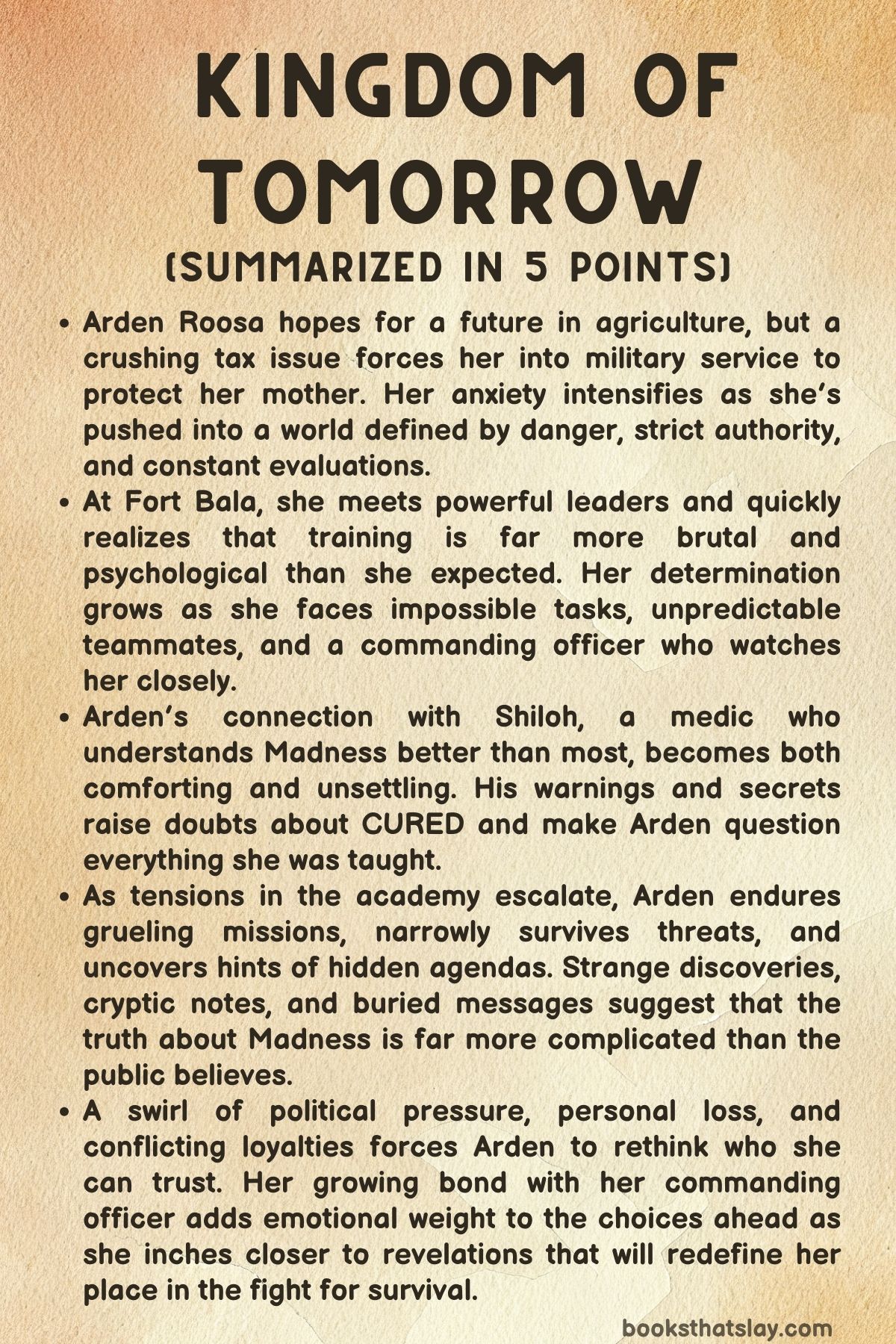
Arden Roosa expects a routine evaluation that will determine whether she can enter the agricultural program she has worked toward for years. In her world, Madness—an infection linked to a mysterious, indestructible Rock—turns people violent, and the governing body known as CURED controls everything from education to military defense.
Arden battles severe anxiety, especially when Madness is mentioned, but manages to remain steady during her evaluation. Her adviser approves her for the program, only for Arden to learn moments later that her mother has an unpaid tax debt.
The consequence is relocation to a dangerous province unless Arden agrees to a three-year term at Fort Bala Royal Academy. With no other option, she signs away her dreams to save her mother.
Outside the building, she encounters chaos when a teen breaks with Madness, attacking civilians. Shiloh Cruz, a medic she met earlier that day, carries her into the safety of a pritis light—the only thing that repels the infected.
During the attack, Arden helps protect a child, while Shiloh restrains the teen until soldiers intervene. Because he touched the infected, he is taken away for testing, leaving Arden shaken.
At home, her mother blames herself for Arden’s forced enlistment and considers desperate measures to avoid punishment. Arden begs her to stay calm; any hint of instability could lead to accusations of infection.
Their final night together is tender and painful as Arden packs to leave. The next morning, she boards the bus to Fort Bala, discovering Shiloh aboard—cleared of infection and beginning his medical rotation at the academy.
Their reunion is brief but warm.
Fort Bala is a stark mix of militaristic stone and crystalline beauty from the realms beyond. New recruits face a stern welcome from the royal leaders, including High Prince Cyrus Dolion, whose intense focus on Arden unsettles her.
Before training even begins, a toxin knocks every recruit unconscious. Arden wakes mid-examination to find Cyrus reviewing her record.
He bluntly predicts she will not survive her first mission and offers her a safe position as his assistant. She refuses, determined to face the same trials as everyone else.
Life at the academy quickly becomes exhausting. Arden trains with weapons, travels through frightening illusions of Theirland, and struggles with classmates, fears, and the oppressive watch of the elite.
Her cellmate Mykal becomes both a challenge and an unexpected partner. Early conflicts include a brutal representative game where trainees fire pain-inducing darts at one another.
Arden refuses to target anyone unfairly, earning respect from some and irritation from others, despite losing the final vote. Shiloh continues to support her quietly, teaching her secret hand signals for communicating without being recorded.
Cyrus oversees much of her progress. Though stern and unpredictable, he teaches her to confront her fear, pushing her past limits she never expected to cross.
Over time, he grants her small recognitions that carry more meaning than he admits.
Arden faces her first missions into Theirland, witnessing the dangers of feeders and glowers while learning how fragile survival truly is. Tension grows when classmates whisper about Soalians—rebels who believe the Rock grants knowledge rather than infection.
Signs of infiltration appear within the academy, and Arden begins seeing hints of a corruption deeper than she imagined.
Shiloh eventually reveals signs that CURED might be hiding the true nature of Madness. Before he can explain further, he breaks into Arden’s cell one night, injured and raving.
Enraged by influences she cannot understand, he attacks Arden and Mykal. Forced to defend herself, Arden kills him with broken glass from the soil vial Cyrus once gave her.
The trauma leaves her numb and haunted by guilt. She later learns Shiloh had joined the Tome Society, a Soalian faction, and that he had been sabotaged before the attack.
Arden discovers incriminating data Shiloh hid for her—files suggesting CURED experiments on soldiers, manipulates outbreaks, and potentially causes Madness rather than curing it. Worse still, she finds evidence that King Tagin sees her as a threat.
Devastated, she doubts everyone around her, especially Cyrus, whose attention suddenly feels like surveillance.
At a royal gathering designed for strategic social maneuvering, Arden questions members of CURED about the Rock and its strange effects. Their fear of her inquiries confirms Shiloh’s warnings.
Cyrus later guides her to retrieve a hidden chip, which contains horrifying footage: a confrontation where it appears Cyrus kills another trainee. Believing he has been deceiving her all along, Arden attacks him and escapes to the Rock, seeking the Tome Society.
Accepted by Ember, the group’s leader, Arden undergoes a ceremony that transforms her into a Soalian, granting her clarity, heightened senses, and a connection to Soal’s immense library of knowledge. There she learns the truth: Cyrus never betrayed her.
He is Unicorn, a Soalian undercover operative working within CURED. He saved both Jericho and Shiloh, who are alive.
Overwhelmed, Arden joins Cyrus, Shiloh, and Ember in a secret meeting to understand their mission and her role.
Cyrus’s own Soal volume reveals that King Tagin plans to harm Arden’s mother. Arden and Cyrus rush into the dark realm to save her, battling altered soldiers along the way.
Tagin confronts them and demands Cyrus kill Arden. Instead, Cyrus refuses.
Arden seizes his hidden star-weapon and kills the king herself. A sinister entity emerges from Tagin’s body before vanishing, hinting that a far larger threat remains.
With Ember’s guidance, Arden and Cyrus retrieve her mother and are ordered to return to their usual lives until called again. Back in their quarters, Arden signs a promise into Cyrus’s palm: Together.
United at last, they commit to exposing CURED’s lies and dismantling its power, no matter the dangers ahead.
Characters
Arden Roosa
Arden is the emotional and moral heart of Kingdom of Tomorrow, shaped by anxiety, trauma, and an unyielding instinct for compassion. From the opening scenes, her fear of Madness defines her worldview, yet her choices consistently demonstrate courage that operates in spite of fear, not in the absence of it.
Her decision to sacrifice her dream of attending the agricultural Center in order to save her mother reveals the depth of her loyalty and selflessness. Throughout the narrative, Arden transforms from a timid young woman controlled by fear into someone capable of confronting violent threats, surviving betrayals, attaching herself to truths that terrify her, and ultimately killing a king to protect those she loves.
Her vulnerability does not diminish as she gains power; instead, it becomes a source of strength, making her uniquely empathetic in a world where power is often synonymous with cruelty. Arden’s arc is also shaped by grief, first for her sister and later for what she believes she has done to Shiloh and Jericho.
Her eventual induction into Soal is not a surrender but an evolution, granting her clarity and resilience while forcing her to reconcile her compassion with the violence she must sometimes commit. Her final commitment to dismantling CURED with Cyrus reflects her newfound combination of purpose and agency.
Shiloh Cruz
Shiloh begins as a gentle, grounding presence in Arden’s life, someone who brings warmth and reassurance in moments she feels her most fragile. As a medic specializing in Madness, he embodies a blend of scientific insight, curiosity, and personal bravery that makes him stand out early on.
However, his idealism gradually reveals darker complexities. His involvement with the Tome Society, his belief in Soal’s teachings, and his growing conviction that CURED is fundamentally corrupt show him as someone desperate to understand the world beneath its surface, even at the cost of his own safety.
His affection for Arden is genuine, but it becomes complicated by his secrecy and his radicalization against CURED. His breakdown and attack, caused by the very sabotage he feared, create one of the book’s most emotionally devastating turns.
Yet the later revelation that he was sabotaged, not treacherous, restores his position as a tragic figure caught between loyalty, truth, and forces far larger than himself. His final messages to Arden and his role in guiding her toward the truth mark him as a catalyst who helps ignite her transformation.
High Prince Cyrus Dolion (Unicorn)
Cyrus is a character defined by contradictions: a feared military leader and a secret Soalian rebel, a cold disciplinarian and an unexpectedly tender mentor, a man trained for violence and a man shaped by deep childhood trauma. His early interactions with Arden appear harsh, manipulative, and intensely scrutinizing, largely because he is navigating dual identities and secret obligations.
Over time, it becomes clear that beneath his calculated exterior is someone who admires resilience and honesty, especially in Arden. His fascination with her is complicated at first by his orders from King Tagin, but it evolves into a mutual trust and emotional connection that challenges his loyalty to CURED.
He is burdened by guilt, by the secrecy of his mission, and by the weight of having witnessed his mother’s murder. Cyrus’s tenderness with Arden during training, his willingness to protect her even when it jeopardizes his mission, and his refusal to harm her when ordered reveal a moral compass not easily swayed by power.
By the end, his true identity as Unicorn recasts him as a covert guardian working from within the heart of the enemy institution. His ultimate partnership with Arden signals a merging of strength, strategy, and emotional vulnerability.
Ember
Ember is a charismatic, enigmatic, and strategically brilliant Soalian leader whose presence looms long before she fully appears. She is both mentor and manipulator, revolutionary and enigma, and she understands far more about Arden’s destiny than she initially reveals.
Ember’s calm confidence contrasts sharply with the terror that Madness instills in others, allowing her to serve as a symbolic counterforce to CURED’s oppressive ideology. She genuinely wants Arden to join Soal, but her methods are steeped in mystery, illusion, and philosophical ambiguity.
The visions she presents, particularly of Soal’s library and Arden’s personal volume, position her as a guardian of higher truths rather than a mere recruiter. Yet her detachment can seem unsettling; she plays a long game, one that requires trust even when her motives remain partly obscured.
Ultimately, Ember facilitates Arden’s transformation, stands by her during her darkest moments, and serves as one of the few characters who fully comprehends the forces shaping their world.
King Tagin Dolion
Tagin represents the entrenched brutality and corruption at the core of CURED. As Cyrus’s father and the reigning king, he exerts absolute control over the institution that dictates who lives, who dies, and who is sacrificed for the sake of order.
He manipulates laws, weaponizes fear, and oversees experiments that blur the line between defense and cruelty. Tagin views people as tools, including his own son, and sees Arden as a potential threat to be neutralized rather than a life worth protecting.
His execution of infected trainees reflects the merciless ideology he has cemented into CURED’s operations. His attempt to force Cyrus to kill Arden solidifies his role as the embodiment of authoritarian corruption.
When Arden kills him, it is both self-defense and symbolic liberation, marking the collapse of a regime that hides tyranny behind the pretense of protection. The revelation that a dark entity emerges from his body at death exposes the depth of the rot beneath his authority.
Mykal
Mykal provides both levity and complexity in Arden’s early training life. She is spirited, outspoken, and eager to prove herself, but beneath her bravado lies insecurity and an earnest desire to belong.
Her enthusiasm for becoming Cyrus’s assistant reflects both ambition and a tendency to seek validation. Mykal’s friendship with Arden grows into one of the few genuine connections Arden forms during training.
Their differences highlight Mykal’s extroversion against Arden’s anxious introspection, yet they complement one another. Her near-fatal assault by Shiloh underscores her vulnerability, and her survival reflects her resilience.
She becomes a symbol of the ordinary trainee caught in extraordinary political and supernatural conflicts.
Roman
Roman is confident, competitive, and charismatic, embodying the classic soldier archetype who thrives under pressure. His leadership in the representative game demonstrates tactical intelligence and a natural ability to command.
Although initially self-assured to the point of arrogance, Roman evolves into a more nuanced figure as he interacts with Arden and witnesses her unexpected strength and moral clarity. He respects fairness, values skill, and ultimately proves himself someone who can recognize merit even when outcomes do not favor him.
His rivalry with characters like Lark and his easy banter during competition reveal his lighter side, making him a blend of humor and intensity within the trainee ranks.
Lark Foster
Lark is sharp-tongued, clever, and provocative, using wit as both weapon and shield. Her initial antagonism toward Arden stems less from personal malice and more from competitiveness and insecurity.
She enjoys testing boundaries, provoking reactions, and challenging assumptions. Her flirtatious clashes with Roman reveal her as someone attracted to conflict, especially when it masks deeper emotions.
Despite her aggressive tactics in the representative game, she is not villainous; she is a survivor shaped by a harsh world. Her interactions add tension and unpredictability to the trainee dynamics.
Titus
Titus is stoic, observant, and quietly formidable. He initially misjudges Arden, assuming she is merely an extension of Roman’s influence, but later acknowledges her independence and potential.
He is not flashy or loud; his strength lies in his stability and reliability. Titus provides moments of grounded companionship during difficult realm walks and helps balance the more volatile personalities around him.
His honesty and simplicity make him a steady presence in a world filled with manipulation and secrecy.
Jericho
Jericho is a perceptive and intuitive character whose suspicions about Cyrus highlight his ability to notice what others miss. His warnings, particularly about Cyrus consuming the Theirland berry, demonstrate courage and a commitment to uncovering the truth even at personal risk.
His disappearance and presumed death deepen Arden’s distrust of Cyrus, and the later revelation that he survived recasts him as another victim of CURED’s dangerous machinations. Jericho embodies the trainee who sees too much before he understands the rules of survival in a corrupt system.
Arden’s Mother
Arden’s mother is a central emotional anchor in Arden’s life, representing love, vulnerability, and the high cost of CURED’s flawed justice system. Her history with Madness, the financial burden of her disability denial, and her near exile to Gradon all show how society punishes the weak and sick.
Despite her fears and her moments of desperation, she remains fiercely protective of Arden. Her guilt over Arden’s sacrifice drives many of their most poignant interactions.
She symbolizes what Arden fights for: family, home, and the right to live without institutional terror. Her targeted endangerment by Tagin confirms her significance in the narrative and her role as a catalyst for Arden’s final confrontation with power.
Themes
State Control, Institutional Power, and Manufactured Truth
In Kingdom of Tomorrow, authority functions not as a stabilizing presence but as an omnipresent force that shapes identity, opportunity, and even reality itself. CURED presents itself as a guardian of civilization, yet every aspect of life—education, military placement, medical treatment, and public narratives—is structured to reinforce dependence on its authority.
Arden’s life demonstrates how deeply institutional decisions infiltrate personal agency: her acceptance into the agricultural Center, a milestone she earned, is instantly revoked once bureaucratic debt is revealed. This moment exposes how “merit” functions only when power permits it.
The organization’s veneer of protection further erodes as Arden uncovers how CURED manipulates the Madness, weaponizes fear, and distorts historical knowledge to maintain absolute control. The more she learns, the more the disparity between public messaging and internal practice becomes undeniable.
Even scientific spaces, such as medical labs and evaluation rooms, function as extensions of surveillance, constantly watching for ideological deviation. The theme ultimately shows how authoritarian structures thrive by manufacturing threats, limiting information, and turning citizens into instruments of their own oppression.
Arden’s gradual recognition that she has been raised inside a controlled narrative is not a dramatic revelation but an accumulation of contradictions—tax policies that punish the sick, enforced military service disguised as opportunity, and forbidden truths about the Rock. This inward collapse of trust becomes a critical engine of the story as she recognizes that truth, once controlled by the state, must be reclaimed rather than granted.
Fear, Trauma, and the Internal Battle for Self-Command
Fear is not just a recurring sensation for Arden; it becomes a defining force shaping her decisions, her relationships, and her sense of self. Her anxiety is not portrayed as a fleeting emotional reaction but as a physiological and psychological barrier that constantly intrudes on her daily functioning.
The Madness itself mirrors her internal experience, manifesting in unpredictable breaks that reflect how fear can transform people into a danger to themselves and others. Arden’s reaction to outbreaks—freezing, hyperventilating, dissociating—illustrates how trauma strips away agency, leaving her trapped inside her body while danger moves around her.
The story traces her struggle to regain stability in environments specifically designed to trigger her worst fears: simulated battles, real patrols, realm walks, and physical confrontations. These moments show how healing rarely comes from a sudden surge of bravery; instead, her progress emerges through repeated survival, reflection, and fragile attempts at control.
Even as her abilities grow, her fear does not vanish; it evolves. After Shiloh’s attack, her fear becomes entangled with guilt, memory, and the resurfacing loss of her sister.
Later, when she becomes a Soalian, the transformation removes fear physically, yet leaves the emotional imprint behind—showing that the absence of fear is not synonymous with peace. The theme emphasizes that courage is not the elimination of terror but the decision to move despite it, and Arden’s internal war becomes as significant as the external conflict surrounding her.
Truth, Knowledge, and the Battle Over Narrative Authority
Competing versions of truth form one of the novel’s most compelling thematic tensions. The world Arden inhabits is structured around curated narratives—what the Madness is, what the Rock does, who the Soalians are, and why certain realms must remain restricted.
CURED’s dominance relies on controlling these narratives, suppressing contradictory data, and rewriting events to maintain a singular interpretation of reality. Scientific evidence becomes classified.
Surveillance systems track speech patterns. Even educational materials simplify or distort the nature of the realms.
When Arden encounters Shiloh’s hidden files and later the Door of Shaddai’s library, she is confronted with the difference between institutional knowledge and unfiltered truth. These revelations destabilize everything she believed about safety, disease, morality, and loyalty.
The Soalian library, with its responsive books that require understanding to open, challenges her to confront information not as static text but as a living, self-interpreted experience. The story frames truth as something that requires courage to pursue, especially when it contradicts long-held social teachings.
This theme culminates in Arden recognizing that both sides have their own narratives, but only one encourages questioning and firsthand verification. Her decision to seek truth through personal experience rather than institutional permission becomes a defining shift, signaling her transition from passive consumer of information to active interpreter.
Identity, Choice, and the Constraints of Circumstance
Identity in the novel is shaped less by personal preference and more by imposed roles: student, trainee, daughter of an indebted woman, potential Soalian recruit, military asset, and eventually a symbolic figure within a rebellion. Arden’s life is repeatedly redirected by forces far beyond her control, yet each imposed identity becomes the jumping-off point for a new form of self-definition.
When she is forced into military service, she initially accepts her role out of necessity rather than desire. Over time, however, that constraint forces her to confront parts of herself she would not have otherwise discovered—her survival instincts, her strategic mind, and her ability to endure psychological and physical hardship.
Even when Cyrus or Ember offers her roles that might protect her—assistant, informant, chosen recruit—Arden pushes against the expectation that others should determine her purpose. Her eventual transformation into a Soalian does not negate her earlier identities; it adds a new layer, complicating her understanding of where she belongs.
This theme highlights the tension between who she is told to be and who she becomes through accumulated experience. Instead of depicting identity as a fixed construct, the narrative shows it as fluid and continually redefined by circumstance, influence, and personal resolve.
Corruption, Moral Ambiguity, and the Question of Loyalty
The boundaries between heroism and villainy blur throughout the story, forcing characters to confront moral ambiguity. CURED is ostensibly the defender of civilization, yet its hidden operations reveal experimentation, exploitation, and political manipulation.
The Soalians are labeled extremists and terrorists, yet their internal structure demonstrates a pursuit of healing, knowledge, and liberation from distortion. Cyrus himself embodies this duality—publicly a ruthless enforcer of CURED doctrine and privately a rebel working to undermine the very system he serves.
Shiloh’s journey follows a similar trajectory, first appearing as a compassionate medic and later revealing a conflicted allegiance shaped by grim discoveries. Arden’s shifting loyalties form the emotional center of this theme.
Her trust is repeatedly violated by those she relies on—teachers, leaders, and even her protectors. Yet the narrative does not frame loyalty as blind adherence; it presents it as a series of choices measured against evolving information.
The tension between personal loyalty and moral duty becomes critical when she must decide whom to believe, whom to protect, and whom to fight. Through these conflicts, the book suggests that morality cannot exist in simplistic binaries; it emerges through constant reevaluation and a willingness to confront the uncomfortable truth that righteousness may require defying the institutions meant to uphold it.
Love, Connection, and the Risks of Vulnerability
Relationships in the novel are fraught with danger because emotional closeness becomes entangled with surveillance, manipulation, and ideological suspicion. Arden’s bonds with Shiloh and Cyrus evolve under extreme circumstances, highlighting how affection can both empower and endanger.
With Shiloh, her initial comfort turns into devastating betrayal, showing how trust can be weaponized. Yet even in that pain, the story frames his actions as the tragic outcome of his fractured loyalty and the destructive influence of the system that shaped him.
Her connection with Cyrus develops through shared hardship, private disclosures, and emotional reciprocity, yet is repeatedly jeopardized by secrets, political constraints, and her growing awareness of the murky reality he navigates. The theme reveals love as something that requires vulnerability, and vulnerability becomes a liability in a world where weakness is exploited and emotional bonds are monitored.
Despite this, Arden’s relationships remain essential to her growth. They humanize her, temper her fear, and help her claim her own agency.
The novel illustrates that connection is not simply about romance; it is about grounding oneself amidst chaos, finding reasons to persist, and allowing intimacy to coexist with dread, uncertainty, and the realities of war.
Rebellion, Liberation, and the Reshaping of Destiny
Rebellion is not initially Arden’s goal; it grows from disillusionment, personal loss, and the accumulation of truths she was never meant to know. Her transformation from reluctant recruit to transformative agent reflects how revolutions often begin—not with grand ambition, but with the realization that existing structures cannot be repaired from within.
The Soalian induction does more than grant her power; it symbolizes liberation from a worldview designed to suppress dissent. Yet the theme does not romanticize rebellion.
It highlights its cost: severed loyalties, moral conflicts, sacrifices, and the heavy burden of confronting a force as entrenched as CURED. The novel positions liberation as a collective effort, driven by individuals who refuse to let their destinies be predetermined by systems that benefit from their ignorance or fear.
By the end, Arden accepts the responsibility that comes with knowledge, refusing to revert to passivity.