Krampus Kruk Summary, Characters and Themes
Krampus Kruk by Serena Pier is an erotic psychological romance that explores loneliness, desire, and the need for connection through the unlikely meeting of two flawed people on Christmas Eve. When Morgan Smith, a young woman suffocated by her family’s hypocrisy, walks into a grim Wisconsin bar to escape, she encounters Piotr Kruk, an older, dangerous man with a violent past.
What begins as teasing banter turns into an intense night of passion and self-revelation. Beneath its sexual energy, the book examines control, trust, and the human craving to be understood, offering a raw look at love born from chaos and pain.
Summary
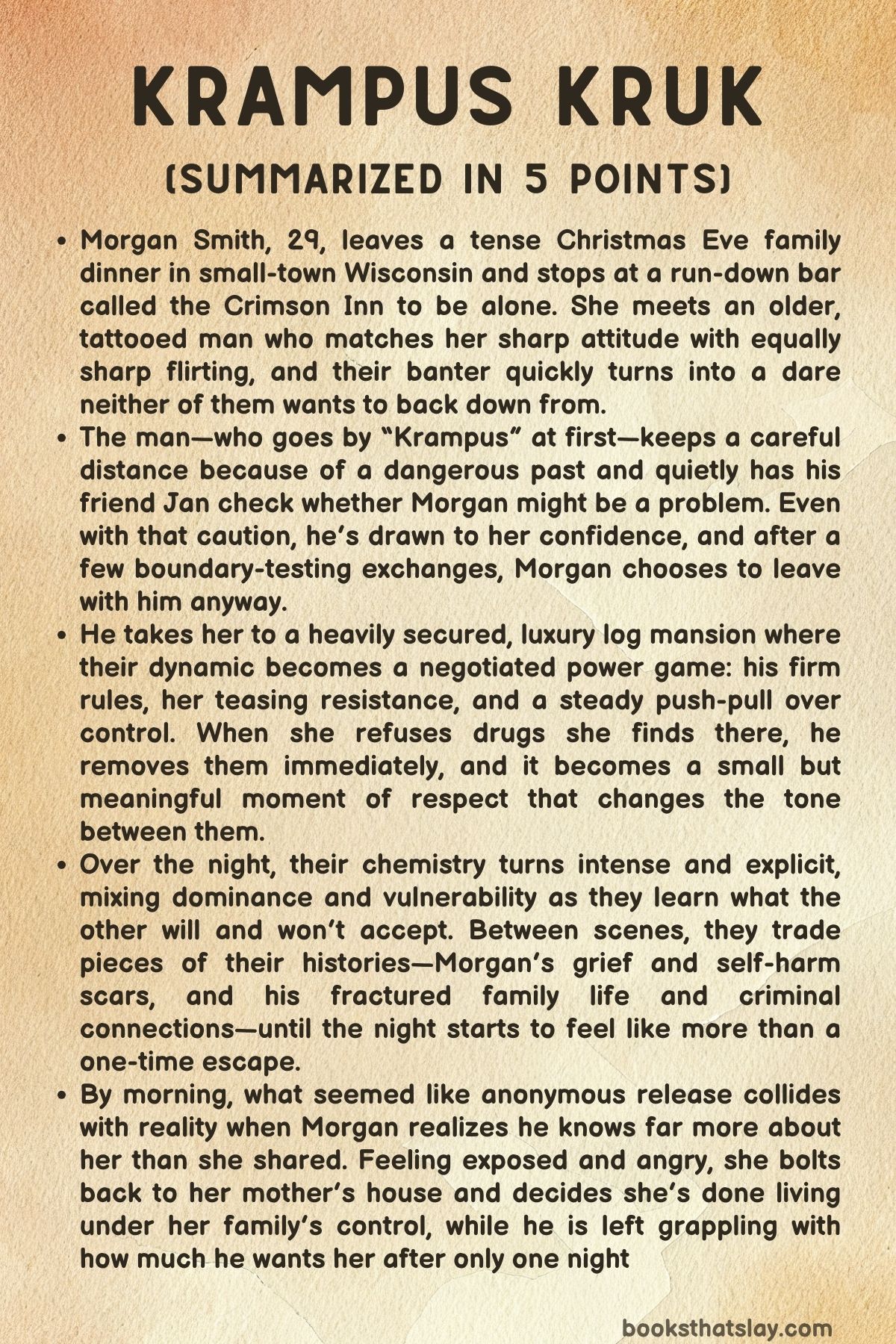
Morgan Smith leaves her mother’s home in small-town Wisconsin on Christmas Eve, worn down by her family’s political rants and casual cruelty. She drives off in frustration, needing space from the noise and resentment.
Spotting the Crimson Inn, a shabby bar she’s always ignored, she decides to stop for a drink, wanting to forget everything for a while. Wearing a gaudy Christmas sweater and no coat, she walks in expecting hostility but instead finds a room full of regulars trying to hide from their own miseries.
At the counter, Morgan encounters an older, tattooed man who warns her she doesn’t belong there. Defiant, she orders whiskey and matches his sarcasm with wit.
Their conversation quickly becomes a mix of mockery and flirtation. He teases her about her age; she challenges his arrogance.
The tension grows electric—two people testing boundaries while pretending indifference. He calls her a brat and jokingly accepts the nickname “Santa” she gives him.
Though he seems dangerous, she senses something magnetic beneath his cold surface.
The man, whose name she doesn’t yet know, is suspicious of strangers. He owns the bar and carries a past steeped in secrets and violence.
When Morgan appears out of nowhere, he quietly has his friend Jan check her belongings to ensure she’s not a threat. Once reassured, he lets his guard down just enough to enjoy her company.
Their banter grows sharper, and when she admits she’s running from her family, he offers her another kind of escape. Against her better judgment, she agrees to leave with him.
Outside, the cold is biting. He drapes his oversized coat over her shoulders and leads her to his SUV.
On the drive, they exchange more provocations, each trying to outmatch the other in boldness. When he receives a call from his grandson in Polish, Morgan glimpses a softer side of him.
He admits he has grown children—older than she is—and regrets not being a better father. She picks at his evasions, guessing that he’s been to jail, and he doesn’t deny it.
She finally confesses she got into his car because she wanted to stop thinking.
He takes her through a secured gate to a sprawling log mansion, his private retreat. Inside, he becomes commanding but never cruel.
Morgan senses both danger and safety in his control. She notices cocaine on a tray, refuses it, and he immediately removes it, testing and approving her judgment.
They begin an intimate dance of dominance and consent, trading stories as they navigate trust and vulnerability.
Morgan reveals fragments of her past—her father’s death when she was fourteen, her mother’s quick remarriage, and the self-harm scars she carries from trying to manage her grief. He listens without pity, sharing that one of his sons is estranged and another died from addiction.
His grandson, he admits, is his chance to do better. When Jan calls to report back, the man learns and repeats her real details: Morgan Smith, twenty-nine, from Delavan, a vice president at a Chicago data company.
Morgan realizes he’s found out everything about her behind her back but decides to stay the night anyway.
As the snow thickens outside, their attraction intensifies. They negotiate control and pleasure, each encounter layered with unspoken emotion.
Morgan challenges his authority; he meets her defiance with restraint and power. When he promises to make her stay unforgettable, she agrees to remain until morning.
Later, it’s revealed that his name is Piotr Kruk—known by his criminal nickname, Krampus. A former mafia enforcer, Piotr hides behind his bar and wealth, living in isolation.
Yet with Morgan, he feels alive again. Their night unfolds in waves of passion, from teasing submission to raw intimacy.
Each act becomes a wordless exchange of trust, both seeking release from loneliness.
Afterward, lying in bed, they smoke and talk. Morgan calls him “Daddy,” half-mocking, half-adoring.
He reveals his past—his years in organized crime, the mistakes that cost him his sons, and the quiet guilt that haunts him. She pushes him for honesty, and he admits he’s drawn to her in ways he hasn’t been in years.
Their sex resumes with renewed force, deepening their connection until exhaustion claims them both.
Morning brings rupture. Morgan wakes to Piotr speaking her name, realizing she never told him what it was.
He confesses that he had her background checked, justifying it as a precaution. To her, it’s a violation.
Feeling betrayed, she leaves in anger. He doesn’t stop her, believing she deserves her freedom.
Driving through the snow, Morgan curses herself for caring. Back home, she faces her mother’s disapproval and her stepfather’s smugness.
The visit turns into another argument, and Morgan finally decides to leave for good. Packing her belongings, she takes with her a painting her late father made—a reminder of simpler happiness.
Meanwhile, Piotr sits alone, haunted by regret. For years, he’s built walls to keep the world out.
Now, for the first time, he wants someone back. He calls in favors, tracks down her address, and shows up at her mother’s house with flowers.
Her stepfather answers the door, bewildered by the imposing man on the porch.
Outside, Morgan confronts him, furious that he followed her. Piotr apologizes, saying he needed to see her again, that his feelings were real despite his mistakes.
She tries to resist him but feels her anger melting. When he kneels in front of her in apology—the same gesture she once teased him into—she relents.
He gives her a diamond necklace, telling her she can wear it when she wants to be his again. She agrees, with one condition: no more lies.
He promises.
They leave together, driving into the winter night, toward something new and uncertain.
Days later, they are in Belize, living in his oceanfront home. Morgan paints by the water while Piotr runs along the sand.
Their relationship has evolved—still filled with teasing dominance, but now grounded in affection. He suggests she quit her job and stay with him, offering comfort and freedom.
She laughs, demanding equal play in their private games, even proposing to reverse roles once. He agrees, sealing their love with humor and trust.
In the end, Krampus Kruk closes not on redemption but on acceptance: two flawed people finding peace in each other, choosing passion and honesty over fear and solitude.
Characters
Morgan Smith
Morgan Smith, the protagonist of Krampus Kruk, is a 29-year-old woman who finds herself at a crossroads in life after a painful family dinner. Frustrated by the toxic atmosphere created by her mother, stepdad, and stepbrothers, she seeks refuge in the Crimson Inn, where her life unexpectedly changes.
Morgan is brash, confident, and unapologetically herself, which is most evident in her interactions with Piotr. Her teasing and assertive personality often drive their dynamic, creating a tension-filled back-and-forth.
Although she presents herself as emotionally detached, especially when it comes to relationships, Morgan’s vulnerability emerges as the story progresses. Her history, shaped by a difficult family life and past trauma, is hinted at through scars on her body and her admission of self-harm, revealing her internal struggle to cope with loss and emotional pain.
As the narrative unfolds, Morgan’s complexity deepens. While she initially dismisses Piotr as just a fleeting encounter, her emotions betray her, and she soon finds herself falling for him.
Her feelings of humiliation and betrayal, when Piotr investigates her background, push her to confront her own need for control, independence, and love. Morgan’s evolution from a defiant, guarded woman to someone willing to embrace vulnerability and love marks her emotional journey throughout the book.
Piotr Kruk (Krampus)
Piotr Kruk, the enigmatic man known as Krampus, is a fascinating character in Krampus Kruk. A man of mystery and contradictions, Piotr is a former mafia member with a dark and dangerous past.
He is a dominant figure, physically imposing, with a sharp mind and an ability to control situations around him. Initially, he is cautious and guarded, treating Morgan’s sudden appearance with suspicion.
However, his growing attraction to her and the playful power struggle that ensues between them reveal a more vulnerable side to Piotr. Despite his tough exterior, Piotr’s regret over his past and his strained relationships with his family show that beneath his hardened shell lies a man seeking redemption and connection.
His complex history—marked by estrangement from one son, the loss of another, and a difficult relationship with his past—adds layers to his character. Piotr’s relationship with Morgan is an intense, evolving blend of dominance, submission, and emotional intimacy.
Although initially driven by physical attraction, Piotr is deeply affected by Morgan’s presence in his life, showing emotional depth and vulnerability. His decision to track Morgan down after she leaves, and his heartfelt apology, demonstrates his willingness to change and make amends.
Piotr’s growth throughout the story is rooted in his desire to reconcile his past and build something genuine with Morgan, despite his complicated and dangerous world.
Jan
Jan is a supporting character in Krampus Kruk, and though his role is secondary, he plays an important part in Piotr’s life. As Piotr’s longtime friend and confidant, Jan helps maintain a sense of security and trust in the narrative.
He is discreet and observant, carrying out tasks such as checking Morgan’s car and ensuring her safety without her knowledge. His involvement in Piotr’s life and his role in keeping an eye on Morgan show that he is loyal to Piotr and willing to act on his behalf.
While Jan’s character does not undergo significant development throughout the story, his presence offers a glimpse into Piotr’s world of loyalty and the protective environment he’s cultivated around himself. He remains a background figure who serves to highlight the stakes of the narrative, offering a sense of reliability to Piotr’s actions and adding to the mysterious atmosphere surrounding Piotr’s life.
Themes
Isolation and the Need for Connection
The story in Krampus Kruk begins with Morgan’s profound sense of emotional and social isolation. Her Christmas Eve escape from her mother’s house sets the tone for a woman alienated from family, identity, and belonging.
The family dinner embodies the modern disconnection between generations and political ideologies, with Morgan surrounded by ignorance, prejudice, and performative affection. Her decision to leave and seek solace in alcohol symbolizes an internal void—an aching need to be seen and understood beyond familial roles or societal expectations.
When she enters the Crimson Inn, she steps into a space that mirrors her psychological state: dim, hidden, and full of strangers seeking refuge from their own demons. Her encounter with Piotr becomes more than a sexual awakening—it becomes an exploration of human connection through vulnerability and risk.
Their attraction operates on multiple levels: lust, loneliness, and the fragile hope of being known. Beneath the erotic power games lies a yearning for authenticity that neither has experienced in years.
Piotr’s guarded nature and Morgan’s impulsivity clash, yet both reveal that connection for them requires confrontation with pain and fear. The isolation each character carries—his as a man haunted by loss and violence, hers as a woman rejected by her family and alienated by modern cynicism—collides to form a connection born from shared emptiness.
By the end, their union in Belize suggests that isolation can only be broken through honesty, vulnerability, and mutual acceptance, even when that connection defies convention.
Power, Control, and Surrender
Power in Krampus Kruk functions as both a literal and emotional force that defines the relationship between Morgan and Piotr. Their sexual dynamic, rooted in dominance and submission, becomes a metaphor for the ways people negotiate control in their personal lives.
Morgan, who has spent years suppressing her anger and independence in order to survive male-dominated spaces—whether at work or at home—finds a paradoxical freedom in surrendering control during her encounters with Piotr. Her submission is not weakness; it is a conscious, defiant act that allows her to reclaim agency over her own desires.
Piotr, on the other hand, exerts control to maintain stability in a life shaped by chaos, guilt, and loss. His dominance is a performance that conceals his emotional vulnerability, and Morgan’s resistance gradually exposes the fragility beneath his authority.
The alternating rhythm of command and consent between them transforms into a language of trust. When she refuses the cocaine or challenges his assumptions, Morgan subverts the traditional submissive role, proving that true surrender requires mutual respect.
Their dynamic ultimately reveals that power in intimacy is not static; it oscillates with emotional truth. In the final scenes, when Piotr kneels before her in apology, the entire power structure inverts, suggesting that genuine love exists only when both partners are willing to relinquish control.
Power becomes not a weapon but a conduit through which trust, forgiveness, and equality emerge.
Trauma, Healing, and Redemption
Both protagonists in Krampus Kruk carry unhealed trauma that governs their choices, fears, and relationships. Morgan’s self-harm scars, emotional volatility, and resistance to vulnerability trace back to the death of her father and her disillusionment with her mother’s remarriage.
Her pain manifests in control—over her career, her image, and her emotions—yet it surfaces through acts of recklessness, such as following a dangerous stranger home. Piotr’s trauma stems from his violent past, failed fatherhood, and the guilt of losing a son to addiction.
Their encounter on Christmas Eve becomes a crucible for confronting grief and shame. What begins as erotic tension transforms into a process of emotional excavation: every confession, every physical act between them becomes a way of acknowledging wounds too long ignored.
Piotr’s decision to remove the drugs when Morgan refuses them signals his respect for her boundaries and his awareness of his own moral decay. Likewise, Morgan’s empathy toward his family losses softens her hostility and allows her to see beyond his hardened exterior.
Their eventual reconciliation—marked by his kneeling apology and her decision to forgive—represents redemption through vulnerability. The novel suggests that healing does not occur through purity or moral perfection, but through confrontation with imperfection and pain.
Love, in this context, becomes the means by which both characters reclaim parts of themselves they believed lost forever.
Gender, Sexuality, and Empowerment
Krampus Kruk confronts traditional gender expectations through its unapologetic portrayal of female sexuality and agency. Morgan’s character disrupts the conventional portrayal of women as passive participants in desire.
She initiates, negotiates, and challenges Piotr throughout their encounters, reclaiming pleasure as her own domain. Her confidence, however, coexists with deep insecurity, revealing that empowerment is rarely absolute.
The novel treats sexuality as a space for both liberation and revelation, where societal taboos and personal trauma intersect. By entering a relationship defined by explicit power play, Morgan rejects the sanitized ideals of femininity imposed by her family and society.
Piotr’s masculinity, meanwhile, is portrayed not as dominance alone but as a complex mix of authority, care, and emotional transparency. His willingness to submit—literally and emotionally—redefines strength as the capacity to be vulnerable.
Their final agreement, with Morgan asserting sexual agency by demanding reciprocity, symbolizes an equilibrium of gender power that challenges patriarchal conventions. The eroticism in the book thus serves a broader commentary on self-definition: how men and women reconstruct identity through intimacy when stripped of social performance.
In the end, empowerment arises not from dominance but from the courage to desire without shame and to love without pretense.
The Search for Redemption Through Love
The culmination of Krampus Kruk rests on the belief that redemption is possible even for those burdened by moral compromise and emotional damage. Piotr’s journey from a cold, calculating ex-mafia patriarch to a man capable of tenderness and devotion marks the central emotional arc of the novel.
His initial interactions with Morgan are transactional—guarded by suspicion, background checks, and manipulative control. Yet, through her defiance and empathy, he rediscovers his capacity for affection and forgiveness.
Similarly, Morgan’s path to redemption unfolds through acceptance rather than rebellion. By the story’s end, she learns to reconcile the fractured parts of herself—the ambitious professional, the grieving daughter, the self-destructive lover—into a coherent whole.
Their relationship, unconventional and morally ambiguous, becomes a sanctuary where brokenness finds meaning. Belize, as their final refuge, symbolizes renewal: a space untouched by past sins where love can exist without pretense or judgment.
The novel thus reframes redemption not as atonement through suffering but as rebirth through connection. It proposes that love, however imperfect, can heal the fractures left by loss, guilt, and disillusionment, turning two damaged individuals into partners capable of creating something genuine and enduring.