Lady Tremaine Summary, Characters and Themes
Lady Tremaine by Rachel Hochhauser is a reimagining of the Cinderella story from the perspective of the woman usually remembered as the cruel stepmother. Instead of presenting her as a simple villain, the book gives her a history shaped by class pressure, widowhood, motherhood, debt, social judgment, and the harsh limits placed on women.
The story follows Etheldreda Tremaine Bramley as she tries to secure futures for her daughters while living in a decaying manor and managing old rivalries, royal schemes, and family wounds. It turns a familiar fairy-tale figure into a flawed, protective, and deeply human protagonist.
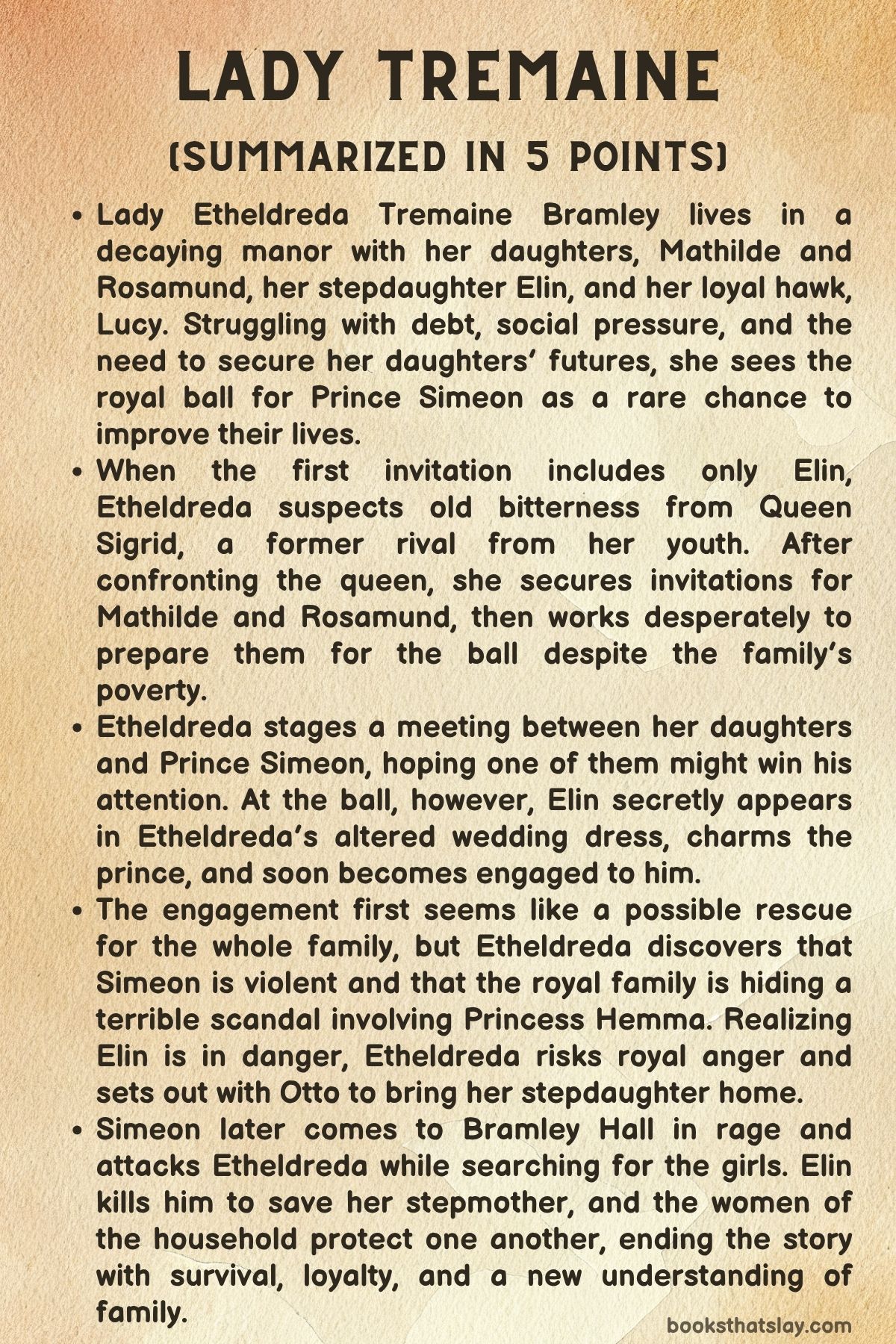
Summary
Etheldreda Verity Isolde Tremaine Bramley begins the story in reduced circumstances, living at Bramley Hall with her daughters, Mathilde and Rosamund, her stepdaughter Elin, two aging servants, and her hawk, Lucy. The manor is falling apart, money is scarce, and survival depends on careful appearances.
Etheldreda hunts small game, manages the household, and worries constantly about the futures of the girls under her care. Though she carries the title of a lady, her daily life is far from elegant.
She is muddy, overworked, and forced to think about food, leaking roofs, unpaid help, and the threat of social disgrace.
A royal messenger arrives with news of a ball being held so Prince Simeon can find a wife. Etheldreda hopes the invitation will offer a chance for Mathilde and Rosamund to enter society and improve their prospects.
Instead, the invitation names only Elin and Etheldreda as her chaperone. This exclusion wounds Etheldreda deeply.
Her own daughters, who have worked and sacrificed to keep the household going, are ignored, while Elin, who spends her time reading etiquette books and dreaming of escape through marriage, is favored. Etheldreda blames the slight on old resentments and on the way her family has always been judged.
Much of Etheldreda’s present bitterness is rooted in her past. She was not born into the upper class.
Her father was a brewer, respectable but not noble, and he hired a tutor named Agatha to teach her how to behave like a lady. Agatha’s lessons shaped Etheldreda’s understanding of womanhood, reputation, marriage, and self-control.
As a girl, Etheldreda met Henry Tremaine during his family’s hunting visits. He taught her about birds of prey, and their friendship became secret, intimate, and joyful.
Henry’s world represented beauty and freedom, but it was also a world she had to enter carefully because class boundaries were never far away.
That early happiness was disrupted by Sigrid Camelia White, a delicate young woman connected to Henry’s circle. Etheldreda disliked Sigrid immediately, seeing her as an intruder and rival.
During a horseback ride, Etheldreda led Henry and Sigrid onto a dangerous path, where Sigrid’s horse was disturbed by wasps. Sigrid was badly injured and lost a finger.
The incident became one of the defining shadows over Etheldreda’s life. Though she later married Henry, she carried guilt, rivalry, and the fear that Sigrid would one day repay the injury.
Years later, Sigrid has become queen, and Etheldreda believes the exclusion of her daughters from the ball may be connected to that old history.
After Henry’s death, Etheldreda’s life changed sharply. She was left with Mathilde and Rosamund, dependent on the Tremaine family and vulnerable to the decisions of men who did not value her or her daughters.
Henry’s father wanted the girls married off young, and Etheldreda feared losing them. To protect them, she remarried Lord Robert Bramley, a widower with a young daughter, Elin.
Etheldreda hoped to become a mother to Elin and to blend the family, but Elin rejected her. Robert indulged his daughter and allowed her to retreat into memory and fantasy.
When Etheldreda asked Robert to remove his late wife’s portrait, he fell and died. His death left the family in debt, trapped in a crumbling house, and socially exposed.
Determined not to accept defeat, Etheldreda visits Queen Sigrid and asks that Mathilde and Rosamund be invited to the ball. Sigrid grants the request with little emotion, and Etheldreda leaves feeling that she has won a small victory.
At the palace she also meets Otto, a court official who has already seen her hunting on royal land and who seems suspicious of her household. Otto watches closely, and Etheldreda resents his scrutiny.
Still, the confirmation that her daughters may attend the ball gives her renewed energy. She and the girls begin raising money for fabric by picking apples, doing embroidery, and planning their dresses with intense hope.
Etheldreda then learns that the royal hunt will pass near Bramley Hall and creates a staged encounter with Prince Simeon. She uses food, decorations, Elin’s late mother’s unfinished apple paintings, and a deliberately broken carriage to make it appear that she and her daughters have suffered a charming accident during a picnic.
The plan works. Simeon stops to help them, notices Mathilde and Rosamund, shares their picnic, and brings them home.
Etheldreda is pleased that she has helped her daughters become visible to the prince, though Otto’s presence during the encounter reminds her that the court is watching.
As the ball approaches, the family prepares with excitement and tension. Etheldreda retrieves a pawned cameo by selling a painting, and she is proud of Mathilde and Rosamund when they dress for the evening.
Elin, however, has failed to complete a proper gown. Her dress is unfinished and poorly made, and Etheldreda forbids her from attending, believing that Elin’s appearance could damage the family’s reputation.
This decision is harsh, but Etheldreda sees it as necessary. She leaves for the palace with her daughters, hoping the night will open a path for them.
At the ball, the grandeur of the court sharpens Etheldreda’s awareness of everything her family lacks. Simeon recognizes Mathilde and Rosamund, and Rosamund dances with him.
Etheldreda briefly enjoys a dance with Otto, but the evening turns when she overhears Otto and Sigrid discussing the prince’s prospects. Otto dismisses Mathilde and Rosamund as serious candidates.
Then a beautiful young woman enters the ballroom and captures everyone’s attention. Etheldreda is horrified to realize the woman is Elin, wearing an altered version of Etheldreda’s first wedding dress.
Elin dances with Simeon, and the two spend the rest of the night together.
The next day, Simeon comes to Bramley Hall for Elin, and the situation quickly moves beyond Etheldreda’s control. Elin and Simeon announce their engagement after a private walk.
Mathilde and Rosamund are furious, believing Elin has stolen the future that should have been theirs. Queen Sigrid supports the engagement and wants the wedding held quickly.
Etheldreda is surprised by the speed of the arrangement but decides it may still help the whole family. If Elin marries the prince, Bramley Hall’s problems could be solved, and Mathilde and Rosamund might benefit from royal connection.
Preparing for the prince’s visit to Bramley Hall becomes a frantic attempt to hide poverty. Etheldreda rearranges furniture, conceals damaged rooms, brings in extra help, and fills the house with apples to make it appear abundant.
During these preparations, she meets Morwen, a new servant who claims experience as a lady’s maid. Morwen resists the kind of work expected of her, and her presence seems unusual.
At dinner, Simeon is polite and attentive, but Otto inspects the house and discovers a dangerous damaged room. He warns that the house is unsafe and that the truth cannot be hidden forever.
Etheldreda begs him not to ruin the engagement, but his concern is not merely about the building.
Morwen later reveals that she once worked at the palace as Princess Hemma’s lady’s maid. Hemma is pregnant, and the royal family wants Simeon married quickly so the child can be passed off as his legitimate heir.
Etheldreda first sees this as a scandal that resembles her own attempts to use marriage as a rescue. But when she visits Hemma at the palace, she learns the truth is far worse: Simeon is the father of Hemma’s child, and he raped her.
Hemma urges Etheldreda to warn Elin. When Etheldreda confronts Sigrid, the queen refuses to stop the marriage and threatens her if she interferes.
Otto admits that he knew Simeon was dangerous and had been trying to protect the girls from him.
Etheldreda returns home and discovers that Elin has left with Simeon, likely to elope. She tells Mathilde and Rosamund the truth, and though they are angry with Elin, they understand the danger.
Otto arrives, and he and Etheldreda set out together to find the couple. During the search, Otto reveals his own painful history: the deaths of his wife and child have left him determined to protect vulnerable people.
He and Etheldreda grow closer, and they share a kiss, though she feels shame and confusion over her desire. Eventually they locate Elin at an inn, where Simeon has left her locked in a room while he goes for money.
Etheldreda tells Elin the truth about Simeon. Elin struggles to accept it because Simeon has been charming and affectionate toward her, and she believes she loves him.
When Simeon returns and realizes that Elin may leave, his mask drops. He strikes her, exposing his cruelty directly.
Elin finally sees who he is. Etheldreda takes her home, and for the first time, the distance between stepmother and stepdaughter begins to close.
At Bramley Hall, Mathilde and Rosamund help care for Elin, and the women share the danger they are all facing.
Simeon later storms into Bramley Hall, demanding to see the girls. Etheldreda tries to mislead him through the darkened house to keep him away from them.
When he realizes her deception, he attacks and strangles her. As she struggles for breath, Lucy flies at him from the shadows and attacks.
Elin enters and strikes Simeon with a post, killing him. Lucy does not survive the violence.
Etheldreda, Elin, Mathilde, and Rosamund then work together to hide Simeon’s body, clean the blood, and bury him on the property. When Queen Sigrid arrives searching for her son, they pretend ignorance.
Otto protects them by supporting their story.
In the months that follow, life at Bramley Hall becomes strange but calmer. Otto lives with Etheldreda and the girls, though he and Etheldreda do not marry.
Hemma gives birth, and the palace covers the scandal by claiming the baby as Queen Sigrid’s child. Elin, Mathilde, and Rosamund remain unmarried.
Their lives do not match the traditional happy ending promised by fairy tales, but Etheldreda begins to question whether marriage was ever the only path to safety. The family has survived not through royal favor, but through loyalty, shared labor, and the difficult bond formed between women who finally choose to protect one another.
Characters
Etheldreda Verity Isolde Tremaine Bramley
In Lady Tremaine, Etheldreda is presented as a woman shaped by hunger for security rather than by simple cruelty. Her choices are often harsh, and she can be manipulative, proud, jealous, and unfair, especially toward Elin.
Yet the book also shows why those qualities developed. She was taught from childhood that a woman’s future depended on marriage, manners, and reputation, and every major loss in her life confirms that lesson.
Henry’s death leaves her vulnerable, Robert’s death traps her in debt, and society gives her few honest routes to protect Mathilde and Rosamund. Etheldreda’s ambition is therefore tied to maternal fear.
She stages encounters, bargains with queens, hides poverty, and tries to manage appearances because she knows how quickly women without protection can be destroyed. Her treatment of Elin is one of her deepest flaws.
She resents Elin’s passivity and privilege, failing to see that Elin’s dreaminess is also a survival strategy. By the end, however, Etheldreda changes.
She chooses Elin’s safety over social advancement, confronts royal corruption, and risks her life to protect all three girls. As the title character of Lady Tremaine, she becomes a complicated portrait of a woman who has made damaging choices but is still capable of courage, tenderness, and moral growth.
Mathilde
Mathilde is practical, sharp, and grounded in the material reality of Bramley Hall. While Rosamund responds to disappointment with tears, Mathilde turns to numbers, plans, and calculations.
She understands the family’s financial danger more clearly than most young women in her position would be expected to, and this makes her both useful and burdened. Her interest in falconry as a possible way to improve the family’s circumstances shows that she has inherited some of her mother’s toughness and resourcefulness.
Mathilde is not merely vain or jealous when she reacts badly to Elin’s invitation or engagement. Her anger comes from the knowledge that she and Rosamund have worked for the household while Elin has remained apart from its labor.
From Mathilde’s perspective, Elin receives opportunity without earning it. This makes her resentment understandable, though not always generous.
Her conflict with her mother over Finnian also reveals her desire for agency. She does not want to be placed into a dull marriage just because it is convenient.
By the end of the book, Mathilde’s care for Elin after Simeon’s violence shows that her anger does not erase her capacity for loyalty. She is stern and sometimes unforgiving, but she is also intelligent, protective, and unwilling to accept a future chosen entirely by others.
Rosamund
Rosamund is more openly emotional than Mathilde, and her pain often surfaces through crying, frustration, and dramatic disappointment. At first, she can seem less practical than her sister, but the book gives her emotional responses real importance.
Rosamund feels the humiliation of exclusion deeply because she knows how much her family has sacrificed. The ball is not just a party to her; it is a possible escape from poverty, invisibility, and the daily strain of a declining household.
Her devastation when Simeon comes for Elin rather than for her is rooted in wounded hope. Rosamund wants to be chosen, admired, and rescued from a future that looks increasingly narrow.
That longing makes her vulnerable to the social myths Etheldreda herself has believed for years. Yet Rosamund is not foolish.
Once the truth about Simeon emerges, she understands the danger and joins the family’s effort to protect Elin. Her emotional nature becomes a form of honesty.
She does not hide disappointment behind strategy as Mathilde does, and she does not retreat into fantasy as Elin does. Rosamund’s role in the book shows how young women are trained to compete for attention when their real enemy is a system that makes marriage look like the only secure outcome.
Elin
Elin is central to the book’s challenge to the familiar Cinderella pattern. She begins as a figure of passivity, distance, and romantic fantasy.
She clings to her late mother’s etiquette book, practices refined accomplishments, and waits for marriage to deliver her from Bramley Hall. To Etheldreda, this behavior looks selfish and useless because Elin refuses the work that Mathilde and Rosamund perform.
Yet Elin’s withdrawal is also a response to grief. She lost her mother, then her father, and never accepted Etheldreda as a replacement parent.
Her attachment to manners and romance gives her a structure for imagining safety. When she attends the ball in Etheldreda’s altered wedding dress, the act is both defiant and desperate.
She wants to claim beauty, attention, and a future for herself. Her mistake is believing Simeon’s charm.
The book treats this with seriousness rather than ridicule, showing how easily a sheltered young woman can mistake control for devotion. Elin’s turning point comes when Simeon strikes her and she recognizes the truth.
Her final act of killing him to save Etheldreda marks a complete break from helplessness. She becomes active, brave, and morally awake, and her relationship with her stepfamily begins to heal through shared danger rather than polite affection.
Queen Sigrid
Queen Sigrid is one of the book’s coldest and most revealing figures. In youth, she is presented as delicate, superior, and dismissive of Etheldreda, especially when it comes to class and femininity.
Her injury during the ride with Henry becomes a lasting physical reminder of rivalry, but her later power makes her far more dangerous than the girl she once was. As queen, Sigrid has mastered composure and authority.
She can grant invitations, arrange marriages, conceal scandals, and threaten those who challenge her. Her willingness to sacrifice Elin to protect the royal family’s reputation exposes the cruelty behind polished court life.
Sigrid understands the rules of the world as well as Etheldreda does, but unlike Etheldreda, she uses those rules from a position of power. She does not protect Hemma, and she does not care about Elin as a person.
Her priority is dynasty, image, and control. This makes her a dark mirror to Etheldreda.
Both women know how society traps women, but Sigrid has chosen preservation of status over solidarity. Her final attempt to discover Simeon’s whereabouts shows that she still expects the world to bend around royal need, even after the harm caused by her son.
Prince Simeon
Prince Simeon represents the danger hidden beneath charm, status, and romantic fantasy. At first, he behaves like the ideal prince: courteous at the staged picnic, attentive at the ball, inclusive at dinner, and affectionate toward Elin.
His public manners allow others to project goodness onto him. This is precisely what makes him dangerous.
He benefits from a society that teaches young women to see royal attention as salvation. The truth about Hemma exposes him as violent and predatory, and his treatment of Elin confirms that his charm is only a mask.
Once challenged, he becomes possessive, entitled, and physically abusive. His slap at the inn destroys Elin’s illusion, and his later attack on Etheldreda shows the full force of his belief that he has the right to control women’s bodies, choices, and silence.
Simeon is not complex in the same way Etheldreda is complex; his function in the book is to reveal the rot beneath the fairy-tale promise. The prince is not a reward.
He is a threat protected by rank, family, and public expectation. His death at Bramley Hall is violent, but it also ends the power he has used to harm women who were expected to submit.
Otto
Otto begins as a suspicious observer, but gradually becomes one of the book’s strongest moral figures. His first encounters with Etheldreda are marked by judgment and surveillance.
He notices her poverty, her muddy dress, her evasions, and later the dangerous state of Bramley Hall. From Etheldreda’s perspective, he seems like another court representative ready to expose and shame her.
Yet Otto’s scrutiny is not driven only by class prejudice. He is trying to understand the household because he knows Simeon is dangerous and wants to protect potential victims.
His past, marked by the deaths of his wife and child, gives him a deep commitment to defending the vulnerable. Otto is not perfect; he works within the court and does not reveal everything at once, which limits how much harm he can prevent.
Still, he becomes an ally when it matters. His relationship with Etheldreda is built on recognition between two wounded adults who understand loss and responsibility.
Their attraction does not lead to a conventional marriage ending, which is important. Otto’s presence at Bramley Hall in the aftermath suggests companionship and trust without making marriage the final proof of happiness.
Henry Tremaine
Henry is remembered through Etheldreda’s youth, and he carries the glow of first love, freedom, and shared passion. He teaches her falconry, calls her by a familiar name, and gives her access to a world that feels larger than the lessons Agatha has given her.
His relationship with Etheldreda is secret because of class expectations, which makes it exciting but also fragile. Henry’s affection appears genuine, and his marriage to Etheldreda gives her status and motherhood, but his early death leaves her exposed to the harsh realities that love alone cannot solve.
In the book, Henry functions as both a beloved memory and a source of later vulnerability. Because he dies, Etheldreda must face the limits of romantic rescue.
His family’s treatment of her after his death shows that marrying upward does not guarantee lasting security when property, money, and male authority remain outside a woman’s control. Henry also connects Etheldreda to Lucy, whose presence becomes a living reminder of that earlier life.
His memory is tender, but it is not enough to save her. This gap between remembered love and practical survival shapes many of Etheldreda’s later choices.
Lord Robert Bramley
Robert Bramley is less romantic than Henry, and Etheldreda approaches him with far more calculation. He is a widower looking for a mother figure for Elin, while she is a widow trying to protect Mathilde and Rosamund from being married off too young.
Their marriage is therefore built on need as much as affection. Robert’s greatest weakness is his indulgence of Elin and his failure to help blend the family.
He allows his daughter to remain emotionally fixed on her dead mother and does not require her to accept Etheldreda or the stepsisters. This makes Etheldreda’s position in the household more difficult from the beginning.
His death while removing his late wife’s portrait is tragic and symbolic. The portrait represents the old family structure that Etheldreda cannot fully enter, and Robert’s fall leaves her with the consequences of a household that was never truly hers.
Worse, he leaves behind unpaid taxes and financial disorder, trapping Etheldreda in a decaying estate. Robert is not malicious, but his passivity damages everyone around him.
His failure to manage grief, money, and family responsibility becomes another burden Etheldreda must carry.
Lucy
Lucy, Etheldreda’s hawk, is more than an animal companion. She represents memory, freedom, instinct, and the part of Etheldreda that exists outside social performance.
Lucy connects Etheldreda to Henry and to falconry, a practice that once gave her joy and skill. In the present, when Etheldreda is trapped by household labor, debt, and the exhausting need to appear respectable, Lucy remains tied to wildness and self-command.
Etheldreda’s fear of losing Lucy reflects her fear of losing the last living bond to a freer self. The hawk’s presence also marks Etheldreda as different from the courtly model of femininity represented by Sigrid and Elin’s etiquette book.
Lucy is not decorative; she hunts, acts, and survives by instinct. Her final attack on Simeon is one of the book’s most powerful moments because she becomes a protector of the household.
Her death is a real loss, not just the loss of a pet but the loss of a companion who has carried Etheldreda through widowhood and struggle. Burying Lucy allows the family to mourn together, and it closes one part of Etheldreda’s past.
Alice
Alice is one of the few steady presences at Bramley Hall. As an aging housekeeper who remains despite the lack of proper pay, she represents loyalty grounded in hardship rather than sentimentality.
She knows the house’s decay, the family’s poverty, and Etheldreda’s flaws, but she continues to help keep the household functioning. Alice speaks practically, often grounding Etheldreda when plans and anxieties threaten to take over.
Her warnings carry the authority of someone who has seen how difficult life can become when people underestimate danger. She is not a grand figure, but her work matters.
Without Alice, Bramley Hall would collapse more quickly, both physically and emotionally. She also recovers Lucy when Etheldreda fears the hawk is lost, which shows her quiet understanding of what the bird means to the family.
Alice belongs to the book’s wider portrait of women whose labor is necessary but undervalued. She does not have power in the social sense, yet her loyalty and competence help sustain everyone around her.
Wenthelen
Wenthelen, like Alice, is part of the hidden labor that holds Bramley Hall together. She remains in service even when the family cannot properly afford staff, suggesting both limited options and a stubborn commitment to the household.
Her concern for Elin’s eating shows that she notices forms of distress others may ignore. While Etheldreda often sees Elin through irritation and resentment, Wenthelen’s worry suggests a quieter compassion.
Her presence helps show that the household is not simply divided between mistresses and servants; it is a fragile community of women surviving under financial and social pressure. Wenthelen’s role may be smaller than Alice’s, but she contributes to the book’s sense of domestic realism.
The leaking roof, food preparation, clothing, cleaning, and care work all shape the lives of the main characters, and Wenthelen is part of that world. She reminds readers that survival depends not only on bold plans or dramatic confrontations, but also on routine acts of maintenance and attention.
Moussa
Moussa is an itinerant minstrel who brings movement, music, and outside perspective into the closed world of Bramley Hall. His visits interrupt the household’s fixed routines, and his friendship with Etheldreda offers her a connection beyond duty and anxiety.
He helps with the staged picnic that introduces Mathilde and Rosamund to Simeon, which shows his willingness to assist Etheldreda’s schemes. However, he also helps Elin attend the ball by painting the carriage and escorting her, an act that Etheldreda experiences as betrayal.
Moussa’s choices suggest that he sees more than one side of the family’s suffering. He understands that Elin, too, is trapped and longing for a chance.
His role is morally mixed but not cruel. He helps create the conditions that lead to Elin’s engagement, yet he also acts from sympathy rather than malice.
Moussa’s presence adds a broader social texture to the book because he exists outside the rigid household and court structures. He is not bound to Bramley Hall, and that freedom gives him a perspective the family members often lack.
Morwen
Morwen appears at first as an inconvenient servant who resists the work Etheldreda needs done before Simeon’s visit. Her insistence that she is a lady’s maid rather than a general servant makes her seem difficult, but this impression changes once her past is revealed.
She formerly served Princess Hemma, and her knowledge of the palace scandal becomes crucial. Morwen carries information that the royal family wants hidden, and her warning begins the process that saves Elin from marriage to Simeon.
Her character shows how servants often know the truths that powerful families conceal. Because she has been close to Hemma, she understands the danger behind the royal image better than Etheldreda does.
Morwen’s reluctance to work at the palace again also gains meaning after the truth emerges. What looks like laziness or pride is actually connected to fear, trauma, and distrust.
Through Morwen, the book shows that class position does not prevent moral clarity. She has less status than the women she warns, but she sees the situation more accurately than those blinded by ambition, romance, or royal prestige.
Princess Hemma
Princess Hemma is one of the book’s most tragic figures, though she appears only briefly. Her pregnancy is first presented as a royal scandal that the palace wants to hide through Elin’s marriage to Simeon.
The truth is far more severe: Hemma has been raped by Simeon and is being forced into silence so the royal family can protect itself. Her position as a princess does not protect her from male violence or family control.
In fact, her royal status makes the cover-up more urgent. Hemma’s conversation with Etheldreda is essential because it changes the moral direction of the story.
Etheldreda can no longer think of the engagement as a useful arrangement once she understands the harm behind it. Hemma also shows courage by urging Etheldreda to warn Elin.
Although she has been silenced, she still tries to prevent another young woman from being trapped. The palace’s later decision to present Hemma’s child as Queen Sigrid’s reveals the cruelty of reputation management.
Hemma survives, but her truth is publicly erased.
Lavinia Enright
Lavinia Enright represents the respectable social world Etheldreda wants access to and approval from. Etheldreda values Lavinia because she is a lady, and that detail matters greatly in a society where connections can determine a girl’s future.
Lavinia’s presence at the market and at the ball gives Etheldreda a way to appear socially included. Yet Lavinia also exposes the fragility of Etheldreda’s performance.
When Elin arrives at the ball and Lavinia recognizes her, Etheldreda’s attempt to control the family image begins to crack. Lavinia is not a villain, but she belongs to a world of observation, judgment, and reputation.
Her relationship with Etheldreda is useful but not fully intimate. Etheldreda cannot afford to be completely honest with her because honesty could mean disgrace.
Lavinia’s son Finnian also becomes part of Etheldreda’s planning when she tries to position Mathilde near him. Through Lavinia, the book shows how friendship among women can be shaped and limited by status, usefulness, and the fear of public embarrassment.
Finnian Enright
Finnian Enright is a minor but revealing character. As Lavinia’s son, he represents a respectable marriage possibility for Mathilde, and Etheldreda tries to encourage that possibility because she is constantly searching for secure futures for her daughters.
Finnian seems decent enough, but Mathilde finds him boring, and her reaction matters. In a book where marriage is repeatedly treated as rescue, Finnian offers a quieter example of how even safe matches can feel like another kind of confinement if a young woman has no desire for them.
He is not dangerous like Simeon, nor careless like some of the older men in the story, but he still becomes part of the system in which women are expected to accept practical arrangements. Mathilde’s resistance to being paired with him shows her wish to have more say in her own life.
Finnian’s function is therefore not to become a major romantic figure, but to reveal the gap between a mother’s survival-based planning and a daughter’s longing for a future that feels personally chosen.
Agatha
Agatha, Etheldreda’s childhood tutor, shapes much of the thinking that guides Etheldreda’s adult life. She teaches her how to behave like a lady, how to hide reduced circumstances, and how to understand marriage as the central path for a woman.
Agatha’s lessons are practical within the world of the book, but they are also limiting. They train Etheldreda to measure herself and other women by presentation, manners, marriageability, and social success.
Even years later, Etheldreda hears Agatha’s teachings in her mind, especially when she faces the queen or tries to manage appearances. Agatha is not simply wrong; the society around Etheldreda often proves that her lessons are useful.
But their usefulness is part of the problem. They help Etheldreda survive a rigid social order while also teaching her to reproduce its values.
Through Agatha, the book shows how women can inherit restrictive beliefs from other women who are trying to prepare them for a harsh world. Her influence explains why Etheldreda can be both a victim of social rules and an enforcer of them.
Themes
Marriage as Security and Trap
Marriage is treated throughout the story as a route to survival, but the book steadily exposes how dangerous that belief can be. Etheldreda learns early that women are expected to marry and bear children, and her life seems to confirm the lesson.
Henry gives her love and status, but his death leaves her exposed. Robert offers protection for her daughters, but his death leaves debts, a crumbling house, and a divided family.
For Mathilde and Rosamund, the royal ball appears to be a rare chance to escape poverty. For Elin, Simeon seems to offer romance, rank, and release from a household where she feels unloved.
Yet each version of marriage carries risk. A woman may be chosen but still lack power; she may gain status but lose safety; she may marry into wealth but remain vulnerable to male violence or family control.
Simeon’s courtship of Elin is the clearest warning. The prince, usually imagined as the perfect reward, is revealed as a threat.
By the end, the unmarried state of Elin, Mathilde, and Rosamund is not presented as failure. It suggests that safety may come from solidarity and truth rather than from a husband.
Motherhood, Step-Motherhood, and Unequal Love
The book presents motherhood as a role filled with fear, labor, protection, resentment, and moral compromise. Etheldreda’s devotion to Mathilde and Rosamund is fierce, but it is not gentle in a simple way.
She pushes, plans, manipulates, and sometimes ignores the feelings of others because she believes survival requires it. Her love is practical and anxious; she wants her daughters fed, married well, socially accepted, and safe from the fate of powerless women.
Her relationship with Elin is much more troubled. She enters Robert’s household intending to become a mother to Elin, but Elin rejects her, and that rejection hardens into years of resentment.
Etheldreda sees Elin as idle and spoiled, while Elin sees Etheldreda as an intruder who cannot replace her dead mother. The book is honest about how stepfamily bonds can fail when grief, class pressure, and unequal labor remain unresolved.
Yet it also allows change. When Etheldreda learns Simeon’s truth, she protects Elin despite years of bitterness.
Elin later saves Etheldreda’s life. Their bond is not healed through sweetness or manners, but through action.
Love becomes something chosen under pressure, not something guaranteed by family titles.
Class, Appearance, and Social Performance
Respectability in Lady Tremaine is shown as something expensive, exhausting, and often false. Etheldreda’s entire life is shaped by the need to appear more secure than she is.
As a brewer’s daughter trained to behave like a lady, she learns early that class is not only about money or birth, but about posture, speech, clothing, and concealment. At Bramley Hall, this performance becomes almost desperate.
The house is decaying, the staff is unpaid, and the family relies on apples, embroidery, pawned jewelry, and improvised plans, yet Etheldreda must still act like a noblewoman. The royal ball, the staged picnic, and the prince’s dinner all become performances designed to hide poverty and create opportunity.
The court does the same thing on a larger scale. Queen Sigrid hides Hemma’s assault and pregnancy behind royal arrangements, proving that the highest ranks are also built on concealment.
The difference is that the palace has enough power to make its lies official. The theme shows that social judgment punishes poverty more harshly than cruelty.
Etheldreda’s shabby house is treated as scandalous, while royal violence is nearly erased.
Female Solidarity Against Male Power
The story gradually shifts from competition among women to protection among women. At first, Etheldreda, Mathilde, Rosamund, and Elin are positioned against one another by the marriage market.
The ball makes the girls rivals, and Elin’s engagement to Simeon intensifies resentment. Queen Sigrid worsens this pattern by protecting royal power instead of Hemma or Elin.
She shows what happens when a woman in authority chooses status over other women’s safety. Against that failure, the household at Bramley Hall slowly forms a different model.
Morwen tells the truth about the palace. Hemma warns Etheldreda to protect Elin.
Etheldreda believes enough of the truth to act. Mathilde and Rosamund, despite anger, help care for Elin after Simeon’s violence.
Elin saves Etheldreda when Simeon attacks. Even Alice and Wenthelen are part of the network of women whose work and loyalty keep the family alive.
This solidarity does not erase jealousy, pain, or past cruelty, which makes it stronger rather than simpler. The women do not become perfect; they become willing to protect one another when the structures around them fail.
The final household stands outside the expected fairy-tale ending, but it survives because women stop treating one another as rivals for rescue.