Lake Effect Summary, Characters and Themes
Lake Effect by Cynthia D’Aprix Sweeney is a family drama about desire, secrecy, damage, and forgiveness in the aftermath of one reckless decision. Set first in 1970s suburban Rochester and then across later decades, the novel follows two neighboring families whose lives are overturned when Nina Larkin and Finn Finnegan leave their marriages and run away together.
Their choice reshapes the futures of their spouses, children, and community. With close attention to domestic life, social judgment, and the long memory of childhood hurt, Lake Effect explores how families fracture, adjust, and sometimes find their way back to one another.
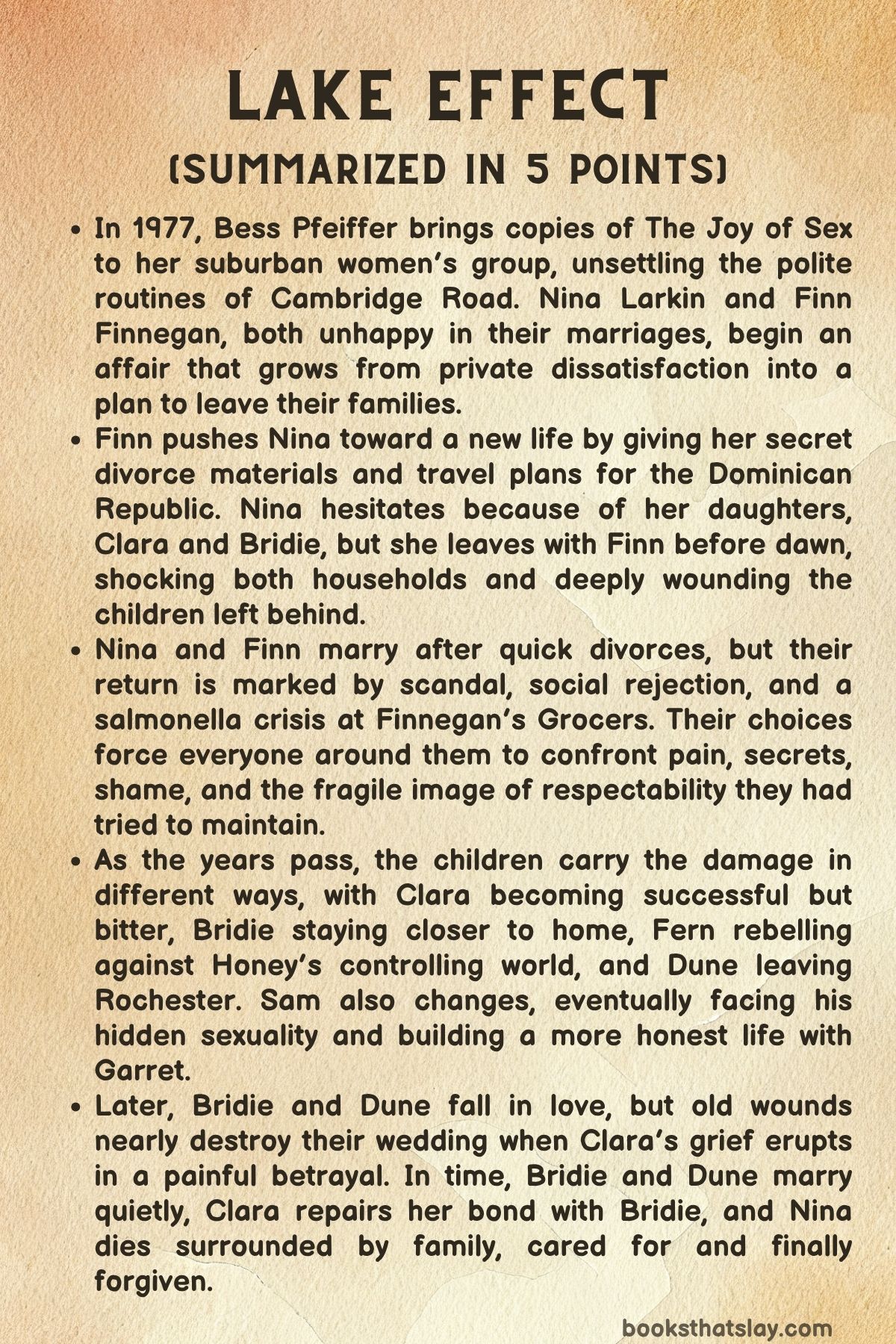
Summary
In Lake Effect, life on Cambridge Road appears orderly, comfortable, and predictable. The families know one another’s habits, reputations, dinners, marriages, children, and secrets, though many of those secrets remain hidden beneath good manners.
The book begins in 1977, when Bess Pfeiffer brings copies of The Joy of Sex to her suburban women’s group, hoping to stir up conversation among women who usually stay within accepted rules of friendship and marriage. The gesture unsettles the neighborhood more than anyone expects, because it arrives at a time when several people are already questioning the lives they have built.
Nina Larkin seems to have everything a woman in her world is supposed to want. She is married to Sam Larkin, a successful Xerox executive, and is admired as a graceful hostess and food columnist.
She has two daughters, Clara and Bridie, and a home that reflects care, taste, and competence. Yet Nina feels lonely inside her marriage.
Her life is full of duties and surfaces, but she no longer feels seen or desired. Across the street lives Finn Finnegan, who helps run his family’s grocery business.
He is married to Honey, a woman deeply invested in order, Catholic respectability, dieting, control, and the appearance of a proper household. Finn, like Nina, feels trapped by the shape of his life.
Nina and Finn’s dissatisfaction turns into an affair after a charged meeting at Finn’s lake-house boathouse. What begins as secret attraction becomes a serious plan to escape.
During Sam’s birthday dinner, the guests discuss Xerox’s new computers and the idea of an “undo” function. The word stays in the air like a question.
Many of the characters are living with choices they wish they could reverse or rewrite. After the party, Finn stays behind in Nina’s kitchen and makes it clear that he wants a future with her, not just an affair.
He later leaves her information about obtaining quick divorces in the Dominican Republic, along with travel documents and practical instructions.
Nina hesitates because she knows leaving will hurt her daughters. Clara and Bridie still need her, and Nina understands that a mother’s departure cannot be explained away as romance or freedom.
Still, her longing for a different life wins. Before dawn, she leaves with Finn.
Fern, Finn’s daughter, sees Nina crossing the street with a suitcase, a quiet image that marks the end of the neighborhood’s old order. Clara and Bridie discover Nina’s note, in which she says she is with Mr. Finnegan and will explain later.
The note does not comfort them. It confirms that their mother has chosen a new life before helping them understand the loss of the old one.
The elopement devastates both households. Clara is especially wounded.
She has recently fallen for Dune Finnegan, Finn and Honey’s son, and Nina’s flight ruins that fragile first love. Dune rejects Clara and blames her mother for destroying both families.
Clara’s pain hardens into anger, and she begins carrying responsibilities that should not belong to a child. She cooks, cleans, watches over Bridie, and turns her grief into resentment.
Bridie is younger and more confused. She feels abandoned but does not have Clara’s sharp language for the injury.
Honey is humiliated, furious, and determined to protect her dignity. Sam is stunned by Nina’s betrayal, but the crisis also pushes him toward truths he has long avoided.
Sam has been hiding his attraction to men and his connection with Garret, a man from Xerox’s Palo Alto office. Nina’s departure exposes the emptiness and dishonesty within their marriage, even though the public story focuses on her scandal.
Sam must face the life he has kept secret. The collapse of his marriage becomes painful, but it also creates the possibility of a more honest future.
In the Dominican Republic, Nina and Finn obtain divorces and marry. Their return, however, is not the beginning of simple happiness.
Almost immediately, Finn’s family grocery business is hit by a salmonella outbreak. A customer dies, and the scandal gives Finn’s uncle Dennis and Helen Harper the chance to push him aside within the company.
Finn has already broken his family’s trust by leaving Honey; now he loses authority in the business that helped define him. Nina and Finn’s new marriage begins under public judgment, family anger, and financial and social strain.
The children suffer in different ways. Clara grows into a capable but guarded young woman.
Her anger at Nina becomes central to her identity, shaping how she remembers her childhood and how she handles love. Fern is drawn into Honey’s world of Weight Watchers and body control, then later resists the harm that world has done to her.
Dune drinks, loses direction, and eventually leaves Rochester. Bridie remains closer to home and develops more quietly, carrying her hurt in a less obvious way than Clara.
Around them, the adults try to rebuild. Nina and Finn attempt to create a stable life from the choice that shattered two families.
Sam leaves Xerox, reconnects with Garret, and gradually builds a life that fits him more truthfully.
Years pass, and the scandal becomes family history, though not a healed wound. Clara moves to New York and becomes a successful food stylist, using the domestic skills and visual instincts connected to her mother’s world while keeping emotional distance from Nina.
Her success does not free her from anger. Bridie, by contrast, remains more open to connection.
When she and Dune meet again at a fundraiser, their shared past makes things awkward. They belong to the same family disaster, and each carries memories of what their parents did.
Yet they begin spending time together, and their relationship grows into love.
Dune visits Clara in New York to ask her to come back for his wedding to Bridie. Clara resists but returns.
The rehearsal dinner appears to suggest that time has softened the old wounds. The blended family seems able, at least briefly, to sit together in peace.
But Clara is not at peace. Drunk, jealous, and still tied to her younger self’s longing for Dune, she corners him and almost kisses him.
Bridie sees them. The wedding is called off, and the old pain returns in a new form.
Clara’s actions show that she has not merely been angry all these years. She has been grieving the loss of her mother, her childhood, and the future she once imagined.
The morning after the ruined rehearsal dinner, Nina confronts Clara. Their conversation forces Clara to face the truth beneath her bitterness.
Nina’s leaving did real damage, but Clara’s refusal to acknowledge her grief has also kept her trapped. The scene does not erase what Nina did, but it opens a path toward a more honest relationship between mother and daughter.
Bridie and Dune eventually marry quietly at the courthouse, choosing a ceremony that belongs to them rather than to the expectations and history surrounding their families. They later have a daughter, Josephine.
Clara returns and helps Bridie through postpartum depression, and the sisters begin to repair their bond. Clara’s care for Bridie becomes one of the clearest signs that love in the family has survived, even after years of injury and distance.
In the final years of Lake Effect, Nina becomes gravely ill. The people most marked by her choice gather around her: Finn, Clara, Bridie, Fern, Dune, and baby Josephine.
Nina moves between memory and the present, aware of the people near her and the life she made with all its costs. She is no longer only the woman who left, nor only the woman who loved Finn.
She is a mother, wife, neighbor, and flawed person whose decisions changed many lives. As she dies, she feels cared for and forgiven.
Her final thoughts carry her toward Finn and toward gratitude, ending the novel with a sense of release after decades of damage, endurance, and imperfect love.
Characters
Nina Larkin
Nina Larkin is one of the central emotional figures in Lake Effect, and her character is shaped by the tension between outward perfection and inward loneliness. At the beginning, she appears to have the kind of life that should satisfy the expectations of her suburban world: she is a food columnist, a graceful hostess, a wife, a mother, and a woman who knows how to perform domestic competence.
Yet beneath that polished surface, Nina feels trapped in a marriage that lacks intimacy and emotional truth. Her affair with Finn Finnegan is not presented simply as recklessness; it grows out of a deep hunger to feel chosen, desired, and alive.
However, Nina’s pursuit of personal freedom comes at a devastating cost. By leaving Sam and her daughters, Clara and Bridie, she fractures the family structure that has defined her children’s lives.
Her choice makes her both sympathetic and morally complicated because she is not merely escaping unhappiness; she is also creating pain that others must carry for years.
Nina’s character becomes especially complex because she is neither a villain nor an innocent victim. She wants love, honesty, and a second chance, but her way of reaching for those things is secretive and destructive.
Her silence before leaving shows how fear and desire can combine into cowardice. She cannot fully face the consequences of her decision until much later, when Clara’s anger forces her to confront how deeply her absence wounded her daughter.
Nina’s later illness softens the emotional atmosphere around her, but it does not erase what happened. Instead, her final moments suggest that forgiveness in the book is not the same as forgetting.
Nina dies surrounded by the people whose lives were shaped by her decision, and this gives her character a tragic tenderness. She is remembered not as a perfect mother or perfect lover, but as a flawed woman who wanted more from life and paid dearly for the way she tried to claim it.
Finn Finnegan
Finn Finnegan is a passionate but impulsive character whose dissatisfaction with his own life pushes him toward a radical break from family, business, and social expectation. As the head of the family grocery business, he carries the image of responsibility, tradition, and masculine stability.
Yet his affair with Nina reveals how unstable his inner life has become. Finn is drawn to Nina because she represents escape from the controlled world he shares with Honey and from the expectations attached to his family name.
His decision to arrange quick divorces in the Dominican Republic shows both determination and selfishness. He wants a future with Nina badly enough to plan it carefully, but that careful planning does not extend to the emotional damage he causes his wife, his children, or Nina’s family.
Finn’s character is also weakened by the fact that he imagines love can undo the rest of life. The Xerox “undo” idea that hangs over the story connects strongly to him because he behaves as though a bold romantic decision can erase the past and create a clean beginning.
Instead, his return with Nina brings immediate consequences: social rejection, family anger, and the salmonella crisis at Finnegan’s Grocers. His loss of power in the business shows how his private choices and public identity cannot be separated.
Still, Finn is not portrayed only as selfish. His continued presence beside Nina, especially in her final illness, suggests loyalty and genuine love.
He is a man who makes a destructive choice, but not a shallow one. His tragedy lies in confusing desire with liberation and underestimating how many lives would be changed by his pursuit of happiness.
Clara Larkin
Clara Larkin is one of the most emotionally wounded characters in the book, and her development is marked by anger, abandonment, and the long struggle to understand grief. As Nina’s daughter, Clara experiences her mother’s elopement not as a romantic act but as a betrayal.
She is forced into a premature form of adulthood, cleaning, cooking, and trying to hold together a household that has been emotionally shattered. Her pain is intensified by her feelings for Dune Finnegan, because Nina’s affair destroys not only Clara’s trust in her mother but also her first romantic hope.
When Dune rejects her and blames Nina, Clara’s humiliation becomes tangled with rage, making the betrayal feel both familial and personal.
As Clara grows older, her success as a food stylist in New York shows her discipline, talent, and ability to build a life away from Rochester. Yet her professional success does not mean emotional healing.
Food, domestic order, and presentation become areas where she can exercise control, perhaps because her childhood home became uncontrollable so suddenly. Her estrangement from Nina reveals how anger can become a protective identity.
Clara holds on to resentment because letting go would require her to admit how much she still grieves. Her near-kiss with Dune at Bridie’s rehearsal dinner exposes the unresolved jealousy and hurt beneath her adult exterior.
It is a deeply damaging moment, but it also reveals that Clara’s cruelty comes from pain rather than simple malice. Her later return to support Bridie through postpartum depression marks an important turn in her character.
Clara begins as a wounded daughter, becomes a hardened adult, and eventually moves toward repair through sisterhood and care.
Bridie Larkin
Bridie Larkin is the quieter and more inwardly vulnerable of Nina’s daughters, and her journey is one of gradual self-formation after family collapse. As a child, she is confused and heartbroken by Nina’s departure, but unlike Clara, she does not express her pain mainly through rage.
Bridie’s hurt is more subdued, and this makes her character especially poignant. She remains closer to Rochester and seems to grow into herself more slowly, carrying the family rupture in a gentler but still profound way.
Her emotional life is shaped by the absence of stability, but she also becomes a character capable of tenderness, patience, and renewal.
Bridie’s later relationship with Dune is significant because it transforms a shared history of pain into a possibility for love. Their connection begins awkwardly because their families were damaged by the same scandal, but that awkwardness also gives them a rare understanding of each other.
Bridie’s decision to marry Dune quietly at the courthouse after the failed wedding shows her growth. She no longer needs the approval, performance, or ceremonial perfection that the older generation often valued.
She chooses a simpler, more personal form of commitment. Her postpartum depression after Josephine’s birth adds further depth to her character, showing that even after finding love, she remains vulnerable to emotional darkness.
Clara’s help during this period allows Bridie to become part of one of the book’s most meaningful repairs: the restoration of the sisters’ bond. Bridie represents endurance, not through dramatic confrontation, but through the slow building of a life that is truly her own.
Sam Larkin
Sam Larkin is a restrained and quietly tragic character whose life is built around concealment. As Nina’s husband and a Xerox executive, he appears to belong securely to the respectable suburban world of work, marriage, and fatherhood.
Yet his hidden attraction to men and his relationship with Garret reveal that Sam’s marriage has also been shaped by silence and emotional absence. Nina’s affair wounds and humiliates him, but it also forces into the open the fact that their marriage was already marked by unspoken truths.
Sam’s pain is therefore complicated. He is betrayed by Nina, but he has also been living behind a carefully maintained social mask.
Sam’s character is important because he reflects another version of the book’s central conflict between appearance and honesty. Unlike Nina, he does not initially make a dramatic public break.
His secrecy is quieter, shaped by fear, social pressure, and the limits of the time in which he lives. Leaving Xerox and reconnecting with Garret suggests that Sam eventually moves toward a more authentic life.
This does not erase his past or the pain within his family, but it gives his character a sense of liberation that is less explosive than Nina’s. Sam is not simply the abandoned husband; he is a man whose wife’s departure forces him to confront the life he has denied himself.
His arc shows that truth can be painful not only because it disrupts others, but because it reveals how much of one’s own life has been spent in hiding.
Honey Finnegan
Honey Finnegan is a character defined by control, respectability, and the fear of public humiliation. As Finn’s wife, she is deeply invested in appearances, Catholic morality, dieting, and social order.
Her world depends on rules: rules about marriage, body image, reputation, and proper behavior. Finn’s affair with Nina attacks the very foundation of that world.
Honey’s anger is not only the anger of a betrayed wife; it is also the fury of someone whose carefully managed identity has been exposed as fragile. She has built her life around being seen in a certain way, and Finn’s abandonment makes her feel publicly diminished.
Honey’s involvement in Weight Watchers reveals how her need for control extends into the bodies and habits of those around her. Her influence over Fern is particularly damaging because it passes insecurity from mother to daughter.
Honey’s character shows how social respectability can become emotionally destructive when it values discipline and appearance over compassion. Yet she is not merely a caricature of repression.
Her humiliation is real, and her anger comes from genuine loss. She has been betrayed, and the community’s gaze makes that betrayal even harder to bear.
Honey represents the cost of living according to rigid expectations. She suffers because those expectations fail to protect her, and she harms others because she continues to enforce them.
Fern Finnegan
Fern Finnegan is one of the younger characters most visibly affected by the adults’ choices. Her role is significant from the moment she sees Nina crossing the street with a suitcase, because she becomes a silent witness to the event that will change both families.
As Finn and Honey’s daughter, Fern is caught between betrayal, confusion, and the emotional atmosphere created by her mother’s humiliation. She does not control what happens, but she must grow up inside its consequences.
Her involvement in Honey’s Weight Watchers world shows how family trauma can be redirected into issues of body image, obedience, and self-worth.
Fern’s later rebellion is important because it suggests that she eventually recognizes the damage caused by the values surrounding her. Her resistance is not just teenage defiance; it is a rejection of the narrow expectations that have shaped her mother’s life and threatened her own.
Fern’s character helps show that the affair does not only affect the central couple or their spouses. It spreads into the children’s identities, friendships, bodies, and futures.
By the end, Fern’s presence around Nina during her illness suggests that time has altered the emotional landscape. She remains part of the blended, wounded family that has formed out of scandal, loss, and reluctant forgiveness.
Dune Finnegan
Dune Finnegan is a character whose life is deeply marked by anger, displacement, and unresolved grief. As Finn’s son, he experiences his father’s affair with Nina as a direct attack on his family.
His rejection of Clara after the elopement reveals how quickly young love can be poisoned by adult betrayal. Dune blames Clara’s mother and, by extension, pushes Clara away, even though she is also suffering.
His reaction is cruel but understandable within the emotional chaos of the moment. Like Clara, he is a child forced to process pain he did not create.
Dune’s drinking and eventual departure from Rochester suggest a young man who cannot remain inside the scene of his family’s collapse. Leaving becomes his way of surviving, though not necessarily healing.
His later reconnection with Bridie shows a more mature version of him, one capable of tenderness and commitment. The relationship between Bridie and Dune is meaningful because it grows out of shared damage rather than innocence.
When he asks Clara to return for the wedding, he shows a desire for reconciliation, or at least a hope that the past can be faced without destroying the present. Clara’s near-kiss with him exposes how unresolved the past still is, but Dune’s eventual quiet marriage to Bridie suggests that he chooses steadiness over drama.
His character moves from wounded anger to a more grounded form of love.
Bess Pfeiffer
Bess Pfeiffer serves as an important catalyst in the story because her decision to bring seven copies of The Joy of Sex to the suburban women’s group unsettles the polite routines of Cambridge Road. She may not be at the center of the family scandal, but her action introduces the question of desire into a world that depends on silence and manners.
Bess wants to shock her friends out of complacency, and in doing so, she helps reveal how much dissatisfaction already exists beneath the surface. The book she brings does not create Nina and Finn’s unhappiness, but it helps disturb the atmosphere of repression that has kept such unhappiness hidden.
Bess represents the disruptive force of curiosity and social daring. She challenges the women’s group not through direct rebellion but through an object that makes private desire impossible to ignore.
Her role is especially interesting because she does not control what follows. The neighborhood’s unraveling is larger than her gesture, yet her gesture belongs to the chain of events that exposes the emotional and sexual dissatisfaction around her.
In a community built on restraint, Bess becomes a figure of provocation. She reminds readers that sometimes a small act of social mischief can reveal truths that everyone has been avoiding.
Garret
Garret is a quieter but essential character because he represents the hidden life Sam has been unable to fully claim. Connected to Xerox’s Palo Alto office, Garret belongs to a world outside Sam’s suburban marriage and public identity.
His relationship with Sam reveals that Sam’s emotional and sexual truth has existed in secrecy for some time. Garret’s importance lies less in dramatic action and more in what he makes visible about Sam.
Through him, readers understand that Nina is not the only person trapped in a false version of marriage.
Garret also represents possibility. When Sam reconnects with him after leaving Xerox, it suggests that Sam’s life can move toward honesty rather than concealment.
Garret is not merely a romantic figure; he is a symbol of the self Sam has suppressed. His presence deepens the book’s treatment of intimacy because it shows that betrayal, secrecy, and longing are not confined to Nina and Finn’s affair.
Sam’s connection with Garret complicates any simple judgment of the marriage. It becomes clear that the Larkin household was already shaped by emotional distance and unspoken truths before Nina left.
Dennis
Dennis, Finn’s uncle, represents the hard edge of family business, power, and opportunism. During the salmonella crisis at Finnegan’s Grocers, he uses the disaster to push Finn out of real authority.
His actions show that family loyalty has limits when reputation, money, and control are threatened. Dennis is important because he connects Finn’s private scandal to the public consequences that follow.
Finn’s romantic choices already weaken his standing, and the outbreak gives Dennis the opportunity to consolidate power.
Dennis’s character adds a practical and ruthless dimension to the story. While other characters are consumed by heartbreak, humiliation, or guilt, Dennis responds to crisis strategically.
He is less concerned with emotional repair than with business survival and control. In this way, he shows how institutions and families can punish vulnerability.
Finn’s fall in the company is not only the result of the outbreak; it is also the result of being surrounded by people ready to take advantage of his weakened position. Dennis helps reveal that personal choices can have consequences far beyond the home.
Helen Harper
Helen Harper works alongside Dennis in using the salmonella crisis to reduce Finn’s power within Finnegan’s Grocers. Her character represents the social and business forces that close in around Finn after his return with Nina.
Like Dennis, Helen is tied to the practical aftermath of scandal and crisis. She is not presented primarily through emotional turmoil, but through her role in shifting authority away from Finn.
This makes her part of the larger pattern of consequence that follows the elopement.
Helen’s importance lies in how she helps show that Finn cannot simply return from the Dominican Republic and resume his former life. His choices have made him vulnerable, and the business crisis gives others the leverage to act against him.
Helen represents judgment in institutional form. The neighborhood may shun Nina and Finn socially, but the company also disciplines Finn materially.
Through Helen, the story widens beyond romance and family pain to include reputation, management, and power.
Josephine
Josephine, Bridie and Dune’s daughter, represents renewal after years of damage between the Larkin and Finnegan families. Her birth does not magically heal the past, but it creates a new emotional center around which repair becomes possible.
As the child of Bridie and Dune, Josephine is born from a relationship that once would have seemed almost impossible, given the bitterness caused by Nina and Finn’s affair. Her existence shows that the next generation can emerge from a history of rupture without being defined entirely by it.
Josephine also plays an important role in bringing Clara and Bridie closer again. Bridie’s postpartum depression creates a moment of vulnerability, and Clara’s decision to return and help her sister becomes one of the clearest signs of healing in Lake Effect.
Through Josephine, care replaces rivalry, and family begins to mean something more flexible than the old suburban ideal. She symbolizes continuity, but not the kind based on appearances or tradition.
Instead, she represents a more honest form of family, built after pain, forgiveness, and the recognition that love often survives in imperfect forms.
Themes
The Long Cost of Personal Freedom
In Lake Effect, Nina and Finn’s decision to leave their marriages is not shown as a simple act of romance or selfishness; it becomes a choice that frees them while injuring almost everyone around them. Their relationship begins because both feel trapped by lives built around duty, performance, and emotional silence.
For Nina, leaving Sam offers a chance to stop pretending that her marriage is fulfilling. For Finn, leaving Honey means escaping a household ruled by control and public image.
Yet their freedom comes at the expense of their children’s security. Clara, Bridie, Fern, and Dune are forced to carry the emotional weight of choices they did not make.
The theme becomes powerful because the story refuses to treat freedom as either purely noble or purely destructive. Nina and Finn gain honesty, but they also create abandonment, anger, shame, and confusion.
Their choice shows that personal liberation can be necessary and damaging at the same time, especially when private desire breaks the structure of family life.
Marriage, Secrecy, and the Failure of Appearances
The marriages in the story appear stable from the outside, but behind that stability are loneliness, repression, and dishonesty. Nina and Sam’s marriage has the shape of respectability, yet lacks emotional and physical intimacy.
Sam’s hidden attraction to men and his connection with Garret reveal how much of his life has been arranged around concealment. Finn and Honey’s marriage also depends on surface order.
Honey’s attention to dieting, Catholic respectability, and social control shows her desperate need to maintain the image of a proper household, even when the relationship itself is empty. The suburban setting strengthens this theme because neighbors know how to host dinners, attend gatherings, and follow social rules, but they do not know how to speak honestly about desire, unhappiness, or fear.
The “undo” function discussed at Sam’s birthday dinner becomes a symbol for the impossible wish to erase wrong choices. The characters cannot undo their lives; they can only face what secrecy has already damaged.
Children as Witnesses to Adult Choices
The children are not passive background figures; they become witnesses, judges, and victims of the adults’ decisions. Fern seeing Nina leave with a suitcase turns the affair into something concrete and unforgettable.
Clara and Bridie finding Nina’s note forces them to understand betrayal before they are emotionally ready. Clara responds by becoming angry, capable, and guarded, taking on domestic responsibility while also hardening herself against her mother.
Bridie’s hurt is quieter, but no less deep; her later bond with Dune shows how childhood wounds can return in adult relationships. Dune’s rejection of Clara and later relationship with Bridie reveal how the parents’ actions distort the children’s emotional lives for years.
This theme is especially strong because the story shows that children often inherit the consequences of adult desire without receiving adult explanations. They are left to make meaning from silence, absence, and rumor.
Their later attempts at love and forgiveness are shaped by what they saw and lost when they were young.
Forgiveness as a Slow and Uneven Process
Forgiveness in the story does not arrive as a sudden emotional cure. It develops slowly, unevenly, and often after years of anger.
Clara’s bitterness toward Nina is not treated as childish resentment; it is rooted in grief, abandonment, and the feeling that her mother chose a new life over her daughters. Nina’s later confrontation with Clara matters because it forces Clara to admit that anger has protected her from pain.
Bridie’s path is different. She remains closer to Rochester and eventually builds a life with Dune, but even her happiness is marked by the old family damage.
The cancelled wedding shows that unresolved grief can still interrupt the future. Yet the later courthouse marriage, Josephine’s birth, and Clara’s return during Bridie’s postpartum depression suggest that repair is possible when people stop performing strength and begin showing need.
Nina’s final illness gathers the family into a space where care becomes more important than blame. Forgiveness here is not forgetting; it is the painful decision to remain connected despite what cannot be changed.