Legend by Karina Halle Summary, Characters and Themes
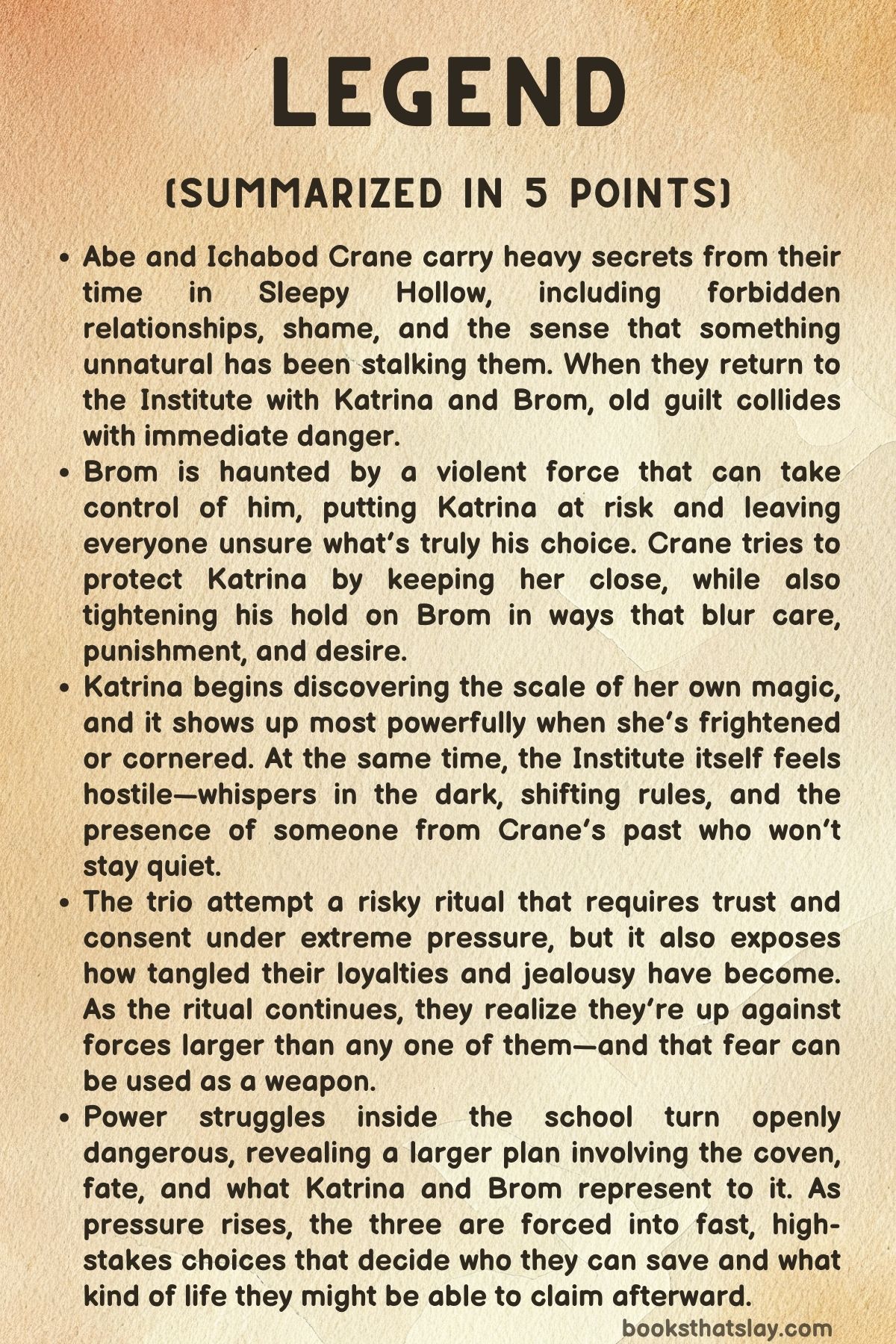
Legend by Karina Halle is a dark, erotic, paranormal reimagining of Sleepy Hollow that turns the familiar myth into a story about power, possession, and chosen loyalty. Katrina Van Tassel is trapped inside the isolated Sleepy Hollow Institute, where witchcraft is taught under strict rules and older forces quietly dictate everyone’s fate.
Ichabod Crane, a teacher with dangerous secrets, and Brom Bones, a man cursed by a violent spirit, are both bound to Kat in ways that are equal parts desire and survival. As deaths mount and the Institute’s true purpose surfaces, the three must decide what they owe destiny—and what they will burn to protect each other.
Summary
A year before the central crisis, Abraham Van Brunt—who calls himself Abe—lives in New York beside Ichabod Crane, haunted by a recurring nightmare. In it, a towering headless darkness approaches with Katrina’s severed head and offers a bargain: let it inside, and it will make her whole again.
Abe wakes in terror, already steeped in guilt and fear. He remembers the path that led him there: meeting Crane at an opium den, accepting small mercies like warmth and shelter, and using sex as a way to feel safe when everything else feels hunted.
The nightmares aren’t only shame and memory; they feel like a presence that can touch him. Abe carries the weight of leaving Sleepy Hollow behind, especially leaving Katrina, because returning meant exposure and punishment.
He tells himself he will go back once the town magistrate is dead and he can retrieve her, yet the dread follows him even in the city. Crane, who understands the pressure of forbidden wants, offers comfort in the only way he knows—through intimacy—while Abe tries to convince himself he can outrun both judgment and the thing that stalks him.
In the present, Crane rides back to the Sleepy Hollow Institute with Katrina after stopping Brom Bones from attacking her. Brom had been overtaken by the Headless Horseman, and Crane shot him in the shoulder to end the assault.
Crane also used magic to heal Brom and restore memories that had been missing, hoping knowledge will help them break the bond between Brom and the spirit. Katrina is exhausted, shaken, and wary of Brom, but she stays close because she has nowhere else safe.
When they pass through the Institute’s warded gates, the campus feels too quiet, the cathedral lit like an eye watching in the dark. Crane decides Katrina will sleep near him, not near Brom, because Brom can only be possessed after nightfall, and Crane wants her within reach.
Crane confronts Brom about a severed head left in the library. Brom admits the victim was a drunk who had harassed Katrina, and Brom insists he wasn’t himself when the killing happened.
Crane doesn’t trust him. He takes leather straps and makes restraints—a collar and reins—intending to keep Brom controlled at night.
He tells them bluntly that breaking the bond will require a ritual using blood magic and sex magic, involving all three. Brom’s restored memories matter because the ritual depends on will, consent, and a full understanding of what the spirit has latched onto.
Inside Crane’s room, anger bursts loose. Crane punches Brom for what happened to Katrina and makes dominance part of discipline, tying him up tighter.
He declares Katrina belongs to him and warns Brom not to touch her unless Crane allows it. Brom argues that he is meant to marry Katrina, but Crane calls the marriage arranged and challenges Brom’s entitlement.
Their argument exposes a shared past: Brom remembers a year in New York, hiding and being with Crane while both were running from their own darkness. Crane turns that history into leverage, using restraint as both punishment and a reminder of who holds control in this room.
Brom, trapped between desire, resentment, and fear of what lives inside him, believes he deserves pain for what he did while possessed. Crane’s interrogation turns physical and sexual, mixing rage with need.
Brom fights the urge to let the Horseman push back, knowing that giving in might open the door wider.
Next door, Katrina lies awake listening to everything. She feels fear of Brom, longing for the boy she once knew, and fury over being abandoned for years with no explanation.
She also hears a woman’s voice pressing her from the shadows—insistent, accusing, intimate in the wrong way. It feels like someone is in the room with her.
Frightened, Katrina leaves and steps into Crane’s room, where she finds Crane humiliating Brom while keeping him restrained. Crane tells her she can leave, but if she stays, she must shut the door.
Katrina stays. Crane uses her presence to intensify Brom’s punishment, instructing Katrina to expose herself and participate while denying Brom any touch.
Katrina, aroused and conflicted, obeys. Crane focuses on Katrina and brings her to orgasm while Brom is forced to watch, then Crane deliberately refuses Brom any relief.
Crane sends Katrina to run a warm bath. Alone, Katrina experiments with the charged energy in her body and heats the water with her magic—something the Institute’s rules and wards usually prevent.
The candles suddenly go out. A monstrous roar erupts in the other room.
Katrina rushes to the door and finds it locked.
Inside, Brom snaps free and attacks Crane. Crane realizes the Horseman has taken Brom again: Brom’s eyes go unnaturally dark, his strength spikes, and he tries to bite and kill.
The Horseman speaks through him, claiming Katrina has been promised “through the ages” and threatening Crane for interfering. Crane fights by pressing into Brom’s half-healed shoulder wound, but the possessed Brom overpowers him and begins choking him.
Katrina forces the bathroom door and bursts in, unleashing visible lightning-like magic that slams Brom against the wall. The effort drains her.
When she weakens, Brom collapses and the possession retreats.
A staff member, Daniels, knocks to complain. Crane lies, calling it a nightmare, then tries to get heavier restraints and fails.
Afterward, they face the mess: Katrina shaking under a blanket, Brom bleeding, bathwater nearly overflowing. Crane learns Katrina can heat water and realizes her power may be stronger than the school wants her to know.
Katrina insists the ritual must happen soon. Crane warns it requires blood, dark workings, and sex.
Katrina refuses Brom’s touch but says she might touch him if she remains in control. Crane agrees they will have to compromise.
Crane puts Brom into the hot bath and tends the gunshot wound. Their exchange is raw: Brom admits he thinks he hates Crane; Crane answers that he will accept hatred if it means Brom feels something real instead of going numb.
Dawn comes with no peace. Katrina wakes in Crane’s room with a note: Crane and Brom went to inspect the library damage.
While Katrina bathes, the water moves wrong. A dead woman appears in the tub and tries to drown her, accusing her of letting “my husband” touch her.
Katrina escapes, and the apparition warns that Crane is dangerous and will never let Katrina leave. Katrina recognizes her as Marie, Crane’s dead wife.
When Crane and Brom rush in, the bathroom is empty except for spilled water. Crane’s reaction is calm enough to be unsettling: he admits Marie has reason to be angry.
Katrina needs clothing before her mother arrives, so she goes to the women’s faculty dorm and asks Ms. Choi for help, inventing a story about falling into the lake. Ms. Choi lends her clothes and notices Katrina’s injuries.
She also reveals practical truths: teachers can leave the Institute but lose most of their magic away from the grounds, and she mentions Leona Van Tassel once instructed her to bring back opium during summer travel—hinting at corruption in the administration. Katrina returns dressed and demands explanations about Marie.
Before more can be said, Katrina’s mother, Sarah, arrives.
Outside, Katrina lies that she spent the night with Brom and ruined her clothes. Sarah is delighted and refuses Katrina’s request for contraceptive tea, insisting Katrina’s purpose is to bear Brom’s child.
Katrina provokes her by suggesting she might also be sleeping with Crane. Sarah grabs and insults her, and Katrina instinctively blasts her mother back with a surge of electrical magic.
Sarah’s reaction is not fear but triumph: she claims she always knew Katrina had power and that the Institute has awakened it. Katrina realizes she made a mistake revealing magic in front of her.
At the same time, Leona Van Tassel summons Crane beneath the cathedral. She accuses him of having sex with student Katrina and orders him to stop or be fired.
When Crane presses her about Goruun, Leona admits Goruun is the coven’s deity and implies the school exists to trap people in a larger design. She then uses Crane’s past as a weapon, claiming he killed his wife and can be exposed and jailed if he disobeys.
Leona insists Katrina belongs to Brom by destiny and that Crane must remain at the Institute because the school needs him.
Crane returns shaken and turns to Brom, initiating rough sex as a way to burn off panic and rage. Brom worries violence could trigger the Horseman even in daylight.
Crane shifts away from escalation and toward release. Afterward, Crane admits he wants both Brom and Katrina for himself and doesn’t want them sharing each other beyond what he allows.
Brom reveals the coven treats him like a tool meant to carry out Goruun’s plans. Crane repeats his rules: Brom touches Katrina only for the ritual, under Crane’s supervision.
Brom refuses to verbally surrender but does not openly defy him.
They proceed with the ritual in a forest clearing. Crane warns Katrina it will hurt and offers a final chance to back out.
Katrina refuses. They drink a foul elixir.
Crystals mark a circle, and Crane begins chanting, declaring the circle unbreakable. Katrina is ordered to the center on hands and knees.
Crane cuts a long line down her back. The pain is sharp, then the elixir flips sensation into intense arousal.
Brom cuts his palm, and blood becomes part of the rite as their blood is pressed into Katrina’s wound. Crane penetrates Katrina while she takes Brom into her mouth, and Crane controls pacing, breath, and release, demanding restraint until he permits it.
Figures appear at the circle’s edge—watching spirits, darker shapes. Katrina panics.
The ritual forces perception to warp: Crane looks like a shadow monster; Brom looks like the Horseman. Katrina tries to flee, but they restrain her because breaking the circle would invite whatever is waiting.
A voice tells her the visions are fear being fed to her and begs her to choose what is real. Katrina forces focus until Brom becomes Brom again and Crane becomes Crane.
Crane cuts more lines across her chest and abdomen, drawing power. Katrina’s eyes turn gold as energy surges.
They continue, combining blood and sex to feed the working while Katrina silently begs the surrounding entities to take the Hessian spirit from Brom. The climax hits with a blinding rush of power, but when the elixir fades and the spirits recede, Brom confirms the connection remains.
The ritual failed. Crane vows to try again at the full moon.
Katrina refuses to accept living with the Horseman inside Brom.
The next morning, Brom wakes beside Crane and notices Crane forgot to chain him. Brom’s private truth surfaces: he has already made a bargain with the Horseman.
If Brom feeds it sacrifices, it can be controlled. In class, Brom hears a lesson about rumors from the Salem Witch Trials: two covens escaping punishment by bargaining with a demon, gaining immortality, and producing a child meant to become a vessel.
The Horseman’s voice presses in Brom’s mind, urging him to take what he wants. His palm wound opens and bleeds.
He runs to find Crane and Katrina.
Crane meets Katrina after class and is relieved she is menstruating, meaning she isn’t pregnant. A colleague reports another decapitated body in Sleepy Hollow, believed to be Constable Kirkbride.
Katrina and Crane look at Brom. Katrina bolts, overwhelmed.
Crane drags Brom into a classroom and demands the truth. Brom admits he told the Horseman to kill the constable and watched it happen through his own eyes.
He frames it as protection: he chooses sacrifices so the Horseman won’t hurt the people he loves. Crane is shaken but says he understands.
Brom then pushes back, claiming Crane has his own ghosts, and that Marie has been speaking at night—saying Crane murdered her.
Crane’s past spills out. Years earlier in San Francisco, he discovered Marie was having an affair with their neighbor, Raymond De Haro.
Crane confronted Ray, and the confrontation turned sexual. Marie walked in, screamed, and threatened to expose Crane as a “sodomite,” promising ruin.
In panic and fury, Crane shoved her. She fell, hit her head, and died.
Desperate, Crane used his strange medical-school power to revive her. Marie briefly returned with unnatural eyes and terror, begged to die, and then went still again.
Crane has lived with the horror of what he did, and with the knowledge that something in him can push past the boundary between life and death—at a cost.
While the men unravel, Katrina discovers Ms. Choi’s room ransacked and finds a spilled bottle labeled “Carbones Corrumpebant.” She pockets it. In the bathroom she finds a tub filled with blood.
From it rises her mother, alive, with fully black eyes. Sarah admits she comes each full moon to “replenish” herself by bathing in blood taken from victims after the Sisters’ sacrifices, pulled from Goruun’s den beneath the school.
She explains the Institute sits atop an ancient source of power tied to a demon.
Katrina confronts Sarah about years of manipulation: her father used, Katrina used as a pawn, Brom tied to a demon-child plan. Sarah insists she never meant to kill Katrina, only to siphon power “here and there,” admitting she has drained Katrina’s magic her whole life without Katrina noticing.
Sarah claims Katrina’s child would bring witches dominion and long life. Katrina counters with what Sister Sophie warned: the coven plans to use the Horseman to control Brom fully, drug Katrina, force conception, kill Brom, and later kill Katrina after birth.
Katrina says she trusts only Crane and Brom and plans to escape once the Horseman is removed.
Leona and Ana enter. Katrina hides in shadows.
Leona confronts Sarah about bypassing the strengthened wards during lockdown. She reveals chaos: murders, missing people, rumors leaking into town.
Sarah demands a promise Katrina won’t be harmed. Leona confirms Sophie was the one who warned Katrina and calls her a traitor for caring about her son.
Leona declares they only need the child soon and can begin under the harvest moon. She also reveals Brom is already in the cathedral and that the Horseman has fully possessed him.
When Leona suspects Sarah is lying about Katrina’s location, Sarah refuses to betray her daughter. Leona burns Sarah alive in the blood-filled bath.
Katrina is forced to watch her mother die and sink beneath the surface.
Another account shows Brom’s earlier surrender: in Manhattan, the Horseman came to his door, and Brom agreed to give up his soul in exchange for control, sealing it with a handshake and a rush of darkness inside him.
Katrina reunites with Crane and learns he can “borrow” her shadow magic through their bond. Katrina warns that Brom has been taken to the cathedral and the coven will act tonight.
She gives Crane the charcoal bottle. Crane recognizes it as an antidote that can neutralize drugging and tells Katrina to drink it.
Using shadow magic, they move toward the cathedral, but Katrina is seized by the Horseman and dragged inside. The Sisters restrain her on an altar and force laudanum down her throat.
Katrina pretends to lose consciousness, relying on the charcoal to blunt the drug.
Brom stands nude inside a candle-lit pentagram, apparently controlled. Under Leona’s orders, he approaches Katrina, but he speaks to her telepathically in Crane’s voice, revealing he is acting and not fully lost.
He tells her to keep up the act while they wait for Crane’s move. Goruun appears: a massive spider demon.
Brom reveals Goruun has already killed Sophie. Brom fakes climax to satisfy the ritual, but Goruun realizes no seed was released and explodes in rage.
At Brom’s signal, the Horseman strikes, decapitating Goruun’s head. Chaos erupts.
Ana is beheaded, Margaret is killed, and Leona is pinned to the wall by Brom’s sword. But Goruun’s still-living body snatches Katrina with its legs and hauls her into the rafters.
Crane travels through shadow to reach Katrina and climbs the demon’s web, but he is speared through the shoulder. Brom breaks through the roof with the Horseman’s axe and joins the fight.
On a count, Crane and Katrina ignite the demon with fire magic, forcing it to drop her. Crane catches Katrina among the rafters as Brom hacks the burning body apart.
Fire spreads through the cathedral. Crane and Katrina escape through the roof opening, but Brom is trapped when a collapsing rafter drops him into the flames.
Students arrive at dawn, rallied by Crane’s earlier telepathic call. Paul uses gravity magic to lower Crane and Katrina safely.
Others pull Brom out unconscious.
Crane pours what remains of his energy into Brom and revives him. With Goruun and the coven dead, the campus wards fail, allowing outside allies and constables to enter.
Brom explains the Horseman is dead and that the bargain’s deeper purpose was the Horseman’s own final death—freedom from being used. With the Institute collapsing into ruin, the trio chooses to leave Sleepy Hollow for good.
Before they go, they take valuable gems from the cathedral’s cases, then disappear as the old structure falls.
Three months later, Katrina and Crane are married, and Katrina is pregnant with Crane’s child. On a ship crossing the Atlantic, the captain also marries Katrina to Brom, with Famke as witness and Crane as best man, binding their chosen family in a way they can carry forward.
They settle in London and build a life that stays private to outsiders. Five years later, they live together on Baker Street with twin boys, Baltus and Johnathan, keeping the truth of their relationship hidden behind respectable masks.
They attend a gathering of a London mystic society hosted by Dorian Gray, meeting other supernatural figures, including vampires. By the end of the night, the three are welcomed into a wider world of magic and secrecy—alive, together, and finally beyond the Institute’s control.
Characters
Katrina “Kat” Van Tassel
Kat sits at the story’s emotional center as both the most endangered person in the triangle and the one whose agency steadily expands. She begins in a state of exhaustion and fear—sleep-deprived, threatened by Brom’s possession, and pressured by the Institute’s expectations—but she keeps choosing engagement over disappearance: she stays when she could flee, watches what she can’t yet stop, and insists the ritual happen on her terms even when it terrifies her.
Her magic is the clearest outward sign of that growth. At first it manifests as raw, lightning-like force when she saves Crane from possessed Brom; later she experiments, tests boundaries, and learns that the Institute’s control isn’t absolute.
Crucially, her power is tied to consent and control: she refuses Brom’s touch after the assault yet remains willing to participate in what’s necessary if she retains command over her body and choices. That throughline—“I will decide what happens to me”—is what transforms her from a pawn of coven destiny into the person who breaks it.
Kat’s relationships are where her complexity sharpens. With Brom, she carries grief for the boy she knew, rage at betrayal, and the trauma of what was done to her through him—feelings that coexist rather than resolve neatly.
With Crane, she experiences protection and intimacy, but also the unsettling realization that safety can come with ownership, rules, and hidden histories. Kat’s arc never becomes a simple “chosen one” empowerment fantasy; it’s built from hard compromises, bodily fear, and moral clarity.
Even when she lies to her mother, even when desire complicates her anger, she keeps returning to the same internal demand: no more being traded, no more being managed as a vessel, no more being told what her fate is. By the end, her freedom isn’t merely escape from the Institute—it’s the creation of a chosen family and an openly private life where she isn’t forced into a single role.
Ichabod Crane
Crane is constructed as a paradox: healer and aggressor, protector and possessor, devoutly wounded and dangerously controlling. He speaks the language of safety—promises, wards, proximity, rules meant to prevent the Horseman’s return—yet he repeatedly reaches for dominance as his primary way of managing fear.
His need to control Brom (through restraints, taunting, punishment) and to define Kat (“Kat is his”) is not presented as simple villainy; it is a coping strategy that reveals how his love is braided with terror of loss, shame about desire, and a compulsion to contain chaos at any cost. The story makes his authority seductive—he is competent, decisive, and brave in crisis—while simultaneously exposing that his competence is fueled by unresolved guilt and a willingness to cross lines.
His past with Marie is the engine of his self-concept: the moment where forbidden desire, panic, and violence converge and he becomes someone who can no longer believe he deserves clean love. The revelation that he shoved Marie to her death—then tried to revive her with unnatural power—places Crane in a moral gray zone that explains why he is so susceptible to Leona’s threats and why Marie’s ghost can destabilize him.
He is a man living with the knowledge that he can be both loving and lethal, and that knowledge leaks into everything: how he touches, how he commands, how he “keeps people safe” by taking decisions away from them. Even his care is often performative in the sense that it must reassure him as much as it protects others.
What keeps Crane from collapsing into a one-note dark archetype is the thread of genuine tenderness and the willingness to be emotionally present when it hurts. He doesn’t just want bodies; he wants connection that acknowledges the full ugliness of him.
He accepts Brom’s hatred as long as it means Brom feels something, and he repeatedly chooses to stand between Kat and the supernatural threat even when it costs him physically. His bond with Kat also changes him: he learns to share power (literally, through shadow magic borrowing), and he ends up choosing a future that requires negotiation rather than unilateral control.
Still, the ending doesn’t erase who he is; it reframes him as someone who can build a life only when secrecy, chosen community, and mutual agreement replace institutions that weaponize shame.
Brom Van Brunt
Brom is both victim and vector: a man whose body becomes a doorway for the Headless Horseman, and whose choices determine whether that doorway consumes everyone around him. The narrative gives him a violent duality—tender loyalty and predatory threat—by making his worst acts occur through possession, then forcing him to live with responsibility anyway.
His shame is real and corrosive: he believes he deserves pain for what happened to Kat, and that belief makes him vulnerable to Crane’s domination and to the Horseman’s internal pressure. Brom’s inner conflict isn’t simply “good man versus evil spirit”; it’s a collapse of boundaries where desire, rage, fear, and power all feed the same darkness.
The most defining pivot for Brom is his decision to bargain—first in Manhattan with the Horseman, later by choosing sacrifices to “manage” it. That choice is morally horrifying, but psychologically legible: when you feel the monster in you is inevitable, control starts to look like ethics.
He convinces himself that directing the violence away from the people he loves is protection, even as it turns him into an accessory to murder. This is where Brom becomes tragic rather than merely dangerous: he is trying to preserve love by committing acts that destroy his right to it.
His admission to Crane—confessing he ordered the constable’s death—also reveals a perverse intimacy between them; he trusts Crane with the ugliest truth because Crane, too, carries an accidental killing and a haunting guilt.
Brom’s relationship with Kat is layered with entitlement that has been culturally installed (“meant to marry,” “destiny”), but the story strips that entitlement down to raw fear of losing her and of being replaced. His jealousy toward Crane is not only romantic—it’s existential, because Crane represents a self Brom can’t be: controlled, learned, powerful without the same susceptibility to invasion.
Yet Brom also wants Crane, and that desire complicates every claim he makes about what is “supposed” to happen. Over time, Brom’s arc becomes one of reluctant self-knowledge: he can’t return to being the uncomplicated boy Kat loved, but he can choose honesty, consent, and partnership over destiny.
When the coven’s endgame collapses and Brom survives, he earns something he’s rarely had—life outside being used as a tool—though the text never pretends redemption is clean or owed.
Leona Van Tassel
Leona is the story’s institutional villain: not the wild supernatural threat, but the human face of the machine that breeds it. She operates through leverage—employment, reputation, records, the law, the threat of exposure—and her power lies in understanding how shame and social punishment can control people more reliably than chains.
Her confrontation with Crane crystallizes her role: she doesn’t argue morality; she argues consequences. By accusing him of sex with a student, threatening to “prove” he murdered Marie, and insisting Kat “belongs” to Brom by destiny, she reveals a worldview where individuals are interchangeable parts in a long ritual economy.
Leona’s devotion is not to people but to outcomes: the child, immortality, dominion, the continuation of the coven’s bargain. She also embodies the hypocrisy of controlled environments—the Institute’s wards, rules, and teachings that claim to civilize power while secretly feeding on sacrifice.
Her calmness in cruelty is what makes her terrifying; she treats violence as administration. When she burns Sarah alive, it isn’t framed as a rage moment—it’s an enforcement action, a message, a pruning of disobedience.
Leona is the character who best illustrates that destiny in Legend is not mystical romance—it’s a political project.
Sarah Van Tassel
Sarah is one of the most unsettling figures because she is both mother and predator, and she uses the language of motherhood to justify exploitation. She pressures Kat toward pregnancy not as care but as purpose, reducing her daughter to a reproductive function and celebrating the idea of a grandchild like a victory for the system that has already consumed their family.
Her delight at Kat’s magic—after being blasted away—reveals that she doesn’t fear her daughter’s power; she wants to harvest it. The later revelation that Sarah has siphoned Kat’s magic her entire life recasts every “motherly” push as long-term grooming for extraction.
Yet Sarah is not simply Leona’s puppet. She shows a thin, late-forming boundary when Leona tries to force Kat’s location from her and she refuses to betray her, admitting she wishes she had warned Kat sooner.
That refusal doesn’t redeem her, but it complicates her: even deeply complicit people can contain one last instinct toward protection, especially when they realize the machine will consume their child as readily as it consumed everyone else. Her ritual of bathing in blood to “replenish” herself makes literal what the coven represents: life purchased with other people’s bodies.
Her death—burned by Leona—completes her arc as a cautionary figure: those who collaborate with exploitative power structures are rarely spared by them.
Marie Crane
Marie’s presence is almost entirely spectral, but she exerts an outsized gravitational pull on Crane and Kat. As a ghost, she is not a gentle messenger; she is accusatory, violent, and intimate in her intrusion, appearing in baths and attempting drowning.
Water becomes her signature environment, linking her to both cleansing and violation—places where bodies are exposed and vulnerable. Her obsession with Kat is not jealousy in the petty sense; it is a claim that Crane corrupts and consumes, and she wants Kat to recognize danger before it becomes irreversible.
Marie is also the embodiment of Crane’s unresolved crime and his fear of being known. Because Crane tried to revive her and briefly brought her back in a distorted state, she is not merely “dead”; she is a consequence that refuses closure.
Her warnings—“he will never let you leave”—echo the central tension in Crane’s love: protection that can become captivity. Whether Marie is purely truthful or partly driven by her own rage matters less than what she forces into the open: Crane’s capacity for harm in moments of panic, and the way that harm can be rationalized as love or necessity.
Daniels
Daniels appears briefly, but his role is functional and revealing: he is the everyday institutional presence that keeps horror hidden behind routine. When he complains about noise and accepts Crane’s lie about nightmares, it underscores how much the Institute relies on denial and compartmentalization.
He also highlights Crane’s isolation: Crane can’t safely tell colleagues the truth, and the system is built to discourage truth anyway. Daniels is a reminder that monstrous structures don’t require everyone to be evil—only sufficiently uninterested.
Ms. Choi “Narae”
Narae functions as a rare point of ordinary kindness inside a predatory setting, and that contrast makes her important. She helps Kat with clothing and practical advice without demanding confession, offering the kind of care that the Institute’s leadership pretends to provide but doesn’t.
Her information about teachers being able to leave while losing most of their magic reveals the Institute’s controlling ecology: power is conditional, tethered to place, and withdrawal is punished. Her mention of Leona requesting opium also connects the school’s authority to dependence and coercion, suggesting that the Institute manages people through both metaphysical and chemical means.
Narae’s role is also to show Kat what solidarity can look like when it isn’t transactional. She doesn’t try to claim Kat’s destiny, police her sexuality, or exploit her injuries; she simply notices and responds.
In a book where nearly every relationship is entangled with power, that small decency becomes a quiet form of resistance.
Sister Sophie
Sophie is the story’s moral fracture line inside the coven. Even though she doesn’t occupy the page as long as the main trio, her actions matter because she demonstrates that care can exist even within corruption—and that the institution will destroy it.
The warning Kat cites, attributed to Sophie, exposes the coven’s plan in practical, ugly terms: drugging, forced conception, disposal of bodies once the “product” is secured. That kind of specificity is what turns fear into strategy for Kat, Crane, and Brom.
Sophie’s connection to motherhood—caring for her son—becomes the reason she is labeled traitor. In a system that treats children as vessels and women as tools, Sophie’s genuine maternal attachment becomes subversive.
Her death at Goruun’s hands underlines the coven’s logic: affection is a liability, and dissent is exterminated.
Ana
Ana is one of Leona’s enforcers, a face of coven power in action rather than policy. She participates in the cathedral ritual, helps restrain Kat, and embodies the willingness to enact bodily control for ideological ends.
Her death in the cathedral fight is swift and unsentimental, which fits her narrative function: she represents the part of the machine that breaks people’s wills, and when the machine collapses, she is removed like a component.
Margaret
Margaret serves a similar purpose to Ana—supporting Leona’s plan and enforcing the ritual’s violence—and helps create the sense that the coven’s cruelty is communal, not the work of one mastermind. Her presence reinforces that the Institute’s horror is social: multiple adults agree to sacrifice, drug, and breed a student for power.
Her death during the uprising functions as the story’s refusal to grant the coven a dignified exit.
Goruun
Goruun is not merely a “boss monster” but the ultimate revelation of what the Institute worships: power that feeds on flesh, fear, and reproduction. Its spider form is symbolically apt—webs, entanglement, predation, the feeling that escape only binds tighter.
Goruun’s role clarifies that the coven’s theology is transactional: worship is a bargain for immortality, and the currency is human life and autonomy.
Goruun’s perception—detecting that Brom hasn’t truly “released seed”—shows it is both animalistic and cunning, and it frames the ritual as surveillance as much as magic. Its partial defeat, with the head severed while the body still acts, emphasizes the lingering danger of systems that continue functioning even after leadership is removed.
The final burning and hacking apart feels less like triumph over evil and more like rupture of an ecosystem that should never have existed.
Abraham “Abe” Van Brunt
Abe’s presence operates like an origin wound threaded through the present conflict. His recurring nightmare—dark figure, severed head, the bargain to “let me inside”—is essentially the story in miniature: intimacy twisted into access, love weaponized as leverage, the supernatural using desire as entry.
Abe’s guilt about leaving Kat behind and his fear of exposure through a forbidden relationship (Pastor Ross) position him as someone crushed by the same social machinery that later targets Kat, Crane, and Brom: punishment for desire, moral policing, and the threat of ruin.
His connection with Crane in New York is also revealing because it shows Crane in a different register—still driven by forbidden desire, but offering refuge, tenderness, and complicity. Abe’s arc, as presented here, is less about plot outcomes and more about atmosphere: he establishes that this world’s horrors are not only demons and possession, but also shame, secrecy, and the ways people abandon others to survive.
Abe is the reminder that even “escape” can carry a haunting cost.
Pastor Ross
Pastor Ross appears primarily through Abe’s memory, but he symbolizes the external moral authority that turns love into a crime. The relationship is “forbidden” not because it is inherently harmful, but because the surrounding culture would punish it, and that threat drives Abe’s choices—especially the choice to leave Kat behind.
Ross therefore functions as a lens on the story’s broader theme: institutions that claim righteousness often produce the very suffering and secrecy that later enable exploitation.
Themes
Desire shaped by shame, threat, and survival
Abe’s nightmares and Crane’s early conversations with him frame desire as something that rarely arrives cleanly or safely in Legend. Wanting someone is repeatedly tied to punishment, exposure, and the fear of being branded “wrong,” so intimacy becomes both refuge and risk.
The story keeps returning to the way shame doesn’t just sit in the background—it actively trains people’s bodies and choices. Abe learns to associate closeness with danger because love can be used as evidence against him, and that fear doesn’t disappear when the setting changes.
Crane’s confession about his wife’s death shows a similar mechanism: one moment of being seen—caught—turns desire into a trigger for panic and violence, and the consequences fossilize into a private conviction that he is damned. That belief doesn’t stay theoretical; it influences how he tries to control what happens next, because control feels like the only protection against losing everything again.
What makes this theme feel heavy is that desire is not presented as purely liberating. It can soothe, but it can also become a lever others pull.
Leona treats sexuality as a disciplinary issue and a political tool, while Sarah treats reproduction as a destiny assignment rather than a choice. Even the supernatural threats mimic the same logic: the Headless Horseman speaks possessively, insisting Kat is owed “through the ages,” turning attraction into entitlement.
Against that pressure, the characters struggle to claim desire as something chosen rather than coerced. Their problem is not that they want; their problem is that the world around them keeps insisting their wanting must serve someone else’s rules, someone else’s plan, or someone else’s hunger.
Power as ownership and the violence of entitlement
A constant pressure in Legend comes from people treating other people as property—socially, sexually, and magically. Brom’s “meant to marry” language, Sarah’s insistence that Kat’s purpose is childbirth, and Leona’s repeated claim that Kat “belongs” to Brom all reflect the same worldview: individuals are assets to be assigned.
The coven pushes this further by designing a system where bonds, wards, and rituals are meant to trap targets into compliance. Even the institute’s rules about magic leaving campus reinforce the message that freedom has a price and that power is controlled by gatekeepers.
This is why Kat’s small experiments—heating bathwater, using electricity—carry so much meaning. They aren’t just displays of ability; they are tiny acts of refusing the limits that have been imposed on her.
The supernatural plot doesn’t replace the human entitlement—it amplifies it. The Horseman’s possession of Brom dramatizes what it looks like when “ownership” becomes literal: another will inside your body, taking your strength and steering your actions.
Brom’s later decision to “manage” the Horseman through chosen sacrifices shows how coercive systems can force victims into becoming collaborators, not because they suddenly turn cruel, but because the alternatives get narrowed until harm feels like strategy. The story also makes clear that entitlement produces violence even when it is dressed up as tradition.
A marriage contract, a prophecy, a coven doctrine—these are portrayed as socially acceptable masks for domination. The tension, then, isn’t simply “good people versus evil cult”; it’s a sustained argument that claiming ownership over others always invites brutality, whether the claim is made by a mother, a headmistress, or a spirit that calls itself eternal.
Control, punishment, and intimacy used as a battlefield
The relationship dynamics in Legend repeatedly show intimacy turning into a site where power is negotiated, tested, and sometimes weaponized. Crane’s treatment of Brom after the return to the institute is not only about safety or containment; it is also about anger, fear, and the need to reassert dominance after witnessing what Brom—possessed—did to Kat.
The restraint devices, the rules about who may touch whom, and the orchestrated humiliation are framed as “necessary,” but the narrative keeps the emotional motives visible: jealousy, terror of losing control, and a craving to make pain mean something. Brom’s internal conflict—wanting Crane, hating him, and believing he deserves suffering—creates a loop where punishment becomes a language the two of them share.
This doesn’t get romanticized as harmless play; it is shown as volatile, unstable, and easily pushed into real danger because both men are carrying trauma and guilt that can hijack arousal into self-destruction.
Kat’s experience in those scenes adds another layer: she is not simply watching two men fight; she is confronting how her presence can be used to intensify a power struggle. Crane directs the terms, Brom is denied agency, and Kat is pulled between fear, anger, desire, and the longing for the Brom she once trusted.
That mixture matters because it mirrors the larger social structure around them—an institution and a coven that treat consent as negotiable when the goal is “destiny.” The ritual scenes make this theme even sharper: sex is explicitly turned into mechanism, a tool of blood and magic, and the “can’t break the circle” rule is a physical metaphor for how boundaries vanish once the process begins. Yet the story also shows attempts to reclaim agency inside the constraints.
Kat insists on control over how she participates. Brom communicates covertly, trying to resist complete takeover.
Even Crane, who craves control, sometimes tries to negotiate instead of only commanding. The theme isn’t that intimacy is inherently corrupt; it’s that when fear and power dominate the environment, intimacy easily becomes a battlefield where people try to win safety, certainty, or relief—often at each other’s expense.
Trauma repeating through dreams, hauntings, and bodily memory
Fear in Legend is not limited to external threats; it lives inside the characters as recurring images, sensations, and compulsions. Abe’s opening nightmare establishes how trauma repeats: the headless figure at the door isn’t just a scary vision, it is guilt given shape, a nightly reenactment of abandonment and dread.
The language of “let me inside” turns trauma into an invasion metaphor—something that wants entry, possession, access. That same idea returns through Brom’s possession, where invasion becomes real and bodily.
He doesn’t only remember harm; he becomes the vehicle for harm, and that produces a specific kind of trauma: the horror of not being able to trust your own hands, your own strength, your own impulses. The story makes the aftermath visceral—shaking, exhaustion, wounds, fear of nightfall—so trauma is not a past event but a continuing condition.
Marie’s ghost intensifies this theme by showing how unresolved violence refuses to stay buried. She appears in the most vulnerable setting—bathwater, nudity, isolation—and attempts to drown Kat while accusing her of being “touched” by Marie’s husband.
The attack blends jealousy, warning, and punishment, which matches how trauma often arrives: fragmented motives, emotional contamination, and a sense that the past is policing the present. Crane’s confession about Marie’s death explains why the haunting has such force.
His attempt to revive her, the momentary return with unnatural eyes, and the plea to die again suggest that some wrongs cannot be “fixed” by willpower or skill; they can only be carried. Kat’s injuries that heal too quickly, the elixir that rewires pain into arousal, and the way magic drains her after blasts of power all underline that the body keeps a score.
Even when wounds close, the experience remains as memory in muscle and reflex—flinching at voices, fearing locked doors, scanning for shadows. Trauma in Legend is presented as contagious: it passes between people through secrets, through coercion, through the forced merging of bodies and magic, until healing requires more than escape—it requires a new structure of safety where the past is not constantly invited back in.