Life as Planned Summary, Characters and Themes
Life as Planned by Amanda Prowse is a family drama about identical twins whose lives are permanently altered by a childhood decision made out of love.
Ashleigh and Remy Brett look alike but approach the world very differently, and one secret act sends them toward contrasting futures shaped by ambition, fear, marriage, parenthood, trauma, jealousy, and regret. Moving across several decades, the novel examines how a choice made with innocent intentions can acquire a meaning nobody could predict. At its center is the changing relationship between two sisters who repeatedly lose and rediscover the connection that once seemed impossible to break.
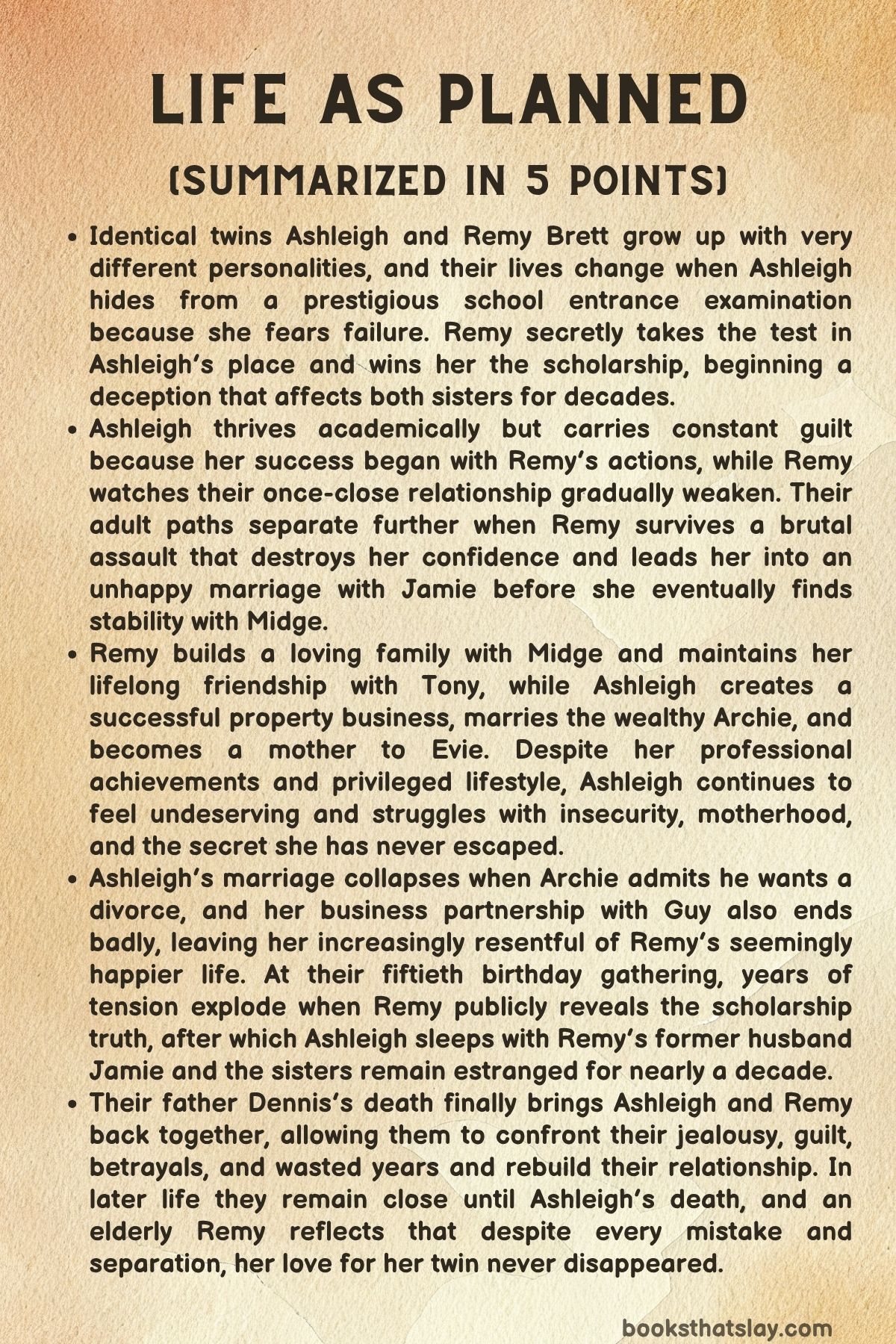
Summary
Ashleigh and Remy Brett grow up as identical twins who share the same face but possess very different personalities. Ashleigh is anxious, driven, and terrified of failure, while Remy is relaxed, confident, and inclined to believe that life will somehow work itself out.
Their parents, Ruthie and Dennis, want both girls to win scholarships to St. Jude’s Academy, convinced that the prestigious school could give them opportunities their family might otherwise struggle to provide. For Ashleigh, however, the entrance examination becomes a source of such overwhelming pressure that she hides in a mower shed rather than risk discovering that she might fail.
Remy knows exactly where her sister is but protects her secret. When teachers confuse the twins, Remy takes advantage of their identical appearance, sits the examination pretending to be Ashleigh, and puts Ashleigh’s name on the paper.
Remy believes she has done exceptionally well, and the sisters agree never to reveal what happened. Their parents consequently believe that Ashleigh earned the scholarship while Remy simply failed to attend the examination, leaving Ruthie disappointed in the daughter she assumes discarded a valuable opportunity.
Ashleigh enters St. Jude’s using the scholarship Remy actually earned. Although she performs well academically, the deception changes how she sees herself, because every achievement seems connected to the fear that somebody might eventually discover how she entered the school.
Surrounded by wealthy classmates discussing prestigious universities and impressive careers, Ashleigh becomes increasingly aware of social differences. Instead of enjoying her success, she keeps people at a distance and quietly wonders whether she belongs in their world at all.
The secret also begins separating the twins. Ashleigh creates more physical and emotional distance at home, while Remy feels increasingly excluded from the life her sister has gained partly because of her sacrifice.
At a St. Jude’s event, Remy encounters the dismissive Mrs Wentworth, whose reaction to Remy attending a comprehensive school exposes the social assumptions surrounding the twins. Ashleigh immediately defends Remy and openly insists that Remy is the clever one, allowing the sisters to briefly recover their old sense of companionship.
Ashleigh also resists the idea that attending an elite school means she must become a doctor or lawyer. She is drawn instead toward history and English, revealing that even after gaining an opportunity many people envy, she still needs to discover what kind of life she genuinely wants.
In their early twenties, their directions appear even further apart. Remy works at a garden centre and remains close to Tony Newman, her loyal childhood friend, while privately considering university and a law degree as a way of proving that she is every bit as capable as Ashleigh.
Ashleigh studies history at Exeter and falls in love with Archie Fitch, a wealthy young man whose family belongs to the sophisticated social world she once viewed from the outside. Her relationship with him seems to confirm that the educational opportunity she received has carried her into an entirely different life.
Remy’s plans are shattered when she and Tony are attacked during a night out. Tony is severely beaten, and Remy suffers serious injuries along with psychological trauma that destroys much of her previous confidence.
Royal Marines intervene and save them, and one Marine named Midge comforts Remy afterward. Before returning to military service, he promises that he will find her again when he comes home from the Falklands.
The attack changes Remy’s understanding of the world. The woman who once believed things would naturally turn out well now becomes frightened of public spaces, haunted by memories of the assault, and unable to imagine following through with her university ambitions.
Ashleigh immediately abandons plans to visit Archie’s family when she learns what happened. Despite the distance between them, her instinct is still to return home when Remy needs her, proving that their connection has not disappeared.
Remy continues struggling physically and emotionally after the assault. During hospital appointments she meets Jamie Aller, whose confidence and physical strength initially make him seem like someone capable of protecting her from a world that no longer feels safe.
Loneliness and fear push Remy rapidly into the relationship. She becomes pregnant, marries Jamie, gives birth to Sophie, and abandons the university prospectuses that once represented another possible future.
The marriage soon becomes deeply unhappy. Jamie spends nights drinking, lies about where he has been, appears unfaithful, and leaves Remy increasingly isolated while she cares for their baby.
Eventually Remy takes Sophie and returns to her parents. Ashleigh comes home after Ruthie contacts her and is shocked by how exhausted her sister has become.
Remy recognizes that she chose Jamie because he temporarily made her feel protected, not because they were suited to one another. Ashleigh reassures her that one damaging marriage does not mean her life is finished and promises that they will remain more connected.
Ashleigh, meanwhile, begins building a professional future of her own. She plans an estate agency with her university friend Guy Gallow, with Archie initially helping to finance the business.
Remy eventually receives the second chance she once believed had disappeared. Midge keeps his promise, returns to find her, patiently supports her recovery, accepts Sophie as his own, and becomes the dependable partner Remy needed.
They build a loving family together, adding Harper and later another child to their household. Tony also rebuilds his life, developing a successful international photography career while remaining one of Remy’s closest friends.
Ashleigh creates Gallow and Fitch with Guy and prepares to marry Archie after a long engagement. Yet even as her ambitions become reality, she remains unable to free herself from the childhood scholarship secret.
She considers confessing, believing that continuing to hide the truth makes her a fraud. Remy strongly opposes disclosure because their parents still believe Ashleigh earned the scholarship, while Midge himself has never been told what Remy did.
Remy argues that Ashleigh’s later accomplishments came from years of genuine effort and cannot be reduced to one dishonest act committed when they were children. Archie’s reassurance helps Ashleigh accept that position, and she chooses not to reopen the past.
By middle age, both women appear successful, but happiness takes very different forms for each sister. Remy shares a busy home with Midge and their children, while Ashleigh lives an affluent London life with Archie and their daughter Evie and continues running her property business.
Remy occasionally suffers reminders of the attack, yet her marriage provides the emotional stability she once lacked. Ashleigh, despite possessing many things she dreamed of as a girl, remains troubled by insecurity and fears that she has failed to establish the closeness with Evie that she wanted.
Trouble also grows professionally when Guy attempts to involve his wife Ada in the business without properly consulting Ashleigh. Yet a more devastating crisis arrives at home.
After a family gathering, Ashleigh discovers Archie with another woman. Archie admits not merely that he has been unfaithful but that he wants a divorce and has not loved her for years.
Ashleigh immediately calls Remy. Once again, at the moment when the life she carefully built collapses, her twin remains the person she instinctively turns toward.
A decade later, Ashleigh has established an independent property business but lives alone. Her bond with Evie improved after the divorce, yet Evie increasingly spends time with Archie and his new wife Leni, making Ashleigh conscious of the family structure she has lost.
Her business relationship with Guy has also ended badly after he forced her out of Gallow and Fitch. These rejections intensify old feelings that she has always been struggling to prove she deserves the life she was given.
For the twins’ fiftieth birthday, Ashleigh stays with Remy and Midge. Tony arrives with his partner Raul, and the gathering initially seems joyful.
Ashleigh gradually becomes painfully conscious of how secure Remy’s life appears. Remy has Midge, a loving family, and an enduring friendship with Tony, while Ashleigh increasingly feels like someone standing outside the happiness around her.
When Dennis proudly remembers Ashleigh winning the St. Jude’s scholarship, decades of shame and resentment finally erupt. Ashleigh accuses Remy of burdening her with a secret that made her feel fraudulent throughout her life.
Remy responds impulsively by revealing the truth to everybody. Ruthie and Dennis learn that Remy actually took the examination, while Midge discovers that his wife has concealed the secret throughout their marriage.
Instead of bringing relief, the truth creates another rupture. Ashleigh leaves, becomes drunk, and sleeps with Jamie, Remy’s former husband, turning an already painful confrontation into a deeper betrayal.
The sisters spend roughly another decade largely estranged. They meet only when family occasions make avoidance impossible, and neither knows how to overcome the anger attached to the confession and Ashleigh’s encounter with Jamie.
Remy undergoes therapy and gradually confronts both the assault and the emotional patterns that developed afterward. Her marriage to Midge survives because they rebuild their trust through patient honesty rather than pretending that the revelation never happened.
The adult children build their own lives, although Harper’s severe depression and anxiety remain a source of concern for Remy. The twins themselves continue wasting years in silence until Dennis dies.
Ruthie tells them that one of their father’s final wishes was for his daughters to spend Christmas together again. His death makes the sisters recognize how much time they have sacrificed to resentment.
When Ashleigh arrives for the funeral, their defenses temporarily disappear and they embrace. Later, they finally talk openly about jealousy, guilt, betrayal, Jamie, the scholarship, and all the years during which neither could bring herself to repair the relationship.
Both women apologize and acknowledge how deeply they have missed one another. Ashleigh also introduces Victor, a new partner, while the return of the sisters’ shared laughter indicates that reconciliation is becoming real rather than merely temporary.
Their restored relationship survives in the years that follow. Ashleigh marries Victor in Sardinia and experiences the respectful, balanced companionship that had been missing from her marriage to Archie.
She also becomes a grandmother when Evie and Kat have a baby named Levi. Holding him allows Ashleigh to reconsider her own experience of motherhood and understand that learning to love Evie was complicated by the fact that she had never fully learned to trust or accept herself.
Remy faces losses of her own, including Tony’s serious illness with cancer in Australia. Within the extended family, Dennis’s absence remains noticeable, and Ashleigh still worries that her father died without completely forgiving her.
Remy encourages her sister to stop trying to alter events that cannot be changed. When Ashleigh asks whether Remy would still take the examination for her if she knew everything that would follow, Remy says she would because the decision came from a genuine desire to help the sister she loved.
Ashleigh finally accepts that intention without demanding that the past become something else. The twins reaffirm their love and recover the instinctive closeness that had defined them before ambition, fear, and resentment complicated their relationship.
In old age, Remy lives in Salisbury surrounded by younger generations of her family. Harper has become more stable, Elio is a doctor, and his partner Pia is expecting Remy’s first great-grandchild.
Remy reflects on how quickly life passes and encourages Elio to value ordinary moments instead of allowing comparison and imagined alternatives to consume years that cannot be recovered. Her advice comes from a lifetime of understanding how easily people can become trapped by thoughts of the lives they might have lived.
Many of the people who shaped Remy’s life are now gone. Dennis died first, followed later by Ruthie, Tony, and eventually Midge, whose steady love had defined the most secure part of Remy’s adult life.
The newest loss is Ashleigh. In the years following their reconciliation, the sisters had continued meeting regularly, protecting the relationship they had finally repaired.
At the family memorial garden, Remy kneels before Ashleigh’s plaque and apologizes for the years they lost, for revealing their secret in anger, and for every moment when stubbornness mattered more than love. She tells her sister that even during their estrangement, she never stopped loving her.
A white bird rises into the winter sky as Remy says goodbye to her “little dove.” Their story ends not by erasing the mistakes that shaped them, but by recognizing that love endured beneath every rivalry, betrayal, regret, and separation.
Characters
Ashleigh Brett
Ashleigh is one of the two central figures in Life as Planned, and much of her life is shaped by the belief that she has received something she did not deserve. Even as a child she is ambitious and intelligent, but her fear of failure is stronger than her confidence, which is why she hides rather than take the St. Jude’s examination.
The scholarship becomes both an opportunity and a psychological burden. Ashleigh works hard enough to justify her place academically, yet she cannot separate her accomplishments from the dishonest circumstances that gave her entry to the school, so success repeatedly creates anxiety instead of security.
Her personality is deeply connected to comparison. At St. Jude’s she compares herself with wealthier classmates, later she measures her accomplishments against the expectations attached to education and social status, and eventually she compares the emotional state of her life with Remy’s apparently happier family.
Ashleigh’s marriage to Archie initially represents the world she once believed she could never enter. His wealth and family background appear to confirm her upward movement, but the eventual collapse of their marriage demonstrates that social advancement cannot remove the insecurity she has carried since childhood.
Her relationship with Evie also reveals Ashleigh’s vulnerability. She loves her daughter but worries that she has never created the instinctive maternal connection she expected, and later comes to understand that her difficulty loving herself affected how freely she could experience motherhood.
Ashleigh’s greatest flaw is her tendency to reinterpret the scholarship secret as the explanation for nearly every disappointment. By the twins’ fiftieth birthday, decades of suppressed guilt have become resentment toward Remy, allowing Ashleigh to blame her sister for a decision that Ashleigh also agreed to conceal.
Her decision to sleep with Jamie after the family confrontation shows how destructive Ashleigh can become when humiliation and anger overwhelm her judgment. It is an act that cannot be defended as innocent confusion, and it becomes one of the reasons the sisters lose another decade together.
Ashleigh nevertheless changes considerably. Through divorce, professional rejection, reconciliation with Remy, her relationship with Victor, and becoming Levi’s grandmother, she gradually stops treating her life as a test of whether she deserved the scholarship.
By the later years of Life as Planned, Ashleigh has learned that the past can be acknowledged without being allowed to control every future decision. Her reconciliation with Remy gives her the emotional peace that achievement, money, marriage, and professional recognition never managed to provide.
Remy Brett
Remy begins the story as Ashleigh’s confident, funny, instinctive opposite. She is clever but less frightened of judgment, and her decision to take the entrance examination for Ashleigh emerges from loyalty rather than a calculated desire to control her sister’s future.
That childhood decision reveals both Remy’s greatest strength and one of her recurring weaknesses. She is willing to act decisively for people she loves, but she can also make enormous choices on their behalf without fully considering consequences that may continue for decades.
Remy initially appears less ambitious than Ashleigh, yet this impression is misleading. Her private interest in studying law shows that she also wants intellectual recognition, especially because the world increasingly assumes Ashleigh is the academically gifted twin.
The assault fundamentally alters Remy’s personality and expectations. Her old confidence is replaced by fear, hyper-awareness of danger, physical pain, and an urgent desire to feel protected, making her relationship with Jamie understandable even though it quickly becomes destructive.
Motherhood gives Remy responsibility at a time when she is psychologically vulnerable, while leaving Jamie demonstrates that the frightened young woman still possesses considerable courage. Returning to her parents with Sophie requires her to admit that the life she chose is failing and that safety cannot be created simply by remaining beside a physically strong man.
Midge becomes important precisely because he provides protection without demanding control. Through his patience, Remy gradually regains stability and builds the family life that becomes the emotional center of her adulthood.
Remy is not presented as morally flawless. Her decision to conceal the scholarship truth from Midge creates a genuine breach of trust, and her angry disclosure at the fiftieth-birthday gathering wounds several people simultaneously.
Her later therapy is therefore important because Life as Planned allows Remy to examine not only what others have done to her but also the ways trauma, secrecy, defensiveness, and impulsive behavior have shaped her relationships. She eventually becomes more willing to communicate honestly instead of relying on silence or sudden confrontation.
In old age, Remy becomes the character most capable of articulating what the sisters’ lives have taught them. Her advice to Elio about ordinary moments shows that she has stopped measuring life through missed opportunities and understands that comparison can consume the very time people later wish they had valued.
Her final goodbye to Ashleigh completes her development from the girl who believed she could fix her sister’s future with one daring action into an elderly woman who knows that love cannot prevent pain, loss, or mistakes. What matters to her finally is that the sisters repaired what could still be repaired before death separated them permanently.
Ruthie Brett
Ruthie is the twins’ mother and represents the hopes parents can attach to their children’s opportunities. Her determination that both girls should try for St. Jude’s comes from believing that education could transform their prospects rather than from a lack of affection for either daughter.
Because she does not know the truth about the examination, Ruthie spends years believing Remy carelessly rejected an opportunity. This misunderstanding quietly contributes to the imbalance between the sisters because Ashleigh receives praise for something Remy actually achieved, while Remy lives with a disappointment she technically did not cause.
Ruthie remains an important point of continuity as the family changes through marriages, children, divorces, arguments, and aging. When Dennis dies, her grief also becomes the setting for the twins to reconsider their estrangement.
Her revelation that Dennis wanted his daughters together for Christmas acts as a catalyst for reconciliation. Ruthie does not repair the sisters’ relationship herself, but the emotional reality of losing their father and seeing their mother bereaved forces Ashleigh and Remy to recognize the cost of continuing their feud.
Dennis Brett
Dennis is a loving father whose pride in Ashleigh’s scholarship becomes unintentionally painful because he never knows, for most of his life, how it was obtained. His faith in education reflects his wish for his daughters to have possibilities beyond those immediately available to them.
At the twins’ fiftieth birthday, his proud recollection of Ashleigh winning the scholarship becomes the final trigger for the secret’s exposure. He does nothing malicious in that moment, but his innocent praise touches the precise wound Ashleigh has carried for decades.
Dennis’s death later changes the emotional landscape of the family. Ashleigh remains troubled by the possibility that he never fully forgave her, showing how deeply his opinion continued to matter to her even after she became an accomplished adult.
His final wish that the twins spend Christmas together gives him a meaningful role in their reconciliation even after his death. Within Life as Planned, Dennis therefore becomes associated with both the original family ambition surrounding St. Jude’s and the later reminder that family bonds are more valuable than decades of unresolved blame.
Midge
Midge enters Remy’s life during one of its most traumatic moments. As one of the Marines who rescues her and Tony, he initially represents immediate physical safety, but his later importance comes from providing something far more lasting than protection.
He keeps his promise to find Remy after military service and patiently supports a woman whose confidence has been damaged by violence and a disastrous marriage. His acceptance of Sophie as his own demonstrates that his commitment to Remy includes the life she already has rather than requiring her to begin again on his terms.
Midge offers a contrast to Jamie because strength in his character is expressed through reliability, patience, and emotional steadiness. He helps create the home in which Remy eventually feels secure enough to stop defining herself only as someone who survived an assault.
His pain when the scholarship secret is revealed is legitimate because Remy has kept a major truth from him throughout their marriage. Their relationship survives not because he dismisses the deception but because both partners are prepared to confront the damage and rebuild trust.
In Life as Planned, Midge represents the possibility of mature love that can survive disappointment without pretending disappointment does not exist. His eventual death leaves a profound absence in Remy’s old age because he has been the most stable and dependable love of her adult life.
Tony Newman
Tony is Remy’s childhood friend and one of the relationships that remains emotionally important across much of her life. His early presence offers her companionship outside the intense twin relationship, and his emerging photography career suggests that both young friends still possess open futures before the assault changes everything.
Tony suffers particularly severe physical violence during the attack, and his recovery takes time. Unlike Remy, however, he later manages to develop a successful photography career abroad, showing that the same traumatic event can alter two people in different ways.
His bond with Remy remains unusually durable. Even decades later, his appearance at the twins’ fiftieth birthday with Raul feels natural because he continues to belong to the emotional history of the family.
Tony’s eventual cancer introduces another form of loss into Remy’s later life. His death reinforces the book’s awareness that long friendships can become part of a person’s identity just as strongly as family relationships, making his absence one more reminder of the people who helped create Remy’s sense of home.
Archie Fitch
Archie initially represents love, privilege, and social acceptance for Ashleigh. His wealthy background places him inside the world she once regarded as inaccessible, and his willingness to support her early business ambitions strengthens the impression that their relationship will secure the future she imagined.
His importance changes drastically when Ashleigh discovers his affair. More damaging than the infidelity is his admission that he has not loved her for years, because it turns what Ashleigh considered a stable marriage into another source of doubt about whether the life she created was ever genuinely hers.
Archie also remains connected to Ashleigh through Evie after the divorce. Evie’s growing closeness to Archie and Leni intensifies Ashleigh’s loneliness, even though this development does not mean Archie has deliberately attempted to destroy the mother-daughter relationship.
He is therefore less significant as an outright villain than as a figure whose choices expose Ashleigh’s deepest insecurity. His rejection leaves her with the task of building an identity that does not depend upon being Archie Fitch’s wife or belonging to his social world.
Jamie Aller
Jamie enters Remy’s life when she is frightened, isolated, and looking for someone whose physical presence can make her feel safe. His confidence and strength initially answer that emotional need, but Remy later understands that she mistook protection for compatibility.
His behavior as a husband quickly becomes destructive. Drinking, dishonesty, suspected infidelity, and emotional absence leave Remy caring for Sophie while feeling even more isolated than before the marriage.
Jamie’s later encounter with Ashleigh carries serious symbolic weight because he belongs to one of the most painful periods of Remy’s life. Ashleigh sleeping with him immediately after the scholarship revelation transforms him into part of a new betrayal between the sisters.
Remy eventually confronts Jamie about his earlier behavior, suggesting that she no longer needs to carry unresolved fear or resentment silently. His role ultimately emphasizes the danger of making permanent life choices while trauma is determining what feels like safety.
Evie Fitch
Evie is Ashleigh and Archie’s daughter and becomes central to Ashleigh’s fears about motherhood. Ashleigh worries that she has failed to create the natural emotional closeness she assumes mothers are supposed to experience with their children.
After the divorce, Ashleigh and Evie actually grow closer, complicating Ashleigh’s belief that the marriage had provided the ideal family environment. Their relationship nevertheless becomes painful again when Evie spends increasing time with Archie and Leni.
Evie’s later adulthood gives Ashleigh another chance to understand their bond. When Evie and Kat have Levi, Ashleigh recognizes that her love for her daughter developed while she herself was still struggling with shame and self-acceptance.
Through Evie, the story shows that imperfect motherhood is not equivalent to absent love. Ashleigh’s relationship with her daughter becomes stronger when she stops judging herself against an imagined standard of how a mother should feel.
Guy Gallow
Guy begins as Ashleigh’s university friend and professional partner. Together they establish Gallow and Fitch, making him an important part of the career Ashleigh builds through her own intelligence and determination.
Their relationship deteriorates when Guy attempts to involve his wife Ada in the business without properly consulting Ashleigh. The move challenges Ashleigh’s sense that she is an equal partner in something she helped create.
His eventual success in forcing Ashleigh out of Gallow and Fitch produces another major rejection following her divorce. Professionally, Guy’s actions force Ashleigh to begin again, but her later independent business demonstrates that she can recover from losing an institution she once believed defined her success.
Sophie
Sophie is Remy and Jamie’s daughter and arrives during a period of profound instability in Remy’s life. Her birth gives Remy both greater responsibility and an important reason to acknowledge that remaining in an unhappy marriage cannot provide the secure family she wants.
Midge’s willingness to accept Sophie completely becomes an important measure of his character. Rather than treating her as evidence of Remy’s previous life, he helps raise her within the loving household Remy eventually creates.
Although Sophie receives less individual development than the central characters, her presence marks the beginning of Remy’s long journey toward building a healthier family environment than the one she experienced with Jamie.
Harper
Harper is Remy and Midge’s daughter and becomes particularly significant later because of her struggles with depression and anxiety. Her difficulties remind Remy that a loving and stable household cannot guarantee that children will be protected from serious emotional suffering.
Remy’s concern for Harper also broadens the story’s treatment of vulnerability. Earlier, Remy’s own psychological distress grew from a violent external event, while Harper’s struggles demonstrate that emotional pain does not always come from an easily identifiable cause.
By Remy’s old age, Harper has achieved greater stability. Her progress provides a quiet indication that difficult periods do not necessarily determine the entire direction of a person’s life.
Bertie
Bertie is the youngest child mentioned in Remy and Midge’s household. Although he is not individually developed to the same extent as Sophie or Harper, his presence contributes to the image of the large, affectionate family Remy builds after the fear and instability of her younger adulthood.
His importance is therefore mainly structural and emotional. The busy household containing Sophie, Harper, and Bertie represents the life Remy gradually created with Midge through patience, commitment, and recovery rather than through the desperate search for protection that led her to Jamie.
Victor
Victor enters Ashleigh’s life after many of her most painful experiences have already occurred. His relationship with her becomes significant because it is defined by mutual respect and equality rather than by Ashleigh’s fascination with social status.
Ashleigh’s quiet marriage to Victor in Sardinia contrasts strongly with the symbolic importance she once attached to marrying Archie. With Victor, partnership matters more than proving that she belongs to a particular world.
He also supports Ashleigh’s renewed relationship with Remy during their later years, including helping her travel to see her sister. His presence demonstrates that Ashleigh can experience love without treating another person as evidence of her success or worth.
Leni
Leni becomes Archie’s new wife after his divorce from Ashleigh. She is not developed as an antagonist, and the emotional pain associated with her presence largely comes from what she represents to Ashleigh rather than from anything she personally does.
When Evie spends increasing time with Archie and Leni, Ashleigh feels displaced from the family structure she once possessed. Leni therefore becomes connected to Ashleigh’s fear of replacement, although the story does not suggest that she is responsible for the collapse of Ashleigh and Archie’s marriage.
Raul
Raul is Tony’s partner and appears during the reunion arranged for the twins’ fiftieth birthday. His presence indicates that Tony has built a meaningful adult life beyond the experiences that once connected him almost entirely to Remy and their shared history.
Although Raul has a limited individual role, including him in the family gathering shows how the twins’ social world has expanded across adulthood. Friends, partners, former spouses, and children have all become part of the larger network surrounding their original sisterly relationship.
Ada Gallow
Ada is Guy’s wife and becomes important through Guy’s attempt to bring her into Gallow and Fitch without Ashleigh’s agreement. The issue is not presented primarily as a personal conflict between Ada and Ashleigh but as a challenge to Ashleigh’s professional authority.
Her proposed involvement signals that decisions affecting the company may be taking place outside Ashleigh’s control. The situation helps foreshadow the eventual breakdown of Ashleigh’s partnership with Guy and her departure from the business she helped establish.
Mrs Wentworth
Mrs Wentworth appears briefly but performs an important social function. Her dismissive reaction after discovering that Remy attends a comprehensive school exposes the assumptions of status and superiority that Ashleigh encounters within the St. Jude’s environment.
Ashleigh’s immediate defense of Remy matters more than Mrs Wentworth herself. The incident reveals that however much distance has developed between the twins, Ashleigh still recognizes her sister’s intelligence and refuses to allow social privilege to determine Remy’s value.
Kat
Kat is Evie’s partner and the other parent of Levi. Although little individual information is provided about her, her presence reflects the continuing expansion of the Brett-Fitch family into another generation.
Through Evie and Kat becoming parents, Ashleigh enters grandmotherhood and gains a new perspective on her own maternal experience. Kat therefore belongs to a later period of Ashleigh’s life in which family is increasingly understood through acceptance and connection rather than through perfection.
Levi
Levi is the baby of Evie and Kat and Ashleigh’s grandson. His importance lies largely in the emotional response he produces in Ashleigh, who is overwhelmed by the love she feels while holding him.
That experience encourages Ashleigh to reconsider her earlier fears about motherhood. Through Levi, she recognizes that her love for Evie was always real even though it emerged gradually during a period when Ashleigh herself was still struggling with insecurity.
Elio
Elio belongs to the youngest adult generation shown in the story and has become a doctor by the time Remy is elderly. His presence demonstrates how far the family has traveled from Ruthie and Dennis’s original concern that education might be the defining opportunity determining their daughters’ futures.
During a drive with Remy, Elio becomes the recipient of one of her clearest reflections on life. She encourages him to value ordinary experiences rather than losing time to comparison and imagined alternatives, allowing her accumulated understanding to pass into another generation.
Pia
Pia is Elio’s partner and is expecting Remy’s first great-grandchild. Her pregnancy represents continuation at a moment when Remy has become increasingly surrounded by death and memory.
The expected child reminds Remy that family does not stop moving forward because important people have died. Pia therefore contributes to the final balance between grief for those who are gone and hope for lives that are still beginning.
Themes
The Cost of Comparison
Comparison shapes the twins long before either of them understands how destructive it can become. Because Ashleigh and Remy are identical in appearance, other people naturally place them beside one another, yet their personalities, educational experiences, ambitions, and adult circumstances develop in radically different directions.
Ashleigh becomes particularly vulnerable to measuring herself against others. At St. Jude’s she compares her background with those of wealthy pupils, within adulthood she compares her achievements with the expectations associated with prestigious education, and after her divorce she compares her loneliness with Remy’s apparently secure marriage and affectionate family.
Remy is not immune to this process. Her secret interest in studying law is partly motivated by wanting to prove she is as intelligent as Ashleigh, especially after the false scholarship narrative causes the family and wider world to treat Ashleigh as the academically successful twin.
In Life as Planned, comparison repeatedly turns genuine accomplishments into sources of dissatisfaction. Ashleigh cannot enjoy professional success because she wonders whether she deserved the opportunity that started it, while Remy sometimes sees the life she might have lived had she followed a different educational path.
The later perspective of old age directly challenges this habit. Remy advises Elio not to waste his years imagining alternative versions of life because experience has taught her that comparison consumes time without altering the past.
The sisters finally become happier when they stop asking whose life turned out better. Their reconciliation becomes possible only when they accept that both lives contain love, damage, achievement, disappointment, and choices that cannot be reduced to a simple contest.
Secrets, Guilt, and the Meaning of Truth
The scholarship secret begins as an act that two children believe they can permanently contain. Remy thinks she is protecting Ashleigh from failure, while Ashleigh accepts the benefit because revealing the truth would immediately destroy the opportunity that has been created.
As the years pass, however, the secret changes meaning. For Ashleigh it becomes evidence that every later accomplishment may rest upon something fraudulent, while for Remy it becomes an event that belongs so firmly to childhood that exposing it seems more damaging than continuing to conceal it.
Neither interpretation is entirely sufficient. Ashleigh genuinely works for everything she achieves after entering St. Jude’s, yet her guilt cannot simply be dismissed because the original deception remains real.
Remy is also correct that disclosure has consequences beyond the twins. Their parents have constructed decades of memories around a false story, and Midge has built a marriage with Remy without knowing about a secret that still affects her relationship with Ashleigh.
When the truth finally emerges, it does not produce immediate freedom. Instead, Remy’s angry method of revealing it causes new injuries because honesty without care can become another form of harm.
The novel therefore distinguishes truth from the manner in which truth is communicated. Eventually the sisters reach peace not because every secret has been exposed but because they can finally discuss their motives, guilt, jealousy, and anger without using honesty as a weapon.
Trauma, Safety, and Recovery
Remy’s assault creates one of the clearest divisions between the life she expected and the life she actually experiences. Before the attack she is considering university and law, but afterward even ordinary public spaces can trigger fear, while physical injuries and traumatic memories continue affecting her.
Her relationship with Jamie demonstrates how trauma can alter decision-making. She is drawn to his physical confidence because protection has suddenly become more important than compatibility, and marriage appears to offer a shortcut toward the safety she can no longer create internally.
That apparent security quickly fails. Jamie’s drinking, dishonesty, and absence leave Remy isolated, forcing her to understand that being beside a physically strong person is not the same as being emotionally safe.
Midge provides a radically different form of security. His patience, consistency, and acceptance of Sophie give Remy the time and space to rebuild confidence rather than demanding that she simply forget what happened.
Life as Planned also refuses to portray recovery as complete or straightforward. Remy continues experiencing reminders of the assault many years later, undergoes therapy after other emotional crises, and worries intensely about Harper’s mental health.
Recovery therefore becomes a continuing process rather than a return to the person Remy used to be. She eventually builds a full and loving life while still carrying memories of violence, showing that healing can coexist with lasting vulnerability.
Time, Regret, and Reconciliation
Time transforms nearly every conflict in the story. The examination deception begins during childhood, affects adolescence and adulthood, explodes when the sisters are fifty, and remains emotionally significant even after they have reached old age.
The twins repeatedly imagine that there will always be another opportunity to repair what has been damaged. Their decade-long estrangement after the birthday confrontation shows how easily pride can convert temporary anger into years that can never be recovered.
Dennis’s death changes their understanding of that wasted time. Grief removes many of the defenses that had allowed them to maintain distance, and his final wish for them to spend Christmas together makes their continuing hostility appear increasingly pointless.
Their eventual conversation succeeds because neither woman demands total innocence. Ashleigh acknowledges the cruelty of sleeping with Jamie, while Remy recognizes the damage caused by revealing the scholarship secret publicly and angrily.
Reconciliation does not erase what happened. The sisters cannot recover the years they spent apart, undo Archie’s betrayal, reverse Remy’s assault, restore Dennis, or return to the afternoon when the examination first changed their lives.
Their later closeness nevertheless proves that regret does not have to determine what remains. By meeting regularly and allowing affection to replace resentment, Ashleigh and Remy use the time still available to them rather than continuing to mourn the time already lost.
Remy’s final visit to Ashleigh’s memorial brings this idea to its fullest expression. Her apology acknowledges wasted years, but her goodbye is ultimately grounded in gratitude that the sisters found each other again before death made reconciliation impossible.