Listen For The Lie Summary, Characters and Themes
Listen for the Lie by Amy Tintera is a psychological suspense novel built around memory, reputation, and the stories people choose to believe. At its center is Lucy Chase, a woman who has spent years living under the shadow of her best friend’s unsolved murder.
A popular true-crime podcast pulls her back to the Texas town she left behind, forcing her to face old suspicions, damaged family ties, and the parts of herself she has tried not to examine too closely. Sharp, darkly funny, and tense, Listen for the Lie looks at how guilt can be assigned long before the truth is known.
Summary
Lucy Chase has spent five years living with the belief that most people think she murdered her best friend, Savannah Harper. On the night Savvy died, Lucy was found covered in blood, injured, and wandering alone, but she had no clear memory of what happened.
The police never charged her, yet in the court of public opinion she was condemned almost immediately. She left her hometown of Plumpton, Texas, and built a new life in Los Angeles, surviving under the weight of suspicion and the constant presence of violent intrusive thoughts that began after Savvy’s death.
Her uneasy routine is shattered when a true-crime podcaster, Ben Owens, reopens the case and turns Lucy once again into public spectacle.
After losing her job and facing the collapse of her relationship, Lucy is pressured into returning to Plumpton for her grandmother Beverly’s birthday. She knows the trip will be difficult, especially with Ben’s podcast stirring up gossip, but Beverly is one of the few people who has always believed in her.
Back in town, Lucy finds that almost nothing has changed. Her parents remain tense and image-conscious, more concerned with appearances than with Lucy’s pain.
Her mother Kathleen still behaves as though Lucy must be guilty, while her father Don’s silence feels just as accusing. Everywhere Lucy goes, she is met with old assumptions, half-hidden stares, and people eager to see the story confirmed.
At the same time, the podcast begins exposing details that were ignored or buried the first time around. Through interviews with townspeople, Ben reveals how quickly everyone settled on Lucy as the obvious killer.
He also shows how shaky that certainty really is. Savvy was adored in town, while Lucy was considered prickly, sharp-tongued, and difficult.
That contrast made it easy for people to cast Lucy as the villain. Yet Ben starts uncovering inconsistencies, especially in the accounts of the people closest to Savvy and Lucy.
Lucy reluctantly agrees to work with Ben. At first she is defensive and skeptical, but she realizes that he may be her only real chance to uncover what happened.
As they investigate, the case opens outward. Suspicion falls on several people, especially Lucy’s ex-husband Matt Gardner.
On the surface, Matt was handsome, charming, and well liked, but Lucy’s memories and the testimony of others reveal that he was abusive, manipulative, and skilled at controlling the narrative around him. Savvy had seen the bruises Matt left on Lucy and knew how dangerous he could be.
Lucy slowly recalls that her marriage had become unbearable and that Savvy had been trying to help her get away.
The podcast also exposes layers of secrecy among the town’s so-called respectable people. Colin Dunn, Savvy’s boyfriend, lied about where he was on the night of the murder.
Kathleen had an affair with him, which further destabilizes the family story Lucy grew up with. Nina, a former school friend, is shown to have been involved with both Matt and Colin, and she becomes another possible suspect.
Lucy’s parents look increasingly suspicious as well, not because they killed Savvy, but because their behavior after the murder suggests they were protecting someone and were willing to let Lucy take the blame.
Alongside the investigation, Lucy’s inner world grows stranger and more painful. She hears Savvy’s voice in her head, not as a ghost in any literal sense but as a persistent, vivid presence tied to trauma and guilt.
These visions are sarcastic, sharp, and often violent, reflecting both Lucy’s grief and the version of Savvy she alone remembers. The public image of Savvy as flawless and sweet does not match Lucy’s memories.
Savvy was loyal, bold, reckless, and far more complicated than the town allows. That private version of her becomes important as Lucy begins recovering pieces of the past.
Those recovered memories reveal the truth about Lucy and Savvy’s friendship. Savvy knew Matt was abusing Lucy and had even proposed killing him.
At first Lucy treated the idea as wild talk, but it came from Savvy’s fierce protectiveness and from her own history of violence. Savvy confided that she had once killed a man who tried to assault her and had hidden that secret ever since.
Lucy keeps that secret, understanding it as part of who Savvy was and what she had survived. Their bond was real, intense, and rooted in mutual loyalty rather than the shallow picture others painted of them.
As Ben digs deeper, Lucy starts remembering more about the wedding night. She recalls that she kissed someone else outside the venue, not Matt, and that Savvy was furious afterward.
For a time, Lucy and Ben suspect this may point toward jealousy, betrayal, or some confrontation between the two women. But the fuller memory changes everything.
The man Lucy kissed was Emmett Chapman, an old friend long presented as kind, harmless, and one of the few people who had stood by her. That revelation cracks the case open.
Lucy finally remembers that after the wedding she and Savvy left together in Savvy’s car. Savvy was not angry out of jealousy but out of concern.
She told Lucy that Emmett was not the good man Lucy imagined. Savvy had slept with him months earlier and found him rough, aggressive, and cruel when rejected.
She and Lucy decided they would leave town and start over in California, choosing escape over violence. But before they could get away, they encountered Emmett on the road.
Emmett stopped them and insisted on speaking to Lucy alone. He confessed his feelings and urged her to leave Matt, but his version of love was possessive and self-serving.
When Lucy rejected him, his anger exploded. Savvy stepped in to protect her, and Emmett attacked both women.
They tried to run, but he chased them. In the struggle, he used a hammer and a tree branch as weapons.
He hit Lucy, then struck Savvy when she tried to shield her. Lucy’s head injury and amnesia came from Emmett’s assault, not from some unexplained blackout after killing her friend.
Matt arrived at some point and saw enough to know Emmett had been there, but instead of telling the truth, he chose to protect himself and preserve the story that Lucy had done something terrible.
In the present, Lucy pieces all of this together while watching Emmett interact with Nina. She sees his controlling behavior and realizes he is hurting Nina too.
When confronted, Emmett tries to rewrite the past, claiming Lucy killed Savvy and that he stayed silent out of love. But Lucy’s memory has returned.
She knows what he did, and when he tries to overpower her again, the violence repeats itself. Emmett attacks Lucy with a hammer, just as he did years earlier.
This time, Lucy fights back. Ben arrives in time to witness the aftermath and supports Lucy’s account, helping ensure that the truth will finally be believed.
Emmett is charged with Savvy’s murder. Matt, Kathleen, and Don face charges for withholding evidence, having chosen silence and self-protection over Lucy’s safety.
The resolution does not erase the damage. Many people still doubt Lucy, and public opinion remains divided.
But Lucy no longer bases her life on being cleared in everyone’s eyes. She understands now that the town was always more willing to trust men like Matt and Emmett than a woman marked as difficult, angry, or unstable.
In the end, Lucy leaves Plumpton with a clearer sense of who Savvy was and what their friendship meant. Savvy was the one person who truly tried to protect her when it mattered most.
Lucy carries grief, anger, and relief with her, but she also carries truth. That truth is messy and incomplete in the public mind, yet it is enough for her.
She reconnects with the possibility of a future, including a tentative relationship with Ben, and steps forward knowing she survived not only the original attack but also the years of blame that followed.
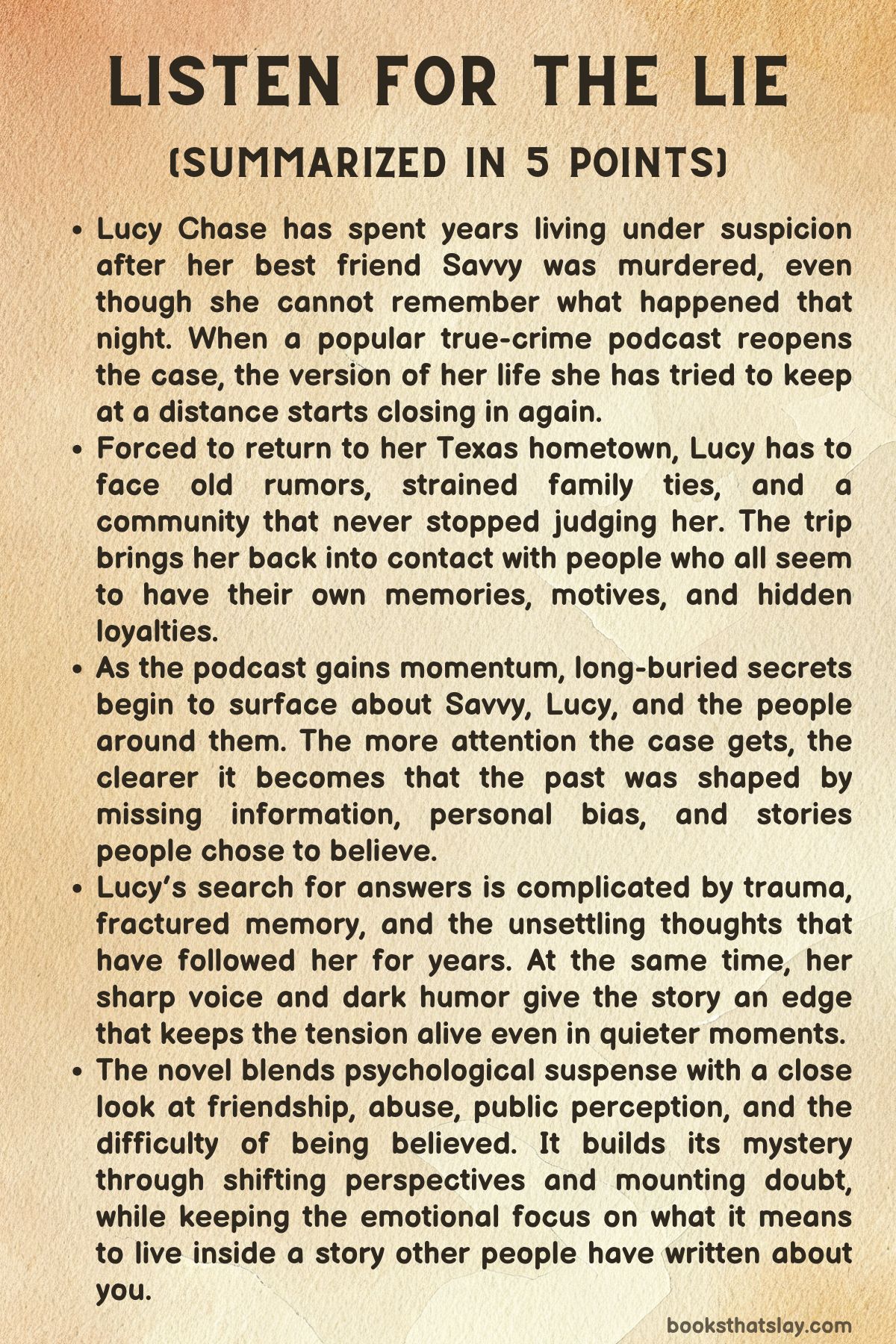
Characters
Lucy Chase
Lucy Chase is the emotional and psychological center of Listen for the Lie, and her character works because she refuses to fit the role other people assign to her. To the town, she is either a killer who escaped punishment or a strange woman who cannot be trusted because she is angry, detached, and difficult to read.
Yet the closer one gets to her, the clearer it becomes that her sharp humor, emotional distance, and flat way of speaking are forms of protection. She has spent years living under suspicion while also dealing with trauma, memory loss, and recurring violent thoughts that frighten her as much as they disturb others.
Her personality is often misread as coldness, but much of it comes from exhaustion, isolation, and the experience of never being fully believed.
Lucy’s complexity also comes from the fact that she is not written as a polished victim. She can be sarcastic, judgmental, impulsive, and emotionally evasive.
She often imagines violent acts, and this gives her a dangerous edge that keeps both other characters and readers uncertain. That uncertainty is essential to her characterization because it mirrors the way the town has treated her: everyone has built a story around her temperament rather than around evidence.
At the same time, Lucy has a strong moral core. She defended vulnerable people when she was younger, she kept Savvy’s most painful secret, and she repeatedly resists the easy path of self-serving lies.
Even when she hides things, she usually does so out of fear, shame, or loyalty rather than cruelty.
A major part of Lucy’s journey is her struggle to understand her own mind. Her amnesia is not just a plot device; it shapes the way she sees herself.
She cannot trust her memory, and because of that, she cannot fully defend herself. There is a terrible psychological cruelty in being accused of something while also wondering if it might be true.
For much of the story, Lucy lives in that uncertainty. She is not trying to prove herself innocent with confidence.
She is trying to survive the possibility that she may have done something unforgivable. That inner conflict makes her far more layered than a conventional wronged heroine.
Her eventual recovery of memory is powerful not because it transforms her into someone new, but because it allows her to reclaim the self that other people’s stories nearly erased.
Lucy also represents one of the novel’s clearest ideas: women who are messy, angry, traumatized, or socially abrasive are often treated as less credible than charming men with practiced manners. Her arc is about truth, but it is also about how truth gets filtered through bias.
By the end, Lucy does not emerge as healed in a simple sense. She emerges clearer, tougher, and more certain about what happened to her and to Savvy.
That makes her final position deeply satisfying. She does not win because everyone loves her.
She wins because she finally refuses to let other people define her reality.
Savannah “Savvy” Harper
Savvy is one of the most important absent presences in the story. Although she is dead before the present timeline begins, she remains vivid because different people remember entirely different versions of her.
To the town, she is almost saintly: pretty, sweet, popular, and beloved. That public image turns her into a symbol rather than a person.
Lucy’s memories, however, reveal someone much more complicated. Savvy is loyal, fearless, impulsive, secretive, and at times morally extreme.
She is capable of warmth and fierce love, but she is also blunt, reckless, and shaped by dark experiences that most people never knew about.
What makes Savvy so interesting is the gap between reputation and reality. The town prefers the polished version because it supports a simple narrative in which a good girl was destroyed by a bad one.
But the real Savvy is harder to contain. She sees Matt’s abuse clearly and refuses to minimize it.
She is the one who believes Lucy when Lucy is being manipulated into doubting herself. She is protective in a way that is both admirable and alarming.
Her suggestion that they kill Matt shows how far she is willing to go for someone she loves. That moment is shocking, but it also reveals the intensity of her moral code.
Savvy is not guided by law or convention. She is guided by who she thinks deserves protection and who deserves punishment.
Her secret about killing a man who tried to assault her deepens her character even further. It explains the hard edge beneath her confidence and helps show why she sees violence as a practical answer rather than an unimaginable line.
This history does not reduce her to trauma, but it does help explain her worldview. She has already learned that terrible things can happen to women and that justice is not always available through normal channels.
Because of that, she becomes someone who is willing to act decisively, even dangerously. In another story she might be turned into a cautionary figure, but here she is treated with more ambiguity and sympathy.
Savvy’s relationship with Lucy is the emotional backbone of the narrative. She is the one person who truly sees how damaged Lucy’s marriage is and how badly Lucy needs help.
Their friendship is not idealized as soft or perfect. It is intense, private, and rooted in the sense that they understand each other beyond appearances.
Even after death, Savvy continues to shape Lucy’s life through memory, guilt, and the voice Lucy hears in her head. In that way, Savvy becomes both a lost friend and a symbol of the only person who stood beside Lucy without demanding that she become easier, quieter, or more believable.
Ben Owens
Ben Owens begins as a figure of threat because he is the person who drags a buried tragedy back into the light and turns it into public entertainment. Lucy has every reason to distrust him.
He is a true-crime podcaster building a career from the worst moment of her life, and he arrives in town asking questions that everyone else has either weaponized or avoided. Yet he quickly becomes more complicated than a simple opportunist.
Ben is ambitious, curious, strategic, and very aware of how stories work. He understands audience expectation, dramatic pacing, and the power of framing.
That makes him useful, but never entirely harmless.
Ben’s strongest quality is his willingness to challenge the town’s easy conclusions. Unlike most of Plumpton, he does not simply accept Lucy’s guilt because it is convenient or culturally satisfying.
He listens, revises his theories, and keeps looking when accounts fail to line up. He is also one of the first people to recognize how much Lucy’s injury and trauma affected her after the attack.
Where her parents and others treated her memory gaps almost like an inconvenience, Ben sees them as central to the case. In this sense, he functions as both investigator and corrective force, someone willing to ask why a wounded woman was immediately treated like a criminal rather than like a victim.
At the same time, Ben is not a spotless rescuer. He shapes material for effect, withholds judgments, and sometimes pushes too hard because he wants answers and a strong story.
He can be manipulative in the way journalists often are when they decide that the larger truth justifies pressure in the moment. His willingness to bend facts slightly near the end reinforces that he is still, fundamentally, a storyteller managing public belief.
This does not make him malicious, but it does keep him morally interesting. He operates in a space where truth and persuasion are not always identical.
His relationship with Lucy gives him another layer. He is drawn to her intelligence, darkness, and unpredictability, and he is less frightened by her than most people are.
Their intimacy is risky because it blurs professional boundaries and threatens the credibility of his project, but it also feels believable because both are attracted to damaged complexity. Ben sees Lucy as more than a suspect or a source, and Lucy sees in him someone who might finally help uncover what everyone else tried to bury.
He becomes a catalyst for change in her life, but he never fully stops being a man who knows how to package pain into narrative. That tension is what keeps him from becoming too simple.
Beverly Moore
Beverly is one of the clearest moral anchors in the book and one of its most satisfying supporting characters. She is Lucy’s grandmother, but more importantly, she is one of the only people who believes in Lucy without hedging, policing, or retreating into appearances.
Where Lucy’s parents are fearful and self-protective, Beverly is direct, practical, and willing to act. She is the person who brings Lucy back to town, engineers the connection with Ben, and keeps pushing for truth even when it is inconvenient.
Her role could easily have been limited to comic relief or warm family support, but she is far more active and perceptive than that.
Beverly’s confidence in Lucy matters because it is not based on denial. She does not blindly insist that Lucy is innocent because she cannot bear the alternative.
She believes Lucy because she knows her character, understands the dynamics around her, and sees through charming men far better than many younger people do. She distrusts Matt early and accurately.
She also recognizes that public opinion, especially in a small town, often settles around the most socially comfortable explanation rather than the most truthful one. Beverly’s age gives her a certain freedom; she says what others avoid and does not seem especially interested in making herself look respectable.
There is also tenderness in the way Beverly handles both Lucy and Savvy. She understands that people are rarely as simple as the town wants them to be.
She allows Lucy room to keep parts of Savvy private, even after the truth comes out. That is an important detail because it shows Beverly values loyalty and emotional truth, not just legal truth.
She knows a person can deserve to have some parts of themselves protected, even in death.
Beverly stands for a kind of belief that is rare in the story: belief without control. She does not demand confession, obedience, or emotional performance from Lucy in exchange for support.
She simply stands beside her. That makes her one of the most generous characters in the novel and one of the few adults who consistently behaves with courage.
Matt Gardner
Matt is one of the most unsettling characters because he is a familiar kind of abuser: attractive, polished, socially convincing, and deeply invested in controlling how others see him. To outsiders, he appears charming and sympathetic.
People describe him as too good for Lucy, and that phrase alone reveals how thoroughly public image protects him. In private, however, he is manipulative, violent, and skilled at making Lucy doubt her own experiences.
He does not merely hurt her physically; he also distorts reality around her, convincing her that she is unstable, reactive, or equally at fault.
What makes Matt effective as a character is that he is not written as openly monstrous at all times. He can be soft, apologetic, nostalgic, and persuasive.
That is exactly why Lucy stays entangled with him emotionally long after their marriage has become destructive. He knows how to alternate between affection and intimidation.
He also benefits from a culture that assumes a polished man must be more trustworthy than a woman who appears abrasive or emotionally difficult. In many ways, Matt is the embodiment of the novel’s criticism of gendered credibility.
His behavior after Savvy’s death is especially revealing. Rather than tell the full truth, he helps create and maintain the conditions that allow Lucy to be blamed.
He frames this as protection, but it is really self-protection. A full investigation might have exposed his abuse, his lies, and the fact that he was near the scene.
Even years later, he continues using the language of care to justify control. He asks Lucy to let things go, to leave town, to stop stirring up trouble, all while presenting himself as concerned for her well-being.
It is a classic strategy: conceal domination inside tenderness.
Matt is also important because he shows how abuse can continue long after a marriage ends. His hold on Lucy is not just physical or legal; it is psychological.
Even after years apart, she still has to sort through his version of events and her own damaged memories. By the end, his moral failure lies not only in what he did during the marriage but in how readily he let Lucy carry suspicion for murder while he guarded his image.
He is not the killer, but he is one of the people who made justice harder to reach.
Emmett Chapman
Emmett is the most dangerous kind of antagonist because he hides behind a long history of seeming safe. He is introduced as one of Lucy’s old friends, someone who defended her, cared for her, and never seemed capable of the violence others attributed to her.
He is gentle in public, artistic, affectionate, and easy to trust. That soft image makes the eventual truth about him especially disturbing.
He is not only the killer; he is also a man who builds fantasies about women, mistakes desire for entitlement, and turns violent when reality refuses to match the story he wants.
The novel carefully prepares this revelation by showing how idealized he appears in contrast to more obviously suspect men like Matt and Colin. Because he lacks Matt’s overt social dominance, he reads as harmless.
Lucy herself nearly accepts that version for too long. That is part of what makes his character effective.
He reflects the danger of the so-called nice man who is never forced to examine his resentment because everyone around him sees sensitivity and assumes goodness. Savvy, notably, sees through him earlier than Lucy does, and that difference says much about both women’s experiences with male aggression.
Emmett’s love for Lucy is not love in any generous sense. It is possessive, self-dramatizing, and rooted in the belief that his feelings should decide her future.
When she rejects him, he does not respond with pain alone but with rage. He cannot tolerate her autonomy.
He constructs a private narrative in which he understands her better than she understands herself, and that delusion allows him to justify violence. This is why his confession in the present is so chilling.
Even when cornered, he still tries to turn the past into a story where he is protecting Lucy rather than attacking her.
His violence toward Savvy is also revealing. Savvy threatens him not because she is physically stronger, but because she sees him clearly and interferes with his access to Lucy.
Killing her is an act of control as much as of panic. Years later, Lucy’s realization that he is also hurting Nina confirms that his behavior was not isolated.
He is not a man who snapped once. He is a man whose gentleness always contained coercion.
Emmett matters beyond his role as the killer because he exposes one of the novel’s sharpest points: the men most easily believed are not always the men who deserve belief. For years, his harmless image helped bury the truth while Lucy carried the stain of his violence.
Kathleen Chase
Kathleen is one of the most frustrating and revealing characters because her failures are intimate rather than dramatic. She is Lucy’s mother, and instead of acting as a source of protection, she repeatedly centers appearance, damage control, and male comfort.
She is not portrayed as a simple villain, but as a woman deeply shaped by denial and by a worldview that tells her survival depends on preserving social order. She wants things quiet, presentable, and manageable.
That instinct makes her emotionally dangerous to Lucy because it means truth is always secondary to optics.
Her affair with Colin shows that she is living a life of concealed disorder even while judging others. Yet rather than becoming more compassionate because of her own compromises, Kathleen becomes even more invested in containment.
She wants Lucy to stay at the family home so people will not talk. She reacts to the podcast less as a mother worried for her daughter and more as someone alarmed by public embarrassment.
Most painfully, she seems ready for years to believe Lucy capable of murder if that belief allows the family to settle into a stable explanation.
Kathleen’s treatment of abuse is especially telling. When Lucy hints at what Matt was like, Kathleen’s instinct is not recognition but resistance.
She behaves like many people who cannot bear to admit that harm happened within sight of them, because to admit it would require acknowledging their own passivity. In that sense, Kathleen is a portrait of complicity built from fear and self-protection rather than direct violence.
She does not strike Lucy, but she repeatedly fails her in the moments that matter.
What makes Kathleen interesting is that she is not empty of feeling. She has anxieties, secrets, and moments of strain that suggest a lifetime of disappointment and compromise.
But she never gathers the courage to choose Lucy clearly over social comfort, at least not when it would have counted most. Her character demonstrates that betrayal within families often comes not from dramatic cruelty but from repeated refusal to face what is real.
Don Chase
Don is quieter than Kathleen, but his silence is not innocence. He represents another form of parental failure: the man who avoids open conflict and mistakes passivity for decency.
He cooks, speaks less, and often appears calmer than Kathleen, which can make him seem safer by comparison. Yet he also believes Matt over Lucy, hovers around conversations rather than intervening in them, and helps maintain the false version of events after Savvy’s death.
His restraint is not moral strength. It is avoidance.
Don’s disappointment in Lucy seems to run deep, and she feels it even when he says very little. He has the sadness and rigidity of someone who values order and cannot cope when family life refuses to stay orderly.
Rather than interrogate the assumptions around Lucy’s guilt, he settles into them. He chooses the explanation that lets him preserve some structure, even if it means abandoning his daughter emotionally.
This is especially painful because quiet fathers are often granted more grace than openly critical mothers, yet Don’s inaction contributes just as much to Lucy’s isolation.
Like Kathleen, Don is also susceptible to male credibility. Matt’s word carries weight with him in a way Lucy’s fragmented, injured state does not.
He trusts the calmer-looking account, the one offered by a husband rather than a wounded daughter. That choice reveals how deeply gendered his judgment is, even if he would never name it that way.
Don’s character is effective because he is believable. He is not theatrical, cruel, or outwardly explosive.
He is simply the kind of man who lets harm continue because confronting it would demand more courage than he has. In stories about family, that kind of weakness can be just as destructive as aggression.
Nina Garcia
Nina is a complicated secondary character because she sits at the intersection of guilt, insecurity, and survival. She is not the central antagonist, yet she contributes to the confusion surrounding Savvy’s death through omission, dishonesty, and misplaced loyalties.
She presents herself as warm, settled, and socially smooth, but there is strain beneath that image. She has a history with Lucy, a grudge-filled history with Savvy, and destructive ties to men like Matt and Colin.
Her life is built on a surface calm that repeatedly cracks under pressure.
One of Nina’s most interesting qualities is that she is both more decent and more compromised than Lucy initially wants to admit. She does defend Lucy in some contexts, and she is not the mastermind of the town’s suspicion.
At the same time, her affair with Matt and her silence about where she was that night make her part of the network of evasions that kept the truth hidden. She does not create the misogynistic environment of the town, but she learns to move within it, protect herself inside it, and sometimes benefit from it.
Her relationship with Lucy is especially layered. There is real history there, but also competition, resentment, and guilt.
Nina is one of the few people who tries to be friendly to Lucy on her return, yet Lucy senses that this friendliness is unstable. Once the truth about Nina’s connection to Matt emerges, that instability makes sense.
Nina has long been caught in a pattern of attaching herself to damaging men while preserving an appearance of normalcy. Her denial about Matt, and later her fear around Emmett, show how thoroughly she has adapted to minimizing male harm.
By the end, Nina becomes an important mirror of Lucy. She shows what can happen when a woman keeps adjusting herself to survive harmful men instead of breaking away from them.
Lucy sees her flinch from Emmett’s behavior and realizes something terrible is still happening. In that moment, Nina stops being merely suspicious or irritating and becomes part of the broader pattern the novel exposes.
Maya Harper
Maya begins as one of Lucy’s harshest accusers, and her anger is understandable. She lost her sister, grew up with a local consensus about who was responsible, and spent years believing Lucy escaped justice.
Her early certainty is not presented as cruelty so much as grief hardened into conviction. She wants someone to blame, and Lucy has always been the easiest answer.
That makes her initial hostility emotionally credible.
What changes Maya is not sentiment but evidence of loyalty. When Lucy reveals she knew Savvy’s secret and never exposed it, Maya is forced to reconsider everything.
She recognizes that someone who truly hated Savvy or felt no connection to her would not have protected such a deeply buried truth. This shift matters because it is based on character rather than forensic proof.
Maya begins to see that Lucy may have loved Savvy more deeply than she allowed herself to believe.
Maya also helps restore Savvy’s humanity. Through her, one sees the family grief surrounding the murder, but also the limits of family knowledge.
She loved her sister, yet she did not know everything about her. That gap is painful, and Maya’s eventual willingness to accept it gives her character maturity.
She moves from certainty to complexity, and that movement is one of the more hopeful turns in the story.
Ivy Harper
Ivy, Savvy’s mother, represents maternal grief shaped by idealization. She remembers her daughter as joyful, radiant, and full of life, and there is tenderness in that image.
But Ivy also participates in the flattening of Savvy into a symbol. Like many grieving parents, she holds onto the version of her child that is easiest to mourn publicly.
That makes it difficult for her to understand the more dangerous, secretive, or morally complicated sides of Savvy’s life.
Her interactions around Lucy are marked by pain, suspicion, and longing for resolution. She wants answers, and for a long time Lucy appears to be the nearest possible source of those answers.
Ivy’s tragedy is that she keeps looking to the wrong people and the wrong story because that is what the town has made available to her. She is not malicious, but she is vulnerable to consensus.
As the truth comes out, Ivy becomes one of the characters who must absorb the shock of realizing how little she knew and how wrongly the blame was placed. Her role is not large, but it matters because it shows how grief can make simple stories seductive, especially when the truth is more painful and morally untidy.
Colin Dunn
Colin serves less as a deep psychological portrait and more as a representative of male carelessness, charm, and self-interest. As Savvy’s boyfriend, he should have been central to honest efforts to understand her death, yet much of what surrounds him is dishonesty.
He lies about where he was that night, conceals sexual encounters, and contributes to the general fog of rumor and misdirection. He is not the killer, but he is one more man whose choices complicate the search for truth.
His relationships with multiple women, including Kathleen and Nina, reflect a pattern of casual betrayal that fits the town’s broader gender politics. He is the sort of man whose behavior becomes gossip rather than moral emergency.
While women are judged harshly and permanently, Colin’s dishonesty is treated more lightly. That imbalance is part of his function in the story.
He also reveals how many people around Savvy were less stable, faithful, or sincere than the town’s nostalgic storytelling suggests. In that way, Colin helps break apart the fantasy of a wholesome small-town tragedy caused by one uniquely bad woman.
Paige
Paige, Ben’s assistant, has a smaller role, but she is useful because she brings professional clarity into an emotionally messy investigation. Where Ben is willing to blur lines, Paige is more alert to optics, ethics, and the danger of contaminating the project.
Her irritation with Ben and Lucy’s involvement is not pettiness. It reflects practical awareness.
She understands that once emotion and intimacy enter an investigation, credibility becomes fragile.
Paige also serves as a reminder that the podcast is a production, not just a truth-seeking mission. There are episodes to shape, risks to manage, and reputations to protect.
Through her, the story acknowledges the machinery behind public narrative. Even when the investigation helps Lucy, it is still a mediated enterprise with professional stakes.
Julia
Julia, Matt’s second wife, plays a crucial role in exposing the continuity of his abuse. She confirms that what happened in Lucy’s marriage was not an isolated or misunderstood episode.
Matt follows the same pattern with another woman: charm, escalation, intimidation, gaslighting, and violence. Julia’s testimony is important because it breaks the protective myth around him in a way that Lucy’s own words could not easily do, precisely because Lucy has already been discredited for years.
Julia is also significant because she arrives at a moment when the investigation needs a witness from outside the old town narrative. She does not carry the same baggage of teenage history, rivalry, or long-held bias.
Her account gives the truth fresh weight. Through her, the novel shows how abusers often repeat themselves, and how later victims can reveal what earlier victims were never believed about.
Nathan
Nathan has a relatively small role, but he helps establish Lucy’s emotional position at the start. Their relationship is already fading, and his quiet withdrawal once the podcast gains attention shows how fragile Lucy’s ordinary life really is.
He is not cruel in an obvious way, yet he cannot withstand the discomfort of proximity to scandal and uncertainty. His exit reinforces a painful truth: even people who care for Lucy in limited ways are often unwilling to stand beside her when things become socially or emotionally costly.
Nathan matters less as an individual and more as an example of how suspicion isolates a person long after the original event. Lucy’s life in Los Angeles is not truly free; it is only a little farther away from the center of accusation.
Keaton Harper
Keaton has a brief but meaningful role as one of the few members of Savvy’s family willing to revise his view when new information appears. He does not cling stubbornly to old certainty for the sake of pride.
Once he understands more about Matt and Nina, he admits that things do not add up. This flexibility makes him stand out in a town defined by fixed judgments.
His presence helps show that grief does not have to produce permanent blindness. While others defend their earlier assumptions, Keaton allows doubt to enter, and that becomes a quiet form of integrity.
Themes
Gender, Credibility, and the Ease of Believing Men
From the opening situation, the story builds a world in which reputation is not shaped mainly by evidence but by gendered expectations. Lucy is difficult, sarcastic, guarded, and visibly damaged, and that makes her easy for people to distrust.
Matt and Emmett, by contrast, know how to appear calm, likable, and convincing, and this social advantage protects them again and again. The novel shows that people do not simply ask who had motive, opportunity, or a pattern of violence.
They ask who feels believable. In that system, men who present themselves well receive patience, while women who are angry or emotionally uneven are treated as suspect from the start.
This theme is present not only in the town’s reaction to Savvy’s death but also in the private dynamics inside families and relationships. Lucy’s parents give more weight to Matt’s version of events than to their injured daughter’s fragmented reality.
Even after Lucy is found covered in blood and suffering from a head injury, people are quicker to imagine her as a killer than as someone who may also have been attacked. That choice reveals how strongly people cling to familiar social scripts.
A charming husband is assumed to be reliable. A woman with a temper is assumed to be dangerous.
The story keeps exposing how destructive that shortcut can be.
What makes this theme especially strong is that it extends beyond one villain. Matt uses charm to hide abuse.
Emmett hides violence behind sensitivity and old friendship. Colin moves through affairs and dishonesty with far less judgment than the women around him receive.
Even Ben, though more honest than most, understands that public belief often depends less on complete truth than on who tells the story in a persuasive voice. The novel is not arguing that every man is automatically trusted and every woman automatically doubted, but it does show a repeated pattern in which male authority carries greater weight, especially when women are perceived as messy, emotional, sexual, or abrasive.
By the end, Lucy reaches a painful but clear understanding: innocence alone does not guarantee belief. She is not simply fighting to solve a murder.
She is fighting a culture that has already decided what kind of woman she is. That makes the mystery larger than one crime.
It becomes a study of how communities create convenient narratives, how quickly a woman can become the vessel for communal blame, and how difficult it is to recover from a story once others have found it useful.
Trauma, Memory, and the Fear of the Self
The novel treats memory not as a neat record waiting to be unlocked but as something damaged by pain, pressure, and survival. Lucy’s amnesia is central to the plot, yet the deeper interest lies in what that missing memory does to her identity.
She does not simply fail to remember what happened to Savvy. She loses the ability to trust herself.
That uncertainty becomes its own form of punishment. If she cannot be certain of her own innocence, then every accusation from the outside gains more power.
The gap in her memory creates a terrible condition in which she must live under suspicion while also wondering whether the suspicion might be justified.
This theme is developed through Lucy’s intrusive violent thoughts and through the recurring presence of Savvy’s voice in her mind. These are not presented as cheap signs of madness.
They are connected to trauma, shame, buried fear, and the emotional aftermath of abuse. Lucy has spent years trying not to look directly at what happened, and her mind has reshaped that refusal into violent fantasies, emotional numbness, and fractured recollection.
Her interior life becomes one more reason for people to distrust her, but the novel pushes readers to see that inner disturbance as evidence of damage rather than guilt. The point is not that trauma makes someone pure or morally simple.
The point is that trauma changes perception, and those changes are often misread by outsiders who want cleaner explanations.
The process of remembering is equally important. Lucy does not recover the truth all at once in a dramatic flash.
Instead, memory returns in fragments, contradictions, sensations, and partial scenes that she struggles to organize. This gradual return feels convincing because trauma rarely behaves like a locked drawer that can be opened on command.
The body reacts before the mind understands. Places trigger collapse.
Conversations stir up flashes. Familiar gestures suddenly connect present danger with past violence.
The recovery of memory is therefore also a recovery of selfhood. Each recalled scene weakens the false identity imposed on Lucy and strengthens her claim to her own experience.
In Listen for the Lie, the fear of memory is also the fear of what the self might contain. Lucy worries that if she remembers, she may discover that she really did kill the person she loved most.
That emotional risk gives the investigation its psychological depth. Solving the case is not merely an external goal.
It requires Lucy to walk toward the possibility of self-condemnation. The eventual truth matters because it does not only identify the killer.
It restores Lucy’s ability to believe that her own mind, though damaged, was not her enemy all along.
Abuse, Control, and the Public Mask of Respectability
Violence in the novel is not limited to the murder at its center. Long before the truth of that crime is revealed, the story shows how abuse can thrive inside social respectability.
Matt is the clearest example. To outsiders he is handsome, polished, and appealing, the sort of man people are eager to defend.
Behind closed doors, however, he is controlling, physically abusive, and manipulative. What gives this theme force is the way the novel links private cruelty with public image.
Matt’s abuse is not hidden because no one could possibly imagine it. It is hidden because people prefer the version of him that allows their world to stay orderly.
The story also explores how abuse distorts perception. Lucy does not remain with Matt simply because she is passive or unaware.
She is being gaslit, threatened, and trained to question her own reading of events. Savvy sees this more clearly than most because she is less invested in preserving appearances.
Through Savvy’s reactions, the novel makes an important point: when someone outside the abusive dynamic names the harm plainly, that clarity can feel shocking precisely because everyone else has normalized it. Lucy’s parents, especially Kathleen, embody another dimension of this theme.
Their failure is not only that they miss signs. It is that, once confronted with the possibility of harm, they still gravitate toward silence, denial, and social management.
Emmett extends this theme in a different direction. He is not the polished husband but the apparently gentle friend, the man whose sensitivity makes him seem safe.
His violence reveals that abuse does not always wear obvious signs. Entitlement can hide inside tenderness just as easily as cruelty can hide inside charm.
The novel shows how men who feel ownership over women’s choices often react with anger when reality refuses their fantasy. Emmett believes his feelings give him access to Lucy.
When she rejects that role, he turns dangerous.
Respectability is therefore not presented as a neutral social good. It becomes a cover under which harmful men are protected and harmed women are doubted.
Small-town approval, family silence, and polished manners all work together to keep abuse unnamed. The story insists that violence is not only the dramatic act of murder.
It is also the ongoing system of intimidation, disbelief, revision, and concealment that allows certain people to keep hurting others while still being called good. That idea gives the mystery a wider social meaning and makes the final revelations feel like an exposure not just of one man, but of the habits that protected him.
Truth, Storytelling, and the Distance Between Facts and Belief
The title itself points toward a tension between what happened and what people are willing to hear. Throughout the novel, truth is never a simple matter of collecting facts and laying them out in order.
Facts exist, but they are filtered through gossip, editing, memory loss, bias, performance, and fear. The podcast structure makes this theme especially rich because it turns the investigation into a study of how stories are built.
Ben is trying to uncover the truth, but he is also making episodes, arranging suspense, choosing interviews, and deciding what listeners will hear first. This does not make him dishonest in any simple sense, but it does highlight that truth in public life usually arrives through narrative form.
Lucy understands this problem at a very personal level. For years she has been trapped inside other people’s version of her.
The town has a story about the sweet dead girl and the unstable living one. Her parents have a story that protects themselves.
Matt has a story that protects his image. Emmett has a story that turns his violence into devotion.
Even Lucy has stories she tells herself to avoid looking directly at unbearable possibilities. What makes the novel compelling is that it does not suggest one pure narrative can erase all distortion.
Instead, it shows how every account carries motive, perspective, and omission.
At the same time, the book does not collapse into cynicism. It does not claim truth is meaningless or impossible.
Rather, it suggests that truth is fragile and often insufficient on its own. People do not believe the most accurate version automatically.
They believe the version that fits their assumptions, flatters their worldview, or comes from the mouth they already trust. That is why the line about truth not mattering carries such force across the story.
It sounds nihilistic at first, but over time it becomes a bitter recognition of how society works. The issue is not that truth has no value.
The issue is that truth alone does not control narrative power.
By the end, the resolution does not create universal agreement. Some people still doubt Lucy.
The internet remains divided. This is crucial because it prevents the ending from becoming falsely tidy.
The legal and factual truth emerges, but belief remains uneven. In Listen for the Lie, that gap is one of the central insights.
Justice is not simply the moment facts come to light. Justice is also shaped by who gets to speak, who is granted credibility, and how long a false story can survive once it has become emotionally satisfying to others.