Little Wonder Summary, Characters and Themes | Sophie Chen Keller
Little Wonder by Sophie Chen Keller is a family drama about ambition, migration, separation, and the lasting power of music. Set largely in Harbin and Beijing, the novel follows Song, a determined working-class mother, and River, her musically gifted son, after they are separated in a crowded railway station.
Their search for each other unfolds across several years as both confront poverty, social inequality, illness, fear, and unexpected kindness. Music becomes more than River’s talent: it is a language connecting him to his mother, his lost childhood, and the sacrifices that shaped his life.
Summary
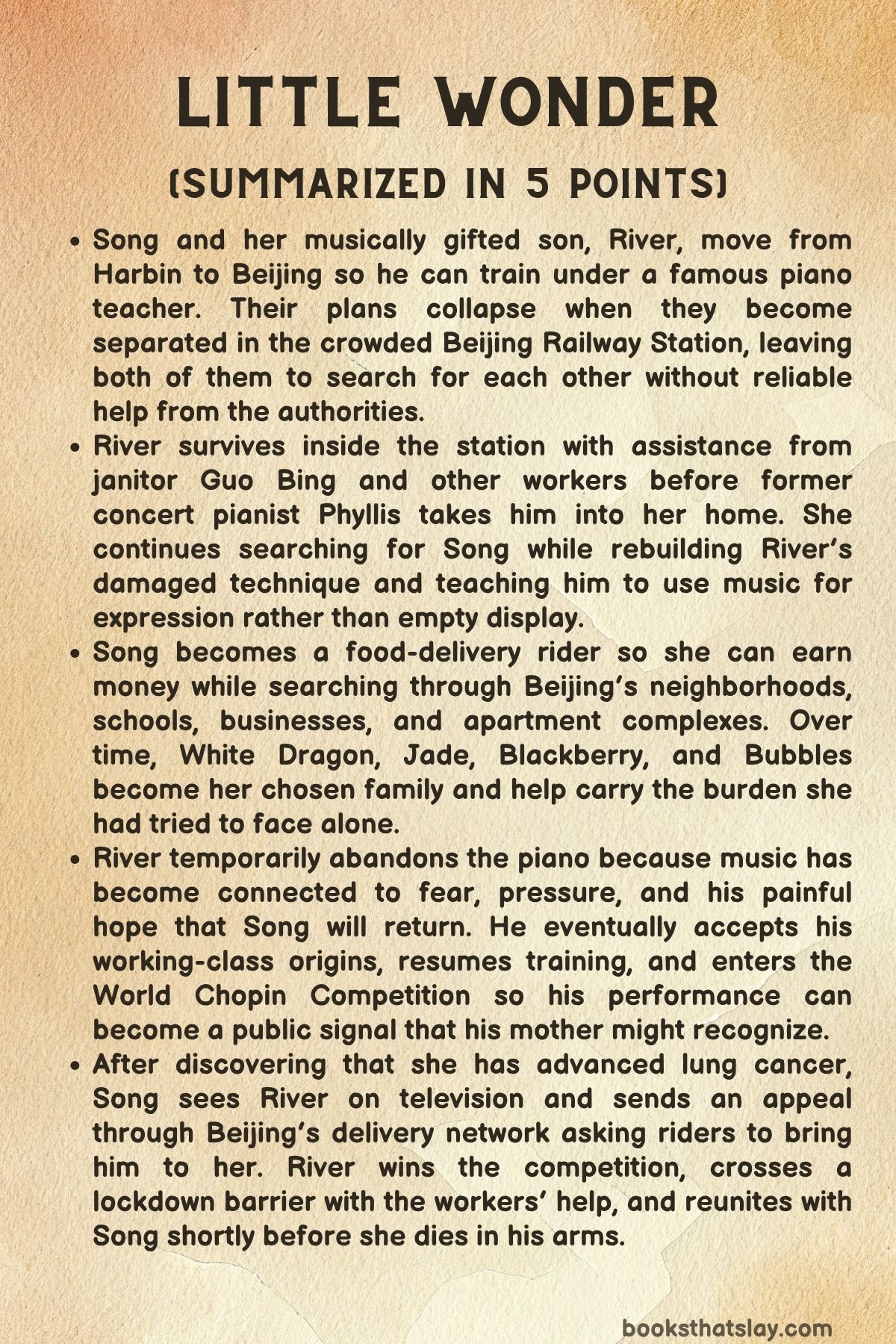
Song and her eleven-year-old son, River, travel from Harbin to Beijing shortly before the Spring Festival. They carry nearly everything they own because Song intends to begin a new life in the capital, where River may receive instruction from a famous piano teacher.
River has an exceptional musical ear and can recognize the pitch of ordinary sounds. Song believes his gift offers him a way out of poverty, poor health, and the limitations faced by migrant families.
Their journey ends in disaster at Beijing Railway Station. When River drops his treasured Tchaikovsky score, he releases Song’s hand to retrieve it, and the moving crowd separates them within seconds.
Song abandons their luggage and fights against the stream of passengers, but River disappears among thousands of people. River is knocked down repeatedly, protects his damaged score, and eventually reaches a sheltered area where he calls for his mother.
A suspicious man approaches River and offers to take him to a telephone supposedly located in his car. River senses danger when the stranger suggests that Song may have intentionally abandoned him, so he escapes and runs out of the station.
River loses his asthma medicine during the pursuit and becomes stranded in an unfamiliar city. Song, meanwhile, has her phone stolen and is removed from the station after a police officer assumes that she is causing trouble rather than reporting a crime.
A sweet-potato vendor tells Song that River escaped from a thin man and ran toward a pedestrian bridge. Song then finds River’s medicine on the ground, confirming that she is following his route while also showing how vulnerable he has become.
River returns to the station after borrowing a telephone and trying to call Song. He reconstructs her number through the musical pattern remembered by his fingers, but the stolen phone is no longer reachable.
Unable to reenter without a ticket, River buys a cheap ticket to Tianjin simply to pass through security. Inside, he meets Guo Bing, a night janitor who realizes that River is alone but chooses to protect him.
Bing hides River in staff rooms, gives him food, and provides an orange cleaning uniform so he can move through restricted areas. Other station workers quietly assist, allowing River to survive while he waits for Song.
An abandoned upright piano beneath a staircase becomes River’s refuge. Playing allows him to express fear and loneliness while sustaining the belief that Song may somehow hear his music and find him.
River’s childhood explains why music and his mother are inseparable in his mind. Song gave birth to him in her poor family home, where poverty, gambling, alcoholism, and old disappointments had damaged nearly every relationship.
Her family had once sacrificed her education for her brother, only for corruption to destroy his opportunity as well. Song therefore learns early that survival requires labor, persistence, and a refusal to trust systems that routinely fail people like her.
River’s father, Blue, is a gentle construction worker who once defended Song when officers attempted to confiscate her fruit cart. They marry, start a small food business, and dream of building a permanent home together.
Economic pressure repeatedly separates the family. When River is still a baby, Song’s mother orders her to leave him behind and find work, claiming that money matters more than a mother’s presence.
Song refuses and takes River to Harbin, although she has almost no savings and cannot find employment while carrying a baby. A cleaning woman finally directs her to an agency, allowing Song to support River while keeping him near her.
Blue continues working far away, but he dies after falling from scaffolding during a storm. Song refuses to return permanently to her family home and instead promises that she will protect River and somehow create a future for him.
River suffers from asthma, worsened by Harbin’s polluted air. Song cannot afford the clean environment recommended by the doctor, but she purchases medicine and tells him that his lungs must continue working because his life has value.
His musical ability becomes evident when, as a small child, he reproduces melodies on a toy piano after hearing them once. Song brings him to Professor Li, a respected teacher who identifies River as a rare talent and agrees to teach him without charging fees.
Song uses the compensation from Blue’s death to buy an upright piano. She organizes every part of their lives around River’s lessons, practices, competitions, and the ten-year plan Professor Li creates for him.
Professor Li teaches a powerful and theatrical style while demanding extreme discipline. He occasionally strikes River’s fingers, but Song tolerates his methods because she believes strict instruction will give her son opportunities unavailable to ordinary migrant children.
River’s technical skill grows, but stage fright repeatedly undermines his performances. He runs away from his first competition, later makes unpredictable mistakes, and begins associating public performance with humiliation and fear.
Professor Li recommends medication to control River’s anxiety, but Song refuses. She argues that River must develop courage rather than depend on drugs and gives him a small clothespin figure carved by Blue to remind him that she is always beside him.
At a major competition, Li secretly gives River beta-blockers. Because of River’s asthma, the medicine triggers a life-threatening attack, and Song realizes that Li values his own ambitions more than River’s safety.
She immediately ends the relationship and decides that River deserves instruction from Professor Tiger, a celebrated Beijing teacher. That decision leads mother and son to the capital and ultimately to the railway-station separation.
While River remains hidden in the station, an elderly woman named Phyllis hears him play the abandoned piano. A former international concert pianist, she recognizes both his remarkable ability and the limitations of Professor Li’s harsh training.
River eventually admits that he has been lost for seven weeks. Phyllis offers to bring him home, continue the search for Song, and retrain him, forcing River to choose between remaining at the station and moving toward an uncertain future.
Remembering Song’s command to keep moving upward and outward, River accepts. He enters Phyllis’s wealthy, protected household, though he keeps his possessions packed because he expects Song to appear at any moment.
Phyllis contacts police departments, government agencies, shelters, and a private investigator. River’s lack of documents, recent photographs, and detailed family information makes the search nearly impossible, while officials suppress missing-child notices to protect appearances.
Phyllis becomes River’s legal guardian and slowly reconstructs his piano technique. She bans competitions, makes him practise slowly, and teaches him to replace physical tension and empty display with control, attention, and emotional meaning.
River also develops a bond with Phyllis’s husband, Eight, whose dementia causes him to mistake River for a childhood friend. Through Eight’s memories, River enters an imagined past in which lost people remain present.
Song spends the same period conducting her own search. She receives help from White Dragon, a delivery worker who assists her in obtaining a new telephone, finding accommodation, and registering with a food-delivery platform.
Becoming a rider allows Song to travel through schools, businesses, restaurants, apartment compounds, and distant neighborhoods. She accepts inefficient orders because every new route gives her another place to show River’s photograph.
Song sometimes comes physically close to River without knowing it. She enters the affluent compound where he lives and even hears recorded piano music, but the closed doors of the protected neighborhood conceal him from her.
River initially struggles to accept Phyllis’s comfortable home because enjoying safety feels like betraying Song. Over time, he recognizes that a new life does not erase his old one, although he continues waiting for his mother.
His unresolved fear returns during a private recital. He becomes sick, hides on the roof, and is found by Mini, a young pianist he first met at a competition in Harbin.
Mini helps River escape to the railway station. There he learns that Bing has left after rescuing a woman from the tracks, and the disappearance of his old protector makes River understand that life has continued while he has remained emotionally frozen.
River announces that he will abandon the piano because music has become connected to waiting for Song. Phyllis accepts his decision, explaining that she once attempted to escape music herself but discovered that it remained part of her identity.
For almost a year, River avoids the instrument. He attends school, exercises, plays games, spends time with Mini, and attempts to become an ordinary teenager.
His wealthy classmates make him ashamed of being a lost migrant child. During one painful incident, he insults a Northeastern lunch worker who regularly gives him an extra steamed bun, hoping the cruelty will win approval from the other students.
River later corrects his behavior by returning each day, accepting the bun, and expressing gratitude. The experience helps him understand that his origins are not something to reject and that Song’s labor created the opportunities he now possesses.
Song also changes during these years. After finding River’s abandoned yellow jacket outside a charity shop, she finally tells her courtyard neighbors why she became a delivery rider.
White Dragon, Jade, Blackberry, and Bubbles immediately offer their assistance. Their response teaches Song that accepting help is not weakness and turns her private search into a shared effort.
White Dragon becomes Song’s partner, although she continues to regard Blue as her only husband. Song also forces White Dragon to face his own abandoned responsibility by urging him to reconnect with his estranged daughter after she is injured in Wuhan.
The outbreak of a new virus soon places Wuhan under lockdown and transforms life in Beijing. Song continues delivering food while others remain inside, aware that public praise for delivery workers does not provide them with security, protection, or social equality.
River becomes increasingly concerned that Song may be among the migrant workers losing employment, housing, and access to assistance. He returns to the piano because he realizes that passive waiting will never make him visible enough for her to find him.
He decides to enter the World Chopin Competition and win on an international stage. His success, he hopes, will become a signal that can reach Song anywhere.
Phyllis agrees to prepare him. River rebuilds his technique and body, while Mini becomes his girlfriend and supports his plan to reunite with his mother.
Song’s persistent cough and exhaustion are eventually diagnosed as advanced lung cancer rather than the virus. The disease has already spread, leaving her with only weeks or months to live.
Even as her strength disappears, she continues searching. Blackberry then recognizes River in a television segment promoting the competition, and Song immediately knows that the seventeen-year-old pianist is her son.
River says during the interview that he plays for his mother and wishes she could hear him. Song speaks back to the television, assuring him that she can.
Her friends prepare to take her to the competition, but a sudden lockdown seals their neighborhood behind barricades. Song is forced to watch from bed while River advances through each round.
Before the final, River must choose between two concert pianos. He plays Debussy’s “Arabesque No. 1,” the piece that once calmed him as a baby, and selects the instrument whose sound seems to remain after the final note.
This choice clarifies his purpose. River is not simply seeking recognition or proving his ability; he is using music to tell the story of Song’s sacrifices and to declare that her life matters.
Song develops a final plan of her own. She sends an appeal through the delivery platform, asking riders across Beijing to meet River after the competition and guide him to her locked neighborhood.
In the final round, River performs Tchaikovsky’s First Piano Concerto. He confronts his stage fright by concentrating on Song, Blue, their years of hardship, and the future his mother fought to create.
River gives the finest performance of his life and wins the competition. When his bus leaves the hall, a vast gathering of delivery workers blocks the road and informs him that Song is alive but dying.
The riders create a route through Beijing, carrying River toward the sealed neighborhood. At the barricade, a guard recognizes him and unofficially allows him to enter by deliberately looking away.
River climbs over the barrier and runs through the dark alleys while singing that he is coming home. Inside the courtyard, Song’s friends welcome him as family and guide him to her room.
River barely recognizes the frail woman in the bed, but Song reaches for him and tells him that she watched him rise. He places Blue’s two clothespin figures together and tells her that they have won.
Mother and son spend several days together, exchanging stories and imagining journeys they know they will never take. River introduces Song to Phyllis, and the two women acknowledge their shared role in protecting him.
As Song weakens, River understands her heartbeat as the first music he ever heard. When she asks to dance, he lifts her in his arms and rocks her as she once carried and danced with him as a baby.
Their final vision carries them beyond the walls and into an open blue sky. Song dies knowing that River survived, found people who loved him, and transformed her sacrifices into music that will continue after her life ends.
Characters
Song
In Little Wonder, Song is defined by extraordinary determination, practical intelligence, and an almost absolute commitment to her son. Poverty teaches her that security is never guaranteed, while her family history teaches her that official systems and promises often fail those without influence.
Her love for River is active rather than sentimental. She works, negotiates, fights, sacrifices sleep, accepts humiliation, and repeatedly begins again because she believes that love must produce concrete protection and opportunity.
Song’s greatest strength is also the source of her hardest decisions. Once she identifies River’s musical ability as his path out of poverty, she organizes both their lives around success and sometimes overlooks the emotional and physical cost of that pressure.
Her acceptance of Professor Li’s aggression shows how ambition can distort parental judgment. Although she never stops caring about River’s safety, she initially interprets harshness as necessary discipline because she fears that any softness will condemn him to the life she has endured.
Song also repeats aspects of her mother’s behavior despite resenting them. Just as her own needs were once sacrificed for the family’s future, she sacrifices comfort, family obligations, and emotional balance for River’s advancement.
The separation transforms Song from a fiercely independent survivor into someone who gradually understands the value of collective support. Her courtyard neighbors do not replace River or Blue, but they help her see that strength can include trust, vulnerability, and reliance on others.
Her illness gives her story a tragic final limit. She has spent years protecting River’s weak lungs while ignoring the pollution damaging her own, and the discovery of her cancer exposes the bodily cost carried by workers whose labor remains socially necessary but personally disposable.
Song’s final victory is not River’s prize alone. It is her knowledge that he remembers where he came from, understands her sacrifices, and has learned to transform love into a purpose larger than fame.
River
River is a sensitive, intelligent, and musically gifted child whose inner life is shaped by sound. Ordinary noises become pitches, colors, patterns, and emotional signals, allowing music to function as the language through which he understands both the world and himself.
His asthma makes him physically vulnerable, while Song’s protection initially encourages caution. Yet his survival after the separation demonstrates that vulnerability does not prevent courage, resourcefulness, or independent judgment.
River’s relationship with music is complicated by pressure. It begins as a natural response to sound and a bond with his mother, but competitions, Professor Li’s methods, and repeated stage fright turn performance into a test of worth.
His years with Phyllis allow him to separate musicianship from empty display. She teaches him that technique should serve expression and that a performer must communicate something truthful rather than merely demonstrate speed or power.
River’s decision to stop playing is an attempt to escape waiting, grief, and responsibility. The period gives him physical freedom, but it also reveals that denying music leaves him without a stable sense of purpose.
His shame about being a migrant child marks an important moral failure. By insulting the lunch worker, River briefly rejects the same social world that produced Song, but his sustained apology shows his ability to recognize wrongdoing and change.
Mini’s friendship helps him move from isolation toward trust, while Phyllis gives him security without demanding that he forget Song. These relationships allow River to understand that receiving love from new people does not diminish his loyalty to his mother.
His final performance transforms ambition into communication. The competition matters because it allows him to tell Song’s story publicly, and his success gives Little Wonder its clearest statement that artistic greatness becomes meaningful when it recognizes the lives that made it possible.
Blue
Blue represents kindness, loyalty, and the unrealized future of Song’s young family. His first important action is defending Song’s livelihood, establishing him as someone willing to stand beside her when authority attempts to overpower her.
His love is expressed through modest gestures rather than wealth. The carved clothespin figures become lasting symbols of his marriage, his family, and the ordinary domestic life that economic hardship prevents them from fully achieving.
Blue’s work requires repeated separation from Song and River. His death on a construction site exposes the danger faced by laborers whose bodies support urban development while their families remain economically insecure.
Although he dies early, Blue remains present in River’s emotional world. The clothespin figure helps River face performance anxiety, while his name, promises, and imagined approval continue influencing Song’s decisions.
The reunion of the two figures near Song’s death symbolically restores the family. Blue cannot return physically, but the values associated with him remain alive in Song’s devotion and River’s recognition of his parents’ sacrifices.
Phyllis
Phyllis is a former concert pianist whose wealth, experience, and social position sharply contrast with Song’s life. She enters River’s story not as a replacement mother but as a protector who gives him the safety and artistic training that Song wanted but could not provide.
Her response to River is guided by recognition rather than charity alone. She hears both his exceptional ability and the damage caused by Professor Li’s emphasis on force, spectacle, and competition.
Phyllis rebuilds River’s technique by slowing him down. Her methods teach patience, bodily awareness, control, and interpretation, allowing River to discover that musical power does not require physical aggression.
Her own history adds depth to her mentorship. Having once fled performance, she understands that artistic identity cannot be managed through ambition alone and that fear must be accepted rather than denied.
Phyllis also respects River’s continuing attachment to Song. She searches through official and private channels, tolerates his packed belongings, and never demands that gratitude erase his former life.
Her relationship with Eight reveals another side of her devotion. The daily effort she makes to preserve his comfort shows a patient, enduring love very different from the competitive musical world she once occupied.
By helping River become visible, Phyllis completes rather than replaces Song’s work. One woman gives him the drive and opportunity to begin, while the other gives him the conditions required to mature.
Mini
Mini initially appears confident, stylish, and socially secure, but her importance grows because she recognizes River without reducing him to either a prodigy or a lost child. She can discuss music seriously while also encouraging him to experience friendship, humor, rebellion, and ordinary adolescence.
Her decision to help River escape from the recital shows that she understands his emotional state. Rather than forcing him back onto the stage, she takes him to the railway station because she sees that his crisis concerns Song, not simply performance anxiety.
Mini gives River companionship during the period when he leaves the piano. Their games, conversations, trips, and shared secrets allow him to build an identity outside practice rooms and competitions.
She also challenges the isolation produced by River’s shame. Mini knows his origins and accepts them, making it possible for him to begin accepting them himself.
Their romantic relationship develops from friendship and mutual trust. Mini does not ask River to choose between love and his search for Song, and she promises that their future should include his mother rather than erase her.
Her support during his return to music helps ensure that the competition remains connected to reunion rather than fame. She becomes part of the future River imagines because she respects the past that formed him.
White Dragon
White Dragon is humorous, generous, and emotionally wounded. His first encounter with Song begins with an accident, but he quickly becomes one of the few people willing to assist her without demanding proof, status, or repayment.
He introduces Song to delivery work and gives her a place within the courtyard community. His practical help allows her to survive in Beijing while extending her search across the city.
White Dragon’s estrangement from his daughter reveals that he understands parental love less fully than Song does. He avoids contacting her because he fears rejection, mistaking emotional withdrawal for self-protection.
Song forces him to recognize that a parent’s responsibility continues even when the relationship is painful. His journey to Wuhan and the gradual repair of his bond with his daughter show that love requires action rather than regret.
His romantic relationship with Song is based on companionship instead of replacement. He accepts that Blue remains central to her identity and does not demand exclusive possession of her emotional past.
During Song’s illness, White Dragon stays beside her and helps bring River home. His development shows how people who begin as strangers can become family through repeated acts of care.
Professor Li
Professor Li is a talented teacher whose knowledge is corrupted by ego, frustration, and a desire for professional recognition. He correctly identifies River’s unusual ability and gives him training that would otherwise have been financially impossible.
His methods, however, treat the child’s body as an instrument to be controlled. Striking River’s hands and demanding theatrical power encourage technical achievement while increasing fear, tension, and emotional instability.
Li’s self-harming behavior suggests that he applies the same cruelty to himself. His violence comes from an artistic culture in which mistakes are treated as personal failures and success appears to justify suffering.
The secret use of beta-blockers is his clearest moral violation. He ignores Song’s refusal and River’s medical condition because he values the possibility of victory over the child’s safety.
Li sees River partly as a second chance for his own ambitions. That desire prevents him from recognizing that teaching requires responsibility for the student as a person, not only investment in the student’s results.
His influence remains important even after Song dismisses him. River must spend years unlearning the physical tension, performance habits, and fear that Li placed inside his music.
Guo Bing
Guo Bing represents quiet compassion within an environment governed by rules, surveillance, and economic insecurity. As a poorly paid janitor, he has little institutional power, yet he uses the access he possesses to keep River alive.
He feeds River, hides him, provides a uniform, and creates temporary shelter without expecting recognition. His actions are especially significant because protecting River could cost him his employment.
Bing does not pressure River to explain everything immediately. He allows trust to develop and understands that the station represents River’s last connection to Song.
When River chooses to leave with Phyllis, Bing accepts the decision. His assurance that River may return allows the child to move forward without feeling that he is betraying his first protector.
The later revelation that Bing left after saving a woman from the tracks confirms that his kindness is not limited to River. He is someone who repeatedly responds when another person is in danger, even when institutions do not reward that courage.
Eight
Eight’s dementia places him between past and present. He often mistakes River for a childhood friend, but these errors create a relationship in which memory becomes emotionally meaningful even when it is factually unstable.
His attachment to familiar food shows how sensory experiences preserve identity. Phyllis’s daily journeys to obtain the dough twists he remembers demonstrate her attempt to protect the remaining pathways into his past.
River finds comfort in Eight’s confused memories because they allow lost people to feel temporarily present. Through him, River imagines a world where Song has not disappeared completely.
Eight also accepts River without asking him to perform or explain himself. Their relationship is free from competition, status, and expectations, giving River a form of companionship unavailable in his musical life.
His presence reinforces the novel’s treatment of memory as something carried through sounds, tastes, habits, and repeated acts. Even when language and recognition weaken, emotional attachment can continue.
Song’s Mother
Song’s mother is stern, practical, and shaped by scarcity. She believes survival requires sacrifice, obedience, and the suppression of personal feeling, which leads her to make decisions that deeply wound Song.
She previously accepts the sacrifice of Song’s education for her son’s advancement. Later, she demands that Song leave baby River behind and work, arguing that income is more necessary than maternal presence.
Her behavior appears cruel, but it grows from a world where poverty narrows every choice. She does not believe affection can protect a child from hunger, limited education, or social exclusion.
Song’s resistance creates a different model of motherhood, yet she also inherits some of her mother’s severity. Both women place a child’s future above immediate comfort, though Song refuses physical separation and seeks opportunities through her own labor.
The fermented bean paste sent near Song’s death becomes a delayed expression of love and regret. Her mother admits that she always hoped Song would return, showing that emotional distance did not mean the absence of attachment.
Their relationship illustrates how love can survive beneath resentment without erasing the damage caused by past decisions. Forgiveness arrives late, but it allows Song to release part of the anger she has carried for years.
Jade
Jade brings warmth, energy, and practical care into Song’s courtyard life. Her beauty work and social confidence contrast with Song’s exhausted isolation, but she never treats Song as an object of pity.
Once Song reveals the truth about River, Jade immediately joins the search. Her reaction shows that Song’s secrecy, rather than other people’s indifference, has partly prevented the formation of a support network.
During Song’s illness, Jade prepares her appearance for the hoped-for reunion. This act respects Song’s desire to be seen by River as his mother rather than solely as a dying patient.
Jade helps turn the courtyard into a home. Her presence demonstrates how everyday companionship can restore dignity to someone consumed by grief and labor.
Blackberry
Blackberry is a dependable member of the courtyard community whose greatest contribution comes through careful attention. He recognizes River during a television broadcast when Song’s failing health has nearly ended the search.
His discovery proves that communal effort can accomplish what individual determination cannot. Song has searched for years, but the answer reaches her because another person is now watching with her.
Blackberry also helps care for Song and participates in the plan to bring River home. His actions show that support does not always require dramatic heroism; sometimes it depends on remaining present, observant, and willing to respond.
Bubbles
Bubbles is a disabled delivery worker whose sociability challenges assumptions about weakness and dependence. He participates fully in the riders’ community and becomes one of Song’s most valuable allies.
He helps circulate River’s photograph and later gives Song access to the delivery platform when she is too ill to work. That access allows her final appeal to reach riders across Beijing.
Bubbles therefore connects private grief with collective action. Without his assistance, Song’s message might never have reached the workers who guide River through the city.
His role shows that people frequently dismissed or underestimated by society possess knowledge, networks, and abilities capable of changing another person’s life.
Themes
Parental Love, Sacrifice, and Ambition
In Little Wonder, parental love is presented as labor, endurance, and a willingness to make difficult choices rather than as affection alone. Song cleans apartments, sells food, delivers meals through dangerous weather, tolerates social humiliation, and reshapes her entire existence around River’s survival and advancement.
Her sacrifices give River opportunities that his social position would otherwise deny him. At the same time, the novel refuses to treat every sacrifice as automatically beneficial, since Song’s ambition sometimes causes her to overlook the emotional pressure created by constant training and competition.
Professor Li’s influence exposes the danger of confusing a child’s success with a parent or teacher’s personal redemption. Song initially accepts his harshness because she believes greatness requires suffering, but the secret medication forces her to recognize that ambition becomes destructive when it ignores the child’s body and autonomy.
Song’s relationship with her own mother adds another layer to the theme. She rejects her mother’s demand that she abandon River for work, yet she inherits the belief that a child’s future may justify severe present hardship.
River’s final achievement transforms the meaning of sacrifice. He does not win merely to validate years of training; he performs to recognize the labor, poverty, fear, and love that carried him to the stage.
The reunion allows mother and son to understand that their dream belonged to both of them, but it also acknowledges the price. Their victory cannot restore the lost years or save Song’s life, making success both meaningful and painfully incomplete.
Music as Memory, Identity, and Communication
Music operates as River’s primary way of understanding experience. He hears pitch in ordinary sounds, remembers telephone numbers through finger patterns, associates melodies with colors, and organizes frightening situations as if they were difficult pieces that can be approached one measure at a time.
His earliest musical memory is inseparable from Song. Debussy’s “Arabesque No. 1” calms him as a baby, while the Tchaikovsky concerto becomes connected to family ambition, Blue’s memory, separation, and eventual reunion.
The abandoned station piano allows River to express emotions he cannot explain verbally. Music becomes both a refuge and a signal, sustaining his belief that Song may hear him even when they are separated by an enormous city.
Yet music also becomes a burden. Competitions and Professor Li’s methods turn an instinctive gift into a source of fear, causing River to associate performance with judgment, failure, and possible abandonment.
His decision to quit reveals that music cannot simply be removed from his identity. Although he enjoys temporary freedom, he gradually feels purposeless because he has rejected the language through which he interprets his life.
Phyllis helps him recover music by teaching him to communicate rather than impress. During the final competition, River overcomes fear by concentrating on the story he wants the audience and Song to understand.
The final image of Song’s heartbeat as the first music River heard completes this idea. Every future performance will carry her presence because his art originates not only in talent but in the rhythm of her care.
Poverty, Migration, and Social Invisibility
Song and River live within systems that depend on migrant labor while withholding protection, dignity, and opportunity from migrant families. Construction work, domestic cleaning, street vending, station maintenance, and food delivery keep cities functioning, but the people performing these jobs remain vulnerable to injury, exploitation, and official indifference.
Blue’s death shows the physical danger faced by construction workers. Song’s experience with police officers, employers, delivery algorithms, and hospital costs demonstrates how institutions often treat poor workers as replaceable rather than as individuals with rights and families.
River’s disappearance is intensified by his lack of documents, photographs, and institutional visibility. Phyllis’s wealth grants her access to officials and investigators, yet even she struggles to overcome a system more concerned with public appearance than with locating one missing migrant child.
The contrast between River’s protected compound and Song’s courtyard reveals the physical separation between social classes. Song delivers food into wealthy neighborhoods without being allowed meaningful access to the people or spaces inside them.
River later feels ashamed of his origins because elite classmates teach him that association with working-class Northeastern migrants lowers his status. His insult toward the lunch worker shows how social prejudice can be absorbed even by someone whose own family has suffered from it.
The delivery riders’ response to Song’s message reverses this invisibility. Workers normally seen only as uniforms, app icons, or service providers become a coordinated human community capable of stopping traffic, crossing the city, and reuniting a family.
Community, Kindness, and Shared Responsibility
Song initially believes that survival depends on self-reliance. Her family disappointments and encounters with corrupt or dismissive officials convince her that depending on others creates weakness and exposes her to further pain.
River survives, however, because strangers repeatedly decide that another person’s suffering is their responsibility. The sweet-potato vendor protects him from the suspicious man, Bing hides and feeds him, station workers share supplies, and Phyllis offers safety without demanding that he abandon his mother.
Song’s search develops in the same way. White Dragon helps her find work and shelter, while Jade, Blackberry, and Bubbles join the search as soon as she allows them to understand her situation.
These relationships do not erase grief or solve every problem immediately. Instead, they create practical networks of food, information, transportation, shelter, companionship, and emotional support.
The pandemic strengthens the contrast between dependence and isolation. Residents rely on delivery workers while remaining physically separated from them, revealing that society is already based on mutual dependence even when privilege allows some people to ignore that fact.
Song’s citywide appeal succeeds because she finally asks openly for help. Her message reaches thousands of riders who recognize her struggle through their own experiences as workers, migrants, parents, and people separated from loved ones.
The final journey toward the courtyard turns individual kindness into collective action. Delivery riders, friends, teachers, guards, and family members each contribute one part of the route, showing that no single person creates the reunion alone.
Community becomes the force that carries Song and River across the distance between them. Their bond survives because other people choose to protect it.