Long Story Short Summary, Characters and Themes
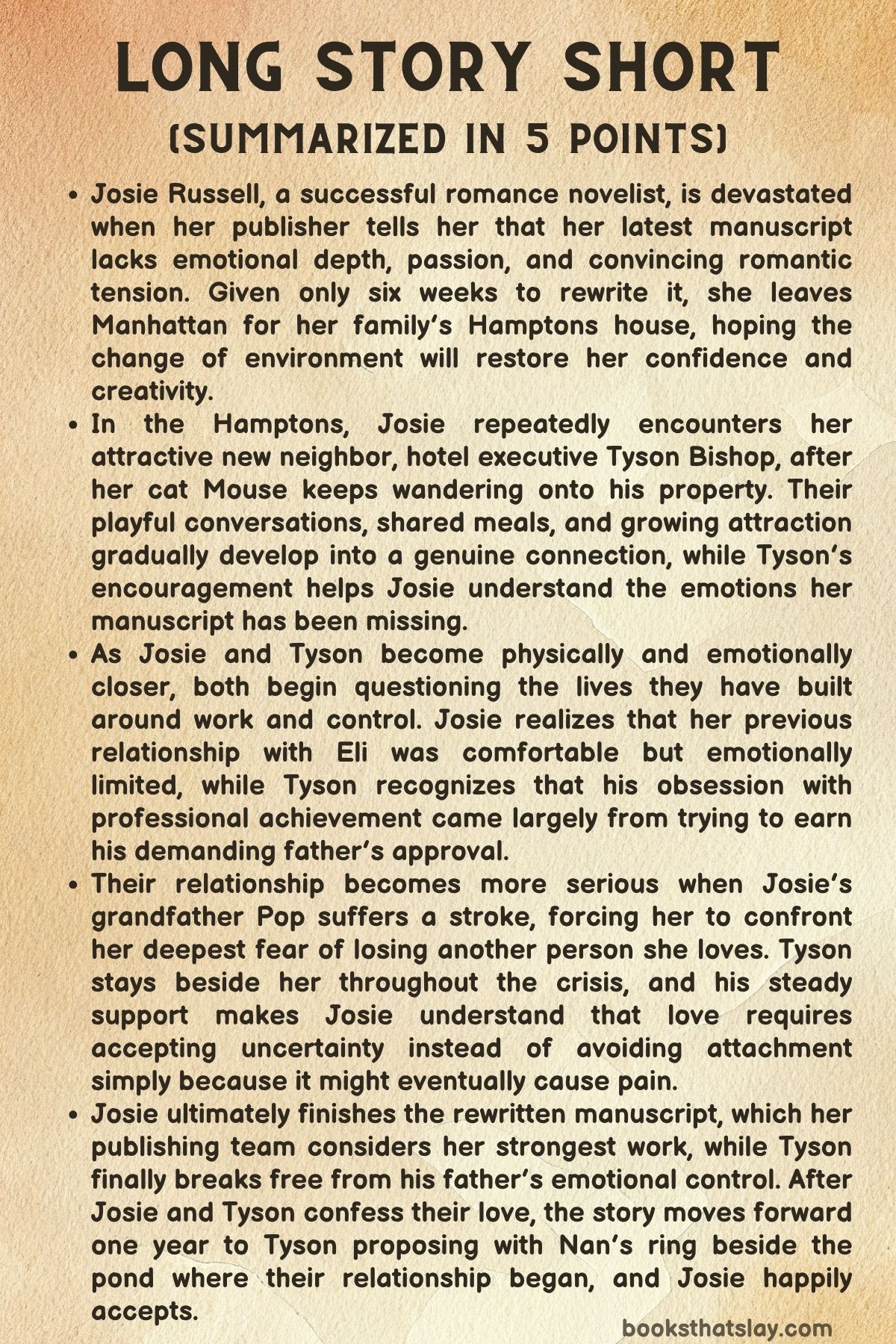
Long Story Short by Kat Singleton is a contemporary romance about two successful people who have allowed work, old emotional wounds, and fear of uncertainty to dominate their lives. Romance novelist Josie Russell arrives in the Hamptons desperate to repair a manuscript that has lost the emotional intensity expected from her writing, while hotel executive Tyson Bishop is trying to learn who he is beyond professional achievement.
Their accidental meeting develops from playful attraction into a relationship that changes how both of them understand love, ambition, vulnerability, family, and the possibility of building a life that is not governed entirely by fear or work. It’s the 4th book of the Pembroke Hills series.
Summary
Josephine “Josie” Russell believes she has completed another romance novel when a meeting with her publishing team overturns that confidence. Her editor, Stevie, tells her that the manuscript lacks the emotional tension, desire, and connection that readers associate with Josie’s earlier books, while Eli, the head of marketing and her former boyfriend, is particularly harsh about its weaknesses.
Josie initially wonders whether Eli’s criticism is influenced by bitterness over their breakup, since their two-year relationship ended partly because he refused to acknowledge her publicly. Yet Stevie and Mandi agree that the manuscript needs substantial work, leaving Josie with no choice but to confront the problem and accept an extremely difficult six-week revision deadline.
The criticism damages Josie’s confidence more deeply than she wants to admit. Scarlett Astor, her actress best friend, is furious on her behalf, but Josie ultimately decides that she wants to prove she can produce a stronger book rather than blame Eli for everything that went wrong.
Her grandfather Arthur Russell, whom she calls Pop, recognizes that she needs both encouragement and a change of environment. Having raised Josie with his late wife after Josie’s parents died when she was five, Pop remains the person whose support steadies her most, and he suggests that she use the family house in the Hamptons while she rewrites.
At the same time, Tyson Bishop arrives in the Hamptons determined to make his own summer different. He and his sister Winnie, along with her husband Archer Moore, have spent years handling the complicated merger that created Bishop-Moore Hotels, and Tyson has built nearly his entire identity around his career.
His relationship with his father has collapsed after Tyson helped remove him from control of the company. Having spent most of his life chasing a difficult parent’s approval, Tyson is beginning to realize that endless professional accomplishment has left him successful but emotionally isolated.
The two meet because Josie’s cat, Mouse, escapes through an open window and wanders onto Tyson’s property. Josie arrives in her robe looking for him and discovers Mouse calmly sitting near the attractive stranger next door.
The meeting is embarrassing for Josie and amusing for Tyson, but their attraction is immediate. Mouse soon escapes again, giving them another opportunity to talk, exchange names, and begin the teasing rhythm that quickly becomes characteristic of their relationship.
Josie repeatedly reminds herself that Tyson is a distraction she cannot afford. Her manuscript is still struggling, the deadline is severe, and she has barely recovered from the disappointment of her relationship with Eli.
Nevertheless, Tyson makes it difficult for her to remain isolated. He invites her to dinner, asks sincere questions about her life and career, and listens with a kind of focused attention that Josie realizes she rarely received from Eli.
Tyson learns why Josie has come to the Hamptons and encourages her to stop treating every hour away from the manuscript as wasted time. Josie points out that he is hardly qualified to give such advice because he is equally obsessed with work, and their similarity becomes one of the foundations of their connection.
Both have allowed achievement to become a form of protection. Josie retreats into writing and deadlines when uncertainty frightens her, while Tyson has used his business career as the one area of life he believed he could control.
Tyson soon begins caring for Josie in small but meaningful ways. After remembering that she misses a particular chocolate cake, he saves his own serving at Pembroke Hills and brings it to her house.
When he discovers that Josie has been surviving on snacks while writing, he decides to make sure she eats proper meals. He also appears one morning with several different coffees because he does not yet know which one she prefers.
These gestures affect Josie because they require attention rather than spectacle. Tyson remembers minor details, notices what she needs, and helps without making her feel indebted to him.
Their growing attraction also becomes unexpectedly useful to Josie’s work. She confesses that part of her writing problem may come from her relationship with Eli, which she now recognizes as comfortable but perhaps never deeply passionate.
Tyson suggests that genuine emotional experience naturally affects someone whose profession depends on creating believable feelings. When he nearly kisses her but deliberately stops short, the unresolved tension sends Josie back to her manuscript with new energy.
For the first time since the revision began, she understands the anticipation and longing her fictional romance was missing. Tyson becomes an inspiration not because Josie mechanically copies their experiences, but because he teaches her how desire can contain excitement, restraint, emotional risk, and uncertainty.
Their first real kiss occurs after breakfast at Pembroke Hills. After weeks of near-misses and playful challenges, Tyson asks permission, and Josie agrees.
The kiss confirms that their connection is not imagined. Josie experiences a kind of chemistry she never had with Eli, while Tyson realizes that his interest in her has already moved beyond casual attraction.
Josie later admits that her past physical relationships often felt predictable. Wanting to understand what she has been missing, she asks Tyson to show her a more passionate form of intimacy.
Tyson responds carefully rather than treating the invitation as an opportunity to rush forward. Their physical relationship develops alongside trust, conversation, humor, and repeated attention to Josie’s comfort, making her understand that passion is not simply physical intensity but also the feeling of being seen and respected.
When Tyson stops their first intimate evening before they have sex and instead asks Josie to spend the night beside him, the decision surprises her. What he wants is not simply access to her body but more time with her.
That night Tyson admits how deeply his need for control has shaped him. He explains that professional achievement always seemed measurable and dependable, unlike family relationships, especially the painful bond with his father.
Josie becomes one of the few people around whom Tyson does not feel compelled to control the outcome. Their relationship is uncertain, but the uncertainty no longer makes him want to withdraw.
As they spend more time together, their lives begin to resemble a real partnership. They work during the day, share meals, explore local shops, spend time with Mouse, and gradually enter each other’s routines.
Tyson proudly watches Josie sign copies of her novels in a bookstore and encourages her to take her own success seriously. Josie begins imagining small signs of permanence at Tyson’s house and starts thinking about introducing him properly to Pop.
Their growing happiness exists beside serious family pressures. Tyson’s estranged father resurfaces with a demand for five hundred million dollars and threatens to reveal damaging information about old business practices connected to Bishop Hotels.
Tyson refuses to surrender immediately to the manipulation. The threat forces him to confront the last major hold his father still has over him and recognize how much of his life has been shaped by the desire to prove himself to someone who continually withholds approval.
Josie faces a different family crisis when Pop suffers a stroke. She had already noticed signs that he was not feeling well, and news of his hospitalization sends her into panic.
Tyson immediately helps organize the return to Manhattan, stays beside Josie at the hospital, and supports her without offering promises he cannot make. He understands that his role is not to remove her fear but to make sure she does not face it alone.
The crisis exposes Josie’s deepest emotional wound. After losing her parents as a child and later losing Nan, she is terrified that loving someone always creates the possibility of another unbearable goodbye.
Yet instead of shutting Tyson out, she reaches toward him. His steady presence teaches her that vulnerability creates the possibility of pain but also allows another person to share that pain when life becomes frightening.
For Tyson, the hospital changes his understanding of his own feelings. Watching Josie beside her unconscious grandfather makes him realize that she is no longer simply the woman who made his summer exciting.
She is the person who matters most to him. Tyson recognizes that he loves her, although he postpones telling her because Pop’s condition must remain the focus.
Tyson then confronts his father directly. Rather than giving him the unrestricted fortune he demanded, Tyson presents a controlled financial arrangement with conditions requiring the older man to leave Bishop-Moore Hotels and stay out of Tyson and Winnie’s lives.
The confrontation marks Tyson’s emotional separation from the approval he once considered essential. He finally accepts that his accomplishments are his own and that his father does not have the right to define his value.
Meanwhile, Pop survives and begins the difficult process of recovery. More than a month later, Josie brings him home, where accessibility changes and nursing support have been arranged.
Tyson has remained beside Josie throughout the crisis, helping with practical responsibilities, attending medical discussions, bringing meals, and supporting her while she continues trying to finish her book. Scarlett also remains an important source of loyalty and companionship.
Against extraordinary circumstances, Josie completes the revised manuscript. Stevie believes the new version is Josie’s strongest work, and even Eli and the marketing team respond enthusiastically.
Josie understands why the revision succeeded. She stopped trying to write romance from emotional distance and began accepting that real love requires uncertainty, exposure, trust, and the willingness to care deeply even when no outcome can be guaranteed.
The same understanding allows Josie and Tyson finally to name what has developed between them. Tyson tells her that he loves her, and Josie reveals that she loves him too.
Their relationship has transformed both of them. Josie recovers the emotional confidence that her failed manuscript and unsatisfying past relationship had damaged, while Tyson learns that success is incomplete when career achievement replaces intimacy, family, and personal happiness.
One year later, Tyson prepares a proposal beside the pond near the place where he and Josie first met. He decorates the backyard with candles, flowers, and an arch, hoping to turn an accidental beginning into a permanent commitment.
Josie realizes what is happening almost immediately and says her answer is already yes, but Tyson still gives her the proposal he planned. He tells her that meeting her changed his understanding of happiness and asks her to marry him.
The ring makes the moment even more significant because it once belonged to Nan. Tyson had asked Pop for permission to propose, and Pop insisted that Josie receive her grandmother’s ring.
Friends and family are preparing to gather for another celebration as well: the release of the novel Josie has dedicated to Tyson, the same book whose troubled first version sent her to the Hamptons. Long Story Short therefore closes by bringing Josie’s personal and creative journeys together, turning what began as a professional crisis into the beginning of the life she and Tyson choose to build.
Characters
Josephine “Josie” Russell
Josie is the emotional center of Long Story Short, and her development depends on recognizing that professional skill cannot protect her from every form of emotional uncertainty. She begins the book wounded by criticism of her manuscript and privately afraid that her earlier success may have been luck rather than evidence of genuine talent.
Her creative problem reflects a larger personal problem. Josie has become accustomed to relationships that feel safe and manageable, particularly her time with Eli, and only gradually realizes that comfort without openness, recognition, or emotional risk is not the same as deep intimacy.
Her family history also explains why she is cautious about attachment. Losing her parents when she was five and later losing Nan has taught her that love can be followed by sudden absence, which is why Pop’s stroke activates such extreme fear.
Tyson changes Josie because he does not demand that she become fearless before loving him. His consistency shows her that uncertainty can exist beside care, and she eventually learns to accept both professional vulnerability and romantic vulnerability instead of protecting herself from them.
Tyson Bishop
Tyson’s journey in Long Story Short centers on separating personal worth from professional accomplishment. He has spent much of his adult life working with relentless intensity because achievement provided structure, measurable results, and the possibility of finally earning his father’s approval.
His success cannot eliminate the loneliness created by that approach. Purchasing the Hamptons house becomes an early sign that Tyson is beginning to imagine a life in which relationships, leisure, and emotional satisfaction matter as much as business performance.
With Josie, his caring nature appears through ordinary behavior rather than declarations. He remembers her preferences, brings food, learns her coffee order, cares for Mouse, listens carefully, and repeatedly respects Josie’s boundaries even when their attraction is strong.
His eventual confrontation with his father completes an equally important part of his development. Tyson realizes that he does not need paternal approval to validate the life he has built, freeing him to choose a future defined by love and personal values rather than inherited expectations.
Arthur “Pop” Russell
Pop represents security, continuity, and unconditional support throughout Long Story Short. After the deaths of Josie’s parents, he and Nan become her caregivers, and he gives Josie the stability required to grow into an independent adult rather than treating her as an heir who must continue his business empire.
His respect for her writing career is especially important. Pop has enough wealth and influence to direct Josie toward a safer or more conventional path, yet he consistently supports the profession she chooses for herself.
His stroke changes his role in the story from protector to someone who must accept help. The crisis forces Josie to confront the possibility of losing the last parental figure from her childhood while also showing that the love Pop gave her has prepared her to form other sustaining bonds.
Pop’s acceptance of Tyson confirms the seriousness of that relationship. His decision to give Tyson Nan’s ring for the proposal symbolically connects Josie’s past family life with the future family she is creating.
Scarlett Astor
Scarlett provides loyalty, humor, and emotional clarity in Long Story Short. As Josie’s best friend since their fine arts school days, she knows Josie before fame, publishing success, or romantic complications, which allows her to challenge Josie without being intimidated by any part of her public identity.
Her immediate anger toward Eli demonstrates how protective she is, but Scarlett is not simply a friend who agrees with everything Josie says. She pushes Josie to admit that her attraction to Tyson matters and challenges the idea that every decision about a new relationship must be made in advance.
Scarlett also helps Josie question what she has accepted as normal in romantic relationships. Through blunt but affectionate conversations, she encourages Josie to recognize the difference between merely functional intimacy and a relationship that creates genuine excitement and emotional involvement.
During Pop’s recovery, Scarlett remains present rather than disappearing once the romantic storyline becomes serious. Her consistency establishes the friendship as one of Josie’s permanent emotional foundations.
Eli
Eli functions as an important contrast to Tyson in Long Story Short because his relationship with Josie demonstrates what emotional limitation looks like even when a relationship lasts for years. Their romance remained secret for two years because Eli refused to acknowledge Josie publicly, creating a dynamic in which she accepted less recognition than she deserved.
His severe criticism of her manuscript initially appears potentially personal because it follows their breakup. Yet the fact that Stevie and Mandi share his concerns prevents Josie from dismissing the criticism entirely and forces her to confront genuine weaknesses in her writing.
Eli therefore plays two roles in Josie’s development. Personally, he represents the comfortable but emotionally insufficient relationship she has outgrown, while professionally, his criticism becomes part of the pressure that pushes her toward a stronger manuscript.
By the end, even Eli responds positively to the revision. His approval is no longer the emotional victory it might once have been because Josie has stopped defining either her talent or desirability through his judgment.
Winnie Bishop
Winnie understands Tyson well enough to recognize how much of his personality has been consumed by work. Her insistence that they deserve a summer containing actual enjoyment helps create the emotional conditions in which Tyson can meet Josie and begin questioning his routines.
She is affectionate but willing to tease her brother, particularly when his growing interest in Josie becomes impossible to hide. That humor reveals a sibling relationship in which Tyson can be treated as a person rather than merely as a powerful executive.
Winnie also shares Tyson’s painful history with their father. Because she participated in removing him from control of the family company, she understands both the business reasons behind the decision and the emotional cost of opposing a parent whose approval once mattered.
Her support of Tyson’s eventual plan for dealing with their father reinforces the idea that the siblings are rebuilding family around mutual respect rather than inherited authority.
Archer Moore
Archer is closely connected to Tyson and Winnie through both family and business. His marriage to Winnie and involvement in Bishop-Moore Hotels place him inside the difficult transition that followed the merger of two rival family companies.
Although he is less central to the romance, Archer represents the stable partnership already present in Tyson’s world. His relationship with Winnie provides an example of a life in which business responsibility and committed love can coexist rather than compete.
He also supports the decisions required to protect the company from Tyson’s father. His presence makes clear that Tyson no longer has to carry every corporate or family burden alone.
Stevie
Stevie serves as Josie’s editor and becomes one of the people willing to tell her something she does not want to hear. Her criticism of the manuscript is painful, but it is presented as professional judgment rather than cruelty.
That distinction matters because Josie initially wants to attribute the failed meeting largely to Eli’s bitterness. Stevie’s agreement with the underlying criticism forces Josie to recognize that the problem with the manuscript is real.
Stevie ultimately validates Josie’s growth by responding enthusiastically to the revision. Her praise carries weight because she was also willing to identify the original book’s weaknesses honestly.
Mandi
Mandi, Stevie’s assistant, occupies a smaller role but contributes to the professional pressure surrounding Josie’s revision. Her agreement that the manuscript needs substantial improvement confirms that the publishing concerns cannot be dismissed as a conflict between Josie and Eli.
Her presence also makes the opening criticism more difficult for Josie because several professional readers have reached similar conclusions. This collective response forces Josie to move beyond defensiveness and approach the rewrite seriously.
Jude Kensington
Jude is one of Tyson’s friends and helps reveal how unusual Tyson’s behavior around Josie appears to people who know him well. He notices Tyson’s distraction at Pembroke and later catches Tyson and Josie kissing, responding with the teasing familiarity of a close friend.
His reaction shows that Tyson has not historically been someone whose romantic life dominates his attention. Josie’s effect on him is therefore visible from the outside long before Tyson fully admits how serious his feelings have become.
Jude also helps draw Josie into Tyson’s social life. His presence, alongside Charlotte and their baby, allows Tyson to imagine Josie participating in friendships and future gatherings rather than existing only inside a private summer romance.
Charlotte
Charlotte responds to Josie with immediate warmth when Jude and Tyson’s worlds intersect. Unlike Jude, who focuses on teasing Tyson, Charlotte quickly forms an independent connection with Josie.
Her recognition of Josie’s work is important because it allows Tyson to observe someone responding to Josie not as Arthur Russell’s granddaughter but as an accomplished author in her own right. This reinforces Tyson’s respect for the career Josie built independently.
Charlotte also represents another glimpse of established partnership and family life. Seeing her with Jude and their baby quietly broadens the future Tyson begins imagining with Josie.
Tyson’s Father
Tyson’s father represents the damaging form of approval that can never truly be earned because its conditions continually change. Tyson spends years trying to prove himself through professional excellence, yet when he acts against his father’s harmful leadership, that approval turns into resentment and hostility.
His demand for money demonstrates how he continues treating family relationships as transactions connected to power, entitlement, and control. He attempts to use hidden business information as leverage rather than approaching Tyson through remorse or genuine reconciliation.
Tyson’s final confrontation with him is therefore not primarily about finances. It is about refusing to allow a parent’s disappointment to determine his identity, choices, or future happiness.
Tyson’s Mother
Tyson’s mother remains largely outside the central action, but her separation from Tyson’s father reinforces the extent of the damage caused by his behavior. The collapse of that marriage becomes another example of how obsession with power and professional status can destroy intimate relationships.
Her situation also contributes to Tyson’s fear that he could become like his father. He sees what happens when work, ego, and control are consistently placed above emotional responsibility, making his eventual choice to build a different life more significant.
Nan
Nan remains emotionally present despite having died before the main events of the story. Josie remembers her as a source of comfort who would quietly lie beside her whenever she became overwhelmed, creating a ritual Josie still uses after the disastrous publishing meeting.
Her death contributes to Josie’s fear of additional loss, particularly when Pop suffers his stroke. Yet Nan’s influence is not limited to grief because the love she gave Josie continues shaping how Josie understands family and emotional safety.
The engagement ring provides the clearest symbol of that continuing influence. When Pop gives Nan’s ring to Tyson, the proposal connects Josie’s memories of being loved as a child with her decision to create a future family of her own.
Beatrice
Beatrice, Pop’s house manager, has limited narrative space but performs a crucial role when Pop’s health deteriorates. Her repeated calls are what alert Josie that he has been taken to the hospital.
Her presence also indicates the support structure surrounding Pop as an elderly man with significant responsibilities and resources. In the crisis, she becomes the practical link between Josie’s ordinary life in the Hamptons and the medical emergency waiting in Manhattan.
Mouse
Mouse functions as far more than a comic pet because his repeated escapes directly create the relationship between Josie and Tyson. Without his decision to wander onto the neighboring property, their first meeting might never have occurred.
His immediate comfort with Tyson also becomes an affectionate running joke. Josie repeatedly notices that her supposedly antisocial cat seems unusually devoted to Tyson, giving their developing relationship a small sense of domestic familiarity.
Mouse therefore serves as a light but meaningful symbol of accidental connection. The animal Josie keeps safely indoors becomes the one force that repeatedly pulls her outside the controlled environment she created for herself.
Themes
Vulnerability as the Price of Genuine Love
Emotional safety initially means avoiding uncertainty. Josie has already lost her parents and Nan, so attachment carries an unspoken danger: anyone important can disappear, and loving someone deeply increases the amount that can be lost.
Tyson protects himself differently, but the result is similar. He invests in work because effort and success appear measurable, whereas relationships cannot guarantee approval, permanence, or predictable outcomes.
Their romance in Long Story Short gradually challenges both defensive systems. Josie must accept that she cannot experience profound intimacy while continually protecting herself from the possibility of disappointment, while Tyson must allow another person to matter even though he cannot control the future.
This becomes especially clear during Pop’s stroke. Josie’s instinct could have been to retreat into private fear, but she instead allows Tyson to stand beside her during one of the most frightening moments of her life.
Tyson learns the same lesson from the opposite direction. He cannot fix Pop, remove Josie’s pain, or guarantee that everything will return to normal, yet he discovers that remaining present is itself a form of love.
The book therefore treats vulnerability not as emotional weakness but as the necessary condition for meaningful connection. Josie and Tyson become stronger not because uncertainty disappears, but because they stop requiring certainty before allowing themselves to love.
Work, Ambition, and Personal Identity
Josie and Tyson are both highly accomplished, but their careers have expanded until professional performance affects how they judge their entire worth. Josie interprets one weak manuscript as possible evidence that she has lost her talent, while Tyson has spent much of his life treating corporate success as proof that he deserves his father’s respect.
Their relationship exposes the limitations of that thinking. Time away from work initially feels irresponsible to both of them, yet the periods they spend talking, eating, walking, resting, and enjoying the Hamptons ultimately make them more emotionally balanced rather than less capable.
Josie’s writing improves after she stops trying to force creativity through endless isolation. Experience, rest, excitement, attraction, and emotional honesty give her new understanding of the feelings she has been trying to create professionally.
Tyson undergoes a comparable shift when he realizes how empty his newly purchased house feels without anyone to share it with. The thought unsettles him because he has spent years assuming that business success would eventually create satisfaction on its own.
Neither character abandons ambition. Instead, they learn that work can be meaningful without becoming the sole measure of identity.
The novel presents balance as a form of maturity. Career success matters, but achievement becomes healthier once Josie and Tyson stop using it to avoid emotional needs that professional accomplishment can never satisfy.
Family, Loss, and the Meaning of Home
Family is defined less by biological completeness than by consistent care. Josie loses her parents at five but grows up surrounded by Nan and Pop, whose devotion gives her security despite the tragedy that brought her into their home.
Her bond with Pop remains central in adulthood. His encouragement allows her to choose writing rather than inherit his business path, demonstrating that his love is based on supporting Josie’s individuality rather than controlling her future.
Tyson’s family experience provides the opposite example. His father’s approval is conditional and tied to achievement, making Tyson believe that love must continually be earned through performance.
The contrast explains why Tyson responds so strongly to Josie’s world. Her relationship with Pop shows him a form of family based on patience, loyalty, and acceptance, while Josie sees in Tyson someone capable of joining that emotional structure rather than threatening it.
Pop’s stroke temporarily destabilizes Josie’s understanding of home because she fears losing the last person who connects her directly to childhood. Yet the crisis also reveals that her support system has expanded.
By the end, home is no longer only the people who raised Josie or the houses owned by wealthy families. It becomes the network of people who remain present when life is difficult: Pop, Scarlett, Tyson, Winnie, and the wider community forming around them.
Love as Attention Rather Than Performance
Many of the most important romantic moments are ordinary. Tyson remembers a piece of chocolate cake, buys several coffees because he does not yet know Josie’s favorite, notices when she has not been eating properly, plays with Mouse, listens to her fears, and remains beside her in the hospital.
These gestures matter because Josie’s relationship with Eli taught her how emotionally unsatisfying a romance can become when recognition and attentiveness are missing. Eli kept their relationship hidden, while Tyson gradually makes Josie feel that knowing her openly is something he values.
Long Story Short repeatedly separates romantic intensity from dramatic display. Physical attraction is important, but Josie eventually understands that the difference she feels with Tyson comes from the emotional context surrounding that attraction.
He pays attention to her responses, respects hesitation, remembers details, and treats care as something natural rather than something performed to earn praise. Josie responds in the same way by learning about Tyson’s family wounds, accepting his vulnerability, and seeing the person beneath the executive identity.
The proposal completes this idea through Nan’s ring. Tyson could easily purchase something more expensive, but the inherited ring carries greater meaning because it reflects his understanding of Josie’s history and the people she loves.
Love ultimately becomes a practice of noticing another person carefully and responding to who they actually are. The strongest relationships in the story are built through repeated acts of recognition, presence, respect, and attention.