Love and Lattes at Pumpkin Hollow Summary, Characters and Themes
Love and Lattes at Pumpkin Hollow by Victoria Walters is a contemporary romance set in the picturesque English countryside. It follows Willow Connor, a young woman determined to save her family’s struggling Birch Tree Farm from being sold to property developers.
Rooted in themes of loss, resilience, and renewal, the story explores how love and community can transform hardship into hope. As Willow launches an ambitious pumpkin patch to rescue the farm, she unexpectedly finds both purpose and connection with Dylan Henderson, the man sent to buy her home. What begins as rivalry evolves into understanding, redemption, and the rediscovery of belonging.
Summary
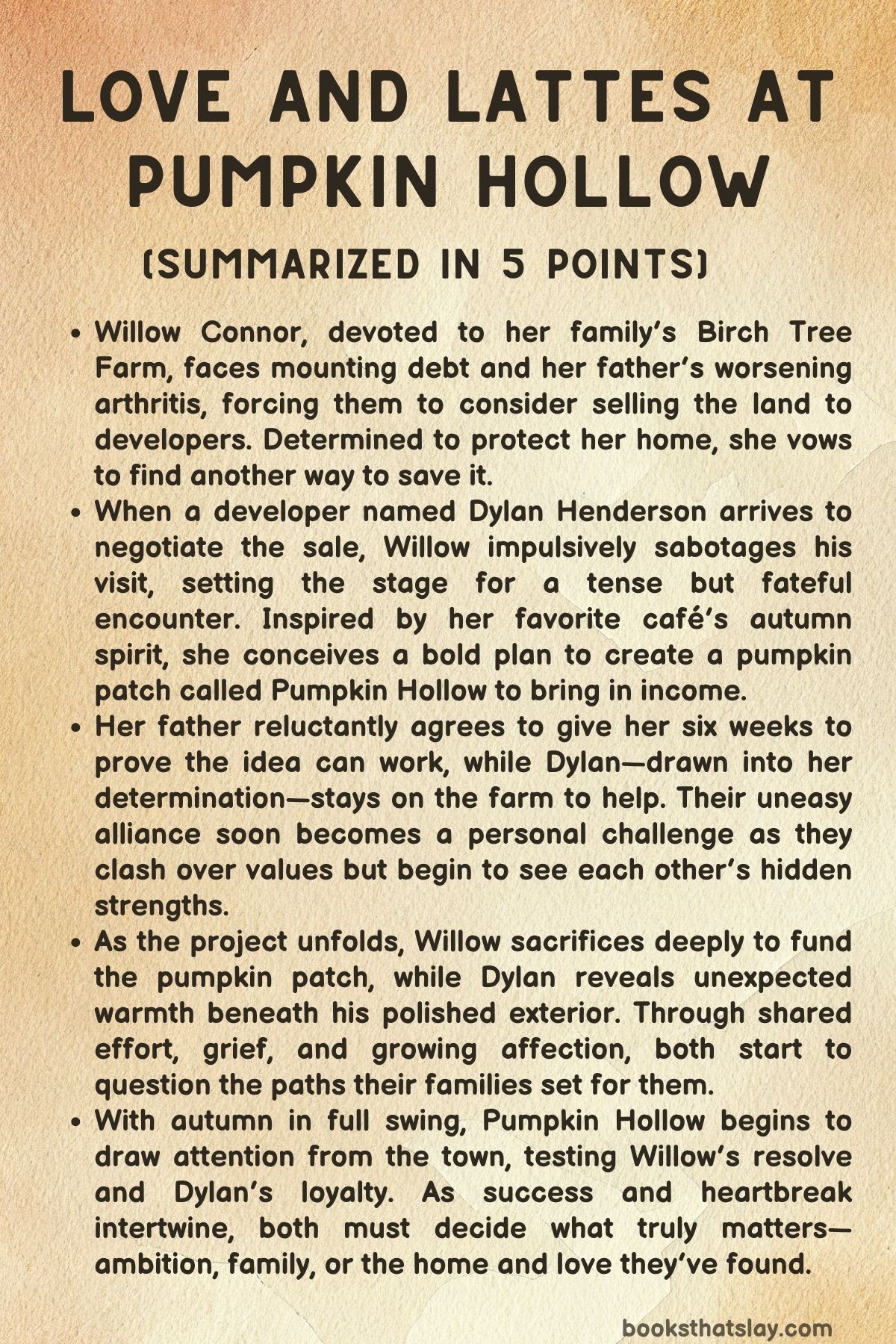
Willow Connor has spent her entire life at Birch Tree Farm, a family property surrounded by birch trees and cherished memories of her late mother. The changing autumn season, her mother’s favorite time of year, brings both comfort and concern—comfort in its beauty and concern because the farm is failing.
Her father, Adam, suffers from worsening arthritis, and mounting debts threaten their livelihood. When a letter arrives from Henderson Homes, a development company offering to buy the farm, Adam considers the proposal.
Willow, horrified at the thought of losing their land, pleads for a chance to find another solution.
While walking the fields with her loyal dog, Maple, Willow reflects on the farm’s decline and the end of its profitable summer season. She realizes that to survive, they need a new autumn income source.
Seeking inspiration, she meets her best friend Sabrina at the Birchbrook Café, a cozy local spot already decked out with pumpkins and cinnamon scents. There, she overhears a stranger asking for directions to the farm and mischievously sends him the wrong way—only to learn later that he is Dylan Henderson, one of the developers.
Over coffee with Sabrina, Willow conceives an idea to create a pumpkin patch filled with seasonal food, events, and family attractions. Excited, she rushes home to pitch the plan to her father.
Adam listens with cautious optimism but worries about expenses. Determined, Willow offers to sell her late mother’s jewelry to fund the project.
Their discussion is interrupted by Dylan’s arrival. He explains that his company intends to build homes on the property, though he offers to keep the birch trees.
Willow, unable to hide her disgust, begs for six weeks to prove her pumpkin patch can succeed. Her father agrees to the challenge, setting a deadline: if she fails by the end of October, he will sell.
Dylan reluctantly consents, agreeing to delay the deal.
As Willow gives Dylan a tour of the farm, their opposing worlds clash. Dylan’s businesslike attitude infuriates her, while he dismisses her passion as naïve.
Yet, as they talk, both reveal a desire to prove themselves—Willow to her father and Dylan to his brother Nate, who leads their company. When Willow challenges Dylan to stay at the farm and help during the six weeks, he surprises her by accepting.
They strike a deal: if she saves the farm, he walks away; if she fails, he gets the sale.
Dylan moves into a cottage on the property, and despite his skepticism, begins to assist with farm work. Over time, the two discover shared pain—both lost their mothers young—and start to respect each other.
One night at the local pub, their mutual honesty breaks through the tension, and they bond over their determination to make their families proud. Back at the farm, Willow sells her mother’s diamond necklace to fund supplies for the pumpkin patch.
When Dylan comforts her, revealing a tattoo in memory of his mother, a quiet connection forms between them.
Together, they prepare the field, plan decorations, and strategize the farm’s reopening. Dylan’s business skills complement Willow’s creativity; he helps with budgeting and setting up a website for “Pumpkin Hollow.
” Sabrina visits and teases Willow about her growing closeness with Dylan, but Willow insists the partnership is strictly professional. Still, as they spend long days working side by side, their affection deepens.
They travel together to negotiate pumpkin supplies, where Dylan’s savvy negotiation saves her money. Willow begins to see that beneath his corporate exterior, Dylan understands her dream more than she expected.
Returning home, they throw themselves into finishing the pumpkin patch. Locals remain doubtful, but the project takes shape.
Decorations, hay bales, and fairy lights transform the fields. Dylan’s encouragement keeps Willow’s confidence alive, and soon, ticket sales start coming in.
Yet, emotions grow complicated. When Dylan mentions dinner plans with someone else, Willow feels jealous but hides it.
That evening, as a storm brews, she visits Dylan’s cottage under the pretense of discussing logistics. They share hot chocolate in pumpkin-shaped mugs, and their attraction finally surfaces.
They spend the night together, though both know their situation is fragile.
The next morning, Willow overhears Dylan telling his brother that she’s “putty in his hands” and the farm will soon be theirs. Devastated, she confronts him, refusing to believe his explanations.
Moments later, disaster strikes—a violent storm has wrecked the pumpkin patch, tearing apart decorations and flooding the fields. Heartbroken, Willow blames herself and drives Dylan away, convinced he betrayed her.
Days later, Dylan’s brother Nate arrives to push the sale forward. When he insults the farm and mocks Dylan’s failure, Willow’s anger flares.
She ends the pact and refuses to sell to them. Adam, proud of her resolve, supports her decision.
Dylan stays behind, trying to prove his sincerity. He admits that the phone call she overheard was a lie meant to appease Nate.
He no longer wants to buy the farm; he wants to help her save it.
With renewed purpose, they rebuild Pumpkin Hollow together. Dylan handles marketing, and his friend Amy, an influencer, promotes the event online, bringing in a surge of visitors.
As autumn deepens, the farm comes alive again. The pumpkin patch becomes the heart of the community, drawing families, laughter, and joy.
Dylan and Willow’s relationship rekindles, marked by understanding rather than rivalry.
On Willow’s birthday, Dylan surprises her with the diamond necklace she sold—he secretly bought it back. The same day, a national newspaper features Pumpkin Hollow, and ticket sales explode.
That evening, at a celebration surrounded by friends and locals, Dylan confesses his love and his desire to stay in Birchbrook permanently. They share their dreams for the future, including renovating the farm’s cottages into holiday rentals.
Willow asks him to join her in running the new venture, and he agrees.
The pumpkin patch’s final week is its most successful. On Halloween, the town’s lantern festival ends at Pumpkin Hollow, now glowing with fairy lights and laughter.
Dylan presents a financial report showing that they have cleared their debts and secured the farm’s future. Adam, moved by his daughter’s dedication, hands her the deeds to Birch Tree Farm, making her the official owner.
As the night unfolds under a harvest moon, Willow and Dylan walk through the vibrant field hand in hand. The farm that once symbolized loss now stands for renewal.
Surrounded by the community she fought for, Willow realizes that saving the farm also saved her heart. In the warm glow of lanterns and autumn leaves, she and Dylan declare their love, ready to begin a new life together in the place that means everything to them.
Characters
Willow Connor
Willow Connor, the spirited protagonist of Love and Lattes at Pumpkin Hollow, is a young woman whose deep connection to Birch Tree Farm forms the emotional center of the novel. She is portrayed as determined, empathetic, and fiercely loyal to her roots.
Her love for autumn and her late mother’s memory drive her to preserve the beauty and legacy of her family’s land. Willow’s resilience is evident when she refuses to sell the farm despite financial hardship, instead channeling her creativity into the ambitious idea of creating Pumpkin Hollow.
Her courage to dream big, even when faced with skepticism from her father and the townspeople, reflects a strength born from both love and necessity.
Throughout the story, Willow evolves from a woman defined by her grief and fear of loss into one who learns to embrace change while holding onto her values. Her relationship with Dylan Henderson challenges her to balance emotion with practicality, highlighting her growth as she learns that strength doesn’t mean isolation.
Her ability to forgive and trust again—after feeling betrayed—marks her transition from uncertainty to empowerment. By the end, Willow stands as a symbol of hope and renewal, blending her mother’s wisdom, her father’s work ethic, and her own vision to secure a future for Birch Tree Farm.
Dylan Henderson
Dylan Henderson begins as an outsider—an urban developer whose motives seem to threaten everything Willow holds dear. Initially characterized by ambition and confidence, he represents the clash between modernity and tradition.
However, as the story unfolds, Dylan’s layers are revealed, exposing his vulnerability, compassion, and yearning for purpose beyond corporate success. His strained relationship with his domineering brother Nate and the weight of family expectations shape his guarded demeanor.
When Dylan agrees to work alongside Willow at the farm, his transformation begins. The hard physical labor, the small-town kindness, and Willow’s sincerity force him to reconsider his priorities.
His journey from detached businessman to devoted partner mirrors a redemption arc built on empathy and self-discovery. The emotional honesty between him and Willow—rooted in shared grief over their mothers—cements his evolution.
By the novel’s end, Dylan becomes not just a romantic hero but a man who finds authenticity and belonging, choosing love and integrity over profit and power.
Adam Connor
Adam Connor, Willow’s father, embodies quiet strength and the bittersweet endurance of a man caught between practicality and sentiment. His love for the farm is matched only by his exhaustion from years of toil and loss.
The death of his wife and the slow decline of Birch Tree Farm leave him emotionally weary, yet his deep affection for Willow anchors him. Adam represents the older generation’s struggle to adapt to changing times—he is torn between selling the land for security and honoring the family’s legacy.
Despite his doubts, Adam’s willingness to give Willow six weeks to prove her idea shows his enduring faith in her spirit. His cautious optimism and grounded wisdom balance Willow’s idealism.
As the story progresses, Adam’s quiet support and eventual trust in his daughter’s vision signify a reconciliation of past and future. His decision to gift Willow the deeds to the farm in the end is both an act of love and recognition of her maturity, making him the moral compass of the narrative.
Sabrina
Sabrina, Willow’s best friend, serves as both confidante and emotional anchor throughout the novel. Her pragmatic yet affectionate personality contrasts with Willow’s idealism, often grounding her when emotions threaten to overwhelm reason.
Sabrina’s early skepticism about Pumpkin Hollow reflects the concerns of a realist who fears for her friend’s stability. However, her eventual support—symbolized by the handmade Pumpkin Hollow sign—shows her loyalty and capacity for growth alongside Willow.
Beyond friendship, Sabrina’s presence emphasizes community and female solidarity. She balances humor and wisdom, offering advice with honesty rather than blind encouragement.
Her teasing interactions with Dylan highlight her protective instincts toward Willow, ensuring that love doesn’t cloud judgment. In a story about courage, dreams, and belonging, Sabrina represents the enduring strength of friendship—the kind that challenges, supports, and celebrates even in uncertainty.
Nate Henderson
Nate Henderson, Dylan’s older brother, functions as the primary antagonist and foil to his brother’s emotional evolution. He is the embodiment of corporate greed and familial dominance—driven by ambition, devoid of sentiment, and dismissive of the emotional value of the land.
Nate’s manipulation of Dylan exposes the pressures of family legacy within a business empire, highlighting the moral conflict Dylan faces.
Nate’s harsh demeanor and condescension serve to heighten Dylan’s transformation, pushing him toward independence and empathy. When he arrives at Birch Tree Farm to confront Dylan, his arrogance and disrespect for Willow and her home crystallize the reader’s understanding of what is truly at stake—not just the land, but the values of integrity, community, and love.
Nate’s presence is crucial in defining the moral boundaries of the story, reinforcing that true success lies not in ownership, but in purpose and connection.
Maple
Maple, Willow’s loyal dog, is a quiet yet meaningful presence throughout Love and Lattes at Pumpkin Hollow. More than a pet, Maple represents constancy, comfort, and the spirit of the home Willow is fighting to protect.
The dog’s companionship offers emotional grounding during moments of loneliness and conflict, reminding both Willow and the reader of the simple joys that tie humans to nature. In many ways, Maple is a living symbol of Birch Tree Farm itself—faithful, enduring, and deserving of care.
Themes
Family, Legacy, and the Meaning of Home
In Love and Lattes at Pumpkin Hollow, the idea of family and home forms the emotional foundation of the story. Willow Connor’s deep attachment to Birch Tree Farm is not simply about land or livelihood—it represents her connection to her late mother and the shared legacy of love, resilience, and belonging that defines her family’s history.
The farm is where her memories live, where her father’s hard work and her mother’s affection still echo through the birch trees and the changing seasons. Losing it would mean losing a piece of herself.
Through Willow’s struggle to protect the farm, the novel examines how people root their identities in the places and traditions built by generations before them. Adam’s declining health and financial worries contrast sharply with Willow’s youthful hope, reflecting the tension between preserving legacy and adapting to survive.
Dylan, too, comes to understand that a “home” is not something built by developers but something created through care, shared effort, and emotional investment. The story suggests that family inheritance is not about property deeds but about the values and bonds that endure when physical structures falter.
By the end, when Willow inherits the farm, the meaning of legacy transforms—it is no longer a burden to preserve the past but a foundation upon which to build a future that honors love, labor, and memory.
Resilience and Reinvention in the Face of Adversity
The novel emphasizes resilience as both an emotional and practical necessity. Willow’s determination to save Birch Tree Farm represents the broader human struggle to endure when circumstances threaten one’s sense of purpose and security.
Faced with her father’s illness, financial ruin, and corporate pressure, Willow refuses to succumb to despair. Instead, she channels creativity and courage into transforming the farm through her pumpkin patch idea.
This reinvention mirrors the adaptive spirit often required to survive change—balancing tradition with innovation. Dylan’s journey parallels hers: he begins as a man bound by expectation, molded by his brother’s authority and family business, yet through his time at the farm he learns to define success on his own terms.
The challenges they face—weather damage, betrayal, community skepticism—become catalysts for growth rather than defeat. Their resilience is not portrayed as blind optimism but as persistence fueled by purpose, vulnerability, and collaboration.
By portraying setbacks as opportunities for transformation, Love and Lattes at Pumpkin Hollow celebrates the power of perseverance and the courage it takes to rebuild one’s life while staying true to one’s values.
Love, Trust, and Emotional Healing
Love in the novel grows not from instant attraction but from shared struggle, emotional honesty, and gradual trust. Willow and Dylan’s relationship begins with mistrust and conflicting interests, symbolizing how love often arises from the tension between vulnerability and resistance.
Their evolving bond mirrors their individual healing journeys—Willow coping with grief and fear of loss, and Dylan confronting guilt, family expectations, and his own emptiness. The novel uses their romance to explore how love can be both a risk and a refuge.
When Willow feels betrayed by Dylan’s apparent manipulation, the heartbreak exposes how fragile trust can be, yet their reconciliation shows that forgiveness and understanding are integral to genuine connection. Love becomes an act of courage—a willingness to believe again despite past pain.
The return of Willow’s mother’s necklace, which Dylan repurchases as a gift, becomes a tangible symbol of renewal and emotional restoration. Ultimately, their union represents not escape but grounding—finding wholeness not in perfection but in the shared effort to heal and build something lasting together.
Community and Belonging
The setting of Birchbrook embodies the importance of community as both a challenge and a source of strength. The townspeople’s skepticism toward Willow’s pumpkin patch reflects the resistance to change that often exists in tight-knit rural communities, yet their eventual support underscores how belonging evolves through participation and shared pride.
Initially, Willow’s dream feels solitary—her vision dismissed as impractical—but through her persistence and Dylan’s contributions, the town becomes part of the farm’s revival. Local businesses collaborate, influencers visit, and the pumpkin patch transforms from a personal project into a communal celebration.
The seasonal festival, culminating under lanterns and laughter, represents the rebirth of collective spirit. In contrast, the Henderson brothers symbolize detachment from community values—viewing land as profit rather than heritage.
Dylan’s transformation from outsider to integral member of Birchbrook demonstrates that belonging is not determined by birthright but by empathy, effort, and shared experience. By the end, the community’s embrace of Pumpkin Hollow mirrors Willow’s own growth—learning that even the most personal dreams flourish when nurtured by collective care.
Identity, Purpose, and Personal Growth
Throughout the story, both Willow and Dylan grapple with questions of identity and direction. Willow defines herself through her loyalty to the farm and her mother’s memory, yet she must learn that honoring the past does not mean remaining trapped by it.
Her journey toward self-reliance and ownership—both literal and emotional—reflects a maturation from daughter to leader, from dreamer to doer. Dylan’s transformation runs parallel: a man once shaped by obligation and corporate ambition discovers meaning through physical labor, authenticity, and emotional connection.
Their growth is grounded in confronting internal fears—the fear of failure, loss, and unworthiness—and finding fulfillment not in external validation but in alignment between heart and purpose. The novel portrays identity as something continually redefined through experience, choice, and love.
By its conclusion, both characters have reshaped their lives: Willow becomes the owner of Birch Tree Farm, embodying agency and renewal, while Dylan redefines success through compassion and partnership. Together, they represent the human capacity to evolve when courage meets sincerity, proving that purpose emerges not from control but from connection and conviction.