Love in Plane Sight Summary, Characters and Themes
Love in Plane Sight by Lauren Connolly is a contemporary romance set in a small town where a near-disaster in the sky forces two people to truly see each other on the ground. Beth Lundberg is a hardworking waitress with a quiet, lifelong dream of becoming a pilot, but money, family pressure, and a crumbling house keep her life stuck in survival mode.
George Bunsen is her half-brother’s longtime friend—steady, private, and maddeningly hard to read. After an emergency landing ties their lives together, Beth gets a second chance at flight training, while George gets pulled into a connection he’s tried to avoid.
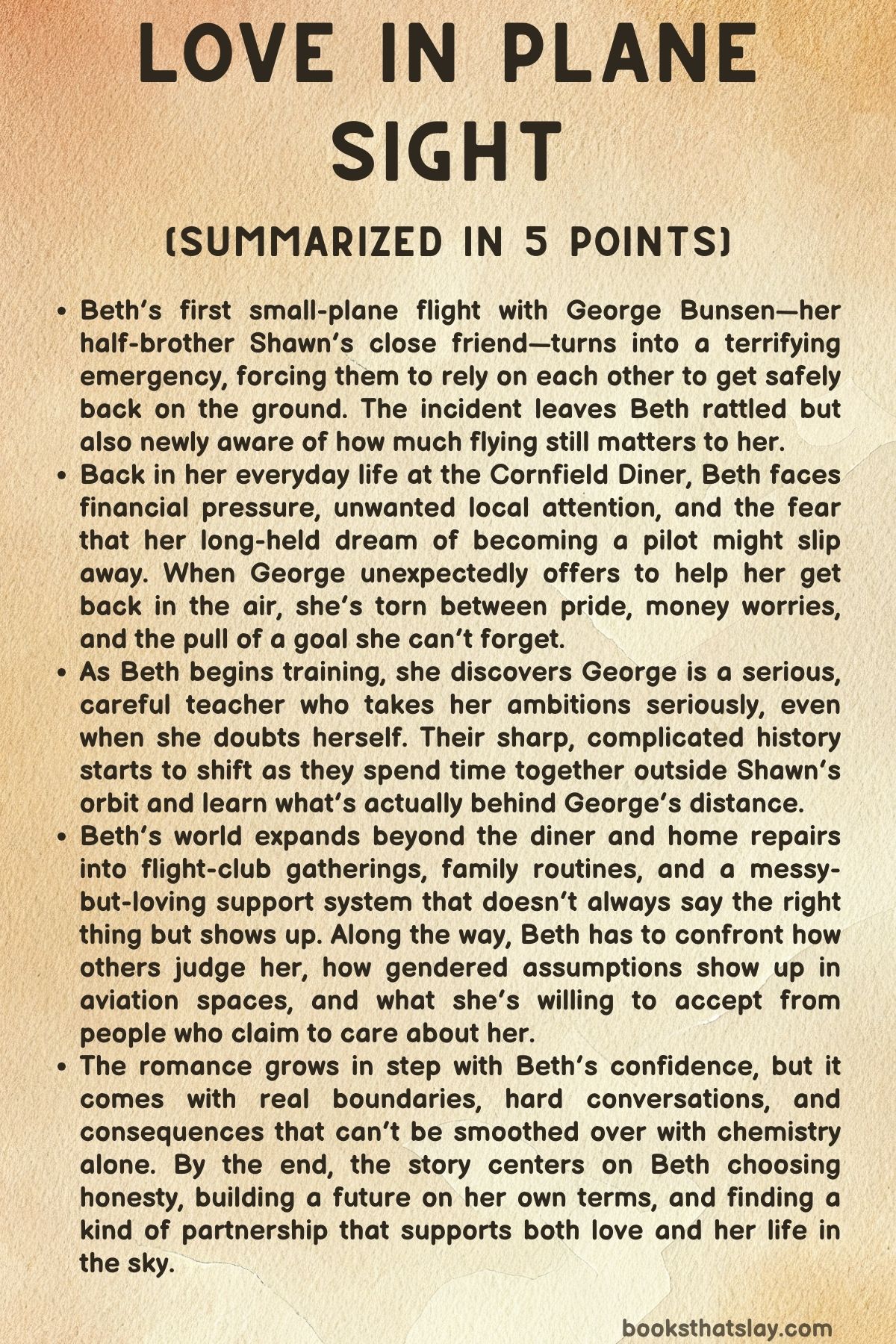
Summary
Beth Lundberg boards a small single-engine plane with George Bunsen, her half-brother Shawn’s best friend. Beth has never liked George; he has always acted as if she barely exists, avoiding her at gatherings and keeping conversations short.
The dislike feels mutual, which makes the flight uncomfortable even before anything goes wrong.
Midair, the propeller slows and stops. The engine falls silent.
Beth notices the oil pressure and RPM drop to zero and realizes the situation is serious. George focuses on the controls and the radio, speaking to air traffic control and declaring an emergency due to engine failure.
Beth fights panic while trying not to distract him. George tells her they are too far from the airport to turn back and will need to land on a highway.
Beth looks down at the moving cars and tries to convince herself that pavement is better than water and that she can handle dying next to someone who seems to wish she weren’t there.
As they descend, drivers begin pulling aside. The plane wobbles in turbulence, and Beth can’t keep quiet.
George stays locked in, guiding the powerless aircraft like a glider. Right before landing, he glances at Beth and apologizes.
The apology doesn’t comfort her; it makes her angrier, as if he’s already decided they are doomed. She snaps at him to focus and land them.
The wheels hit the highway with a shriek. The plane bounces, steadies, and rolls toward the shoulder.
George steers them to safety and stops. Beth can barely process that they survived.
George removes her headset and cups her face, repeating that they are on the ground and it’s over. He urges her to move fast because traffic could return and strike the plane.
He unbuckles her and leans across her lap to get the door open, and Beth is startled by how intensely her body reacts after the adrenaline. Embarrassed, she slaps his hands away, scrambles out, and staggers into the grass beside the road to breathe.
George keeps an eye on her while calling for help. Beth is shaken by the way her fear has mixed with unwanted attraction, and she tells herself it’s temporary.
The next day, Beth returns to waitressing at the Cornfield Diner, where locals have already turned her close call into gossip. People come in to stare, ask questions, and tip more than usual.
Beth needs the money badly. She owes Shawn a large loan, and he thinks she can repay him when she turns twenty-five and receives a trust fund from their wealthy father, Karl Newton.
Beth knows the trust fund does not exist. She lied when her mother’s illness, medical bills, and urgent house repairs pushed her into a corner.
With her birthday only a few months away, Beth is terrified Shawn will discover the truth.
Shawn shows up at the diner to check on her, and George comes with him. The sight of George makes Beth’s “adrenaline crush” flare again.
She remembers the first time they met at one of Shawn’s parties, how George seemed to dismiss her, and how he has avoided her ever since. Beth assumes it’s because she is the inconvenient part of Shawn’s family story and because George moves easily in the world of wealthy heirs and corporate connections.
The diner staff treats George like a celebrity after the highway landing. Sam and Sally fuss over him, insist he eats for free, and congratulate him like he performed a miracle.
When Beth gets a moment alone with him, she thanks him sincerely for saving her. George asks when she’ll fly again and warns her not to wait too long, because fear grows when you feed it.
Beth admits that money and the lack of a license are the real obstacles. George, hearing her age, seems to assume she has access to Newton money.
Beth refuses to lie again and says she doesn’t know when she will fly next. George offers to take her up after he is cleared by the FAA investigation, and he offers to do it free.
Beth tries to refuse, but he is firm, leaves her his number, and tells her to call when she is ready.
Beth’s life at home is a constant balancing act. She lives with her mother, Charlotte, and Charlotte’s partner, Marge, in a rundown house they can barely afford.
Charlotte is nearly a year cancer-free, and Beth is determined to keep life stable for her. She has taught herself repairs room by room using online videos, and she spends nights fixing wiring, patching walls, and handling problems that never seem to end.
The house was bought under pressure: when Charlotte’s diagnosis came, Beth panicked at the thought that her mother might die without ever owning the home she and Marge had always dreamed about. Beth called Shawn and rushed into the purchase.
Now the dream has become a financial trap Beth refuses to admit is crushing her.
Despite everything, Beth has always wanted to fly. She keeps a cockpit poster on her wall and recites instrument names the way other people recite prayers.
The emergency landing scares her, but what scares her more is the idea that her dream might slip away. She decides she needs one more flight, not to prove something to anyone else, but to prove to herself that fear will not decide her future.
She texts George and accepts his offer.
On the day of the flight, Beth brings homemade spicy dark chocolate brownies as a form of payment, partly as a joke and partly because she cannot tolerate feeling like she is taking without giving. George meets her at the airport with his usual bluntness and puts her to work immediately.
This time, he uses a different Cessna. He runs through preflight checks and includes Beth instead of brushing her off.
He teaches her how to check fuel for water contamination and supervises while she drains fuel from one wing herself. The hands-on involvement makes her feel like she belongs there.
When the engine starts, Beth freezes, unable to speak into her headset. George admits he is scared too.
He tells her that sometimes the thing you love can scare you, and asks if she can love flying more than she fears it. Beth decides she can, because losing flying would be worse than being afraid.
She tells him she is ready.
They take off. Beth grips her seat and snaps at George to keep them in the air.
As the plane climbs, her breathing returns, and exhilaration begins to replace dread. She recognizes landmarks below and feels her old fascination wake up.
George explains the instruments in detail and offers to let her fly. Beth takes the yoke and discovers how responsive the aircraft is.
The fear doesn’t disappear, but it exists alongside joy, and that feels like a victory.
After they land smoothly, Beth helps with post-flight tasks, tying down the plane and helping clean it. George reveals he works as a flight instructor on the side and offers to be her instructor.
Beth admits she can’t pay and hints that the Newton money won’t be coming. George shocks her by offering instruction and plane time for free.
Beth is torn between gratitude and humiliation, but she can’t deny how badly she wants this.
As Beth continues lessons, the community starts treating George and Beth like a story everyone owns. A teen regular asks for an interview with “the hot pilot.” The diner staff names a sandwich after George and forces a photo moment that leaves Beth flustered.
George invites her to a flight club cookout, where she meets other pilots and gets study manuals from Tim. The club president, Vernon Roswell, makes a comment that reduces Beth to decoration, and she leaves uneasy.
George’s protective tension shows, and afterward he pushes Beth to explain why she keeps insisting they don’t get along. Beth blurts out the real issue: she can’t stand accepting what she can’t afford.
George insists he wants her to succeed and tells her she can pay him in brownies if she must.
Beth’s friend Darla refuses to let Beth hide behind pride. During a chaotic book club night with Shawn, Beth argues loudly about a novel ending, drinks through their traditional “War” card game, and falls asleep in Shawn’s apartment.
The next morning, the playful mood cracks when Beth runs into Karl Newton in the parking garage. Karl makes cutting remarks about Beth’s life and implies she expects others to fund her.
George, faced with Karl, goes cold and distant, insisting he and Beth aren’t friends. Beth is hurt by how quickly he steps away from her, and she spirals into shame about her debt and her lies.
George later comes to the diner alone and tries to repair things. Beth lashes out, calling herself his charity case.
Marge arrives and treats George warmly, asking about his life and drawing him into real conversation. Beth is reluctantly pulled back into the social orbit when George invites her to a plane-washing event.
At the event, Beth relaxes, jokes, and even throws a soapy sponge at George when he sneaks up on her. When they talk privately, Beth accuses him of making it clear they weren’t friends in front of Karl.
George explains he pulled away because Karl dislikes him too, and he didn’t want Beth stuck in the middle. He shares pieces of his past: being cut off by his father at eighteen, living in a van, and building his life through work at an airport.
Beth begins to understand that George’s distance isn’t only about her; it’s a habit formed from survival.
The emotional tension finally breaks during a lesson day when Beth sees George has been flying with Tasha Baylor, an heiress in Shawn’s circle. Beth’s jealousy flashes, then fades when she learns Tasha is engaged to a woman.
Still, George grows tense and quiet afterward. Beth pushes him, and he admits he has been trying to be her friend while fighting the urge to kiss her.
Beth responds by kissing him first, fierce and undeniable. The kiss changes the rules between them, even though Beth insists they should slow down.
George tells her he will follow her lead, and she texts him afterward that she doesn’t want him to forget it. He replies that he can’t.
Beth’s financial pressure escalates. She takes a second job at a steakhouse called Beefies to pay Shawn back faster.
The uniform is designed to sell an image, and she quickly realizes customers feel entitled to comment on her body. One night, she is assigned a table that includes Vernon from the flight club.
He ogles her, then recognizes her and shifts into smug insinuations about George paying for her and about her “using” him. After the meal, Vernon corners Beth in the parking lot and warns her that people will assume she is sleeping with her instructor for lessons, and that she will never earn respect that way.
Beth drives home devastated, pulls over at the dead end of her road, and cries under the stars.
The next morning, Darla finds out and explodes—not because Beth needs more money, but because Beth chose a job that makes her feel small and unsafe. Their argument spills into the diner staff and Beth’s family.
Beth is overwhelmed by the sense that every lie and secret is collapsing at once. Darla forces her into a fierce hug and tells her the truth is going to cost her something eventually, but lies cost more.
Beth goes to George’s apartment and tries to regain control by ending their instructor relationship. She tells him that sleeping together while he isn’t charging her will feed rumors and destroy her reputation in aviation.
George insists he doesn’t care what people think and argues that partners support each other. In frustration, he calls himself her boyfriend and blurts out, “Then marry me.” Beth hears it as a weapon in an argument, not a promise, and storms out, shaken and angry.
At home, the money problems keep coming, including a failing water heater that will cost more than Beth can manage. She breaks down in the unused bedroom and swings a sledgehammer into the wall, using force to release everything she’s been holding in her body for years: fear, exhaustion, and the constant humiliation of not having enough.
Shawn arrives, worried after she ignores calls. He admits George has liked Beth for years, since a moment when George helped her during a painful episode involving a FOR SALE sign.
The confession pushes Beth past the point of pretending. She finally tells Shawn the truth: there is no trust fund.
She borrowed money under false hope and can’t repay him the way she promised. Shawn is stunned and hurt, then furious at Karl for letting Beth believe she was disposable.
He tells her he doesn’t care about the money, forgives her, and insists their father is the one who should be ashamed. They drink beer on the porch, and Shawn encourages Beth to use what she can to invest in her future rather than punish herself.
Beth talks with Charlotte, who reveals the hardest truth from the past: Karl demanded she end the pregnancy, and she once scheduled an abortion, but changed her mind after meeting young Shawn and realizing a child could belong to herself, not to Karl’s control. Beth understands more clearly how much of her life has been shaped by Karl’s cruelty, even from a distance.
Charlotte isn’t angry about the loan; she’s angry Beth carried the burden alone.
Beth switches instructors to Aden to keep her training clean and to protect George’s professional standing. She completes her first solo flight, landing with a rough bounce but succeeding on her own.
George shows up afterward, and the strain between them surfaces again when Vernon appears with sexist jokes about Beth choosing a “young, handsome” instructor. This time, George confronts Vernon publicly, calls out his behavior toward women, and bans him from using the planes George leases to the club.
Vernon reveals he has been the source of the rumors all along, and he admits he knew Beth wasn’t paying George, confirming the cruelty was deliberate.
George and Beth drive together to the dead end road where Beth cried after the confrontation at Beefies. George apologizes, admitting he was blind to Vernon’s ugliness because of history and habit.
Beth admits she didn’t tell George about Vernon’s harassment because she didn’t want to damage George’s place in the club or his mentor relationships. They finally speak plainly: George tells Beth he loves her, and she says she loves him too.
Beth admits her solo felt lonely without him there, and George admits that loving her makes him worry, but he wouldn’t trade it.
On Beth’s birthday, she completes her solo cross-country flight, traveling the required distance and landing at multiple airports alone. George waits at the home airport with Shawn and Darla, tracking her progress and fighting anxiety until she returns and lands safely.
They celebrate her achievement, and Beth feels her life opening in a way it never has before.
A year later, the outcomes have rippled outward. Charlotte opens a plant shop, Charlotte’s Shrubbery, and the family’s financial and emotional footing is stronger.
Shawn and George leave their old corporate orbit and start a nonprofit called Fly Free Sky Aviation, offering ground school and flight time to people who can’t afford it, along with public-benefit flights for needs like animal rescue and medical transport. Beth moves in with George near the airport, continues helping her moms with repairs, keeps working at the diner while finishing her commercial license, and plans to become a flight instructor with the nonprofit.
The story closes with Beth and George at the airport, flirting and watching another plane take off, her future no longer defined by debt and fear, but by the sky she chose to claim.
Characters
Beth Lundberg
Beth is the emotional engine of Love in Plane Sight—a woman whose life is defined by love expressed as responsibility, even when that responsibility is crushing her. She’s fiercely competent in a practical, unglamorous way: she learns electrical work online, keeps a collapsing house standing, works punishing shifts, and mentally itemizes every dollar because she’s carrying the weight of survival for her little family.
Under that competence sits a raw mix of fear and longing that the book keeps placing side by side: she is terrified of the sky after the engine failure, but even more terrified of losing the dream of flying that has quietly shaped her identity for years. Beth’s biggest flaw—lying about the trust fund—doesn’t come from greed or manipulation so much as panic and scarcity; it’s the kind of lie that begins as a life raft and becomes a chain, and the story uses it to show how shame isolates her even from people who love her.
Her romantic arc with George also mirrors her larger arc: she starts by assuming rejection and bracing for abandonment, then slowly learns to accept care without interpreting it as pity or payment, which is ultimately the same lesson she needs in order to reclaim flying, friendship, and a future that isn’t built entirely out of emergency fixes.
George Bunsen
George is introduced as emotionally unavailable and frustratingly silent, which makes him easy to misread as cold—until the crisis hits and his competence becomes unmistakable. George’s defining trait is control, but not the domineering kind; it’s the disciplined, practical control of someone who has survived by managing risk, managing emotions, and staying useful when everything goes wrong.
The emergency landing establishes his core: he doesn’t perform heroism for applause, he does it because it has to be done, and he absorbs fear by converting it into procedure. That same coping style becomes his interpersonal obstacle—he pulls away, chooses distance, and tries to “solve” problems (including Beth’s life) with logistical fixes, because vulnerability is harder than action.
His backstory explains why: he grew up with rejection, a father who treats his profession as embarrassment, and a history that taught him attachment can be revoked without warning. The anniversary of his mother’s death deepens him further, because it reveals the shadow behind his protectiveness—he has lived with the knowledge that losing control can take away the thing you love, and even take away a person.
Loving Beth therefore isn’t just romantic for him; it’s frightening, because it threatens to undo the carefully built emotional systems that kept him functioning. When he finally confronts Vernon and admits love openly, the book signals real growth: George stops managing appearances and starts prioritizing what is right, even when it costs him social comfort, and that shift is what makes him capable of being a partner rather than just a rescuer.
Shawn Newton
Shawn is the story’s catalyst character—he’s the bridge between Beth’s struggling life and the world of money, aviation culture, and George’s orbit, but he’s also a complicated mirror of Beth’s deepest wounds. Shawn initially seems like the “golden” half-sibling with resources, confidence, and a powerful surname, yet his most consistent role is not superiority but devotion: he shows up, checks on her, lends money, and folds her into his life as if that’s the most natural thing in the world.
His personality is intentionally chaotic—his book club dramatics, his enthusiasm, his impulsive declarations—because the book uses him as bright noise against Beth’s quiet, grinding stress. But beneath the humor, Shawn carries his own pain about their father, and the trust-fund lie becomes a turning point that exposes how much he has been compensating for Karl’s failures without fully naming them.
The forgiveness scene matters because it reveals Shawn’s emotional maturity: he is shocked and hurt, but he chooses relationship over pride and turns his anger where it belongs—toward Karl, not Beth. By the end, when he leaves BBN to build Fly Free Sky Aviation with George, Shawn’s arc becomes a values arc: he moves from inheriting a system to reshaping it, and in doing so becomes the sibling Beth needed all along—not a savior with money, but family with loyalty and purpose.
Charlotte Lundberg
Charlotte represents the quieter kind of courage in Love in Plane Sight—not the adrenaline courage of landing a plane, but the courage of staying soft after life tries to harden you. Her cancer history and recovery sit behind nearly every choice Beth makes, because Beth’s fear of losing her mother is what drove the desperate push to buy the house and what fueled the secrecy that followed.
Charlotte is also a portrait of reclaimed agency: her past corporate ambitions were derailed by trauma with a powerful male boss, and the story uses that to show how institutions can steal a person’s sense of future. Yet Charlotte doesn’t remain defined by what was taken from her; she builds new joy through plants, home life, and eventually a plant shop, which becomes a symbol of living forward rather than just surviving.
Importantly, Charlotte is not written as fragile—she has limitations, but she also has humor, warmth, and a clear-eyed understanding of what matters. When Beth finally tells her truths—about the money, about Karl, about the burdens she carried—Charlotte’s reaction isn’t rage, it’s grief that Beth carried it alone.
That response crystallizes Charlotte’s role: she is the emotional home Beth has been trying to protect, and the book’s healing movement depends on Beth realizing that home can protect her too.
Marge
Marge functions as stabilizing love and everyday tenderness—an adult who doesn’t romanticize struggle, but also doesn’t treat it like shame. She is the house’s practical heart: cooking, joking, handling the trapped squirrel, building bizarre school projects, and filling the space with the kind of normalcy that makes hardship bearable.
Her work as a teacher also matters thematically, because Marge embodies belief in people becoming more than their circumstances, which pairs neatly with Beth’s aviation dream and later with the nonprofit mission. Marge’s interactions with George are especially revealing, because she engages him without suspicion and helps drain some of the tension Beth keeps feeding with her insecurities.
When Beth blurts that George isn’t her friend and frames herself as a charity case, Marge doesn’t escalate the drama—she redirects, softens, and keeps the human connection intact, which shows her emotional intelligence. Marge is also a quiet counterweight to Karl: where Karl uses power to diminish, Marge uses steadiness to enlarge others.
By the end, her presence reinforces one of the book’s central claims: chosen family is not second-best; it is often the most intentional and sustaining kind of love.
Darla
Darla is written as a blunt instrument with a soft center, and the storyline uses her to force truths into the open when Beth is drowning in politeness and avoidance. She doesn’t coddle, doesn’t speak in careful therapy language, and doesn’t let Beth hide behind “I’m fine,” because Darla understands that Beth’s pride is actually fear—fear of being a burden, fear of being judged, fear of losing the people she depends on.
That’s why Darla’s anger about Beefies is so intense: she isn’t just judging the job; she’s reacting to Beth choosing degradation and secrecy as the price of independence. Darla’s love shows up as confrontation and containment at the same time, most vividly when she knocks Beth’s keys away and then holds her in a tight hug—she won’t let Beth run from the consequences, but she also won’t let her face them alone.
Her dynamic with Shawn adds texture, because their banter is both comedic and revealing: Darla’s refusal to be impressed punctures Shawn’s polished world, and Shawn’s attraction suggests he craves exactly what Darla embodies—honesty without hierarchy. By the epilogue, Darla’s place in the plant shop and her closeness to the whole group underline her narrative purpose: she’s the friend who makes community real, not sentimental.
Sally
Sally is the diner’s maternal force—meddling, loud, affectionate, and deeply community-minded. She turns a traumatic event into communal pride by calling George a hero, feeding him, hugging him, and essentially declaring him “ours” in the way small towns do when something big happens.
Her matchmaking energy and playful interference with Billy’s “love note” gag show her as someone who treats romance and connection like practical needs, not private luxuries. Sally also serves a structural role: she creates a safe, familiar space that contrasts with the status-driven environment around Shawn and Karl, and she gives Beth a place where she is seen as a person rather than a problem.
When Sally is hurt that Beth didn’t tell her about the second job, it reveals how deep the diner relationships run—Sally isn’t just an employer, she’s part of Beth’s support system. Even when she’s overbearing, it comes from the belief that people should be looked after, fed, teased, and kept close, which is one of the book’s clearest expressions of warmth.
Sam
Sam operates as the diner’s grounding presence—less flashy than Sally, but just as protective in a quieter, steadier way. He’s the one who confronts George directly about the emergency landing, not to accuse him, but to understand what happened and to place responsibility accurately.
That matters because it reinforces a theme the book returns to: blame often lands on the wrong person when people don’t ask good questions, and Sam is someone who does ask them. His quick shift into declaring George a hero also shows his values—he respects competence, accountability, and effort rather than wealth or image.
Like Sally, Sam is hurt by Beth’s secrecy, and his reaction helps emphasize that Beth’s problem isn’t a lack of love around her; it’s her inability to believe she’s allowed to rely on it. Sam may not dominate scenes, but his consistent decency helps define the “home base” energy that makes Beth’s eventual honesty possible.
Billy
Billy’s role is subtle but important: he represents a kind of acceptance that isn’t dramatic, just matter-of-fact and present. His joking dynamic with Beth at work establishes the diner as a place where Beth can be playful, not only stressed.
Billy coming out as asexual in the epilogue is handled as a normal, integrated part of who he is, which reinforces the book’s broader emotional stance—people are allowed to be themselves without being turned into a spectacle. His plan to adopt an older dog also ties into the story’s tenderness toward overlooked beings, echoing the nonprofit’s mission and the book’s general preference for care over status.
Billy isn’t a plot-driver, but he adds texture: the world feels kinder and more lived-in because characters like him exist with their own trajectories.
Riann
Riann functions as youthful enthusiasm and the outside gaze that turns private moments into public story. Her desire to interview “the hot pilot” in Love in Plane Sight isn’t just a cute subplot—it shows how quickly Beth and George become a narrative in the community, whether they want to be or not.
Riann is also a reminder of Beth’s influence even when she feels small; Beth is someone younger people notice and approach, and that reinforces that Beth has a presence beyond her debt and stress. Riann’s school-paper angle ties the romance to social context: attraction isn’t only between Beth and George, it’s also shaped by how others talk about them, label them, and project onto them.
Tim
Tim represents the healthier side of aviation community—generous, encouraging, and aware of the ways women can be treated unfairly in male-dominated spaces. His offering of old study manuals is a small act that carries real weight because Beth’s biggest barrier is access: knowledge, time, money, and permission to belong.
Tim’s presence also indirectly highlights George’s protectiveness; George tenses when Tim helps Beth, revealing how George’s fear of losing Beth can slip into territorial behavior even when he’s trying to be supportive. Tim isn’t framed as a romantic threat so much as a social mirror: he shows what normal mentorship can look like, which helps clarify why George teaching Beth for free is both beautiful and complicated.
Through Tim, the book suggests that not all gatekeepers are hostile—some people genuinely want the sky to be bigger.
Aden
Aden serves as a corrective and a milestone: the instructor Beth switches to when the ethics and rumors around George become too heavy. Aden’s significance is less about his personality and more about what he enables—Beth’s solo flight becomes a proof of self that doesn’t depend on romance or charity, and Aden is the professional container that makes that proof feel clean.
His presence also intensifies the emotional stakes for George, because it exposes how deeply George equates “not being the one beside her” with “losing her,” even when Beth is simply doing what she needs to do. Aden’s neutral professionalism helps the story show that Beth’s progress is real and replicable—it isn’t a magical result of being loved by the right man, it’s the outcome of her dedication and training.
Vernon Roswell
Vernon is the story’s clearest antagonist, not because he’s powerful in an epic sense, but because he embodies a familiar, corrosive kind of social power: misogyny wrapped in entitlement and “just joking” charm. He objectifies Beth openly, reduces her to scenery, and then escalates into insinuations that she is trading sex for access—attacks designed to shame her out of belonging.
Vernon’s behavior reveals how reputations are policed in communities like the flight club, especially for women, and how quickly generosity can be recast as exploitation when a woman is the recipient. His confrontations with Beth also expose Beth’s vulnerability: she’s already afraid of being seen as someone who expects others to pay her way, so Vernon’s accusations hook directly into her deepest shame.
Importantly, Vernon also exposes George’s blind spot; George’s history with him as an “old friend” shows how easy it is for decent people to normalize someone’s ugliness until it harms someone they love. When George finally cuts Vernon off from the planes and names the behavior as unacceptable, the moment isn’t just romantic protection—it’s moral boundary-setting, and it marks the story’s rejection of the idea that women should endure humiliation as the cost of entry.
Tasha Baylor
Tasha functions as a pressure-release valve and a social bridge in the novel. When Beth first sees her with George, Beth’s insecurity spikes, and the book uses that moment to show how easily Beth assumes she is replaceable.
Tasha’s warmth—and the fact that she is engaged to a woman—diffuses jealousy and reframes Beth’s interpretation of the scene, letting Beth feel safe enough to stay in the moment. Tasha also represents the wealthy world adjacent to Shawn’s life, but she isn’t written as cruel or dismissive; she’s friendly, grounded, and inclusive, which complicates Beth’s assumption that money automatically equals judgment.
Her wedding reception invitation becomes a narrative mechanism to bring the ensemble together and push relationships into new contexts, but her deeper role is thematic: she shows what it looks like to have access and still choose kindness, and she subtly contrasts with Karl, who has access and chooses control.
Grumps
Grumps, Beth’s grumpy dog, is a small but meaningful emotional anchor. He’s part of Beth’s routine and responsibility, and his presence underscores how Beth’s life is packed with caretaking that never pauses for romance or dreams.
Walking him on her day off frames Beth’s “rest” as still labor, still obligation, which keeps the story honest about her reality. Grumps also gives Beth a simple, nonjudgmental attachment—an affection she doesn’t have to earn through productivity—which quietly echoes what Beth struggles to accept from people.
Karl Newton
Karl is the central source of long-term damage, less through active villainy in every scene and more through a persistent pattern of emotional abandonment and moral cowardice. He’s wealthy and influential, but his power expresses itself as dismissal: he treats Beth like an inconvenience, positions her as someone who expects handouts, and uses social insinuation to reassert hierarchy.
His cruelty is often indirect—comments that land like blades because they echo Beth’s private fears—and that indirectness is part of what makes him effective as an antagonist. Karl also warps relationships around him: Shawn has spent years compensating for Karl’s failures, Beth has built her identity around proving she deserves space, and even George reacts to Karl’s presence by retreating into old avoidance habits.
The revelation that Karl demanded an abortion and then provided nothing afterward clarifies the story’s underlying indictment: Karl doesn’t merely fail as a father; he leverages power to avoid responsibility while still expecting control over the narrative. In contrast to the book’s many forms of chosen family, Karl represents legacy without love—inheritance without care—and the characters’ eventual honesty and independence function as a rejection of his definition of worth.
Mrs. McGuire
Mrs. McGuire is a minor character, but she helps establish the community lens that shapes Beth’s experience in the novel. Her excited gossip about the “crash” shows how quickly a terrifying event becomes a story people consume, and Beth correcting her—“the pilot landed the plane”—reveals Beth’s instinct to honor skill and truth even while she’s emotionally unraveling.
Mrs. McGuire also reinforces how public Beth becomes after the incident, which matters because Beth’s later fear about reputation and rumors isn’t abstract; she’s already been turned into local entertainment once.
Themes
Fear, Control, and What Courage Looks Like
A powerless engine and a forced landing put Beth in a situation where she has almost no agency, and that lack of control becomes a pressure point that keeps resurfacing long after the wheels touch the highway. She hates how her body reacts in the aftermath—adrenaline, attraction, embarrassment—because it makes her feel even less in charge of herself.
That experience doesn’t just scare her; it threatens something she has treated as part of her identity for years: flying. What makes the fear complicated is that it isn’t only about dying in a crash.
It’s about losing a dream that has been rehearsed in private for so long that it functions like a promise to herself, a promise she’s afraid she won’t keep if she lets fear decide. The story keeps returning to the difference between fear that warns you and fear that cages you.
Beth’s determination to get back in the air isn’t a dramatic “no fear” moment; it’s a decision to move while afraid, and to accept that bravery can be sweaty-palmed, sharp-tongued, and imperfect. George contributes to this theme not by playing the unshakable hero, but by admitting he is scared too, which gives Beth permission to stop treating fear as failure.
The training scenes reinforce that courage isn’t just emotion; it’s a series of procedures, checklists, repetitions, and choices. Each small task—checking fuel, naming instruments, holding the yoke—turns panic into something measurable.
By the time Beth solos, she isn’t fearless; she has learned how to function with fear present, and that shift becomes a model for how she handles the rest of her life: money, family, pride, and love.
Class, Money, and the Quiet Violence of Being Assumed
Money in Love in Plane Sight isn’t merely a background stressor; it shapes how people look at Beth, how they speak to her, and what they think they are entitled to infer about her character. Beth’s world is one of constant calculation—mortgage, repairs, medical bills, tips—and her exhaustion is not only physical but moral, because she is always deciding what to hide in order to keep her family stable.
The lie about the trust fund isn’t framed as a clever scheme; it’s a survival maneuver that grows teeth over time. It also exposes how quickly people sort women into categories: deserving, dependent, manipulative, “charity case,” “pretty view.” Vernon’s comments are a concentrated form of that sorting.
He watches her body at a second job designed to monetize women’s appearance, then pretends to be concerned while warning her that people won’t respect her if she doesn’t pay her own way. The cruelty is that Beth already knows this, and she’s trying to pay her way with labor that costs her dignity.
Meanwhile, Karl’s insult—that she expects others to pay—lands because it echoes a cultural script that punishes poor women for accepting help and punishes them again for needing it. George’s free instruction becomes emotionally complicated because it feels like generosity and like exposure at the same time.
Beth wants the opportunity, but she also wants the protection of being seen as legitimate. The story is blunt about how financial scarcity can trap someone into choices that look irrational from the outside: taking a degrading job, lying longer than intended, refusing help even when it would be wise to accept it.
What resolves the theme is not Beth magically becoming wealthy; it’s her refusing to let money determine her worth, and her community building structures—like the nonprofit—that challenge the idea that only the rich deserve access to the sky.
Women’s Autonomy, Sexualization, and Respect in Male Spaces
Beth’s path into aviation places her in a space where attention can be flattering, threatening, or transactional, sometimes within the same conversation. The flight club cookout makes that tension visible: a casual comment reduces her to scenery, and the story does not treat it as harmless because it changes the temperature of the room for her.
Later, the steakhouse job makes the dynamic explicit—uniform, body-first service, men treating her as part of the entertainment—and Beth’s strategy becomes endurance. She performs politeness as armor, then collapses in private because the cost of that armor is silence.
Aviation adds another layer, because it is a skill-based domain that still carries gendered gatekeeping. The rumors about her sleeping with her instructor for lessons aren’t really about truth; they are about policing access.
If Beth can be reframed as someone who “got in” through sex or charity, then her achievement becomes dismissible. That threat explains why she tries to cut off lessons with George: not because she doesn’t want him, but because she understands how quickly respect can be stripped away when people are eager to believe the worst.
The story also examines bodily autonomy through Beth’s reactions—her unwanted arousal after trauma, her anger at herself, her insistence on boundaries, her choice to kiss George on her terms. Attraction here is not presented as a cute complication; it is tied to power, reputation, and the right to be taken seriously.
When George finally confronts Vernon and removes his access to planes, it isn’t a grand rescue scene; it’s an overdue boundary that signals a shift in what the community will tolerate. Beth’s eventual success—solo flight, commercial track, future instructor role—doesn’t erase the sexism.
Instead, it demonstrates that she can carry both realities: she can love a world that doesn’t always welcome her, and still demand the right to belong in it.
Chosen Family, Care Work, and the Weight of Being the “Capable One”
Beth’s home life is built on devotion and labor, and the story treats that labor as both love and burden. The house is a physical symbol of care work: repairs, squirrels, faulty wiring, failing appliances, the constant effort to keep something from collapsing.
Beth’s competence is not a hobby; it’s what stands between her family and disaster. That role shapes her personality—she becomes the person who fixes, manages, absorbs panic, and protects others from the full truth.
Her mothers, Charlotte and Marge, are not portrayed as helpless, but Beth’s fear of losing Charlotte after cancer creates a pattern where Beth equates love with control: if she can keep the house standing, pay the bills, and hide the worst stress, then maybe she can keep her mother safe too. This theme is why the trust-fund lie grows so heavy.
Beth isn’t lying to get ahead; she’s lying to hold everyone together, and she is terrified that honesty will be the moment the structure fails. The community around Cornfield’s functions as an extension of family, offering support that Beth resists because it challenges her self-image as the one who gives rather than receives.
Darla’s anger and hug capture that contradiction perfectly: Beth’s friends are not simply offering comfort, they are demanding that she stop self-erasing. Shawn’s forgiveness matters because it reframes what family can be.
Instead of being a ledger of who owes what, family becomes the place where the truth can be survived. When Beth finally tells Charlotte and Shawn what she has been carrying, it doesn’t solve every problem, but it redistributes the load.
The theme closes not with Beth becoming independent in the sense of “needing no one,” but with Beth allowing herself to be supported while still being strong, which is a deeper form of maturity than solitary endurance.
Truth, Pride, and the Damage Caused by “Good” Lies
Beth’s deception about the trust fund sits at the center of many smaller conflicts because it forces her to shape every interaction around what cannot be said. Pride plays a double role: it protects her from being treated like a burden, but it also isolates her and makes her vulnerable to manipulation by people who sense her insecurity.
The story is careful about why Beth lies. She is not casually dishonest; she is cornered by medical bills, an unstable house, and a father who offers nothing except judgment.
The lie starts as a stopgap, then becomes a trap because time turns it into a test of character in the eyes of others, including her own. That’s why Karl’s accusation hurts so much: it sounds like the worst version of what Beth fears might be true about her.
The longer she hides the truth, the more she believes she deserves the contempt she anticipates. This is also why Beth resists George’s help.
She can accept kindness only if she can repay it in a way that preserves her dignity. When George calls her his girlfriend and talks about couples supporting each other, the emotional argument clashes with Beth’s survival logic: support has always come with strings in her world, so she treats generosity as danger.
The wall-smashing scene is the emotional climax of this theme because it shows how repression turns into physical force. Beth cannot fix the cost of a water heater with skill alone, and the frustration has nowhere to go.
The resolution arrives through confession, not because confession is noble, but because secrecy is destroying her relationships. Shawn’s reaction is crucial: he is hurt, but he prioritizes Beth over the money, and his anger redirects toward Karl, the person whose neglect created the conditions for the lie.
In that moment, the story argues that truth is not simply moral purity; it is a practical tool for staying connected, and pride that blocks honesty becomes self-harm disguised as strength.
Love as Safety, Not Escape
The romance between Beth and George grows from a situation where survival is shared, but it doesn’t stay trapped in the intensity of that moment. Beth initially tries to dismiss her attraction as chemistry created by adrenaline, and that reaction makes sense because she’s wary of confusing crisis with intimacy.
What changes is that George’s presence becomes consistent rather than dramatic. He shows up, offers time, teaches patiently, and remains steady when Beth is reactive or defensive.
The relationship is not framed as George “saving” Beth; in fact, Beth repeatedly refuses that narrative because she knows how it would be used against her. Instead, love becomes a space where Beth can practice being cared for without losing autonomy.
George’s struggle—his habit of withdrawing, his instinct to protect himself, his complicated relationship with his father—keeps the romance from becoming a fantasy of perfect rescue. His mother’s suicide after losing her ability to drive and fly adds emotional depth to his fear, because it reveals why he understands what it means to have a beloved freedom taken away.
That shared understanding creates tenderness that isn’t performative. Even when they cross the line into physical intimacy, the story keeps returning to consent, boundaries, and choice: Beth sets the pace, George agrees to follow her lead, and both of them have to learn that closeness does not require self-erasure.
The conflict with rumors and reputation also tests whether their connection can survive public judgment. When George tells Beth he loves her and admits he worries, it isn’t possessiveness; it’s recognition of how much she matters and how fragile safety can feel when someone you love takes real risks.
The epilogue reinforces that love doesn’t replace Beth’s ambition; it supports it. Beth’s future is still centered on flying, training, and work.
Love becomes the environment where her dream can grow rather than a distraction from it, and that is why it feels earned: it doesn’t shrink her world, it expands what she believes she deserves.