Love Is an Algorithm Summary, Characters and Themes
Love Is an Algorithm by Laura Brooke Robson is a contemporary romance about love, ambition, technology, and the uneasy question of whether human connection can ever be measured. The novel follows Eve Olsen, a singer-songwriter rebuilding her life after a dull relationship, and Danny Aagaard, a dating-app cofounder who is losing faith in the system he helped create.
As Eve’s music career rises and Danny’s app becomes more powerful, their relationship tests the limits of data, timing, fear, and trust. At its center, Love Is an Algorithm is about choosing real love over certainty.
Summary
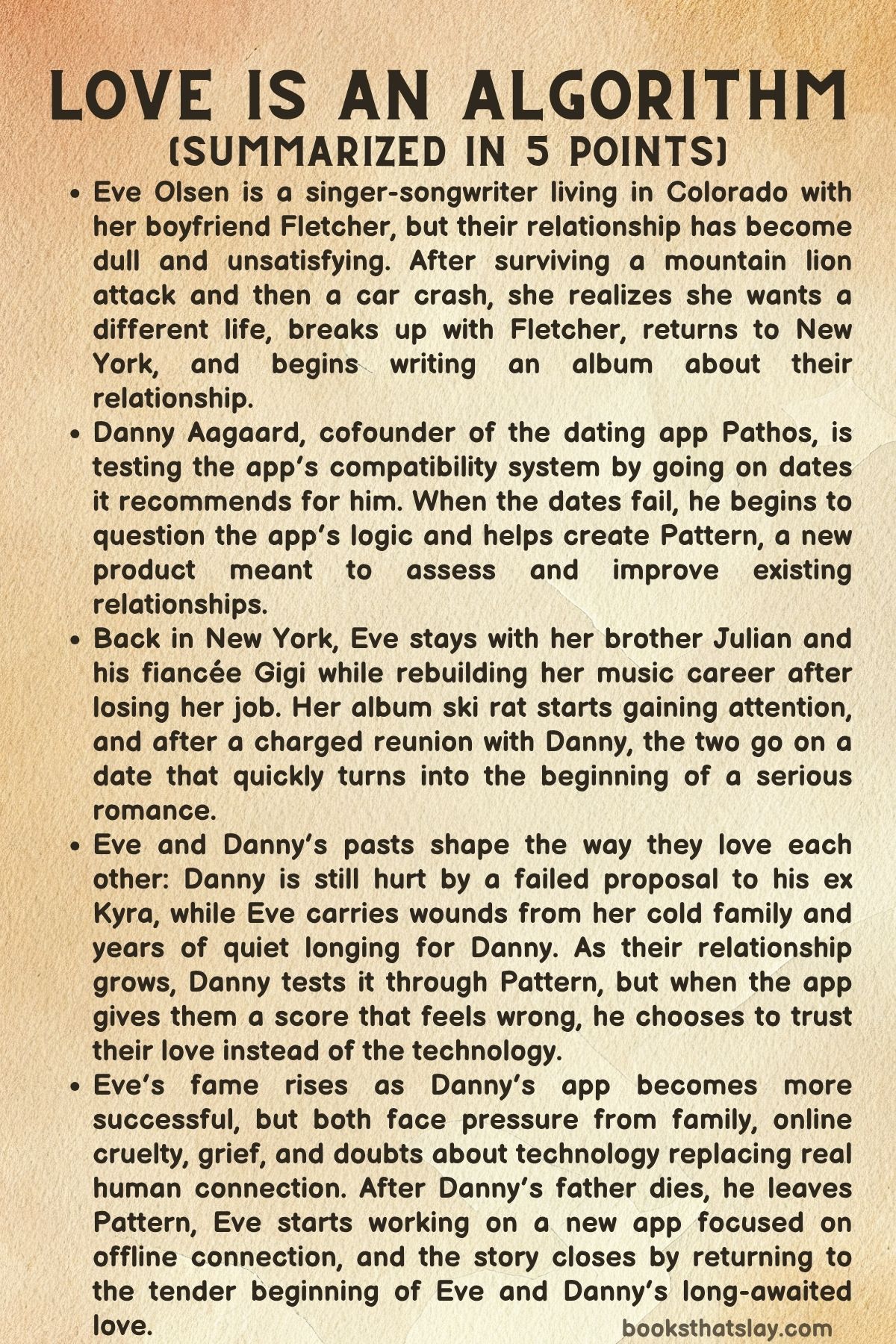
Eve Olsen is living in Colorado with her longtime boyfriend, Fletcher, but the life they have built together no longer feels alive to her. Their relationship has settled into routine, and Eve has begun to sense that staying with him means accepting a smaller version of herself.
Fletcher is an ultramarathon runner, and while she is supporting him at one of his races, Eve walks near a stream and is attacked by a mountain lion protecting its cubs. She survives by striking the animal with her phone, but the experience leaves her shaken and newly aware of how fragile and strange her life has become.
Fletcher leaves the race to check on her, and on the drive home they are caught in a serious crash. The accident becomes a turning point for Eve.
The mountain lion attack, the crash, and the emotional distance between her and Fletcher all force her to face what she has been avoiding. She realizes she does not want to continue the relationship, and she does not want to stay in Colorado.
She breaks up with Fletcher and decides to return to New York, where she can be closer to her brother Julian and try to restart her music career. The end of the relationship also gives her new material, and she begins turning the pain and boredom of that chapter into songs.
While Eve is leaving one life behind, Danny Aagaard is struggling with the direction of his own work. Danny is the cofounder of Pathos, a dating app he created with Julian.
To test the app’s matching system, Danny goes on dates with women the algorithm says should be highly compatible with him. Instead of feeling encouraged, he finds the dates uncomfortable and disappointing.
The matches look good on paper but fail in person, and Danny begins to doubt whether the app understands attraction, intimacy, or emotional timing at all.
From this doubt, Danny proposes a new idea. Rather than only helping single people find partners, Pathos could also help people who are already in relationships assess and improve their connection.
This idea grows into a relationship-health product that eventually becomes Pattern, with an AI assistant called Bug. Danny hopes the tool can help couples communicate, but his own worries about love begin shaping the product in ways he does not fully understand.
Eve arrives in New York after losing her remote copywriting job because her employer has suffered a data breach. With her work gone and her relationship over, she stays with Julian and his fiancée, Gigi, while she tries to rebuild.
Her new album, “ski rat,” starts gaining attention, especially the song “rings.” The music is personal, sharp, and honest, and listeners begin responding to the way Eve has turned a failed relationship into art.
One night, after celebrating her growing success, Eve returns to Julian’s apartment and runs into Danny. They have known each other for ten years because of Julian, but something about this meeting feels different.
Danny asks her to an outdoor Snowy Owl concert, and their first date becomes romantic quickly. They are playful, attracted to each other, and surprised by how easy it feels to be together.
They sleep together, and both sense that this is not casual. Something that has been waiting in the background for years has finally started.
The story also looks back at the histories that shaped them. Danny once planned to propose to his girlfriend Kyra, but she rejected him in Central Park.
That rejection left him afraid of wanting too much and of being the person who loves harder than the other person. Eve’s past is different but just as formative.
She grew up in a wealthy family that offered comfort without much warmth. As a teenager, she dealt with an undiagnosed illness, and songwriting became a way for her to understand herself.
Years earlier, when Julian brought Danny home for Thanksgiving, Eve developed a crush on him. She never acted on it because Danny had a girlfriend, so she pushed the feeling aside.
As adults, Eve and Danny fall into each other with speed and intensity. Their relationship grows through dinners, jokes, sex, shared routines, music, and the small private habits that make two people feel like a world of their own.
Eve is more willing to trust what is happening between them, while Danny keeps searching for proof that it is safe. His insecurity follows him into Pattern, especially when he and Eve test the app’s relationship score.
Bug gives their relationship an 84. Eve rejects the number immediately, certain that no score can explain what they feel.
Danny is forced to see the limits of the system he has built. In that moment, he understands that he would rather believe in Eve and in their love than in an algorithm’s judgment.
They tell each other they love each other.
Eve’s career continues to grow. She tours, releases more music, gains fans, and moves in with Danny.
Success brings freedom, but it also brings pressure. She has to manage money, public attention, bad reviews, and the discomfort of being judged by strangers.
Her parents remain unimpressed by her artistic life. Her father, in particular, dismisses her work and demands that she repay her college tuition unless she gets what he considers a real job.
Eve eventually responds by sending him a large check taped to her album, a gesture that shows both her anger and her refusal to let him define her worth.
Pattern also becomes more successful, especially after a tie-in with a reality show brings it wider attention. Yet Danny becomes increasingly uncomfortable with what the app is doing.
Bug was meant to help people talk to each other, but users begin leaning on it instead of having honest conversations themselves. The product Danny hoped would support relationships starts to look like something that might replace parts of them.
His doubts grow as the business becomes more valuable.
At the same time, Danny’s father, Cal, becomes seriously ill. Danny learns that Cal has hidden the seriousness of his diagnosis, and the discovery hurts him.
He goes to Montana to care for his father, leaving Eve to handle her own rising problems in New York. Eve faces online harassment, AI-generated impersonations, and even rumors that she has died.
Her public image begins to feel less and less under her control. The same culture of technology and attention that has helped make her successful now threatens to distort her identity.
When Cal is near death, Julian tells Eve that she cannot keep waiting for Danny to ask for help. Danny is not good at needing people openly, but that does not mean he does not need her.
Eve chooses to go to Montana, even though it means missing her own “vigil” in New York, an event connected to the false rumors about her death. She goes to Danny because their love matters more than the strange performance of fame.
Her arrival gives Danny support at the moment he most needs it.
After Cal dies, Eve and Danny drive back across the country together. The journey gives them time to sit with grief, love, silence, and the reality of what they have survived.
Danny later meets Georgia, his long-absent mother, and begins facing another part of his family history. He and Julian eventually decide that it is time to sell Pattern.
Danny leaves the company, but before he goes, he makes one final quiet change to Bug, suggesting that he wants the product to do less harm and perhaps push people back toward real human contact.
Eve also begins looking toward something new. She starts working with Chloe on an app meant to bring people together offline, a project that contrasts with Pattern’s growing dependence on scores, predictions, and AI mediation.
Where Pattern tried to measure relationships, Eve’s new direction is more interested in creating chances for people to meet and connect in the real world.
The novel ends by returning to the night after Eve and Danny’s first date. They are awake in bed at 4 a.m., talking in the private, dreamlike hours when new love feels both impossible and obvious.
The ending shows that their relationship is not simply a sudden spark but the beginning of something that has been waiting for years. Both of them have carried fear, longing, disappointment, and hope into this moment.
By choosing each other, they choose uncertainty over calculation, presence over prediction, and love over the comfort of being told what will happen next.
Characters
Love Is an Algorithm presents its characters as people who are trying to understand love in a world where emotion, technology, ambition, fear, and timing constantly interfere with one another. The major characters are not simply defined by romance; they are shaped by family wounds, professional pressure, insecurity, grief, and the difficult process of learning how to trust another person without trying to control the outcome.
Eve Olsen
Eve Olsen is the emotional center of the book, and her journey begins with a powerful realization that her life has become too small for her. At the start, she is living in Colorado with Fletcher, but the relationship has lost its energy and meaning.
The mountain lion attack and the later car crash become turning points because they force her to confront what she has been avoiding: she does not want to remain in a relationship, place, or version of herself that no longer feels alive. Eve’s decision to leave Fletcher and return to New York shows courage, but it also shows how long she has been suppressing her own dissatisfaction.
She is not reckless; rather, she is someone who finally understands that survival is not the same as happiness.
As a singer-songwriter, Eve processes her life through music. Her album becomes a way for her to transform pain, disappointment, and emotional confusion into art.
This makes her deeply expressive, but also vulnerable, because her career exposes her private life to public judgment. As her music gains attention, she has to handle fame, money, criticism, online harassment, and even AI-generated impersonations.
These experiences show that success does not make her life simpler. Instead, success forces her to become stronger and more self-aware.
Eve is ambitious, but her ambition is not cold or calculating. She wants her work to matter because it comes from something honest inside her.
Eve’s family background also explains much of her emotional complexity. She comes from wealth, but not warmth.
Her parents’ disapproval, especially her father’s demand that she repay her tuition unless she gets a conventional job, reveals the pressure she has lived under for years. Their love appears conditional, tied to achievement, respectability, and control.
Eve’s response, sending her father a large check taped to her album, is both defiant and symbolic. She refuses to let him define the value of her art or the legitimacy of her choices.
This moment shows that Eve’s independence is not just romantic or professional; it is personal and deeply tied to her need to be seen on her own terms.
In her relationship with Danny, Eve is passionate, direct, funny, and emotionally brave. She is willing to believe in what she feels, even when Danny is tempted to measure love through an app score.
When Pattern gives their relationship an 84, Eve rejects the number because she understands that love cannot be reduced to a calculation. Her certainty becomes a contrast to Danny’s insecurity.
Yet Eve is not perfect or endlessly confident. She struggles with fame, pressure, and the loneliness that can come with being misunderstood.
Her decision to go to Montana when Danny is grieving shows her growth: she learns that love is not only about chemistry and romance, but also about showing up when someone is too overwhelmed to ask for help.
Danny Aagaard
Danny Aagaard is one of the most emotionally conflicted figures in the book because he wants love deeply but fears the pain that can come from wanting too much. As the cofounder of Pathos and later the creator behind Pattern, Danny tries to understand relationships through systems, compatibility, and data.
His work reflects his intelligence and creativity, but it also reveals his anxiety. He is drawn to the idea that love might become safer if it can be measured, predicted, or improved through technology.
His disappointing app-generated dates make him question the product, but they also reveal a deeper truth: Danny is searching for reassurance that no algorithm can fully provide.
Danny’s past with Kyra is central to understanding his emotional guardedness. He once planned to propose to her, only to be rejected in Central Park.
That rejection leaves him afraid of being the person who loves more, hopes more, or risks more. Because of this, his relationship with Eve brings both joy and panic.
He feels the importance of their connection quickly, but his old fear makes him uncertain about trusting it. The score from Pattern becomes a test of his growth.
When he realizes that he would rather believe in his love for Eve than in the system he helped create, Danny begins to move beyond the emotional defenses that have shaped him.
Danny’s relationship with his father, Cal, adds another layer to his character. Cal’s illness forces Danny into a painful confrontation with mortality, secrecy, and family responsibility.
Danny’s decision to go to Montana and care for him shows loyalty and tenderness, but it also isolates him from Eve because he does not know how to ask for support. This is one of Danny’s defining flaws: he often tries to manage pain privately, even when love requires openness.
Cal’s death changes him because it makes him see the limits of control more clearly. Technology, ambition, and cleverness cannot protect him from grief.
By the end, Danny becomes more honest about what he values. His decision to sell Pattern and leave the company shows that he no longer wants to build something that encourages people to avoid real communication.
His final quiet change to Bug suggests a moral awakening. He understands that a tool meant to help relationships can become harmful if it replaces vulnerability.
Danny’s growth lies in learning that love is not proven by certainty. It is proven by presence, trust, and the willingness to remain emotionally available even when there is no guarantee.
Fletcher
Fletcher represents the life Eve has outgrown. As her longtime boyfriend in Colorado, he is not presented as a villain, but as someone connected to stagnation, routine, and emotional dullness.
Their relationship has gone flat, which suggests that the problem is not one dramatic betrayal but a slow loss of intimacy and possibility. Fletcher’s presence at the beginning of the story helps reveal how disconnected Eve has become from her own desires.
The relationship may have once offered comfort, but by the time the book begins, it has become something that keeps Eve in place rather than helping her grow.
His decision to leave the ultramarathon and check on Eve after the mountain lion attack shows that he is not uncaring. He has concern for her, and that makes the breakup more realistic.
The problem is not that Fletcher is cruel; it is that care alone is not enough to sustain love when the emotional connection has disappeared. The car crash becomes a symbolic rupture between them.
After surviving two frightening events so close together, Eve understands that she cannot continue living a life that feels accidental or half-chosen.
Fletcher’s importance lies in what he reveals about Eve. Through him, the book explores the difference between safety and fulfillment.
Fletcher belongs to a version of Eve that accepted less than she wanted, perhaps because leaving felt too disruptive or painful. Once she breaks up with him, she begins reclaiming her voice, her music, and her future.
Fletcher therefore functions as a meaningful figure in Eve’s transformation, even though he is not her final romantic destination.
Julian Olsen
Julian Olsen, Eve’s brother and Danny’s cofounder, plays an important role as both family member and professional partner. He connects Eve and Danny long before their romance begins, which gives their relationship a sense of history rather than sudden coincidence.
Julian is close enough to Eve to offer her shelter when she returns to New York, and close enough to Danny to build a major company with him. This places him between the emotional and technological sides of the story.
Julian is practical, observant, and often more emotionally direct than the people around him. One of his most important moments comes when he tells Eve to stop waiting for Danny to ask for help and sends her to Montana.
This shows that Julian understands Danny’s weakness: Danny may need support but be unable to request it. Julian’s intervention reveals his loyalty to both of them.
He does not treat love as something that should remain passive or prideful. Instead, he pushes Eve toward action because he recognizes that real relationships require people to show up before everything is neatly explained.
As Danny’s business partner, Julian is also part of the ethical arc surrounding Pattern. He helps create and expand the app, but he is also involved in the decision to sell it.
This suggests that Julian can recognize when a successful idea has reached a complicated moral point. He is not portrayed as emotionally central in the same way as Eve or Danny, but he is a stabilizing figure.
His role is to connect people, challenge avoidance, and help move the story toward resolution.
Gigi
Gigi, Julian’s fiancée, appears as part of the New York life Eve enters after leaving Colorado. Her role may be quieter than that of Eve, Danny, or Julian, but she contributes to the sense of domestic and emotional support that Eve needs while rebuilding herself.
By staying with Julian and Gigi, Eve enters a space that allows her to recover, create, and begin again. Gigi therefore represents stability during a transitional moment in Eve’s life.
Gigi also helps show that love in the book is not limited to Eve and Danny’s romance. Her relationship with Julian provides a contrast to the uncertainty, intensity, and insecurity that surround the central couple.
While Eve is leaving a stagnant relationship and Danny is struggling with fear, Gigi is associated with a more settled form of partnership. This makes her presence important because it broadens the story’s view of commitment.
Love can be dramatic and transformative, but it can also be steady, supportive, and quietly present.
Although the plot gives limited direct detail about Gigi’s inner life, her narrative function is meaningful. She is part of the community that makes Eve’s reinvention possible.
In a book concerned with connection, Gigi helps create an environment where connection feels available rather than abstract. Her character supports the emotional architecture of the story by giving Eve a place to land before she fully steps into her new future.
Kyra
Kyra is important because of the effect she has on Danny, even though her role belongs mostly to his past. She once occupied the place that Eve later comes to fill, but her rejection of Danny’s proposal leaves a lasting wound.
For Danny, Kyra becomes associated with humiliation, loss, and the fear that loving someone openly can lead to devastating rejection. Her refusal in Central Park changes the way he approaches relationships, making him more anxious and more likely to search for certainty before giving himself fully.
Kyra is not simply an obstacle from the past; she is part of Danny’s emotional formation. Through her, the book explores how old heartbreak can shape new love.
Danny’s fear with Eve is not only about Eve herself. It is about the memory of having trusted love before and being wrong.
This makes his hesitation more sympathetic, even when it creates tension. Kyra’s presence in the backstory helps explain why Danny is drawn to systems like Pattern.
If human emotion once surprised and hurt him, then an algorithm may seem like protection.
At the same time, Kyra’s rejection ultimately becomes something Danny must outgrow. He cannot let one failed relationship define every future possibility.
His love for Eve requires him to stop treating the past as a prediction. Kyra’s role is therefore indirect but powerful.
She represents the emotional scar that Danny must stop confusing with wisdom.
Cal Aagaard
Cal Aagaard, Danny’s father, is one of the most significant family figures in the book. His illness brings grief, secrecy, and responsibility into Danny’s life, forcing Danny to confront realities that cannot be solved through intelligence or technology.
Cal hides his diagnosis, and that secrecy becomes emotionally important because it reflects a pattern of silence within the family. Danny discovers not only that his father is dying, but also that Cal has chosen to carry part of that truth alone.
Cal’s relationship with Danny reveals tenderness, pain, and emotional distance. Danny goes to Montana to care for him, which shows that their bond matters deeply, even if it is imperfect.
The caregiving period forces Danny into a role where love is practical rather than theoretical. He cannot optimize or analyze his way out of loss.
He can only be present. This experience becomes one of the major forces that changes Danny’s understanding of love.
Cal’s decline teaches him that relationships are not valuable because they can be made efficient or predictable. They are valuable because they are fragile.
Cal’s death also affects the direction of Danny’s professional life. After losing his father, Danny becomes less willing to support a product that encourages people to rely on Bug instead of speaking honestly to one another.
Cal’s hidden illness may help Danny see how damaging silence can be. In that sense, Cal’s character continues to influence the story even after his death.
He becomes part of Danny’s moral awakening and emotional maturation.
Georgia
Georgia, Danny’s long-absent mother, represents absence, abandonment, and unresolved family history. Her absence has shaped Danny long before she appears directly.
A parent who is missing from a child’s life leaves behind questions that do not disappear with age. For Danny, Georgia’s absence likely contributes to his insecurity and his fear of emotional dependence.
If one parent was absent and the other later hides a fatal illness, Danny’s difficulty asking for support becomes easier to understand.
When Danny later meets Georgia, the encounter suggests his willingness to face parts of his life that he may have avoided. Meeting her does not erase the past, but it allows him to confront it more directly.
Georgia’s role is not to provide a simple resolution. Instead, she represents the complicated truth that family wounds may need to be acknowledged even when they cannot be fully repaired.
Georgia also helps complete Danny’s arc of emotional honesty. By facing his absent mother after losing his father, Danny steps into a more adult understanding of himself.
He can no longer define his life only through avoidance, fear, or old hurt. Her character shows that love is not only about romance; it is also about the unfinished stories people carry from childhood into adulthood.
Chloe
Chloe becomes important near the end of the book because she is connected to Eve’s next creative and ethical step. After Pattern’s success exposes the dangers of people using technology to avoid real communication, Eve begins working with Chloe on a new app meant to bring people together offline.
This makes Chloe part of the story’s hopeful answer to the problems raised by Pattern and Bug.
Chloe’s role suggests a healthier relationship with technology. Instead of using an app to replace conversation or measure intimacy, the project she shares with Eve is designed to encourage real-world connection.
This matters because Love Is an Algorithm is not anti-technology, but it is deeply concerned with what happens when people allow technology to stand in for vulnerability. Chloe helps move the story toward a more balanced vision, where digital tools can support human connection without controlling it.
Although Chloe is not described in great personal detail, her presence is meaningful because she is tied to Eve’s growth. Eve’s work with her shows that Eve is not only a musician reacting to her own pain; she is also someone thinking about how people connect more broadly.
Chloe therefore represents collaboration, renewal, and a future where creativity and technology might serve human closeness rather than weaken it.
Eve’s Father
Eve’s father is a force of pressure, judgment, and conditional approval. His demand that Eve repay her college tuition unless she gets a “real” job reveals his limited understanding of success and his inability to respect her artistic path.
He sees legitimacy through conventional achievement, financial security, and status. This makes him emotionally cold, especially because he uses money as a tool of control rather than support.
His relationship with Eve helps explain why she is so determined to prove herself. Her music career is not only about fame or self-expression; it is also an act of resistance against the values that shaped her upbringing.
When she sends him a large check taped to her album, the gesture carries emotional force. She is repaying more than money.
She is rejecting the idea that he owns her choices or has the right to define her worth.
Eve’s father is important because he shows how family can undermine confidence even when it provides material privilege. Eve may come from wealth, but she does not come from emotional safety.
His character helps the book explore the difference between financial support and genuine love. He gives Eve something to push against, and in doing so, he becomes part of the reason her independence feels so hard-won.
Eve’s Mother
Eve’s mother belongs to the emotionally cold family environment that shapes Eve’s early life. While the plot gives fewer specific actions from her than from Eve’s father, her presence still matters because she is part of the parental disapproval Eve experiences.
She contributes to the atmosphere of distance and expectation that makes Eve feel unseen. In this family, wealth does not create comfort, and status does not create intimacy.
Her importance lies in how she helps define Eve’s emotional hunger. Eve wants to be recognized not as a disappointment or an unconventional problem, but as a person with real talent, feeling, and purpose.
The lack of warmth from her parents makes Eve’s later relationships more meaningful because she is searching for love that is active, attentive, and accepting. Her mother’s emotional distance therefore helps explain why Eve values being truly heard.
As a character, Eve’s mother represents the quieter side of family pressure. She may not be associated with the same explicit financial demand as Eve’s father, but she still belongs to the world Eve must leave behind emotionally.
Eve’s growth requires her to stop waiting for approval from people who may never understand her. Her mother’s role supports that larger conflict between inherited expectations and chosen identity.
Bug
Bug is not a human character, but it functions like an important presence in the story because it reflects the central conflict between algorithmic advice and human intimacy. As Pattern’s AI assistant, Bug is designed to help people understand or improve their relationships.
However, its growing use reveals a serious problem: people may begin relying on it instead of speaking honestly to one another. Bug becomes a symbol of emotional outsourcing, where technology offers the comfort of guidance while allowing people to avoid vulnerability.
For Danny, Bug is especially important because it exposes the moral consequences of his work. He begins with the hope that technology can help people find or strengthen love, but he eventually sees that the tool can also weaken direct communication.
When he makes one final quiet change to Bug before leaving the company, it suggests that he wants to correct something at the heart of the system. This moment shows Danny’s growth from creator to critic.
He no longer sees technological success as automatically meaningful.
Bug also sharpens the contrast between Eve and Danny. Eve distrusts the relationship score immediately because she knows their love cannot be captured by a number.
Danny takes longer to reach that certainty, but he eventually does. Bug therefore helps reveal the book’s central belief: love may be supported by tools, but it cannot be replaced by them.
The most important truths between people still have to be spoken, lived, and chosen.
Themes
Love Beyond Calculation
In Love Is an Algorithm, romance is placed against a world that wants to measure compatibility, predict behavior, and reduce emotional risk. Danny’s work with Pathos and later Pattern shows the appeal of turning love into data: numbers seem safer than uncertainty, especially for someone who has been hurt before.
Yet his relationship with Eve challenges the belief that love can be judged accurately by a system. Their connection grows through timing, memory, attraction, honesty, humor, and shared vulnerability, none of which can be fully captured by an app score.
The moment Danny chooses to trust what he feels with Eve rather than the rating produced by his own technology becomes central to this theme. The story suggests that algorithms may observe patterns, but they cannot replace emotional courage.
Love requires presence, risk, and the willingness to believe in something that cannot be fully proven.
Reinvention After Emotional Stagnation
Eve’s journey begins with a life that has become too small for her. Her relationship with Fletcher is not openly disastrous at first, but it has lost energy, honesty, and possibility.
The mountain lion attack and the later crash become violent interruptions that force her to recognize what she has been avoiding. Leaving Fletcher and Colorado is not only a romantic decision; it is a decision to reclaim movement in her own life.
Returning to New York allows Eve to rebuild herself through music, independence, and creative ambition. Her album grows out of heartbreak, but it also becomes proof that pain can be reshaped into art.
This theme shows reinvention as uncomfortable rather than easy. Eve loses work, faces judgment, and has to confront old family wounds, yet each challenge pushes her closer to a life that feels self-directed instead of inherited or tolerated.
Communication, Silence, and Emotional Fear
Many of the conflicts in the story come from people withholding what they feel or need. Danny’s fear after Kyra’s rejection makes him cautious, even when his love for Eve is clear.
Cal hides his illness, leaving Danny to discover the truth instead of being trusted with it. Eve, too, has a history of burying feelings, especially her long-standing attraction to Danny and the hurt caused by her parents’ coldness.
Pattern’s AI assistant becomes a symbol of misplaced communication: people begin using technology to avoid direct conversation with those they love. The story repeatedly shows that silence may feel protective, but it often creates distance and confusion.
Real closeness arrives when characters stop waiting to be perfectly safe before speaking. Eve going to Montana is powerful because it rejects passive waiting; she understands that love sometimes means showing up before being asked.
Art, Identity, and Public Exposure
Eve’s music gives her a way to understand herself, but success also exposes her to pressure, criticism, and loss of control. Her songs begin as private emotional truth, shaped by failed love and personal history, but once they reach the public, they are judged, shared, misread, and even distorted through online harassment and AI impersonation.
This creates tension between artistic freedom and public consumption. Eve wants to be heard, but being heard also means being watched.
Her parents’ disapproval adds another layer, because they treat music as unstable and unserious compared with conventional success. By sending her father a large repayment attached to her album, Eve turns her art into both proof and defiance.
The theme shows that identity is not only discovered privately; it must also be defended publicly. Eve’s growth depends on claiming her voice even when fame makes that voice vulnerable.