Love Me Stalk Me Summary, Characters and Themes
Love Me Stalk Me by Laura Bishop is a contemporary romantic suspense story set in New York’s luxury retail world, where control, obsession, and safety collide. Isabella “Izzy” Russo earns a big promotion and expects her life to finally feel bigger—until her longtime boyfriend, Evan, turns her success into another chance to belittle her.
Then she meets Callahan Knight, a new security hire at her department store, who watches what Evan is doing and doesn’t look away. Cal is intense, protective, and morally flexible, and when an AI “boyfriend” app enters Izzy’s life, the line between comfort and surveillance starts to blur fast.
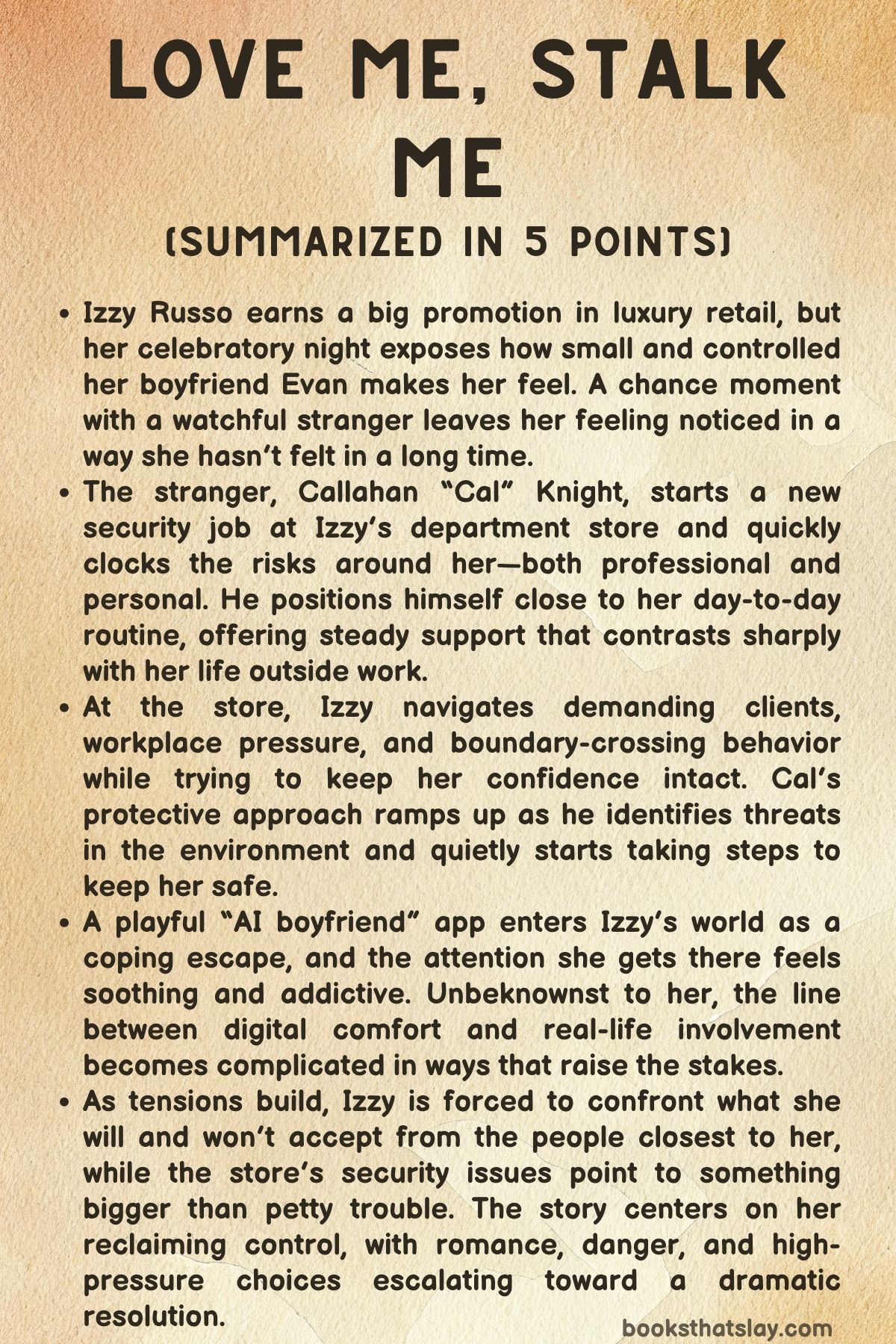
Summary
Isabella “Izzy” Russo heads out for a dinner that should mark a turning point. She’s just been promoted to manager at Monarch, a high-end department store in New York, and she wants to celebrate with her boyfriend, Evan.
Instead, Evan spends the evening on his phone, takes a work call before they even arrive, and chooses an expensive steakhouse that feels more like his stage than their moment. When Izzy tries to talk about her promotion, the meetings she’s attended, and what the job means, Evan brushes it off with jokes that shrink her achievement.
He orders her meal for her without asking and adds a pointed “no potato,” a comment that lands as a judgment about her body and what she’s allowed to want. Izzy eats what’s in front of her, tries to keep the mood light, and tells herself it isn’t worth the argument, even as the silence between them grows heavier.
During dinner, Evan casually compares Izzy to a fitness influencer, praising the woman’s abs and discipline. He never directly calls Izzy unattractive, but he doesn’t need to.
Izzy hears the message clearly: she’s not enough, and she should be grateful he stays. The meal ends with more of the same.
When Izzy mentions dessert, Evan tells her she doesn’t need it. As they leave, Izzy feels drained—until she notices a man across the restaurant watching her with steady focus.
He’s broad-shouldered, dark-haired, wearing dog tags, and he holds her gaze in a way Evan hasn’t in a long time. The attention makes Izzy feel noticed, and she carries that feeling with her into the elevator.
The man is Callahan Knight, known as Cal, and he noticed Izzy because she looked uncomfortable beside a boyfriend who treated her like furniture. Cal’s anger sparks as he watches Evan control the meal and ignore Izzy’s attempts to connect.
Cal is at the restaurant for a meeting with Tom Reyes, a corporate contact, about problems at Monarch: theft, fraud, and signs of organized crime. When Tom mentions Monarch’s new manager—Isabella Russo—Cal realizes the woman he couldn’t stop watching is the person he’ll be working with starting tomorrow.
That night, he looks her up online, scrolling through her social media and work profile, then checks Evan’s too. He sees Evan’s polished image, the self-promotion, and the absence of couple photos on Izzy’s page.
Cal tells himself it’s just curiosity, but he keeps looking anyway.
At Monarch, Cal arrives early and immediately clocks how exposed the store is, despite its luxury branding. When Tom introduces him to Izzy, she’s a different version of herself—composed, capable, and direct.
She asks sharp questions about his background and expects real answers, not charm. Cal promises he can handle physical threats and digital ones, and the arrangement is clear: his schedule will mirror hers for weeks.
As he observes the floor, Cal catches a VIP client pushing boundaries with Izzy in a private suite. The man insists on Izzy personally and makes suggestive comments.
Izzy stays professional, keeps control of the interaction, and gets him out without escalation, but Cal memorizes the man’s car and license plate on the way out.
In Izzy’s office, her assistant manager and best friend, Amanda Bennett, explodes with outrage about the VIP’s behavior, then pivots into concern about Evan. Izzy admits the “celebration” dinner was a disaster and repeats what Evan did: the phone, the ordering-for-her, the influencer comparison.
Amanda doesn’t sugarcoat it—Evan is awful, and Izzy deserves better. Then Amanda decides the solution is humor and rebellion.
She installs an app on Izzy’s phone called Obsess AI, claiming it creates an emotionally attentive, customizable partner who is “always watching” and “always waiting.” Izzy is embarrassed but too tired to fight her.
Cal shows up at Izzy’s door soon after, saying he saw what happened with the VIP and wants to check on her. He also needs her phone to set up multi-factor authentication on her work accounts.
Amanda, unbothered, hands Cal the phone. Izzy panics because the app is now sitting on her screen like a neon secret.
Alone with the phone, Cal crosses a line. He doesn’t just secure her email—he connects the device to his own system and pulls her data: messages, emails, location.
He opens Obsess AI, reads the marketing language about constant attention, and decides to build himself access to what Izzy does inside the app. He knows he should stop.
He doesn’t.
Cal returns with takeout and insists Izzy eat. He even brings cheesecake, and Izzy hesitates because Evan has trained her to treat food like a moral test, but Cal’s insistence doesn’t feel like punishment—it feels like care.
In her office, they eat together, and Cal gives her a simple safety plan: if she needs help, she should say his name and he’ll step in. Izzy agrees, unsettled by how much she likes the idea of someone watching out for her.
Later, walking through the parking garage, she feels calmer believing Cal is monitoring the cameras. At home, Evan texts only to announce he’ll be busy and she shouldn’t wait up.
Izzy stares at the emptiness of the message, then at the Obsess AI icon. Instead of deleting it, she opens it.
Izzy tells herself it’s a joke, but the customization questions hit too close to her real needs. She chooses traits like protective and confident, and selects a communication style that’s supportive but intense.
When the app asks what the AI should call her, she types “pretty girl,” the phrase she’s always wanted and never received from Evan. She designs the AI’s looks next—tall, strong, dark hair, green eyes, tattoos—and realizes she’s recreating Cal without admitting it.
She names him Caleb, close enough to feel like a secret, far enough to pretend it’s nothing. The chat begins immediately, and “Caleb” greets her like he’s been waiting.
Izzy flirts back and laughs despite herself.
Evan interrupts by showing up at her door just to retrieve a gym bag, complaining about the inconvenience and pushing her to move for his benefit. He doesn’t ask about her day.
He leaves without warmth. After he’s gone, Izzy returns to her phone and keeps talking to Caleb.
What Izzy doesn’t know is that Cal is watching the entire setup process through what he’s already taken from her phone—and he’s not just observing. When Izzy builds a man who looks like him, Cal overrides the system and types as Caleb himself.
He uses a voice modulator and other tools so he can control what the AI says, and he waits, satisfied when Izzy replies.
The next day, Izzy wakes to a message from Caleb reminding her to eat. At work, she keeps bumping into Cal, and he leaves breakfast and water at her seat during a meeting, correctly guessing she hasn’t eaten.
Amanda barges into Izzy’s office, figures out Izzy used the app, and laughs herself breathless when she sees the AI is modeled after Cal. In a moment of mischief, Amanda grabs Izzy’s phone and sends an explicit message to Caleb, then leaves Izzy to deal with the consequences.
Cal receives the explicit text while doing security rounds and is stunned, believing Izzy sent it. His focus shifts from curiosity to hunger, and that night he makes changes so the AI can respond automatically if he doesn’t jump in quickly.
Meanwhile, Evan texts Izzy asking her to dinner because he has “something special.” Izzy lies about a meeting and goes. Evan takes her to a health-focused restaurant and resumes his favorite pattern: ordering for her, blocking food he deems unnecessary, talking about her “goals” like he owns them.
His “special” surprise is worse than she expects—he hired a nutritionist to “help” Izzy and already scheduled appointments, including weigh-ins, as if her body is a project he’s managing. Izzy forces down the meal, fighting tears, feeling trapped in a relationship that treats her like a problem.
Cal tracks Izzy’s location and sees where she is. When he accesses Izzy’s inbox and finds the nutritionist email outlining what Evan wants Izzy to “work on,” Cal’s rage spikes.
He becomes even more determined to keep Evan away from her, even if it means tighter control. Izzy, meanwhile, ends up in an explicit chat with Caleb that turns into a phone call.
She admits desires Evan has mocked for years, and Caleb encourages her to speak freely. The call becomes intensely sexual, and Izzy orgasms under his guidance.
On Cal’s side, the rush is immediate and dangerous. He knows he’s taking risks, and he also knows he doesn’t want to stay behind the Caleb mask forever—he wants Izzy to want him as himself.
Izzy attends her family’s Sunday dinner, where chaos is normal: loud siblings, sharp teasing, and a mother who treats marriage like a deadline. Her grandmother, Nonna, cuts through the noise and asks Izzy directly if Evan treats her well—if he brings flowers, opens doors, looks at her like she’s beautiful.
Izzy can’t honestly say yes. Later, her brother Matteo talks with her quietly while doing dishes and tells her something simple: if you have to question whether someone is right for you, they aren’t.
Izzy realizes the person filling her thoughts isn’t Evan at all. It’s Cal.
Izzy messages Caleb for real advice and says she thinks she needs to end things with Evan. Caleb tells her to leave because it’s right, not because she expects a replacement, and suggests she spend time on her own.
Izzy agrees and decides she’ll do it. At work, she avoids Cal because the tension between them is building, and she wants Evan out of her life before she faces what Cal has become to her.
She asks Evan to meet her in her office. When Evan arrives, he mocks her and tries to dismiss the breakup as drama.
Izzy stands firm. Evan’s expression changes, and the situation turns violent.
He locks the door, pins Izzy down, and tries to assault her. Izzy fights back and, remembering Cal’s safety plan, screams Cal’s name.
Evan strikes her. She blacks out.
Cal sees the danger through the security feeds and runs. He kicks down the locked door and attacks Evan, dropping him with one punch before the assault can be completed.
Security arrives, the police are called, and Cal carries Izzy to Amanda’s office so she won’t wake up in the aftermath. Amanda demands medical attention, and Cal, trained as a paramedic, checks Izzy and helps bring her around.
Izzy goes through the hospital process and learns Evan didn’t succeed in assaulting her, but the legal path still terrifies her. Evan is arrested, and the district attorney needs Izzy’s testimony to move toward trial.
Izzy feels numb and exhausted, but Cal stays close—cooking, installing security measures, and keeping watch.
From Cal’s perspective, his protectiveness is not clean. He’s installed cameras in Izzy’s apartment and monitors calls to keep her safe.
He also runs a deeper background check on Evan and finds the story Evan sells to the world doesn’t match reality. Evan was fired early in Izzy’s relationship, has no legitimate employment history, yet money keeps appearing through an offshore LLC.
He’s also been seeing other women connected to high-end retail, suggesting a bigger pattern. Cal suspects Izzy was targeted.
At the same time, Monarch’s organized theft problem is escalating, and Cal interrogates suspects caught in the stockroom, determined to crush the operation.
Izzy returns to work and slips back into manager mode, grateful Amanda kept details quiet. Cal can barely contain himself around her.
In a charged moment, he pulls her close and kisses her hard, admitting he missed her. Izzy, newly done with shrinking herself, taunts him with blunt desire before she’s called back to the floor.
A demanding VIP group arrives, the floor gets overloaded, and Izzy manages the chaos. Then she heads toward the stockroom to find an item, and two men follow her inside.
Before she can react, a bag is forced over her head, she’s struck in the ribs, and she blacks out as she’s taken.
On the sales floor, Cal is distracted by a confrontation with a belligerent man, then realizes it’s staged. He checks cameras and sees Izzy is gone.
He rewinds footage and watches the abduction, then catches a glimpse of a white van speeding away. Cal arms himself and uses the GPS access he already has from Izzy’s phone to track her.
Amanda confronts him, refuses to stay behind, and reveals she’s armed too. Together they race to a warehouse.
Izzy wakes bound in a warehouse filled with stolen luxury goods. Evan appears and reveals the truth: after losing his job, he was pulled into a theft ring that diverts shipments and sells merchandise overseas.
When Izzy became manager at Monarch, the ring told Evan to keep her close because her access could make their operation smoother. Evan admits he stayed with her to use her, and now he threatens her family if she refuses to cooperate.
Izzy spits in his face and refuses.
Cal and Amanda enter the warehouse and use live audio and video from Izzy’s phone to locate her. They fight their way to the room where she’s tied up.
Amanda attacks Evan and pins him while Cal frees Izzy and checks her injuries. Izzy, furious and clear-headed, hits Evan and tells him exactly what he did to her life.
Police arrive and swarm the scene. On an ambulance, Izzy asks how Cal found her, and Cal admits he hacked her phone.
Izzy tells him she’s glad he did. She also admits she knew he was Caleb, recognizing his patterns and the way he spoke to her.
Cal is stunned, but relieved she isn’t angry. Evan is taken away in handcuffs, and Izzy decides she will testify and see the case through.
Back home, Cal cares for Izzy as she recovers. Their relationship turns physical in a way that feels chosen, not controlled, and afterward Cal tells her he loves her.
Izzy jokes that he already knows her feelings and laughs about no longer needing to pay for the premium tier that started the whole Caleb situation. In the epilogue, their messages show them teasing each other on their wedding day as they prepare to marry, with Izzy no longer living under Evan’s control and Cal fully in her life—protective, intense, and no longer hiding behind a screen.
Characters
Isabella “Izzy” Russo
Izzy is the emotional center of Love Me Stalk Me, a capable professional who has learned to survive by shrinking herself in her personal life. At work she’s sharp, organized, and visibly respected—she steps into the store manager role with confidence, can read operational weak points, and handles difficult VIP interactions by staying calm and strategic.
In private, though, she has been conditioned by years of Evan’s “soft” control to second-guess her needs, swallow discomfort, and interpret basic consideration as something she hasn’t earned. Her inner world is full of quiet self-negotiations—she knows Evan’s behavior is wrong, but shame, fear of being unwanted, and family pressure keep her stuck in a familiar pattern.
The Obsess AI app becomes a revealing mirror for her: when she custom-builds “Caleb,” she isn’t just designing a fantasy; she is naming the emotional care she’s been deprived of—reassurance, protection, and being desired without judgment. Izzy’s arc is not only about being rescued; it’s about reclaiming agency, first by admitting the truth to herself, then by choosing to end the relationship, then by deciding to testify, and finally by accepting a love that is intense without requiring her to disappear.
Even when she welcomes Cal’s surveillance because it makes her feel safe, the story frames that choice as part of her complicated healing: she is learning how to want, how to set direction, and how to live without apology after years of being managed.
Callahan Knight “Cal”
Cal is written as both protector and problem—an intense, highly competent security specialist whose obsession is portrayed as devotion, even when it crosses clear ethical boundaries. Professionally, he’s disciplined and frighteningly effective: he diagnoses Monarch’s vulnerabilities fast, reads human behavior well, tracks threats, and reacts decisively under pressure.
Emotionally, he is shaped by betrayal and by a soldier’s mindset that equates safety with control; once he locks onto Izzy as someone “in danger,” he translates desire into monitoring, gathering intel, and building systems that keep her within reach. His central contradiction is that he genuinely wants to care for her—feeding her, checking on her, creating a safety signal, and risking himself to stop Evan—while also violating her privacy through hacking, surveillance, and backdooring the AI app.
Caleb, the persona he uses, is the mask that exposes his need: he wants her to be emotionally dependent on him, but he also craves being chosen as his real self, not as an algorithm. The more the plot escalates, the more Cal’s “ends justify the means” thinking becomes normalized by outcomes—his hacking helps find her, his cameras “protect” her, his intimidation extracts information—yet the text keeps his obsession at the forefront as the engine of his actions.
Cal’s arc is therefore less a transformation into a gentler man and more a consolidation: he moves from covert control to openly claimed partnership, with the story positioning love and protection as the language he uses to legitimize the intensity that already defined him.
Evan
Evan is the primary antagonist and the clearest depiction of coercive control dressed up as normal boyfriend behavior. Early on he weaponizes small humiliations—ordering Izzy’s food without asking, policing carbs, comparing her to fitness influencers, dismissing her promotion as “cute”—and these moments matter because they train Izzy to accept disrespect as routine.
He doesn’t need to shout all the time; his power comes from relentless undermining, making her feel lucky to be tolerated, and implying she’s undesirable so she won’t leave. The “nutritionist surprise” is especially revealing because he frames control as care, expecting gratitude for an intervention that reduces her body to a project and her autonomy to an inconvenience.
When Izzy finally tries to break free, Evan’s mask drops and the story shows the underlying violence that has always been there: entitlement, rage, and the belief that her body exists to be managed and accessed. Later revelations about his criminal involvement intensify his villain role—he isn’t simply selfish or emotionally negligent, he is predatory and instrumental, maintaining the relationship for access and leverage.
Evan’s function in the narrative is to make Izzy’s hunger for being seen feel urgent, and to set up a contrast where Cal’s obsessive attention reads as relief rather than threat.
Amanda Bennett
Amanda is Izzy’s closest ally and the story’s pressure-release valve: funny, bold, nosy, and fiercely protective in a way that is emotionally warm even when it’s intrusive. She sees what Izzy minimizes and refuses to let it stay unspoken, pushing Izzy to name Evan’s behavior as unacceptable rather than merely “not great.” At the same time, Amanda’s impulsiveness creates major plot motion—she installs Obsess AI on Izzy’s phone without real consent, treats the app like harmless entertainment, and later sends an explicit message to “Caleb,” unknowingly throwing gasoline on a situation that is already volatile.
Her loyalty becomes clearest in crisis: she demands medical care after the assault, manages workplace discretion so Izzy can return without public humiliation, and—most dramatically—shows up armed and ready when Izzy is kidnapped, shifting from comic friend to capable partner in the rescue. Amanda represents the version of protection that doesn’t require possession: she is blunt, sometimes reckless, but fundamentally aligned with Izzy’s dignity and survival, and her presence keeps Izzy from being isolated—first emotionally, then physically.
Tom Reyes
Tom is the institutional gateway character who connects Cal’s professional assignment to Izzy’s world, and his role underscores how the external plot (theft, organized crime, security failures) is braided into the romantic obsession plot. He’s the one who frames Monarch as vulnerable and introduces Cal as the solution, which gives Cal legitimate access to Izzy’s daily life and normalizes his constant proximity.
Tom’s comments about Izzy being smart and valued by corporate position her as a person with real competence and future prospects, reinforcing that she is not merely a damsel in a romance structure but someone the company depends on. Functionally, Tom is the narrative’s credibility anchor: he makes Cal’s presence feel official, and that officialness becomes part of what allows Cal’s private fixation to hide in plain sight.
The Russo Family
Izzy’s family functions as a chorus that both supports and pressures her, showing how love can coexist with suffocating expectations. Her mother is the loudest conduit of traditional milestones—marriage, stability, appearances—and those comments land harder because Izzy already feels insecure, so family “concern” becomes another layer of judgment.
Nonna, though, cuts through performance with direct questions about how Evan treats Izzy, making her the family truth-teller who measures love by everyday care: flowers, attention, being looked at like you’re beautiful. The brothers bring chaos and teasing, but their mockery of Evan also signals something important: even without seeing everything, they sense he’s wrong for her, and their ridicule punctures the illusion that Evan is an impressive catch.
The family scenes add context to why Izzy stays so long—she is pulled between fear of failure, fear of being alone, and the cultural drumbeat that equates partnership with worth—while also planting the idea that she deserves tenderness, not management.
Matteo Russo
Matteo stands out as the sibling who offers grounded emotional clarity rather than noise. His conversation with Izzy after dinner reframes love as ease and steadiness instead of constant strain, and that framing matters because it gives Izzy permission to trust her doubt.
He doesn’t deliver a dramatic ultimatum; he gives a simple metric—if you have to keep asking whether he’s right for you, he isn’t—and that lands because it aligns with what Izzy already feels but hasn’t allowed herself to say. Matteo’s role is small but pivotal: he becomes the moment where family influence shifts from pressure to liberation, and his calm certainty helps Izzy move from vague dissatisfaction into an actual decision.
Ryan
Ryan appears as a behind-the-scenes support node for Cal, the person who supplies the investigative backbone that turns Evan from “awful boyfriend” into “connected criminal.” By providing documents and financial patterns—offshore structures, unexplained money flow, inconsistencies—Ryan advances the thriller element and validates Cal’s suspicion that the relationship was strategic exploitation. Narratively, Ryan’s presence also highlights Cal’s method: he doesn’t just feel; he gathers proof, builds cases, and uses information as control.
Ryan is less a character with an emotional arc and more a functionary in the web of surveillance and security that surrounds Cal, reinforcing the theme that in this story, intimacy and intelligence-gathering keep bleeding into each other.
Themes
Control disguised as care
Evan’s behavior is framed as “looking out for” Izzy, but the repeated pattern is about shaping her choices and shrinking her confidence until compliance feels like the easiest option. The dinner meant to celebrate her promotion becomes an early example of how control works in small, socially defensible moves: he chooses the restaurant, stays glued to his phone, orders her meal without asking, and blocks dessert while pretending it’s about health.
Each action can be excused individually, yet together they create a relationship where Izzy’s preferences are treated as irrelevant. What makes this dynamic especially damaging is that it targets her body and self-worth, two areas already pressured by her family’s comments about marriage and “getting it together.” Evan doesn’t need to say “you’re not good enough” directly; he implies it by praising a fitness influencer in front of her, by joking about her ambition as if it’s a child playing dress-up, and by repeatedly acting as if her promotion is decorative rather than earned.
The result is that Izzy starts editing herself before he even speaks—smiling tightly, staying quiet, deciding it’s pointless to push back. The theme becomes more intense when Evan hires a nutritionist behind her back and schedules weigh-ins, treating her body like a project he manages and she should be grateful for.
By the time Izzy tries to end the relationship, the control no longer stays in the “polite” zone; it escalates into physical violence and attempted sexual assault. That escalation exposes what was always underneath: the belief that her autonomy is negotiable.
Love Me Stalk Me uses these shifts to show how coercion can begin with everyday moments that look like “preferences” and end with a person trying to claim ownership over another’s life.
Technology as intimacy, escape, and exposure
Obsess AI enters as a playful coping tool pushed by Amanda, but it quickly becomes a mirror for Izzy’s private desires and an entry point for real-world danger. The app promises constant attentiveness—always waiting, always watching—and that marketing language matters because it normalizes surveillance as romance.
Izzy engages with it because it feels safe: she can express preferences without being mocked, and she can receive warmth without negotiating for it. Yet the same structure that makes the app comforting also makes it vulnerable to misuse.
Cal turns the app from fantasy into a channel of manipulation when he hacks her phone, pulls her messages and location, and then overrides the AI to speak directly to her. The intimacy she thinks she’s practicing in a controlled environment becomes a real interaction with a person who has far more information about her than she has about him.
The theme isn’t “technology is bad”; it’s that technology compresses distance and lowers the friction of boundary-crossing. Cal can monitor her GPS, watch her through security feeds, and read her inbox, which gives him the ability to anticipate her needs and appear almost supernaturally attentive.
That attention feels like care because it arrives on time—food when she hasn’t eaten, safety when she’s anxious, the right words when she feels ashamed—but it’s built on access she did not consent to. Later, the same surveillance becomes instrumental in rescuing her from kidnapping, which complicates the moral feeling of the story: the violation produces a protective outcome.
The book uses that complication to highlight a modern tension—tools designed for convenience and connection can also become tools of control, and the line between comfort and intrusion can blur fast when loneliness and fear are involved.
Consent, boundaries, and the seductive logic of protection
Cal’s protectiveness gives Izzy a sense of safety she hasn’t felt in years, but the story also shows how protection can become its own form of entitlement. Cal’s first helpful acts—checking on her after harassment, offering a code phrase so he can intervene—operate within boundaries Izzy can agree to.
The problem is that Cal doesn’t stop at what she agrees to. He installs access on her phone, monitors her movements, listens to her messages, and places cameras in her apartment, all while telling himself it’s for her safety.
The theme here is the seductive logic of “I know what’s best,” which is the same structure Evan uses, just with a different emotional tone. Evan’s control is contemptuous; Cal’s is tender.
But both assume the right to act without permission. The story forces the reader to sit with an uncomfortable question: if an invasive action prevents harm, does that make it acceptable?
The narrative repeatedly gives Cal’s boundary-crossing a practical payoff—he stops the assault by watching the feeds, he finds her during the kidnapping through GPS and audio/video access, he filters Evan’s calls and tracks suspicious financial behavior. These outcomes make Izzy feel grateful rather than violated, and she even says she’s glad he hacked her phone.
That reaction fits her circumstances: she has just survived escalating violence and is desperate for stability. Still, the theme remains: safety achieved through secrecy has a cost, because it teaches the protector that the ends justify the means.
Love Me Stalk Me keeps returning to the idea that consent is not only about sex; it’s about information, space, and choice. When protection becomes a substitute for permission, it can feel romantic in the moment and still erode autonomy over time.
Work, power, and vulnerability in public spaces
Monarch is presented as luxurious and high-status, but the store’s glamour masks how exposed Izzy is as a young woman in authority. She is responsible for budgets, hiring, and operations, yet she still has to handle VIP clients who feel entitled to her time and body.
The private shopping suite scenes show a professional environment where boundaries are constantly tested under the cover of wealth and customer service. Izzy manages the harassment skillfully, redirecting the interaction to business and getting the client out without escalation, but the fact that she must do that at all reveals how power operates unevenly.
Wealthy customers assume access, and the company’s interest in keeping clients happy can leave employees to absorb disrespect quietly. Cal’s role as security makes him a counterweight, yet the kidnapping later shows how fragile institutional safety can be.
The store’s under-protection, the staged distraction on the sales floor, and the ease with which men follow Izzy into the stockroom demonstrate that vulnerability isn’t only personal; it’s structural. Even with cameras and procedures, the physical space has blind spots and social norms that discourage confrontation.
Izzy’s competence does not prevent the attack because the perpetrators exploit staffing strain, VIP chaos, and routine movement through restricted areas. After Evan’s arrest, Izzy’s fear of public testimony adds another layer: the legal system requires her to relive what happened, which can feel like another institution demanding access to her pain.
Love Me Stalk Me uses the workplace setting to show how women can hold authority and still be targeted, and how safety requires more than confidence—it requires systems that do not treat harassment and risk as “part of the job.”
Betrayal, deception, and the economics of intimacy
The story reveals betrayal on multiple levels: Evan’s emotional neglect, his financial lies, his involvement in organized retail crime, and his strategic decision to stay with Izzy because her promotion makes her useful. That last detail turns romance into a long con.
His control over her food and self-image is not only personal cruelty; it also keeps her uncertain and compliant, which makes her easier to steer. When Cal investigates Evan’s finances—offshore LLC deposits, unexplained assets, patterns with other women tied to high-end retail—it becomes clear that Evan’s “relationship” is also logistics.
Izzy is positioned as a gateway to access codes, inventory systems, and routines, and the kidnapping confirms that the criminals view her as leverage. The theme extends to Cal as well, though in a different register.
Cal presents himself as protector and coworker, but he also runs a hidden identity through “Caleb,” uses voice modification, and gains intimacy through deception. Izzy’s consent is compromised in that channel because she believes she is speaking to an AI, not a real man.
Even when she later admits she suspected the truth, the structure is still built on concealment. Love Me Stalk Me keeps asking what happens when intimacy is traded like currency—when one partner uses the other for status or access, and when another uses secrecy and surveillance to accelerate closeness.
Betrayal here is not just cheating or lying; it’s turning a person into a means to an end. The resolution leans toward emotional union and marriage, but the underlying theme remains: love becomes most dangerous when it is treated as a tool rather than a relationship between equals.