Love’s a Witch Summary, Characters and Themes
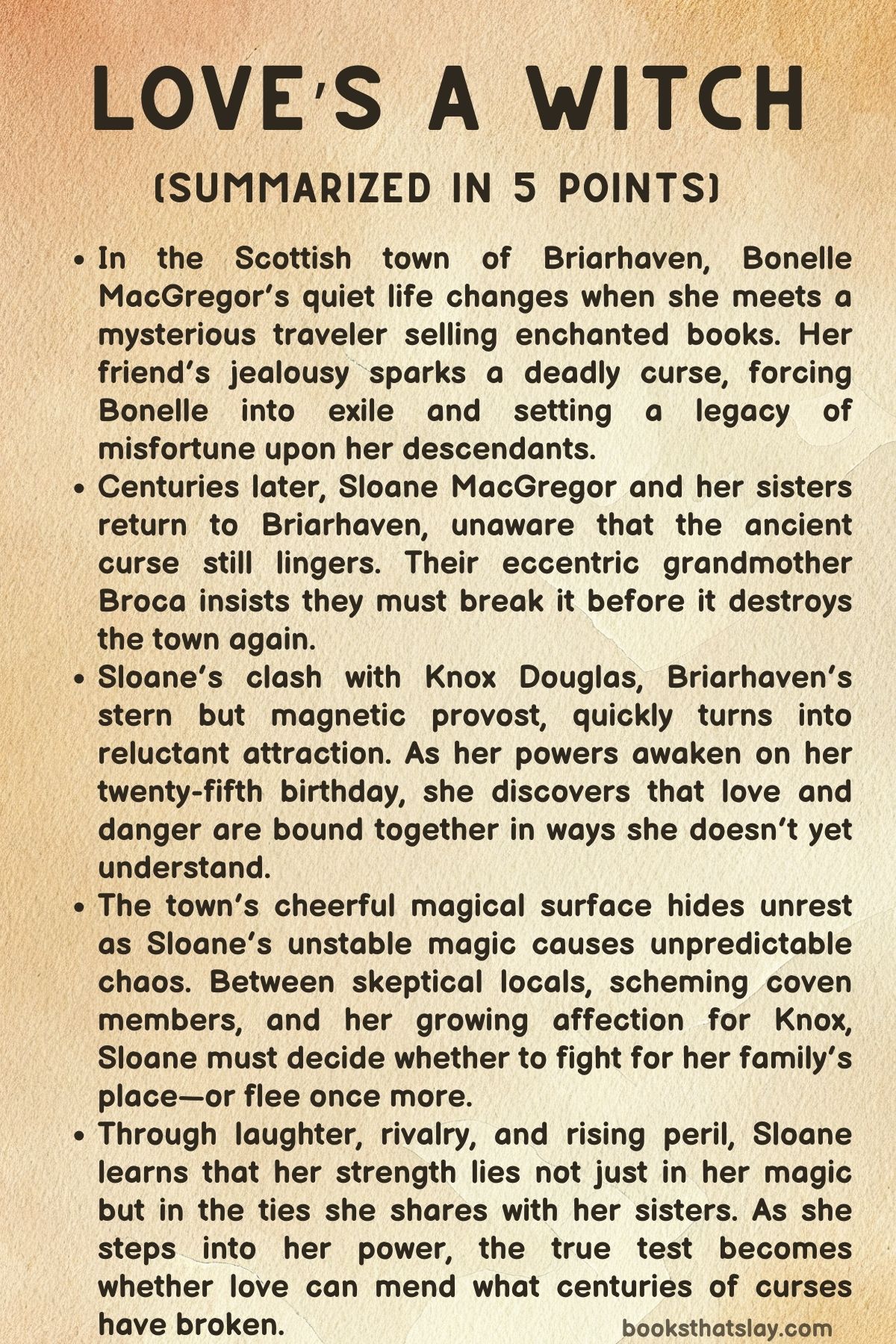
Love’s a Witch by Tricia O’Malley is a contemporary paranormal romance set in the enchanted Scottish town of Briarhaven, where ancient curses, restless magic, and generations of witches collide. The novel follows Sloane MacGregor, a modern descendant of a once-powerful witch family burdened by a centuries-old curse that brings misfortune wherever they go.
When she and her sisters return home to break it, they find themselves entangled with the town’s magnetic provost, Knox Douglas—descendant of the very knight who once exiled their ancestor. The story blends humor, magic, family bonds, and slow-burning romance as Sloane discovers not only her powers but also the meaning of belonging and love.
Summary
The story begins centuries ago in Briarhaven, a small Scottish town where humans, witches, and fae coexist uneasily. Bonelle MacGregor, a young witch waiting for her powers to awaken on her twenty-fifth birthday, encounters a mysterious traveler selling enchanted goods during the Mabon festival.
When their hands touch, a surge of energy reveals a fated connection. However, events spiral when the town’s prince, expected to choose a bride, selects Bonelle over her best friend Vaila.
Consumed by jealousy, Vaila curses Bonelle so that any town she inhabits will fall into ruin. As fiery creatures called emberwolves attack, the traveler—revealed as Eoin Douglas, protector of Briarhaven—urges Bonelle to flee.
Exiled and heartbroken, she carries the curse into the world, marking the beginning of her family’s long misfortune.
Centuries later, the MacGregor curse still lingers. Sloane MacGregor, a sharp, practical woman, returns to Briarhaven with her sisters Lyra and Nova.
Their eccentric grandmother, Broca, has summoned them to the family’s crumbling ancestral cottage to finally end the curse. The town has transformed into a tourist attraction that celebrates its magical roots, but locals still whisper about the cursed MacGregors.
Almost immediately after their arrival, out-of-season snow begins to fall—a sign that the curse is stirring once again.
When Knox Douglas, the handsome but overbearing provost of Briarhaven, appears at their door demanding they leave, sparks fly. Knox, descended from Eoin Douglas, views the sisters as a threat to the town’s prosperity.
Sloane, fiercely independent, refuses to be intimidated and uses a protective spell to eject him from the house. The tension between them is electric—equal parts irritation and attraction.
The following days bring more chaos and humor as the sisters navigate life back in Briarhaven. The local coven, called the Charms, led by the self-important Mandy Meadows, insists that Sloane join them since her twenty-fifth birthday is approaching and her magic will soon awaken.
Broca eagerly accepts on Sloane’s behalf, leaving her no choice but to prepare for a public celebration. When the day arrives, Sloane’s magic manifests through levitation—a modest but promising start.
Her new familiar, Blue, a mischievous winged emberwolf gifted by Broca, immediately bonds with her.
Knox continues to meddle, even cutting the cottage’s power in an attempt to scare the sisters into leaving. Furious, Sloane confronts him, and their argument turns heated.
Yet beneath their sparring lies undeniable chemistry. At the town’s traditional cèilidh dance, Sloane’s confidence and magic shine, and Knox finds himself captivated despite his resolve to protect Briarhaven from her curse.
Their dance is charged with emotion and attraction, hinting that their fates are intertwined.
As time passes, Sloane’s relationships with the townspeople begin to shift. She reconnects with her childhood friend Raven, now a confident apothecary and member of the Charms, and starts to see that Briarhaven’s magic—once hidden—is now embraced openly.
However, Sloane’s powers remain unstable, manifesting unpredictably and causing comic chaos, from floating pastries to exploding light fixtures. Knox, though frustrated, secretly admires her strength and courage.
The town’s Halloween celebration marks a turning point. Dressed reluctantly as a risqué Princess Peach, Sloane feels out of place until Knox appears as Aquaman, and their mutual attraction finally ignites.
In a moment of passion, they surrender to desire, leaving Sloane both exhilarated and conflicted. Soon after, a magical mishap at the party—glitter exploding from the disco ball—reminds her how unstable her powers remain.
Despite her embarrassment, it becomes clear that her emotions and magic are deeply connected.
The Charms later meet to study an ancient grimoire that only Sloane can open. Inside, she discovers a ritual to break her family’s curse: a blood offering combined with honey and whisky within a circle of hematite stones.
But there’s a catch—the ritual requires participation from the descendants of those who originally cast the curse, whose identities are long forgotten. Sloane and her sisters begin searching for clues, aided by Raven and Knox, whose loyalty starts to outweigh his doubts.
Meanwhile, Sloane learns the truth about her estranged father. Long believed to have abandoned the family, he reveals he’s been living as a guardian of dragons in the nearby hills, protecting their secrets.
The revelation shakes Sloane but also offers hope that he might help them uncover the origins of the curse.
As Briarhaven’s Pinecones & Peppermint Festival approaches, the tension between Sloane and Knox transforms into genuine affection. During the festivities, surrounded by music, laughter, and holiday magic, they admit their feelings for each other.
Yet the worsening snowstorm—a manifestation of the curse—threatens the town’s safety. When a friend is injured in an accident, Sloane blames herself and decides to leave to protect everyone she loves.
Knox, unwilling to lose her, intervenes and gathers the town’s magical families for a bold plan.
At the Rune & Rose pub, Knox leads a communal unbinding ritual using Sloane’s discovered spell. Townsfolk add drops of blood, honey, and whisky to a cauldron, and even Sloane’s emberwolf, Blue, contributes dragon’s blood.
When they chant the incantation, the snow clears and a fragment of pink quartz appears—a symbol that one part of the curse is broken. The inscription “three fragments mended” reveals that each MacGregor sister must complete her own piece of the ritual to end the curse forever.
Sloane and Knox finally confess their love and begin a new chapter together. The following morning, Sloane learns she is a Fireheart witch—a rare kind tied to dragon magic, able to channel and transmute elemental fire.
Her powers are no longer chaotic, symbolizing balance and acceptance. Knox asks her to move in with him on a trial basis, and she agrees, ready to embrace both love and responsibility.
In the epilogue, Broca confronts the scheming Mandy Meadows and invokes an old ordinance to replace her as head of the Charms. Sloane is elected as the new president, earning the respect of her coven and the town.
Yet the story ends with the reminder that the MacGregor curse is not fully lifted—two fragments remain, hinting at more trials, romance, and revelations to come in the series. With the town safe, her magic stabilized, and love in her heart, Sloane MacGregor finally claims her place as both witch and leader in Briarhaven.
Characters
Bonelle MacGregor
Bonelle MacGregor, the earliest known matriarch of the MacGregor line in Love’s a Witch, is both the foundation and the tragedy of the family’s magical legacy. A studious and principled witch, Bonelle’s story unfolds as one of innocence meeting destiny.
Her fascination with knowledge and her yearning to master her craft define her as an intellectual and independent woman in a world that often measures witches by their beauty or marriage prospects. Her chance encounter with the mysterious traveler, Eoin Douglas, sparks the fateful chain of events that sets the novel’s central curse in motion.
Bonelle’s curiosity and strength contrast sharply with her vulnerability—the curse cast by her friend Vaila not only banishes her from Briarhaven but condemns her lineage to centuries of wandering and sorrow. Through Bonelle, the novel establishes its themes of love, betrayal, and redemption, painting her as both victim and architect of her fate.
Her character’s blend of defiance, tenderness, and tragedy lingers throughout the generations that follow.
Vaila
Vaila embodies the darker side of friendship and envy in Love’s a Witch. Initially introduced as Bonelle’s lively and affectionate companion, she transforms into a figure consumed by jealousy when the prince’s attention turns toward Bonelle instead of her.
Her impulsive curse against Bonelle is a moment of emotional volatility that reveals how fragile ambition can become when intertwined with pride. Vaila’s magic, once playful, turns destructive, echoing her emotional turmoil.
She represents how love’s rejection can distort into cruelty, yet her character also underlines the immense power of emotion in witchcraft—a motif that recurs throughout the book. Though she disappears from the narrative after her act of vengeance, Vaila’s presence haunts every MacGregor descendant, her name becoming synonymous with wrath and regret.
Eoin Douglas
Eoin Douglas, the enigmatic traveler and First Knight of the Iron Thistle Order, serves as both savior and symbol of chivalric restraint in Love’s a Witch. His initial meeting with Bonelle is steeped in mystery and allure, as he tempts her with enchanted blue books and an unspoken bond that defies ordinary magic.
Eoin’s sense of duty conflicts with his growing affection for Bonelle, forcing him to become her reluctant rescuer and eventual exile enforcer. His dual role as protector and judge positions him as a tragic figure—one who upholds order but loses love in the process.
Through Eoin, the novel contrasts the rigidity of tradition with the chaos of passion, setting a precedent for the dynamic between his descendant, Knox, and Sloane in the modern era.
Sloane MacGregor
Sloane MacGregor, the modern heroine of Love’s a Witch, is a richly layered character—sharp-witted, independent, and burdened by the generational curse she neither chose nor deserves. Her return to Briarhaven marks the beginning of her reluctant transformation from cynic to leader.
Initially skeptical of both magic and belonging, Sloane evolves through confrontation—with her past, her lineage, and her feelings for Knox Douglas. Her sarcasm masks vulnerability, and her stubbornness is both her shield and her undoing.
The novel traces her journey from resistance to acceptance, as she learns to wield her volatile powers and embrace her identity as a Fireheart witch, one aligned with dragons and transformation. Sloane’s relationship with Knox, fraught with rivalry and passion, mirrors the ancient tension between Bonelle and Eoin but ultimately transcends it through healing and trust.
By the end, Sloane’s ascension to coven leadership signifies not just personal growth but the restoration of her family’s dignity and purpose.
Knox Douglas
Knox Douglas is the modern echo of Eoin’s legacy—a man divided between duty and desire. As Briarhaven’s provost, he is the town’s guardian and moral compass, but beneath his composed exterior lies a heart torn by love for the very woman he believes could destroy everything he protects.
His dynamic with Sloane is one of sharp contrasts: logic against emotion, control against chaos. Knox’s protectiveness sometimes borders on arrogance, yet his affection for Sloane humanizes him, revealing a tender side hidden behind authority.
His internal conflict—between the inherited responsibility of the Douglas line and his personal longing—cements him as a romantic hero who learns to balance strength with vulnerability. Knox’s evolution from enforcer to partner underscores the novel’s central message: that love can rewrite even the oldest curses.
Broca MacGregor
Broca MacGregor, the flamboyant grandmother of the MacGregor sisters, is a delightful fusion of eccentricity and wisdom. Her vivacious energy, colorful attire, and string of failed marriages create a façade of lightheartedness that conceals deep intuition and power.
Broca acts as the spiritual anchor of the family, her foresight and humor guiding her granddaughters through chaos. Despite her playful nature, Broca embodies resilience, having survived the curse’s consequences longer than anyone.
She understands the importance of laughter as magic’s twin and views love as both risk and remedy. Her mentorship, especially of Sloane, bridges the old world of witchcraft with the modern era, proving that heritage can be celebrated rather than feared.
Broca’s leadership in reclaiming the coven and ousting Mandy Meadows in the epilogue marks her as a matriarch who restores balance through charm, not domination.
Lyra MacGregor
Lyra MacGregor serves as the emotional glue among the sisters, balancing Sloane’s guarded cynicism with warmth and humor. A free spirit with a nurturing heart, Lyra’s empathy makes her both the mediator and the dreamer of the family.
While she occasionally masks her pain with jokes and impulsive behavior, her optimism anchors the group when the curse’s effects grow overwhelming. Lyra’s connection with Rab and her growing magical confidence highlight her capacity for both love and leadership.
She represents the strength found in emotional openness—a counterpoint to Sloane’s restraint—and her gentle defiance ensures that the MacGregor legacy is carried forward with heart as well as power.
Nova MacGregor
Nova, the youngest of the three sisters, is the embodiment of creativity and rebellion in Love’s a Witch. Her boldness and quick wit often push boundaries, but her loyalty to her sisters never wavers.
Nova approaches magic like art—experimental, expressive, and sometimes reckless. Beneath her playful exterior lies a deep yearning to prove herself, to step out of her sisters’ shadows and make her own mark.
Her curiosity about Briarhaven’s magical evolution and her growing independence suggest she will play a vital role in completing the unbinding of the curse. Nova’s youthful perspective injects modern vitality into the family dynamic, ensuring that the MacGregor name remains not just a legacy of loss, but of reinvention.
Raven O’Ryan
Raven O’Ryan stands at the intersection of past and present—a bridge between Briarhaven’s magical traditions and the modern witch community. As Sloane’s childhood friend and a member of the Charms coven, Raven embodies balance: compassionate yet firm, wise yet unpretentious.
Her apothecary symbolizes healing and connection, both physical and emotional. Raven’s grounded nature contrasts with Sloane’s volatility, often serving as her voice of reason.
Through her steady friendship, the novel explores the theme of forgiveness—both between people and within oneself. Raven’s quiet strength ensures that amidst curses, romance, and chaos, the power of enduring friendship remains one of the story’s purest forms of magic.
Mandy Meadows
Mandy Meadows, the self-important leader of the Charms coven, is the story’s embodiment of control, hypocrisy, and insecurity. Her polished demeanor hides a fear of losing power and prestige.
Throughout Love’s a Witch, Mandy’s interactions with Sloane reveal her disdain for unrefined, “imperfect” magic—an attitude rooted in elitism rather than wisdom. She personifies the institutional obstacles faced by women who defy conformity within their magical communities.
Her eventual downfall at Broca’s hands not only satisfies narrative justice but symbolizes the triumph of authentic magic—born from emotion and individuality—over hollow authority. Mandy’s lingering presence as an adversary at the story’s end ensures that power struggles within the coven remain unresolved, hinting at future conflict.
Russell MacGregor
Russell MacGregor, Sloane’s long-lost father, embodies the complexities of love, sacrifice, and redemption. Once thought to have abandoned his family, he is revealed as a “keeper of dragons,” bound by sacred duty to protect their realm.
His reappearance reframes Sloane’s understanding of loss and truth, showing how love can persist even through silence and separation. Russell’s character adds a mythic dimension to the narrative, linking the MacGregors’ lineage not only to witchcraft but to the ancient guardianship of dragons.
His reunion with his daughters rekindles hope and closure, grounding the fantasy of Love’s a Witch in the very human need for forgiveness and family reconciliation.
Themes
Legacy and Generational Burden
Across Love’s a Witch, the curse of the MacGregor bloodline symbolizes the weight of inherited trauma and the struggle to reclaim one’s own narrative from the shadow of the past. The MacGregor women are haunted not only by literal magic but also by the emotional legacy of shame, loss, and exile.
The curse, originating from Bonelle’s tragedy centuries earlier, becomes a metaphor for how the sins and mistakes of one generation echo through time, shaping the destinies of those who come after. Sloane’s journey back to Briarhaven forces her to confront that inheritance head-on.
Her reluctance to return to her hometown and her denial of her powers represent the universal human fear of repeating familial mistakes. Yet, as she learns about her ancestry and the truth of her father’s disappearance, the curse transforms from a symbol of punishment to one of reclamation.
Through unity, forgiveness, and courage, Sloane and her sisters rewrite their family’s legacy, proving that generational wounds can be healed through acceptance rather than avoidance. This theme underlines the idea that heritage is both a burden and a source of power—the very thing that curses can also liberate, once understood and embraced.
Identity and Self-Acceptance
Sloane’s evolution from a restless wanderer to a confident witch encapsulates a journey of self-acceptance. Her resistance to her magic parallels her emotional reluctance to belong—to her family, to Briarhaven, and even to herself.
Her powers, volatile and unpredictable, mirror her internal chaos and fear of being unworthy or dangerous. Throughout Love’s a Witch, Tricia O’Malley uses magic as a metaphor for authenticity.
To deny one’s magic is to deny one’s identity; to master it is to accept one’s true nature. Sloane’s eventual discovery that she is a Fireheart witch, bound to the dragons of Briarhaven, signifies the ultimate integration of her power and purpose.
The path to this revelation is fraught with failure, guilt, and impulsive magic—yet each misstep is essential in her learning to trust herself. By the end, her control over fire represents inner balance, while her acceptance of her family and her role in the town symbolizes reconciliation with all parts of herself.
Through Sloane, O’Malley suggests that self-acceptance is not found in perfection or control but in understanding one’s chaos and claiming it as strength.
Love and Redemption
Romantic and familial love in Love’s a Witch serves as a redemptive force that breaks cycles of pain and separation. The love story between Sloane and Knox begins with conflict and mistrust, echoing the ancient divide between their families, yet it grows into a healing bond that bridges centuries of bitterness.
Their passion is not a fairytale escape but a confrontation with vulnerability and forgiveness. Knox’s lineage, tied to the family that once banished Bonelle, adds moral complexity to their union, making love an act of rebellion against inherited prejudice.
Similarly, the rediscovery of paternal love through Russell’s return redeems the abandonment that defined Sloane’s childhood. Broca’s flamboyant affection and her belief in her granddaughters’ potential anchor the narrative in intergenerational healing.
Love here is not blind or naïve—it is deliberate, messy, and transformative. It demands the courage to trust after betrayal, to rebuild where destruction once ruled.
The romantic, familial, and communal forms of love all converge in the final ritual, where every drop of blood and honey becomes a testament to love’s power to dissolve curses both magical and emotional.
Female Solidarity and Empowerment
The sisterhood of Sloane, Lyra, and Nova forms the heart of the novel, reflecting the strength found in unity among women. Their dynamic—playful, argumentative, and fiercely loyal—represents the resilience of women who have been misunderstood and ostracized.
Each sister brings a distinct perspective on power and femininity: Lyra’s whimsy, Nova’s pragmatism, and Sloane’s guarded determination create a balance that allows them to grow both individually and together. Their grandmother Broca, flamboyant yet wise, embodies the unapologetic womanhood that the younger generation must learn to embrace.
Even within the Charms coven, despite conflicts with figures like Mandy Meadows, the story celebrates collective female energy as a source of renewal and protection. Magic itself is depicted as inherently feminine—a creative, emotional, and intuitive force that thrives on connection.
The eventual transfer of leadership to Sloane signifies the triumph of empathy and authenticity over control and vanity. Through this lens, Love’s a Witch becomes not only a tale of curses and romance but also a manifesto of women reclaiming space, voice, and agency in a world that once feared their power.
Homecoming and Belonging
The return to Briarhaven is both a literal and spiritual homecoming for the MacGregor sisters. The town, with its cobblestone streets and magical tourism façade, reflects the tension between authenticity and performance—between what is real and what is staged to please outsiders.
Sloane’s discomfort with Briarhaven’s commercialization mirrors her own fractured relationship with belonging. Yet as she reconnects with Raven, Knox, and the rhythms of the town, the idea of home shifts from a physical place to a state of acceptance.
Briarhaven itself becomes a living character, testing and nurturing those who inhabit it. By confronting its myths, histories, and unresolved tensions, Sloane transforms it from a site of exile to one of rebirth.
The final clearing of the snow signifies more than the lifting of a curse—it represents the thawing of emotional isolation and the restoration of harmony between self and community. In O’Malley’s vision, home is not where one escapes judgment, but where one learns to face it and still choose to stay.