Lucky Seed Summary, Characters and Themes | Justinian Huang
Lucky Seed by Justinian Huang is a sweeping multigenerational family saga that explores ambition, superstition, identity, and legacy within a wealthy Chinese American dynasty. Set between Los Angeles, Hong Kong, and beyond, the novel follows the Sun family as they fight to preserve their empire, Sunfang Global, while unraveling the secrets that threaten to destroy them.
At its core, it’s about inheritance—both the material and spiritual kinds—and how family myths can shape or shatter lives. Through fierce matriarchs, estranged siblings, and conflicted heirs, Lucky Seed reveals how power and destiny are never purely inherited—they are constantly contested.
Summary
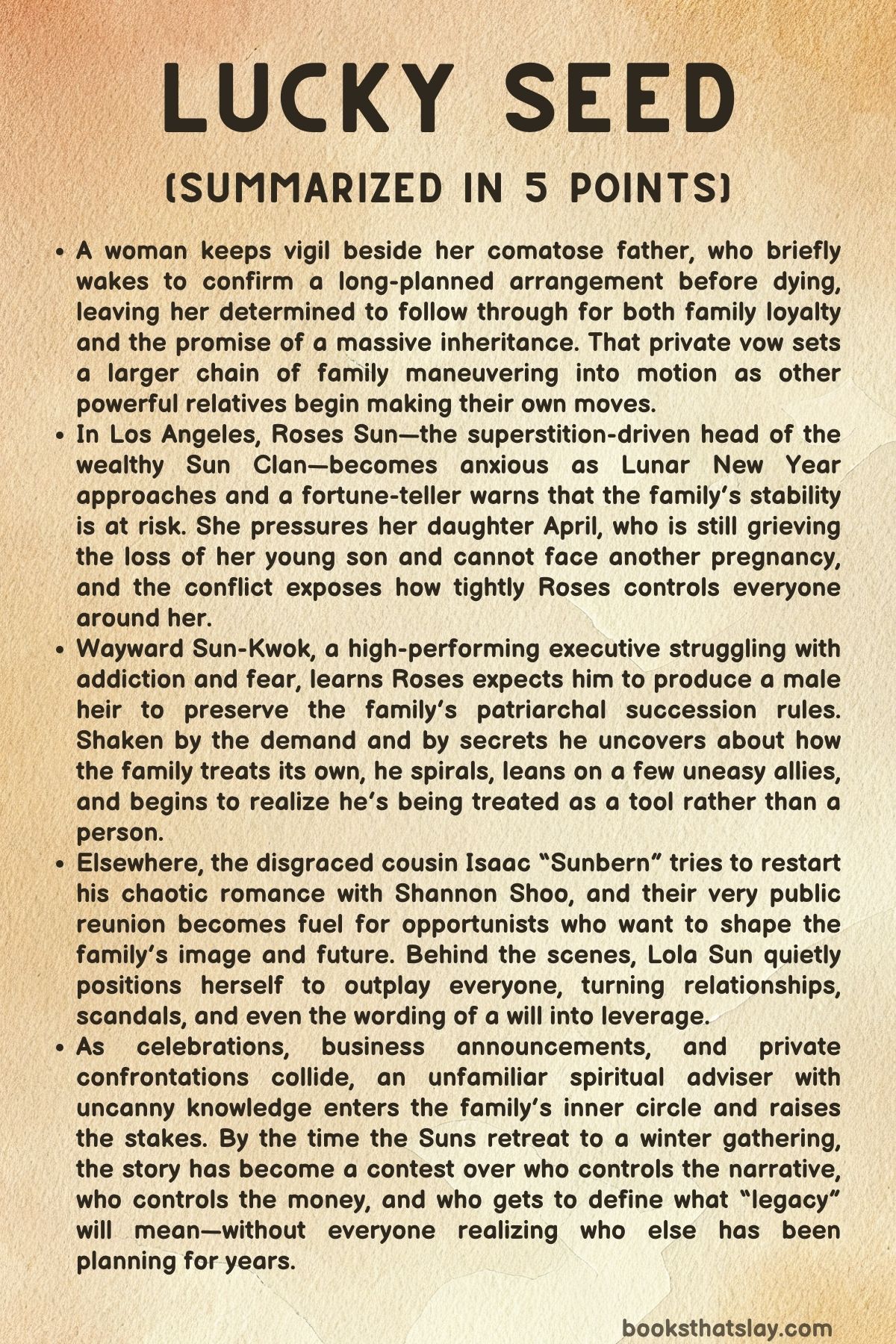
The novel begins with a mysterious scene: a woman sitting beside her dying father, who briefly awakens to confirm that their secret plan is in motion before dying peacefully. His daughter, though grief-stricken, resolves to fulfill his wish, knowing it could determine the future of their immense fortune.
From there, the story centers on Roses Sun, the imperious matriarch of the Sun Clan in Los Angeles. As the Lunar New Year nears, she grows anxious—this year marks her own zodiac year, a time she believes invites misfortune.
Her Hong Kong fortune-teller, Master Chu, warns her that the Suns’ good days may soon end. Disturbed, Roses begins devising a plan to protect her family’s empire, Sunfang Global.
Her daughter April, meanwhile, struggles under Roses’s shadow, juggling a faltering marriage to Cristiano and the grief of losing her young son, Lewis. Their breakfast confrontation reveals both women’s pain: Roses clings to ancient traditions, while April rejects them, exhausted by expectations she can’t meet.
Elsewhere, Roses’s sister Iris is in Mongolia, scavenging an abandoned airfield for a relic tied to family history. Once glamorous and calculating, Iris is now consumed by secrets.
When she receives news that Roses is calling for a rare family dinner, she knows something major is brewing. Iris flies back to Los Angeles, determined to confront her sister.
Other members of the Sun Clan emerge, each bearing their own burdens. Isaac “Sunbern” Sun-Bernard, once a famous model, now sells his body to survive, haunted by his mother Hyacinth’s disapproval and his scandalous breakup with his ex-fiancée, Shannon Shoo.
His cousin Lola, ruthless and cunning, manages his work while secretly manipulating him to secure the Sunfang inheritance for herself. Meanwhile, Wayward Sun-Kwok, Iris’s son and Roses’s nephew, works at Sunfang Global, fighting to modernize the family’s empire while battling addiction and inner demons.
At a tense board meeting, Wayward’s progressive sustainability proposal is mocked by older executives, and Roses—his powerful CEO aunt—cuts him down in private. Yet she also hints at an opportunity: the company’s presidency could be his, if he ensures the continuation of the male bloodline.
The suggestion horrifies him. When Iris returns and learns of this, she recognizes Roses’s dangerous intentions: to manipulate Wayward into producing a male heir to fulfill an old family prophecy.
Iris vows to stop her sister’s scheme, recruiting April to join forces.
Meanwhile, Sunbern attempts to win Shannon back at a chaotic restaurant meeting that devolves into a public argument—and then into an impulsive sexual reunion, which goes viral online. Their rekindled scandal inadvertently fuels Roses’s fears about the family’s “hungry ghosts,” spirits that must be appeased through lineage.
Master Chu insists the family’s fate depends on Wayward, whom he calls the “lucky seed.”
Wayward’s downward spiral deepens. Haunted by the revelation of his mother’s lies and Roses’s manipulations, he relapses after an emotional confrontation with Iris.
April, suspicious of her mother’s phone calls, secretly listens in and learns that Roses and Hyacinth deliberately leaked the scandal that destroyed Sunbern’s career, calling it their “nuclear option.” Horrified, April alerts Iris.
Lola, ever calculating, realizes that the Sunfang fortune will go to the first male descendant born of any grandchild if no direct grandson exists. Determined to win, she pushes Sunbern and Shannon toward having a baby, convincing them that a child could redeem their public image.
Unbeknownst to them, Lola intends to use this potential heir for her own advantage.
As tensions rise, Iris and Roses finally clash face to face in the Sunfang offices. Iris accuses her sister of stealing her plan, of manipulating Wayward, and of betraying family bonds.
Bessie, Wayward’s assistant, secretly witnesses their fight. Shaken, she later finds Wayward attempting suicide on the rooftop, but he survives when a gust of wind prevents his fall—something Roses interprets as divine proof of fate.
Roses’s belief in prophecy only intensifies. April discovers her husband Cristiano has been secretly aiding Roses’s scheme, believing it will secure their family’s future.
Feeling utterly betrayed, April plans revenge. During the Suns’ lavish Lunar New Year gala, every hidden tension erupts.
April and Cristiano’s marriage implodes in front of guests, Wayward’s ex-lover Jamaal reappears at Roses’s invitation, and the enigmatic Galahad Chu—Master Chu’s supposed grandson—arrives, claiming to guide Roses spiritually. But when Wayward rejects him, Galahad drugs and nearly assaults him before the party descends into chaos.
April, in fury, sabotages the mansion’s water system, flooding the estate during Roses’s triumphant speech. Amid the ruin, April and Cristiano’s relationship collapses violently.
In the aftermath, the family scatters. Months later, Roses continues consulting Galahad, unaware that Master Chu has been dead for over a year.
Wayward becomes Sunfang’s president and enters a secret surrogacy with Bessie while pretending loyalty to Roses. April, pregnant and estranged, hides with Cristiano and their daughter.
After escaping him, she reveals she’s carrying his son.
The final act unfolds at the Suns’ mountain retreat in Big Bear. The surviving family gathers, and Wayward announces that his baby with Bessie is a girl—not the expected boy.
Roses’s faith in prophecy wavers. Then Cristiano boldly promises that April will bear a son, just as Lola—long presumed dead—returns, shocking everyone.
At that moment, the truth unravels: Galahad is exposed as Galahad Fang, descendant of the rival Fang Clan. Tingting Fang, George Sun’s estranged wife and mother to Lola, reveals her hand in the years-long feud.
Her secret weapon is Felicia, Lola’s sister, who has transitioned to male and is now known as Fenix Sun—the only legal paternal grandson of Big Boss Sun, and thus the true heir to the Sunfang Trust.
A flashback exposes the origins of this power struggle: Tingting’s marriage to George was arranged to unite the Sun and Fang clans. But when Roses undermined them through superstition and manipulation, Tingting vowed revenge.
She partnered with Galahad and her transformed child Fenix to reclaim what was once promised to her bloodline.
The confrontation reaches its peak when Tingting smashes Big Boss Sun’s stolen ashes, symbolically ending his rule. Iris races to stop her but crashes en route.
Roses breaks down, clutching the fragments of the urn, while the rest of the family walks away in silence. Lola, ever the survivor, forces Cristiano into exile through blackmail and then releases her pit bull, Houyi, to maul Galahad, exacting her final vengeance.
In the aftermath, Fenix becomes the rightful heir, but the family fortune is frozen due to Wayward’s strategic loans. Wayward steps aside as president, moving to Brazil with Jamaal and their baby daughter, Jamala.
April gives birth to her son after learning her lover Chinoiserie is dead but has left her a vast inheritance.
The novel closes during another Lunar New Year. The Suns gather to reinter Big Boss Sun’s ashes.
Wayward and Jamaal propose marriage, April reclaims her power as an international investor, and even Roses, humbled, begins to share her control. The final scenes show each surviving family member finding fragile peace, their future uncertain but free from the weight of old ghosts.
In the end, Lucky Seed reveals that legacy is not about bloodlines or omens—it’s about the courage to break the cycles that bind us.
Characters
Roses Sun
Roses is the story’s gravitational force: a matriarch whose authority is so complete that even her fear becomes policy. She runs Sunfang Global as CEO, governs her Malibu compound like a court, and treats superstition not as personal comfort but as executive strategy.
Her obsession with entering her zodiac year and her reliance on prophecy show that her power is built on a paradox: she appears ruthlessly modern in wealth and influence, yet she clings to ancestral logic about “hungry ghosts,” bloodlines, and male heirs. Roses’s deepest vulnerability is not sentimentality but uncertainty; when she stops hearing the “baby crying” she interprets as fate, she spirals, revealing how dependent her confidence is on signs that confirm she is chosen.
Her cruelty is often framed as duty—exiling April, separating Meadow from her mother, deploying “nuclear” scandal tactics—yet the narrative repeatedly exposes that her “duty” is also a personal addiction to control. By the end, her collapse over the shattered urn makes her feel briefly human, not redeemed, but cracked open by the one loss she cannot intimidate into reversing.
April Sun
April is the emotional conscience of the family, not because she is pure, but because she refuses to let the Suns’ logic feel normal. She is shaped by grief—especially the death of Lewis—and by the bodily finality of trauma that makes “try again” impossible on command.
Her relationship to her mother is defined by suffocation: Roses’s dominance turns April’s home into an extension of corporate hierarchy, where April is both daughter and subordinate. April’s drinking, volatility, and public unravelings are not presented as random messiness; they are the visible cost of being trapped in a lineage machine that treats her womb as a corporate asset.
Yet she is also capable of decisive sabotage and cold planning, as seen when she triggers the mansion flooding and later navigates exile, pregnancy, and escape. April’s arc becomes a struggle to reclaim authorship over her life—first from Roses, then from Cristiano, and finally from the myth that the family’s legacy is the only story worth living.
Cristiano
Cristiano is one of the book’s most unsettling portraits of a “useful” man inside a matriarchal empire: he is close to power, benefits from it, and still behaves like someone who believes entitlement will save him. He presents as a family-oriented father and supportive husband, but he repeatedly reveals a talent for betrayal when incentives align—convincing Wayward to become a father, aligning with Roses behind April’s back, and weaponizing Lewis’s death during their public fight.
His intimacy is transactional; even sex becomes a tool for dominance, most horrifyingly when he forces himself on April amid chaos. Cristiano’s cowardice shows in how quickly he flees when the family’s counterforce arrives, and his ending—coerced into disappearing and surrendering custody—feels less like punishment from a court than the inevitable outcome of a man who mistook proximity to a dynasty for immunity.
Meadow
Meadow functions as both character and symbol: she is the living future everyone claims to protect while using her as leverage. Her innocence highlights how the adults weaponize family language—custody, safety, legacy—to justify control.
When Roses insists Meadow stay with her, Meadow becomes proof that the matriarch’s love is inseparable from possession. At the same time, Meadow motivates April’s will to fight; she is the reason April’s despair turns into “war,” the reason April cannot simply self-destruct, and the reason the family’s schemes feel urgent rather than abstract.
Teddy
Teddy appears mild, almost backgrounded, but his quiet observations—like recognizing the “baby crying” is probably a coyote pup—make him a subtle counterpoint to Roses’s prophetic certainty. He represents the kind of spouse who survives by not challenging the throne, absorbing eccentricity and cruelty as “just how it is.” His gentleness is not framed as heroism; it reads more like adaptation, a strategy for living near a storm without being struck, which also makes him complicit through passivity.
Iris Sun-Kwok
Iris is the family’s shadow strategist: elegant, calculating, and emotionally armored by years of distance and secrets. Her global searching through abandoned cargo planes suggests she has been chasing an object or truth that matters more than comfort, and her return to Los Angeles signals that she views Roses as a threat requiring direct confrontation.
Iris’s complexity comes from her duality—she recognizes the family’s brutality and still plays its games better than most, threatening sibling votes, exposing scandals, and thinking in leverage rather than pleas. Her relationship with Wayward is painfully fractured; she wants to protect him but cannot offer the honesty he demands, and her absence has become its own wound.
Even her crash on black ice feels thematically aligned with her role: the person racing to stop catastrophe, injured not by an enemy’s blade but by the cold reality of forces already in motion.
Wayward Sun-Kwok
Wayward is the book’s portrait of a modern heir trapped in an ancient script. Professionally, he is driven and idealistic, trying to pitch sustainability inside a company built on patriarchal inheritance and boardroom cruelty.
Personally, he is fragile in ways the family pretends not to see: a recovering addict whose stress manifests as panic, relapse, and a near-suicide attempt. What makes Wayward compelling is that he does not simply “fall”; he oscillates between collapse and clarity, between wanting to flee and wanting to prove he belongs.
The demand that he father a son exposes the core insult of his life in the clan—years of loyalty reduced to breeding criteria—and his disgust becomes the moral shock that punctures the family’s rationalizations. His eventual turn toward building Promessa by borrowing against the trust reads like his first truly independent power move: he uses the dynasty’s machinery to create an escape hatch, not just for himself, but as a way to re-route the future away from Roses’s prophecy economy.
Bessie Machado
Bessie begins as a competent assistant, but she evolves into something rarer in this world: a witness who becomes an anchor. Her concern when Wayward goes missing, her decision to follow Iris, and her rooftop intervention show courage that is not performative; she steps into danger without the shield of being a Sun.
Bessie’s intimacy with Wayward is built on emotional labor and honesty—she is the person he can cry with, confess to, and be seen by without being turned into a pawn. When she becomes part of the surrogacy story, it also complicates her: she is both helper and participant, navigating love, ambition, and the moral ambiguity of making a child inside a dynastic war.
Her role suggests that chosen family might be the only antidote to inherited cruelty, even if it still requires bargaining with the system.
Kat
Kat’s presence reinforces the idea that the Sun saga spills into the lives of outsiders who did not consent to its rules. As Bessie’s girlfriend and one of Wayward’s allies, she is positioned as part of a small supportive triangle that contrasts with the clan’s manipulative intimacy.
Kat also represents the normalcy Wayward keeps reaching for—simple loyalty, partnership, concern—yet even that normalcy is forced to exist in the shadow of a mansion where floods, speeches, and surveillance define family life.
Jamaal Golightly
Jamaal is both love interest and moral mirror for Wayward. As a teacher, he embodies grounded purpose, and his reaction to Roses’s demand—appalled, incredulous—clarifies how distorted the Sun family’s expectations are.
Jamaal’s past with Wayward is marked by pain tied to addiction, making him cautious about being pulled back into chaos, yet his lingering love is real enough to reopen wounds when Roses tries to use him as bait. His eventual partnership and proposal with Wayward, and their shared parenting of their daughter, feel like a hard-won alternative blueprint: intimacy not based on bloodline performance, but on mutual choice and survival.
Isaac “Sunbern” Sun-Bernard
Sunbern is the clan’s fallen idol, a character built out of exposure—tabloids, scandal, commodified sexuality, and the hunger to be wanted even when it destroys him. Once the golden boy, he is now physically and emotionally wounded by escort work, and his decline reads as both personal tragedy and family policy outcome: the Suns are willing to burn one of their own to maintain control.
His attachment to Shannon is obsessive and theatrical, mixing genuine longing with addiction-like compulsion, and his eagerness to reignite “SunShoo” shows how he confuses publicity with intimacy. Sunbern’s sensitivity is real, but it is constantly exploited—by Lola, by Roses, by Hyacinth—making him a tragic example of what happens when a dynasty treats vulnerability as a weakness to monetize or punish.
Shannon Shoo
Shannon is introduced as an object of scandal and desire, but her real power is intellectual and predatory in the most strategic sense. She understands narrative, leverage, and how to turn humiliation into a bargaining chip, which is why her confrontation with Sunbern can flip instantly from rage to performative passion that trends nationwide.
Shannon’s charm is a weapon; she uses it to infiltrate Hyacinth’s trust, to access family secrets, and later to subdue SANTI through blackmail once she realizes he is a fraud. The book refuses to make her purely victim or villain—she is both someone harmed by a leak and someone capable of harm—yet what stands out is her adaptability.
In a family where everyone plays spider-and-fly, Shannon is the outsider who learns the web faster than the heirs who inherited it.
Lola Sun
Lola is the story’s purest practitioner of dynasty logic: she sees the family as a system of predators and decides to become one on purpose. Sharp-tongued, calculating, and relentlessly ambitious, she manages Sunbern’s escort life, funnels money, and keeps him emotionally dependent, all while planning to seize the Sunfang Trust.
Her fixation on the will’s conditions reveals her as someone who treats law and blood as game mechanics to exploit. Yet Lola is not just cold; she is shaped by childhood isolation, resentment toward her father’s capitulation, and the rupture with her sister Felicia, which leaves her craving control over any bond she cannot guarantee.
Her final dominance over Cristiano, and her decision to unleash Houyi on Galahad, show that she has become the kind of force she once feared—someone who believes chaos is acceptable if it yields order for her.
Hyacinth Sun-Bernard
Hyacinth is a portrait of maternal love corrupted by obsession with reputation and spiritual rationalization. She disapproved of Shannon and framed it as concern, but her later participation in the “nuclear option” leak reveals a willingness to destroy others to “protect” the family’s image and her son’s standing.
Hyacinth’s vulnerability is her longing for meaning, which makes her susceptible to cultish figures like SANTI and to manipulation through romance mythology, such as the story of the French boy with heterochromatic eyes. She is not simply naïve; she is hungry—for explanation, for absolution, for a narrative that makes cruelty feel righteous.
Her careful gathering of Big Boss Sun’s scattered ashes at the end suggests a capacity for tenderness, but it is tenderness built on devotion to symbols rather than to living boundaries.
Lewis
Lewis’s presence is mostly in absence, but he is one of the book’s central emotional stakes. His death is the fracture that turns April’s body into contested terrain and transforms family pressure into something violent.
Lewis is also weaponized: his memory becomes a tool for blame, shame, and coercion, especially when Cristiano uses the tragedy to humiliate April. In that sense, Lewis functions as a ghost within the “hungry ghosts” framework—not as superstition, but as real grief that the family cannot honor without turning it into leverage.
Chinoiserie
Chinoiserie is a crucial figure because they offer April a vision of life outside Roses’s jurisdiction, even if that refuge is complicated and ultimately destabilized. Their relationship with April represents chosen intimacy, secrecy, and the possibility of being valued for more than lineage.
The revelation that Chinoiserie died months earlier, alongside evidence that April arrived alone, reframes their role into something haunting: whether as literal loss, psychological refuge, or a relationship remembered through fog, Chinoiserie becomes the embodiment of how trauma and isolation can distort time and certainty. Their estate leaving April as primary beneficiary also flips the power dynamic—April’s future is no longer dependent only on Sun money, which weakens Roses’s favorite weapon.
Houyi
Houyi, April’s dog, is more than background; he is companionship when human relationships are unsafe. April sobbing to Houyi shows how completely she lacks a secure listener within the family, and Houyi becomes a physical extension of loyalty without manipulation.
When Lola later unleashes Houyi on Galahad, the dog becomes an instrument of justice in the Suns’ language—violence deployed as consequence—while still retaining the emotional meaning of being the one creature whose loyalty was not bought.
Master Chu
Master Chu begins as the mystical authority Roses uses to justify her anxieties, a fortune-teller whose warnings (“good days may be numbered”) give superstition the weight of strategy. His prophecy about the “lucky seed” is the lever that moves the plot, persuading Roses that destiny is not just possible but required.
The later discovery of his mummified corpse—dead for a year—turns him into a symbol of how easily the powerful can be manipulated when they need certainty. In death, he becomes the ultimate indictment of Roses’s reliance on prophecy: she wasn’t guided by wisdom, she was steered by a vacuum filled by an impostor.
Galahad Chu, later revealed as Galahad Fang
Galahad is the book’s con artist-mystic, a character who weaponizes intimacy, surveillance, and spiritual language to infiltrate a dynasty already primed to believe in fate. His ease at unnerving April with private knowledge shows that his “mysticism” is powered by information, not insight, and his seduction of a drunk Wayward—paired with offering drugs—reveals a predatory understanding of weakness.
Galahad’s true talent is reading what each Sun craves: Roses wants prophecy, Wayward wants escape, April wants justice, and he tries to turn those cravings into openings. His eventual unmasking as Fang-aligned reframes him as an agent in a long revenge strategy rather than a lone trickster, and his fate on the dock—attacked by Houyi—feels like the story’s verdict on someone who thought chaos was only a tool, not a force that bites back.
“Theo G”
“Theo G” is less a person on the page and more a signal flare of the Suns’ hidden infrastructure—an implied fixer or specialist connected to escalation after scandals. The fact that Roses and Hyacinth can casually reference an external operator suggests the family’s power includes outsourced expertise in suppression, intimidation, and narrative control.
Even without full detail, Theo G functions as proof that the Suns’ violence is not always emotional; it can be procedural, professional, and planned.
SANTI
SANTI is the cultish predator dressed as spiritual teacher, thriving on the vulnerability of wealthy followers like Hyacinth. His attempted assault of Shannon exposes the core truth beneath his “healing” persona: domination.
The fake heterochromatic lenses are a perfect emblem of his role—manufactured mystique used to exploit longing—until Shannon reverses the power dynamic by blackmailing him. SANTI is important because he shows that the Sun family’s world attracts parasites who understand that money and superstition are an easy harvest together.
George Sun
George is a quieter pillar of the clan’s political architecture, defined by compromise and the consequences of it. His earlier decision to step aside and let Roses seize power becomes the origin story for Lola’s worldview, marking him as the man whose softness taught the next generation to be sharp.
The revelation that he is tied to the phone-recording capability, framed as a “nuclear option,” places him at the intersection of family governance and authoritarian surveillance. George’s tragedy is that he seems to believe he is keeping the peace, but his peacekeeping creates a system where everyone else must become more ruthless to survive.
Tingting Fang
Tingting is the saga’s long-game architect, driven by humiliation, clan politics, and the brutality of being treated as a womb for diplomacy. Pushed into marriage with George to “produce a boy,” she learns to think in timelines rather than arguments, and her eventual orchestration of surveillance and chaos shows a mind that can out-wait any opponent.
Tingting’s fury at Roses is not just personal; it is historical, tied to what the Fangs believe was stolen. Smashing Big Boss Sun’s urn is her most symbolic act: she attacks not the company first, but the myth at the center of the Sun universe.
Tingting represents vengeance that has matured into governance—she does not merely want to hurt the Suns, she wants to rewrite the inheritance story in her clan’s favor.
Big Boss Sun
Big Boss Sun exists as legacy more than character, but his influence is everywhere: the company empire, the patriarchal succession rules, the will that turns birth order into battlefield. Even in death, he remains a resource to be stolen, intercepted, and shattered, which shows how thoroughly the Suns treat ancestors as assets.
The burial and re-interment of his ashes highlight the clan’s fixation on ritualized legitimacy—his body becomes a symbol everyone fights to possess, because possessing him means possessing the right to claim the future.
Big Boss Fang
Big Boss Fang is the counter-legacy, the patriarch whose exclusion fuels the Fang clan’s grievance and strategy. His recognition of Felicia’s gender identity as a potential political key shows a chilling pragmatism: even authenticity can be folded into inheritance warfare.
His funeral scene, where alliances form and long plans are offered, frames him as the origin point of the Fang retaliation—not necessarily kinder than Big Boss Sun, but equally willing to treat family identity as a lever in a dynastic machine.
Felicia Sun, later Fenix Sun
Fenix is one of the most conceptually pivotal characters because he collapses the Suns’ obsession with “male heirs” into an outcome they did not anticipate and cannot control. Formerly Felicia, later transitioned and legally recognized as male, Fenix becomes the true heir through the very patriarchal clause the Suns relied on, turning their worldview against them.
What makes Fenix compelling is the contrast between personal identity and institutional consequences: his gender is real, but it is also weaponized by clan politics, making him both person and proof-of-claim. His interaction with Wayward—gratitude for immediate acceptance and agreement to step into leadership—suggests a steadier temperament than many Suns, and his rise implies a new era where legitimacy is legal and personal rather than purely mythic, even if it was achieved through manipulation.
Jamala
Jamala, Wayward and Jamaal’s daughter, represents the story’s final rebuttal to prophecy. Her being a girl—after everyone assumed a boy—undercuts the obsession that drove so much cruelty, and it forces characters like Roses to confront how wrong certainty can be.
Jamala’s presence in the epilogue, raised in a quieter chosen-family arrangement with Iris nearby, turns “legacy” into something softer: not a bloodline weapon, but a life built with intention rather than coercion.
Themes
Power and Legacy
In Lucky Seed, the pursuit of power and legacy defines every choice the Sun family makes, shaping both their relationships and moral decay. The Sun Clan’s wealth is not simply material but spiritual and generational—a dynastic empire built on the myth of the “lucky seed,” the supposed guarantee of male succession.
Roses Sun, the matriarch, embodies this obsession, treating power as a birthright ordained by ancestry and cosmic design. Her relentless fixation on ensuring a male heir reflects an inherited patriarchal ideology disguised as tradition.
Despite her commanding presence, Roses remains bound to the same patriarchal values she claims to control, internalizing her father’s belief that only men can preserve the Sun name. This contradiction exposes how legacy becomes a form of enslavement: the very system the Suns sustain for prestige continually erodes their humanity.
Wayward’s confrontation with this ideology reveals the novel’s central irony—those who inherit power are also its prisoners. His rebellion, coupled with April’s refusal to be defined by reproductive expectations, begins dismantling the notion that family legacy must follow rigid lineage.
By the end, when Fenix—once Felicia—emerges as the true heir, the book redefines legacy as something fluid, inclusive, and self-defined rather than dictated by patriarchal descent. Power in this narrative is cyclical, devouring those who seek to master it, and Lucky Seed exposes how inherited empires perpetuate trauma under the guise of destiny.
Family and Control
Family in Lucky Seed functions as both sanctuary and battleground. The Suns’ interactions are steeped in manipulation, emotional coercion, and generational revenge.
Roses’s control over her children and siblings masquerades as protection, but it is fundamentally rooted in fear—fear of losing relevance, fortune, and spiritual balance. Every member of the clan becomes entangled in her schemes, revealing a family where love is indistinguishable from control.
April’s grief over her dead son and her struggle with infertility expose how maternal love can be twisted by expectation; her mother’s demand for another child is less about comfort and more about preserving the dynasty’s bloodline. Similarly, Wayward’s bond with his mother, Iris, oscillates between resentment and yearning, illustrating how parental absence can wound as deeply as parental dominance.
The Suns operate under an illusion of unity, but loyalty is transactional—each gesture of affection carries a cost. Control is exercised through secrets, surveillance, and spiritual manipulation, culminating in Roses’s collaboration with the false mystic Galahad Chu.
Even tenderness becomes strategic. The final scenes, where the surviving members gather in fragile reconciliation, underscore that family in this world is not a refuge but a mirror reflecting one’s capacity for cruelty and endurance.
Lucky Seed portrays the family not as bloodline but as a system of control that must be redefined to heal.
Gender and Inheritance
Gender roles in Lucky Seed are tightly bound to the Suns’ concept of inheritance. Women are tasked with preserving the dynasty yet are denied true authority within it.
Roses, Hyacinth, Iris, April, and Lola—all powerful in their own right—must navigate a world where legitimacy is tied to male heirs. Roses’s desperate attempt to produce a “Sun boy” reveals the internalized misogyny that governs the clan: even a woman who rules cannot imagine her empire without a man’s name attached.
April’s body becomes a battlefield for these expectations, her infertility treated as a spiritual and social failure. The narrative critiques how women inherit not only wealth but also the burden of sustaining male power structures.
Yet, within this constraint, each woman finds a way to subvert her role. Lola weaponizes sexuality and cunning to claim influence, while Iris uses intellect and strategy to counter Roses’s dominance.
The ultimate revelation—that Fenix, who transitions into a man, becomes the legitimate heir—reconfigures gender inheritance entirely. It questions whether identity or biology defines lineage and whether systems built on gendered hierarchies can ever evolve.
By intertwining generational power with evolving notions of gender, Lucky Seed reimagines inheritance as an act of transformation rather than replication.
Fate, Superstition, and Spiritual Manipulation
Throughout Lucky Seed, superstition and prophecy serve as both guidance and weaponry. The Sun family’s belief in fate—channeled through fortune tellers, omens, and ancestral curses—becomes a mechanism for control.
Roses’s dependence on Master Chu and later Galahad transforms spirituality into a political tool, legitimizing her authority and silencing dissent. Her conviction that destiny determines the family’s future blinds her to moral decay and allows exploitation under the guise of divine will.
The theme extends beyond mere superstition; it examines how faith can be corrupted by ambition. Every spiritual ritual, from the appeasement of “hungry ghosts” to the search for the “lucky seed,” is reinterpreted as a transaction—an exchange of morality for power.
Yet, spirituality also provides rare glimpses of redemption. Characters like Wayward and April reinterpret fate as personal agency rather than cosmic decree, choosing self-determination over prophecy.
The eventual exposure of Galahad’s fraud symbolizes the collapse of blind faith and the reclaiming of moral clarity. Fate, in the world of Lucky Seed, is never external; it is the reflection of human choices disguised as divine design.
The Suns’ downfall demonstrates how superstition, when wielded as control, can destroy both belief and believers.
Identity, Shame, and Reinvention
The Suns live in a perpetual struggle between public persona and private self. Their immense wealth and fame force each member to perform an identity that conceals deep personal fractures.
Sunbern’s fall from celebrity into self-destruction, April’s grief hidden beneath luxury, and Wayward’s concealed queerness all reveal how reputation becomes a cage. Shame operates as a family inheritance—passed down like the Sunfang fortune itself.
The pressure to embody perfection leads to addiction, betrayal, and psychological unraveling. Yet, Lucky Seed transforms this cycle through reinvention.
Characters reclaim identity by embracing vulnerability: Wayward’s recovery and open love with Jamaal signify liberation from generational shame, while Fenix’s transformation represents a literal rebirth that redefines what legitimacy means in a dynastic world. The novel suggests that true inheritance is not wealth or blood but self-knowledge—the courage to break the performance of perfection.
In dismantling the Suns’ illusions of identity, the story turns shame into possibility, revealing that survival depends not on preserving the family image but on rewriting it.
Corruption and Redemption
Corruption permeates every corner of Lucky Seed, from boardroom conspiracies to intimate betrayals. Wealth operates as both armor and poison, corrupting love, faith, and morality.
Roses manipulates spiritual beliefs for dominance, Hyacinth weaponizes motherhood, and Lola turns family loyalty into strategy. Yet, redemption lingers at the margins of this decay.
It arrives not through grand gestures but through fragile moments of empathy—Wayward comforting Iris, April’s quiet rebellion, Jamaal’s forgiveness. The novel refuses to offer moral absolution; instead, it portrays redemption as endurance, the willingness to live with brokenness and still seek meaning.
In the final chapters, where ashes are gathered and futures redefined, corruption does not vanish—it evolves into acceptance. Lucky Seed closes on a vision of imperfect healing: the Suns, stripped of illusion, begin to rebuild their legacy not through dominance but through understanding.
The story’s moral resolution rests in this recognition—that redemption is not purity restored but power relinquished.