Lucky Shot by Rebecca Jenshak Summary, Characters and Themes
Lucky Shot by Rebecca Jenshak is a contemporary sports romance that blends humor, love, and personal rediscovery. The story follows Ruby Madison, a struggling writer whose career is on the brink after a string of disappointments.
When she’s offered a second chance to publish an old manuscript—on the condition she rewrites it as a hockey romance—she’s thrown into a world she knows nothing about. Enter Nick Galaxy, a professional hockey player and single father, whose gruff demeanor hides a kind heart. As Ruby learns the sport and rebuilds her confidence, their unexpected connection turns into something that could change both their lives forever.
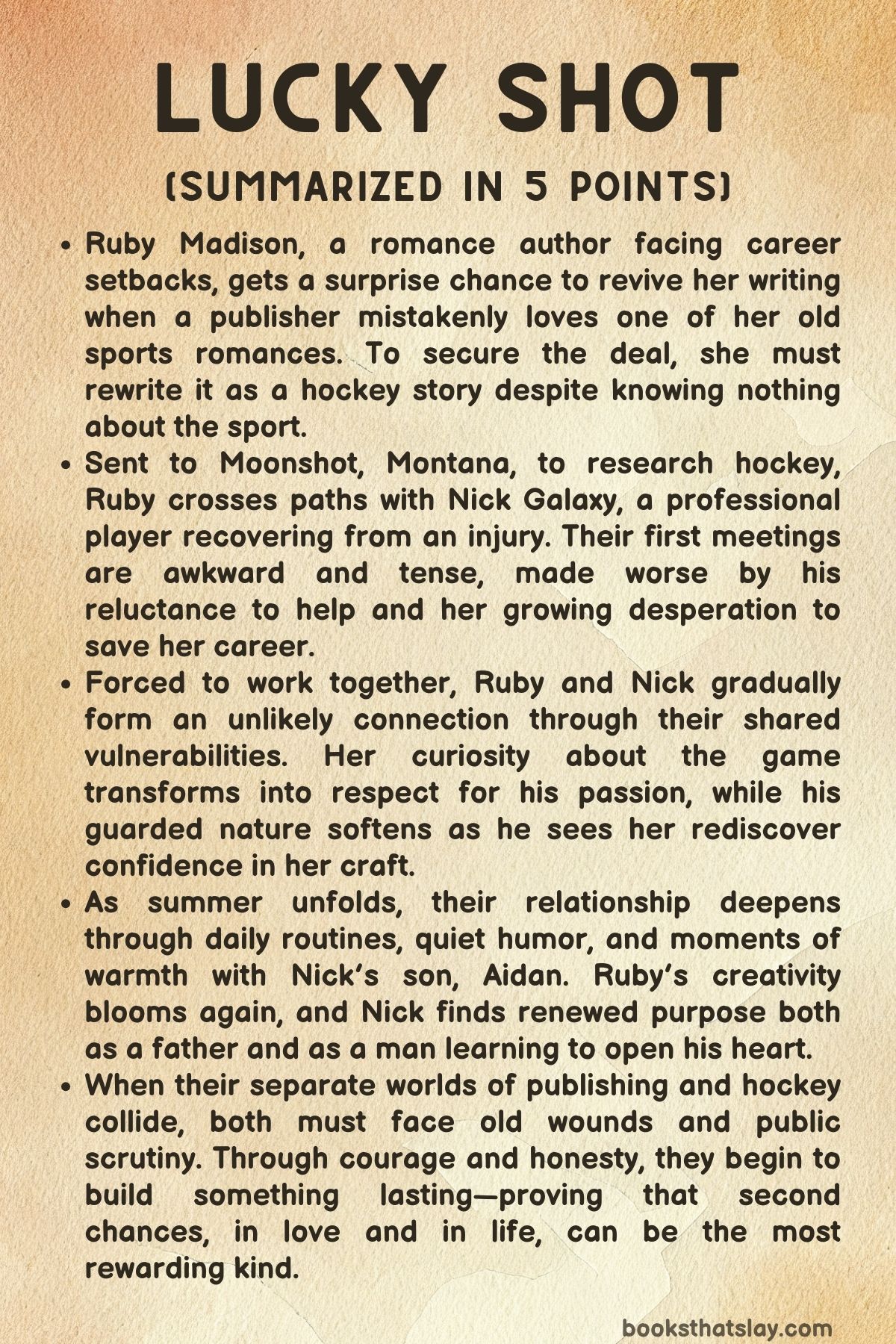
Summary
Ruby Madison, once a bestselling author of vampire romances, finds herself stuck in a creative slump. Her career has stalled after a poorly received novel and a painful breakup.
When her agent Molly arranges a surprise meeting with an editor from a major publishing house, Ruby’s stunned to learn the editor is interested in publishing an old manuscript—A Sporty Romance—that Ruby had long given up on. There’s one catch: the story’s sport needs to shift from baseball to hockey.
Ruby knows nothing about hockey, but the generous advance and looming deadline persuade her to take the deal. Determined to make the best of it, Molly arranges for Ruby to spend the summer in Moonshot, Montana, where she can research the sport and focus on her rewrite.
On her arrival, Ruby literally bumps into a brooding stranger at the airport, blurting out an awkward comment about dead bodies before fleeing in embarrassment. That man turns out to be Nick Galaxy, a professional hockey player and local celebrity returning home to recover from an injury.
When Ruby reaches her lakeside rental cabin, she discovers it’s next door to Nick’s property. Mike, Nick’s friendly and matchmaking father, had arranged Ruby’s stay, hoping it would help his son move on from his isolated lifestyle.
Nick, however, isn’t pleased with the unexpected tenant and keeps his distance.
Ruby tries to settle into her new environment, exploring Moonshot’s quiet beauty and preparing to start her research. But her first shock comes when she learns her assigned “hockey expert” is Nick himself.
Their initial interactions are tense—Nick is curt and uninterested in helping, while Ruby’s cheerful persistence only irritates him further. Yet when Ruby opens up about her struggles and how much this project means to her, Nick reluctantly agrees to give her some guidance.
Their first meeting at a local sports bar becomes unexpectedly warm as Nick explains hockey’s rules, strategies, and nuances. Beneath his guarded exterior, Ruby sees a man passionate about his sport and devoted to his young son, Aidan.
Despite their rocky start, circumstances keep pushing Ruby and Nick together. When Ruby ends up stranded at a sketchy motel, Nick—after worrying about her safety—shows up to check on her.
A frightening night convinces Ruby to accept his offer to stay at his cabin. The arrangement begins awkwardly, but they slowly find common ground.
Ruby learns about Nick’s demanding career, his injury, and his responsibilities as a single father. In return, Nick becomes intrigued by Ruby’s creative spirit and resilience.
Their daily interactions at the rink, where she observes his coaching sessions, reveal his gentler side as he patiently teaches kids, including his son and a shy young girl.
Over time, their relationship softens into friendship and then into something deeper. Ruby’s confidence begins to return as Nick’s honesty and humor reignite her creativity.
They share late-night talks, coffee by the lake, and teasing moments that blur the line between professional collaboration and personal connection. Ruby learns Nick was once a championship player who requested a trade to be closer to Aidan, sacrificing fame for family stability.
In turn, she confides about the betrayal that crushed her spirit—her ex-boyfriend, Matt, had stolen her book idea and turned it into a bestseller. Their shared vulnerabilities create an emotional bond that deepens as the summer progresses.
As Ruby rewrites her book, her new draft begins to mirror her experiences with Nick—the intensity, teamwork, and unexpected joy of rediscovery. Their chemistry builds through flirtation and shared experiences, culminating in a passionate night together after a day at a local youth hockey game and a team outing.
The following morning, they fall into an easy domestic rhythm, with Nick cooking breakfast and bringing coffee to her cabin. Their relationship flourishes quietly, filled with playful teasing and steady affection.
He becomes her muse, while she gives him a sense of warmth he’d been missing.
One day, Nick invites Ruby to join him and his teammates on a boat trip. The outing is lighthearted until Ruby spots a copy of Matt’s stolen novel, triggering painful memories.
Seeing her distress, Nick reacts protectively, throwing the book into the lake and earning laughter and cheers from his teammates. Ruby is touched but also embarrassed by the attention.
The incident underscores how much Nick cares and how much Ruby still struggles with her past. That evening, surrounded by friends and laughter, she realizes how far she’s come since her arrival—she feels at home again, not just in the world of writing but in life.
As summer draws to a close, Ruby finishes her rewrite and prepares to return to her old life. She and Nick part ways with promises to stay in touch, but both feel the weight of distance and uncertainty.
Back in the city, Ruby attends a major book convention arranged by her agent. To her dismay, her ex Matt is also there, still smug and dismissive.
While Ruby tries to focus on her event, she misses Nick and texts him about trivial things, like cookies, just to feel close again. Later, at the convention’s cocktail party, Matt’s arrogance and belittling comments test Ruby’s patience—until Nick unexpectedly appears in the crowd.
He’s traveled on his day off just to see her, and his sudden presence shocks her and delights the audience.
During a panel discussion, Matt mocks Ruby publicly, claiming she inspired a character he kills off. Nick interrupts from the back, asking Ruby to explain a dedication in her book “to my favorite grumpy hockey player,” revealing their relationship to the audience.
Afterward, they reunite with a kiss amid the chaos. Matt confronts them again, making snide remarks, and Nick finally punches him, much to everyone’s satisfaction.
Ruby drags Nick away before the situation worsens, laughing despite the scandal. Soon after, her editor offers her a three-book deal, cementing her professional comeback.
Ruby realizes her story has come full circle—she’s no longer the insecure writer who arrived in Montana.
Nick confesses he’s in love with her and wants a future together despite their busy lives. He gives her a hockey-stick pendant that symbolizes their bond.
Ruby, moved, admits she loves him too. When Nick returns to training camp, Ruby surprises him by visiting with the news that her book deal is finalized.
She announces she’s moving back to Moonshot to live with him and his family. Their reunion is joyful, supported by Mike and Nick’s teammates.
As winter arrives, Ruby, Nick, Aidan, and Mike settle into a cozy domestic life by the frozen lake. Aidan plays guitar as Nick proposes with a ring beside the fire, and Ruby says yes, surrounded by the family and peace she’d been searching for.
In the end, Lucky Shot celebrates second chances—in love, career, and self-belief. Ruby’s journey from creative burnout to fulfillment mirrors Nick’s path from injury and isolation to emotional openness.
Together, they rediscover not just passion but purpose, proving that sometimes, the most unexpected detours lead to exactly where you’re meant to be.
Characters
Ruby Madison
Ruby Madison stands at the heart of Lucky Shot as a deeply human protagonist whose creative struggle and emotional vulnerability drive the story forward. Once a celebrated author of vampire romances, she enters the narrative at a low point in her career and life.
Her creative spark has dimmed after professional setbacks, a devastating betrayal, and personal heartbreak. The offer to rewrite her old sports romance into a hockey-centered story becomes not just a job but a chance for redemption.
Ruby’s journey from insecurity to confidence parallels her rediscovery of passion—for both her craft and love.
Her clumsiness and humor mark her as relatable and endearing, while her emotional honesty makes her growth compelling. Initially self-conscious and hesitant, Ruby learns to take risks again, both professionally and personally.
In Moonshot, Montana, her awkward charm collides with Nick Galaxy’s guarded stoicism, sparking chemistry that evolves into genuine affection. Over time, Ruby transforms from an anxious, self-doubting writer into a woman who asserts herself, defends her work, and embraces vulnerability.
Her creative revival mirrors her emotional healing—by the end, she’s not only writing again but living with authenticity and joy.
Nick Galaxy
Nick Galaxy, the professional hockey player whose life intertwines with Ruby’s, embodies quiet strength and complexity. Recovering from an injury and juggling single fatherhood, Nick is initially portrayed as brooding and closed-off—a man hardened by experience but softened by responsibility.
His gruff exterior conceals deep loyalty, patience, and emotional depth. The presence of his young son, Aidan, exposes his nurturing side, revealing that beneath the stoicism lies tenderness and devotion.
Nick’s cautious approach to relationships stems from loss and disappointment—his failed partnership with Aidan’s mother and his mother’s death have made him wary of attachment. Yet Ruby’s persistence and sincerity break through his walls.
Their dynamic evolves from tension to mutual trust, allowing Nick to rediscover hope and companionship. As he mentors kids at hockey camp and reconnects with his teammates, his identity broadens beyond that of an athlete; he becomes a father, mentor, and lover who learns to balance all parts of himself.
Ultimately, Nick’s emotional growth complements Ruby’s creative rebirth, making him both her muse and her mirror.
Aidan Galaxy
Aidan, Nick’s young son, serves as both a grounding and illuminating presence in Lucky Shot. His innocence and warmth offer a counterpoint to the emotional guardedness of the adults around him.
Through Aidan, readers see Nick’s gentler side and Ruby’s nurturing instincts emerge. Aidan’s curiosity and acceptance create a bridge between Ruby and Nick, fostering their domestic bond and symbolizing the family that gradually forms.
He represents continuity and the future—a reason for Nick to strive for emotional stability and for Ruby to imagine a new kind of belonging. His interactions, especially his openness toward Ruby, reflect the novel’s themes of second chances and found family.
In his simple yet profound moments—encouraging his dad to “not be alone,” or approving Ruby as part of their life—Aidan anchors the story’s emotional center.
Mike Galaxy
Mike Galaxy, Nick’s father, injects warmth, humor, and wisdom into the story. A retired local with a mischievous streak, Mike is both a matchmaker and an emotional compass.
His decision to rent the lakeside cabin to Ruby—while perhaps meddlesome—sets the entire romance in motion. His actions stem not from manipulation but from love and a deep desire to see his son happy again.
Mike’s presence provides generational contrast, embodying an old-fashioned sense of family and community. His kindness toward Ruby offers her a sense of belonging she’s been missing, while his support for Nick underscores his role as a stabilizing force.
Even as he struggles with his own health and memories of loss, Mike maintains optimism and emotional insight. His subtle influence reminds both Ruby and Nick that love often requires a leap of faith.
Travis
Travis, Nick’s best friend and teammate, is the comic relief and loyal confidant of Lucky Shot. His charm, teasing humor, and irreverent attitude balance Nick’s intensity.
As a secondary character, he lightens heavy moments and encourages emotional honesty—often calling Nick out on his stubbornness or denial. Yet beneath his jokes lies sincerity; Travis genuinely wants Nick to be happy and recognizes Ruby’s positive impact on him early on.
Travis’s flirtatious banter with Ruby introduces playful tension, but it’s clear he respects the deepening connection between her and Nick. His role also foreshadows future stories within the same universe, hinting at his own potential for love and growth.
Ultimately, Travis embodies the camaraderie, loyalty, and humor that define Nick’s hockey family.
Molly
Molly, Ruby’s agent and friend, represents professional pragmatism and unwavering belief in Ruby’s talent. Her initial role as the instigator of Ruby’s trip to Moonshot catalyzes the entire plot.
While often brisk and businesslike, Molly’s actions reveal deep care—she pushes Ruby not out of ambition alone but because she refuses to let her client’s career fade. Throughout the story, Molly functions as a mentor and voice of reason, balancing the romance’s emotional intensity with realism about deadlines and the publishing industry.
By the end, Molly’s faith is vindicated as Ruby’s rewritten novel succeeds, securing a multi-book deal. Her persistence and savvy mirror Ruby’s evolution from doubt to self-assurance.
She’s the archetype of the tough but loyal friend who fights for others’ dreams, embodying the theme that true support sometimes comes in the form of a push rather than comfort.
Matt
Matt, Ruby’s ex-boyfriend and literary rival, is the story’s most prominent antagonist. His betrayal—stealing Ruby’s idea and profiting from it—represents the emotional and creative wound that drives much of Ruby’s insecurity.
At the book convention, his arrogance and mockery expose his moral bankruptcy. Matt’s condescension toward Ruby and athletes alike reinforces his role as a foil to Nick: where Matt is self-serving and manipulative, Nick is humble and sincere.
Matt’s presence is essential not just as conflict but as contrast. He symbolizes Ruby’s past—her pain, humiliation, and mistrust—while Nick embodies her healing and self-worth.
When Nick punches Matt after he belittles Ruby, it’s a cathartic moment of justice and affirmation. Through Matt, the narrative underscores the importance of integrity, loyalty, and believing in one’s truth even after betrayal.
Themes
Creative Identity and Renewal
Ruby’s journey in Lucky Shot centers on her struggle to rediscover her creative voice after a series of personal and professional setbacks. Once a bestselling author of vampire romances, she finds herself creatively paralyzed and emotionally drained following a failed book and betrayal by both a colleague and her agent.
Her assignment to rewrite an old sports romance into a hockey story forces her into an unfamiliar world, one that mirrors her own internal chaos. Through her immersion in Moonshot, Montana, Ruby learns to reconnect with the joy and spontaneity of storytelling.
The creative process transforms from an obligation into a healing act, one that rekindles her sense of purpose. Her bond with Nick Galaxy becomes a catalyst for this renewal—his discipline and passion for hockey remind her of the persistence art requires.
Ruby’s rediscovery of her creative confidence parallels Nick’s journey to trust himself again after his injury, creating a shared experience of rebuilding. By the time Ruby finishes her manuscript, writing has evolved from a job to a reclamation of identity.
Her art no longer stems from external validation but from authenticity and emotional truth, reflecting how creative revival often requires personal vulnerability and the courage to start anew.
Healing and Emotional Vulnerability
Both Ruby and Nick carry deep emotional wounds that shape their guarded exteriors. Ruby’s betrayal by her ex and her struggle with professional failure have left her cautious and self-deprecating, while Nick’s past injury, single fatherhood, and fear of disappointment keep him emotionally reserved.
Their relationship unfolds as a process of mutual healing, where shared vulnerability becomes the foundation of intimacy. Small acts—Nick offering her coffee, Ruby cheering at his son’s game, late-night conversations—slowly dismantle their defenses.
Nick’s willingness to share his insecurities about his career and fatherhood allows Ruby to confront her fears of inadequacy and failure. Their connection is not born of dramatic confessions but of steady trust, forged through humor, honesty, and presence.
The emotional honesty they cultivate transforms both of them: Nick reclaims a sense of belonging that extends beyond hockey, and Ruby learns that emotional openness is not weakness but resilience. By the novel’s conclusion, their love symbolizes the restoration of emotional balance through empathy, where understanding another person’s scars helps one accept their own.
Family, Community, and Belonging
The sense of family in Lucky Shot extends beyond blood ties to encompass chosen connections and communal warmth. Nick’s small-town life in Moonshot, with his father Mike and son Aidan, forms the emotional nucleus of the novel.
His home exudes stability and routine, yet beneath it lies a quiet loneliness stemming from years of responsibility and loss. Ruby’s arrival disturbs this equilibrium but ultimately completes it, weaving her into a network of care she didn’t realize she was missing.
The camaraderie among Nick’s teammates, the affectionate meddling of Mike, and Aidan’s innocent acceptance of Ruby all contribute to her feeling of belonging. For Ruby, who had been drifting through isolation and self-doubt, the warmth of this surrogate family becomes transformative.
The domestic scenes—shared meals, hockey games, and lakeside gatherings—emphasize that fulfillment arises not merely from success but from shared life. The theme highlights that love flourishes most when grounded in community, portraying family as an evolving structure built on affection, respect, and mutual support rather than conventional boundaries.
Resilience and Reinvention
Resilience defines both protagonists as they navigate personal and professional crises. Ruby’s willingness to accept the daunting hockey rewrite reflects her underlying tenacity, even when self-belief falters.
Her persistence through rejection, creative stagnation, and emotional hurt underscores the human capacity to rebuild. Nick’s injury and career uncertainty parallel Ruby’s creative struggles, forcing him to redefine his identity beyond his role as an athlete.
Both characters face the challenge of reinvention—Ruby as a writer reclaiming her voice, Nick as a man rediscovering purpose beyond the rink. Their growth emerges from setbacks rather than triumphs, emphasizing that resilience is not about unyielding strength but adaptability and humility.
By supporting each other, they transform obstacles into stepping stones for renewal. The narrative underscores that reinvention is not a single act but a continuous choice to evolve, portraying success as a journey of self-understanding rather than public recognition.
Love as Transformation
The romance between Ruby and Nick unfolds not as a fairytale escape but as a grounded evolution rooted in respect, vulnerability, and growth. Both characters enter the relationship hesitant, carrying emotional baggage that prevents them from trusting easily.
Their chemistry builds through shared effort—learning, teasing, arguing, and listening. Love becomes the medium through which they confront their fears rather than avoid them.
Ruby learns to believe in her worth, not just as a writer but as a partner capable of giving and receiving love without losing independence. Nick, in turn, learns that emotional connection does not weaken his focus or discipline but enriches it.
Their relationship evolves from reluctant acquaintance to profound partnership, illustrating how genuine love nurtures rather than consumes. The novel culminates in their engagement, not as a grand romantic gesture but as the natural result of two people who have helped each other become whole.
Love, in Lucky Shot, is not a destination but a mirror of personal growth—a reflection of how connection can transform self-perception, restore hope, and create the courage to begin again.