Made You Look Summary, Characters and Themes
Made You Look by Tanya Grant is a contemporary thriller set in the high-gloss, high-pressure world of influencers, brand deals, and curated online personas. When a group of creators travels to a remote luxury retreat to shoot campaign content, the trip is meant to be a career boost and a fun escape.
Instead, a string of “accidents” and escalating conflicts exposes how fragile their friendships really are. As the weather turns and their connection to the outside world is cut off, the group discovers that fame can be a weapon—and that someone among them is ready to turn their weekend into a public spectacle.
Summary
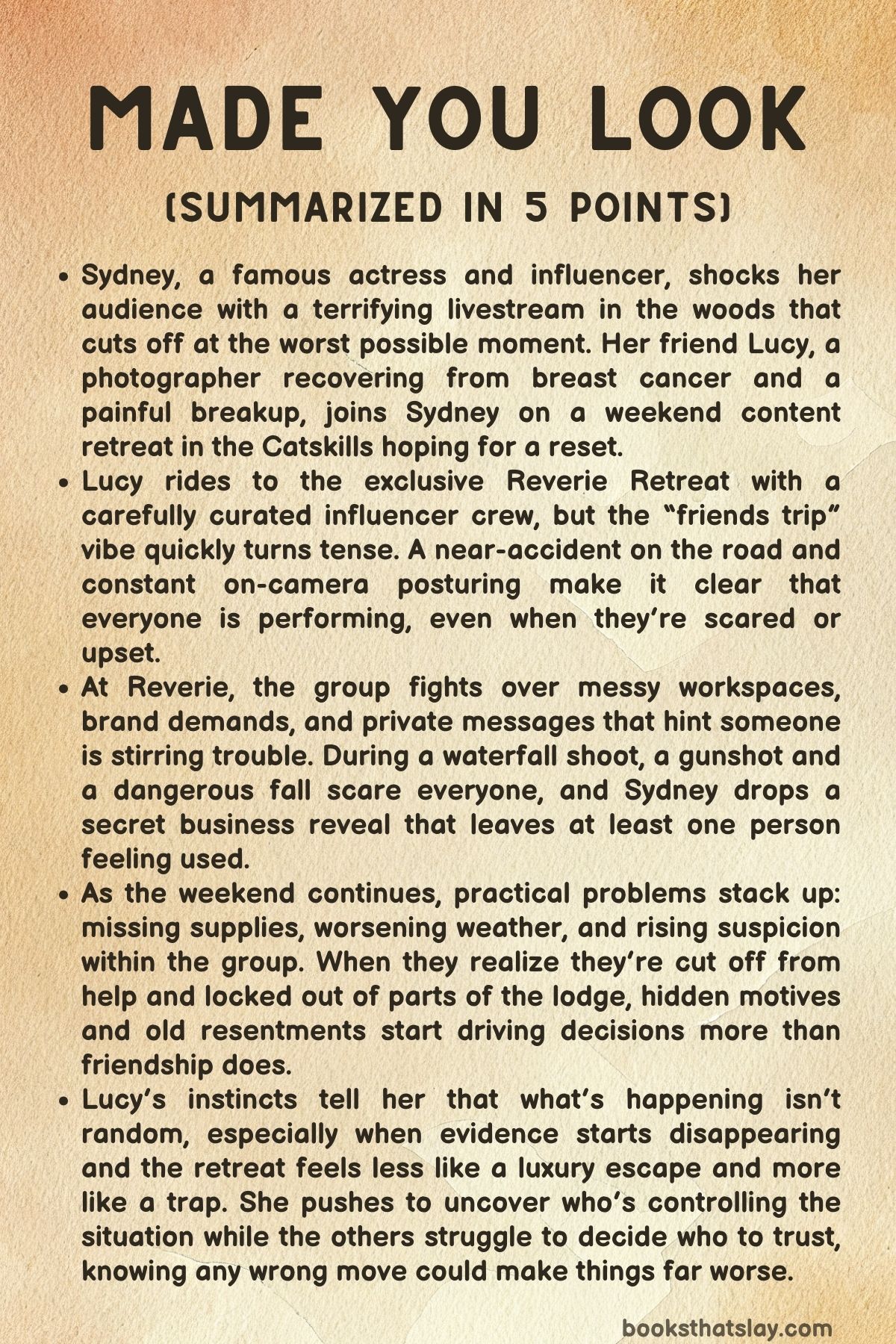
Sydney, a famous actress and social media star known for immersive story content, shocks her audience with a silent livestream: she is running through a forest in a white corset, bleeding from a cut on her arm and breathing hard, as if she’s being chased. Viewers can’t tell if it’s performance art or real danger.
She falls, a shadow looms, and the feed abruptly cuts out.
Not long before that moment, Sydney and her longtime friend Lucy are still trying to act normal. Lucy is a photographer and a breast cancer survivor who is struggling to rebuild her life after treatment.
Her engagement to Nick has deteriorated, and the distance between them feels permanent. Even leaving for a weekend trip hurts, especially because their dog Oboe will stay with Nick.
Lucy goes anyway, telling herself she needs the work and the change of scene.
Sydney arrives with her usual force of personality and sweeps Lucy into the plan: a content and fashion weekend in the Catskills at Reverie Retreat, a private luxury property not yet open to the public. On the party bus are Caitlyn, a lifestyle influencer who treats every moment as an ad; Nash, the group’s makeup artist and creative partner; Jeff, Sydney’s loud, attention-seeking boyfriend; and Brent, their manager, who tracks money, optics, and deliverables.
The group performs cheer and closeness for the camera, but Lucy keeps her distance. The drive turns shaky when the bus hits black ice and nearly crashes, setting an anxious tone they try to laugh off.
At Reverie, the setting is pristine and isolated: sleek cabins near a cliff, a glassy main lodge, and a waterfall trail through quiet woods. There’s no Wi-Fi in the cabins, and everyone must go to the lodge to post.
Caitlyn complains immediately, while Lucy focuses on getting untouched shots for the retreat’s sponsors. She nearly slips at the cliff edge while framing a photo, and Brent snaps at her to stay professional and stop letting her breakup distract her.
Inside the lodge, Lucy finds the interior already cluttered with makeup kits, clothing racks, and equipment, ruining the clean photos she needs. Caitlyn is livestreaming, and Lucy’s frustration is captured in real time.
Jeff needles her, and Lucy confronts him about sending Nick a strange message. Jeff denies it and claims he’s more worried about a missing drone.
Sydney pulls Lucy aside and tries to calm her down, borrowing Lucy’s cabin for a “story” video. Alone, Sydney films herself in a robe, teasing a mysterious project and inviting fans to guess what she’s planning.
The next day, the group hikes to the waterfall for a gown shoot. Along the trail, tension spikes when they hear a gunshot despite it not being hunting season.
They decide to stick together and continue. At the rocks near the falls, Caitlyn climbs for a dramatic pose when a rock drops from above and nearly smashes into her.
She slips and screams as she hangs on, then recovers, furious. Brent, who had been higher up, is bleeding and shaken and claims he slipped, but Caitlyn doesn’t believe it was simply bad luck.
Still, she insists they keep shooting, unwilling to lose content.
Lucy captures striking images, especially of Sydney, who knows exactly how to command a frame. Nash suggests a final concept: Sydney floating in the water with flowers arranged around her hair.
Sydney convinces Caitlyn to join, pressuring her into the freezing water for paired shots. Lucy photographs them side by side as the light fades, creating images that are beautiful but also unsettling in how carefully staged they are.
On the hike back, Sydney reveals what she’s been hiding: she and Nash have been developing a haircare line called Plentifol, and the retreat content is meant to support its launch. Caitlyn feels used—she’s been part of a campaign without consent—and her anger simmers under forced smiles.
Back at the lodge, basic planning falls apart. Brent has mishandled food arrangements, leaving them with almost nothing to eat.
Then Jeff discovers nude photos from his phone have been leaked through a hacked account. He orders Brent to fix it and insists Sydney can’t find out, terrified of the damage to his image.
That night, the group tries to reset with a swim in the indoor pool. Caitlyn receives a romantic gesture at her cabin door—a heart made of roses—and her complicated feelings toward Sydney spike again.
At the pool, the mood swings between playful and charged, especially during a private exchange between Sydney and Caitlyn that blurs friendship and attraction. When Lucy goes looking for towels, she finds multiple doors locked in the spa hallway.
Soon after, an out-of-season snowstorm begins outside, trapping them in the retreat’s isolation. For a brief moment, they treat the snowfall as a gift and pose for photos, but the calm doesn’t last.
Their situation becomes dire when a locked door becomes the focus of panic. Jeff tries to smash it open and dislocates his shoulder.
In the chaos, Lucy admits she has a master key because her cousin owns Reverie and asked her to help keep certain areas off-limits. She also admits she quietly arranged this job, hoping for a more equal, normal weekend with Sydney rather than the constant boss-and-employee dynamic.
Sydney feels betrayed, and the group’s distrust sharpens.
They use the key to search locked rooms for supplies and a way to communicate. They find storage closets and, finally, a radio—without batteries.
In a garage they find a golf cart, tools, a flashlight, a whistle, and duct tape. With no working communications, they decide someone must drive out for help.
Brent volunteers and leaves bundled in spare clothing, including Nash’s oversized pink fur coat, to follow the only road out. Caitlyn records the departure, arguing it could matter later, while Lucy is disgusted by how quickly tragedy becomes content.
After Brent leaves, the retreat feels smaller and more threatening. Lucy grows uneasy and hides information, including medication she fears could be misused.
Then the truth breaks through in pieces: the Wi-Fi router has been deliberately smashed, and Lucy realizes someone wants them isolated. When she later finds her camera destroyed and an SD card snapped, she understands someone is erasing evidence.
Looking at a backed-up photo, she notices something impossible—six cabins lit, even though only five should be occupied. In a window of the unused cabin, she spots the pink blur of the fur coat Brent wore.
Her conclusion is immediate: Brent never left.
Lucy runs to warn the others, and the confrontation explodes. Brent appears battered and claims he crashed the cart and spent the night outside, but his story doesn’t hold.
He turns violent, and Sydney and Caitlyn flee into the snow barefoot. Lucy discovers a hidden satellite router in the basement—proof that someone had secret internet access the whole time—and manages to connect long enough to call 911.
A scream cuts through the night, and Lucy races outside.
In the woods, Lucy starts livestreaming for help as chaos unfolds. She sees Sydney bleeding and Brent pursuing her.
Lucy tries to reach them but witnesses Brent stab Sydney. Then, in a brutal reversal, Caitlyn grabs Lucy and calls out to Brent, revealing she has been helping him.
Brent claims he killed to protect his career and control his clients. Caitlyn admits a more personal motive: she wants revenge for her brother Cole, and she believes Sydney was responsible for his death.
She also wants the attention that would come from being the “sole survivor.”
Caitlyn turns on Brent and shoots him in the head with a flare gun Lucy had secretly taken earlier. She plans to blame everything on him.
Lucy stops her by revealing the buried truth: years ago, Lucy killed Cole herself to protect Sydney from his abuse. Caitlyn, consumed by rage, points the flare gun at Lucy—until Sydney, still alive, crawls close enough to shove Caitlyn over the cliff.
Caitlyn falls to her death.
Lucy and Sydney, injured and exhausted, make it back toward the lodge as help finally closes in. Oboe arrives barking, followed by Nick, who came searching after seeing disturbing posts and footage.
Sirens approach, and the nightmare ends in the open, even as some secrets remain known only to the survivors.
Months later, Sydney recovers and launches Plentifol, dedicating it to Nash and establishing a scholarship in his name. Lucy and Nick reconcile and rebuild their life together.
The world consumes the story as content and inspiration, while Lucy and Sydney carry the private cost of what happened at Reverie—and the history that set it in motion.
Characters
Sydney
Sydney stands at the dazzling yet fragile center of Made You Look, embodying both the allure and danger of modern celebrity. A master of performance, she blurs the boundary between authenticity and spectacle, turning her life into an ongoing narrative crafted for her audience.
At the novel’s opening, Sydney’s live-streamed terror sets the tone—her bleeding, breathless panic seems real, yet her followers question whether it’s just another act. This duality defines her character: the tension between truth and performance, vulnerability and control.
Behind the confidence of a glamorous influencer lies a woman desperate for validation, haunted by guilt, and manipulated by her own ambitions. Her relationships—particularly with Lucy and Caitlyn—reveal her charisma and her blindness to the emotional costs of her stardom.
Sydney’s ultimate survival and reinvention through her brand Plentifol highlight her resilience, yet her recovery carries a bittersweet note: she rebuilds her image while the scars of betrayal and loss remain hidden beneath the gloss of success.
Lucy
Lucy serves as the emotional core of Made You Look, grounding the novel’s chaos in human fragility and perseverance. A breast-cancer survivor and photographer, Lucy approaches life through observation rather than spectacle.
Her struggle to reclaim identity after illness parallels her moral journey through deception, guilt, and redemption. Once Sydney’s closest friend and artistic partner, Lucy now exists in her shadow, torn between admiration and resentment.
Her trauma—both from her illness and from killing Sydney’s abusive ex-boyfriend, Cole—haunts her actions. Yet Lucy’s quiet strength grows as the story darkens.
Her discovery of the sabotage, her protection of others, and her confrontation with Caitlyn transform her from passive observer to active survivor. By the end, Lucy not only survives the physical ordeal but also reconciles with her past, reclaiming both her artistry and her agency.
Her reunion with Nick and her renewed bond with Sydney symbolize a hard-won peace rooted in truth, not illusion.
Caitlyn
Caitlyn’s journey in Made You Look is a descent into obsession masked by beauty and control. Initially portrayed as a shallow lifestyle influencer, she gradually reveals a calculating intelligence and a festering pain beneath her perfectionism.
Her resentment toward Sydney—fueled by envy and the death of her brother Cole—drives her toward manipulation and violence. Caitlyn represents the corrosive side of fame, where image becomes identity and revenge masquerades as empowerment.
Her alliance with Brent exposes her moral decay, as she transforms from victim of insecurity to architect of chaos. Caitlyn’s final unraveling—culminating in murder and betrayal—underscores how the relentless pursuit of attention can consume the self.
Her death, dramatic and cinematic, mirrors the performative nature of her entire existence: even in dying, she envisions an audience watching.
Brent
Brent embodies the exploitative machinery behind influencer culture in Made You Look. As a talent manager, he views his clients not as people but as commodities to manipulate for reach and revenue.
Initially a figure of authority and comic arrogance, he becomes increasingly sinister as the story unfolds. His greed and desperation to maintain control push him into deceit and violence, revealing the rot beneath the curated glamour of social media fame.
Brent’s complicity in murder and his alliance with Caitlyn expose his moral emptiness. His death at her hands is grimly fitting—a man who built his power on manipulation ultimately destroyed by the very vanity he exploited.
Brent represents the corruption of authenticity in the digital age, where connection is transactional and morality expendable.
Jeff
Jeff’s character oscillates between bravado and vulnerability, illustrating the hollowness of performative masculinity within the influencer ecosystem of Made You Look. As Sydney’s boyfriend and a self-styled provocateur, he thrives on attention, flaunting his body and humor for followers.
Beneath this façade lies insecurity and dependence on Sydney’s fame. His online scandals, jealousy, and emotional volatility expose how deeply entangled his identity is with digital validation.
Jeff’s eventual death underscores the fragility of those who live entirely for the gaze of others; his swagger cannot shield him from the consequences of deceit and isolation. Though often comic relief early on, Jeff’s arc becomes tragic—a warning about the emptiness of a life curated for likes rather than meaning.
Nash
Nash serves as both creative soul and moral compass within the volatile ensemble of Made You Look. As a makeup artist and Sydney’s collaborator, he brings genuine artistry and emotional sensitivity to a group dominated by ego.
His aesthetic vision and empathy make him one of the few characters motivated by beauty rather than ambition. Nash’s secret work on Plentifol’s formula hints at deeper complexities—he is idealistic but not naïve, striving to merge creativity with authenticity.
His death becomes a turning point that shatters the illusion of control within the retreat, forcing others to confront the real cost of deceit. Nash represents integrity in a world built on performance, and his loss marks the moral collapse of the group.
Nick
Nick, Lucy’s ex-fiancé, exists largely on the periphery of Made You Look, yet his presence anchors Lucy’s emotional evolution. His disappointment and withdrawal early in the story reflect Lucy’s inner disconnection after illness.
His reappearance at the end—arriving with Oboe and rescuing Lucy and Sydney—symbolizes the return of sincerity and stability amid chaos. Nick’s steadfastness contrasts sharply with the vanity of the influencer world, reminding Lucy of life beyond spectacle.
His renewed partnership with her suggests the possibility of rebuilding not just relationships but also trust and identity grounded in real emotion rather than curated images.
Oboe
Oboe, though a dog, carries quiet symbolic weight in Made You Look. As Lucy’s loyal companion, he represents innocence, unconditional love, and the life she seeks to reclaim beyond trauma and performance.
His reunion with Lucy at the novel’s close provides an emotional release, emphasizing survival, loyalty, and the persistence of genuine connection in a world corrupted by artifice.
Themes
The Illusion of Identity and the Performance of Self
In Made You Look, Tanya Grant explores how identity becomes a construct shaped by the gaze of others, particularly through social media. The novel portrays influencers like Sydney and Caitlyn, whose entire sense of self-worth depends on external validation, likes, and followers.
Their personas are carefully curated performances, designed for visibility rather than authenticity. Sydney, who broadcasts her fear and trauma online even in moments of real danger, exemplifies this obsession with self-display.
The line between performance and reality blurs so completely that both she and her audience lose the ability to distinguish what is real. Caitlyn’s desire to reclaim control over her public image—by becoming the “sole survivor” of a staged tragedy—reveals how identity in the digital age is not fixed but constantly rewritten according to perception.
Even Lucy, though not a social media figure, is complicit in this performance culture through her photography, which packages emotion and beauty into consumable images. Grant uses these characters to expose how the relentless demand for visibility transforms people into products and authenticity into a strategy.
The novel’s live streams, photo shoots, and online betrayals highlight the psychological toll of living in a world where selfhood is mediated through a lens, and where validation replaces intimacy. The digital self becomes both armor and prison, trapping individuals within versions of themselves they no longer recognize.
Female Friendship, Power, and Betrayal
The friendship between Sydney and Lucy forms the emotional center of the novel, marked by affection, envy, and unspoken hierarchies. Their relationship oscillates between empowerment and competition, reflecting how women’s friendships can be both nurturing and destructive in environments that commodify image and success.
Sydney’s charisma often dominates Lucy’s quieter resilience, and Lucy’s gratitude shades into guilt as she realizes how much of her career depends on Sydney’s influence. Their friendship becomes a mirror for the imbalance of power that fame and insecurity create between women—one constantly seen and one always behind the camera.
Caitlyn’s relationship with Sydney extends this theme further, turning admiration into vengeance. Her betrayal, motivated by jealousy and unresolved grief, demonstrates how rivalry and resentment can fester beneath the façade of female solidarity.
Grant avoids reducing these dynamics to simple jealousy; instead, she shows how systemic pressures—patriarchal validation, career hierarchies, and social media comparison—distort bonds that might otherwise be supportive. Even acts of care in the novel, such as Sydney’s forgiveness of Lucy at the end, are tinged with guilt and the need for absolution.
The theme underscores that betrayal between women is rarely just personal—it is often the byproduct of a society that teaches them to measure worth in comparison to one another.
The Corruption of Ambition and the Price of Fame
Ambition drives nearly every character in Made You Look, but Grant portrays it as both intoxicating and corrosive. Sydney’s pursuit of influence and success blinds her to the emotional costs of her curated perfection.
Caitlyn’s obsession with reclaiming fame through infamy reveals how ambition can mutate into moral decay. Brent and Nash’s manipulative involvement in the branding of Plentifol shows how professional aspiration in the entertainment world often justifies deceit and exploitation.
Lucy’s arc serves as a counterpoint—her ambition was once pure, rooted in artistic vision, but becomes compromised by association with a performative industry. Fame in the novel is portrayed not as achievement but as addiction, an unending hunger that feeds on approval and spectacle.
The retreat, with its isolation and artificial luxury, becomes a metaphor for the emptiness at the heart of influencer culture—a place where ambition turns inward and devours its creators. By the time the truth emerges, the cost of fame is measured in death, guilt, and psychological disintegration.
Grant exposes the paradox of ambition: it promises empowerment but demands submission to forces beyond one’s control.
Trauma, Guilt, and the Quest for Redemption
Lucy’s struggle with trauma—from her cancer, her near-death experience, and her past killing of Cole—anchors the novel in moral complexity. Her guilt manifests not only in her secrecy but also in her inability to connect fully with others.
Trauma shapes every choice she makes, often pushing her toward isolation and self-blame. Sydney, too, carries her own emotional wounds beneath her confident surface, using success to mask fragility.
When both women confront death and betrayal at Reverie, their survival becomes symbolic of confronting the buried pain that has governed their lives. Grant’s portrayal of trauma rejects melodrama; instead, it focuses on endurance and the slow, painful process of rebuilding identity.
Redemption in the novel is not achieved through public forgiveness or spectacle but through private understanding. When Lucy confesses her secret and Sydney forgives her, the act signifies release from the weight of guilt that has haunted them both.
The closing scenes, where they emerge scarred yet alive, affirm that healing does not erase trauma—it transforms it into resilience. Grant’s treatment of trauma emphasizes that survival is not just physical but emotional, requiring the courage to confront one’s past and reclaim agency.
The Manipulation of Truth and Media Spectacle
Throughout Made You Look, the manipulation of truth becomes a weapon—both for survival and destruction. From Sydney’s staged livestream to Caitlyn’s orchestrated massacre, the narrative repeatedly exposes how easily media can distort reality.
Every moment of crisis is filtered through a screen, reframed for engagement. What the public sees is never what actually happened.
The novel critiques a society addicted to spectacle, where authenticity becomes irrelevant and truth is valued only if it generates views. The viral nature of Sydney’s initial livestream sets the tone, suggesting that in the digital world, suffering itself becomes content.
Caitlyn’s desire to control the narrative by presenting herself as the “sole survivor” demonstrates the dark extremes of this phenomenon—the transformation of violence into performance. Even after the ordeal, Sydney capitalizes on her trauma to rebuild her brand, showing how the cycle of exploitation persists.
Grant presents this theme with chilling precision, suggesting that the greatest horror lies not in the violence itself but in the way it is consumed, edited, and repackaged. Truth, in this world, is never lost—it is monetized.