Merry Christmas, You Filthy Animal Summary, Characters and Themes
Merry Christmas, You Filthy Animal by Meghan Quinn is a fun and heartwarming holiday romance set in the festive town of Kringle, known for its year-round Christmas spirit. The story follows Max, the youngest member of the quirky Kringle family who runs Evergreen Farm, a local Christmas-themed attraction.
Max’s life is turned upside down when he becomes suspicious of a new farm project run by Betty, a newcomer to town. As tension grows between them and old rivalries resurface, the two must navigate personal and professional obstacles. The book is a humorous and emotional exploration of love, family, and the competitive spirit of the holiday season. It’s the 2nd book in the Kringletown Christmas series.
Summary
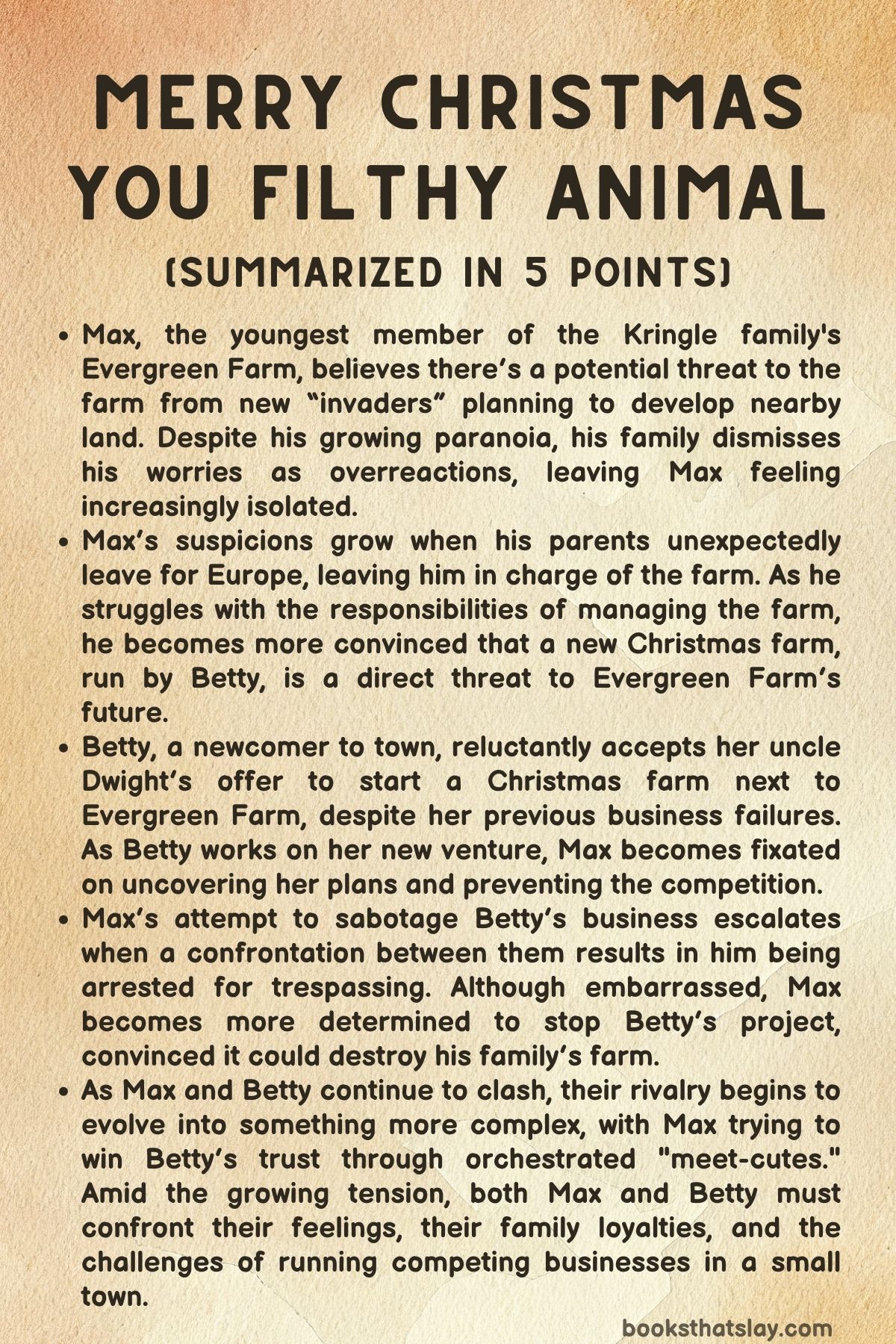
Max Kringle lives on Evergreen Farm in Kringle, a town famous for its Christmas-themed businesses and celebrations. The Kringle family has operated Evergreen Farm for generations, attracting visitors with its festive charm.
Max, the youngest of three brothers, is known for his dramatic and paranoid tendencies. He is convinced that something is wrong with the land next to their farm, which has been vacant for years.
One Thanksgiving, Max overhears a conversation about the land being sold, and he believes that outsiders are planning to develop the property into a competing farm. Despite his family’s dismissive attitude toward his concerns, Max’s paranoia only grows, and he continues to investigate the situation, even texting his best friend Cole about the potential threat.
The next day, Max wakes up to find that his parents have mysteriously disappeared, leaving no explanation behind. He learns that they have taken a surprise trip to Europe without informing him, leaving him in charge of the farm.
Max is left feeling unprepared and embarrassed, but he reluctantly steps up to handle the responsibilities of running the farm. At the same time, his suspicions about the invaders on the neighboring land remain unresolved, adding to his stress and sense of isolation.
Meanwhile, Betty, a newcomer to Kringle, is trying to adjust to her new life in the town. Her uncle Dwight, who owns a piece of land near Evergreen Farm, convinces Betty to help him set up a Christmas-themed farm on the property.
Betty is hesitant at first, having recently failed in her own Christmas-themed business venture, but Dwight offers her a home and a salary, making it difficult for her to refuse. She agrees to help, setting up her new life in a cozy cottage on the property.
One night, Betty notices strange lights flashing behind her cottage and assumes someone is trying to break in. When she goes outside to investigate, she throws a bottle of Pepsi at the intruder, knocking him out cold.
The intruder turns out to be Max, who had been spying on her property as part of his investigation into the potential threat. Betty, furious and embarrassed by the situation, calls the police, and Max is arrested for trespassing.
His friend Cole picks him up from jail, leaving Max humiliated and more determined to uncover the truth.
Despite his embarrassment, Max continues to work on the farm while dealing with the aftermath of his arrest. He runs into Betty again, who admits that she was the one who knocked him out.
Max is intrigued by her but still suspicious of her intentions. He learns that Betty has been asking around about Evergreen Farm’s suppliers, further fueling his belief that her farm is a direct competitor to his family’s business.
Max becomes more convinced that Betty’s project poses a serious threat to Evergreen Farm and sets out to confront her.
Max’s family, including his brothers, dismiss his concerns, calling him paranoid and overly dramatic. However, Max is determined to protect the farm and uncover the truth about Betty’s plans.
As Christmas approaches, tensions rise between the two farms, and Max feels a growing sense of urgency to stop Betty from putting Evergreen Farm out of business.
Betty, on the other hand, is struggling with her own doubts and insecurities about the new farm. She feels pressure from her uncle Dwight, who is determined to compete with Evergreen Farm.
Betty begins to question her abilities and the business’s potential, especially after a heated encounter with Atlas, who is a local and a friend of Max’s family. Dwight encourages Betty to continue with her plan despite the challenges, but Betty begins to wonder if her project is worth the personal sacrifices it might require.
As Max and Betty’s rivalry escalates, Max hatches a plan to win Betty over by using charm and manipulation. He believes that if he can make Betty fall in love with him, she will abandon her plans to compete with Evergreen Farm.
Max enlists the help of his friends and family to orchestrate “booby-trapped meet-cutes,” where he sets up accidental romantic encounters with Betty, hoping to win her affection. However, his plan is met with skepticism from his friends, who question his motives and the ethics of his actions.
Meanwhile, Betty’s relationship with Atlas becomes more complicated. She has a growing attraction to him, but her loyalty to her uncle and her doubts about Atlas’s intentions weigh heavily on her.
After a series of misunderstandings, Betty learns that Atlas has been involved in a scheme to sabotage her farm, orchestrated by her uncle Dwight. Atlas admits that he had planned to manipulate her into abandoning her business venture, but as their relationship deepens, he regrets his actions and expresses genuine feelings for her.
Betty is torn between her loyalty to her uncle and her growing feelings for Atlas. She confronts him about his involvement in the scheme, and Atlas makes a public apology to her, organizing a heartfelt gesture to show his remorse.
Betty, though hurt, begins to forgive Atlas and allows herself to trust him. As the holiday season progresses, Betty and Atlas grow closer, and they start to plan for their future together.
As Christmas approaches, Max realizes that his actions, although well-intentioned, have caused more harm than good. He reflects on his rivalry with Betty and comes to terms with the fact that their businesses don’t have to be in direct competition.
Max and Betty’s relationship evolves from animosity to mutual understanding, and they begin to work together to find a way to merge their farms and create something special for the town.
The story concludes on a hopeful note, with Betty and Atlas looking forward to a future together, while Max finds peace in his role on the farm. The town of Kringle, known for its Christmas spirit, embraces the new beginning for both families, and the promise of love and renewal fills the air.
Characters
Max
Max, the protagonist of Merry Christmas You Filthy Animal, is a character driven by his deep-seated fear and paranoia. Living on Evergreen Farm in Kringle, a town famous for its Christmas spirit, Max is the youngest in his family, with parents Otto and Ida and two older brothers, Felix and Ansel.
His tendency to overreact and exaggerate his worries often isolates him, as his family dismisses his concerns as over-dramatic. Despite their skepticism, Max remains fixated on the potential threat posed by a neighboring Christmas farm, which he fears might ruin his family’s legacy.
His paranoia becomes a central theme in the story, as he constantly feels a sense of impending doom about the competition. Max’s dramatic nature is evident when he acts impulsively, such as when he breaks into Betty’s cottage, convinced of some intruder’s presence, only to end up getting arrested for trespassing.
This act of humiliation marks a turning point for him, where he starts to mature and take responsibility for the farm. Max’s struggle with his feelings of inadequacy and need to protect his family is a key part of his character development.
Though his actions may seem extreme at times, they come from a genuine place of love and desire to preserve the family legacy. His journey is one of self-discovery, as he learns to navigate his emotions, relationships, and the complexities of small-town rivalry.
Betty
Betty is a complex character who enters the town of Kringle with a sense of uncertainty and a strong desire to prove herself. Initially reluctant to dive into her uncle Dwight’s Christmas farm project, Betty feels the weight of expectations pressing down on her.
Her past failure in running a Christmas-themed shop haunts her, and she is hesitant to repeat that experience. However, she ultimately agrees to take on the project, driven by a mix of necessity and the offer of a cozy home and a salary.
Betty’s internal struggle is amplified by her growing romantic tension with Max, who views her as a threat to Evergreen Farm’s dominance. She is caught between loyalty to her uncle Dwight, who has a long-standing rivalry with Max’s family, and the emotional pull she feels towards Atlas, Max’s brother.
Betty’s evolving relationship with Atlas complicates her professional life, as she begins to question her uncle’s motivations and her own feelings. As the story unfolds, Betty’s character deepens, revealing a woman who is both strong and vulnerable.
She finds herself torn between love and duty, a theme that resonates as she navigates the difficult dynamics of family, business, and romance in a town that has its own set of traditions and loyalties. Her growth throughout the story is marked by her increasing confidence and ability to stand up for herself, both in her professional endeavors and her personal relationships.
Atlas
Atlas is a pivotal character in the narrative of Merry Christmas You Filthy Animal, acting as a catalyst for much of the emotional and romantic development in the story. Initially, he is presented as a playful and charming figure, particularly in his interactions with Betty, whom he teases flirtatiously.
However, Atlas’s character complexity emerges as his connection with Betty deepens, especially when he reveals the role he played in the scheme to sabotage her business plans. His initial motivations are rooted in protecting his family’s farm from competition, but his feelings for Betty complicate his actions.
As the story progresses, Atlas grapples with the consequences of his deceit and feels genuine remorse for manipulating Betty. His character evolves from someone driven by loyalty to family into a man determined to make amends and earn Betty’s trust.
Atlas’s willingness to go above and beyond, from trekking through a snowstorm to check on Betty to organizing a grand gesture to apologize, demonstrates his sincere affection for her. Despite the rocky start to their relationship, Atlas proves that his feelings are genuine, and he becomes a more self-aware and vulnerable character, ready to move forward and build a future with Betty.
His transformation from a manipulative figure to a devoted partner is central to the emotional arc of the story, and his relationship with Betty represents the complexities of love, trust, and redemption.
Dwight
Dwight, Betty’s uncle, is a driving force behind much of the tension in Merry Christmas You Filthy Animal. He represents the old guard of Kringle, holding onto traditions and personal rivalries that influence his decisions.
Dwight is a manipulative character, using his influence over Betty to push her into a project that may harm her emotionally and professionally. His rivalry with Max’s family, particularly with Max’s father, Otto, fuels his desire to see Evergreen Farm outdone.
He is a businessman at heart, focused on profits and success, even if it means playing dirty. Throughout the story, Dwight’s interactions with Betty show a man who is both controlling and caring, although his brand of care is often rooted in selfishness.
He wants what’s best for his business, but his lack of regard for Betty’s personal well-being creates conflict. Betty’s struggle with her uncle is a key point of her character’s journey, as she must decide whether to follow Dwight’s lead or carve her own path.
Dwight’s eventual downfall comes when Betty recognizes his manipulative tendencies and begins to trust her own instincts, choosing to forge a path independent of his influence. Dwight’s character serves as both an antagonist and a reflection of the pressures of small-town business dynamics, providing a stark contrast to the more emotionally driven characters of Max and Betty.
Felix and Ansel
Felix and Ansel, Max’s brothers, provide comic relief and contrast to Max’s more intense personality. Both characters are less concerned with the dramatic events Max fixates on, and they often serve to downplay the seriousness of his concerns.
Felix is the more laid-back of the two, displaying a carefree attitude toward the farm and its operations. Ansel, while still dismissive of Max’s paranoia, shows a bit more empathy, though his loyalty lies with their family rather than with Max’s suspicions.
Despite their differences, both brothers contribute to Max’s development by acting as a sounding board for his frustrations. While their dismissiveness often frustrates Max, it also highlights the tension between his desire for attention and validation and the more grounded perspectives of his family.
Their roles, though secondary to the main conflict, provide the necessary balance to Max’s intensity, offering moments of levity and grounding that make the family dynamic more relatable and realistic.
Themes
Family and Legacy
The concept of family and its influence on personal identity is one of the most central themes in Merry Christmas You Filthy Animal. Max, the protagonist, is deeply embedded in his family’s legacy, particularly the responsibility of Evergreen Farm.
From the beginning, he is presented as the youngest member of a family that has spent generations maintaining the Christmas-themed farm, making it a cornerstone of their lives and the town’s identity. Max’s concern for the possible threat from Betty’s new Christmas farm business is not merely a matter of competition, but a deep fear of losing the family legacy.
His paranoid behavior is driven by his belief that any change or outside influence could undo the traditions and values that have been passed down. The pressure of maintaining the family farm, which has become an institution in the town, weighs heavily on Max.
His willingness to go to extremes to protect the farm reflects a sense of duty and pride in the family’s work. However, this theme is also explored through Betty’s storyline, where she is trying to carve out her own legacy while still trying to find her place in a new town and family dynamic.
Both Max and Betty wrestle with expectations placed on them by their families, shaping their decisions, behavior, and ultimately, their growth. The narrative showcases how family obligations and legacies can both nurture and confine individuals, affecting their choices in profound ways.
Rivalry and Competition
At the heart of the story is the intense rivalry between Max’s Evergreen Farm and Betty’s new venture, With Joyful Ring Farm. This competition represents more than just business—it taps into a deeper, almost existential conflict, where both characters are fighting for recognition and the opportunity to thrive.
Max, already established in the town with his family farm, views Betty’s arrival as a direct threat to the stability of everything he has known and worked for. His paranoia intensifies as he becomes convinced that Betty’s intentions are aimed at undermining his family’s reputation.
For Betty, the rivalry takes on a different tone. She’s starting over in a new town, with doubts about her ability to succeed.
Her uncle Dwight’s encouragement, however, pushes her to challenge the long-standing dominance of Evergreen Farm, leading to tension and confrontation. The competition between them is not just about business—it’s about proving one’s worth, asserting independence, and navigating the expectations of family and community.
Max’s strategies to undermine Betty’s farm, including attempting to sabotage her efforts, reflect the lengths to which individuals can go when they feel threatened by an outsider. At the same time, Betty’s determination to succeed despite the odds and the influence of her uncle shows her resilience and ambition.
The rivalry develops as both characters confront personal and professional challenges, ultimately evolving into something more complex than simple business competition.
Trust and Betrayal
Trust and betrayal are recurring themes that shape the relationships and character arcs throughout Merry Christmas You Filthy Animal. Max and Betty’s interactions are fraught with misunderstandings and miscommunications, particularly as Max begins to question Betty’s motivations.
His actions, driven by paranoia and fear of losing his family farm, lead to him resorting to underhanded methods in an attempt to sabotage Betty’s business. Max’s growing suspicions eventually result in him discovering Betty’s true intentions, which only deepens his sense of betrayal.
Similarly, Betty is faced with conflicting advice from her uncle Dwight and her personal feelings toward Atlas, which makes it difficult for her to determine whom to trust. Dwight’s manipulative nature casts doubt on Betty’s relationships, and she finds herself torn between loyalty to her uncle and her own growing feelings for Atlas.
The central betrayal, however, emerges when Atlas admits that he had been involved in a plan to manipulate Betty into abandoning her business venture. This revelation shatters Betty’s trust in him, forcing her to reconcile her feelings of hurt with her emotional investment in their relationship.
Atlas’s subsequent remorse and efforts to make amends represent his desire to rebuild the trust he broke, culminating in an elaborate public gesture of apology. This theme emphasizes the fragile nature of trust and how betrayal can test the limits of relationships.
However, it also shows that trust, once broken, can be repaired through honesty, vulnerability, and self-reflection. The resolution of this theme is key to the development of both characters, as they navigate the challenges of love, loyalty, and forgiveness.
Love and Redemption
The theme of love, especially in its transformative capacity, plays a crucial role in Merry Christmas You Filthy Animal. The romantic dynamics between Max and Betty, as well as between Betty and Atlas, are filled with tension, growth, and personal revelation.
Max’s initial approach toward Betty is driven by manipulation and self-interest, as he believes that if he can make Betty fall in love with him, she will abandon her business venture, thus protecting his family farm. His plan is rooted in his own insecurities, as he sees her as both a rival and a potential romantic partner.
This manipulation, however, backfires as Max begins to genuinely care for Betty, complicating his feelings and actions. His journey is one of personal growth, where he must confront his own flaws and the ethics of his behavior.
On the other hand, Betty’s evolving relationship with Atlas is characterized by mutual vulnerability and understanding. Their relationship, though initially based on misunderstandings and outside manipulation, evolves into something genuine as they spend more time together and open up about their fears, desires, and hopes.
Atlas’s efforts to redeem himself for his past mistakes, particularly the betrayal of Betty, reflect his desire to be a better person and to earn her trust once again. Love, in this context, becomes not only a source of emotional connection but also a catalyst for personal redemption.
Both Max and Betty experience growth through their romantic entanglements, learning the importance of selflessness, forgiveness, and emotional honesty. By the end of the story, their respective journeys toward love and redemption highlight the transformative power of these experiences and how they can lead to personal healing and new beginnings.