Mestra: A Short Story Summary, Characters and Themes
Mestra by Madeline Miller is a mythological retelling that explores exploitation, personal freedom, family loyalty, and the difficult process of reclaiming one’s identity.
Inspired by Greek mythology, the story follows Mestra, the daughter of a cursed king whose endless hunger has destroyed his household. When she discovers that she can transform into different people and animals, her father exploits her extraordinary ability to satisfy his appetite. What begins as a daughter’s desperate attempt to save her parent gradually becomes a struggle for independence. Through Mestra’s experiences, Miller examines the destructive consequences of greed and the courage required to reject relationships built on sacrifice and control.
Summary
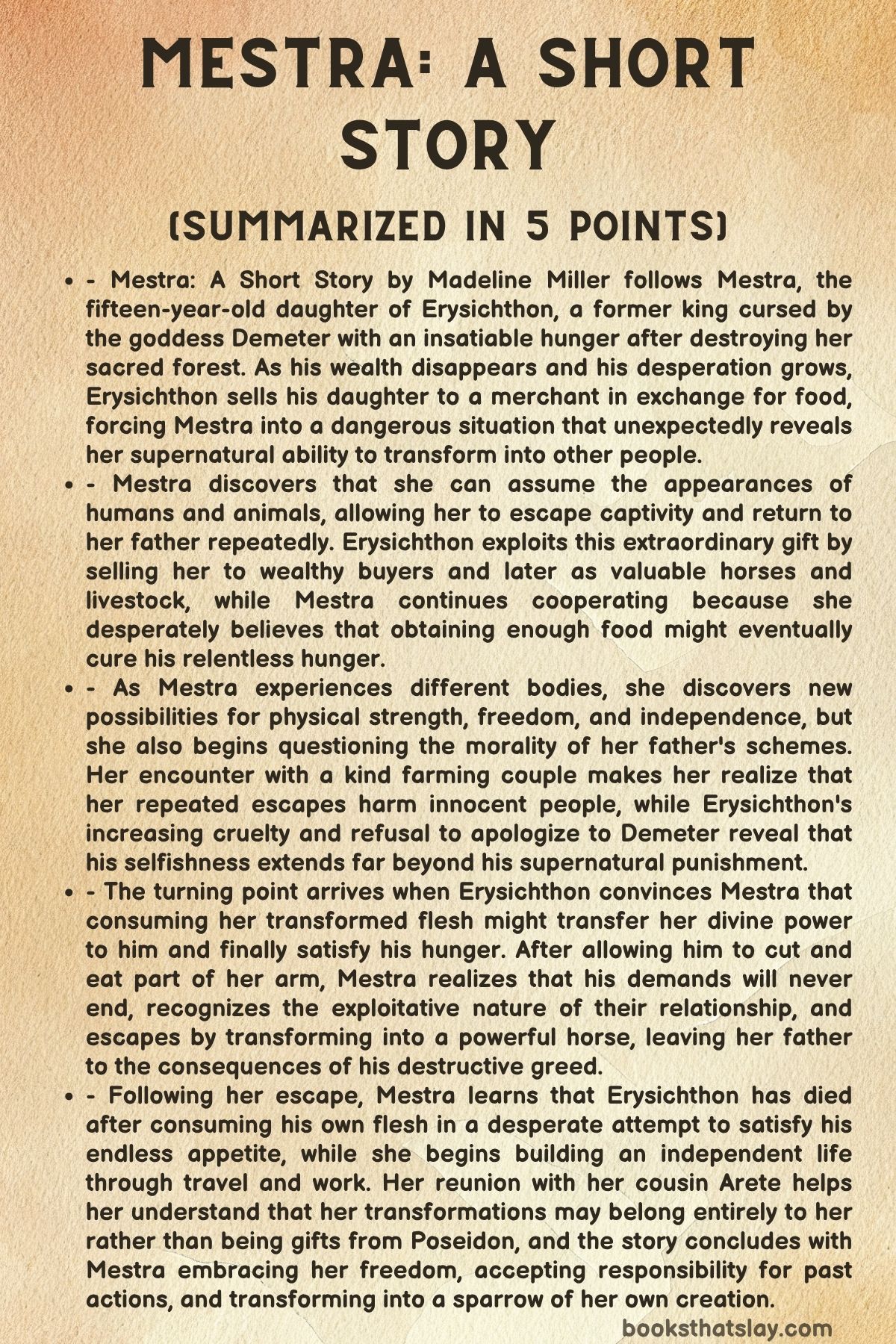
Mestra is fifteen years old when her father, Erysichthon, the former King of Thessaly, sells her to a merchant in exchange for seven roasted chickens. Once a wealthy and powerful ruler, Erysichthon has lost his fortune, possessions, and dignity because of a terrible curse inflicted by the goddess Demeter. His hunger is impossible to satisfy, and everything he owns has been consumed in his desperate attempts to obtain food.
Despite her father’s cruelty, Mestra remains devoted to him. She believes that surrendering herself to the merchant might help Erysichthon survive, even though she fears what awaits her.
As the merchant leads her away, Mestra remembers a violent encounter with Poseidon three months earlier. The sea god assaulted her on a secluded beach, leaving her injured and frightened. He told her that she would bear his child, but she has experienced no signs of pregnancy.
Mestra worries that the merchant will discover she is not a virgin and punish her. Desperate for protection, she prays to Poseidon, asking him to save her so that she can continue helping her father.
Suddenly, her body transforms into that of a large, powerful man. The merchant is terrified and demands to know where the girl has disappeared. Mestra explains that she is the person standing before him and orders him to leave.
For the first time in months, Mestra experiences a sense of physical security. Her unfamiliar body provides strength, confidence, and freedom from the vulnerability she has endured.
Walking home, she enjoys her newfound abilities and climbs an apple tree to gather fruit. However, when she reaches her father’s ruined palace, she unexpectedly returns to her original appearance.
Erysichthon is astonished by her transformation, but his interest quickly turns toward its practical possibilities. He asks Mestra to assume different appearances, and she discovers that she can become people she remembers.
Among the figures she imitates are the family’s former cook, her cousin Arete, the Queen of Mycenae, and her nurse’s daughter. Her father immediately recognizes that her extraordinary gift might provide a solution to his financial problems.
He proposes repeatedly selling Mestra to different buyers, allowing her to escape by changing her appearance. Although uncomfortable with the arrangement, Mestra agrees because she hopes the money will provide enough food to end his suffering.
Erysichthon begins by selling her to a butcher. Mestra escapes by transforming into the butcher himself and commanding his guard dog to move aside. She successfully returns to her father, who celebrates her achievement before preparing another transaction.
Over the following days, Mestra is sold to merchants, wealthy men, and minor nobles. She becomes increasingly skilled at assuming different appearances and escaping dangerous situations.
Sometimes she steals food on her way home, hoping to bring her father additional relief. Yet despite her efforts, Erysichthon’s hunger continues growing.
Mestra occasionally enjoys the freedom of experiencing unfamiliar bodies. Transforming allows her to escape the restrictions placed on her as a young woman, particularly the dangers associated with being physically vulnerable.
Nevertheless, her ability also creates emotional difficulties. She realizes that the people whose appearances she borrows are real individuals with lives and identities of their own.
Taking Arete’s appearance becomes especially disturbing because Mestra feels that she is allowing strangers to mistreat the likeness of someone she loves. Her discomfort reveals that her transformations are becoming more complicated than simple disguises.
Meanwhile, Erysichthon grows increasingly demanding. He criticizes Mestra for failing to create more attractive appearances that could command higher prices. His treatment demonstrates that he regards her abilities primarily as a means of satisfying his appetite.
The origins of his suffering become clearer through Mestra’s memories. Before his downfall, Erysichthon wanted to expand his dining hall to accommodate increasingly extravagant feasts.
When his advisors informed him that ordinary timber was unavailable, he ordered the destruction of an ancient forest sacred to Demeter. His workers warned him against violating the goddess’s sanctuary, but he ignored them and personally began cutting down the trees.
Demeter punished his arrogance by imposing an endless hunger that no amount of food could relieve. The curse gradually destroyed his wealth and reduced his once-powerful household to poverty.
Mestra’s situation becomes particularly dangerous when an elderly buyer attempts to assault her. She transforms into the powerful fisherman whose appearance first helped her escape, frightening him away.
When others respond to his cries, she unexpectedly discovers that she can also become animals. Remembering Honey, her cousin’s pet sparrow, she transforms into the bird and escapes through a narrow window.
This discovery dramatically expands her understanding of her abilities. Mestra realizes that she no longer needs to be sold as a woman and suggests that her father sell her as a valuable animal instead.
She transforms into Oak, a magnificent horse once kept in her father’s royal stables. Erysichthon had previously slaughtered the animal for food, but Mestra can reproduce its appearance through memory.
Her father sells her to a wealthy lord for a substantial amount of gold. Mestra escapes by returning to human form and then transforming into a falcon.
Encouraged by this success, Erysichthon repeatedly sells her as other horses, including Fury, River, and Bright-face. She also adopts the appearances of deer, dogs, and birds to return home unnoticed.
Although these transactions provide enough money to purchase enormous quantities of food, Erysichthon continues wasting away. His body becomes increasingly thin, and his desperation turns into hostility.
When he discovers that Mestra has eaten a little bread and cheese, he accuses her of selfishness. She is stunned that her father resents her satisfying her own hunger after everything she has sacrificed for him.
Mestra suggests that he apologize to Demeter and begin restoring the sacred forest. Erysichthon angrily refuses, insisting that he did nothing wrong and that the punishment is undeserved.
His refusal exposes the deeper problem behind his condition. He cannot acknowledge the destructive consequences of his choices, even when those consequences threaten his life.
Mestra’s understanding changes further when she transforms into Dainty, a cow, and is sold to a farmer whose wife is expecting a child. Unlike her previous buyers, the couple treats her gently and welcomes her into their modest household.
Their kindness makes Mestra reconsider the morality of her repeated escapes. She recognizes that the money her father receives comes from people who believe they are making legitimate purchases.
For wealthy buyers, the losses may be manageable, but ordinary families can suffer serious hardship. Mestra realizes that helping her father has required her to participate in actions that harm innocent people.
Before leaving the farmer’s home, she allows him to milk her once so that the couple receives something in exchange for their payment. Although this cannot compensate them fully, it reflects her growing awareness of her responsibility toward others.
Mestra also begins accepting that her father’s hunger cannot be cured through additional food. Regardless of how much she obtains, his suffering only intensifies.
Returning home, she announces that she no longer wants to be sold. Surprisingly, Erysichthon appears calm and claims to have discovered the true purpose of her supernatural power.
He argues that Poseidon must have given Mestra her transformations specifically to save him from Demeter’s curse. According to his reasoning, eating part of her transformed body will allow him to absorb the divine power responsible for her abilities.
Still desperate to help him, Mestra agrees to his experiment. She allows him to cut a piece of flesh from her arm, which he roasts and eats.
Erysichthon claims that consuming her flesh has temporarily relieved his hunger. However, instead of expressing gratitude or concern for her suffering, he immediately demands another piece.
This moment forces Mestra to confront the reality of their relationship. She remembers the countless sacrifices she has made to win her father’s approval and keep him alive.
She has endured hunger, humiliation, danger, and exploitation because she believed that a good daughter must protect her father regardless of the consequences. Yet his demands have continually increased, and he has never truly considered her welfare.
Mestra recognizes that his behavior did not begin with Demeter’s punishment. Even before the curse, Erysichthon valued her primarily for what she could provide him.
His occasional displays of affection helped preserve her loyalty, but they concealed a relationship based on possession and entitlement. His willingness to consume her body reveals the ultimate consequence of treating another person as a resource.
She finally understands that his supernatural appetite reflects the greed that defined him long before he was cursed. He destroyed a sacred forest because he wanted a larger dining hall, and now he is prepared to destroy his daughter because he wants more food.
When Erysichthon attempts to cut her again, Mestra transforms into the fisherman, forcing him to release her. He commands her to return to her original form, expecting the obedience he has always demanded.
Instead, Mestra becomes Oak. In the horse’s powerful body, she overturns furniture, frightens her father, and escapes from the palace into the night.
Her departure marks the first time she chooses her own survival over his demands. Rather than accepting responsibility for a suffering she cannot cure, she claims the freedom that her extraordinary abilities have made possible.
After leaving Thessaly, Mestra travels along the coast and works aboard boats. During her journeys, she hears that Erysichthon has died.
Unable to satisfy his terrible hunger, he began eating his own flesh and eventually consumed himself. His death demonstrates the self-destructive nature of the greed that governed his life.
Rumors about Mestra circulate among sailors, but nobody knows where she has gone or what she has become. Her disappearance protects her independence and allows her to build an identity beyond her father’s reputation.
Eventually, Mestra reunites with her beloved cousin Arete. Although Arete has grown during their separation, she welcomes Mestra with warmth and understanding.
Mestra confesses that she repeatedly used Arete’s appearance while being sold to strangers. She feels guilty about exposing her cousin’s likeness to humiliating experiences, but Arete reassures her that those experiences did not happen to the real Arete.
Their conversation leads Mestra to recognize something important about her transformations. She has never reproduced people or animals with complete accuracy.
Instead, she unconsciously changes certain details according to her memories and imagination. This discovery suggests that her gift is more creative and flexible than she previously understood.
Mestra also begins questioning whether Poseidon truly gave her the power. Although she initially believed that her prayer caused the first transformation, the god has never returned or shown any interest in her abilities.
She considers the possibility that her transformations belong to her independently of any divine intervention. The ability need not exist as compensation for Poseidon’s violence or as a means of saving Erysichthon.
Mestra remains aware of the harm caused by her earlier actions. She tells Arete that she intends to repay the farming couple by providing them with a real cow.
Her desire to make restitution demonstrates that freedom does not require abandoning responsibility. Unlike her father, she wants to recognize how her choices affect other people.
By the end, Mestra accepts the many forms she has inhabited without believing that any single appearance defines her completely. She is the girl who suffered, the fisherman who defended himself, the horse who escaped, and the birds who experienced flight.
In the final scene, she transforms into a sparrow resembling Honey, but with a fuller body and brighter wings. She flies toward Arete and settles on her hand, displaying a newfound confidence in her ability to become whatever she chooses.
The story ends with Mestra no longer existing for her father’s benefit or under the authority of the men who sought to possess her. Her freedom comes from recognizing that her life and identity belong to her alone.
Characters
Mestra
Mestra is the central character of Mestra: A Short Story, a fifteen-year-old girl whose devotion to her father initially makes her vulnerable to repeated exploitation. Her experiences reveal a young woman struggling to distinguish genuine love from the obligation to sacrifice herself for someone who refuses to recognize her independence.
At the beginning of the story, Mestra measures her worth through her ability to help Erysichthon. She accepts being sold because she believes that securing food for him is more important than protecting herself.
Her loyalty is particularly troubling because her father rarely demonstrates genuine concern for her safety. Even when she returns from frightening encounters, he focuses on how her supernatural abilities might provide additional wealth.
Mestra’s earlier assault by Poseidon adds another dimension to her vulnerability. The violence has left her fearful of male power, and she initially regards her transformations as protection against the possibility of further abuse.
Her ability to assume different bodies gradually changes her understanding of strength. As a powerful man, she discovers physical confidence, while her animal transformations allow her to experience speed, flight, and independence.
These experiences are not merely methods of escape. They help Mestra recognize that the limitations imposed upon her are not permanent or inevitable.
Despite becoming increasingly powerful, Mestra retains a strong moral conscience. She feels uncomfortable using Arete’s appearance and recognizes the injustice of taking money from innocent buyers without providing what they purchased.
Her concern for the farming couple demonstrates that she can understand suffering beyond her immediate family. This separates her from Erysichthon, who considers other people’s needs irrelevant whenever they conflict with his desires.
The decisive change in Mestra’s character occurs when her father demands pieces of her flesh. His willingness to injure her reveals that no sacrifice will ever be sufficient to win his lasting approval.
In Mestra: A Short Story, her escape represents more than resistance against one cruel parent. It marks the collapse of a belief system that taught her to confuse obedience with love and self-destruction with goodness.
By the conclusion, Mestra accepts that she can care about others without surrendering control over her own existence. Her final transformation into a distinctive sparrow represents an identity shaped by personal choice rather than inherited expectations.
Erysichthon
Erysichthon is the former King of Thessaly and Mestra’s father, whose insatiable hunger drives much of the conflict. His supernatural punishment follows his destruction of a forest sacred to Demeter, an act motivated by excessive ambition and disregard for divine authority.
Before the curse, Erysichthon possessed wealth, political influence, and considerable social standing. Nevertheless, his desire for increasingly extravagant feasts led him to destroy sacred trees merely to enlarge his dining hall.
His actions demonstrate an inability to distinguish desire from necessity. Rather than accepting reasonable limits, he regards anything that prevents him from obtaining more as an unjust restriction.
Demeter’s punishment makes this existing character flaw physically visible. His hunger becomes endless, mirroring a personality that can never be satisfied with what it already possesses.
Erysichthon’s relationship with Mestra exposes the cruelty beneath his paternal authority. He repeatedly sells her to strangers, praises her successful escapes, and demands increasingly profitable transformations without considering their emotional consequences.
Even when Mestra risks her safety to obtain food, he responds with criticism rather than gratitude. His anger at discovering that she has eaten some bread and cheese demonstrates his belief that her needs should always remain secondary.
His refusal to apologize to Demeter reveals another defining characteristic: an absolute unwillingness to accept responsibility. Even as his body deteriorates, he insists that he has done nothing wrong.
The most disturbing expression of his selfishness occurs when he proposes eating Mestra’s transformed flesh. Rather than recognizing the horrifying implications of the act, he interprets her supernatural power as another resource provided for his personal use.
Within Mestra: A Short Story, Erysichthon represents the destructive consequences of unchecked entitlement. His eventual death through consuming his own body completes the pattern established throughout his life, as his refusal to recognize limits ultimately destroys him.
Poseidon
Poseidon is the sea god whose assault on Mestra becomes one of the defining traumatic experiences of her early life. Although he appears primarily through her memories, his actions influence her fears, her understanding of power, and her initial interpretation of her transformations.
His violence demonstrates the enormous imbalance between gods and mortals. Mestra has little ability to resist him, and his promise that she will bear his child introduces further uncertainty into an already devastating experience.
When Mestra faces the prospect of being sold to a merchant, she prays to Poseidon for protection. Her transformation immediately afterward encourages her to believe that the god has granted her a supernatural gift.
However, Poseidon never returns to confirm that interpretation. His absence becomes increasingly meaningful as Mestra discovers new possibilities within her abilities.
The uncertainty surrounding his involvement challenges the assumption that a powerful male figure must be responsible for her strength. What she originally understands as a divine favor may be an ability that belongs to her independently.
Poseidon’s role therefore extends beyond the violence he commits. His presence in Mestra’s memories represents the broader problem of powerful figures claiming influence over vulnerable people while offering little responsibility or protection in return.
By questioning whether he gave her anything at all, Mestra begins separating her identity from the god who harmed her. She no longer needs to understand her abilities through his actions or regard her freedom as something granted by him.
Arete
Arete is Mestra’s beloved cousin and one of the few characters associated with genuine affection and emotional security. Although she is absent during much of Mestra’s exploitation, her importance is established through the memories that influence Mestra’s transformations.
Mestra frequently assumes Arete’s appearance because she knows her cousin well. However, these transformations gradually become emotionally uncomfortable because Mestra feels that she is exposing someone she loves to the degrading treatment of strangers.
This discomfort reveals the depth of their relationship. Unlike Erysichthon, Mestra recognizes Arete as a separate individual whose dignity matters independently of her usefulness.
When they eventually reunite, Arete responds to Mestra with warmth rather than judgment. Their meeting provides a striking contrast to Mestra’s experiences with her father, whose approval was always connected to what she could provide.
Mestra apologizes for using her cousin’s appearance during the repeated sales. Arete reassures her that the experiences belonged to Mestra and did not happen to Arete herself.
Her response helps Mestra distinguish between appearance and identity. The realization that a borrowed likeness does not reproduce another person’s entire existence becomes central to Mestra’s growing self-understanding.
Arete also helps Mestra recognize that her transformations are imperfect reproductions shaped by memory and imagination. This discovery encourages a more flexible understanding of the supernatural gift.
In Mestra: A Short Story, Arete represents love that does not require suffering as proof of devotion. Her acceptance allows Mestra to experience a relationship founded on companionship, understanding, and respect rather than obligation.
Demeter
Demeter is the goddess responsible for Erysichthon’s supernatural hunger. Her punishment follows his destruction of an ancient forest dedicated to her, establishing the relationship between human greed, divine authority, and the natural world.
Although Demeter does not dominate the story through direct appearances, her influence shapes the circumstances surrounding Mestra’s suffering. The curse destroys Erysichthon’s wealth and ultimately drives him to exploit his daughter.
Her punishment is closely connected to the offense itself. Because Erysichthon destroyed sacred trees to satisfy his appetite for luxury, he receives a hunger that cannot be satisfied by any quantity of food.
This relationship between wrongdoing and consequence gives the curse symbolic significance. The king’s physical suffering reflects the unlimited desires that previously governed his actions.
Demeter also represents boundaries that human ambition cannot violate without consequences. Erysichthon assumes that royal authority allows him to take whatever he wants, but the sacred forest exists beyond his legitimate control.
His refusal to acknowledge Demeter’s authority prevents any possibility of reconciliation. Even when Mestra suggests apologizing and restoring the forest, he rejects the proposal.
The goddess’s role is nevertheless morally complicated because her punishment has consequences for people other than the original offender. Mestra suffers enormously because of a transgression she did not commit.
Demeter’s presence consequently raises questions about justice, responsibility, and the suffering caused when powerful individuals face punishment. Her curse exposes Erysichthon’s character while also creating circumstances in which his daughter must struggle to survive.
The Merchant
The merchant who purchases Mestra for seven roasted chickens introduces the immediate danger of her father’s willingness to exchange her for food. His transaction establishes the degrading circumstances into which Mestra has been placed.
He treats Mestra as property acquired through a legitimate bargain, showing little concern for the young girl’s wishes or emotional condition. His authority over her depends on the social and physical inequalities that make such transactions possible.
When Mestra unexpectedly transforms into a powerful man, the merchant becomes frightened and confused. The reversal demonstrates how quickly his assumed control disappears when she acquires physical strength.
His reaction is important because it provides Mestra with her first direct experience of escaping ownership through transformation. She discovers that the authority of those who purchase her can be challenged.
Although his appearance is brief, the merchant helps establish the story’s examination of power. He represents a social arrangement that allows vulnerable individuals to be reduced to possessions.
The Elderly Buyer
The elderly buyer is one of the men who purchases Mestra during Erysichthon’s repeated transactions. His attempt to assault her demonstrates the physical danger created by her father’s exploitation.
Rather than regarding Mestra as a person entitled to safety and autonomy, he treats his purchase as permission to exercise control over her body. His behavior reflects the same disregard for consent that shapes her earlier encounter with Poseidon.
Mestra responds by transforming into the powerful fisherman, frightening him away. Her ability allows her to resist an attack that might otherwise have left her defenseless.
The encounter also leads to an important discovery when Mestra transforms into a sparrow to escape the attention of others. What begins as another frightening experience becomes the moment when she recognizes that her abilities extend beyond human appearances.
His role highlights the relationship between vulnerability and power. Mestra’s transformations allow her to resist abuse, but the danger arises because men repeatedly assume that possession grants them authority over another person’s body.
The Farmer
The farmer who purchases Mestra in the form of Dainty is important because he challenges her assumption that every buyer deserves to be deceived. Unlike the wealthy and aggressive men she previously encountered, he treats the animal with kindness.
He lives modestly with his pregnant wife and appears to value the cow as an important addition to their household. His purchase represents a meaningful financial commitment rather than an extravagant indulgence.
When Mestra observes his gentle behavior, she begins recognizing the consequences of her repeated escapes. Returning to her father has allowed her to survive, but it has also deprived innocent people of property they purchased in good faith.
The farmer is particularly significant because he has done nothing to justify being cheated. His circumstances force Mestra to confront the difference between helping someone she loves and acting ethically toward everyone else.
Her decision to allow him one milking demonstrates the beginning of this moral reassessment. Later, her intention to provide him with a real cow shows that she wants to repair the harm caused by her actions.
The farmer represents ordinary kindness and the practical responsibilities that accompany freedom. Through him, Mestra learns that escaping exploitation does not eliminate the need to consider how her choices affect others.
The Farmer’s Wife
The farmer’s wife appears as an expectant mother whose household offers Mestra an unexpected experience of gentleness. Although she occupies a relatively small role, her presence makes the consequences of Mestra’s actions more personal.
Her pregnancy emphasizes the couple’s responsibility for a growing family. Losing a valuable cow could affect their financial security and their ability to provide for their child.
The warmth of the household contrasts sharply with Erysichthon’s ruined palace. While Mestra’s father possesses an insatiable appetite and little concern for others, the farming couple demonstrates appreciation for what they have.
The wife’s presence helps Mestra recognize that the people affected by her transformations are not merely anonymous buyers. They have relationships, responsibilities, and futures that may be damaged by her father’s schemes.
Although she does not directly determine Mestra’s decisions, she contributes to the young woman’s developing moral awareness. Her role reinforces the distinction between genuine need and the destructive entitlement represented by Erysichthon.
Oak
Oak is one of the magnificent horses formerly kept in Erysichthon’s royal stables before being slaughtered to satisfy his hunger. Although Oak is an animal rather than a developed human character, the horse’s remembered form becomes central to Mestra’s transformation.
When Mestra first assumes Oak’s appearance, she experiences extraordinary strength and physical freedom. The horse’s body allows her to imagine possibilities beyond the restrictions associated with her original circumstances.
Erysichthon initially treats Oak’s form as a valuable commodity, selling the horse for a substantial amount of gold. Yet Mestra experiences the transformation as something much more meaningful than another source of income.
The same appearance later enables her decisive escape from her father. When he attempts to cut her flesh again, she becomes Oak and uses the horse’s physical power to frighten him and flee.
Oak therefore represents the transformation of an exploited resource into an instrument of independence. A body that Erysichthon regards as property becomes the means by which Mestra rejects his control.
Honey
Honey is Arete’s pet sparrow, whose appearance provides Mestra with her first successful animal transformation. The bird becomes important when Mestra needs to escape a dangerous buyer and discovers that she can assume forms beyond human bodies.
As Honey, Mestra can pass through a narrow window and fly away from confinement. The transformation introduces a new sense of freedom because flight allows her to escape physical barriers that would otherwise restrict her movements.
Honey also connects Mestra’s supernatural abilities to her affection for Arete. The bird is associated with a relationship founded on warmth and familiarity rather than exploitation.
Near the conclusion, Mestra again assumes a sparrow’s appearance, but she does not reproduce Honey exactly. Instead, she creates a version with a fuller body and brighter wings.
This altered appearance reflects her recognition that transformation need not mean copying another living being. She can use memory as a starting point while creating an identity shaped by her own imagination.
Honey’s symbolic importance lies in this progression from imitation to self-expression. The sparrow that initially represents escape eventually becomes an image of freely chosen identity.
Themes
Greed and the Destructive Nature of Endless Desire
Greed shapes the suffering and moral conflict throughout Mestra: A Short Story, appearing most clearly in Erysichthon’s inability to recognize limits. His supernatural hunger is not simply a punishment imposed from outside but an exaggerated expression of the desires that already controlled his life.
Before receiving Demeter’s curse, Erysichthon possessed significant wealth and authority. Nevertheless, he was dissatisfied with what he owned and wanted an even larger dining hall to accommodate more extravagant feasts.
His willingness to destroy a sacred forest for this purpose reveals that his ambitions have become disconnected from genuine necessity. He regards the natural world as something that exists for his personal consumption, regardless of its significance to others.
The curse transforms this attitude into a physical condition. No matter how much Erysichthon eats, his hunger continues increasing, demonstrating the impossibility of satisfying a desire that recognizes no boundaries.
His treatment of Mestra extends the same destructive logic into family relationships. He repeatedly sells her, demands greater profits, and eventually attempts to consume her flesh because he believes that everything available to him should serve his needs.
The tragedy is intensified by his refusal to understand the relationship between his behavior and suffering. Even when Mestra suggests apologizing to Demeter, he insists that he has committed no offense.
His eventual death through consuming his own body provides the ultimate expression of the theme. Having exhausted his wealth, possessions, and relationships, he becomes the final victim of his own appetite.
The story suggests that uncontrolled desire eventually destroys both the person experiencing it and the people forced to endure its consequences.
Exploitation, Family Loyalty, and the Limits of Sacrifice
Mestra’s relationship with her father demonstrates how loyalty can become destructive when affection is combined with manipulation and unequal power. She begins the story believing that her responsibility as a daughter requires her to endure almost anything to relieve Erysichthon’s suffering.
Her willingness to be sold reflects genuine concern for his survival, but it also reveals how thoroughly she has accepted the idea that her needs matter less than his. She rarely questions whether his demands are reasonable because she has learned to associate obedience with love.
Erysichthon reinforces this belief through occasional praise and approval. When Mestra successfully escapes from a buyer, he celebrates her achievement, but his satisfaction comes primarily from the money the transaction provides.
His affection is therefore conditional upon her usefulness. As long as Mestra continues supplying food, wealth, or opportunities for profit, he treats her as valuable.
The relationship becomes increasingly disturbing because each sacrifice creates the expectation of another. Mestra’s ability to transform initially appears to offer a solution, but Erysichthon quickly turns it into a system of repeated exploitation.
The moment he demands her flesh makes the underlying pattern impossible to ignore. Even her bodily integrity becomes something he believes he is entitled to consume.
Mestra’s escape demonstrates that love does not require unlimited self-denial. Her refusal to continue sacrificing herself is not evidence that she lacks compassion, but recognition that responsibility must have boundaries.
Her later relationship with Arete offers an alternative understanding of affection. Unlike Erysichthon, Arete accepts Mestra without demanding payment, obedience, or suffering.
Through this contrast, the story distinguishes relationships sustained by mutual respect from those maintained through guilt, control, and emotional dependency.
Identity, Transformation, and Personal Freedom
The ability to change physical form allows Mestra to question whether identity is determined by appearance, social expectations, or personal choice. Throughout Mestra: A Short Story, her transformations gradually shift from desperate methods of survival into expressions of independence.
At first, Mestra understands her supernatural gift primarily as protection. Becoming a powerful man allows her to escape the merchant and experience a level of physical security that has previously been unavailable to her.
The transformation also challenges the restrictions imposed upon her as a young woman. In an unfamiliar body, she discovers that strength, confidence, and freedom of movement are possibilities she can experience directly.
As she begins assuming the appearances of animals, her understanding expands further. Horses provide extraordinary power, birds offer flight, and other forms allow her to explore ways of existing beyond ordinary human limitations.
However, transformation does not immediately produce genuine freedom. While Erysichthon controls how she uses her abilities, each new appearance becomes another means of exploitation.
The distinction between possessing power and controlling its purpose is therefore essential. Mestra cannot achieve independence merely by changing her body; she must also reject the belief that her abilities exist for someone else’s benefit.
Her reunion with Arete introduces another important discovery. Because her transformations contain details shaped by imagination, Mestra realizes that she does not simply reproduce existing identities.
She can create something different from anything she has previously known. This possibility changes the meaning of her supernatural gift from imitation into self-expression.
The final sparrow transformation brings this development to completion. Mestra becomes a bird resembling Honey while incorporating features of her own choosing, demonstrating that she can retain connections to the past without remaining confined by them.
Her freedom ultimately depends upon claiming authority over her own existence, regardless of the body she inhabits.
Responsibility, Moral Growth, and Breaking Cycles of Harm
Mestra’s development involves more than escaping an abusive father; it also requires recognizing the harm she has caused while attempting to survive. Her repeated transformations protect her from exploitation, but the financial arrangements created by Erysichthon place other people at a disadvantage.
Initially, Mestra focuses almost entirely on obtaining food for her father. Because she believes that saving him is her primary responsibility, she gives comparatively little attention to the buyers who lose money when she escapes.
Her perspective changes when she encounters the farming couple who purchase her in the form of a cow. Their kindness forces her to recognize that not everyone involved in her father’s schemes is cruel or wealthy enough to absorb significant losses.
The farmer and his pregnant wife depend upon their limited resources. Depriving them of a valuable animal could create genuine hardship, even though they have treated Mestra with respect.
Her decision to allow the farmer to milk her once represents a small but meaningful attempt to acknowledge their investment. More importantly, her later promise to provide the couple with a real cow demonstrates a willingness to accept responsibility for past actions.
This moral development distinguishes Mestra from Erysichthon. Her father consistently refuses to acknowledge wrongdoing, whereas Mestra becomes increasingly willing to examine the consequences of her behavior.
The theme also emerges through her feelings about borrowing Arete’s appearance. Although her cousin reassures her that the experiences did not belong to the real Arete, Mestra’s concern demonstrates an awareness of other people’s dignity.
Her growing independence does not lead her to reject responsibility altogether. Instead, she learns to distinguish between obligations imposed through exploitation and responsibilities arising from genuine ethical concern.
By choosing to repair harm rather than deny it, Mestra breaks from her father’s destructive example. Her eventual freedom is therefore both personal and moral, allowing her to shape a life guided by compassion, accountability, and respect for others.